
外贸

Search documents
多维赋能外贸企业 全力护航“出海”之旅
Jin Rong Shi Bao· 2025-07-23 02:29
Group 1 - China's foreign trade has shown a clear upward trend in 2023, with total import and export volume reaching a historical high of 20 trillion yuan in the first half of the year, marking a year-on-year growth of 4.5% in Q2, accelerating by 3.2 percentage points from Q1 [1] - The China Export-Import Bank has provided significant financial support to foreign trade, issuing over 610 billion yuan in loans and 47 billion yuan in themed financial bonds in the first half of the year, focusing on supporting private and small to medium-sized foreign trade enterprises [1][2] Group 2 - Private enterprises have become the largest foreign trade operators in China, with their import and export scale exceeding 12 trillion yuan in the first half of the year, accounting for 57.3% of the total foreign trade volume [2] - The China Export-Import Bank has introduced a special plan to enhance financial support for private enterprises, including 16 specific measures to facilitate their international trade and participation in the Belt and Road Initiative [2] Group 3 - The Jinjiang Land Port in Fujian has become a crucial hub for small and micro foreign trade enterprises, with the China Export-Import Bank providing financial support to enhance supply chain services and expand overseas markets [3][4] - The bank has innovated financial service models to assist small and micro foreign trade enterprises, including risk-sharing loan products and direct lending solutions [4] Group 4 - The establishment of an overseas warehouse project by Shanghai Yashi in Kazakhstan aims to enhance logistics and trade capabilities, with the China Export-Import Bank providing long-term financing to support its development [5] - The bank's financial support covers the entire lifecycle of projects, from construction to stable operation, addressing the diverse financial needs of new foreign trade models such as overseas warehouses and cross-border e-commerce [6]
跨海实习,台湾学生发现“新大陆”
Ren Min Ri Bao Hai Wai Ban· 2025-07-22 21:56
Core Insights - The article highlights the increasing opportunities for Taiwanese students to intern in mainland China, allowing them to gain practical experience and a deeper understanding of various industries and cultures [4][5][6]. Group 1: Internship Opportunities - Numerous cities in mainland China are actively providing summer internship opportunities for Taiwanese students, with events like the Sichuan-Taiwan Youth Employment and Entrepreneurship Development Exchange Conference offering 6,793 internship positions from 746 companies [5]. - The "2025 WAY! Come to Shenzhen" initiative aims to provide over 1,200 internship positions and 1,800 job opportunities for Taiwanese youth [5]. - The "Dreaming of the Pearl River: Guangzhou Taiwan Exchange Season" has been launched to facilitate learning, employment, entrepreneurship, and cultural exchange for Taiwanese students in Guangzhou [5][6]. Group 2: Cultural and Historical Engagement - Internship programs often include cultural experiences, such as visits to historical sites in Shaanxi, allowing students to appreciate the region's rich history and cultural heritage [7][8]. - Activities like the "Lingnan Cultural Tour" in Guangzhou and the "Yangming Cultural Study Camp" in Ningbo provide insights into local traditions and modern business practices [8][9]. Group 3: Personal Experiences and Insights - Taiwanese students report a significant shift in their perceptions of mainland China, noting the warmth and friendliness of the local people, contrasting with their previous abstract understanding based on statistics [4][11]. - Interns express a desire to understand the financial market and employment environment in mainland China, with many considering future career opportunities there due to the rapid development and innovation [6][9].



科技赋能外贸 兰州海关智慧化助企“闯世界”
Zhong Guo Xin Wen Wang· 2025-07-22 16:02
Core Insights - The construction of a smart customs system has significantly improved operational efficiency for companies, reducing copper concentrate processing time from 18 days to approximately 8 days and customs clearance time from 5-10 days to an average of 30 hours, resulting in cost savings exceeding 100 million yuan [1][2] - Gansu's import of metal ores reached 19.77 billion yuan in the first half of the year, marking a 44% increase and accounting for 74.2% of the province's total imports, with notable increases in nickel and cobalt materials [1][2] - The "Gansu Agricultural Foreign Trade Pass" program has been instrumental in promoting Gansu's agricultural products abroad, with over 160 agricultural enterprises trained to utilize the program, enhancing the quality and efficiency of exports [3] Group 1: Smart Customs Development - The smart customs initiative has led to a reduction in logistics costs and manpower, with frontline staff reduced from 4-5 to 2 [1] - The implementation of a "joint supervision" customs model for imported copper concentrate has been a key innovation, combining technology and risk assessment to enhance regulatory efficiency [2] Group 2: Agricultural Export Support - The "Gansu Agricultural Foreign Trade Pass" app has been launched to support agricultural exports, with continuous improvements based on enterprise feedback [3] - Gansu's foreign trade totalled 35.21 billion yuan in the first half of the year, with a year-on-year growth of 33.8%, ranking second nationally [3]
广州上半年外贸增长15.5%,创历史同期新高
2 1 Shi Ji Jing Ji Bao Dao· 2025-07-22 08:49
Core Insights - Guangzhou's foreign trade environment is becoming increasingly efficient, supporting companies like Miniso in expanding their international markets [1][5] - The city's foreign trade import and export total reached 605.05 billion yuan in the first half of the year, marking a 15.5% year-on-year increase, a historical high for the same period [2][7] Group 1: Trade Expansion Initiatives - Guangzhou is leveraging exhibition resources to accelerate companies' overseas expansion, with over 200 local enterprises participating in the 2025 Asia Fashion (Thailand) exhibition, resulting in over 20,000 intended orders [3] - The 137th Canton Fair saw over 900 participating enterprises from Guangzhou, generating an intended transaction amount of 2.7 billion USD, a record high [3] - The city is providing substantial support for enterprises participating in over 300 overseas exhibitions in 2025, offering up to 80% subsidies for booth fees [3] Group 2: Export Growth - In the first half of the year, exports of Guangzhou's self-owned brand electromechanical products grew by 14%, integrated manufacturing technology exports surged by 51%, and clothing exports increased by 19% [4] - The cross-border e-commerce "9610" export model has effectively boosted the export of traditional advantageous products such as clothing, bags, and small appliances [4] Group 3: Policy and Infrastructure Improvements - Guangzhou's "Yiqi Xing" enterprise service initiative has conducted over 50 policy briefings, serving more than 4,000 enterprises and enhancing government-enterprise interaction [5] - The city has implemented four nationally pioneering measures to facilitate trade, including a new cross-border e-commerce export model and a global data service platform for battery-powered goods [6] - The establishment of the "Sui-Hong Kong Automobile Export Fast Track" has significantly reduced the vehicle registration wait time from 14 to 3 working days [5] Group 4: Trade Statistics - In the first half of the year, Guangzhou's bonded logistics imports and exports reached 56.65 billion yuan, a growth of 29.9% [7] - Trade with the European Union amounted to 105.24 billion yuan, increasing by 30.5%, while trade with ASEAN reached 101.91 billion yuan, up by 36.7% [7] - Trade with countries involved in the Belt and Road Initiative totaled 282.41 billion yuan, reflecting a growth of 26.2% [7]
产业机遇与出海挑战下,速览广东经济2025上半年成绩
2 1 Shi Ji Jing Ji Bao Dao· 2025-07-21 14:57
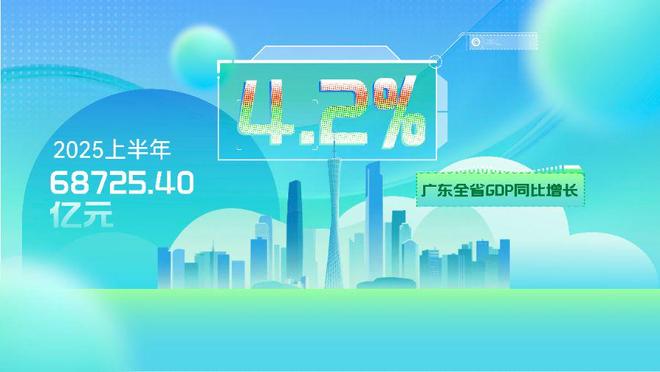
Core Insights - Guangdong's GDP grew by 4.2% year-on-year in the first half of 2025, indicating a steady growth trend [2] - The growth is attributed to both opportunities and challenges in the global market, particularly the emergence of DeepSeek and the unpredictable U.S. tariff policies [4][9] Economic Performance - The new momentum industries, including AI and humanoid robots, have shown rapid growth [5] - Guangdong's foreign trade reached 4.55 trillion yuan in the first six months, a 4% increase compared to the same period last year, outpacing the national growth rate by 1.1 percentage points [10] - Exports amounted to 2.89 trillion yuan, maintaining positive growth, with private enterprises accounting for 64.2% of the total trade value [10] Sector Contributions - High-tech products have significantly contributed to the economic landscape, with notable advancements in robotics [7] - The retail sector saw a steady increase, with total retail sales growing by 3.5% year-on-year, driven by effective policies like the trade-in program [10] - The tourism industry experienced growth, with passenger traffic and turnover increasing by 4.0% and 6.5%, respectively, during the Spring Festival [12] Future Outlook - The resilience and vitality of Guangdong's economy are attributed to its solid industrial foundation and adaptability [12] - With the implementation of policies aimed at promoting industrial innovation, Guangdong's economy is expected to have support, confidence, and growth potential in the second half of 2025 [12]
五年来,高质量发展成绩斐然、答卷精彩
Yang Shi Wang· 2025-07-21 08:40
Core Viewpoint - During the "14th Five-Year Plan" period, China's foreign trade has shown resilience and growth amidst global changes, with significant improvements in both scale and structure, accelerating the construction of a trade powerhouse [1][2]. Foreign Trade - China's goods trade volume is projected to reach $6.16 trillion in 2024, a 32.4% increase from the end of the "13th Five-Year Plan," maintaining its position as the world's largest for eight consecutive years [1]. - Service trade is expected to exceed $1 trillion for the first time in 2024, ranking second globally, with the share of private enterprises in exports rising from 56% at the end of the "13th Five-Year Plan" to 64.8% in 2024 [2]. - The structure of foreign trade has been optimized, with cross-border e-commerce imports and exports reaching 2.7 trillion yuan, a 67% increase over five years [2]. - High-tech product exports are projected to account for 18.2% of total goods trade in 2024, indicating a significant increase in the "value" and "innovation" of exports [2]. Consumption Market - The total retail sales of consumer goods are expected to exceed 50 trillion yuan in 2024, with an average annual contribution rate of around 60% to economic growth [4]. - Retail sales have grown from 39.1 trillion yuan in 2020 to 48.3 trillion yuan in 2024, with an annual growth rate of 5.5% [4]. - Service consumption is growing faster than goods consumption, with an average annual increase of 9.6% from 2020 to 2024 [5]. Innovation and R&D - R&D expenditure is projected to reach 3.6 trillion yuan in 2024, a nearly 50% increase from the end of the "13th Five-Year Plan," with over 77% of this investment coming from enterprises [9]. - The production of integrated circuits is expected to increase by approximately 190 billion units by 2024, reflecting the deep integration of technological and industrial innovation [10]. Green Development - By 2024, China's energy consumption per unit of GDP is expected to decrease by 11.6% compared to the end of the "13th Five-Year Plan," while resource output rates have improved by 12% [12]. - The number of new energy vehicles is projected to reach 31.4 million by 2024, a more than fivefold increase since the end of the "13th Five-Year Plan" [12]. Infrastructure Development - Over 10,000 kilometers of new high-speed rail have been put into operation during the "14th Five-Year Plan" period, with 90% of county-level administrative centers achieving access to highways within 30 minutes [14]. - The number of 5G base stations has exceeded 4.48 million, with 90% of administrative villages having access to 5G [15]. Economic Growth - China's GDP is expected to reach around 140 trillion yuan in 2024, with an economic increment of over 35 trillion yuan during the "14th Five-Year Plan" period [16]. - The manufacturing sector has maintained an annual added value of over 30 trillion yuan, solidifying China's position as the world's leading manufacturing nation [16].
第 29 周全球港口拥堵实况报告
Sou Hu Cai Jing· 2025-07-21 08:06
Core Insights - The global shipping industry is facing significant delays, with nearly 30% of container ships acting as "floating parking lots," leading to a 40% decrease in vessel turnaround rates and increased costs for shipping companies [2][6]. Group 1: Shipping Delays - A container ship in Morocco has been waiting for 6 days, causing European retailers to miss the peak season for autumn product launches [1] - In Bangladesh, containers have been stuck for 22 days, affecting Christmas orders for North American markets [1] - Global port data reveals severe delays, with ports like Algeria's Skikda averaging 6.5 days of waiting and South Africa's Cape Town experiencing 3 days of delays [1] Group 2: Financial Impact - The daily operating cost for an 18,000 TEU container ship is approximately $120,000, meaning a 6-day wait at Tangier Med Port incurs an additional cost of $720,000 [2] - Since July, detention fees on Asia-Europe routes have increased by 25%, which will ultimately lead to higher prices for consumers [2] Group 3: Supply Chain Disruptions - Non-scheduled arrivals at ports like Kenya's Mombasa have caused delays of 2-3 days, disrupting shipping schedules and leading to production halts in factories [3] - Exporters in Guangdong face significant risks of order cancellations due to delays caused by typhoons, with waiting times of 2-3 days at Shanghai Yangshan and 1.5-2 days at Ningbo [3] Group 4: Trust Issues in Trade - Delays have led to increased demands for "delay compensation agreements" in regions like Cameroon, indicating a shift in trust dynamics within international trade [4] Group 5: Port Congestion - Ports in Malaysia are operating at 85-90% capacity, leading to severe congestion and delays in truck deliveries [5] - In Vietnam, the influx of goods due to manufacturing shifts from China has overwhelmed port infrastructure, causing significant delays in logistics [5] Group 6: Global Supply Chain Vulnerabilities - The current congestion crisis highlights the fragility of global supply chains under pressures such as extreme weather, geopolitical shifts, and consumer demand rebounds [6] - The mismatch between the increasing size of vessels and the slow pace of port expansions has exacerbated the situation [6]
内蒙古:民营企业成外贸主力军,上半年进出口796.1亿元
news flash· 2025-07-21 07:15
接下来,呼和浩特海关将以中蒙AEO(海关高级认证企业)互认安排正式实施为契机,进一步加大对 内蒙古AEO企业培育力度,扩大中蒙AEO互认实施享惠面。严格规范涉企行政检查,今年计划压减管 理类核查作业30%以上,最大限度实现"无事不扰",减少干预企业经营。(内蒙古日报) 从呼和浩特海关获悉,今年上半年,内蒙古民营外贸企业进出口值达796.1亿元,占全区外贸进出口总 值的78.6%,成为内蒙古外贸主力军。截至今年6月底,内蒙古民营外贸企业达到1.8万家,占全区进出 口企业总量的97%。 ...
《中国经济半年报》亮点解读:外贸多元化拓展,破解外部危机
Yang Guang Wang· 2025-07-19 13:55
Group 1 - China's foreign trade achieved a total of 21.79 trillion yuan in the first half of the year, representing a year-on-year growth of 2.9%, despite challenges from a complex international economic environment and a significant decline in trade with the U.S. by 20.8% in the second quarter [1][2] - The diversification of foreign trade strategies has been crucial in mitigating external uncertainties, with Chinese manufacturers showcasing new products and technologies at trade fairs to expand their market reach [1][2] - The number of trading partners with a trade scale exceeding 50 billion yuan increased to 61, up by 5 from the previous year, indicating a more diversified foreign trade network [2] Group 2 - China's export scale surpassed 13 trillion yuan for the first time in history during the same period, with a rapid year-on-year growth of 7.2%, particularly strong in emerging markets such as ASEAN, Central Asia, and Africa [2] - The trade dependency on a single country has decreased to single digits, accelerating the construction of a diversified trade pattern [2] - The Chinese manufacturing sector is expected to continue adapting high-quality supply to meet international market demands, with a focus on enhancing industrial competitiveness and expanding into potential markets like the Belt and Road Initiative and RCEP [3]
人民财评:“十四五”商贸亮点彰显何种活力?
Ren Min Wang· 2025-07-19 09:07
Group 1 - The core viewpoint highlights the transformation in consumer behavior from merely "living" to "living well," with an emphasis on quality consumption and convenient shopping experiences, such as next-day delivery becoming the norm [1] - During the "14th Five-Year Plan," China's commerce development has shown resilience against various challenges, with key indicators in consumption, foreign trade, foreign investment, and international cooperation meeting expectations [1][2] - The growth in retail sales from 39.1 trillion yuan in 2020 to an expected 48.3 trillion yuan in 2024 reflects a significant expansion in the market, alongside China's continued leadership in online retail and automotive sales globally [2] Group 2 - The diversification of trade partners has been crucial, with a 9.9% decline in exports to the U.S. in the first half of the year, contrasted by an overall export growth of 7.2%, showcasing the adaptability and resilience of foreign trade enterprises [3] - The establishment of free trade pilot zones serves as a testing ground for institutional innovation, aligning with international high-standard economic and trade rules, leading to breakthroughs in key areas of reform and opening up [3] - The focus on high-quality development emphasizes the need for continuous action and practical measures to enhance trade mechanisms, develop digital trade, and expand market opportunities, thereby countering external uncertainties with internal stability [4][5]