股票

Search documents
【UNFX课堂】滞涨的阴影:70年代的美国经济、市场表现与政策博弈
Sou Hu Cai Jing· 2025-05-27 03:22
Core Viewpoint - The article discusses the phenomenon of stagflation, characterized by the coexistence of high inflation and high unemployment, which challenges traditional economic theories and policies [2][9]. Group 1: Definition and Characteristics of Stagflation - Stagflation is defined as an economic condition where stagnation (slow or negative growth) and inflation (rising prices) occur simultaneously [3]. - It disrupts the traditional trade-off between inflation and unemployment, leading to a complex economic environment [2]. Group 2: Causes of Stagflation - Supply shocks, such as sudden increases in oil prices, are classic causes of stagflation, leading to higher costs and reduced economic activity [2][7]. - Poor economic policies, including overly loose monetary and fiscal measures, can exacerbate inflation without addressing stagnation [2][7]. - Other contributing factors include restrictive production policies, wage-price spirals, and self-fulfilling inflation expectations [7]. Group 3: Historical Context and Market Reactions - The 1970s in the U.S. serve as a historical example of stagflation, marked by high inflation rates reaching nearly 15% and unemployment rates exceeding 8% [6][8]. - The stock market suffered significantly during this period, with the Dow Jones Industrial Average showing little to no growth, and many previously popular stocks collapsing [6][8]. - Bond markets also faced challenges, with rising interest rates leading to falling bond prices and negative real yields [8][12]. Group 4: Policy Responses to Stagflation - Initial policy responses included price and wage controls, which failed to resolve underlying issues and led to market distortions [8]. - The later approach involved aggressive monetary tightening under Federal Reserve Chairman Paul Volcker, which successfully reduced inflation but resulted in a severe economic recession [8][9]. - The experience of the 1970s highlights the dilemma policymakers face: stimulating the economy can worsen inflation, while tightening can deepen stagnation [9]. Group 5: Implications for Current Economic Conditions - Understanding the causes and historical responses to stagflation is crucial for analyzing current economic conditions in the U.S. and globally [10].
美债收益率再飙升,市场情绪再受挑战
Sou Hu Cai Jing· 2025-05-22 12:51
Core Viewpoint - The surge in U.S. Treasury yields is primarily driven by escalating national debt and weak demand in recent bond auctions, reflecting investors' demand for higher returns amid increasing fiscal risks [1][3][4]. Group 1: Treasury Yield Trends - As of May 22, 2025, the yields for U.S. Treasury bonds are as follows: 10-year at 4.6%, 20-year at 5.109%, and 30-year at 5.10%, indicating a significant rise in yields [3]. - The weak demand for the 20-year Treasury auction, requiring a yield of 5.047% to attract buyers, highlights declining market confidence following Moody's downgrade of the U.S. credit rating from AAA to AA1 [3][4]. Group 2: Fiscal Challenges - By 2025, approximately $9.2 trillion of U.S. debt will mature, representing about one-third of all circulating market debt, with an estimated 55% to 60% maturing before July 2025 [4]. - The total U.S. national debt is approximately $36.21 trillion, with interest payments projected to be around $684 billion for the fiscal year 2025, accounting for 16% of total federal spending [4]. Group 3: Economic Implications - The debt-to-GDP ratio is expected to rise to 124.4% by the end of 2025, indicating that federal borrowing is significantly outpacing economic growth [6]. - Concerns about fiscal sustainability and political gridlock are diminishing long-term confidence in the U.S. dollar, especially with increasing credit quality risks [7]. Group 4: Market Impact - Rising Treasury yields and recent bond market volatility reflect investor concerns about the U.S. government's ability to refinance large debts in a high-interest environment, which could pressure the dollar and stock markets [7]. - The S&P 500 index has shown strong recovery driven by optimism in U.S.-China trade talks, but uncertainties surrounding future negotiations and fiscal concerns pose risks to the sustainability of this rebound [8]. Group 5: Technical Analysis - The S&P 500 index is approaching a critical psychological level at 6000 points, with recent pullbacks indicating weakening momentum [9]. - The 5700-point level is becoming a significant support point; a breach below this level could trigger further downward pressure on the U.S. stock market [9].

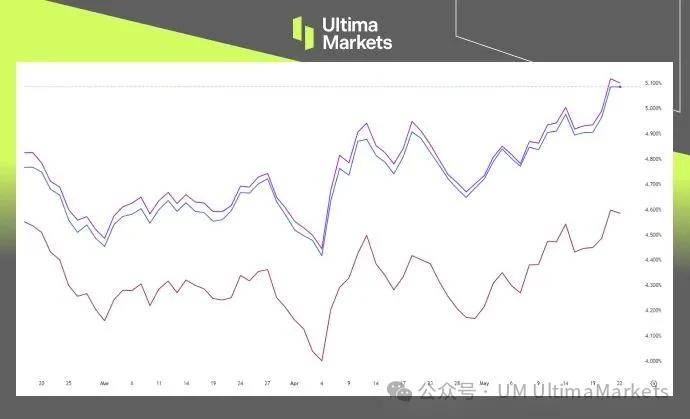
美债收益率创新高,财政赤字爆表,特朗普减税惹怒全市场?
Sou Hu Cai Jing· 2025-05-22 04:56
Core Viewpoint - The U.S. bond market is experiencing significant turmoil, driven by concerns over rising debt levels and proposed tax cuts by the Trump administration, leading to a sharp increase in bond yields and a lack of investor interest in bond auctions [1][3]. Bond Market Summary - The 20-year U.S. Treasury bond auction faced extremely low demand, with interest rates soaring above 5%, marking the coldest auction in five years [3]. - The 30-year Treasury yield reached 5.1%, nearing a 20-year high, while the 10-year yield climbed to 4.595%, indicating that borrowing costs are increasing for both the government and consumers [3]. Stock Market Summary - The stock market reacted negatively, with the Dow Jones Industrial Average dropping 817 points, while the S&P 500 and Nasdaq fell by 1.4% and 1.6% respectively, reflecting investor concerns over fiscal policies [5]. - As the stock market declined, investors shifted towards gold and Bitcoin as safe-haven assets, indicating a flight to safety amid rising uncertainty [5]. Investor Sentiment Summary - Market participants are skeptical about the government's ability to genuinely reduce the deficit, as highlighted by comments from industry experts [5]. - The current state of the bond market is likened to a stressed individual facing financial pressures, exacerbated by proposed tax cuts without clear funding sources [5].

大类资产早报-20250522
Yong An Qi Huo· 2025-05-22 01:59
1. Report Industry Investment Rating - No relevant content provided 2. Core View of the Report - The report presents the performance data of global asset markets on May 21, 2025, including 10 - year and 2 - year government bond yields of major economies, exchange rates of the US dollar against major emerging - economy currencies, major economies' stock indices, credit bond indices, as well as trading data of stock index futures and government bond futures [3][4][5] 3. Summary According to Related Catalogs Global Asset Market Performance Government Bond Yields - **10 - year Government Bond Yields**: On May 21, 2025, the 10 - year government bond yields of the US, UK, France, etc. were 4.601, 4.756, 3.310 respectively. There were different changes in the latest, weekly, monthly, and yearly data. For example, the latest change in the US was 0.112, and the one - year change was 0.114 [3] - **2 - year Government Bond Yields**: The 2 - year government bond yields of the US, UK, Germany, etc. on May 21, 2025, were 3.970, 4.078, 1.868 respectively. Similar to the 10 - year bonds, there were various changes over different time periods. For instance, the latest change in the US was - 0.010, and the one - year change was - 0.830 [3] Exchange Rates - **US Dollar against Major Emerging - Economy Currencies**: On May 21, 2025, the exchange rate of the US dollar against the Brazilian real was 5.646. There were different percentage changes in the latest, weekly, monthly, and yearly data. For example, the latest change was - 0.39%, and the one - year change was 9.61% [3] - **Renminbi**: The on - shore, off - shore, and middle - price of the renminbi on May 21, 2025, were 7.202, 7.204, and 7.194 respectively. There were also different percentage changes over different time periods [3] Stock Indices - **Major Economies' Stock Indices**: On May 21, 2025, the S&P 500, Dow Jones Industrial Average, and NASDAQ were 5844.610, 41860.440, and 18872.640 respectively. The latest, weekly, and yearly changes varied. For example, the latest change in the S&P 500 was - 1.61%, and the one - year change was 11.94% [3] - **Other Stock Indices**: Including the Russian, Japanese, and Hong Kong stock indices, with their respective values on May 21, 2025, and different changes over different time periods [3] Credit Bond Indices - There were different percentage changes in the latest, weekly, monthly, and yearly data for US investment - grade, euro - zone investment - grade, and emerging - economy investment - grade credit bond indices, as well as high - yield credit bond indices [3] Stock Index Futures Trading Data - **Index Performance**: The closing prices of A - shares, CSI 300, SSE 50, ChiNext, and CSI 500 were 3387.57, 3916.38, 2728.43, 2065.39, and 5757.92 respectively, with corresponding percentage changes [4] - **Valuation**: The PE (TTM) of CSI 300, SSE 50, CSI 500, S&P 500, and German DAX were 12.65, 10.98, 29.04, 25.00, and 39.60 respectively, with corresponding环比 changes [4] - **Risk Premium**: The 1/PE - 10 - year interest rate and its环比 change were provided for S&P 500 and German DAX [4] - **Trading Volume**: The latest trading volumes of the Shanghai and Shenzhen stock markets, CSI 300, SSE 50, small - and medium - sized board, and ChiNext were 11734.45, 2170.38, 597.88, 2684.11, and 3160.19 respectively, with corresponding环比 changes [4] - **Main Contract Basis**: The basis and basis percentage of IF, IH, and IC were - 35.18 (- 0.90%), - 15.83 (- 0.58%), and - 102.32 (- 1.78%) respectively [4] Government Bond Futures Trading Data - The closing prices of government bond futures T00, TF00, T01, and TF01 were 108.570, 105.725, 108.835, and 106.010 respectively, with corresponding percentage changes [5] - The R001, R007, and SHIBOR - 3M of the money market were 1.5426%, 1.5884%, and 1.6400% respectively, with corresponding daily changes in basis points [5]
IEXS盈十证券:美联储官员表态下的投资分析
Sou Hu Cai Jing· 2025-05-21 09:52
美联储副主席杰斐逊指出,需防止政策变化引发的价格上涨转为持续通胀压力。这表明美联储对通胀问 题保持高度警惕。在当前经济环境下,若通胀压力持续增加,美联储可能会采取相应措施,如调整货币 政策等。这对于投资者而言,意味着市场的不确定性增加。例如,通胀上升可能导致债券实际收益率下 降,从而影响债券市场的表现。对于 IEXS 盈十证券的投资者来说,在配置债券资产时,需要更加关注 通胀数据以及美联储后续可能的政策调整。 纽约联储主席威廉姆斯提到,投资者正在重新审视其美国资产投资策略,但未见大规模资金撤离迹象。 他认为当前经济表现良好,货币政策适中,美联储有足够时间考虑下一步利率调整。这显示出美国经济 目前有一定的稳定性。然而,投资者重新审视投资策略这一现象值得关注。随着全球经济形势的变化以 及其他地区投资机会的出现,美国资产的吸引力可能会受到影响。IEXS盈十证券认为投资者如果持有 较多美国资产,需要思考是否要根据自身风险承受能力和投资目标,适当调整资产配置比例。比如,可 以考虑增加一些新兴市场资产的配置,以分散风险。同时,由于美联储有时间考虑利率调整,市场利率 在短期内可能相对稳定,但长期来看仍存在不确定性,这对固定 ...
大类资产早报-20250521
Yong An Qi Huo· 2025-05-21 01:58
Global Asset Market Performance - The 10-year treasury bond yields of major economies on May 20, 2025, were 4.489% in the US, 4.702% in the UK, etc. The latest, weekly, monthly, and annual changes varied across countries [3]. - The 2-year treasury bond yields of major economies on May 20, 2025, were 3.980% in the US, 4.003% in the UK, etc. Changes also differed in different time - spans [3]. - The US dollar exchange rates against major emerging - economy currencies on May 20, 2025, were 5.652 against the Brazilian real, 108.000 against the Russian ruble, etc. Weekly, monthly, and annual changes were presented [3]. - Major economy stock indices on May 20, 2025, included 5940.460 for the S&P 500, 42677.240 for the Dow Jones Industrial Average, etc. Their latest, weekly, monthly, and annual changes were provided [3]. - Credit bond indices: for the latest change, all investment - grade and high - yield credit bond indices in the US, eurozone, and emerging economies were 0.00%. Weekly, monthly, and annual changes were also shown [3]. Stock Index Futures Trading Data - Closing prices of A - shares, CSI 300, SSE 50, ChiNext, and CSI 500 were 3380.48, 3898.17, 2716.63, 2048.46, and 5747.37 respectively, with corresponding percentage changes [4]. - PE (TTM) values of CSI 300, SSE 50, CSI 500, S&P 500, and German DAX were 12.59, 10.94, 29.00, 25.51, and 39.29 respectively, along with their环比changes [4]. - Risk premiums of CSI 300, SSE 50, CSI 500, S&P 500, and German DAX were 3.70, 5.77, - 0.38, - 0.53, and - 0.04 respectively, with no环比changes [4]. - The latest values and 5 - day average values of capital flows in A - shares, main board, SME board, ChiNext, and CSI 300 were presented [4]. - The latest trading volumes of Shanghai and Shenzhen stock markets, CSI 300, SSE 50, SME board, and ChiNext were 11696.81, 2016.37, 566.74, 2657.66, and 3242.13 respectively, with环比changes [4]. - The basis and amplitude of IF, IH, and IC in stock index futures were - 32.77, - 17.23, - 96.57 and - 0.84%, - 0.63%, - 1.68% respectively [4]. Treasury Bond Futures Trading Data - Closing prices of T00, TF00, T01, and TF01 treasury bond futures were 108.565, 105.705, 108.840, and 105.955 respectively, with corresponding percentage changes [5]. - R001, R007, and SHIBOR - 3M in the money market were 1.5556%, 1.5986%, and 1.6420% respectively, with daily changes in basis points [5]. Domestic and Foreign Markets - There are domestic and foreign currency markets, bond markets, stock markets, and exchange - rate markets [6][7]
永安期货大类资产早报-20250520
Yong An Qi Huo· 2025-05-20 04:18
国内货币市场 免责声明: 以上内容所依据的信息均来源于交易所、媒体及资讯公司等发布的公开资料或通过合法授权渠道向发布人取得的资讯,我们力求分析及建议内 容的客观、公正,研究方法专业审慎,分析结论合理,但公司对信息来源的准确性和完整性不作任何保证,也不保证所依据的信息和建议不会 发生任何变化。且全部分析及建议内容仅供参考,不构成对您的任何投资建议及入市依据,客户应当自主做出期货交易决策,独立承担期货交 易后果,凡据此入市者,我公司不承担任何责任。未经公司授权,不得随意转载、复制、传播本网站中所有研究分析报告、行情分析视频等全 部或部分材料、内容。对可能因互联网软硬件设备故障或失灵、或因不可抗力造成的全部或部分信息中断、延迟、遗漏、误导或造成资料传输 或储存上的错误、或遭第三人侵入系统篡改或伪造变造资料等,我们均不承担任何责任。 国外货币市场 债 券 市 场 国内债券市场 国外债券市场 股 票 市 场 汇 率 市 场 | 大类资产早报 | | --- | 研究中心宏观团队 2025/05/20 | | 全 球 资 产 市 场 表 现 | | | | | | | | | --- | --- | --- | --- ...
[5月18日]美股指数估值数据(全球股市上涨,黄金低迷)
银行螺丝钉· 2025-05-18 13:40
Core Viewpoint - The article discusses the valuation of global stock indices, U.S. Treasury indices, and the performance of various markets, highlighting the recent trends in stock markets and the contrasting behavior of gold prices. Group 1: Global Stock Market Performance - The global stock market has continued to rise, recovering from a short-term drop in early April, with global indices returning to around 3.5 stars after previously falling to 4.1-4.2 stars [1] - U.S., European, and Asian stocks have generally increased, with Hong Kong's Hang Seng Index rising over 2% this week, recovering losses from the tariff crisis [1] - The Hang Seng Index has outperformed the A-share large-cap index by 20% since the beginning of the year, with the healthcare and technology sectors in Hong Kong also outperforming their A-share counterparts by 20% [1] Group 2: Gold Market Trends - Despite the rise in global stock markets, gold has experienced a downturn, correcting approximately 9% since its peak in early April [1] - The strength of the U.S. dollar and its impact on real interest rates have been significant factors influencing gold prices, with a strong dollar generally being unfavorable for gold [1] Group 3: Investment Strategies and Products - The article mentions the availability of global stock index funds in overseas markets, which total over a trillion dollars, but notes the lack of such funds in mainland China [8] - A "Global Index Advisory Portfolio" has been introduced, which diversifies investments across U.S., UK, Hong Kong, and A-share indices to track global stock market performance [9] - The article also highlights the release of a new edition of "The Long-Term Investment Guide," which emphasizes the importance of stock assets for wealth accumulation over the long term [11][12]

黄金跌破3150美元,油价跌超3%,美元兑日元跌0.7%
Hua Er Jie Jian Wen· 2025-05-15 08:04
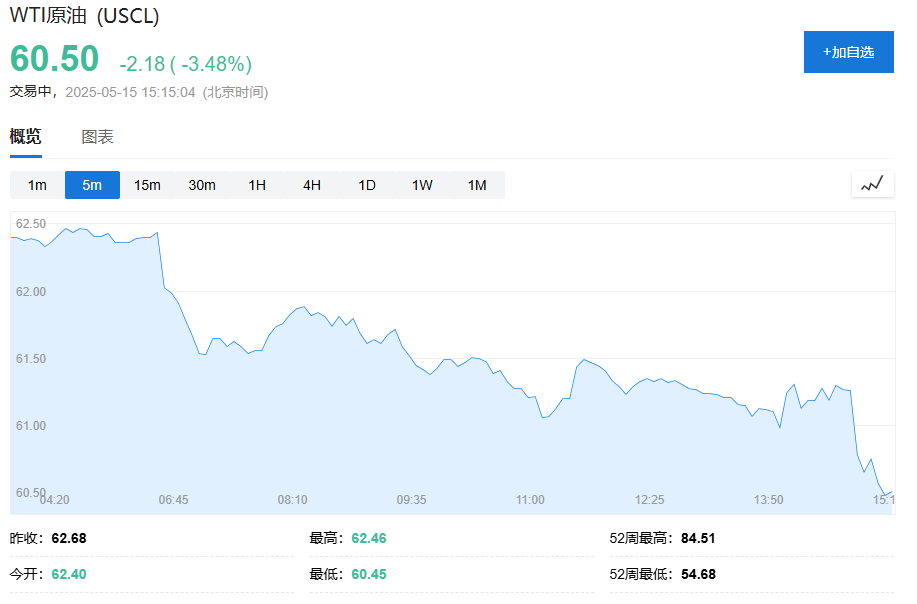
Group 1 - Iran's Supreme Leader's advisor stated that Iran is willing to commit to never developing nuclear weapons in exchange for the U.S. lifting sanctions, leading to a drop of over 3% in oil prices [1] - WTI crude oil fell over 3% to $60.60 per barrel, while Brent crude oil also dropped over 3% to $63.97 per barrel [2] - The geopolitical situation is easing, and high U.S. Treasury yields are pressuring commodities, causing gold, silver, copper, and oil to decline [5] Group 2 - European stock indices opened lower, with the Euro Stoxx 50 down 0.5%, Germany's DAX down 0.4%, and the UK's FTSE 100 down 0.5% [9] - The Indian stock market maintained its upward trend after President Trump mentioned India's proposal to eliminate tariffs on U.S. goods [9] - The Japanese opposition party suggested using long-term U.S. Treasury holdings and importing U.S.-made Japanese cars as negotiation leverage in trade talks with Washington [12]
2025年第二季度经济报告影响全球市场与商业健康的经济和市场因素英文版
Sou Hu Cai Jing· 2025-05-15 03:30
Domestic Economy - The U.S. economy is currently influenced by policy uncertainty, particularly regarding tariffs, which have raised inflation expectations and created concerns about economic growth [1][18] - The unemployment rate remained stable at 4.2% in March 2025, with non-farm payrolls increasing by 228,000, indicating a balanced labor market despite ongoing uncertainties [14][19] - Consumer confidence has declined following tariff implementations, with retail sales (excluding vehicles) stabilizing and vehicle sales increasing due to lower interest rates [24][26] Inflation and Monetary Policy - Inflation has moderated, with the core Personal Consumption Expenditures (PCE) rising by 2.8% year-over-year as of March 2025, and the Consumer Price Index (CPI) decreasing to 2.4% [2][26] - The Federal Reserve has maintained interest rates steady in January and March 2025, with market expectations for at least three rate cuts by the end of the year [12][14] Financial Markets - The stock market faced pressure, with the S&P 500 index declining by 4.3% in Q1 2025, particularly affecting the technology and biotech sectors due to monetary policy uncertainties [2][17] - In contrast, the bond market performed well, with investment-grade (IG) and high-yield (HY) bonds delivering strong returns, driven by declining interest rates and increased demand for safe-haven assets [2][14] International Economic and Policy Linkages - The U.S. dollar exhibited volatility, initially declining due to tariff uncertainties and concerns about economic growth, with investors reassessing risks associated with U.S. policy [3][38] - Global monetary policy remains divergent, with expectations of rate cuts in the U.S. while other regions may follow suit, impacting cross-border capital flows [3][6] Key Sector Outlook - The outlook for economic growth remains uncertain, heavily influenced by the actual impact of tariff policies and the pace of Federal Reserve actions [3][29] - The housing market showed volatility, with a decrease in existing home supply leading to fewer transactions in early 2025, although median home prices continued to rise [29][31] - Business sentiment improved in Q1 2025, with strong manufacturing data in January and February, although a dip was noted in March [32][34]