
装备制造业

Search documents
这些新提法,写入“十五五”规划建议|同城化,让都市圈更红火
Ren Min Ri Bao Hai Wai Ban· 2025-12-04 04:16
Core Insights - Urban agglomerations are becoming a significant highlight in China's regional economic development, with 18 modern urban agglomerations approved since 2019 [1][2] - The "14th Five-Year Plan" emphasizes the modernization of governance in mega cities and the integration of urban clusters, guiding the high-quality development of urban agglomerations [1][2] Transportation Efficiency - The Nanjing urban agglomeration has achieved a 100% connectivity rate for high-speed rail and rapid rail nodes, facilitating efficient commuting [3] - Chengdu urban agglomeration has implemented 17 cross-city bus routes, with over 650,000 daily cross-city commuters [3] Industrial Collaboration - The Chongqing urban agglomeration showcases complementary industrial layouts, with 85% of enterprises in the high-tech zone supporting Chongqing's main industries [3] Shared Public Services - Many urban agglomerations have implemented direct settlement for medical services across cities, benefiting patients with seamless access to healthcare [3] Urban Integration - Urban integration involves breaking down administrative barriers and achieving comprehensive connectivity in infrastructure, resource flow, and public services [5][6] - The goal is to enhance resource integration and policy consistency, fostering collaborative development within urban agglomerations [5][6] Differentiated Development - Urban agglomerations should focus on differentiated development while achieving integration, with major cities like Shanghai and Guangzhou needing to alleviate "big city syndrome" [10] - Regional urban agglomerations like Chengdu and Wuhan should strengthen their manufacturing clusters and promote cross-regional innovation [10] Future Development Trends - The "14th Five-Year Plan" anticipates the expansion and enhancement of urban agglomerations, aiming for a multi-polar support and networked development pattern [11]


锚定“稳、进、新” 实体经济转型升级动能强
Shang Hai Zheng Quan Bao· 2025-12-03 18:46
Core Viewpoint - The article emphasizes the resilience and vitality of China's real economy, highlighting the importance of industrial upgrading as a key to development amidst various challenges in the domestic and international economic environment [1][2]. Group 1: Stability in Economic Growth - The Chinese government has implemented a series of targeted policies to stabilize the real economy, focusing on cost reduction, resource assurance, and market relief, which have allowed industrial enterprises to operate with confidence [1][2]. - The National Development and Reform Commission and the Ministry of Finance have expanded support for equipment upgrades to various sectors, effectively stimulating corporate technological transformation and production enthusiasm [2]. - As of October 2025, the sales revenue of China's equipment manufacturing industry increased by 7.3% year-on-year, with the battery manufacturing sector experiencing a significant surge of 27.2% [2]. Group 2: Advancements in Quality and Efficiency - The focus on industrial upgrading has led to a shift from scale expansion to quality and efficiency, with traditional industries undergoing rapid intelligent transformation [3][4]. - The Ministry of Industry and Information Technology has recognized 15 factories as leading smart factories, marking a critical leap in China's smart manufacturing [3]. - The establishment of a green manufacturing system has been prioritized, with 6,430 green factories and 491 green industrial parks cultivated, promoting over 40,000 green products [3]. Group 3: Innovation-Driven Future Development - Innovation is positioned as a core driver for the sustained growth of the real economy, with a focus on emerging industries and the construction of an innovative ecosystem [5][6]. - Various regions are actively developing new sectors such as artificial intelligence, humanoid robots, and low-altitude economy, creating new spaces for industrial development [5]. - The Ministry of Industry and Information Technology has outlined plans to enhance the comprehensive strength of future industries by 2027, aiming for global leadership in certain fields [6].
利润总额7123.3亿元,我国采矿业利润降幅收窄!
Xin Lang Cai Jing· 2025-12-03 12:20
Core Insights - The total profit of industrial enterprises above designated size in China reached 59,502.9 billion yuan from January to October, reflecting a year-on-year growth of 1.9% [4][5] Industrial Profit Analysis - The mining industry reported a total profit of 7,123.3 billion yuan, showing a year-on-year decline of 27.8%, although the decline rate narrowed by 1.5 percentage points compared to the first nine months of the year [5] - The equipment manufacturing sector's profit increased by 7.8% year-on-year, contributing 2.8 percentage points to the overall profit growth of industrial enterprises [7] - The profit share of the equipment manufacturing sector reached 38.5% of the total industrial profit, an increase of 2 percentage points from the previous year [7] - Key industries such as non-ferrous metal smelting and rolling increased profits by 14%, while electrical machinery and equipment manufacturing grew by 7% [7] - The chemical raw materials and chemical products manufacturing sector saw a profit decline of 5.4%, while the oil and gas extraction industry experienced a 12.5% drop [7] Industrial Investment Trends - Industrial investment grew by 4.9% year-on-year, contributing 1.7 percentage points to overall investment growth [7] - Mining investment increased by 3.8%, with a slight acceleration of 0.1 percentage points compared to the previous three quarters [7] - Manufacturing investment rose by 2.7%, contributing 0.7 percentage points to total investment growth [7] Industrial Value Added - The industrial value added for enterprises above designated size grew by 6.1% year-on-year from January to October [8] - The mining sector's value added increased by 5.6%, with coal mining and washing growing by 6.5% in October [8]

好评中国|聚力前行,为做好经济工作积蓄磅礴力量
Huan Qiu Wang· 2025-12-02 08:58
Group 1 - China's economy is maintaining a stable and progressive development trend, showcasing strong resilience and a bright outlook for the future [1] - In the first three quarters, the GDP grew by 5.2% year-on-year, accelerating by 0.2 and 0.4 percentage points compared to the previous year and the same period last year, respectively [1] - The urban unemployment rate averaged 5.2% in the first three quarters, remaining stable compared to the first half of the year [1] - The scale of foreign trade reached a historical high, with import and export growth rates gradually recovering, and foreign exchange reserves maintained above $3.3 trillion [1] Group 2 - The optimization of China's economic structure and the transition of growth drivers are progressing steadily, with significant advancements in high-quality development [2] - In the first three quarters, the added value of the equipment manufacturing industry and high-tech manufacturing industry accounted for 35.9% and 16.7% respectively, indicating a clear trend of industrial upgrading [2] - Investment in equipment and tools increased by 14% year-on-year, with emerging industries like lithium-ion battery manufacturing and new energy vehicles showing rapid growth [2] Group 3 - China's strong resilience is fundamental to its ability to cope with uncertainties and achieve stable long-term growth [3] - The first three quarters of stable growth laid a solid foundation, while new productive forces are being cultivated to create new growth points [3] - The macro policy space remains ample, providing continuous support for the economy, with positive factors accumulating as indicated by leading indicators and high-frequency data [3]
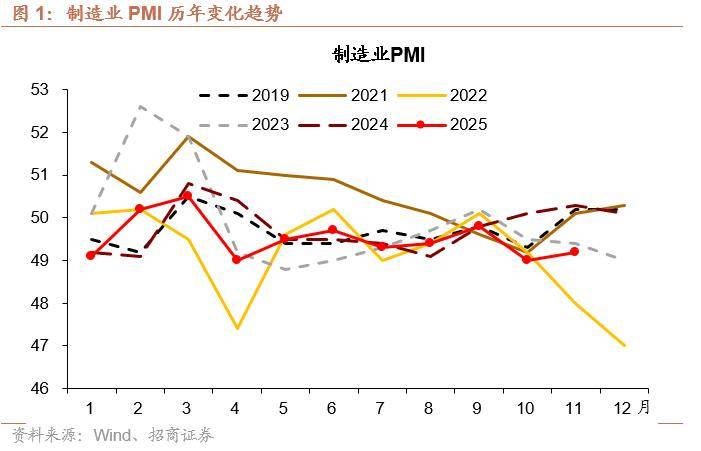
2025年11月PMI数据点评:制造业景气水平小幅回升,市场预期仍保持乐观
KAIYUAN SECURITIES· 2025-12-02 03:58
Group 1: Report Summary - The report is a commentary on the November 2025 PMI data, titled "Manufacturing Sentiment Improves Slightly, Market Expectations Remain Optimistic" [1] - The analysts are Chen Xi and Wang Shuaizhong, with contact information and certificate numbers provided [2] Group 2: PMI Data Overview - In November 2025, the manufacturing PMI was 49.2%, up 0.2 pct month-on-month and down 1.1 pct year-on-year; the non-manufacturing PMI was 49.5%, down 0.6 pct month-on-month; the composite PMI was 49.7%, down 0.3 pct month-on-month [2][3] Group 3: Manufacturing PMI Analysis - The manufacturing sentiment improved slightly due to export improvement, but it remained in the contraction range for eight consecutive months. New export orders rose 1.7 pct, on-hand orders rose 1.0 pct, and the production index rose 0.3 pct month-on-month [3] Group 4: Non-manufacturing PMI Analysis - The decline in the service PMI dragged the non-manufacturing PMI into the contraction range. In November, the service PMI was 49.5%, down 0.7 pct month-on-month and 0.6 pct year-on-year, the first time in 2025 to fall into the contraction range [4] - New export orders rose, but new orders fell, indicating insufficient domestic demand. Policy measures for new consumption scenarios and promoting domestic demand and consumption may be in the works [4] Group 5: Structural Highlights - High-tech manufacturing remained in expansion, with a PMI of 50.1%. Equipment manufacturing, consumer goods, and basic raw materials industries also had PMIs above the overall manufacturing level, despite some declines [5] - Price indices improved. The purchase price of major raw materials and the ex-factory price of manufacturing rose 1.1 pct and 0.7 pct respectively, and the input price and sales price of non-manufacturing rose 1.0 pct and 1.3 pct respectively [5] Group 6: Construction PMI - The construction PMI rose to 49.6%, up 0.5 pct month-on-month. The business activity expectation index was 57.9%, up 1.9 pct month-on-month, indicating improved confidence [6] Group 7: Market Expectations - Expectations for both manufacturing and non-manufacturing improved. The manufacturing production and operation activity expectation was 53.1%, up 0.3 pct, and the non-manufacturing business activity expectation was 56.2%, up 0.1 pct [6] Group 8: Bond Market View - Bond yields are expected to rise trendily as economic expectations are revised. For stock and bond allocation, the view is that economic growth may not decline significantly in H2 2025, structural issues like prices will improve, and the stock-bond allocation will continue to shift [7]
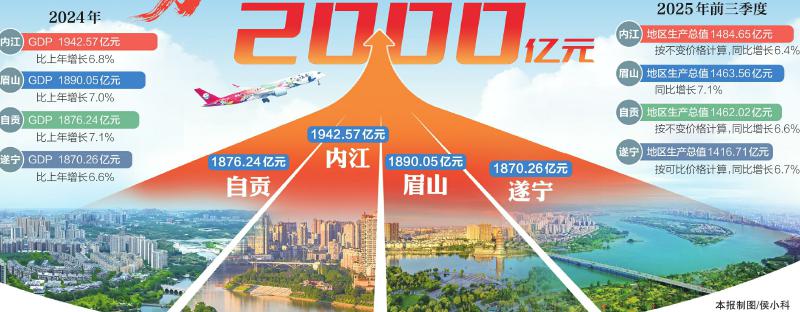
四川经济“黄金腰部”集体发力,内眉自遂四市加速冲刺 竞速之势 谁将跨过两千亿元
Si Chuan Ri Bao· 2025-12-02 00:06
Core Insights - The four cities of Neijiang, Meishan, Zigong, and Suining are targeting an economic development goal of over 200 billion yuan for the year, with each city having already surpassed 140 billion yuan in GDP by the third quarter, aiming to collectively enter the "200 billion club" for the first time in Sichuan's history [2][3][4]. Economic Performance - All four cities are positioned between 140 billion and 150 billion yuan in GDP, showcasing strong growth potential as they pursue their shared goal of reaching 200 billion yuan [3]. - Neijiang's GDP reached 194.26 billion yuan in 2024, with a target of exceeding 200 billion yuan as part of its "14th Five-Year Plan" [5]. Industrial Growth - Industrial output is the primary driver of economic growth in these cities, with significant contributions to GDP from various sectors [6][7]. - Zigong's industrial output value increased by 16% year-on-year from January to October, while Meishan maintained a leading industrial growth rate, contributing 3.7 percentage points to GDP growth [6][7]. - Suining's industrial output value grew by 11.3% in the first three quarters, contributing 48.5% to GDP growth, marking a 12.1 percentage point increase from the previous year [6]. Sector-Specific Highlights - Meishan's industrial growth is significantly driven by the lithium battery sector, with a leading enterprise reporting a 190% increase in sales revenue from January to September [7]. - Suining's investment in fixed assets grew by 8.6% year-on-year, with major infrastructure projects underway, including the Chengda-Wan High-speed Railway [8]. - Zigong is focusing on traditional manufacturing and energy-efficient industries, with the equipment manufacturing sector accounting for 46.4% of the total industrial output value [8]. Future Outlook - The performance in the fourth quarter will be crucial for achieving the 200 billion yuan target, emphasizing the importance of speed, strategy, and endurance in the final stretch [9].
产需修复持续性有待观察——11月PMI点评
Changjiang Securities· 2025-12-01 23:30
1. Report Industry Investment Rating No relevant content provided. 2. Core View of the Report In November 2025, the manufacturing PMI showed a marginal improvement with synchronized recovery in production and demand and accelerated destocking, but the asymmetric recovery of raw material and finished product prices may still restrict corporate profit repair, and the sustainability of external demand contribution remains to be verified. The decline in service - sector sentiment indicates that the resilience of domestic demand also needs to be observed. The bond market has adjusted, and the impact of PMI data is expected to be limited. It is recommended to allocate 10 - year Treasury bonds with a taxable coupon yield above 1.8% when there are adjustments [2]. 3. Summary by Related Catalogs Manufacturing PMI - **Overall situation**: In November 2025, the manufacturing PMI was 49.2%, up 0.2 pct from the previous month, still seasonally weak but with marginal improvement. Production, procurement, and import indices on the supply - side increased, and new order and backlog order indices on the demand - side rose. Inventory destocking accelerated, and some predictive indicators showed improved supply - demand relationships [5][9]. - **External demand contribution**: The new export order index rose 1.7 pct to 47.6%, and the new export order indices of four major manufacturing industries and large, medium, and small enterprises all increased. However, the asymmetric recovery of raw material and finished product prices may pressure corporate profit repair [9]. - **Enterprise size and industry differences**: Small and medium - sized enterprises' sentiment improved, especially small enterprises which rose 2 pct to a nearly 6 - month high of 49.1%, while large enterprises' sentiment declined 0.6 pct to 49.3%. High - tech manufacturing with a high proportion of small and medium - sized enterprises remained in expansion, while the sentiment of equipment and consumer goods manufacturing declined, and their production sides may be stronger than the demand sides [9]. Non - manufacturing PMI - **Overall situation**: The non - manufacturing business activity index was 49.5% in November 2025, down 0.6 pct from the previous month, the first time below the boom - bust line since 2023. The service - sector sentiment was dragged down by factors such as the fading holiday effect, while the construction industry's sentiment improved [5][9]. - **Sub - item structure**: The inventory and new order indices of non - manufacturing declined, while the new export order index rose. The sales price and input price indices increased for two consecutive months. In the service sector, the financial industry and some new - energy industries showed good performance. The construction industry's business activity index increased, possibly boosted by financial activities and policy support [9]. Investment Suggestion The bond market has adjusted, and the impact of PMI data is expected to be limited. It is recommended to allocate 10 - year Treasury bonds with a taxable coupon yield above 1.8% when there are adjustments [2][9].
【权威解读】11月份制造业采购经理指数小幅回升 非制造业商务活动指数有所回落
中汽协会数据· 2025-12-01 12:41
Group 1: Manufacturing Purchasing Managers Index (PMI) - In November, the manufacturing PMI rose to 49.2%, indicating a slight improvement in economic conditions [2] - Both production index and new orders index improved, reaching 50.0% and 49.2% respectively, with production index crossing the critical point [2] - Small enterprises showed significant recovery with PMI at 49.1%, marking a 2.0 percentage point increase, the highest in six months [2][3] Group 2: Non-Manufacturing Business Activity Index - The non-manufacturing business activity index decreased to 49.5%, down 0.6 percentage points from the previous month, indicating a decline in non-manufacturing economic conditions [4] - The service industry index fell to 49.5%, influenced by the end of holiday effects, while certain sectors like railway transport and financial services remained robust [5] - The construction industry index improved to 49.6%, with a business activity expectation index of 57.9%, reflecting increased confidence in the sector [5] Group 3: Comprehensive PMI Output Index - The comprehensive PMI output index fell to 49.7%, a decrease of 0.3 percentage points, with manufacturing production index at 50.0% and non-manufacturing business activity index at 49.5% [6]

招商宏观:服务消费淡季回调明显
Sou Hu Cai Jing· 2025-12-01 08:58
Core Viewpoint - The manufacturing and construction PMIs showed slight recovery in November, yet remain below the expansion threshold, particularly the construction sector at its lowest level in five years, while the service sector experienced a notable decline during the off-peak consumption season [2][3] Manufacturing Sector - The manufacturing PMI rose by 0.2 to 49.2 in November, with most sub-indices improving, indicating a recovery in demand and stable production activities. The production index reached 50, up 0.3 from the previous month, and the new orders index increased to 49.2, up 0.4 [2] - The "two 500 billion" growth stabilization policies introduced at the end of September are expected to boost infrastructure and manufacturing investments in November. The new export orders index improved to 47.6, up 1.7, reflecting a stabilization in foreign trade due to the outcomes of US-China tariff negotiations [2] - The raw material purchasing price index rose to 53.6, up 1.1, while the factory price index increased to 48.2, up 0.7. However, the widening gap between raw material purchasing and finished product prices indicates a blockage in price transmission, which may hinder future profit recovery for enterprises [2] Service Sector - The service sector PMI fell to 49.5, down 0.7 from the previous month, marking the only decline among the three sectors. Following the concentrated release of consumer demand during the "Golden Week," various sectors such as retail, accommodation, transportation, and entertainment saw a decline due to high base effects from the previous month [3] - The financial sector's business activity index and new orders index both rose significantly, exceeding 55%, indicating strong performance. The service sector PMI expectation index remains at 55.9, suggesting potential recovery in consumer-related services in December due to year-end festivities and winter demand [3] Construction Sector - The construction PMI increased by 0.5 to 49.6, indicating some recovery in construction activities, yet it remains at the lowest level for the same period since 2019, reflecting ongoing weak demand in the industry [3] - The civil engineering business activity index remains above 52, indicating growth in civil engineering activities. The business expectation index improved by 1.9, suggesting that accelerated progress on key projects and the impact of policy financial tools may drive further growth in the construction sector [3] Future Outlook - In December, all sectors are expected to enter a year-end sprint phase, coinciding with important policy implementation and capital injection points. The anticipated demand increase from the "15th Five-Year Plan" and the backdrop of a phased US-China trade agreement may lead to a steady rise in the manufacturing PMI [4] - For the construction sector, an increase in the speed of capital injection related to infrastructure is expected in Q4, which may lay a solid foundation for growth stabilization [4] - The concentrated release of consumer-related demand during year-end festivities and winter is anticipated to boost the service sector in the coming month, with financial activities continuing to support the sector [4]
2025年11月PMI数据点评:11月制造业PMI指数如期小幅回升,年底前稳增长政策有望进一步加码
Dong Fang Jin Cheng· 2025-12-01 06:53
Manufacturing PMI Insights - In November 2025, China's manufacturing PMI rose to 49.2%, an increase of 0.2 percentage points from October, aligning with market expectations[1] - The manufacturing new orders index increased by 0.4 percentage points to 49.2%, driven by the implementation of the "two 500 billion" growth stabilization policies[2] - The manufacturing production index rebounded to 50.0%, up 0.3 percentage points from the previous month, indicating a return to non-contraction territory[3] Economic Factors - The recent "anti-involution" policies have led to a rise in raw material prices, with the main raw material price index increasing by 1.1 percentage points to 53.6%[4] - The production expectations index for manufacturing improved by 0.3 percentage points to 53.1%, reflecting a more optimistic outlook among manufacturers[5] - The construction PMI rose to 49.6%, up 0.5 percentage points, supported by the completion of 500 billion new policy financial tools[7] Service Sector Performance - The non-manufacturing business activity index fell to 49.5%, a decrease of 0.6 percentage points, marking the first entry into contraction territory for the year[6] - The service sector's decline is attributed to weakened consumer demand and significant adjustments in the real estate market[6] Future Outlook - The overall macroeconomic environment remains stable but shows signs of weakness, with the comprehensive PMI output index falling below the equilibrium line for the first time this year[8] - Projections indicate a potential decline in the manufacturing PMI to around 49.1% in December, influenced by external trade pressures and ongoing adjustments in the real estate market[8]