新消费

Search documents
中信证券:港股科技中报或存在较大弹性
Di Yi Cai Jing· 2025-07-30 00:26
(文章来源:第一财经) 中信证券研报表示,预计港股2025年中期业绩将于8月中下旬集中发布。按当前已有盈利预期的公司测 算,2025年上半年恒指整体营收同比增速较去年同期显著抬升,惟盈利增速或温和放缓。部分细分行业 呈现信心增强趋势,如新消费、科技与医药板块,业绩高增或大幅好转预期下,财报披露前的盈利预期 仍在上修,建议布局业绩预期向好且有良好确定性的板块。恒生科技指数方面,近期盈利预期虽有小幅 下调,但主要缘于外卖补贴扰动的几家互联网平台,且相关利空已被市场充分定价;其余子行业盈利预 期普遍呈上修态势,尤以新能源汽车、半导体及消费电子最为突出。其中,新能源车与半导体的业绩预 期分歧较大,隐含更高的弹性空间;消费电子业绩预期虽分化较小,但景气确定性强。综合来看,恒科 2025年中报有望呈现"稳健为主、向上有弹性"的格局。 ...

今年以来超九成主动权益类基金实现正收益
Shang Hai Zheng Quan Bao· 2025-07-29 17:53
Group 1 - The performance of actively managed equity funds has significantly improved this year, with over 90% achieving positive returns and a notable emergence of "doubling funds" [1][2] - As of July 28, the average return of actively managed equity funds is 13.74%, with nearly 400 funds exceeding 30% returns and around 60 funds surpassing 60% [1] - Several funds have reported returns exceeding 100%, including the Changcheng Medical Industry Selected Mixed Fund at 120.89% and the Huatai-PB Hang Seng Innovation Drug ETF [1][2] Group 2 - Funds heavily invested in the innovative drug sector have shown strong performance, with the sector continuing to rise as of July 29, indicating potential for more "doubling funds" [2] - Other sectors such as technology and new consumption are also performing well, with funds like the GF Growth Leading Mixed Fund achieving a return of 90.5% [2] - The risk appetite of private equity and financing funds has played a crucial role in driving market uptrends since June 23, contributing to a structural market rally [2] Group 3 - The market recovery has sparked enthusiasm among fund companies, with 48 equity funds currently in issuance and 39 more set to launch soon [3] - Public funds have increased their stock positions significantly, with the average allocation for equity mixed funds rising to approximately 85.99% as of July 25, up by 2.05 percentage points from July 18 [3]
世界人工智能大会签约成果丰硕,机构看好港股科技修复空间
Mei Ri Jing Ji Xin Wen· 2025-07-29 01:55
Market Overview - As of July 28, Hong Kong's three major indices closed mixed, with the Hang Seng Index up 0.68% at 25,562.13 points, the Hang Seng China Enterprises Index up 0.29% at 9,177.15 points, and the Hang Seng Tech Index down 0.24% at 5,664.02 points [1] - Large tech stocks showed mixed performance, while the pharmaceutical and financial sectors exhibited strong trends [1] - Notable stocks included Tencent Holdings rising nearly 1%, Kuaishou up nearly 0.5%, and Meituan down over 0.5% [1] Southbound Capital - On July 28, southbound funds net bought HK stocks worth 9.253 billion HKD, bringing the cumulative net purchase amount since 2025 to 829.282 billion HKD, surpassing last year's total net inflow of 807.869 billion HKD [2] U.S. Market Performance - U.S. stock indices closed mixed overnight, with the Dow Jones down 0.14%, the S&P 500 up 0.02%, and the Nasdaq up 0.33%, with the S&P 500 and Nasdaq reaching new historical highs [3] - The Hang Seng Index ADR fell, closing at 25,353.70 points, down 208.43 points or 0.82% compared to Hong Kong's close [3] Key Events - The Federal Reserve is expected to announce its interest rate decision on July 31, with market expectations leaning towards maintaining rates unchanged and possibly lowering rates twice within the year [4] - The 2025 World Artificial Intelligence Conference concluded with over 300 project procurement demands announced, with an expected procurement amount of 16.2 billion CNY, and 31 major projects signed with investments exceeding 15 billion CNY [4] - Goldman Sachs raised the 12-month target for the MSCI China Index from 85 to 90 points, indicating about an 11% potential upside from last Friday's closing price [4] Short Selling Data - On July 28, a total of 618 Hong Kong stocks were short-sold, with total short selling amounting to 25.577 billion HKD. The top three stocks by short selling amount were China Ping An at 1.385 billion HKD, Tencent Holdings at 1.274 billion HKD, and Alibaba at 973 million HKD [5] Institutional Insights - Huatai Securities remains optimistic about opportunities in the Hong Kong stock market, particularly in the technology sector, which is expected to have significant recovery potential [6] - Recommended sectors include internet (e-commerce, local life), coal, cement, cyclical products, social services, textiles, and aviation, with a focus on high-growth and low-valuation industries [6] - The new consumption sector in Hong Kong remains strong, but attention is needed regarding potential pressure from stock unlocks in Q3 [6] Related ETFs - Key ETFs include the Hang Seng Pharmaceutical ETF (159892), Hang Seng Internet ETF (513330), and Hong Kong Consumption ETF (513230) [7] - Additional ETFs include the Hong Kong Stock Connect Automotive ETF (159323) and Hang Seng Technology Index ETF (513180) [8]

公募基金二季度调仓路径明晰大幅增配港股
Zheng Quan Ri Bao Zhi Sheng· 2025-07-28 17:08
Core Viewpoint - The public fund's allocation towards Hong Kong stocks has reached a historical peak, driven by unique valuation advantages and structural opportunities in the market, particularly in the healthcare and financial sectors [1][2]. Group 1: Fund Allocation Trends - As of the end of Q2 2025, the number of public funds eligible to invest in Hong Kong stocks reached 4,048, with a total market value of 734.3 billion RMB, marking a 12.8% increase from the previous quarter [1]. - The allocation ratio of public funds to Hong Kong stocks rose from 36.9% to 39.8%, the highest since the launch of the Shanghai-Hong Kong Stock Connect [1]. - Active equity funds showed a significant increase in their holdings of Hong Kong stocks, with a market value of 437.9 billion RMB, up 6.5% from the previous quarter [1]. Group 2: Heavyweight Stocks - The number of Hong Kong stocks in the top ten holdings of public funds increased, with Tencent Holdings, Xiaomi Group-W, Alibaba-W, and SMIC being prominent [2]. - Tencent Holdings maintained its position as the largest holding for two consecutive quarters, reflecting strong institutional interest [2]. - The number of Hong Kong stocks held by active equity funds rose from 327 to 360, with the total holding value increasing from 318.3 billion RMB to 326.5 billion RMB [2]. Group 3: Stock Selection Logic - The stock selection logic for public funds in the Hong Kong market focuses on three dimensions: industry leadership, growth certainty, and reasonable valuation [3]. - Key sectors for increased allocation include innovative pharmaceuticals and new consumption, which exhibit clear growth trajectories [3]. - The increase in allocation to Hong Kong stocks is attributed to valuation attractiveness, improved liquidity, and changes in the policy environment [3]. Group 4: Future Outlook - The Hong Kong market is expected to experience an overall upward trend with rapid sector rotation, as current valuations are at a historically mid-to-high level [3]. - Suggested investment directions include high-dividend stocks for stable returns, sectors benefiting from favorable policies, and those with better-than-expected mid-year performance [3]. - The continuous inflow of southbound funds is anticipated to be a key variable influencing the future of Hong Kong stocks, with projections of over 1 trillion HKD in cumulative inflows for the year [3].
金鹰基金:重磅举动轮番出台提振经济复苏信心 A股涨势加速冲关压力位
Xin Lang Ji Jin· 2025-07-28 06:16
Group 1 - The A-share market has accelerated its upward trend, with the Shanghai Composite Index breaking through the 3600-point mark and average daily trading volume rising to 1.86 trillion yuan [1] - The overall market style is characterized by a performance hierarchy: cyclical > growth > financial > consumer sectors [1] - Recent policy announcements and national strategic plans have boosted economic recovery confidence, with the upcoming Politburo meeting expected to play a crucial role in market performance [1] Group 2 - The Jin Ying Fund suggests a balanced allocation to mitigate potential volatility, particularly in the financial sector due to the upcoming Stablecoin regulations [2] - In the technology growth sector, interest in AI applications and the semiconductor industry is expected to rise following the World Artificial Intelligence Conference [2] - Despite a potential decrease in "anti-involution" enthusiasm due to falling futures prices, related policies are likely to continue, with sectors like photovoltaic and building materials still worth monitoring [2]
3600点关键时刻!最新研判
Sou Hu Cai Jing· 2025-07-27 15:05
Group 1 - The A-share market has recently shown a reasonable valuation level, but it is still slightly undervalued in the long term, leading to a cautiously optimistic outlook for future performance [2][18] - Fund managers suggest increasing equity asset allocation as a clear strategy for this year, focusing on themes such as "anti-involution," domestic demand recovery, and new productivity [2][12] - The current market environment is characterized by a low interest rate, making equity assets more attractive compared to bonds, with equity risk premiums remaining favorable [12][17] Group 2 - The market is expected to continue a trend of oscillating upward, supported by policies aimed at counter-cyclical measures and "anti-involution" [6][22] - Key investment themes include high-dividend stocks, strong consumer and pharmaceutical leaders, and sectors benefiting from the "anti-involution" policy [10][30] - The focus on sectors like AI, new consumption, and innovative pharmaceuticals indicates a shift towards industries that align with national strategic goals and technological advancements [29][34] Group 3 - Fund managers emphasize the importance of asset allocation based on individual risk tolerance, suggesting a shift from fixed-income assets to equity assets as market conditions improve [36][37] - For conservative investors, options include "fixed income plus" products, while balanced investors may consider high-dividend low-volatility assets [36][37] - The overall sentiment is that the market is entering a phase where risk appetite is increasing, and investors should be mindful of macroeconomic indicators and policy developments [21][36]


“投资家网·2025中国价值企业榜单”盛大开启
Sou Hu Cai Jing· 2025-07-27 12:29
Group 1 - The core viewpoint is that innovative enterprises in China are becoming a significant force in economic growth, contributing 38.7% to GDP increment and surpassing 45 million in total number [2] - Innovative enterprises have created 120 million jobs over the past year, with leading companies driving 20 million flexible jobs through adaptable employment platforms [2] - Chinese innovative enterprises rank among the top globally in international patent applications, showcasing their technological advancements [2] Group 2 - The "Investment Value Enterprise List 2025" aims to identify innovative enterprises that contribute meaningfully to the Chinese economy, providing valuable industry reference for both primary and secondary markets [3] - The evaluation criteria for the list include five dimensions: financing, technology, product, team, and influence, assessing the overall performance of companies in the industry [5] - The list will feature various categories, including the most investment-worthy enterprises, the most anticipated IPOs, and innovation in sectors like digital economy, high-end manufacturing, and artificial intelligence [7]
私募大佬赵军,最新发声!
中国基金报· 2025-07-26 01:59
Core Viewpoint - The founder and CIO of Freshwater Spring, Zhao Jun, highlighted the "dumbbell" characteristic of market opportunities in the first half of the year, with a focus on value dividend assets and emerging growth assets [2][4]. Market Overview - Investor risk appetite has remained high since September 24 of the previous year, despite a stable overall index, indicating significant internal structural changes in the market [4]. - Macro factors such as domestic demand, tariffs, and geopolitical conflicts have had a neutral and converging impact on the market, suggesting stable macro expectations [4]. - The economic situation shows that while government policies are aimed at stabilizing growth, consumer and business confidence still needs to recover [4]. Investment Strategy - Freshwater Spring has developed a top-down macro allocation framework to complement its bottom-up stock selection strategy, allowing for better adaptation to market changes [6]. - In a context of rising risk appetite and weak economic expectations, emerging growth assets are expected to perform well, with small-cap stocks showing superior performance [7]. Structural Opportunities - For the second half of the year, three structural opportunities are identified: 1. Revaluation of quality Chinese assets due to market changes and increased global allocation [9]. 2. Globalization of advantageous industries, focusing on leading companies with strong individual alpha [9]. 3. Opportunities in technology with a focus on domestic substitution in "choke point" areas and investments driven by breakthroughs in AI technology [9]. Sector Focus - The company is optimistic about three main sectors for the second half: 1. Consumer sector, focusing on new consumption trends and overseas expansion [10]. 2. Technology sector, with AI remaining a key investment theme, including overseas and domestic computing power [10]. 3. Automotive industry, emphasizing high-end, intelligent, and overseas markets, particularly in the new energy vehicle supply chain [10]. Risk Awareness - The company emphasizes the need to be cautious of potential risks, including the possibility of fundamental improvements lagging behind market optimism and external shocks [10].

【开源食饮】食品饮料仓位新低,建议布局白酒与新消费潜力股——行业点评报告
Sou Hu Cai Jing· 2025-07-25 20:24
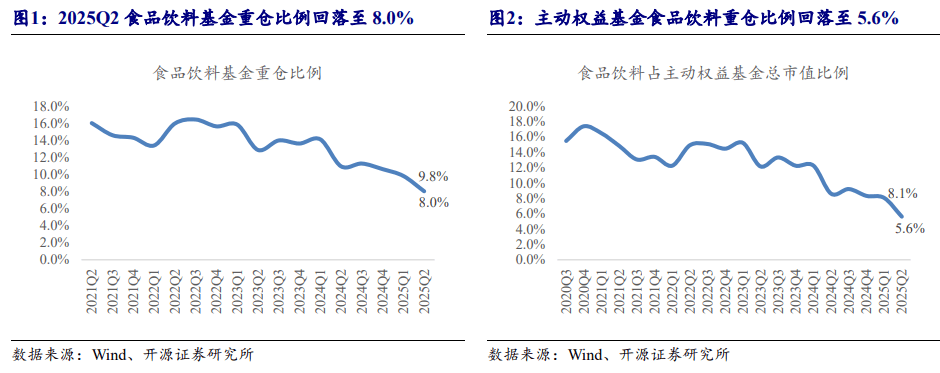
Group 1 - The core viewpoint of the articles indicates a significant decline in the allocation of food and beverage sectors by funds, reaching a new low since 2020, with the allocation ratio dropping from 9.8% in Q1 2025 to 8.0% in Q2 2025 [1][5][6] - Active equity funds have notably reduced their allocation to the food and beverage sector, with a decrease from 8.1% in Q1 2025 to 5.6% in Q2 2025, reflecting a 2.5 percentage point drop [1][5][6] - The decline in the food and beverage sector is attributed to the impact of the alcohol ban, which has further contracted consumption scenarios, particularly affecting traditional sectors like liquor [1][3][5] Group 2 - The proportion of active equity funds heavily invested in liquor has decreased from 6.57% in Q1 2025 to 3.97% in Q2 2025, a decline of 2.6 percentage points, indicating a widespread reduction in liquor holdings [2][11] - The overall market fund allocation to liquor has also fallen from 8.5% in Q1 2025 to 6.8% in Q2 2025, showing a similar trend of reduced investment in liquor [2][11] - Major liquor companies such as Luzhou Laojiao, Wuliangye, and Shanxi Fenjiu have seen significant reductions in fund holdings, while only a few companies like Kuaijishan and Shede Liquor experienced slight increases [2][11][20] Group 3 - The investment recommendation suggests strategically positioning in the liquor sector, as the current low expectations and valuations present potential opportunities for gradual accumulation [3][25][27] - The report anticipates that the liquor industry will find a bottom in the second half of the year, with expectations of a recovery in demand as the market adjusts to the impacts of the alcohol ban [3][27] - For new consumption targets, the focus should be on companies that can leverage channel expansion opportunities and emerging product categories, with recommendations including Ximai Food and Bai Run Shares [3][28]






见证历史!南向资金,疯狂买入
Zheng Quan Shi Bao· 2025-07-25 12:19
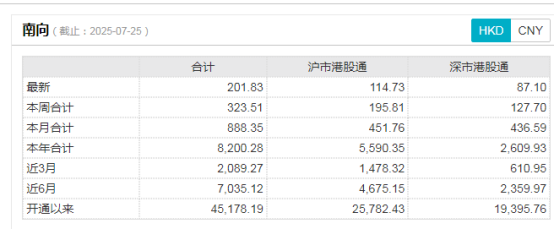
Group 1 - The Hong Kong stock market is experiencing a significant capital influx led by southbound funds, with a net buying amount exceeding 200 billion HKD on July 25, 2025, and a total net buying amount of over 820 billion HKD for the year, surpassing the previous record of 807.87 billion HKD for the entire year of 2024 [1][2] - The Hang Seng Index, Hang Seng Tech Index, and Hang Seng China Enterprises Index have shown year-to-date increases of 26.56%, 27.08%, and 25.52% respectively, ranking among the top global markets [2] - Southbound funds have frequently recorded daily net inflows exceeding 10 billion HKD, with 32 days in 133 trading days this year exceeding 10 billion HKD, and 9 days exceeding 20 billion HKD, including a record high of 35.586 billion HKD on April 9 [2][3] Group 2 - The continuous influx of southbound funds is attributed to the undervaluation of Hong Kong stocks, as the Hang Seng Index has undergone a six-year adjustment since 2018, with many companies maintaining good growth despite significant declines [5] - The Hong Kong market offers unique assets such as Tencent, Meituan, and Alibaba, along with new consumer companies like Pop Mart and Mixue Ice City, providing more investment options for southbound funds [5] - The influx of southbound funds reflects a "scarcity of assets," as domestic funds seek effective allocation opportunities amid a backdrop of abundant liquidity but limited high-quality assets [6] Group 3 - The sustained inflow of southbound funds has improved liquidity in the Hong Kong market and enhanced the pricing power of domestic funds, which accounted for 34.64% of the market's trading volume in 2024 [7] - The share of foreign capital in the Hong Kong stock market has decreased from 75% in October 2020 to 61% in June 2025, indicating a shift towards greater influence from domestic funds [7][8] - Southbound funds are gaining marginal pricing power in sectors such as consumer goods and telecommunications, with holdings exceeding 50% in these areas [8][9] Group 4 - The Hong Kong stock market has shown strong performance globally, driven by AI breakthroughs and the appeal of being a "value trap," with the Hang Seng Index reaching new highs [10] - Future market performance may depend more on corporate earnings growth rather than further valuation expansion, as the expected earnings growth for the Hang Seng Index is relatively low [10][11] - A balanced investment strategy focusing on stable returns and growth returns is recommended, particularly in sectors less affected by tariff impacts and those benefiting from AI advancements [11]