
纯碱

Search documents
10.22纯碱日评:纯碱行情暂无实质性突破
Sou Hu Cai Jing· 2025-10-23 08:36
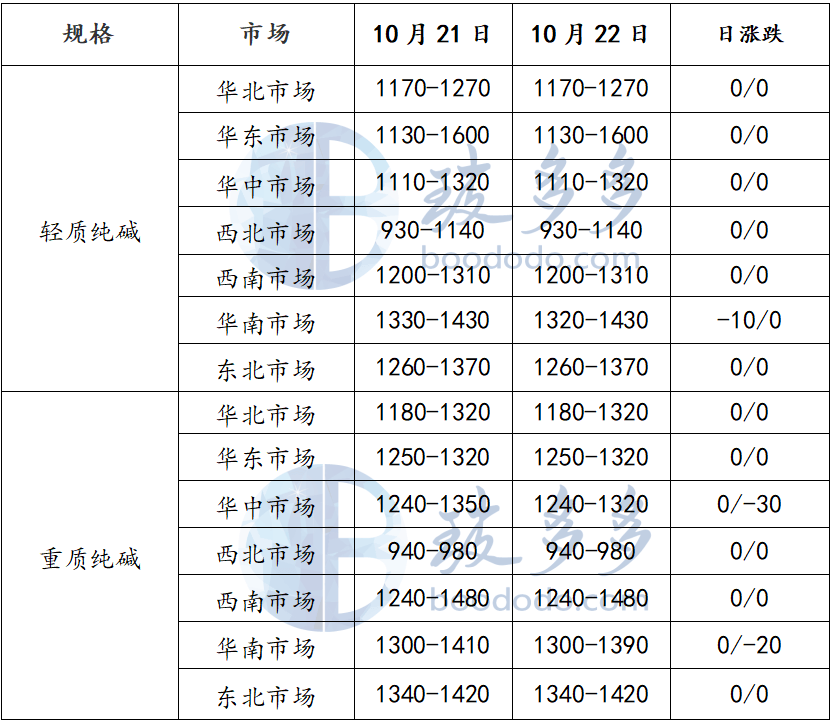
Core Viewpoint - The domestic soda ash market is currently experiencing a stable yet fluctuating trend, with prices remaining steady across various regions, but overall market sentiment is low due to weak demand from downstream enterprises [2]. Price Analysis - As of October 22, the mainstream prices for light soda ash in North China are between 1170-1270 CNY/ton, while heavy soda ash prices are between 1180-1320 CNY/ton. In South China, light soda ash prices range from 1320-1430 CNY/ton, and heavy soda ash prices are between 1300-1390 CNY/ton [2]. - The light soda ash price index on October 22 is 1162.86, a decrease of 1.43 from the previous working day, reflecting a -0.12% change. The heavy soda ash price index remains stable at 1210 [3]. Market Dynamics - The main contract for soda ash (SA2601) opened at 1211 CNY/ton and closed at 1223 CNY/ton on October 22, showing a daily increase of 1.33%. The highest price during the day was 1230 CNY/ton, while the lowest was 1205 CNY/ton, with total open interest at 1,390,463 contracts, a decrease of 924 contracts [5]. - The slight rebound in soda ash futures prices is primarily driven by a strong rebound in oil prices, which has improved overall sentiment in the chemical sector. However, the soda ash market lacks substantial driving factors and is expected to follow market fluctuations [5]. Future Outlook - The soda ash market is still in an adjustment phase, with supply-demand conflicts not effectively alleviated. In the absence of substantial positive support, the market is likely to maintain a stable yet fluctuating pattern, with limited price movement expected. Close attention should be paid to changes in downstream purchasing rhythms and the impact of policy factors on market sentiment [6].

黑色建材日报:库存环比下降,钢价有所反弹-20251023
Hua Tai Qi Huo· 2025-10-23 02:42
Report Industry Investment Ratings - No specific industry investment ratings are provided in the report. Core Views - The inventory of steel decreased month - on - month, and steel prices rebounded. The cost of glass and soda ash increased, and their prices rebounded from the low level. The prices of ferrosilicon and silicomanganese futures rose slightly, while the spot market remained on the sidelines [1][3]. - Glass prices are expected to be volatile and weak, and soda ash prices are also expected to be volatile and weak. Silicomanganese and ferrosilicon prices are expected to remain volatile [2][4]. Market Analysis and Strategy for Different Products Glass and Soda Ash - **Market Analysis** - Glass futures fluctuated strongly yesterday with active trading. The spot market was cautious, and enterprises offered flexible prices. The supply of glass is on a low - level upward trend, the inventory of middle - stream traders is high and still accumulating. With the end of the consumption peak season approaching and the possibility of some production lines resuming production, glass demand is expected to weaken further [1]. - Soda ash futures also fluctuated strongly yesterday with relatively active trading. The downstream's purchasing enthusiasm was low, mainly for rigid demand. The supply - demand contradiction of soda ash remains prominent, with supply at a high level and still having growth expectations. The demand side has some resilience, and inventory reduction pressure persists throughout the year [1]. - **Strategy** - Glass: Volatile and weak [2]. - Soda ash: Volatile and weak [2]. Silicomanganese and Ferrosilicon - **Market Analysis** - For silicomanganese, the main contract of silicomanganese futures rose slightly yesterday. The silicomanganese market fluctuated, and the market was cautious. The price of 6517 silicomanganese in the northern market was 5630 - 5680 yuan/ton, and in the southern market was 5650 - 5700 yuan/ton. From January to August, India's cumulative export volume of silicomanganese was 761,400 tons, a year - on - year decrease of 0.90%; the cumulative import volume was 15,000 tons, a year - on - year decrease of 8.98%. Silicomanganese enterprises' losses have intensified, production is high, and with the decline of hot metal, demand has weakened. Considering the futures discount to the spot, the price is expected to remain volatile [3]. - For ferrosilicon, the main contract of ferrosilicon futures fluctuated and rose yesterday. The spot price was stable. The price of 72 - grade ferrosilicon natural block in Ningxia was 5150 - 5200 yuan/ton, the 72 - grade ferrosilicon standard block was quoted at 5250 - 5300 yuan/ton, and the 75 - grade ferrosilicon was quoted at 5800 yuan/ton. Currently, the production of ferrosilicon enterprises has decreased slightly, enterprises are continuously losing money, and the motivation to increase production is insufficient. The downstream demand for ferrosilicon has begun to weaken, and the inventory of sample enterprises has increased [3]. - **Strategy** - Silicomanganese: Volatile [4]. - Ferrosilicon: Volatile [4].
纯碱、玻璃日报-20251023
Jian Xin Qi Huo· 2025-10-23 02:42
Group 1: Report Overview - Report Name: Soda Ash and Glass Daily Report [1] - Date: October 23, 2025 [2] - Research Team: Energy and Chemical Research Team [4] - Researcher: Feng Zeren (Soda Ash and Glass) [4] Group 2: Industry Investment Rating - No investment rating information provided in the report Group 3: Core Views - Soda ash market is in a weak pattern with supply exceeding demand, and the contract shows signs of bottoming out, expected to fluctuate weakly [8] - Glass market is in a weak balance of supply and demand, and the disk may test the bottom again, but excessive short - selling is not advisable, and attention should be paid to potential positive factors from policies and production lines [9] Group 4: Summary by Directory 1. Soda Ash and Glass Market Review and Operation Suggestions - **Soda Ash Market** - On October 22, the main futures contract SA601 of soda ash fluctuated and rebounded, with a closing price of 1,223 yuan/ton, a rise of 16 yuan/ton, and a daily decline of 924 lots [7] - Fundamentally, supply decreased, inventory increased slightly, and the overall weak pattern remained unchanged. Weekly production decreased by 30,300 tons to 740,500 tons, and enterprise inventory rose to 1.705 million tons [8] - The market supply - demand imbalance has not been effectively improved, and it is expected to fluctuate weakly [8] - **Glass Market** - Fundamentally, the production of float glass remained stable, and the photovoltaic glass was in a weak balance. The overall glass supply was at a high level within the year, and the inventory was at a high level after the festival [9] - The real - estate market has not shown a stabilizing trend, and the demand for float glass may not continue to rise. The disk may test the bottom again, but excessive short - selling is not advisable [9] 2. Data Overview - The report provides data on the price trends of active contracts for soda ash and glass, as well as data on soda ash weekly production, enterprise inventory, central China heavy soda market price, and flat glass production [11][17][18] - Data sources include Wind and iFind, and the research and development department of Jianxin Futures [12][16][20]
基本?逐渐“钝化”,宏观及政策仍可期待
Zhong Xin Qi Huo· 2025-10-23 00:43
1. Report Industry Investment Rating - The report gives a "sideways" outlook for the mid - term of the black building materials industry [7]. 2. Core Views of the Report - As the peak season draws to an end, although the demand for steel products has a slight month - on - month improvement, it cannot strongly support the prices of sector varieties. After the "15th Five - Year Plan" related meeting on October 23, the trading expectation around the introduction of favorable policies is expected to heat up. The fundamentals' guidance for prices will be "blunted", and short - term sector varieties may remain volatile. It is recommended to continue to pay attention to the rebound opportunities under the background of policy introduction [1][2][6]. 3. Summary According to Related Catalogs 3.1 Iron Element - **Iron Ore**: The fundamentals of iron ore have slightly weakened at the margin, but the overall contradiction is not significant. The overseas mine shipments have a slight month - on - month rebound, the arrival volume at 45 ports has declined from a high level, and the port inventory has continued to accumulate. The daily output of sample hot metal and the steel mill profitability rate have continued to decline slightly, but the hot metal is still at a high level. It is expected that the short - term price will fluctuate. The port trading volume is 122.9(+21.8) million tons, the swap main contract is 105.08(+0.52) dollars/ton, and the PB powder is 781(+4) yuan/ton [2][9]. - **Scrap Steel**: The supply of scrap steel is relatively stable, with a significant decline in the arrival volume this week and a slight year - on - year decrease, and a slight rebound in yesterday's arrival at the port. The demand has seen a slight increase in the daily consumption of scrap steel due to the resumption of some electric furnaces after the festival, and a decrease in the daily consumption of long - process scrap steel due to a slight decline in hot metal production. The inventory has increased slightly in steel enterprises. It is expected that the short - term price will follow the trend of finished products. The average tax - free price of shredded materials in East China is 2173(+1) yuan/ton, and the price difference between rebar and scrap steel in East China is 945(+9) yuan/ton [11]. 3.2 Carbon Element - **Coke**: The profit margins of the coking and steel sectors have both narrowed, and the game between coking plants and steel mills continues. With the hot metal remaining at a high level in the short term, the expectation of a price increase is strong. It is expected that the coke price will fluctuate. The futures market fluctuated yesterday, and the spot price of quasi - first - grade coke at Rizhao Port is 1470(+20) yuan/ton [12][13]. - **Coking Coal**: The supply has been disrupted, and capacity release is still restricted. The demand for coke production can provide rigid support in the short term, and the fundamentals are relatively healthy with low upstream inventory. However, with the steel under pressure, the upward driving force of furnace materials is temporarily limited. It is expected that the coking coal price will fluctuate in the short term. The price of medium - sulfur main coking coal in Jiexiu is 1300 yuan/ton, and the price of Mongolian No. 5 cleaned coal in Wubulangkou Jinquan Industrial Park is 1307 yuan/ton [12][13]. 3.3 Alloys - **Silicomanganese**: Cost reduction is limited, steel production is at a high level, and macro - policy expectations support the price. However, the market supply - demand expectation is pessimistic, and the price center may shift downward in the medium - to - long - term. The main contract price of silicomanganese rose yesterday. The ex - factory price of 6517 silicomanganese in Inner Mongolia is 5680 yuan/ton, and the price of Australian ore blocks with 45.0% Mn at Tianjin Port is 39 yuan/ton - degree [16][18]. - **Ferrosilicon**: High steel production, macro - policy expectations, and firm cost support the price. However, the market supply - demand relationship is relatively loose, and the rebound height of the ferrosilicon price is expected to be limited. The main contract price of ferrosilicon rose yesterday, and the ex - factory price of 72 ferrosilicon in Ningxia is 5180(+50) yuan/ton [19]. 3.4 Glass and Soda Ash - **Glass**: The upstream inventory has been continuously accumulating, and after the negative feedback between futures and spot, the short - term price shows a weak and volatile trend. The mid - stream has not significantly reduced inventory, and it is difficult to have a rebound in the short term. In the medium - to - long - term, market - oriented production capacity reduction is still needed. If the market refocuses on fundamentals, the price may continue to decline. The mainstream large - plate price in North China is 1140(-20) yuan/ton, and the national average price is 1196(-7) yuan/ton [3][14]. - **Soda Ash**: The supply - surplus pattern remains unchanged. It is expected to follow the macro - fluctuations and have a wide - range volatile trend. In the long run, the price center will continue to decline to promote production capacity reduction. The delivered price of heavy soda ash in Shahe is 1160 yuan/ton, the daily production is 105,000 tons, and the upstream inventory increased by about 10,000 tons on Monday [16]. 3.5 Steel Products - The spot market transactions are average, with a strong willingness to sell at low prices. The profit of blast furnaces and electric furnaces is not good, but the profitability rate of steel mills is still relatively high. The downward trend of hot metal is not obvious, and there is a situation of electric furnace restart. The supply of steel products is at a relatively high level. The demand continues to recover, but the recovery height is still limited. The steel inventory continues to decline, but the inventory level is still at a moderately high level. It is expected that the short - term futures market will fluctuate at a low level. The price of Hangzhou rebar is 3170(+20) yuan/ton, the price of Shanghai hot - rolled coil is 3260(+10) yuan/ton, the trading volume of construction steel is 107,573(+6,422) tons, and the trading volume of hot - rolled coil is 35,237(+2,107) tons [9].
瑞达期货纯碱玻璃产业日报-20251022
Rui Da Qi Huo· 2025-10-22 09:59
表现低迷,若后续央行降息,对于地产需求将有所支撑,否则恐继续拖累玻璃需求,下游深加工订单小幅 本报告中的信息均来源于公开可获得资料,瑞达期货股份有限公司力求准确可靠,但对这些信息的准确性及完整性不做任 纯碱玻璃产业日报 2025-10-22 | 项目类别 | 数据指标 纯碱主力合约收盘价(日,元/吨) | 最新 | 环比 数据指标 | 最新 | 环比 | | --- | --- | --- | --- | --- | --- | | | 纯碱与玻璃价差(日,元/吨) | 1223 129 | 13 玻璃主力合约收盘价(日,元/吨) 6 纯碱主力合约持仓量(日,手) | 1094 1390463 | 7 -924 | | 期货市场 | | | | | | | | 玻璃主力合约持仓量(日,手) | 1659798 | -1382 纯碱前20名净持仓 | -242017 | 17359 | | | 玻璃前20名净持仓 | -206377 | 6247 纯碱交易所仓单(日,吨) | 10202 | -566 | | | 玻璃交易所仓单(日,吨) | 455 | 0 纯碱基差(日,元/吨) | -55 | 14 | | ...

黑色产业链日报-20251022
Dong Ya Qi Huo· 2025-10-22 09:32
Report Industry Investment Rating No relevant content provided. Core Views - The steel market is currently focused on the Fourth Plenary Session. Steel prices may experience a slight rebound, but the weak fundamentals limit the upside potential, and a subsequent decline is likely. Short - term outlook is for a rebound, while the medium - to - long - term remains weak [3]. - The iron ore market is operating weakly under macro - sentiment and fundamental pressures. The supply is strong, and demand is weak. The price may be supported if there are positive policy signals [18]. - The coking coal market has strong bottom support due to tight resources and policy expectations, but the rebound space is limited by downstream contradictions. The price rebound depends on the downstream steel supply - demand balance [30]. - The ferroalloy market is under pressure due to weak downstream demand and high inventory. Without unexpected stimulus policies, prices will remain under pressure [48]. - The soda ash market has supply pressure in the long - term. Although exports are better than expected, high inventory restricts the price, with limited downside due to cost support [61]. - The glass market has weak demand and high inventory, and prices are suppressed. The implementation of the coal - to - gas project in Shahe and production line ignition plans need to be monitored [86]. Summary by Directory Steel - **Prices and Spreads** - On October 22, 2025, the closing price of rebar 01 contract was 3068 yuan/ton, up from 3047 yuan/ton on the 21st. The 01 - 05 month - spread was - 52 yuan/ton, up from - 57 yuan/ton [4]. - The hot - rolled coil 01 contract closed at 3247 yuan/ton on the 22nd, up from 3219 yuan/ton on the 21st. The 01 - 05 month - spread was - 12 yuan/ton, up from - 17 yuan/ton [4]. - The rebar - to - iron ore ratio and rebar - to - coke ratio remained stable on the 22nd compared to the 21st [15]. - **Spot Prices and Basis** - The aggregated rebar price in China was 3215 yuan/ton on the 22nd, up slightly from 3212 yuan/ton on the 21st. The 01 rebar basis in Shanghai was 142 yuan/ton, down from 153 yuan/ton [7]. - The aggregated hot - rolled coil price in Shanghai was 3280 yuan/ton on the 22nd, up from 3270 yuan/ton on the 21st. The 01 hot - rolled coil basis in Shanghai was 33 yuan/ton, down from 51 yuan/ton [9]. Iron Ore - **Prices and Basis** - On October 22, 2025, the 01 contract closed at 774 yuan/ton, up 4.5 yuan from the 21st. The 01 basis was 7.5 yuan/ton, down 2.5 yuan from the 21st [19]. - The price of Rizhao PB powder was 779 yuan/ton on the 22nd, up 2 yuan from the 21st [19]. - **Fundamentals** - The daily average pig - iron output was 240.95 million tons on October 17, 2025, down 0.59 million tons week - on - week. The 45 - port inventory was 14278.27 million tons, up 253.77 million tons week - on - week [24]. Coking Coal and Coke - **Prices and Spreads** - On October 22, 2025, the coking coal warehouse - receipt cost (Tangshan Mongolian 5) was 1238 yuan/ton, up 38 yuan week - on - week. The coking coal 09 - 01 month - spread was 153 yuan/ton, up 4 yuan from the 21st [35]. - The coke warehouse - receipt cost (Rizhao Port wet - quenched) was 1594 yuan/ton, unchanged from the 21st. The coke 09 - 01 month - spread was 220 yuan/ton, down 27 yuan from the 21st [35]. - **Spot Prices and Profits** - The ex - factory price of Anze low - sulfur primary coking coal was 1550 yuan/ton on the 22nd, up 20 yuan week - on - week. The immediate coking profit was 31 yuan/ton, down 10 yuan from the 21st [36]. Ferroalloy - **Silicon Iron** - On October 22, 2025, the silicon iron basis in Ningxia was - 8 yuan, down 14 yuan from the 21st. The silicon iron 01 - 05 month - spread was - 60 yuan, down 24 yuan from the 21st [49]. - The silicon iron spot price in Ningxia was 5280 yuan/ton, up 50 yuan from the 21st [49]. - **Silicon Manganese** - The silicon manganese basis in Inner Mongolia was 220 yuan on the 22nd, down 64 yuan from the 21st. The silicon manganese 01 - 05 month - spread was - 38 yuan, down 4 yuan from the 21st [52]. - The silicon manganese spot price in Inner Mongolia was 5680 yuan/ton, unchanged from the 21st [52]. Soda Ash - **Prices and Spreads** - On October 22, 2025, the soda ash 05 contract closed at 1308 yuan/ton, up 10 yuan from the 21st. The 05 - 09 month - spread was - 62 yuan, up 1 yuan from the 21st [62]. - **Spot Prices** - The heavy - soda ash market price in North China was 1300 yuan/ton on the 22nd, unchanged from the 21st. The heavy - soda ash to light - soda ash price difference in North China was 100 yuan/ton [65]. Glass - **Prices and Spreads** - On October 22, 2025, the glass 05 contract closed at 1241 yuan/ton, up 5 yuan from the 21st. The 05 - 09 month - spread was - 89 yuan, down 3 yuan from the 21st [86]. - **Sales and Production** - On October 21, 2025, the sales - to - production ratio in Shahe was 59%, in Hubei was 86%, in East China was 84%, and in South China was 98% [87].
2025年1-8月中国纯碱(碳酸钠)产量为2625.4万吨 累计增长3.4%
Chan Ye Xin Xi Wang· 2025-10-22 05:16
Core Viewpoint - The report highlights the growth of China's soda ash (sodium carbonate) production, indicating a positive trend in the industry with a year-on-year increase in production figures for 2025 [1] Industry Summary - As of August 2025, China's soda ash production reached 3.28 million tons, reflecting a year-on-year growth of 3.8% [1] - Cumulative production from January to August 2025 totaled 26.254 million tons, with a cumulative growth rate of 3.4% [1] - The data is sourced from the National Bureau of Statistics and compiled by Zhiyan Consulting, a leading industry consulting firm in China [1] Company Summary - Listed companies in the soda ash sector include: Yuanxing Energy (000683), Sanyou Chemical (600409), Shandong Haihua (000822), Shuanghuan Technology (000707), Chlor-Alkali Chemical (600618), Jinjing Technology (600586), Hubei Yihua (000422), Yuntu Holdings (002539), and Hebang Biotechnology (603077) [1] - The report provides insights into the competitive strategies and market analysis for the soda ash industry from 2025 to 2031 [1]


黑色建材日报:市场情绪好转,钢价震荡运行-20251022
Hua Tai Qi Huo· 2025-10-22 02:25
1. Report Industry Investment Ratings - Glass: Oscillating weakly [2] - Soda Ash: Oscillating weakly [2] - Silicomanganese: Oscillating [4] - Ferrosilicon: Oscillating [4] 2. Core Views - Market sentiment for steel has improved, and steel prices are oscillating; market sentiment for glass and soda ash is low, with glass and soda ash prices oscillating at low levels; the futures prices of silicomanganese and ferrosilicon have risen and then fallen, while the spot prices have shown mediocre performance [1][3] - For glass, supply is on a low - level upward trend, middle - stream trade inventory is high, speculative demand is weakening, and demand is expected to further decline with the end of the consumption peak season; for soda ash, the supply - demand contradiction remains prominent, supply is at a high level and has growth expectations, and the de - stocking pressure persists throughout the year [1] - For silicomanganese, enterprises' losses are intensifying, production is high, demand is weakening, and prices are expected to oscillate; for ferrosilicon, enterprise production has slightly decreased, losses continue, demand is weakening, and prices will follow the sector's fluctuations [3] 3. Summary by Related Catalogs Glass and Soda Ash Market Analysis - Glass futures oscillated yesterday with active intraday trading, while the spot market had low trading sentiment and a wait - and - see attitude; soda ash futures also oscillated, with regional spot prices slightly adjusted and downstream buyers restocking based on rigid demand [1] Supply - Demand and Logic - Glass supply is on a low - level upward trend, middle - stream trade inventory is high, speculative demand is weakening, and demand is expected to decline further with the end of the consumption peak season; soda ash supply is at a high level and has growth expectations, demand has resilience, and de - stocking pressure persists throughout the year [1] Strategy - Glass: Oscillating weakly; Soda Ash: Oscillating weakly; No strategies for inter - period and inter - variety trading [2] Silicomanganese and Ferrosilicon Market Analysis - The main contract of silicomanganese futures oscillated steadily yesterday, and the mainstream steel tender price was 5820 yuan/ton, with the 6517 grade having different market prices in the north and south; the main contract of ferrosilicon futures oscillated upward, and the spot prices were stable, with different prices for different grades in Ningxia [3] Supply - Demand and Logic - Silicomanganese enterprises' losses are intensifying, production is high, demand is weakening with the decline of hot metal, and prices are expected to oscillate; ferrosilicon enterprises' production has slightly decreased, losses continue, demand is weakening, and inventory has increased, and prices will follow the sector's fluctuations [3] Strategy - Silicomanganese: Oscillating; Ferrosilicon: Oscillating [4]
“钢矿连承压,煤焦亦难独善其
Zhong Xin Qi Huo· 2025-10-22 01:56
1. Report Industry Investment Rating - The report gives a "neutral" rating to the black building materials industry, with the overall outlook being "sideways" [2][3] 2. Core Viewpoints of the Report - The fundamentals of the black building materials sector were generally stable yesterday, but steel and iron ore prices on the futures market continued to face pressure, dragging down coal and coke products. As the traditional off - season approaches, the actual demand for steel is unlikely to improve significantly. With the approaching of the blast furnace maintenance season for steel enterprises, there are still expectations of negative feedback in the industrial chain. However, in late October, the expectation of positive news from domestic and foreign macro - level meetings has increased, and short - term sector varieties are expected to remain volatile. Attention can be paid to the rebound opportunities under the background of policy introduction [2][3] 3. Summary by Category 3.1 Iron Element - Iron ore: The fundamentals of iron ore have slightly weakened at the margin, but the overall pressure is not prominent. With the still - existing macro - level expectation disturbances, a slight recovery in steel demand, and uncertainties in Sino - US trade relations, the short - term price of iron ore is expected to fluctuate within a range. - Scrap steel: The contradictions in the scrap steel market are not prominent. With the current pressure on finished steel prices and poor EAF profits, the short - term price of scrap steel is expected to follow the trend of finished steel [2] 3.2 Carbon Element - Coke: In the short term, the supply and demand of coke are tight. With the deterioration of coking profits, the second - round price increase has been initiated. However, steel mills' profits are also poor, and the game between coking plants and steel mills continues. Whether the price increase can be implemented remains to be seen. The price of coke is expected to fluctuate. - Coking coal: Under the background of "anti - involution" and over - production inspections, the release of supply - side production capacity is restricted. The demand side still has rigid demand support from short - term coke production. With low inventories upstream, the fundamentals are relatively healthy. The price of coking coal is expected to fluctuate [2] 3.3 Alloys - Manganese silicon: Cost, high steel production, and macro - policy expectations support the price of manganese silicon, but the market's supply - demand expectation is pessimistic, and the medium - to - long - term price center may still decline. - Ferrosilicon: Ferrosilicon is also supported by high finished steel production, policy expectations, and cost. However, the supply - demand relationship is becoming looser, and the price still faces downward pressure in the later stage [2] 3.4 Glass and Soda Ash - Glass: The spot sales of glass are weak. After the synchronous decline of the spot and futures markets, the short - term price fluctuates weakly. Currently, the middle - stream has not significantly reduced inventory, and there is little chance of a short - term rebound. In the long - term, market - based capacity reduction is still needed. If the market refocuses on fundamentals, the price may continue to decline. - Soda ash: The pattern of over - supply in the soda ash market remains unchanged. It is expected to fluctuate widely following macro - level changes in the future, and the long - term price center will still decline to promote capacity reduction [3] 3.5 Specific Product Analysis - Steel: The recovery of post - holiday demand is limited, and steel inventories are at a moderately high level. Fundamental contradictions still exist, and the upper limit of the futures price is suppressed. With important domestic meetings this week, attention should be paid to policy - related disturbances. The short - term futures price is expected to fluctuate at a low level [7] - Iron ore: The short - term price is expected to fluctuate due to marginal weakening of fundamentals, macro - level disturbances, and uncertainties in Sino - US trade relations [7] - Scrap steel: With its own fundamentals having no prominent contradictions, the short - term price is expected to follow the trend of finished steel due to pressure on finished steel prices and poor EAF profits [9] - Coke: In the short term, the supply and demand of coke remain tight. With the continuous deterioration of coking profits, the second - round price increase has been initiated, but it still needs time to be implemented. The price is expected to fluctuate [11] - Coking coal: With supply still restricted and good auction results, the price is expected to fluctuate [10][11] - Glass: The spot sales are weak, and the short - term price fluctuates weakly. There is little chance of a short - term rebound. In the long - term, it is expected to decline if the market focuses on fundamentals [12] - Soda ash: The over - supply pattern remains unchanged. It is expected to fluctuate widely following macro - level changes, and the long - term price center will decline [14] - Manganese silicon: Cost, high steel production, and macro - policy expectations support the price, but the market's supply - demand expectation is pessimistic, and the price center may decline [14][15] - Ferrosilicon: Although supported by high finished steel production, policy expectations, and cost, the supply - demand relationship is becoming looser, and the price still faces downward pressure [16] 3.6 Index Information - Comprehensive Index: The commodity index was 2239.21, up 0.35%; the commodity 20 index was 2544.06, up 0.41%; the industrial products index was 2185.29, up 0.06%; the PPI commodity index was 1323.60, up 0.10%. - Plate Index: The steel industry chain index on October 21, 2025, was 1968.47, with a daily decline of 0.39%, a 5 - day increase of 0.42%, a 1 - month decline of 2.87%, and a decline of 6.63% since the beginning of the year [102][103]
《特殊商品》日报-20251022
Guang Fa Qi Huo· 2025-10-22 01:42
Report Industry Investment Ratings - No industry investment ratings are provided in the reports. Core Views Industrial Silicon - Industrial silicon spot prices are stable, while futures prices fluctuate and closed down 60 yuan/ton to 8,505 yuan/ton. September's export volume decreased by 8% month-on-month to 70,200 tons but remained year-on-year growth. In October, the supply of industrial silicon increased significantly, with a risk of inventory accumulation and price pressure. Although some enterprises in the southwest region reduced production, the impact on output was small, and the supply side still increased due to the increase in Xinjiang's output. Considering the potential increase in raw material costs such as coal prices and the rise in electricity prices in November, the future price center is expected to move up. Currently, the price is expected to fluctuate at a low level, mainly in the range of 8,000 - 9,000 yuan/ton. If the price of the 11 - contract falls to the low level of 8,000 - 8,300 yuan/ton, one can consider buying on dips [1]. Polysilicon - The spot price of polysilicon rose by 0.2 yuan/kg to 53 yuan/kg, and the futures price fluctuated and slightly rebounded by 375 yuan/ton to 50,715 yuan/ton, with futures at a discount. On the demand side, the output of silicon wafers increased significantly, and the demand for battery wafers was supported by overseas purchases driven by India's ALMM policy and the demand for high - efficiency wafers in domestic centralized projects. It is highly likely that the output will increase in October. Whether the demand can absorb the increased output during the fourth - quarter rush installation and the increase in export orders will have a significant impact on prices. Currently, the polysilicon market is relatively stable. One should pay attention to policy implementation, production control, and whether there is an increase in demand orders. In the future, the supply in the southwest region will decrease during the dry season, which will support prices, but one should guard against the risk of inventory accumulation due to lower - than - expected demand [2]. Glass and Soda Ash - Soda ash continues to weaken, with manufacturers' inventories and mid - stream delivery inventories increasing, highlighting the surplus. The weekly output is at a high level, and the surplus is obvious compared with the current rigid demand. Most of the inventory has been transferred to the mid - and downstream, and the trade inventory continues to rise. In the medium term, there is no expectation of a significant increase in downstream production capacity, so the overall demand for soda ash will continue the previous rigid - demand pattern. If there is no actual production capacity exit or load reduction, the supply - demand situation will be further pressured. One can track macro fluctuations and the load - control situation of soda ash plants. The overall supply - demand pattern is bearish, and the operation idea is to short on rebounds [4]. - Glass manufacturers' sales are average, and they continue to cut prices. Hubei's price is basically at par with the futures market. In recent days, the futures market has continued to weaken, trading on the logic of a non - prosperous peak season and fundamental surplus. In addition, the mid - stream inventory in some regions remains high without obvious destocking. In terms of industry supply - demand, although the deep - processing orders have improved seasonally, they are still weak, and the LOW - E开工率 remains low without obvious peak - season characteristics. In the long - term, the real - estate cycle is at the bottom, and the industry needs to clear production capacity to solve the surplus problem. Currently, the futures market has been trading on the non - prosperous peak - season logic. In the medium term, one should pay attention to the spot trading rhythm, high - frequency data changes, and macro - level drivers [4]. Natural Rubber - On the supply side, the prices of overseas raw materials have been firm recently, and the significant destocking of dark - colored rubber still provides cost support for rubber prices. However, there is a strong expectation that the weather in northeastern Thailand will improve, and the raw material prices are expected to weaken. One should pay attention to future weather conditions. On the demand side, after the "Double Festival" holiday, most of the enterprises that had maintenance have resumed normal production, but the overall market has not shown obvious improvement. To control inventory growth, some enterprises are still in a state of flexible production control. It is expected that the enterprise equipment will operate stably in the short term, adjusting production according to their own orders. In summary, the short - term macro - environment has improved, and the rubber price has rebounded due to the improvement in fundamentals. One should pay attention to the raw material output in the peak - production season of the main producing areas and macro - level changes. If the raw material supply is smooth, the rubber price may decline further; if not, the rubber price is expected to operate around 15,000 - 15,500 [5]. Logs - The log futures fluctuated yesterday, with the 2601 contract closing at 838 yuan/cubic meter, up 3.5 yuan from the previous day. The spot prices of the main benchmark delivery products remained unchanged, with the price of 3.9 - meter medium - A radiata pine in Shandong being 760 yuan/cubic meter and that in Jiangsu being 780 yuan/cubic meter. Last week, the inventory decreased. As of October 17, the total inventory of coniferous logs in the country was 2.92 million cubic meters, a decrease of 70,000 cubic meters from the previous week. On the demand side, the outbound volume increased. As of October 17, the daily average outbound volume of logs was 63,200 cubic meters, an increase of 5,900 cubic meters from the previous week. On the supply side, this week, 12 New Zealand log ships are expected to arrive at 13 Chinese ports, an increase of 0 from the previous week; the total arrival volume is about 438,000 cubic meters, an increase of 20,000 cubic meters from the previous week, a week - on - week increase of 5%. Currently, there is no obvious driving force in the supply - demand of logs. The 01 contract is relatively strong. The new round of overseas quotes has increased, and the subsequent port fees are expected to rise, providing strong cost support. During the seasonal peak season, there is some support below the futures price, and the 01 contract may be strong [6]. Summary by Relevant Catalogs Industrial Silicon Spot Price and Basis - The spot prices of East China's oxygen - containing SI5530 industrial silicon, SI4210 industrial silicon, and Xinjiang 99 silicon remained unchanged on October 21 compared with October 20. The basis of oxygen - containing SI5530 increased by 60 to 845, with a 7.64% increase; the basis of SI4210 increased by 60 to 392, with a 17.91% increase; the basis of Xinjiang increased by 60 to 1045, with a 6.09% increase [1]. Inter - month Spread - The spread of 2510 - 2511 decreased by 45 to - 40, a decrease of 900%; the spread of 2511 - 2512 remained unchanged; the spread of 2512 - 2601 increased by 5 to 55, an increase of 10%; the spread of 2601 - 2602 increased by 5 to - 10, an increase of 33.33%; the spread of 2602 - 2603 decreased by 15 to - 5, a decrease of 150% [1]. Fundamental Data (Monthly) - The national industrial silicon output increased by 35,100 tons to 420,800 tons, an increase of 9.10%; Xinjiang's output increased by 33,600 tons to 203,200 tons, an increase of 19.78%; Yunnan's output increased by 1,400 tons to 59,500 tons, an increase of 2.41%; Sichuan's output decreased by 800 tons to 52,900 tons, a decrease of 1.49%. The national operating rate increased by 6.07 percentage points to 61.94%; Xinjiang's operating rate increased by 13.39 percentage points to 74.00%; Yunnan's operating rate decreased by 5.68 percentage points to 41.71%; Sichuan's operating rate increased by 0.65 percentage points to 44.94%. The output of silicone DMC decreased by 12,900 tons to 210,200 tons, a decrease of 5.78%; the output of polysilicon decreased by 1,700 tons to 130,000 tons, a decrease of 1.29%; the output of recycled aluminum alloy increased by 46,000 tons to 661,000 tons, an increase of 7.48%. The export volume of industrial silicon decreased by 6,400 tons to 70,200 tons, a decrease of 8.36% [1]. Inventory Change - Xinjiang's factory inventory decreased slightly by 0.01% to 108,500 tons; Yunnan's factory inventory remained unchanged; Sichuan's factory inventory increased by 2.89% to 25,000 tons; the social inventory increased by 3.12% to 562,000 tons; the non - warehouse receipt inventory increased by 6.45% to 317,700 tons; the warehouse receipt inventory decreased by 0.92% to 244,300 tons [1]. Polysilicon Spot Price and Basis - The average price of N - type re - feeding material increased by 200 yuan/ton to 53,000 yuan/ton, an increase of 0.38%; the average price of N - type granular silicon remained unchanged; the basis of N - type material decreased by 175 yuan/ton to 2,285 yuan/ton, a decrease of 7.11% [2]. Futures Price and Inter - month Spread - The main contract price increased by 375 yuan/ton to 50,715 yuan/ton, an increase of 0.74%. The spread of the current month - the first continuous contract increased by 52,265 yuan/ton to 1,925 yuan/ton, an increase of 103.82%; the spread of the first continuous - the second continuous contract increased by 130 yuan/ton to - 2,360 yuan/ton, an increase of 5.22%; the spread of the second continuous - the third continuous contract increased by 35 yuan/ton to 75 yuan/ton, an increase of 87.50% [2]. Fundamental Data (Weekly) - The output of silicon wafers increased by 15,200 tons to 143,500 tons, an increase of 11.85%; the output of polysilicon remained unchanged at 31,000 tons [2]. Fundamental Data (Monthly) - The output of polysilicon decreased by 1,700 tons to 130,000 tons, a decrease of 1.29%; the import volume increased by 300 tons to 1,300 tons, an increase of 28.46%; the export volume decreased by 800 tons to 2,100 tons, a decrease of 28.16%; the net export volume decreased by 1,100 tons to 900 tons, a decrease of 56.83%. The output of silicon wafers increased by 30,100 tons to 590,500 tons, an increase of 5.37%; the import volume decreased by 100 tons to 400 tons, a decrease of 17.96%; the export volume remained unchanged at 6,700 tons; the net export volume increased by 100 tons to 6,300 tons, an increase of 1.96%. The demand for silicon wafers increased by 27,200 tons to 613,400 tons, an increase of 4.64% [2]. Inventory Change - The polysilicon inventory increased by 13,000 tons to 253,000 tons, an increase of 5.42%; the silicon wafer inventory increased by 5,300 tons to 173,100 tons, an increase of 3.16%; the polysilicon warehouse receipt increased by 140 to 9,290 [2]. Glass and Soda Ash Glass - related Price and Spread - The prices of glass in North China, East China, South China remained unchanged or decreased slightly. The prices of glass 2505 and 2509 increased slightly. The 05 basis decreased by 15 to - 76, a decrease of 24.59% [4]. Soda Ash - related Price and Spread - The prices of soda ash in North China, East China, Central China, and Northwest China remained unchanged. The prices of soda ash 2505 and 2509 decreased slightly. The 05 basis increased by 6 to 2, an increase of 150% [4]. Supply - The operating rate of soda ash increased by 3.37 percentage points to 88.41%, and the weekly output increased by 25,000 tons to 770,800 tons, an increase of 3.37%. The daily melting volume of float glass increased by 2,000 tons to 161,300 tons, an increase of 1.16%; the daily melting volume of photovoltaic glass remained unchanged [4]. Inventory - The glass factory inventory increased by 5.84% to 62,824,000 weight boxes; the soda ash factory inventory increased by 3.74% to 1.6598 million tons; the soda ash delivery inventory increased by 4.05% [4]. Real - estate Data (Month - on - Month) - The new construction area increased by 0.09 percentage points to - 0.09%; the construction area decreased by 2.43 percentage points to 0.05%; the completion area decreased by 0.03 percentage points to - 0.22%; the sales area decreased by 6.50 percentage points to - 6.55% [4]. Natural Rubber Spot Price and Basis - The price of Yunnan Guofu full - latex rubber remained unchanged; the basis of full - latex decreased by 340 to - 850, a decrease of 66.67%. The price of Thai standard mixed rubber increased by 100 yuan/ton to 14,550 yuan/ton; the non - standard price difference decreased by 240 to - 600, a decrease of 66.67%. The FOB intermediate price of cup rubber increased by 0.25 baht/kg to 50.45 baht/kg; the FOB intermediate price of glue remained unchanged. The price of natural rubber blocks in Xishuangbanna increased by 300 yuan/ton to 12,800 yuan/ton; the price of natural rubber glue in Xishuangbanna remained unchanged. The market mainstream price of raw materials in Hainan decreased by 100 yuan/ton to 12,800 yuan/ton [5]. Inter - month Spread - The 9 - 1 spread decreased by 5 to - 5, a decrease of 10%; the 1 - 5 spread increased by 10 to 5, an increase of 200%; the 5 - 9 spread decreased by 5 to - 50, a decrease of 11.11% [5]. Fundamental Data - In August, Thailand's rubber production decreased by 20,000 tons to 458,800 tons, a decrease of 0.43%; Indonesia's production decreased by 85,000 tons to 189,000 tons, a decrease of 4.30%; India's production increased by 5,000 tons to 50,000 tons, an increase of 11.11%; China's production increased by 12,200 tons to 113,700 tons. The operating rate of semi - steel tires increased by 26.21 percentage points to 72.72%; the operating rate of full - steel tires increased by 20.56 percentage points to 64.52%. In August, the domestic tire output increased by 859,000 to 102.954 million; in September, the tire export volume decreased by 671,000 to 5.63 million. In August, the total import volume of natural rubber increased by 46,000 tons to 520,800 tons, an increase of 9.68%; in September, the import volume of natural and synthetic rubber increased by 80,000 tons to 740,000 tons, an increase of 12.12%. The production cost of dry rubber (STR20) in Thailand increased by 67 yuan/ton to 12,717 yuan/ton,