证券业

Search documents
李扬:值得注意的金融格局变化
和讯· 2025-12-08 10:25
Group 1 - The core viewpoint of the article highlights significant structural changes in China's financial landscape, particularly the transition to a low-interest-rate environment and the shift in monetary policy focus towards asset price stability [2][5] - The downward trend in interest rates is not unique to China but part of a global phenomenon, with various indicators pointing to a decline in rates across different markets [4][5] - The "disintermediation" trend is accelerating, indicating a shift in the financing structure, with a notable decrease in the proportion of indirect financing in total social financing from 86% to 65.3% over the past decade [6] Group 2 - The transformation of monetary policy is emphasized, moving from a traditional focus that ignored asset prices to an active management approach aimed at stabilizing financial markets [8][9] - Historical lessons from past financial crises underscore the importance of central banks being responsive to asset market conditions, marking a significant shift in China's monetary policy approach since September 2024 [8][9] - The People's Bank of China has begun to engage in market operations, such as buying and selling government bonds, which enhances its ability to manage liquidity and supports the development of the bond market [9]


上市公司监督管理条例公开征求意见,资金面略有收敛,债市震荡回暖
Dong Fang Jin Cheng· 2025-12-08 09:44
Report Summary 1. Report Industry Investment Rating No relevant information provided. 2. Core Viewpoints On December 5, the liquidity slightly tightened; the bond market fluctuated and recovered; the main indices of the convertible bond market collectively rose, and most convertible bond issues increased in price; yields on U.S. Treasuries across all maturities generally increased, and yields on 10-year government bonds of major European economies generally rose [1]. 3. Summary by Directory 3.1 Bond Market News - **Domestic News**: On the evening of December 5, Chinese and U.S. economic and trade leaders held a video call, discussing the implementation of previous consensuses and promoting stable and positive development of Sino-U.S. economic and trade relations [3]; on December 6, China Securities Regulatory Commission Chairman Wu Qing emphasized accelerating the creation of first-class investment banks and institutions to boost high-quality development of the capital market [4]; on December 5, the CSRC solicited public opinions on the "Regulations on the Supervision and Administration of Listed Companies"; the "Administrative Measures for Financial Leasing Business of Financial Leasing Companies" will be implemented from January 1, 2026; the central bank renewed a bilateral currency swap agreement with the Macao Monetary Authority, expanding the scale to 50 billion yuan/57 billion Macao patacas [5][6]. - **International News**: U.S. economic data for September showed inflation and personal income increases, but actual personal consumption expenditures remained stagnant; the preliminary December consumer confidence index rose, and short-term inflation expectations dropped to the lowest level since January; key European economies' 10-year government bond yields generally increased [7][8][30]. - **Commodities**: On December 5, international crude oil futures prices continued to rise, with WTI January crude futures up 0.69% to $60.08 per barrel and Brent February crude futures up 0.77% to $63.75 per barrel; COMEX February gold futures closed flat at $4,243 per ounce; NYMEX natural gas prices rose 5.25% to $5.337 per ounce [9][10]. 3.2 Liquidity - **Open Market Operations**: On December 5, the central bank conducted 139.8 billion yuan of 7-day reverse repurchase operations at an interest rate of 1.40%, with 303.1 billion yuan of reverse repurchases maturing, resulting in a net withdrawal of 161.5 billion yuan [12]. - **Funding Rates**: On December 5, the liquidity slightly tightened but remained generally loose. DR001 rose 0.06bp to 1.300%, and DR007 rose 0.04bp to 1.438% [13]. 3.3 Bond Market Dynamics - **Interest Rate Bonds**: On December 5, affected by rumors of the Politburo's mention of "dual cuts," the bond market fluctuated and recovered. Yields on 10-year government bonds and 10-year China Development Bank bonds decreased [16]. - **Credit Bonds**: On December 5, the trading prices of two industrial bonds deviated by over 10%; several companies, including Zhengyuan Real Estate and Fosun Group, faced regulatory actions due to information disclosure violations; many companies, such as Vanke and Longfor Group, announced bond-related events [18][19][22]. - **Convertible Bonds**: On December 5, the A-share market rose, and the convertible bond market followed suit. The main convertible bond indices increased, and most individual convertible bonds rose. Several companies, including Aowei Electronics, announced convertible bond-related events [21][23][27]. - **Overseas Bond Markets**: On December 5, yields on U.S. Treasuries across all maturities generally increased, and yields on 10-year government bonds of major European economies generally rose; the daily price changes of Chinese dollar bonds are provided [26][30][32].




超千亿险资活水来了!跨年行情会来吗?
Sou Hu Cai Jing· 2025-12-08 09:43
Group 1 - The core viewpoint of the news is that the National Financial Regulatory Administration has lowered the risk factors for insurance companies' long-term holdings in equity assets, which is expected to release more capital for investment in the stock market [1][3][11] - As of the end of the third quarter, the balance of insurance capital invested in stocks was 3.62 trillion yuan, with an estimated 40% in the CSI 300 and 5% in the CSI 100 Low Volatility Index [1][3] - The adjustment in risk factors is anticipated to improve the solvency adequacy ratio of the insurance industry by approximately 1 percentage point if no additional stock investments are made [1][3] Group 2 - The reduction in risk factors allows insurance funds to invest more in the capital market while meeting solvency requirements, positively impacting market liquidity and stability [4][11] - The China Securities Regulatory Commission (CSRC) is also expected to relax leverage restrictions for securities firms, which may enhance capital utilization efficiency and indirectly influence the market [7][11] - The upcoming political bureau meeting may lead to positive policy changes, further supporting the potential for a cross-year market rally [10][11]

中金:流动性的新变化
中金点睛· 2025-12-07 23:42
Core Viewpoint - Since the end of October, investor risk appetite has decreased, leading to pressure on global risk assets, with the S&P, Nasdaq, and Hang Seng Tech experiencing maximum declines of 5.1%, 7.3%, and 12.6% respectively. This is attributed to concerns over the AI bubble, tight liquidity in the repurchase market, and fluctuating expectations regarding Federal Reserve interest rate cuts [2][4]. Group 1: Market Conditions and Liquidity - The current market, particularly for liquidity-sensitive tech stocks, requires either breakthroughs in AI industry trends or significant improvements in liquidity for any upward movement [4]. - A series of events affecting liquidity is anticipated in the coming month, including the FOMC meeting on December 11, where an 88% probability of a rate cut is priced in, but the market will be attentive to any hawkish statements or discussions about restarting balance sheet expansion [4][5]. - The Bank of Japan's interest rate decision on December 19 is also a concern, as it may echo last year's liquidity "storm" [4]. Group 2: Federal Reserve Rate Cuts - The expectation for a December rate cut is well established, with the focus on the dot plot and statements from the Fed. A return to neutral rates may require three cuts [5][7]. - Recent data indicates a need for rate cuts due to high current rates suppressing traditional demand, with the ISM manufacturing PMI in contraction for eight consecutive months and a significant drop in consumer confidence [7][11]. - The Fed's ability to cut rates is supported by recent inflation data, which suggests that tariff impacts on inflation are less significant than previously feared, with consumer exposure to tariffs at only 11% [13][15]. Group 3: New Fed Chair Nomination - The upcoming nomination of a new Fed chair is critical, with Kevin Hassett being the frontrunner. His potential policies may lean towards more dovish stances while maintaining some restraint to preserve the Fed's independence [20][21]. - If Hassett is appointed, he may advocate for more aggressive rate cuts than currently anticipated, which could stimulate the economy but also raise concerns about the Fed's independence [27][28]. - The market is closely monitoring how the new chair will balance the need for rate cuts with the preservation of the Fed's autonomy, as excessive dovishness could lead to fears of political influence over monetary policy [20][27]. Group 4: Market Implications - The potential for the Fed to restart balance sheet expansion could significantly enhance market liquidity and support financial assets. The cessation of balance sheet reduction and the potential for further expansion are expected to improve liquidity conditions [29][30]. - The overall financial liquidity in the U.S. is projected to expand by 7%-14% in 2026, which is likely to have a positive correlation with U.S. equities [37][41]. - The anticipated actions of the Fed and the new chair could lead to fluctuations in U.S. Treasury yields and the dollar, with short-term pressures expected but a long-term recovery likely if independence is maintained [54][55].

全省前三季度社会融资规模增量全国第一银行业不良贷款率处于全国较低水平
Xin Hua Ri Bao· 2025-12-07 23:12
Core Insights - The report highlights that Jiangsu province has achieved significant financial growth, with a social financing scale increase of 2.99 trillion yuan, ranking first in the nation [1] - The province's banking sector maintains a low non-performing loan ratio of 0.82%, indicating a stable financial environment [1] Financial Performance - In the first three quarters, Jiangsu's new loans in both domestic and foreign currencies reached 2.31 trillion yuan, also the highest in the country [1] - Loans to the manufacturing sector, technology enterprises, green projects, and small and micro enterprises have seen year-to-date growth rates of 11.1%, 16.2%, 22.9%, and 11% respectively [1] - Non-financial enterprises (excluding state-owned enterprises) issued bonds totaling 1.15 trillion yuan [1] - The province has seen the establishment of 24 new domestic listed companies, leading the nation, with 23 of these in strategic emerging industries [1] Financial Institutions and Services - Jiangsu has 187 legal financial institutions and over 1,500 various local financial organizations [2] - The province is set to have 13 banks listed in the top 1,000 global banks by 2025, leading the country [2] - The government financing guarantee system has been enhanced, with a recorded scale of 137.3 billion yuan in the national financing guarantee fund, maintaining the top position nationally [2] - The provincial comprehensive financial service platform has assisted 74,000 enterprises in obtaining credit worth 447.9 billion yuan [2] Financial Reforms and Innovations - The establishment of the Jiangsu National Financial Investment Group and Jiangsu Rural Commercial Bank has optimized the layout of state-owned financial capital [2] - The province has initiated the first credit enhancement company in East China to support bond financing for small and medium-sized technology enterprises [2] - The strategic emerging industry fund cluster has accelerated development, with a total scale exceeding 100 billion yuan [2] - Jiangsu has been approved to conduct a national-level pilot for a comprehensive intellectual property financial ecosystem [2] Risk Management and Consumer Protection - Jiangsu has implemented policies to optimize the financial ecosystem and promote the creation of financial ecological counties [3] - The province has established 111 financial dispute mediation service points to enhance consumer rights protection [3] - Efforts to strengthen financial support for local debt risk resolution and assist private enterprises in financial distress have been emphasized [3] - A reward mechanism for reporting illegal fundraising activities has been introduced to maintain a strict crackdown on illegal financial activities [3]
外汇储备连续四个月站稳3.3万亿美元
Bei Jing Shang Bao· 2025-12-07 15:42
Core Viewpoint - The latest foreign exchange reserve data indicates a slight increase in China's foreign reserves, with a notable rise in gold reserves, reflecting ongoing economic stability and strategic asset management by the People's Bank of China [1][3][5]. Foreign Exchange Reserves - As of November 2025, China's foreign exchange reserves reached $33,464 billion, an increase of $30 billion from October, representing a growth rate of 0.09% [1][3]. - The rise in reserves is attributed to various factors, including macroeconomic data from major economies and expectations regarding monetary policy, leading to a decline in the US dollar index [3][4]. - The reserves have remained above $3.3 trillion for four consecutive months, with a significant year-to-date increase of $144 billion, primarily driven by the depreciation of the US dollar and lower US Treasury yields [4]. Gold Reserves - China's official gold reserves increased to 7,412 million ounces (approximately 2305.39 tons) by the end of November, marking the 13th consecutive month of growth, although the increase was modest [1][5]. - The People's Bank of China has been gradually increasing its gold reserves, with the latest increment being the lowest since the resumption of purchases in November 2024, reflecting a strategic response to global economic conditions [5][6]. - Analysts suggest that the ongoing geopolitical risks and the anticipated easing of US monetary policy are driving the need for continued gold accumulation to optimize the international reserve structure [6][7].

一周要闻|全球市场本周回顾与下周展望
Xin Hua Cai Jing· 2025-12-07 14:11
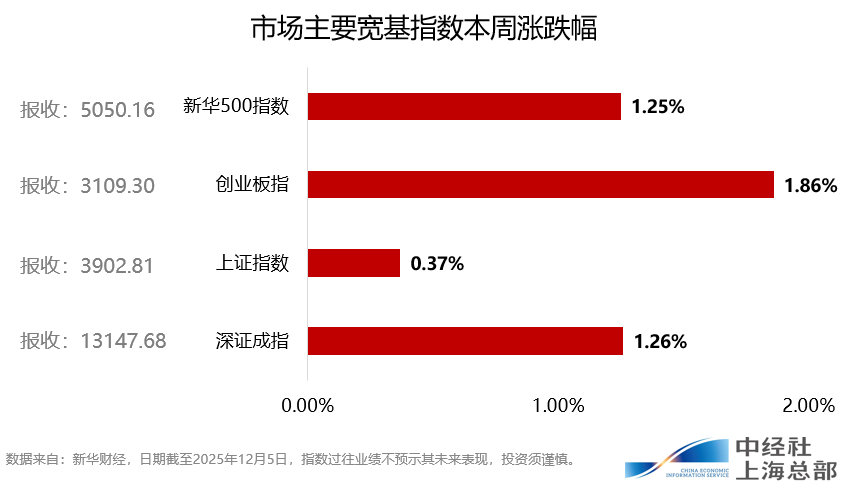
Stock Market - The A-share market indices rose during the week from December 1 to December 5, with the Shanghai Composite Index increasing by 0.37%, the Shenzhen Component Index by 1.26%, the ChiNext Index by 1.86%, and the Xinhua 500 Index by 1.25% [1] - The Xinhua 500 Index opened at 5001.85 points and closed at 5050.16 points, with a weekly fluctuation of 1.82% and a total trading volume of 2.62 trillion yuan [1] Industry Performance - Among the Shenwan first-level industry indices, sectors such as non-ferrous metals, telecommunications, defense and military industry, machinery equipment, and non-bank financials saw significant gains, while media, real estate, beauty care, food and beverage, and computer sectors experienced declines [3] Commodity Market - Precious metals maintained high volatility, with spot gold nearing $4260 per ounce before declining, resulting in a weekly drop of 0.5%. COMEX gold futures closed at $4227.7 per ounce, down 0.64% for the week [6] - Spot silver reached a record high of $59.3 per ounce due to supply shortages and soaring industrial demand, with COMEX silver futures rising by 2.86% to $58.8 per ounce [6] Foreign Exchange Market - The US dollar index fell by 0.46% to 98.98, while the euro, pound, and Australian dollar appreciated against the dollar. The euro rose by 0.37%, the pound by 0.77%, and the Japanese yen increased by 0.53% due to heightened expectations of a rate hike by the Bank of Japan [8] Market News - The People's Bank of China conducted a 1 trillion yuan reverse repurchase operation on December 5 to maintain liquidity in the banking system [9] - The China Securities Regulatory Commission (CSRC) announced plans to strengthen differentiated regulation for quality institutions while tightening oversight on problematic brokers [9] - The National Financial Regulatory Administration lowered risk factors for several insurance company business lines, including those related to the CSI 300 Index and the STAR Market [9] Upcoming Events - The Federal Reserve's interest rate decision will be a key focus next week, with expectations of a 25 basis point cut following recent weak employment data [13]
品种久期跟踪:高波动的久期选择
SINOLINK SECURITIES· 2025-12-07 13:48
Report Summary Investment Rating No investment rating for the industry is provided in the report. Core Viewpoints - The duration of secondary capital bonds has been continuously rising, while the durations of other credit bonds have generally shortened. As of December 5, the weighted average trading durations of urban investment bonds and industrial bonds were 1.90 years and 2.27 years respectively. Among commercial bank bonds, the weighted average trading durations of secondary capital bonds, bank perpetual bonds, and general commercial financial bonds were 4.31 years, 3.78 years, and 1.94 years respectively. General commercial financial bonds were at a relatively low historical level, and secondary capital bonds were at a relatively high historical level. For other financial bonds, the durations of securities company bonds, securities subordinated bonds, insurance company bonds, and leasing company bonds were 1.53 years, 1.83 years, 3.33 years, and 1.19 years respectively. The duration of securities subordinated bonds has significantly shortened compared to last week, and the durations of securities company bonds and securities subordinated bonds were at relatively low historical levels [2][9]. - The coupon duration crowding index has slightly increased. After reaching its highest value in March 2024, the coupon duration crowding index declined. This week, it increased compared to last week and is currently at the 20.8% level since March 2021 [11]. Summary by Directory 1. All - Variety Duration Overview - Urban investment bonds: The weighted average trading duration hovered around 1.90 years. The duration of Hebei provincial urban investment bonds lengthened to 5.50 years, and the trading duration of Guangxi provincial urban investment bonds shortened to around 1.22 years. The historical quantiles of the durations of urban investment bonds in regions such as Zhejiang prefecture - level cities, Henan prefecture - level cities, and Hunan province have exceeded 90%, and the duration of Hunan provincial urban investment bonds is approaching the highest level since 2021 [3][15]. - Industrial bonds: The weighted average trading duration of industrial bonds shortened compared to last week and was generally around 2.27 years. The trading duration of the transportation industry lengthened to 2.02 years, and the trading duration of the food and beverage industry shortened to 0.55 years. The trading duration of the real estate industry was at a relatively low historical level, while those of the non - ferrous metals and pharmaceutical and biological industries were at relatively high historical levels [3][21]. - Commercial bank bonds: The duration of general commercial financial bonds shortened to 1.94 years, at the 35.9% historical quantile, lower than the level of the same period last year. The duration of secondary capital bonds lengthened to 4.31 years, at the 95.1% historical quantile, higher than the level of the same period last year. The duration of bank perpetual bonds shortened to 3.78 years, at the 67.7% historical quantile, higher than the level of the same period last year [3][23]. - Other financial bonds: In terms of the weighted average trading duration, insurance company bonds > securities subordinated bonds > securities company bonds > leasing company bonds, at historical quantiles of 71.4%, 22%, 31.8%, and 61.2% respectively. The overall duration of other financial bonds has shortened compared to last week [3][26]. 2. Variety Microscope - Coupon duration crowding index: After reaching its peak in March 2024, the coupon duration crowding index decreased and then increased slightly this week. It is currently at the 20.8% level since March 2021 [11]. - Regional analysis of urban investment bonds: The report provides the durations and historical quantiles of urban investment bonds in different provinces and administrative levels, such as the duration of Hebei provincial urban investment bonds lengthening to 5.50 years and Guangxi provincial urban investment bonds shortening to 1.22 years [15][20]. - Industry analysis of industrial bonds: Different industries within industrial bonds showed different duration changes. For example, the transportation industry's duration lengthened, and the food and beverage industry's duration shortened [21].
超长债承接不足如何缓解?
Western Securities· 2025-12-07 13:08
1. Report Industry Investment Rating No relevant content provided. 2. Core Viewpoints of the Report - Year - end allocation of ultra - long bonds is weak. The problem of insufficient ultra - long bond underwriting has intensified this week, driving up the 30Y Treasury bond rate. Although some institutions have increased their allocation, funds still have weak buying power due to redemption pressure [1][10]. - Banks' willingness to allocate ultra - long bonds in the secondary market has decreased due to primary underwriting and IRRBB assessment pressure. Insurance funds continue the trend of stock - bond rebalancing and focus on local bonds and long - term credit bonds [1]. - There are feasible paths to solve the ultra - long bond underwriting problem, such as controlling the duration of new government bonds, central bank's purchase of ultra - long Treasury bonds, guiding non - bank funds to participate in subscriptions, and reducing the pressure on banks' book interest rate risk indicators [2]. - The central bank maintains a supportive attitude. The carry trade strategy is dominant, and investors can moderately participate in band trading after adjustments [2]. 3. Summary by Relevant Catalogs 3.1 Review Summary and Bond Market Outlook - This week, the bond market sentiment was weak, with the 10Y and 30Y Treasury bond rates rising by 1bp and 7bp respectively. The market showed different trends on different days due to factors such as PMI data, stock market performance, and policy expectations [9]. - The allocation of ultra - long bonds at the year - end is weak. Banks' willingness to allocate ultra - long bonds in the secondary market has decreased, and insurance funds focus on local bonds and long - term credit bonds [1][10]. - There are feasible paths to solve the ultra - long bond underwriting problem, and the central bank's supportive attitude remains unchanged. The carry trade strategy is dominant, and investors can moderately participate in band trading [2][24]. 3.2 Bond Market Review 3.2.1 Funding Situation - The central bank conducted a net withdrawal, and funding rates declined. From December 1st to 5th, the central bank's net withdrawal was 8480 billion yuan. R007 and DR007 decreased by 3bp compared to November 28th [28][29]. 3.2.2 Secondary Market Trends - Yields first rose and then fell this week. Except for the 1Y and 3Y Treasury bonds, the rates of other key - term Treasury bonds increased. The 10Y and 30Y Treasury bond yields rose by 1bp and 7bp respectively compared to November 28th [37]. 3.2.3 Bond Market Sentiment - The 30Y - 10Y Treasury bond term spread widened significantly, and the duration of bond funds decreased. The 30Y Treasury bond weekly turnover rate continued to rise to 35%, and the inter - bank leverage ratio rose to 107.3% [43]. 3.2.4 Bond Supply - This week, the net financing of interest - rate bonds decreased compared to last week. The net financing of Treasury bonds increased, while that of local government bonds and policy - bank bonds decreased. The net financing of inter - bank certificates of deposit turned positive, and the average issuance rate increased [57][63]. 3.3 Economic Data - Since December, movie consumption has been significantly stronger than seasonal trends, and the freight rate index has weakened. Real estate, consumption, export, and industrial production show different trends [69]. - Infrastructure and price high - frequency data show that the mill operation rate has rebounded, inventory indicators have continued to decline marginally, and most price indicators have increased [72]. 3.4 Overseas Bond Market - US consumer confidence slightly increased in December, and the expectation of the Fed's interest rate cut has risen. US bonds, Japanese and Korean bond markets declined. The 10Y - 2Y US Treasury bond spread widened, and the Sino - US 10Y Treasury bond spread widened [77][78][81]. 3.5 Major Asset Classes - The Shanghai - Shenzhen 300 index rebounded this week. Shanghai copper rose significantly, and the Nanhua live - hog index weakened. The performance of major asset classes is: Shanghai copper > rebar > Shanghai - Shenzhen 300 > Shanghai gold > CSI 1000 > Chinese - funded US dollar bonds > crude oil > Chinese bonds > convertible bonds > US dollar > live hogs [82]. 3.6 Policy Review - On December 5th, relevant policies such as the adjustment of insurance company risk factors, the management method of financial leasing company business, and articles on capital market development were released. On December 4th, an article on the construction of the monetary policy system was published. On December 1st, the list of infrastructure REITs project industries was released [86][90][91].
一财首席经济学家调研:宏观政策维持宽松基调,为“十五五”开局奠定基础
Di Yi Cai Jing· 2025-12-07 12:10
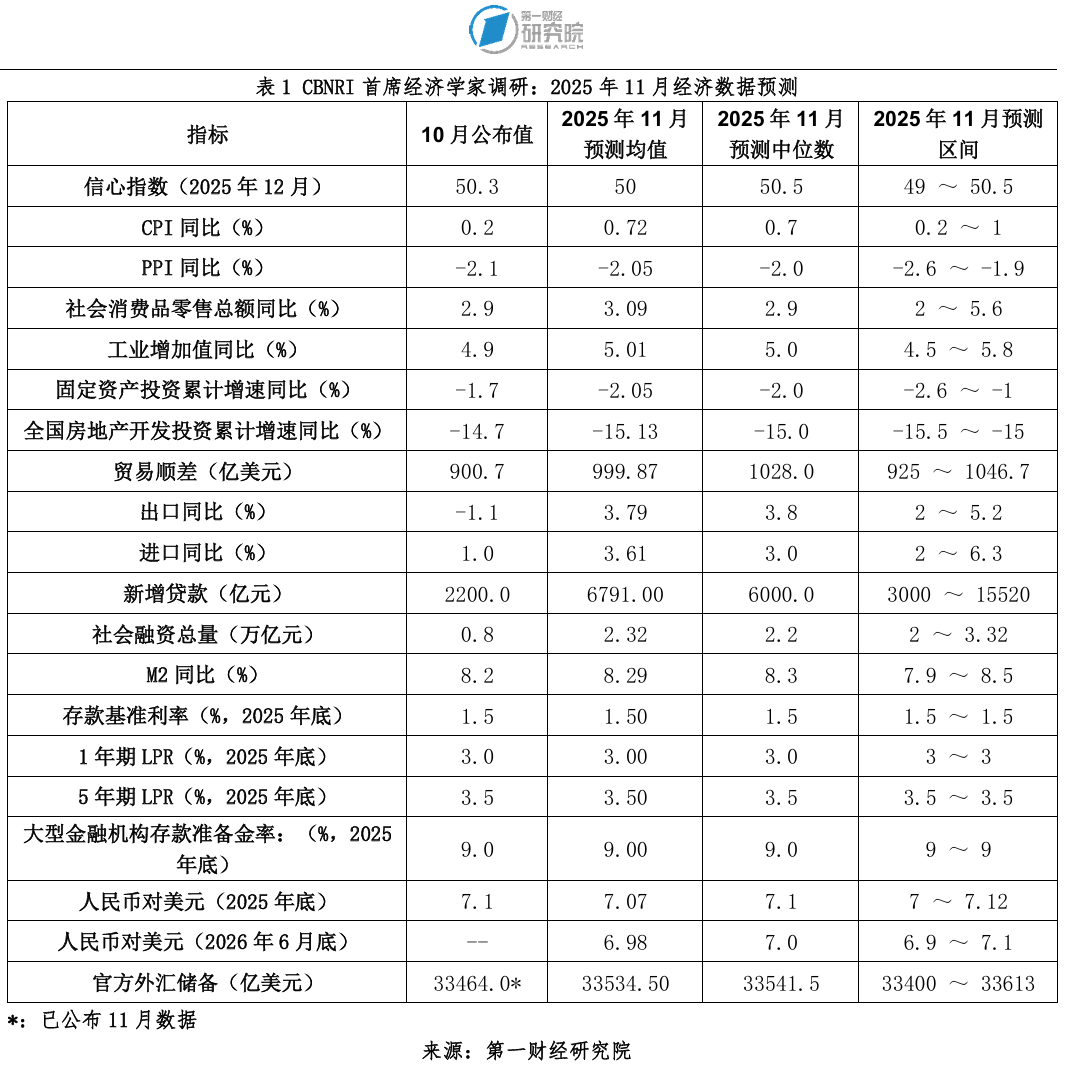
Core Viewpoint - The "First Financial Chief Economist Confidence Index" for December 2025 is at 50, slightly lower than the previous month, indicating a weak recovery in China's economy, with macro policies expected to maintain a loose tone to support the start of the "14th Five-Year Plan" [1][5][24]. Economic Indicators - The predicted Consumer Price Index (CPI) for November is 0.72%, up from 0.2% in the previous month, while the Producer Price Index (PPI) is expected to be -2.05%, slightly better than the previous month's -2.1% [7][8]. - The forecast for total retail sales of consumer goods in November is a year-on-year growth of 3.09%, an increase from 2.9% in October, driven by the "Double 11" shopping festival and a recovery in dining trends [8][9]. - Industrial added value is predicted to grow by 5.0% year-on-year in November, up from 4.9% in October, reflecting a slight recovery in manufacturing activity [9][10]. - Fixed asset investment is expected to decline by 2.1% year-on-year in November, worsening from the previous month's -1.7%, with pressures from the real estate market and manufacturing sector [10][11]. - Real estate development investment is forecasted to decrease by 15.1% year-on-year in November, indicating ongoing challenges in the sector [11][12]. Trade and Financial Data - The trade surplus for November is projected to be $999.87 billion, an increase from $900.7 billion in October, with both imports and exports expected to rise [14][15]. - New loans for November are anticipated to rebound to 6,791 billion yuan, significantly higher than the previous month's 2,200 billion yuan [15][16]. - The total social financing amount is expected to reach 2.32 trillion yuan in November, up from 0.81 trillion yuan in October [16][17]. - The M2 money supply growth rate is forecasted at 8.29%, slightly above the previous month's 8.2% [17][18]. Monetary Policy and Exchange Rates - Economists predict little change in the LPR and reserve requirement ratios in the near term, with a focus on maintaining liquidity in the market [18][19]. - The expected exchange rate for the Chinese yuan against the US dollar by the end of November is 7.07, with a potential adjustment to 6.98 by mid-next year [19][20]. Foreign Exchange Reserves - As of the end of November, China's foreign exchange reserves are reported at $33,464 billion, a slight increase from the previous month [20][21]. Policy Outlook - Future fiscal policies are expected to be more proactive, with an emphasis on increasing investment in infrastructure and social sectors to stimulate economic growth [22][24]. - The upcoming Central Economic Work Conference is anticipated to focus on the strategic significance of 2026 as the start of the "14th Five-Year Plan," emphasizing high-quality development and domestic demand [24][26].