
金属

Search documents
美欧关税战升级,欧洲经济如何应对挑战?
Sou Hu Cai Jing· 2025-08-25 09:53
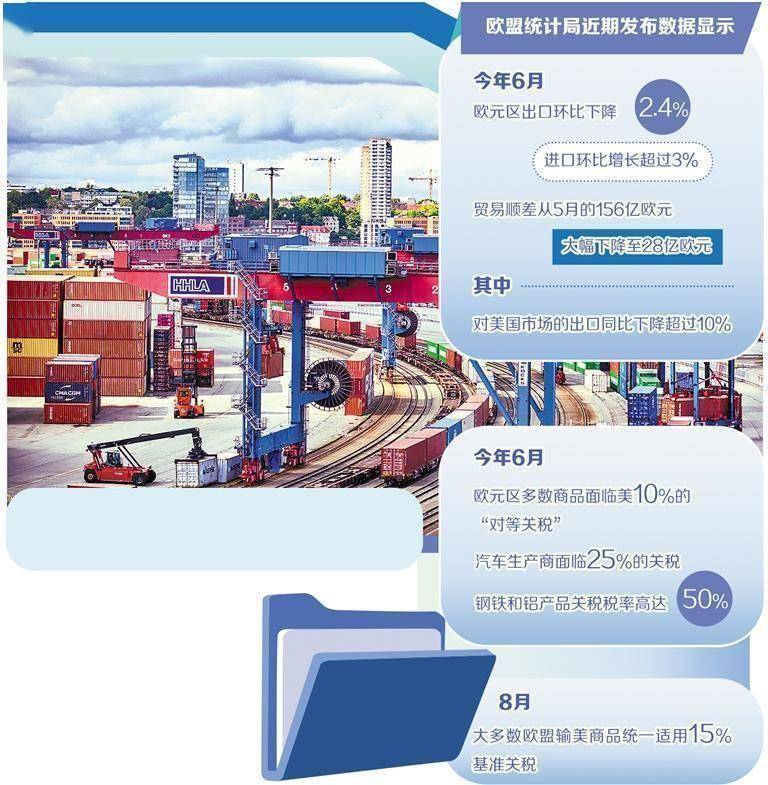
Group 1 - The recent joint statement between the US and EU indicates an agreement on trade framework, but high tariffs continue to cast a shadow over the European economy [1][3] - The US will impose tariffs of up to 15% on most EU goods, affecting key export products such as automobiles, pharmaceuticals, semiconductors, and timber [3][4] - In June, Eurozone exports fell significantly, with exports to the US dropping over 10% year-on-year, reflecting the impact of US tariff measures [3][4] Group 2 - The Eurozone's trade surplus has sharply decreased, with exports declining by 2.4% month-on-month in June while imports increased by over 3%, leading to a drop in trade surplus from €15.6 billion in May to €2.8 billion [3][4] - The automotive industry is under significant pressure due to high tariffs, with German and French car manufacturers heavily reliant on the US market [4][5] - The metal industry is also struggling, facing a 50% tariff on steel and aluminum products, resulting in reduced orders from major exporting countries like Germany and Italy [4][5] Group 3 - European companies are actively seeking strategies to cope with high tariffs, including price increases to pass costs onto consumers and expanding local production to mitigate tariff risks [4][5] - Some small and medium exporters are shifting their market focus to Southeast Asia and the Middle East to reduce dependence on the US, although this transition poses challenges [5] - The Eurozone's industrial output fell by 1.3% month-on-month in June, indicating pressure on the manufacturing sector, which could impact investment and employment in export-dependent countries like Germany and the Netherlands [5]

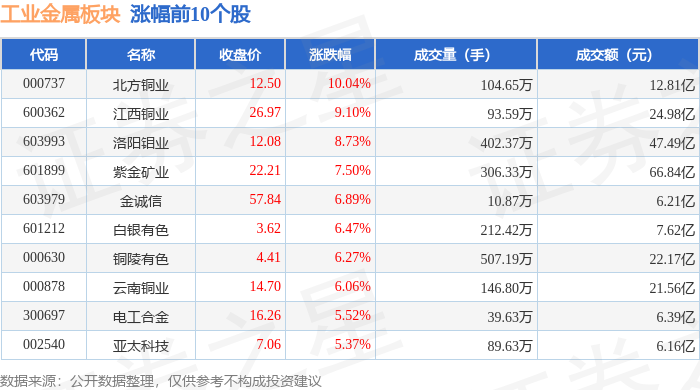
工业金属板块8月25日涨5.29%,北方铜业领涨,主力资金净流入14.67亿元
Zheng Xing Xing Ye Ri Bao· 2025-08-25 08:47
Market Performance - On August 25, the industrial metals sector rose by 5.29% compared to the previous trading day, with Northern Copper leading the gains [1] - The Shanghai Composite Index closed at 3883.56, up 1.51%, while the Shenzhen Component Index closed at 12441.07, up 2.26% [1] Individual Stock Performance - Northern Copper (000737) closed at 12.50, with a gain of 10.04% and a trading volume of 1.0465 million shares, resulting in a turnover of 1.281 billion [1] - Jiangxi Copper (600362) closed at 26.97, up 9.10%, with a trading volume of 935,900 shares and a turnover of 2.498 billion [1] - Luoyang Molybdenum (603993) closed at 12.08, gaining 8.73% with a trading volume of 4.0237 million shares, totaling a turnover of 4.749 billion [1] - Other notable performers include Yunnan Copper (000878) with a 6.06% increase and a turnover of 2.156 billion [1] Capital Flow Analysis - The industrial metals sector saw a net inflow of 1.467 billion in main funds, while speculative funds experienced a net outflow of 921 million, and retail investors had a net outflow of 546 million [2] - The capital flow for individual stocks indicates that Luoyang Molybdenum had a net inflow of 539 million from main funds, while Northern Copper experienced a net outflow of 170 million from speculative funds [3]





高频数据跟踪:生产热度整体回落,原油有色价格回升
China Post Securities· 2025-08-25 06:18
Report Summary 1. Report Industry Investment Rating No industry investment rating is provided in the report. 2. Core Viewpoints - The overall production heat has declined, with the operating rates of blast furnaces, asphalt, and PTA all decreasing, and the output of rebar decreasing, while the operating rate of tires has increased [2][32]. - The real - estate market has weakened marginally, with the transaction area of commercial housing decreasing and the land supply area increasing [2][32]. - The price trends are diverging. Crude oil, non - ferrous metals, and agricultural products have risen, while coking coal and rebar have fallen. Agricultural product prices continue the seasonal upward trend [2][32]. - Shipping indices have continued to decline, including SCFI, CCFI, and BDI [2][32]. - In the short term, focus on the implementation of a new round of growth - stabilizing stimulus policies, the recovery of the real - estate market, and the impact of international geopolitical changes [2][32]. 3. Summary by Directory 3.1 Production: The heat of blast furnaces, rebar, asphalt, and PTA has all declined, and the tire operating rate has increased - **Steel**: The coke oven capacity utilization rate increased by 0.04 pct, the blast furnace operating rate decreased by 0.23 pct, and the rebar output decreased by 5.8 tons. The inventory increased by 2.27 tons [8]. - **Petroleum Asphalt**: The operating rate decreased by 2.2 pct [8]. - **Chemical Industry**: The PX operating rate remained flat compared with the previous week, while the PTA operating rate decreased by 7.52 pct [8]. - **Automobile Tires**: The operating rate of all - steel tires increased by 1.67 pct, and that of semi - steel tires increased by 1.06 pct [9]. 3.2 Demand: The transaction of commercial housing has continued to decline, and shipping indices have continued the downward trend - **Real Estate**: The transaction area of commercial housing continued to decline, and the inventory - to - sales ratio increased. The land supply area increased, and the transaction premium rate of residential land increased [14]. - **Movie Box Office**: It decreased by 399 million yuan compared with the previous week [14]. - **Automobile**: The daily average retail sales of automobile manufacturers increased by 13,800 vehicles, and the daily average wholesale sales increased by 22,400 vehicles [17]. - **Shipping Indices**: SCFI decreased by 3.07%, CCFI decreased by 1.55%, and BDI decreased by 4.89% [20]. 3.3 Prices: Crude oil, non - ferrous metals, and agricultural products have risen, while coking coal and rebar have fallen - **Energy**: The Brent crude oil price rose by 2.85% to $67.73 per barrel, and the coking coal futures price fell by 6.7% to 1,141.5 yuan per ton [22]. - **Metals**: The LME copper, aluminum, and zinc futures prices changed by +0.37%, +0.73%, and +0.32% respectively, and the domestic rebar futures price decreased by 2.1% [23]. - **Agricultural Products**: The overall price continued the seasonal upward trend. The prices of pork, eggs, vegetables, and fruits changed by +0.25%, +1.05%, +1.89%, and - 1.30% respectively compared with the previous week [25]. 3.4 Logistics: The number of international flights has decreased, and the congestion index in first - tier cities has continued to rise - **Subway Passenger Volume**: In Beijing, it decreased, while in Shanghai, it increased [28]. - **Executed Flight Volume**: Domestic flights increased slightly, and international flights decreased [29]. - **Urban Traffic**: The peak congestion index in first - tier cities continued to rise [29]. 3.5 Summary: The overall production heat has declined, and the prices of crude oil and non - ferrous metals have risen The summary is consistent with the core viewpoints, emphasizing the changes in production, real - estate, prices, and shipping indices, and suggesting short - term focus areas [32].
关税令欧洲经济蒙上阴影 多个支柱产业首当其冲
Zhong Guo Jing Ji Wang· 2025-08-25 00:38
Group 1 - The US and EU have reached a framework agreement on trade, maintaining a 15% tariff cap on most EU goods, impacting sectors like automotive, pharmaceuticals, semiconductors, and timber [1][2] - Eurozone exports have significantly declined, with a year-on-year drop of over 10% to the US, reflecting the impact of increased tariffs [1][2] - In June, Eurozone exports fell by 2.4% month-on-month, while imports rose by over 3%, leading to a substantial decrease in trade surplus from €15.6 billion in May to €2.8 billion [1] Group 2 - The automotive industry is under severe pressure, with companies like German and French automakers heavily reliant on the US market facing uncertainty due to tariffs [3] - The metal industry is struggling with a 50% tariff on steel and aluminum, leading to reduced orders and canceled contracts for major exporting countries like Germany and Italy [3] - The wine and spirits industry is also affected, with a 15% tariff on EU imports, potentially leading to significant economic losses and increased financial burdens [3] Group 3 - European companies are responding to high tariffs by raising prices, with brands like BMW and Mercedes-Benz passing some costs onto consumers [4] - Companies are also localizing production and considering expanding manufacturing capacity in the US to mitigate tariff risks [4] - Some small and medium exporters are shifting focus to markets in Southeast Asia and the Middle East to reduce dependence on the US [5] Group 4 - The pressure from tariffs is translating into macroeconomic challenges, with Eurozone industrial output declining by 1.3% month-on-month in June, indicating manufacturing sector stress [6] - Although the Eurozone GDP showed positive growth in Q2, signs of industrial weakness are becoming more apparent, particularly for export-dependent countries like Germany and the Netherlands [6] - Economists warn that if automotive tariffs are not reduced soon, Eurozone exports may face further pressure, impacting corporate profits and overall economic growth [6]
阿布扎比上半年非石油出口增长64%
Shang Wu Bu Wang Zhan· 2025-08-23 03:13
Core Insights - Abu Dhabi's non-oil foreign trade increased by 34.7% year-on-year in the first half of 2025, with non-oil exports rising by 64% [1] - The growth trend in non-oil trade is expected to continue, with projections of 9% growth in 2024, including a 16% increase in exports [1] Trade Performance - Non-oil exports saw a significant increase of 64%, while re-exports grew by 35% and imports rose by 15% [1] - The industrial sector, particularly in chemicals, metals, and engineering, showed a notable rise in the issuance of certificates of origin, indicating an expansion of Abu Dhabi's industrial base [1] Support for SMEs - Small and medium-sized enterprises (SMEs) experienced a substantial increase in export volumes, benefiting from the support initiatives provided by the Chamber of Commerce, including business matchmaking, export training, and strategic partnerships [1]
转债投资机构行为分析手册
Tianfeng Securities· 2025-08-22 00:42
1. Report Industry Investment Rating No relevant content provided. 2. Core Viewpoints of the Report The report conducts a detailed analysis of the convertible bond investment strategies and preferences of different types of investment institutions, aiming to form a handbook for analyzing the behavior of convertible bond investment institutions. It focuses on an overview and the public fund section, considering the significant differences in investment strategies and information disclosure mechanisms between public funds and non - public funds [1][9]. 3. Summary According to Relevant Catalogs 3.1 Convertible Bond Investment Institutions and Analysis Method Overview - **Investor Structure and Proportion**: As of the end of July 2025, public funds and enterprise annuities are the "main forces" in direct convertible bond investment. Public funds hold a significant proportion, with 35.56% of the face value of Shanghai - listed convertible bonds and 33.31% of the market value of Shenzhen - listed convertible bonds. Enterprise annuities are the second - largest investment institutions, holding 18.41% of Shanghai - listed convertible bonds and 13.23% of Shenzhen - listed convertible bonds. Insurance institutions, securities self - operation also occupy important positions. Other professional institutional investors hold a relatively small proportion [10]. - **Changes in Investor Structure**: Compared with the end of 2021, the "influence" of public funds and insurance institutions has increased, while the proportion of enterprise annuities has decreased. The investment proportions of securities self - operation, private funds, and trust institutions have increased, and the proportion of general institutional investors represented by listed company shareholders has significantly decreased [13]. - **Differences in Investment Strategies**: Different types of professional institutional investors have differences in convertible bond investment restrictions, preferences, and investment strategies. Public funds generally have fewer restrictions on convertible bond ratings and focus on relative returns. Pension funds, insurance institutions, and social security funds have clear rating restrictions and focus on absolute returns [19]. - **Analysis Data Sources**: For public funds, quarterly reports can be used to analyze their convertible bond investment preferences. For other investment institutions, the top ten holders of convertible bonds disclosed in the semi - annual and annual reports of convertible bond issuers provide detailed analysis materials [20]. 3.2 What are the Characteristics of Public Funds' Convertible Bond Investment? 3.2.1 Overview of Public Funds' Convertible Bond Holdings - **Scale and Proportion Changes**: Since Q4 2023, the market value and proportion of convertible bonds held by public funds have been slightly decreasing. The number of public funds investing in convertible bonds has decreased overall, but their participation in the convertible bond market has increased [24]. - **Industry Distribution Preference**: As of Q2 2025, public funds significantly over - allocate convertible bonds in industries such as metals, chemicals, transportation, automobiles, agriculture, forestry, animal husbandry, and banking, and under - allocate those in industries such as petrochemicals, steel, construction decoration, public utilities, environmental protection, and power equipment [29]. - **Price, Valuation, and Rating Preferences**: As of the end of Q2 2025, public funds over - allocate convertible bonds in the 120 - 130 yuan range and above 150 yuan, and AA and AA - rated convertible bonds; they under - allocate other convertible bonds [29]. - **Differences in Sub - investor Structure**: Public funds account for about 30% in the overall convertible bond investor structure, but their influence varies in different industries, price ranges, and rating segments [35]. 3.2.2 Differences in Convertible Bond Holdings among Various Funds - **Differences in Convertible Bond Holdings by Fund Type**: Secondary bond funds, the main force in convertible bond allocation, have significantly reduced their convertible bond holdings since Q3 2023. Convertible bond funds and primary bond funds are important holders. The convertible bond positions of convertible bond funds have reached a historical high, while those of secondary bond funds, primary bond funds, and partial - debt hybrid funds have decreased [44][46]. - **Characteristics of Convertible Bond Funds' Holdings**: In Q2 2025, convertible bond funds increased their holdings in industries such as petrochemicals, public utilities, and communications, and decreased their holdings in upstream energy materials and mid - stream manufacturing industries. They stably over - allocate convertible bonds in the 120 - 130 yuan range and under - allocate those in the 100 - 120 yuan range [48][57]. 3.2.3 Characteristics of Convertible Bond Holdings of High - performing Funds - **Scale and Quantity of Convertible Bond Holdings**: Different high - performing funds have different scales and quantities of convertible bond holdings. For example, Fuguo Jiuli Stable Allocation has a relatively concentrated holding, while Huashang Fengli Enhancement has a large number of holdings but a small average holding per bond [73]. - **Industry, Rating, and Price Preferences**: Different high - performing funds have different preferences in terms of industry, rating, and price. For example, Fuguo Jiuli Stable Allocation prefers convertible bonds in the power equipment, banking, and pharmaceutical industries, while Huashang Fengli Enhancement prefers high - priced and manufacturing - related convertible bonds [74]. 3.3 How to Analyze Non - public Fund Convertible Bond Investments? 3.3.1 Starting from the "Top Ten Holders" of Individual Bonds - **Investor Classification**: Convertible bond investors are divided into 11 major categories and 24 sub - categories based on the names of bondholders. The top ten holders' data accounts for about 40% of the convertible bond market, and public funds, pension products, etc. frequently appear in the list [86][87]. - **Data Representativeness**: The data of the top ten holders is representative for analyzing the convertible bond investment preferences and characteristics of various investors. After excluding the "repurchase pledge special account" and "company - related institutions", the data (referred to as "top ten holders 2") can more objectively present the data conclusions [88][89]. 3.3.2 Preliminary Exploration of Non - public Fund Institutions' Convertible Bond Investments - **Industry Distribution of Convertible Bond Holdings**: As of the end of 2024, "private asset management" institutions hold more convertible bonds in the power equipment industry but less in pro - cyclical industries. "Securities self - operation" has a relatively high proportion of holdings in the steel, non - ferrous metals, and power equipment industries. "Insurance" has a relatively dispersed convertible bond portfolio [97]. - **Rating and Price Distribution of Convertible Bond Holdings**: "Private asset management" and "QFII" have a higher tolerance for low - rated convertible bonds. "Insurance" and "securities self - operation" have a relatively high proportion of AAA - rated convertible bonds. In terms of price, "private asset management" has a high proportion of convertible bonds below 100 yuan, while "insurance", "social security funds", and "QFII" mainly hold convertible bonds in the 110 - 120 yuan range [97][98].
工业金属板块8月21日跌0.35%,金田股份领跌,主力资金净流出18.3亿元
Zheng Xing Xing Ye Ri Bao· 2025-08-21 08:26
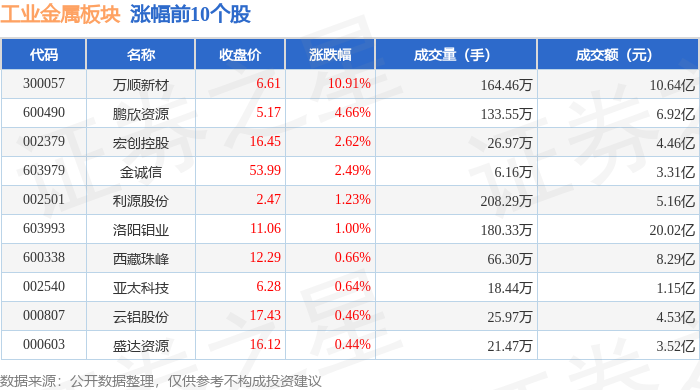
证券之星消息,8月21日工业金属板块较上一交易日下跌0.35%,金田股份领跌。当日上证指数报收于 3771.1,上涨0.13%。深证成指报收于11919.76,下跌0.06%。工业金属板块个股涨跌见下表: | 代码 | 名称 | 收盘价 | 涨跌幅 | 成交量(手) | 成交额(元) | | | --- | --- | --- | --- | --- | --- | --- | | 300057 | 万顺新材 | 6.61 | 10.91% | 164.46万 | | 10.64亿 | | 600490 | 鹏欣资源 | 5.17 | 4.66% | 133.55万 | | 6.92亿 | | 002379 | 宏创控股 | 16.45 | 2.62% | 26.97万 | | 4.46亿 | | 603979 | 金诚信 | 53.99 | 2.49% | 6.16万 | | 3.31亿 | | 002501 | 利源股份 | 2.47 | 1.23% | 208.29万 | | 5.16 Z | | 603993 | 洛阳镇水 | 11.06 | 1.00% | 180.33万 | | 20.02亿 | ...

甬金股份(603995):新建项目持续推进,公司经营平稳
GUOTAI HAITONG SECURITIES· 2025-08-21 05:16
Investment Rating - The report maintains a rating of "Accumulate" for the company [5][12]. Core Views - The company's performance in the first half of 2025 met expectations, with steady progress in new projects in Vietnam and stable overall production and sales [2][12]. - The demand for stainless steel is showing stable growth, with a year-on-year increase in apparent consumption of 2.83% in the first half of 2025 [12]. - New projects are progressing smoothly, with the Jiangsu Jingjiang project ramping up production and the Vietnam project showing significant improvement in capacity utilization [12]. Financial Summary - Total revenue for 2025 is projected at 45.708 billion yuan, reflecting a 9.2% increase from 2024 [4]. - Net profit attributable to the parent company is expected to be 828 million yuan in 2025, a 2.9% increase from 2024 [4]. - Earnings per share (EPS) for 2025 is estimated at 2.27 yuan, with a projected price-to-earnings (P/E) ratio of 10 times for valuation [12][14]. Market Data - The current stock price is 18.30 yuan, with a target price set at 22.70 yuan [5][6]. - The company has a total market capitalization of 6.691 billion yuan [6]. - The stock has traded within a range of 15.59 to 21.64 yuan over the past 52 weeks [6]. Project Progress - The company has successfully launched its titanium and battery shell material projects, which are expected to contribute to profits in 2025 [12]. - The production volume for the company's products increased by 4.29% year-on-year in the first half of 2025, with stable profit margins per ton of product [12].

宝城期货资讯早班车-20250821
Bao Cheng Qi Huo· 2025-08-21 01:49
1. Report Industry Investment Rating No relevant content provided. 2. Report's Core View - The report presents a comprehensive overview of macro - economic data, commodity investment trends, financial news, and stock market conditions. It shows a complex economic situation with various factors influencing different markets, such as central bank policies, geopolitical events, and supply - demand dynamics [1][2][11]. 3. Summary by Related Catalogs Macro Data - GDP in Q2 2025 had a year - on - year growth of 5.2%, slightly lower than the previous quarter's 5.4% but higher than the same period last year (4.7%). The manufacturing PMI in July 2025 was 49.3%, down from 49.7% in the previous month and 49.4% in the same period last year. The non - manufacturing PMI for business activities in July was 50.1%, lower than the previous month (50.5%) and similar to the same period last year (50.2%) [1]. - In July 2025, M1 had a year - on - year growth of 5.6%, up from 4.6% in the previous month and a significant improvement from - 2.6% in the same period last year. M2 grew by 8.8% year - on - year, higher than the previous month (8.3%) and the same period last year (6.3%) [1]. - The CPI in July 2025 had a year - on - year growth of 0%, down from 0.1% in the previous month and 0.5% in the same period last year. The PPI in July was - 3.6% year - on - year, the same as the previous month but lower than - 0.8% in the same period last year [1]. Commodity Investment Comprehensive - China's new LPR remained unchanged for three consecutive months, with the 1 - year LPR at 3.0% and the 5 - year and above at 3.5%. The stability is due to the unchanged 7 - day reverse repurchase rate, the pricing basis for LPR [2]. - The Fed's July meeting minutes showed that almost all policymakers supported not cutting interest rates, with only two opposing. There were differences among officials regarding inflation, employment risks, and the impact of tariffs on inflation [3]. Metals - On August 20, international precious metal futures generally rose. Policy differences within the Fed and uncertainties in the inflation outlook brought volatility to the precious metal market. The SPDR Gold Trust's (GLD) holdings decreased by 0.42% (4.01 tons) to 958.20 tons as of August 20 [4][5]. - On August 19, tin inventory increased by 85 tons to 1715 tons, zinc inventory decreased to a new low in over 1 year and 9 months (71250 tons), copper inventory reached a new high in over 2 months (156350 tons), and lead inventory decreased by 1850 tons [5]. Coal, Coke, Steel, and Minerals - In Shandong, coke prices were planned to increase on August 19. The resumption of production of Yichun Yinli led to a sharp drop in lithium carbonate futures. The US expanded the tariff list for steel and aluminum derivatives, which may have a greater impact on China's indirect exports [6]. - India's coal production in July decreased by 12.3% year - on - year, natural gas production decreased by 3.2%, and steel production increased by 12.8% [6]. Energy and Chemicals - On August 20, the main contract of US crude oil rose. The significant decline in US crude oil inventory and the expected recovery of Asian demand supported oil prices. The market's concern about the increase in Russian oil supply eased [8]. Agricultural Products - India exempted cotton import tariffs from August 19 to September 30. US exporters sold 228606 tons of soybeans to Mexico for delivery in the 2025/2026 season. Datagro estimated Brazil's 2024/25 soybean production at 1.691 billion tons and corn production at 1.269 billion tons [9]. Financial News Open Market - On August 20, the central bank conducted 616 billion yuan of 7 - day reverse repurchase operations, with a net injection of 49.75 billion yuan after 118.5 billion yuan of reverse repurchases matured [10]. Key News - China's new LPR remained unchanged for three months. It is expected that the central bank may implement a new round of interest rate and reserve requirement ratio cuts in early Q4, which may drive down LPR [11]. - The US Treasury Secretary was satisfied with the current tariff level on China. The Ministry of Foreign Affairs hoped that the US would work with China to achieve positive results in economic and trade consultations [11]. Bond Market - The stock market's rebound in the afternoon suppressed the bond market. Yields of major interest - rate bonds in the inter - bank market generally rose by 1 - 2bp, and most Treasury bond futures closed down. The central bank's increased reverse repurchase operations eased the liquidity tightness [16]. Foreign Exchange Market - The on - shore RMB closed at 7.1793 against the US dollar at 16:30, and the central parity rate was 7.1384. The US dollar index fell 0.03% to 98.25 in New York trading [21]. Research Report Highlights - Guosheng Fixed Income believed that the "anti - involution" market could still be expected. It suggested investors pay attention to certain convertible bonds such as Wanfu Convertible Bond and Tong 22 Convertible Bond [22][23]. - CITIC Securities recommended the credit sector with "defensive" attributes, especially AA - and above rated city and rural commercial bank perpetual and subordinated bonds [23]. Stock Market - On Wednesday, the A - share market rebounded strongly, with the Shanghai Composite Index rising 1.04% to 3766.21 points and the Shenzhen Component Index rising 0.89%. The semiconductor industry chain led the rise, while some concepts such as stock trading software and brain - computer interface adjusted [26]. - The Hong Kong Hang Seng Index rose 0.17% to 25165.94 points. The securities sector has performed well since August, with the industry index rising over 7% and 8 stocks rising over 10% [26]. - As the A - share semi - annual report disclosure entered the intensive period, over 140 companies announced semi - annual dividend plans, with a total planned dividend amount exceeding 100 billion yuan [27].
中原期货晨会纪要-20250821
Zhong Yuan Qi Huo· 2025-08-21 00:40
Report Industry Investment Rating No relevant content provided. Core Viewpoints of the Report - The market shows complex trends across various sectors including agriculture, energy - chemical, industrial metals, and options - finance. Different factors such as policies, supply - demand relationships, and international events influence the prices and trading strategies of different products [7][11][15]. Summary by Relevant Catalogs 1. Macro News - The Ministry of Finance and the State Taxation Administration announced the exemption of personal income tax on child - rearing subsidies starting from January 1, 2025 [7]. - China's new - period LPR remained unchanged for three consecutive months, with the 1 - year LPR at 3.0% and the over - 5 - year LPR at 3.5%, in line with market expectations [7]. - The Fed's July meeting minutes revealed that almost all policymakers supported not cutting interest rates, with only two opposing. There were disagreements on inflation, employment risks, and the impact of tariffs on inflation [7]. - Trump called on Fed理事Cook to resign, increasing pressure on the Fed. The FHFA director accused Cook of mortgage fraud [8]. - President Xi Jinping emphasized the importance of stability, development, ecology, and border - strengthening in Tibet and the construction of major projects [8]. - Premier Li Qiang stressed promoting the upgrading of the biomedical industry [8]. - The Ministry of Commerce held a round - table meeting with foreign - funded enterprises in the Pearl River Delta [8]. - The Financial Regulatory Administration plans to introduce the "Administrative Measures for Commercial Bank Merger and Acquisition Loans" to boost industrial transformation [9]. - In July, the comprehensive inventory coefficient of automobile dealers was 1.35, down 4.9% month - on - month and 10% year - on - year, with inventory below the warning line but above the reasonable range [9]. 2. Morning Meeting Views on Major Varieties 2.1 Agricultural Products - Sugar: On August 20, the sugar main contract closed at 5676 yuan/ton, showing a narrow - range oscillation. Brazil's production decline provided support, but concentrated imports pressured the spot market. The domestic inventory pressure is light, but the de - stocking process is slow. The price is expected to oscillate, with key support at 5650 yuan [11]. - Corn: On August 20, the corn main contract closed at 2170 yuan/ton, breaking through the previous support at 2180 yuan. New grain supply pressure and import increases affected the market. Feed consumption was suppressed, but deep - processing profits improved. A bearish operation is recommended, with new support at around 2140 yuan [11]. - Live Pigs: The national live - pig price was stable. Supply - side resistance to price drops and improved demand due to cooler weather led to a stable - to - rising price in the short - term. However, the futures market showed a bearish trend [11]. - Eggs: The national egg spot price was stable. High egg - laying hen inventory, large cold - storage stocks, and increased small - sized egg supply weakened the price increase momentum. A strategy of shorting on rebounds and inter - month arbitrage is recommended [11]. - Cotton: The international cotton market has sufficient supply. In the domestic market, the approaching new - flower listing may increase supply, while the demand in the cotton yarn market is improving. A wait - and - see strategy is recommended as the price showed a weak oscillation [11][13]. 2.2 Energy - Chemical Products - Urea: The domestic urea price increased significantly, but downstream follow - up enthusiasm weakened. The industry's daily output was 19.52 tons, and inventories were rising. The demand from compound fertilizer enterprises is increasing, but the impact of environmental policies and high finished - product inventory need to be monitored. Pay attention to India's tender and export policies [15]. - Caustic Soda: The price of caustic soda in Shandong showed an upward trend. With the approaching peak demand season, a bullish strategy on dips for the 2511 contract is recommended [15]. - Coking Coal: The spot prices of coking coal and coke showed some fluctuations. The steel - coke game continued, and the high iron - water output provided support. The prices of coking coal and coke are expected to oscillate [16]. 2.3 Industrial Metals - Copper and Aluminum: The copper price continued to oscillate due to a lack of new macro - drivers and increased inventory. The aluminum price is expected to adjust at a high level, waiting for the demand performance in the peak season [18][20]. - Alumina: The supply of alumina increased, and the demand was relatively stable. The spot price was weak, and the 2601 contract was running weakly. Attention should be paid to bauxite supply disruptions [20]. - Rebar and Hot - Rolled Coil: The night - session prices of rebar and hot - rolled coil increased. The spot market trading was average, and inventory data was mixed. Steel prices are expected to stabilize in the short - term [20]. - Ferroalloys: The prices of ferroalloys showed a downward trend with a slowdown in decline. The market is expected to continue wide - range oscillations, and risk control is recommended for hedging and speculation [20]. - Lithium Carbonate: The price of lithium carbonate dropped sharply, breaking through the key support level. Although cost support increased, supply concerns were alleviated. A wait - and - see strategy is recommended, focusing on the implementation of production - cut policies in Jiangxi [20][22]. 2.4 Options - Finance - Options: On August 20, the A - share market rose, and the trading volume of stock - index options increased. Different options showed various changes in PCR and implied volatility. Trend investors can focus on inter - variety arbitrage, and volatility investors can short volatility [24]. - Stock Indices: The A - share market showed a volatile trend. With the Shanghai Composite Index reaching a 10 - year high, investors' sentiment fluctuated. Different investment strategies are recommended for different types of investors, and a bullish view on the market is maintained [25][26][27].