
焦炭

Search documents
焦炭板块1月16日跌2.72%,美锦能源领跌,主力资金净流出1.66亿元
Zheng Xing Xing Ye Ri Bao· 2026-01-16 09:00
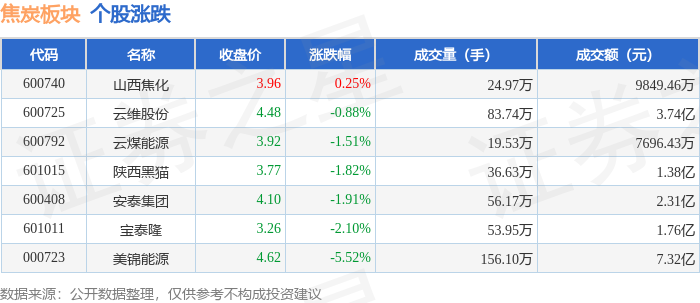
Core Viewpoint - The coking coal sector experienced a decline of 2.72% on January 16, with Meijin Energy leading the drop. The Shanghai Composite Index closed at 4101.91, down 0.26%, while the Shenzhen Component Index closed at 14281.08, down 0.18% [1]. Group 1: Market Performance - The coking coal sector saw a significant drop, with Meijin Energy falling by 5.52% to a closing price of 4.62 [1]. - Other notable declines included An Tai Group down 1.91% to 4.10, and Shaanxi Black Cat down 1.82% to 3.77 [1]. - The total trading volume for the coking coal sector was substantial, with Meijin Energy alone accounting for a trading volume of 156.10 million shares [1]. Group 2: Capital Flow - The coking coal sector experienced a net outflow of 166 million yuan from main funds, while retail investors saw a net inflow of 114 million yuan [1]. - Among individual stocks, Meijin Energy had the highest net outflow from main funds at 93.13 million yuan, representing a 12.73% decrease [2]. - Retail investors showed a strong interest in Shaanxi Black Cat, with a net inflow of 1.84 million yuan, despite the stock's overall decline [2].


山西美锦能源股份有限公司 2025年度业绩预告
Zheng Quan Ri Bao· 2026-01-15 23:04
Group 1 - The company expects a net profit to be negative for the fiscal year 2025, covering the period from January 1, 2025, to December 31, 2025 [2][3] - The company has communicated with its accounting firm regarding the performance forecast, and there are currently no discrepancies in the forecast [3] - The primary reason for the expected loss is the downward trend in coal and coke prices throughout the year, which has pressured the gross profit margin of the company's main products [4] Group 2 - The company plans to closely monitor macroeconomic trends and industry market dynamics while continuing to enhance operational efficiency and risk resilience to ensure long-term sustainable development [4]
美锦能源:预计2025年度净利润亏损8.5亿元~12.5亿元
Mei Ri Jing Ji Xin Wen· 2026-01-15 10:36
每经头条(nbdtoutiao)——不到20万元,就能买特斯拉了?"廉价版"Model 3或进入中国市场,续航里 程480公里!关于自动驾驶,美国市场也有大调整 (记者 曾健辉) 每经AI快讯,美锦能源1月15日晚间发布业绩预告,预计2025年归属于上市公司股东的净利润亏损8.5亿 元~12.5亿元。基本每股收益亏损0.19元~0.28元元。上年同期归属于上市公司股东的净利润亏损约11.43 亿元。基本每股收益亏损0.26元元。业绩变动主要原因是,本报告期公司出现亏损,主要系受市场环境 影响,煤炭、焦炭价格全年整体呈下行态势,导致公司主要产品毛利率持续承压。公司将密切关注宏观 经济走势及行业市场动态,稳健开展生产经营,同时持续深化精细化管理,提升运营效率与抗风险能 力,保障公司长期可持续发展。 ...
美锦能源:预计2025年净利润亏损8.5亿元—12.5亿元
Zheng Quan Shi Bao Wang· 2026-01-15 10:36
人民财讯1月15日电,美锦能源(000723)1月15日发布业绩预告,预计2025年净利润亏损8.5亿元—12.5 亿元,上年同期亏损11.43亿元。报告期内,受市场环境影响,煤炭、焦炭价格全年整体呈下行态势, 导致公司主要产品毛利率持续承压。 ...
美锦能源:2025年预计亏损8.5亿-12.5亿元
Xin Lang Cai Jing· 2026-01-15 10:27
美锦能源公告称,预计2025年1月1日至12月31日归属于上市公司股东的净利润亏损8.5亿元-12.5亿元, 上年同期亏损11.43亿元;扣除非经常性损益后的净利润亏损8.85亿元-12.85亿元,上年同期亏损10.93亿 元;基本每股收益亏损0.19元/股–0.28元/股,上年同期亏损0.26元/股。本期业绩亏损主要受市场环境影 响,煤炭、焦炭价格全年下行,产品毛利率承压。 ...
《黑色》日报-20260115
Guang Fa Qi Huo· 2026-01-15 01:58
1. Report Industry Investment Ratings - No industry investment ratings are provided in the reports. 2. Core Views Steel Industry - Steel exports are expected to remain high due to low valuations and some export - grabbing factors. Before the Spring Festival, the domestic market is weak, and prices have fully priced in weak demand. The overall steel market is expected to fluctuate within a range in January. The reference range for the May contract of rebar is 3050 - 3250 yuan; for hot - rolled coils, it is 3200 - 3350 yuan [1]. Iron Ore Industry - The iron ore market will gradually transition to a situation of weak supply and demand. Prices are expected to remain high and volatile, with high inventory suppressing the upside and steel mill restocking expectations and molten iron production recovery providing support. Short - term prices are expected to fluctuate widely, and the trading strategy is range - bound operation, with a reference range of 770 - 830 [4]. Coke and Coking Coal Industry - For coke, the futures market has fallen in advance, and the spot price decline depends on the coking coal price drop. After the fourth round of spot price cuts, some coke enterprises resist price cuts and limit production to protect prices. The recommended strategy is to go long on the dips and consider the arbitrage of long coking coal and short coke. For coking coal, the pre - Spring Festival restocking demand drives the market. The strategy is also to go long on the dips and consider the same arbitrage [6]. Ferrosilicon and Ferromanganese Industry - For ferrosilicon, supply is stable, and production has reached a historically low level. Demand has some support, and costs also provide support. It is recommended to go long on the dips, with a reference support level of around 5500. For ferromanganese, the supply is at a historically neutral - low level, and demand has support. Manganese ore prices support the ferromanganese price. It is recommended to go long on the dips, with a reference support level of around 5800 [7]. 3. Summary by Directory Steel Industry Prices and Spreads - Rebar and hot - rolled coil spot and futures prices show different changes. For example, rebar 01 contract increased by 10 yuan, while hot - rolled coil 01 contract decreased by 49 yuan [1]. Cost and Profit - Steel billet and slab prices remained unchanged. The cost of steelmaking in Jiangsu increased, and the profit of hot - rolled coils in different regions decreased [1]. Supply - The daily average molten iron output increased by 1.6 to 229.0, a 0.7% increase. The output of five major steel products increased by 3.4 to 818.6, a 0.4% increase [1]. Demand - The total apparent demand of steel has recovered. The export of steel remains high [1]. Inventory - The inventory of five major steel products increased by 21.8 to 1253.9, a 1.8% increase. Rebar inventory increased, while hot - rolled coil inventory decreased [1]. Iron Ore Industry Prices and Spreads - The basis of some iron ore varieties decreased, and the 5 - 9 and 1 - 5 spreads increased [4]. Supply - The 45 - port arrival volume increased by 164.0 to 2920.4, a 5.9% increase, while the global shipment volume decreased by 32.8 to 3213.7, a 1.0% decrease [4]. Demand - The daily average molten iron output of 247 steel mills increased by 2.1 to 229.5, a 0.9% increase. The 45 - port daily average ore - unloading volume decreased by 1.9 to 323.3, a 0.6% decrease [4]. Inventory - The 45 - port inventory increased by 304.4 to 16275.26, a 1.9% increase, and the inventory of 247 steel mills' imported ore increased by 43.0 to 8989.6, a 0.5% increase [4]. Coke and Coking Coal Industry Prices and Spreads - Coke and coking coal futures prices changed slightly. For example, the coke 05 contract decreased by 7 yuan, and the coking coal 05 contract increased by 6 yuan [6]. Supply - Coke production increased slightly, and coking coal production showed a small - scale recovery [6]. Demand - The molten iron output of 247 steel mills increased, and the demand for coke and coking coal increased [6]. Inventory - The overall inventory of coke and coking coal increased slightly, with different inventory changes in different sectors [6]. Ferrosilicon and Ferromanganese Industry Prices and Spreads - Ferrosilicon and ferromanganese futures prices were relatively stable. The prices of some spot products remained unchanged [7]. Cost and Profit - The production cost of ferrosilicon in some regions increased slightly, and the production profit decreased [7]. Supply - Ferrosilicon production was basically flat, and ferromanganese production decreased slightly [7]. Demand - The demand for ferrosilicon and ferromanganese from the steelmaking industry had some support due to the recovery of molten iron production [7]. Inventory - The inventory of ferrosilicon in 60 sample enterprises increased, and the inventory of 63 sample enterprises of ferromanganese decreased [7].
焦炭板块1月14日跌0.35%,安泰集团领跌,主力资金净流出9552.63万元
Zheng Xing Xing Ye Ri Bao· 2026-01-14 08:58
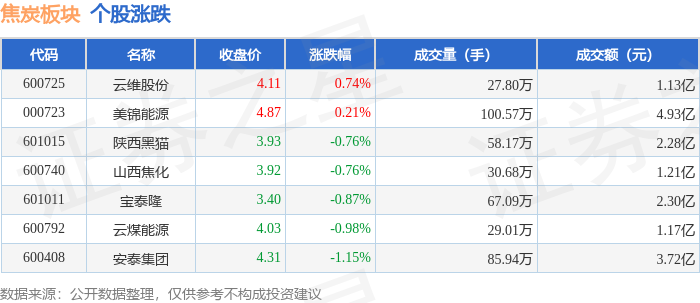
从资金流向上来看,当日焦炭板块主力资金净流出9552.63万元,游资资金净流出2273.23万元,散户资金 净流入1.18亿元。焦炭板块个股资金流向见下表: | 代码 | 名称 | 主力净流入(元) | 主力净占比 游资净流入 (元) | | 游资净占比 散户净流入 (元) | | 散户净占比 | | --- | --- | --- | --- | --- | --- | --- | --- | | 000723 美锦能源 | | > 935.56万 | 1.90% | -1319.60万 | -2.68% | 384.05万 | 0.78% | | 600725 云维股份 | | -205.24万 | -1.81% | 28.25万 | 0.25% | 176.99万 | 1.56% | | 600792 云煤能源 | | -413.66万 | -3.52% | 716.86万 | 1 6.11% | -303.20万 | -2.58% | | 600740 山西焦化 | | -697.40万 | -5.78% | 169.78万 | 1.41% | 527.61万 | 4.37% | | 601015 陕 ...

《黑色》日报-20260114
Guang Fa Qi Huo· 2026-01-14 01:30
1. Report Industry Investment Ratings - There is no information about industry investment ratings in the provided reports. 2. Core Views of the Reports Steel Industry - Yesterday, the steel futures market weakened with market sentiment, while the spot market remained stable. The industry showed little change, with a significant seasonal decline in apparent demand, mainly in rebar. Inventory is about to enter the off - season accumulation phase. Rebar's inventory pressure will increase in the future, while hot - rolled coil's inventory is decreasing. Before the Spring Festival, real - world demand is weak, but prices have already factored in the weak demand. The price of steel is pushed up by the strengthening of raw material prices recently, and it is expected to maintain a range - bound trend in January. The reference range for rebar May contract is 3050 - 3250 yuan, and for hot - rolled coil is 3200 - 3350 yuan [1]. Iron Ore Industry - The iron ore futures market was in high - level oscillation yesterday with a slight increase in positions. The spot market was relatively strong, but downstream steel mills still purchased on demand. In terms of fundamentals, the global iron ore shipment volume declined this period, and the shipment center will gradually decline after the end of the peak shipment season. The impact of weather on shipments is expected to be limited. On the demand side, the influence of steel mill maintenance on SMM increased slightly, and there is still room for the resumption of hot - metal production. The average hot - metal production in January is expected to be around 2.3 million tons. The export orders of finished products increased significantly, and demand is still supported. The port inventory increased significantly. In the future, iron ore will gradually transition to a situation of weak supply and demand. The price is suppressed by high inventory above and supported by steel mill restocking expectations and hot - metal production resumption below. It is expected to maintain high - level oscillation. The short - term price is expected to fluctuate in a wide range, and the trading strategy is mainly range - bound operation, with a reference range of 770 - 830 [4]. Coke Industry - Yesterday, both coke and coking coal futures showed a trend of rising and then falling. In the spot market, the fourth round of coke price cuts was implemented on January 1st, and the port price rebounded with the futures. The coke market is currently weakly stable. On the supply side, the adjustment of coke prices lags behind coking coal, and the coking profit is under pressure, but the start - up rate is increasing. On the demand side, the steel mill's losses and maintenance decreased, the hot - metal production increased steadily, and the steel price rebounded at a low level. In terms of inventory, the overall inventory of coke and coking coal increased slightly at a medium level. In terms of policy, ensuring the long - term coal supply for power plants is still the main tone. The trading strategy is to go long on dips unilaterally and consider the arbitrage strategy of going long on coking coal and short on coke [6]. Ferrosilicon and Ferromanganese Industry - Yesterday, the ferrosilicon futures contract was in oscillation with a slight decline, and the 03 contract continued to reduce positions. The spot price fluctuated within a limited range, and downstream buyers remained on the sidelines. In terms of fundamentals, the ferrosilicon production was basically flat, reaching a historically low level. The hot - metal production continued to resume, and there is still some support for demand. The factory inventory decreased, and the cost was supported by the strong price of manganese ore. It is recommended to go long on dips, with a support level of around 5500. The ferromanganese futures contract was also in oscillation, with supply at a historically neutral - low level. The hot - metal production continued to resume, and there is support for demand. The manganese ore price is expected to be supported by factors such as port inventory and shipping issues. It is expected that the price will fluctuate widely, and it is advisable to go long on dips, with a support level of around 5800 [7]. 3. Summary by Relevant Catalogs Steel Industry Steel Prices and Spreads - Rebar spot prices in East China, North China, and South China were 3300, 3210, and 3280 respectively, with changes of - 10, 10, and - 10 compared to the previous day. The 05, 10, and 01 contracts of rebar were 3158, 3202, and 3134 respectively, with changes of 14, 6, and 45. - Hot - rolled coil spot prices in East China, North China, and South China were 3280, 3190, and 3280 respectively, with changes of 0, 0, and - 10. The 05, 10, and 01 contracts of hot - rolled coil were 3303, 3321, and 3280 respectively, with changes of 9, 3, and 25 [1]. Cost and Profit - The billet price was 2970 with no change, and the slab price was 3730 with no change. The cost of Jiangsu electric - arc furnace rebar was 3232, up 16; the cost of Jiangsu converter rebar was 3223, up 2. The profit of East China hot - rolled coil was - 27, up 13; the profit of North China rebar was - 107, up 3; the profit of South China rebar was 193, up 3 [1]. Supply - The daily average hot - metal production was 229.0, up 1.6 (0.7%) from the previous day. The production of five major steel products was 818.6, up 3.4 (0.4%); rebar production was 191.0, up 2.8 (1.5%); hot - rolled coil production was 305.5, up 1.0 (0.3%) [1]. Inventory - The inventory of five major steel products was 1253.9, up 21.8 (1.8%); rebar inventory was 438.1, up 16.1 (3.8%); hot - rolled coil inventory was 368.1, down 2.8 (- 0.8%) [1]. Transaction and Demand - The building materials trading volume was 8.4, down 2.2 (- 20.9%); the apparent consumption of five major steel products was 796.8, down 44.2 (- 5.3%); the apparent consumption of rebar was 175.0, down 25.5 (- 12.7%); the apparent consumption of hot - rolled coil was 308.3, down 2.4 (- 0.8%) [1]. Iron Ore Industry Iron Ore - Related Prices and Spreads - The warehouse - receipt costs of Karara fines, PB fines, Brazilian mix fines, and Jinbuba fines were 878.4, 885.3, 884.1, and 922.0 respectively, with changes of - 13.1 (- 1.5%), - 2.2 (- 0.2%), - 2.2 (- 0.2%), and - 2.2 (- 0.2%) compared to the previous day. The 05 - contract basis of Karara fines, PB fines, Brazilian mix fines, and Jinbuba fines were 58.9, 0.8, 62.5, and 102.5 respectively, with changes of - 10.1 (- 14.6%), 65.0 (1.2%), 0.8 (1.4%), and 0.8 (0.8%). The 5 - 9 spread was 21.5, up 1.0 (4.9%); the 1 - 5 spread was - 74.7, down 31.0 [4]. Supply - The 45 - port arrival volume (weekly) was 2920.4, up 164.0 (5.9%); the global shipment volume (weekly) was 3213.7, down 32.8 (- 1.0%); the national monthly import volume was 11054.0, down 76.9 (- 0.7%) [4]. Demand - The daily average hot - metal production of 247 steel mills (weekly) was 227.4, up 2.1 (0.9%); the 45 - port daily average ore - removal volume (weekly) was 325.2, down 1.9 (- 0.6%); the national monthly pig - iron production was 6234.3, down 320.6 (- 4.9%); the national monthly crude - steel production was 6987.1, down 212.6 (- 3.0%) [4]. Inventory Change - The 45 - port inventory (weekly) was 16275.26, up 304.4 (1.9%); the imported ore inventory of 247 steel mills (weekly) was 8989.6, up 43.0 (0.5%); the inventory - available days of 64 steel mills (weekly) was 19.0, down 1.0 (- 5.0%) [4]. Coke Industry Coke - Related Prices and Spreads - The price of Shanxi quasi - first - grade wet - quenched coke (warehouse - receipt) was 2224, up 13; the price of Rizhao Port quasi - first - grade wet - quenched coke (warehouse - receipt) was 1745, up 22. The coke 05, 09 contracts were 1745, 1824 respectively, with changes of - 25 (- 1.4%) and - 20 (- 1.1%). The 05 - 09 spread was - 79, down 5 [6]. Coking Coal - Related Prices and Spreads - The price of Shanxi medium - sulfur primary coking coal (warehouse - receipt) was 1260 with no change; the price of Mongolian No. 5 raw coal (warehouse - receipt) was 1259, up 24 (1.9%). The coking coal 05, 09 contracts were 1191, 1268 respectively, with changes of - 47 (- 3.8%) and - 43 (- 3.2%). The JM05 - JM09 spread was - 77, down 5 [6]. Supply - The daily average production of all - sample coking plants (weekly) was 62.7, up 0.9 (1.4%); the daily average production of 247 steel mills was 46.9, up 0.1 (0.1%); the raw - coal production was 853.4, down 2.7 (- 0.3%); the clean - coal production was 438.2, down 0.6 (- 0.1%) [6]. Demand - The hot - metal production of 247 steel mills (weekly) was 229.5, up 2.1 (0.9%); the daily average production of all - sample coking plants was 63.6, up 0.9 (1.4%); the daily average production of 247 steel mills was 46.9, up 0.1 (0.1%) [6]. Inventory Change - The total coke inventory was 915.7, up 0.2 (0.0%); the coke inventory of all - sample coking plants was 86.1, down 5.5 (- 6.0%); the coke inventory of 247 steel mills was 645.7, up 1.7 (0.3%); the coking - coal inventory of all - sample coking plants was 1071.7, up 12.0 (1.2%); the coking - coal inventory of 247 steel mills was 797.7, down 4.5 (- 0.6%); the port inventory was 299.8, down 1.5 (- 0.5%) [6]. Ferrosilicon and Ferromanganese Industry Spot Prices and Spreads - The closing price of the ferrosilicon main contract was 5682.0, down 16.0 (- 0.3%); the closing price of the ferromanganese main contract was 5916.0, down 14.0 (- 0.2%). The spot prices of 72% FeSi in Inner Mongolia, Qinghai, Ningxia, and Gansu were 5350.0, 5300.0, 5320.0, and 5300.0 respectively, with no changes. The spot prices of FeMn65Si17 in Inner Mongolia, Guangxi, Ningxia, and Guizhou were 5750.0, 5850.0, 5650.0, and 5800.0 respectively, with increases of 50.0 (0.9%), 50.0 (0.9%), 0.0 (0.0%), and 50.0 (0.9%) [7]. Cost and Profit - The production cost of ferrosilicon in Inner Mongolia was 5882.9, up 38.1 (0.7%); the production cost in Guangxi was 6236.3 with no change; the production cost in Qinghai was 5831.0 with no change; the production cost in Ningxia was 5433.0 with no change. The production profit of ferrosilicon in Inner Mongolia was - 132.9, up 11.9; the production profit in Ningxia was - 113.0 with no change [7]. Supply - The weekly production of ferrosilicon was 0.0, up 0.2 (0.2%); the weekly production of ferromanganese was 19.1, down 0.3 (- 1.4%). The operating rate of ferrosilicon production enterprises (weekly) was 29.6, up 0.1 (0.3%); the operating rate of ferromanganese was 36.8, down 0.1 (- 0.2%) [7]. Demand - The weekly demand for ferrosilicon (estimated by Steel Union) was 1.9, up 0.0 (0.1%); the weekly demand for ferromanganese (estimated by Steel Union) was 11.6, up 0.1 (0.7%). The daily average hot - metal production of 247 steel mills (weekly) was 229.5, up 2.1 (0.9%); the blast - furnace operating rate (weekly) was 79.3, up 0.4 (0.5%); the production of five major steel products (weekly) was 818.6, up 3.4 (0.4%) [7]. Inventory Change - The inventory of 60 sample ferrosilicon enterprises (weekly) was 6.9, up 0.5 (7.1%); the inventory of 63 sample ferromanganese enterprises (weekly) was 38.3, down 1.1 (- 2.8%). The average available days of ferrosilicon for downstream users (monthly) was 15.4, down 0.4 (- 2.5%); the average available days of ferromanganese inventory (monthly) was 16, up 0.1 (0.9%) [7].
焦炭板块1月12日涨0.45%,宝泰隆领涨,主力资金净流出3742.98万元
Zheng Xing Xing Ye Ri Bao· 2026-01-12 09:10
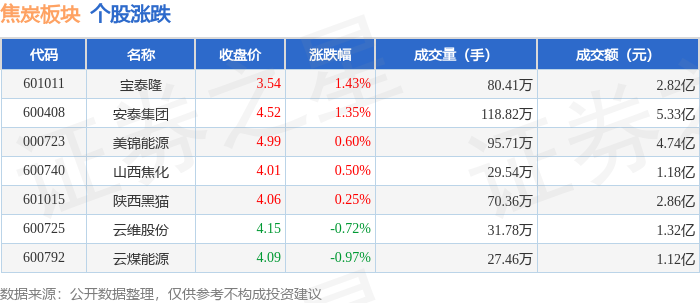
Core Insights - The coke sector experienced a 0.45% increase on January 12, with Baotailong leading the gains. The Shanghai Composite Index closed at 4165.29, up 1.09%, while the Shenzhen Component Index closed at 14366.91, up 1.75% [1] Group 1: Market Performance - The closing prices and percentage changes for key coke stocks are as follows: Baotailong at 3.54 (+1.43%), Antai Group at 4.52 (+1.35%), Meijin Energy at 4.99 (+0.60%), Shanxi Coking at 4.01 (+0.50%), Shaanxi Black Cat at 4.06 (+0.25%), Yunwei Co. at 4.15 (-0.72%), and Yunmei Energy at 4.09 (-0.97%) [1] - The total trading volume for Baotailong was 804,100 shares, while Antai Group had a volume of 1,188,200 shares, and Meijin Energy had 957,100 shares traded [1] Group 2: Capital Flow - The coke sector saw a net outflow of 37.43 million yuan from institutional investors and 62.90 million yuan from retail investors, while there was a net inflow of 100 million yuan from individual investors [1] - Specific capital flows for individual stocks indicate that Shaanxi Black Cat had a net inflow of 3.10 million yuan from institutional investors, while Shanxi Coking experienced a net outflow of 1.06 million yuan from retail investors [2]


广发期货日报-20260112
Guang Fa Qi Huo· 2026-01-12 07:37
1. Report Industry Investment Ratings No information about industry investment ratings is provided in the reports. 2. Core Views Steel Industry - The current demand for steel is weak, and prices have fully priced in the weak demand. Before the holiday, attention should be paid to the impact of policies on the expected demand for steel. In December, steel prices fluctuated with the rhythm of raw material prices and maintained a sideways trend. With significant steel production cuts, the downward driving force is not strong, but the weak demand expectation for the May contract restricts the upward price space. The upward elasticity depends on changes in the raw material supply side. Overall, it is expected to fluctuate within a range in January. The reference range for the May contract of rebar is 3050 - 3250 yuan, and for hot - rolled coils is 3200 - 3350 yuan [1]. Iron Ore Industry - The fundamental pattern of iron ore has shifted to a situation of weak supply and demand. The price ceiling is suppressed by high inventories, and there is support from the expected restocking of steel mills below. In terms of supply, the global iron ore shipment volume decreased this period, and the mine's fiscal year impulse is basically over. Future focus should be on the weather in the Southern Hemisphere. On the demand side, the hot - metal production continued to resume, and the resumption speed accelerated. The iron ore inventory in ports increased significantly this week, and it is expected to continue to accumulate in the short term. In the future, iron ore will gradually transition from a situation of loose supply - demand to weak supply - demand. During the off - season, attention should be paid to macro - sentiment and policy expectations. It is expected that iron ore prices will fluctuate widely in the short term [4]. Coke and Coking Coal Industry - For coking coal, last week, the coking coal futures fluctuated upward. The spot prices of Shanxi increased more than decreased, and the Mongolian coal quotes rebounded following the futures. The supply side has entered the resumption stage, with improved shipments but still inventory accumulation. The demand side has seen a decrease in steel mill losses and an increase in hot - metal production, and the restocking demand has improved. For coke, last week, the coke futures also fluctuated upward. After the fourth round of price cuts on January 1st, the coke market is currently weakly stable. The supply side has a lag in coke price adjustment compared to coking coal, with pressured coking profits and increased production starts. The demand side has seen an increase in hot - metal production and a rebound in steel prices. In terms of inventory, the overall inventory has slightly increased. For both, the one - sided strategy suggests going long on dips, and the arbitrage strategy is to go long on coking coal and short on coke [6]. Ferrosilicon and Ferromanganese Industry - For ferrosilicon, the supply - demand situation has marginally improved, and there is support from the cost side. The supply is at a relatively low level in the same period of history, and the production in Inner Mongolia is stable with new capacity put into operation at the end of last year, so there is still room for short - term production growth. The demand for steelmaking has support, and the demand for ferrosilicon from the metal magnesium industry is also strong. It is expected that the price will fluctuate within the range of 5500 - 6200 yuan, and short - term attention should be paid to macro, policy expectations, and cost - side changes. For ferromanganese, it is in a state of self - oversupply but overall balance of manganese elements. The manganese ore provides support for the price, and there is also support from off - season demand. It is expected that the price will fluctuate widely, and the strategy suggests range - bound operations with a reference range of 5800 - 6300 yuan [7]. 3. Summary by Relevant Catalogs Steel Industry Steel Prices and Spreads - Rebar and hot - rolled coil prices in various regions and contract prices all decreased compared to the previous day. For example, the spot price of rebar in East China decreased from 3320 yuan to 3290 yuan, and the 05 - contract price of hot - rolled coils decreased from 3332 yuan to 3294 yuan [1]. Cost and Profit - The prices of steel billets and slabs remained unchanged. The cost of Jiangsu's electric - arc furnace rebar increased by 3 yuan, while the cost of converter rebar decreased by 17 yuan. The profits of hot - rolled coils in East and North China decreased, while the profit of rebar in North China increased by 28 yuan [1]. Production - The daily average hot - metal production increased by 1.6 to 229.0, a 0.7% increase. The production of the five major steel products increased by 3.4 to 818.6, a 0.4% increase. The production of rebar increased by 2.8 to 191.0, a 1.5% increase, with the electric - arc furnace production increasing by 6.6% and the converter production increasing by 0.5%. The production of hot - rolled coils increased by 1.0 to 305.5, a 0.3% increase [1]. Inventory - The inventory of the five major steel products increased by 21.8 to 1253.9, a 1.8% increase. The rebar inventory increased by 16.1 to 438.1, a 3.8% increase, while the hot - rolled coil inventory decreased by 2.8 to 368.1, a 0.8% decrease [1]. Transaction and Demand - The building materials trading volume increased by 0.5 to 8.9, a 6.6% increase. The apparent demand for the five major steel products decreased by 44.2 to 796.8, a 5.3% decrease. The apparent demand for rebar decreased by 25.5 to 175.0, a 12.7% decrease, and the apparent demand for hot - rolled coils decreased by 2.4 to 308.3, a 0.8% decrease [1]. Iron Ore Industry Prices and Spreads - The warehouse - receipt costs of various iron ore powders increased slightly, and the 05 - contract basis of some powders changed slightly. The 5 - 9 spread increased by 0.5 to 21.5, a 2.4% increase, and the 1 - 5 spread decreased by 7.5 to 37.5, a 16.7% decrease [4]. Supply - The 45 - port arrival volume increased by 155.0 to 2756.4, a 6.0% increase, while the global shipment volume decreased by 463.4 to 3213.7, a 12.6% decrease. The national monthly import volume decreased by 76.9 to 11054.0, a 0.7% decrease [4]. Demand - The 247 - steel - mill daily average hot - metal production increased by 2.1 to 229.5, a 0.9% increase. The 45 - port daily average ore - removal volume decreased by 1.9 to 323.3, a 0.6% decrease. The national monthly pig - iron production decreased by 320.6 to 6234.3, a 4.9% decrease, and the national monthly crude - steel production decreased by 212.6 to 6987.1, a 3.0% decrease [4]. Inventory Changes - The 45 - port inventory increased by 304.4 to 16275.26, a 1.9% increase. The 247 - steel - mill imported ore inventory increased by 43.0 to 8989.6, a 0.5% increase, and the inventory - available days of 64 steel mills decreased by 1.0 to 19.0, a 5.0% decrease [4]. Coke and Coking Coal Industry Prices and Spreads - The prices of coke and coking coal contracts decreased slightly. The coking profit decreased by 11, and the sample coal - mine profit decreased by 26, a 5.14% decrease [6]. Supply - The daily average production of all - sample coking plants increased by 0.9 to 63.6, a 1.4% increase, and the 247 - steel - mill daily average production increased by 0.1 to 46.9, a 0.1% increase. The raw - coal production decreased by 2.7 to 853.4, a 0.3% decrease [6]. Demand - The 247 - steel - mill hot - metal production increased by 2.1 to 229.5, a 0.9% increase [6]. Inventory Changes - The total coke inventory increased slightly. The coke inventory of all - sample coking plants decreased by 5.5 to 86.1, a 6.0% decrease, and the 247 - steel - mill coke inventory increased by 1.7 to 645.7, a 0.3% increase. The coking - coal inventory of 247 steel mills decreased by 4.5 to 797.7, a 0.64% decrease [6]. Supply - Demand Gap - The calculated coke supply - demand gap decreased from - 0.6 to - 0.7, a 15.1% decrease [6]. Ferrosilicon and Ferromanganese Industry Prices and Spreads - The spot prices of ferrosilicon and ferromanganese decreased. The ferrosilicon main - contract closing price decreased by 36.0 to 5632.0, a 0.6% decrease, and the ferromanganese main - contract closing price increased by 12.0 to 5904.0, a 0.24% increase [7]. Cost and Profit - The production costs of ferrosilicon in some regions remained unchanged, and the production profit in Inner Mongolia decreased. The production costs of ferromanganese in some regions changed slightly, and the manganese - ore supply indicators such as shipment volume, arrival volume, and removal volume increased [7]. Supply - The ferrosilicon production enterprise's operating rate increased slightly, and the weekly ferromanganese production decreased by 0.3 to 19.1, a 1.4% decrease [7]. Demand - The demand for ferrosilicon and ferromanganese from the steel - making industry has support. The 247 - steel - mill daily average hot - metal production increased by 2.1 to 229.5, a 0.9% increase [7]. Inventory Changes - The ferrosilicon inventory of 60 sample enterprises increased by 0.5 to 6.9, a 7.1% increase, and the inventory of 63 sample enterprises of ferromanganese decreased by 1.1 to 38.3, a 2.8% decrease [7].