
非银金融

Search documents
华泰 | 海外看中国:海外上市公司如何看中国修复
Xin Lang Cai Jing· 2026-02-20 01:40
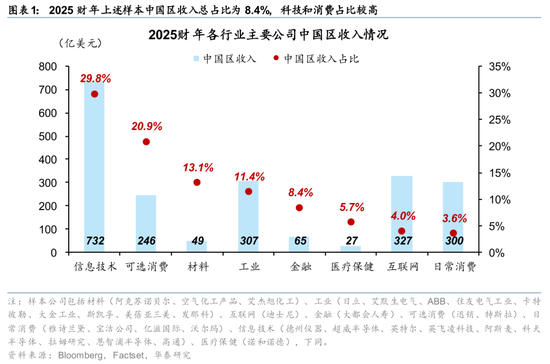
Core Insights - Domestic demand recovery is ongoing, with technological advancements and emotional consumption as structural highlights [1] - 45% of multinational companies reported improved performance in Q4 2025, while 33% expect further improvement [1][5] - The real estate sector continues to drag down growth, but there are notable structural strengths, particularly in technology and service consumption [1][5] Domestic Demand - Overall domestic demand remains weak, but there are structural highlights such as optimistic prospects for renovation in coatings and elevators [2][12] - Service and emotional consumption are experiencing high demand, with companies like Estée Lauder and Procter & Gamble reporting double-digit growth in specific product lines [2][12] - Companies are adapting to trade friction by increasing localization, with ABB reporting over 85% localization in China [2][12] Trade Friction - Localization strategies are being adopted by companies to mitigate the impact of trade tensions, with some firms shifting to local development and sales models [2][12] - Companies like SKF are facing supply chain pressures due to trade policy uncertainties, but are implementing measures to manage these risks [34] Technology - There is a slight decline in external demand for technology products, with a trend towards domestic substitution becoming evident [3][13] - Traditional companies are benefiting from increased demand driven by technological advancements, particularly in the semiconductor sector [3][13] - U.S. export restrictions and domestic competition are impacting overseas companies' revenues in China [3][13] Industry Summaries Materials and Industrial - Demand for materials and industrial products is generally weak, but there are structural demands in electronic gases due to the semiconductor industry [14][26] - The coatings sector is showing resilience due to renovation demand, while traditional electrical and elevator businesses are facing declines [14][27] Consumer Sector - The consumer sector shows significant differentiation, with companies like Uniqlo experiencing revenue declines due to increased competition [20][21] - High-end products in the beauty sector are performing well, while food and beverage sectors are facing slight declines [21][22] Financial Services - MetLife's operations in China are showing strong recovery, with a focus on optimizing distribution channels and enhancing service offerings [19][41] - The company is transitioning away from telemarketing and focusing on high-end customer segments [41] Technology Hardware - Semiconductor companies maintain a high revenue share in China, but face challenges from export controls and supply chain adjustments [23][30] - Companies like Intel and AMD are experiencing delays and increased competition from local manufacturers [30][31] Machinery - Caterpillar anticipates positive growth in the Chinese market, particularly in larger excavators, while SKF is facing challenges in the automotive sector [32][33] - Companies are adjusting their strategies to focus on local development and sales, with a shift in production towards Southeast Asia [39]

多个重要指数涨幅超50%!农历蛇年A股完美收官,马年如何走?
天天基金网· 2026-02-15 07:30
Core Viewpoint - The A-share market in the lunar year of the Snake has shown a strong performance, with major indices experiencing significant increases, indicating a bullish trend in the market [3][5]. Market Performance - The A-share market recorded a cumulative increase of 25.58% for the Shanghai Composite Index, 38.84% for the Shenzhen Component Index, and a remarkable 58.73% for the ChiNext Index during the trading period from February 5, 2025, to February 13, 2026 [3]. - The CSI 2000 Index, which includes 2000 smaller-cap stocks, saw a cumulative increase of 50.39%, while the CSI 500 and CSI 1000 indices rose by 48.49% and 40.35%, respectively [3]. Sector Performance - The performance across various sectors was generally positive, with the non-ferrous metals sector leading with a cumulative increase of over 100%. The defense and military industry followed with an increase of nearly 80% [5]. - Other sectors such as telecommunications, electrical equipment, electronics, machinery, construction materials, basic chemicals, light industry manufacturing, and construction decoration also performed well, each with cumulative increases exceeding 50% [5]. - The banking sector lagged behind, with a cumulative increase of less than 10%, while sectors like food and beverage, non-bank financials, transportation, social services, and retail showed relatively weak performance [5]. Individual Stock Performance - Over 4600 A-shares increased in value during the trading period, accounting for nearly 90% of all A-shares, with more than 700 stocks doubling in value [7]. - Notable stocks that saw increases exceeding 500% include Upwind New Materials, Tianpu Co., and others, while stocks like *ST Aowei and *ST Yanshi experienced declines exceeding 50%, highlighting structural risks even in a bullish market [8]. Future Outlook - The market is expected to maintain a positive long-term trend due to reasonable valuations, ongoing supportive policies, and a solidifying macroeconomic recovery [8]. - Looking ahead to the Year of the Horse, it is anticipated that the A-share market will gradually stabilize and recover, with recommendations for investors to adopt a balanced and rational investment strategy focusing on fundamentally strong assets and growth sectors [9][10].

存款再搬家!1月,居民存款少增超过3万亿元
Sou Hu Cai Jing· 2026-02-15 02:50
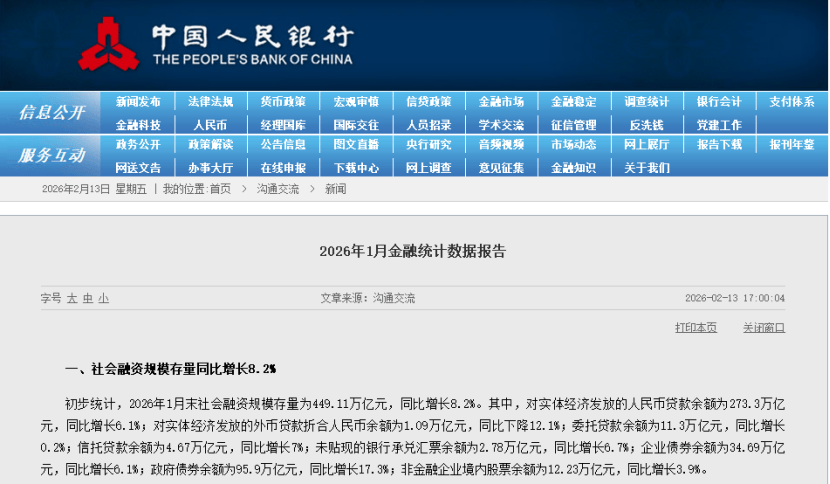
Group 1 - The central bank reported that as of the end of January 2026, the total social financing stock was 449.11 trillion yuan, reflecting a year-on-year growth of 8.2%, indicating support for stable growth in the real economy [5][6] - The broad money supply (M2) increased by 9.0% year-on-year, significantly outpacing the nominal GDP growth rate, which suggests a moderately loose monetary policy is in place to support economic stability [5][6] - In January 2026, new loans in renminbi amounted to 4.71 trillion yuan, a decrease of 420 billion yuan year-on-year, with residential loans contributing 456.5 billion yuan, showing an increase in both short-term and medium-to-long-term loans [5][6] Group 2 - In January 2026, residential deposits decreased by 3.39 trillion yuan year-on-year, while non-bank financial institutions saw an increase of 2.56 trillion yuan in deposits, indicating a shift in deposit allocation among residents [6][7] - The discussion around the maturity of over 50 trillion yuan in fixed deposits has led to a trend of "deposit migration," where residents are reallocating their savings towards higher-yielding assets [6][7] - Analysts suggest that the ongoing low growth rate of residential deposits compared to M2 indicates a potential shift of funds towards enterprises, government, or non-bank financial sectors, with implications for capital market dynamics [6][7]
开源量化评论(121):港股CCASS优选20组合的年度回顾及最新持仓
KAIYUAN SECURITIES· 2026-02-13 06:43
- The "Hong Kong CCASS Preferred 20 Portfolio" was constructed using a two-step screening method: "select brokers first, then select stocks"[3][4] - The first step involves selecting top-performing brokers by standardizing and equally weighting their excess Sharpe ratio and monthly win rate, then selecting the top 10 brokers[4][16] - The second step involves equally distributing funds to the 10 selected brokers, aggregating their latest holdings, and retaining the top 20 stocks by weight for equal allocation[5][17] - The portfolio has shown significant outperformance over the Hang Seng Index, with an annualized excess return rate of 19.3% and an excess Sharpe ratio of 2.45 over the period from 2020 to 2025[3][12][15] - The portfolio demonstrated defensive characteristics during market adjustments, achieving a positive return of 2.05% from October 8, 2025, to December 31, 2025, while the Hang Seng Index fell by 4.47% and the Hang Seng Technology Index dropped by 15.32%[3][12] - The latest holdings of the portfolio as of February 2026 include a low valuation and high dividend yield configuration, with the banking and non-bank financial sectors accounting for about 45%, the energy sector about 10%, and the technology and internet sectors about 20%[6][19][22] Portfolio Performance Metrics - Annualized return: 19.3%[15] - Annualized volatility: 7.9%[15] - Sharpe ratio: 2.45[15] - Maximum drawdown: -7.6%[15] - Monthly win rate: 75.3%[15]
中信证券A股2025年报预告全景透视:预喜公司占比达37% 大市值龙头盈利修复显著
Zhi Tong Cai Jing· 2026-02-13 01:17
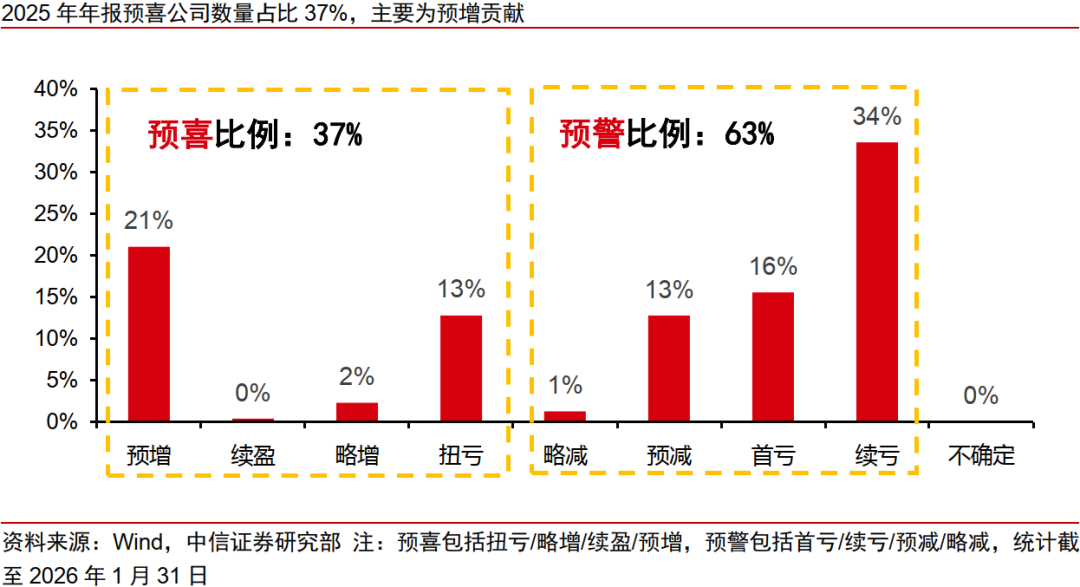
Core Viewpoint - As of January 31, 2026, 2,976 A-share companies have disclosed their 2025 annual performance forecasts, with a total disclosure rate of 54.0%. The proportion of companies with positive forecasts has increased to 37% from 33% in 2024, indicating a structural recovery driven by technology, supported by external demand, while financial sectors face pressure [1][9]. Group 1: Performance Forecast Overview - The number of companies with positive forecasts has expanded, with technology, finance, and cyclical sectors being the highlights. The overall disclosure rate is 54.0%, with 37% of companies forecasting positive results, up from 33% in 2024. Key sectors showing growth include communication, basic chemicals, non-ferrous metals, non-bank finance, electronics, and utilities [1][5]. - The performance forecast reveals significant improvements among large-cap leaders, while small-cap companies continue to face substantial pressure. The positive forecast ratio is highly correlated with market capitalization, with the Shanghai Stock Exchange 50 index showing a 75% positive forecast ratio [9][12]. Group 2: Sector-Specific Insights - The current performance forecasts exhibit structural characteristics of "technology-driven, externally supported, and financial pressure." Notably, 9 companies from the Shanghai Stock Exchange 50 have released forecasts, with 6 showing growth, particularly in machinery, non-ferrous, pharmaceuticals, and electronics [12]. - The technology sector shows high resilience due to global AI infrastructure and semiconductor demand growth, while industries like non-ferrous metals and chemicals are experiencing performance releases due to improved pricing power [12][22]. Group 3: Institutional Investment Strategies - Fund companies focus on clear growth sectors, with the top three heavy investment industries being electronics (20.1%), pharmaceuticals (10.1%), and power equipment & new energy (9.3%). The top 20% of holdings have a forecasted net profit of 3,976.3 billion yuan, reflecting a 46.4% year-on-year growth [16][21]. - Insurance companies prioritize cash flow and defensive attributes, with a significant portion of their holdings in banking and non-bank financial sectors. The top 20% of holdings forecast a net profit of 814.7 billion yuan, with limited growth elasticity [16][20]. Group 4: Analyst Expectations and Market Reactions - Analyst expectations are generally optimistic, with 537 companies forecasting below market consensus and only 160 exceeding expectations, indicating a significant bias towards optimism in earnings predictions [22][27]. - The analysis of market reactions shows that 658 stocks experienced a gap down on the day following their forecasts, while only 230 saw a gap up, suggesting that overall earnings expectations were overly optimistic prior to announcements [27][33].

【12日资金路线图】两市主力资金净流出近12亿元,电子等行业实现净流入
证券时报· 2026-02-12 12:55
Market Overview - The A-share market experienced a narrow range of consolidation on February 12, with the Shanghai Composite Index rising by 0.05%, the Shenzhen Component Index increasing by 0.86%, and the ChiNext Index up by 1.32%. The total trading volume for the day was 2.16 trillion yuan, compared to 2 trillion yuan the previous day [1]. Capital Flow - The main funds in the Shanghai and Shenzhen markets saw a net outflow of approximately 12 billion yuan, with an opening net outflow of 31.42 billion yuan and a closing net outflow of 8 billion yuan, resulting in a total net outflow of 11.81 billion yuan for the day [2]. - Over the last five trading days, the main funds have shown a consistent trend of outflow, particularly in the ChiNext, which saw a net outflow of 39.79 billion yuan on February 12, while the CSI 300 index recorded a net inflow of 10.85 billion yuan [3][4]. Sector Performance - The electronics sector achieved a net inflow of 167.93 billion yuan, with a growth of 1.36%. Other sectors with positive net inflows included electric power equipment (143.16 billion yuan, up 1.10%) and computers (81.72 billion yuan, up 0.89%) [5]. - Conversely, the banking sector experienced a significant net outflow of 76.90 billion yuan, declining by 1.51%. Other sectors with notable outflows included non-bank financials (-64.83 billion yuan), pharmaceuticals (-57.24 billion yuan), and retail (-40.91 billion yuan) [5]. Institutional Activity - The top stocks with net buying from institutions included Yingweike (32.02 million yuan, up 10.00%), Zhichuan Co. (22.56 million yuan, down 4.92%), and Jingchen Co. (18.68 million yuan, up 15.75%) [7]. - The stocks with the highest net selling included Jihua Group (-12.02 million yuan, down 14.19%) and Jianxin Culture (-10.16 million yuan, down 14.19%) [9]. Institutional Focus - Recent institutional ratings highlighted stocks such as Guangdong Hongtu (target price 13.00 yuan, current price 12.25 yuan, potential upside 6.12%) and China Duty Free Group (target price 116.00 yuan, current price 94.17 yuan, potential upside 23.18%) [10].

上证基金评级分析2026年第1期:股混基金超额收益效应回落,债基持券评级中枢上移
Shanghai Securities· 2026-02-12 04:20
Performance Analysis - In Q4, the average return of heavily held stocks in mixed funds was 2.84%, outperforming the average return of all A-shares at 2.62% and the CSI 800 component stocks at 1.04%[1] - Among 31 first-level industries, 22 industries' heavily held stocks outperformed their benchmark industry indices, with an average excess return of 1.87%[1] - The performance of stock funds in Q4 showed a decline of 2.11%, underperforming the CSI All Share Index which increased by 1.01%[6] Fund Rating Overview - A total of 9,215 funds were included in the three-year rating, with 1,379 (14.96%) rated as five-star funds[5] - For the five-year rating, 5,265 funds were included, with 738 (14.91%) rated as five-star funds[5] Risk Management and Efficiency - The risk-return efficiency of bond funds improved significantly, with a notable increase in returns and a decrease in volatility[21] - The average return of pure bond funds was 0.52%, outperforming the total wealth index of bonds at 0.33%[10] Market Timing Ability - The average stock position for equity funds increased by 0.99 percentage points to 91.19%, while mixed funds increased by 1.42 percentage points to 74.29%[19] - The bond fund's holding level decreased by 0.49 percentage points, indicating poor allocation effectiveness[19] Long-term Performance Tracking - Since 2015, the three-year return of five-star ordinary stock fund combinations was 296.11%, compared to only 67.35% for the CSI All Share Index[3] - The probability of five-star funds maintaining performance in the top 40% of their category within 6 months to 1 year is approximately 60%[29]
今日视点:重回报 启新程 A股“新春红包”派送中
Zheng Quan Ri Bao· 2026-02-11 21:49
Group 1 - The core viewpoint of the article highlights a significant trend in the A-share market, where nearly 302 listed companies are set to distribute cash dividends totaling 389.68 billion yuan, reflecting a year-on-year growth of approximately 13.34% [1] - The robust performance of cash dividends is attributed to three main factors: the resilience of corporate profits, regulatory policy guidance, and improvements in corporate governance, indicating a profound shift in the A-share market from "heavy financing" to "heavy returns" [1][2] - The banking sector is a major contributor, accounting for about 70% of the total dividend amount, supported by the recovery of the real economy and improved asset quality, showcasing the sector's stable profitability and ample cash flow [1] Group 2 - Regulatory policies have played a crucial role in promoting cash dividends, with recent guidelines emphasizing the importance of shareholder returns and encouraging companies to adopt a more consistent dividend distribution approach [2] - The introduction of measures to enhance dividend stability and predictability, such as the new "National Nine Articles" and the CSRC's guidelines on market value management, has made dividend payments a key aspect of corporate governance [2] - The normalization of dividends is reshaping the market ecosystem, fostering a transition towards a "value-oriented" investment approach, which is essential for long-term healthy market development [2][3] Group 3 - For investors, stable cash dividends enhance the attractiveness of equity assets, alleviating pre-holiday risk aversion and contributing to market stability, especially in a declining interest rate environment [3] - Active dividend distribution can improve corporate valuation and market recognition, compelling companies to enhance operational management and capital efficiency, thereby focusing on core business and strategic development [3] - The recent surge in dividends before the Spring Festival serves as a vivid reflection of stable corporate profits and responsible governance, while also being a practical implementation of precise regulatory guidance and ongoing market ecosystem optimization [3]
重回报 启新程 A股“新春红包”派送中
Zheng Quan Ri Bao· 2026-02-11 16:21
Group 1 - The core viewpoint of the article highlights a significant trend in the A-share market, where nearly 302 listed companies are set to distribute cash dividends totaling 389.68 billion yuan, reflecting a year-on-year increase of approximately 13.34% [1] - The robust performance of cash dividends is attributed to three main factors: the resilience of corporate profits, regulatory policy guidance, and improvements in corporate governance, indicating a profound shift in the A-share market from "heavy financing" to "heavy returns" [1][2] - The banking sector is a major contributor, accounting for about 70% of the total dividend amount, supported by the recovery of the real economy and improved asset quality, showcasing the sector's stable profitability and ample cash flow [1] Group 2 - Regulatory policies have played a crucial role in promoting cash dividends, with the new "National Nine Articles" emphasizing the strengthening of cash dividend supervision for listed companies, particularly targeting those with low or no dividends [2] - The enhancement of corporate governance has further ensured the compliance and sustainability of dividend distributions, with many companies incorporating cash dividends into their long-term plans [2] - The normalization of dividends is reshaping the market ecosystem, subtly driving a transition towards a "value-oriented" market, which injects momentum for long-term healthy development [2][3] Group 3 - Stable cash dividends enhance investor sentiment and attract long-term funds, creating a virtuous cycle of improved corporate profitability, stable dividends, and sustained corporate development [3] - Active dividend distribution can elevate a company's valuation and market recognition, compelling firms to enhance operational management and capital efficiency [3] - The recent surge in dividends before the Spring Festival serves as a vivid reflection of stable corporate profits and responsible governance, while also promoting the deepening of value investment concepts [3]
策略跟踪报告:A股盈利能力有望延续回升
Wanlian Securities· 2026-02-11 12:24
Group 1 - The core viewpoint of the report indicates that the profitability of A-shares is expected to continue its recovery, with a notable increase in the number of companies issuing positive earnings forecasts for 2025 [3][4] - As of February 9, 2026, 2,976 A-share companies have disclosed their annual earnings forecasts, representing a disclosure rate of 54.32% [8][10] - Among the disclosed forecasts, 1,106 companies (37.16%) issued positive earnings forecasts, with the largest segment being those predicting earnings growth, totaling 625 companies (21.00%) [12][21] Group 2 - The stable sector has the highest proportion of positive forecasts at 57.58%, followed by the cyclical sector at 42.55%, and the financial sector at 42.27% [13][19] - Five industries have a positive forecast rate exceeding 50%, with non-bank financials, non-ferrous metals, and the automotive industry leading in expected profit growth [16][21] - The report highlights significant performance disparities among industries, with defense, automotive, and beauty care sectors turning losses into profits, while energy-related sectors like oil and coal show negative growth [21][24] Group 3 - Investment recommendations suggest focusing on sectors with improving profitability, particularly in non-ferrous metals, basic chemicals, machinery, and TMT (Technology, Media, and Telecommunications) [24] - The report emphasizes that technological innovation and industrial upgrades are key drivers for the recovery in profitability, suggesting a strategic focus on high-end manufacturing and technological innovation sectors [24]