有色金属

Search documents
金融期货早评-20260304
Nan Hua Qi Huo· 2026-03-04 03:13
Report Industry Investment Ratings No relevant information provided. Core Views of the Report - For the Middle East geopolitical conflict, it is necessary to use the "risk preference shock" framework for analysis. The current conflict has not shaken the underlying framework of the five major global market macro narratives, but has strengthened the trading priority of the long - term geopolitical narrative. The impact depth of this conflict on the market mainly depends on the disruption degree and duration of the Strait of Hormuz. Attention should be paid to the intensity of the conflict and two core signals to determine the peak of the conflict intensity. There is a risk of the risk preference shock evolving into a liquidity crisis [2]. - The Middle East conflict has hit the global market risk preference, and the A - share market has also been affected. The geopolitical risk is high, and the market volatility has increased. It is recommended to appropriately reduce positions [4]. - In the bond market, short - term bonds perform slightly better due to loose liquidity, while medium - and long - term bonds show a narrow - range oscillation. It is recommended to hold a small number of medium - term long positions in T2606 and temporarily wait and see in the short term [5]. - In the commodity market, the prices of various commodities are affected by the Middle East situation. For different varieties, corresponding investment strategies are proposed, such as focusing on structural long - making opportunities for lithium carbonate after the correction, and taking a long - position layout on dips for industrial silicon in the medium term [7][9]. Summaries According to Relevant Catalogs Financial Futures - **Macro**: Continue to focus on the Middle East situation. The statements of Fed officials show uncertainty about interest rate cuts in 2026 due to the war situation. The Iran situation is tense, with various events such as the destruction of US missile defense systems by Iran, and the consideration of military actions by some countries. The US Senate will vote on the "war powers resolution" [1]. - **Renminbi Exchange Rate**: The RMB depreciated against the US dollar. The strength of the US dollar is supported by Trump's tough stance on the Iran issue and relevant news about the Fed Chairman nominee. The subsequent impact on the US dollar index and the USD/CNY exchange rate depends on whether the conflict is a blitzkrieg or a protracted war. Short - term export enterprises are recommended to lock in forward exchange settlement at around 6.93, and import enterprises are recommended to adopt a rolling foreign exchange purchase strategy at around 6.82 [2][3]. - **Stock Index**: The escalation of the Middle East conflict has reduced market risk preference, causing the stock index to fall. The uncertainty of geopolitical risks is high, and it is recommended to reduce positions to avoid risks [4]. - **Treasury Bonds**: The bond market did not get a boost from the sharp decline in the A - share market. Short - term bonds perform slightly better due to loose liquidity. It is recommended to hold a small number of medium - term long positions in T2606 and temporarily wait and see in the short term [5]. Commodities New Energy - **Lithium Carbonate**: The futures price of lithium carbonate has dropped significantly. Affected by the Middle East situation, the market risk - aversion sentiment has increased, leading to a phased tightening of liquidity. It is recommended to focus on structural long - making opportunities after the correction and downstream enterprises can replenish inventory at low prices [7]. - **Industrial Silicon & Polysilicon**: The prices of industrial silicon and polysilicon futures have fallen. The short - term price of industrial silicon is affected by the macro sentiment and its own weak fundamentals, but there is strong bottom support in the medium and long term. It is recommended to take a long - position layout on dips. The photovoltaic industry needs to wait for capacity clearance and the improvement of the supply - demand pattern [8][9]. Non - ferrous Metals - **Aluminum Industry Chain**: The escalation of the US - Iran situation may affect the import and export of the Middle East aluminum industry chain and increase the cost of electrolytic aluminum. It is recommended to sell out - of - the - money put options for Shanghai aluminum. The spot price of alumina has rebounded, and it is recommended to sell deep out - of - the - money put options. For cast aluminum alloy, it is recommended to pay attention to the price difference with aluminum [12][13]. - **Copper**: The copper price has weakened. The market speculation degree has decreased, and the copper price has fallen below the important support range. It is recommended that non - position holders wait and see or consider buying out - of - the - money call options, and industrial customers can consider replenishing inventory [13][16]. - **Zinc**: The zinc price is weak in the short term due to liquidity issues and the overall pressure of the sector. It is expected to be strong in the medium term [17]. - **Nickel - Stainless Steel**: The prices of nickel and stainless steel have fallen. The supply - shortage logic has been broken, but the actual industrial impact remains to be seen. The demand is expected to be boosted in the peak season, and the inventory of stainless steel has accumulated recently [18]. - **Tin**: The tin price has dropped sharply and is expected to fluctuate at a high level. The supply is tight, and the demand has started to resume work [18][19]. - **Lead**: The lead price is expected to fluctuate. The current supply - demand pattern is weak, and there is a pressure of inventory accumulation and cost support [20]. Oils and Fats and Feeds - **Oilseeds**: The external market of US soybeans has risen, and the domestic market has oscillated. The supply pressure is expected to return in the second quarter. It is recommended to widen the price difference between soybean meal and rapeseed meal [21]. - **Oils**: The oil market is strong due to the geopolitical conflict. The international palm oil supply and demand situation is complex, and the domestic oil supply is sufficient. It is expected that the oil price will remain strong in the short term [21][22][23]. Energy and Oil and Gas - **Fuel Oil**: The Middle East conflict has led to concerns about the tightening of the Asian fuel oil supply, supporting the Singapore fuel oil market [25]. - **Asphalt**: The asphalt price is driven by the cost of crude oil. The current terminal demand is low, and the supply is expected to increase. The price will follow the change of crude oil in the future [26]. Precious Metals - **Gold & Silver**: The price of precious metals has fallen sharply due to the delay of interest rate cut expectations and liquidity pressure. It is recommended to maintain a long - term bullish stance on precious metals and be cautious about short - term adjustment risks. It is advisable to buy on dips and replenish positions step by step [28][29]. Chemicals - **Pulp - Offset Paper**: The pulp price is close to the previous low, and the offset paper price is close to the previous high. The pulp inventory pressure is large, and the offset paper supply - demand situation has improved. It is recommended to conduct range trading for pulp in the short term and try a long - position strategy at low prices in the medium term. For offset paper, it is recommended to try a short - position strategy at high prices [30][31][32]. - **Pure Benzene - Styrene**: The prices of pure benzene and styrene have risen. The cost support has been enhanced due to the Middle East conflict, and attention should be paid to the refinery start - up changes and the situation in the Strait of Hormuz [32][33]. - **LPG**: The LPG market is affected by the US - Iran situation. The market is concerned about the supply from the Middle East, and it is necessary to pay attention to the subsequent development of the situation [33][35]. - **Methanol**: The geopolitical conflict has a significant impact on methanol. It is necessary to pay attention to whether the conflict will affect the main methanol production areas, gas fields, and ports in Iran [35][36]. - **Plastic PP**: The prices of plastic and polypropylene have risen. The rise is driven by cost increase and the improvement of the fundamental supply - demand expectation. It is necessary to be cautious about the market correction risk if the conflict eases [36][38][39]. - **Rubber**: The natural rubber price is under pressure, and the synthetic rubber price is affected by the geopolitical conflict. The macro sentiment dominates, and the natural rubber price is expected to oscillate. The butadiene rubber cost is supported, and it is expected to oscillate strongly in the short term [39][44][45]. - **Urea**: The US - Iran war has an impact on the urea market, causing a "collapse of global supply" and an "explosion of domestic sentiment". It is expected to drive a price increase in the domestic market [47][48]. - **Glass Soda Ash**: The supply of soda ash may be affected by the expected overhaul, and the glass demand has not recovered yet. The supply return expectation and high inventory in the middle stream limit the price increase of glass [48][49]. - **Propylene**: The propylene price is affected by the cost and supply - demand. The cost is the dominant factor in the short term. The propane price has risen, and there is an expectation of production reduction in some olefin enterprises [49][50]. Black Metals - **Rebar & Hot - Rolled Coil**: The prices of rebar and hot - rolled coil are weak. The market has expectations for infrastructure and real estate policies, but the fundamental pressure of the finished steel still exists. The short - term policy expectations support the market, but the weak fundamentals limit the price increase space [51]. - **Iron Ore**: The iron ore market shows a supply - demand game pattern. The supply pressure persists, and the demand is affected by seasonal restrictions and pessimistic expectations. The price has limited downward space but lacks upward drive [53]. - **Coking Coal and Coke**: The prices of coking coal and coke have risen. The risk assets may fluctuate more violently. The coking enterprises' operating rate is expected to rise slightly, and the coke may face a price cut risk in the future [53][54]. - **Silicon Iron & Silicon Manganese**: The prices of silicon iron and silicon manganese have risen. The short - term sentiment is strong, but the black metal fundamentals are weak. The silicon manganese is affected by high inventory, and the silicon iron has a better fundamental situation [54][55]. Agricultural and Soft Commodities - **Hogs**: The hog futures price has continued to decline. The piglet market is weak, and it is recommended to sell call options on the main hog futures contract [57][58]. - **Cotton**: The cotton futures price has fallen slightly. The domestic cotton supply - demand situation is expected to be tight this year. It is recommended to lay out long positions on dips and pay attention to the international situation and the US foreign trade policy [58][59][60]. - **Sugar**: The domestic sugar futures price has basically stood above the 5300 mark. The fundamental situation is favorable, but the international raw sugar price is under pressure. The upward space is expected to be limited [61][62]. - **Eggs**: The egg futures price has declined. The egg market shows a pattern of strong supply and weak demand, and it is recommended to sell call options on the main egg futures contract [62]. - **Apples**: The apple futures price has risen. The market is affected by the fundamentals and delivery issues. The price is likely to rise and difficult to fall, and attention should be paid to the pressure level around 10,000 [69][70]. - **Jujubes**: The jujube futures price has risen slightly. The domestic jujube supply is sufficient, and the price is expected to fluctuate at a low level [71][72]. - **Logs**: The log futures price is approaching the previous high. The inventory has increased significantly, and the demand has not recovered significantly. It is recommended to shift from a long - position strategy to a range - trading strategy [73].
国新证券每日晨报-20260304
Guoxin Securities Co., Ltd· 2026-03-04 03:07
Domestic Market Overview - The domestic market experienced a significant trading volume with a volatile pullback on March 3, 2026. The Shanghai Composite Index closed at 4122.68 points, down 1.43%, while the Shenzhen Component Index closed at 14022.39 points, down 3.07%. The ChiNext Index fell by 2.57%, and the STAR Market 50 Index decreased by 5.21%. The total trading volume of the A-share market reached 31,576 billion yuan, continuing to rise compared to the previous day [1][4][7] - Among the 30 first-level industries of CITIC, 4 sectors saw an increase, with oil and petrochemicals, coal, and transportation leading the gains. In contrast, the defense, non-ferrous metals, and electronics sectors experienced significant declines. Concept indices such as oil and gas extraction, natural gas, and selected shipping performed actively [1][4][7] Overseas Market Overview - On the same day, all three major U.S. stock indices closed lower, with the Dow Jones Industrial Average down 0.83%, the S&P 500 down 0.94%, and the Nasdaq down 1.02%. Notably, Micron Technology fell nearly 8%, leading the decline in chip stocks. The Nasdaq China Golden Dragon Index dropped by 3.34%, with companies like Hesai Technology and Kingsoft Cloud experiencing declines of nearly 9% and over 8%, respectively [2][4][7] News Highlights - The Ministry of Industry and Information Technology and five other departments jointly issued guidelines to promote the comprehensive utilization of photovoltaic components, aiming to transform waste photovoltaic components into valuable resources [3][12] - The National Energy Administration held a symposium on the development of the green fuel industry, emphasizing the need for systematic planning and innovative approaches to enhance competitiveness in the sector [3][13] - Ongoing conflicts in the Middle East have raised concerns about the stability of energy supplies, with reports indicating a significant decrease in shipping volumes through the Strait of Hormuz [3][11][14]
早间评论-20260304
Xi Nan Qi Huo· 2026-03-04 03:04
1. Report Industry Investment Ratings No relevant content provided. 2. Core Views of the Report - For the bond market, it is expected to face certain pressure, and caution is advised [5][6]. - For the stock index market, the volatility center is expected to gradually move up, and long positions can be held [9][10]. - For the precious metals market, market volatility is expected to significantly increase, and it is advisable to stay on the sidelines [12][13][14]. - For the steel products market, investors can pay attention to low - level long - buying opportunities and manage positions carefully [15][17][20]. - For the energy market, the crude oil main contract is recommended to focus on long - buying opportunities [24][25][26]. - For the chemical products market, polyolefins and some chemical products are expected to be bullish, and investors can focus on long - buying opportunities [27][38][39]. - For the agricultural products market, different products have different trends. For example, cotton is expected to be bullish in the medium - to - long term, while sugar is recommended for a wait - and - see approach [73][74][77][78]. 3. Summary by Relevant Catalogs 3.1 Bonds - **Market Performance**: On the previous trading day, most bond futures closed higher. The 30 - year main contract rose 0.09% to 112.770 yuan, the 10 - year main contract fell 0.01% to 108.500 yuan, the 5 - year main contract remained flat at 106.065 yuan, and the 2 - year main contract rose 0.01% to 102.470 yuan [5]. - **Open Market Operations**: On March 3, the central bank conducted 34.3 billion yuan of 7 - day reverse repurchase operations at a fixed interest rate. With 526 billion yuan of reverse repurchases maturing on the same day, the net withdrawal was 491.7 billion yuan [5]. - **Outlook**: The current macro - data is stable, but the macro - economic recovery momentum needs to be strengthened. Monetary policy is expected to remain loose. The bond yield is at a relatively low level. The Chinese economy shows a steady recovery trend, core inflation continues to rise, and there is room for domestic demand policies to take effect. The global economic and financial situation is stable, and the global financial market risk appetite is high. It is expected that there will still be some pressure in the future, and caution should be maintained [5]. 3.2 Stock Index - **Market Performance**: On the previous trading day, stock index futures showed mixed performance. The CSI 300 stock index futures (IF) main contract fell 1.29%, the SSE 50 stock index futures (IH) main contract fell 0.83%, the CSI 500 stock index futures (IC) main contract fell 4.24%, and the CSI 1000 stock index futures (IM) main contract fell 3.57% [7]. - **New Account Data**: In February 2026, there were 2.523 million new A - share accounts opened, a 49% month - on - month decrease and an 11% year - on - year decrease. There were 239,700 new fund accounts opened, a significant decline from 546,300 in January. In February, there were 117,000 new margin trading accounts opened, a 20% year - on - year increase [7]. - **Outlook**: The domestic economy is stable, but the macro - economic recovery momentum is weak, and corporate profit growth is at a low level. However, domestic asset valuations are at a low level, and there is room for valuation repair. The Chinese economy has sufficient resilience, core inflation continues to rise, and the policy environment is favorable. Market sentiment is rising, and incremental funds are continuously entering the market. The global financial market risk appetite is high, and it is expected that overseas macro - disturbances will have limited impact. The volatility center is expected to gradually move up, and long positions can be held [9][10]. 3.3 Precious Metals - **Market Performance**: On the previous trading day, the gold main contract closed at 1,182 with a decline of 1.27%, and the silver main contract closed at 21,645 with a decline of 11.40% [11]. - **Geopolitical and Economic News**: Trump submitted a notice to Congress regarding the military action against Iran on February 28. The eurozone's February CPI and core CPI data showed an increase [11]. - **Outlook**: The current global trade and financial environment is complex. The trends of "anti - globalization" and "de - dollarization" are beneficial to the allocation and hedging value of gold. Central bank gold purchases support the gold price. The medium - to - long - term logic of precious metals remains strong. The global economic and financial situation is generally stable, and geopolitical factors such as the Iran situation are expected to have limited impact. The previous sharp rise in precious metals has been fully priced in the market, and there is currently no significant fundamental driver. It is expected that market volatility will significantly increase, and it is advisable to stay on the sidelines [12][13][14]. 3.4 Steel Products (including螺纹, 热卷, 铁矿石, 焦煤焦炭, 铁合金) - **螺纹 and 热卷** - **Market Performance**: On the previous trading day, rebar and hot - rolled coil futures showed weak oscillations. The spot price of Tangshan common carbon billet was 2,910 yuan/ton, the spot price of Shanghai rebar was between 3,070 - 3,190 yuan/ton, and the price of Shanghai hot - rolled coil was between 3,220 - 3,240 yuan/ton [15]. - **Supply and Demand**: In the medium term, the price of finished products is dominated by industrial supply - demand logic. The real estate industry's downward trend has not reversed, and rebar demand is in a year - on - year decline. The market is in the off - season of demand. On the supply side, the over - capacity situation remains unchanged, the weekly output of rebar is at a low level, and the supply pressure has been alleviated. The inventory increase during the Spring Festival was the lowest in recent years [15]. - **Outlook**: Rebar prices still lack bullish drivers but are at a low valuation. The fundamental logic of hot - rolled coils is similar to that of rebar, and their trends may be consistent. Technically, steel futures may continue to be weak in the short term. Investors can pay attention to low - level long - buying opportunities and manage positions carefully [15][16]. - **铁矿石** - **Market Performance**: On the previous trading day, iron ore futures oscillated. The port spot price of PB powder was 752 yuan/ton, and the spot price of Super Special powder was 640 yuan/ton [17]. - **Supply and Demand**: The daily output of molten iron in the country has rebounded month - on - month, but steel mills may limit production during key meetings, which will suppress iron ore demand. In 2025, iron ore imports increased by 1.8% year - on - year, and domestic raw ore production was lower than the same period in 2024. Iron ore port inventories continued to rise and were at the highest level in the same period in the past five years [17]. - **Outlook**: The supply - demand pattern of the iron ore market is weak. Technically, iron ore futures may test the support near the previous low again. Investors can pay attention to low - level long - buying opportunities and manage positions carefully [17][18][19]. - **焦煤焦炭** - **Market Performance**: On the previous trading day, coking coal and coke futures continued to rebound [20]. - **Supply and Demand**: The conflict between the US and Iran has a limited impact on the domestic coking coal and coke supply - demand pattern. For coking coal, the main coal - producing areas have basically resumed production, and the supply side is gradually recovering. The demand side is generally weak. For coke, the supply side is stable, and the inventory pressure of coking enterprises is not large. The daily output of molten iron in the country has rebounded month - on - month, but steel mills may limit production during key meetings, which will put pressure on the coke price. There is an expectation of a price cut for coke spot [20]. - **Outlook**: Technically, coking coal and coke futures may continue to oscillate in the medium term. Investors can pay attention to low - level buying opportunities and manage positions carefully [20][21]. - **铁合金** - **Market Performance**: On the previous trading day, the manganese - silicon main contract rose 1.16% to 6,118 yuan/ton, and the silicon - iron main contract rose 1.12% to 5,786 yuan/ton. The spot price of Tianjin manganese - silicon increased by 50 yuan/ton to 5,850 yuan/ton, and the price of Inner Mongolia silicon - iron increased by 20 yuan/ton to 5,350 yuan/ton [22]. - **Supply and Demand**: The shipping volume of manganese ore from Gabon decreased to 107,900 tons in the week of February 27. The supply of Australian ore gradually returned to normal, and the port manganese ore inventory increased by 650,000 tons to 4.95 million tons. The main - producing area electricity price and the prices of coke and semi - coke were stable. The cost of ferroalloys fluctuated slightly at a low level. The output of rebar by sample building material steel mills in the week of February 27 was 1.65 million tons, a decrease of 50,000 tons month - on - month. The output of manganese - silicon and silicon - iron increased by 3,600 tons and 600 tons respectively compared with the previous week. The weekly output was at a relatively low level in the past five years, and the short - term over - supply situation was slightly alleviated, but the supply surplus still led to inventory accumulation [22][23]. - **Outlook**: The current cost has limited downward space at a low level, and the support at the low - level range is gradually strengthening. Since 2026, the output of ferroalloys has remained at a low level, and the demand is weak, and the overall over - supply pressure continues. After a rapid short - term price rebound, investors can consider taking profits on long positions [23]. 3.5 Energy (including原油) - **Market Performance**: On the previous trading day, INE crude oil closed at the daily limit again due to the ongoing Middle East war [24]. - **Market News and Data**: Speculators increased their net long positions in US crude oil futures and options. The number of US oil and gas rigs decreased. The US and Israel launched a large - scale joint military strike against Iran, and the Middle East situation has escalated. OPEC+ agreed in principle to increase oil production by 206,000 barrels per day in April [24]. - **Outlook**: The increase in CFTC net long positions indicates that US funds are optimistic about the future of crude oil. OPEC's production increase is less than expected and cannot fill the gap left by Iranian crude oil. The conflict between the US, Israel, and Iran shows signs of escalation, and the closure of the Strait of Hormuz supports oil prices. Investors can focus on long - buying opportunities in the crude oil main contract [24][25][26]. 3.6 Chemical Products (including聚烯烃, 合成橡胶, 天然橡胶, PVC, 尿素, 对二甲苯PX, PTA, 乙二醇, 短纤, 瓶片, 纯碱, 玻璃, 烧碱, 纸浆) - **聚烯烃** - **Market Performance**: On the previous trading day, the Hangzhou PP market reported a rapid price increase. The geopolitical risk and the increase in international oil prices led to a high - level speculation atmosphere in the market. The拉丝 mainstream price was between 6,950 - 7,200 yuan/ton. The price of LLDPE in the Yuyao market increased by 200 - 400 yuan/ton [27]. - **Outlook**: In the short term, affected by macro - policies, the increase in crude oil prices provides strong cost support for PE and PP. Although the production enterprise maintenance has decreased after the holiday, downstream demand is mainly for rigid replenishment. Driven by the macro - sentiment, the mentality of industry players has improved. It is expected that the polyolefin market price will be bullish in the short term. Investors can focus on long - buying opportunities [27]. - **合成橡胶** - **Market Performance**: On the previous trading day, the synthetic rubber main contract rose 3.64%, and the mainstream price in Shandong was adjusted up to 13,800 yuan/ton, and the basis remained stable [28]. - **Supply and Demand**: Affected by the conflict, the synthetic rubber price may rise in the short term. In the medium term, it is necessary to pay attention to the trend of crude oil and the post - holiday demand recovery. On the raw material side, butadiene may rise driven by crude oil this week, and the price is significantly affected by cost. On the supply side, most butadiene rubber plants maintained high - load operation this week, and only the load of an individual butadiene rubber plant in Shandong decreased slightly. In addition, the butadiene rubber plants of Haopu New Materials and Zhejiang Chuanhua are expected to be overhauled in March. On the demand side, affected by the Spring Festival holiday, the capacity utilization rate of tire sample enterprises recovered slightly at a low level. On the inventory side, as of February 25, 2026, the domestic butadiene rubber inventory was 53,500 tons, a significant increase of 19,600 tons compared with before the Spring Festival, a month - on - month increase of 57.68% [28]. - **Outlook**: The market is expected to be bullish and oscillating [29]. - **天然橡胶** - **Market Performance**: On the previous trading day, the natural rubber main contract fell 1.55%, the 20 - rubber main contract fell 1.75%, and the Shanghai spot price was adjusted down to around 16,100 yuan/ton, and the basis remained stable [30]. - **Supply and Demand**: The weekend conflict may drive the short - term rise of natural rubber through the transmission from crude oil to synthetic rubber. In the future, it is necessary to pay attention to the trend of crude oil and the fundamentals of natural rubber, especially the inventory situation from March to April. On the supply side, the global main - producing areas have entered the seasonal low - production period, and the output is in short supply, and the raw material price continues to strengthen. On the demand side, enterprises have resumed work as planned after the holiday, and the tire capacity utilization rate is in the recovery stage. On the inventory side, the domestic natural rubber inventory continued the pre - holiday inventory accumulation trend, and the inventory accumulation was mainly concentrated in Qingdao [31]. - **Outlook**: The market is expected to be bullish and oscillating [32]. - **PVC** - **Market Performance**: On the previous trading day, the PVC main contract rose 2.49%, the spot price increased by 100 yuan/ton, and the basis remained basically stable [33]. - **Supply and Demand**: The overseas geopolitical risk has brought supply concerns, which conflict with the domestic seasonal demand off - season. It is necessary to pay attention to the inventory trend. On the supply side, the capacity utilization rate of PVC plants increased by 0.01% this week, and the PVC output increased by 0.01% month - on - month. On the demand side, as of February 26, 2026, the start - up rate of domestic PVC pipe sample enterprises was 13.60%, a month - on - month increase. On the cost - profit side, the supply of US dollar - denominated ethylene is insufficient, which has an obvious supporting effect on the US dollar market. For calcium carbide, the demand support is unstable, and the sentiment of expecting a price decline in calcium carbide is strong, and the short - term market is difficult to improve. The inventory of the PVC industry increased significantly this period. The inventory of the PVC industry (upstream + social) increased by 1.72% month - on - month, and the factory inventory and social inventory increased simultaneously this week [33][34]. - **Outlook**: The market is expected to be bullish and oscillating [35]. - **尿素** - **Market Performance**: On the previous trading day, the urea main contract fell 0.38%, and the price in Linyi, Shandong decreased by 10 yuan/ton, and the basis remained stable [36]. - **Supply and Demand**: The conflict in Iran has a direct impact on the urea market supply. As the world's second - largest exporter, Iran has shut down many factories due to the conflict, and Egypt has also stopped production, resulting in a hard gap in global production capacity. This has led to a possible sharp increase in international fertilizer prices within a week, and the gap cannot be quickly filled. For China, although the domestic supply and demand are stable, large buyers such as India and Brazil will be forced to turn to China for emergency procurement, opening an export arbitrage window for Chinese enterprises. However, it is currently the spring plowing season, and there is no export for the purpose of stable production and supply. In the short term, it may be bullish and oscillating. The biggest risk point in the future lies in the shipping safety of the Strait of Hormuz. If it
未知机构:东财策略每日复盘20260303一市场概况3月-20260304
未知机构· 2026-03-04 02:50
Summary of Conference Call Notes Industry Overview - The conference call discusses the A-share market performance on March 3, 2023, highlighting a significant decline across major indices. The Shanghai Composite Index fell by 1.43% to close at 4122 points, while the Shenzhen Component Index and the ChiNext Index dropped by 3.07% and 2.57%, respectively. The total trading volume reached 3.13 trillion yuan, an increase of over 100 billion yuan compared to the previous trading day [1][1][1]. Key Points on Industry Performance - **Top Performing Industries**: - Oil and Petrochemicals: +6.75% - Coal: +1.76% - Transportation: +1.13% - Banking: +1.07% - Public Utilities: +0.49% [1][1][1] - **Underperforming Industries**: - Defense and Military: -6.74% - Non-ferrous Metals: -5.61% - Electronics: -5.30% - Computers: -4.94% - Media: -4.29% [1][1][1] Market News - The Ministry of Industry and Information Technology, along with five other departments, released guidelines to promote the comprehensive utilization of photovoltaic components, aiming to enhance technology and equipment levels by 2030 [3][3][3]. - In the first week following new policies in the Shanghai real estate market, there was a rapid increase in demand-side activity, with online inquiries rising by 97.6% and conversion rates improving by 180% [3][3][3]. - Qatar Energy, the world's largest natural gas producer, announced a halt in liquefied natural gas exports due to military attacks on its facilities [3][3][3]. Market Outlook and Considerations - The Shanghai Composite Index's recent performance has created a situation of trapped capital and pessimism that will require time to resolve. If the intensity of the U.S.-Iran conflict continues, short-term risk aversion may persist. However, there is no need for excessive pessimism as the current economic resilience and cycle position have improved compared to 2022. The impact of war and high oil prices on inflation affecting AI hardware and other assets is expected to be limited [4][4][4]. - Despite the overall market decline, sectors with solid supply-demand dynamics, such as gas turbines, remain strong. Core assets with robust supply-demand support are crucial indicators. As the Two Sessions approach, the deeply corrected technology growth sector may see a rebound in funding due to policy catalysts [4][4][4]. Recommendations - It is advised to closely monitor the situation in the Middle East and oil price trends, while also paying attention to policy signals from the Two Sessions that may influence market risk appetite [5][5][5].
国新国证期货早报-20260304
Guo Xin Guo Zheng Qi Huo· 2026-03-04 02:34
Report Industry Investment Rating - No relevant information provided Core Viewpoints - On March 3, 2026, the A-share market showed a collective decline, with the Shanghai Composite Index down 1.43%, the Shenzhen Component Index down 3.07%, and the ChiNext Index down 2.57%. The trading volume of the Shanghai, Shenzhen, and Beijing stock markets reached 3.16 trillion yuan, an increase of 111.8 billion yuan from the previous day [1]. - The prices of various futures showed different trends, and the market was affected by multiple factors such as supply and demand, international situations, and weather conditions [1][4][5] Summary by Relevant Catalogs Stock Index Futures - On March 3, the A-share market declined, with the Shanghai Composite Index closing at 4122.68 points, down 1.43%; the Shenzhen Component Index closing at 14022.39 points, down 3.07%; and the ChiNext Index closing at 3209.48 points, down 2.57%. The trading volume reached 3.16 trillion yuan, up 111.8 billion yuan from the previous day [1]. - The CSI 300 Index was weak on March 3, closing at 4655.90, a decrease of 72.77 from the previous day [2]. Coke and Coking Coal - On March 3, the weighted index of coke fluctuated widely, closing at 1703.5, up 56.0 from the previous day [2]. - The weighted index of coking coal was strong on March 3, closing at 1147.2 yuan, up 44.1 from the previous day [3]. - Coking profit is average, and daily production has a slight increase. Coke inventory has a slight decline, and the purchasing willingness of traders is average. The customs clearance volume of Mongolian coal is 1346 vehicles. Attention should be paid to the resumption of work in coal mines. The production of coking coal mines has decreased significantly in the early stage. The spot auction transactions have gradually increased during the week, and the transaction prices have mainly decreased slightly. The terminal inventory has decreased significantly, and there may be a certain degree of replenishment after the Spring Festival. The total inventory of coking coal has decreased significantly, and the production - end inventory has decreased significantly [4]. Zhengzhou Sugar - Affected by factors such as the rise in crude oil prices and abundant spot supply, the US sugar fluctuated widely and closed slightly lower on Monday. Due to the downward adjustment of the spot quotation and the large short - term increase affected by the technical side, the Zhengzhou Sugar 2605 contract fluctuated lower on Tuesday. Affected by short - selling pressure, the Zhengzhou Sugar 2605 contract oscillated downward at night. The industry organization ISMA said that as of February, the sugar production in India in the current market year (starting from October 2025) reached 24.75 million tons, a year - on - year increase of 12.43% [4]. Rubber - The escalation of the US - Iran dispute led to a sharp rise in crude oil prices. The market was worried about whether the global economy would decline, and the global capital market declined significantly. Affected by this and the large increase in futures prices recently, long - position liquidation pressured the Shanghai rubber to oscillate and decline on Tuesday. Affected by the concern about the possible global economic recession, the Shanghai rubber continued to oscillate downward at night. As of March 1, 2026, the total inventory of natural rubber in bonded and general trade in Qingdao was 679,900 tons, an increase of 12,200 tons from the previous period, an increase of 1.82%. The bonded area inventory was 118,100 tons, an increase of 6.52%; the general trade inventory was 561,800 tons, an increase of 0.89% [4]. Vegetable Oil and Related Products - The international crude oil market rose strongly due to the war, and the spill - over effect of the oil price increase strongly boosted the vegetable oil market. As of last Thursday, Brazil had harvested 39% of its soybeans, with the harvest progress slower than the same period in previous years. The agency predicted that the soybean production in Brazil in 2025/26 would reach 178 million tons, lower than the previous forecast of 181 million tons due to the yield loss in Rio Grande do Sul caused by drought [5]. - On March 3, the main contract of soybean meal M2605 closed at 2836 yuan/ton, an increase of 0.35%. The operating rate of domestic oil mills has risen rapidly, the soybean meal inventory has increased, the downstream enterprises have sufficient inventory, and the purchasing enthusiasm is not high, so the spot price has continuously declined under pressure. The US soybeans remain at a high level, and the cost side still provides support for soybean meal [5]. Livestock (Pig) - On March 3, the main contract of live pigs LH2605 closed at 11,150 yuan/ton, a decrease of 0.62%. The supply of suitable - weight live pigs in March shows a loose trend, and the demand for fat pigs is in the off - season. The risk of holding pigs for sale in the market has increased, which has increased the enthusiasm of the breeding side for capacity reduction. The price - holding mentality of retail farmers and group pig enterprises has loosened, and the slaughter rhythm of some leading pig enterprises has accelerated. The supply capacity of suitable - weight standard pigs and medium - large pigs is sufficient. Coupled with the high inventory of breeding sows in the country, the production capacity base supports sufficient supply. At the same time, the breeding efficiency continues to improve, further amplifying the effective supply. The short - term supply pressure is difficult to relieve quickly. On the demand side, the pork consumption after the festival has entered the annual off - season, the sales of downstream white - striped pork are not smooth, the operating rate of slaughtering enterprises is low, the demand - side carrying capacity is weak, and the support for pig prices is insufficient. Overall, the live pig market is still in a pattern of strong supply and weak demand [5]. Palm Oil - On March 3, the overall trend of oils continued to rise. The palm oil futures gapped up and rose for three consecutive days. By the afternoon close, the main contract of palm oil P2605 closed with a positive line with short upper and lower shadows. The highest price of the day was 9028, the lowest price was 8926, and the closing price was 8994, an increase of 1.08% from the previous trading day. As of February 27, 2026 (Week 9), the commercial inventory of palm oil in key areas across the country was 786,700 tons, an increase of 80,300 tons from the previous week, an increase of 11.37%; compared with 414,600 tons in the same period last year, it increased by 372,100 tons, an increase of 89.75% [5]. Shanghai Copper - The main contract of Shanghai copper closed at 102,100 yuan/ton, opened at 103,320, reached a maximum of 103,630, a minimum of 101,270, with a trading volume of 177,900 lots, a position of 198,000 lots, and a settlement price of 102,410 yuan/ton. It opened low and moved lower within the day, oscillating downward. The outer - market London copper and US copper also weakened synchronously, and the inner and outer markets resonated and corrected. The US dollar rebounded, and the funds at the previous high took profits and left the market. Coupled with the downstream's resistance to high prices, the spot price of Shanghai 1 electrolytic copper was about 101,725 yuan/ton, with a discount of 375 yuan/ton to the main contract. The inventory of copper in the Shanghai Futures Exchange increased slightly and remained at a high level overall. Attention should be paid to the resumption progress of terminal work and the release of orders, the change of inventory in the Shanghai Futures Exchange, and the disturbance of macro and geopolitical situations to market sentiment [5]. Iron Ore - On March 2, the main contract of iron ore 2605 oscillated and closed up, with a gain of 0.67% and a closing price of 753.5 yuan. The iron ore shipments continued to rise this period, the arrival volume continued to decline, the port inventory was at a historical high, and the molten iron output maintained an increasing trend. However, some steel mills were restricted during the Two Sessions, so the short - term iron ore price was in an oscillating trend [5]. Asphalt - On March 2, the main contract of asphalt 2604 oscillated and rose, with a gain of 4.69% and a closing price of 3639 yuan. Recently, some refineries in the region plan to resume production, the supply is expected to increase, the inventory pressure has increased, the downstream rigid demand is weak, and the demand recovery is slow. The short - term asphalt price shows an oscillating trend [5][6]. Logs - The main contract of logs 2605 opened at 801 on Tuesday, with a minimum of 797, a maximum of 804, and a closing price of 799.5, with a daily reduction of 46 lots. On March 3, the spot price of 3.9 - meter medium - grade A radiata pine logs in Shandong was 770 yuan/cubic meter, an increase of 10 yuan/cubic meter from the previous day, and the spot price of 4 - meter medium - grade A radiata pine logs in Jiangsu was 780 yuan/cubic meter, unchanged from the previous day. Attention should be paid to the spot - end price, import data, inventory changes, and the support of macro - expected market sentiment for the price [6]. Cotton - The main contract of Zhengzhou cotton closed at 15,160 yuan/ton on Tuesday night. The cotton inventory increased by 44 lots compared with the previous trading day. The growth of new cotton in Australia is generally good, and most producing areas have entered the late development stage. However, since the area of dry - land crops has decreased compared with previous years, timely rainfall is needed to achieve the expected yield [6]. Steel - On March 3, rb2605 closed at 3074 yuan/ton, and hc2605 closed at 3219 yuan/ton. The situation in the Middle East is tense, but the impact on the domestic black - series market is relatively limited. The market is still trading on the expectations of the Two Sessions and the supply - demand structure relationship in the industrial end. As the downstream terminal market gradually resumes work, the rigid - demand replenishment increases, and the market speculation sentiment has heated up. Attention should be paid to the inventory inflection point and the driving force of policies [6]. Alumina - On March 3, ao2605 closed at 2807 yuan/ton. The ore price has continued to decline, and the cost support for alumina has weakened. Since the beginning of this year, there have been successive production cuts on the alumina supply side, and the pressure of oversupply has been slightly relieved, but the overall oversupply pattern has not changed. At the same time, the total inventory of alumina has continued to accumulate, suppressing the price, and the upward space of the main contract is limited. On the demand side, the market consumption enthusiasm is not high after the festival, the resumption process of alumina enterprises is slow, and some markets are still on holiday. The resumption situation needs to be observed after the Lantern Festival [6]. Shanghai Aluminum - On March 3, al2604 closed at 23,905 yuan/ton. Overseas, attention is continuously paid to the evolution of the situation in the Middle East. The transportation in the Strait of Hormuz is restricted, the shipping cost has increased significantly, and the energy facilities in Middle - Eastern countries also have certain safety risks. The market is worried about disturbing the aluminum supply - demand balance, and the risk - aversion sentiment is still relatively strong. In China, the Two Sessions are approaching, and the market is concerned about the subsequent guidance. On the fundamental supply side, the operation is stable, the molten aluminum ratio remains at a low level during the year, the backlogged and in - transit goods continue to be transported, and the social inventory continues to accumulate. On the demand side, the performance continues to improve. The receiving of goods in all major downstream consumption areas has improved to a certain extent, and there is a certain mentality of buying on the rise. The downstream continues to resume work, the receiving of goods increases, and the overall trading atmosphere improves [6].
早盘直击|今日行情关注
申万宏源证券上海北京西路营业部· 2026-03-04 02:13
Group 1 - The core viewpoint of the articles highlights the impact of geopolitical tensions in the Middle East on market risk appetite, leading to significant declines in A-shares, particularly in the technology sector, while the oil and chemical sectors see gains [1] - The A-share market is experiencing a rotation where the strong performance of the oil sector negatively affects the technology growth sector, indicating a clear negative correlation between these sectors [1] - The uncertainty surrounding the Middle East situation and its potential impact on global oil supply is difficult to assess, with rising oil prices likely to exacerbate market concerns and influence sector performance [1] Group 2 - As March approaches, the annual report season is expected to focus on high-performance sectors, with technology hardware, advanced manufacturing, and price-increasing cycles showing promising results [2] - The trend of AI hardware remains strong, with increasing token usage for major AI models, suggesting a peak in AI applications by 2026, warranting continued attention on this growth trajectory [2] - The domestic and overseas demand for new energy materials is rapidly increasing, leading to supply shortages and price hikes, with this trend expected to continue into 2026 [2]


国泰君安期货商品研究晨报:贵金属及基本金属-20260304
Guo Tai Jun An Qi Huo· 2026-03-04 01:41
1. Report Industry Investment Rating No information provided in the report. 2. Core Views of the Report - Gold: Geopolitical conflicts have broken out [2][4]. - Silver: In a volatile pattern [2][4]. - Copper: The sharp rise of the US dollar exerts pressure on prices [2][7]. - Zinc: Follows macro - level fluctuations [2][10]. - Lead: The reduction of domestic inventories limits price decline [2][13]. - Tin: Attention should be paid to macro - level sentiment [2][16]. - Aluminum: Supply concerns are intensifying [2][20]. - Alumina: Focus on the commissioning of new production capacity [2][20]. - Cast aluminum alloy: Follows the trend of electrolytic aluminum [2][20]. - Platinum: Due to the spread of panic sentiment, platinum is in a weak position [2][24]. - Palladium: Remains at a low level [2][24]. - Nickel: The actual situation of the Indonesian mining end is catching up, and beware of its speculative nature in March [2][30]. - Stainless steel: The contradictions at the mining end are increasing marginally, and the cost support center is moving up [2][31]. 3. Summary by Relevant Catalogs Gold and Silver - **Price and Trading Volume**: For gold, the closing price of Shanghai Gold 2602 was 1,147.90 with a daily increase of 0.12%, and the night - session closing price was 1,159.98 with a night - session increase of 1.31%. For silver, the closing price of Shanghai Silver 2602 was 23,019 with a daily increase of 1.94%, and the night - session closing price was 23,927.00 with a night - session increase of 6.95% [4]. - **Inventory and Spread**: The inventory of Shanghai Gold decreased by 12 kilograms, and the inventory of Shanghai Silver decreased by 39,773 kilograms. The spread between Gold T + D and AU2602 remained unchanged at - 5.42 [4]. - **Trend Intensity**: Gold trend intensity is 1; silver trend intensity is 1 [6]. Copper - **Price and Trading Volume**: The closing price of the main Shanghai Copper contract was 102,100 with a daily decrease of 1.69%, and the night - session closing price was 101,330 with a night - session decrease of 0.75%. The trading volume of the Shanghai Copper index increased by 33,376 [7]. - **Inventory and Spread**: The inventory of Shanghai Copper increased by 4,624 tons, and the LME copper inventory remained unchanged. The LME copper cash - 3M spread decreased by 24.54 [7]. - **Macro and Industry News**: US - Israeli strikes on Iran have pushed up oil prices, affecting US inflation and the Fed's interest - rate cut space. Hudbay Minerals has received approval to expand its Copper Mountain mine [7]. - **Trend Intensity**: Copper trend intensity is 0 [9]. Zinc - **Price and Trading Volume**: The closing price of the main Shanghai Zinc contract was 24,370 with a daily decrease of 1.93%. The trading volume of the main Shanghai Zinc contract increased by 31, and the LME zinc trading volume increased by 5,385 [10]. - **Inventory and Spread**: The Shanghai Zinc futures inventory increased by 2,359 tons, and the LME zinc inventory decreased by 1,400 tons. The LME CASH - 3M spread decreased by 2.26 [10]. - **News**: Trump's measures to protect shipping in the Gulf and Qatar's closure of the LNG plant have affected the market [11]. - **Trend Intensity**: Zinc trend intensity is - 1 [12]. Lead - **Price and Trading Volume**: The closing price of the main Shanghai Lead contract was 16,840 with a daily decrease of 0.33%. The trading volume of the main Shanghai Lead contract decreased by 6,926 [13]. - **Inventory and Spread**: The Shanghai Lead futures inventory decreased by 41 tons, and the LME lead inventory remained unchanged. The LME CASH - 3M spread decreased by 3.13 [13]. - **News**: US - Israeli strikes on Iran have affected US inflation and the Fed's interest - rate cut space [14]. - **Trend Intensity**: Lead trend intensity is 0 [14]. Tin - **Price and Trading Volume**: The closing price of the main Shanghai Tin contract was 394,890 with a daily decrease of 12.00%, and the night - session closing price was 387,840 with a night - session decrease of 8.31%. The trading volume of the main Shanghai Tin contract increased by 1,501 [16][17]. - **Inventory and Spread**: The Shanghai Tin inventory decreased by 215 tons, and the LME tin inventory increased by 260 tons. The spread between the near - month contract and the consecutive - first contract decreased by 46,950 [17]. - **Macro and Industry News**: The US - Iran conflict has reignited "inflation concerns", and the probability of the Fed's second interest - rate cut this year has dropped to 50% [17]. - **Trend Intensity**: Tin trend intensity is - 1 [18]. Aluminum, Alumina, and Cast Aluminum Alloy - **Price and Trading Volume**: The closing price of the main Shanghai Aluminum contract was 23,905, and the night - session closing price was 24,410. The closing price of the main Shanghai Alumina contract was 2,807, and the night - session closing price was 2,797. The closing price of the main Aluminum Alloy contract was 22,750, and the night - session closing price was 23,090 [20]. - **Inventory and Spread**: The domestic aluminum ingot social inventory remained unchanged at 124.60 million tons, and the LME aluminum ingot inventory decreased by 0.20 million tons [20]. - **Comprehensive News**: Iran - related conflicts and Qatar's production suspension have affected the aluminum market. Goldman Sachs predicts that if the disturbance lasts for a month, the aluminum price may reach $3,600 [22]. - **Trend Intensity**: Aluminum trend intensity is 1; Alumina trend intensity is 0; Aluminum Alloy trend intensity is 1 [22]. Platinum and Palladium - **Price and Trading Volume**: The closing price of Platinum Futures 2606 was 570.30 with a decrease of 8.97%. The closing price of Palladium Futures 2606 was 433.90 with a decrease of 6.42% [25]. - **Inventory and Spread**: The inventory of Shanghai Platinum decreased, and the inventory of NYMEX Platinum decreased by 907 ounces. The spread between PT9995 and PT2606 increased by 20.75 [25]. - **Macro and Industry News**: Trump's trade - related statements and the Iran situation have affected the market [29]. - **Trend Intensity**: Platinum trend intensity is - 1; Palladium trend intensity is - 1 [28]. Nickel and Stainless Steel - **Price and Trading Volume**: The closing price of the main Shanghai Nickel contract was 135,450, and the closing price of the main Stainless Steel contract was 14,185 [31]. - **Industry Chain Data**: The price of 8 - 12% high - nickel pig iron remained unchanged at 1,088. The price of 304/2B coil - cut edge (Wuxi) Taiyuan Iron and Steel/Zhangpu remained unchanged at 14,950 [31]. - **Macro and Industry News**: Indonesia plans to revise the nickel ore benchmark price formula, and some nickel mines have production - related news [31]. - **Trend Intensity**: Nickel trend intensity is 0; Stainless steel trend intensity is 0 [38].
观点与策略:国泰君安期货商品研究晨报-20260304
Guo Tai Jun An Qi Huo· 2026-03-04 01:24
Report Industry Investment Ratings The report does not provide an overall industry investment rating. However, it gives trend intensities for various commodities, which can be used as a reference for investment: - **Strongly Bullish (2)**: LLDPE, PP, fuel oil, low - sulfur fuel oil [86][129] - **Bullish (1)**: gold, aluminum, synthetic rubber, toluene - p - xylene, PTA, MEG, benzene, LPG, propylene, short - fiber, bottle - chip, cotton [5][23][82][75][156][122][148][179] - **Neutral (0)**: silver, copper, lead, nickel, stainless steel, lithium carbonate, industrial silicon, polysilicon, iron ore, rebar, hot - rolled coil, ferrosilicon, ferromanganese, coke, coking coal, steam coal, log, pulp, glass, urea, soda ash, PVC, palm oil, soybean oil, soybeans, corn, sugar, eggs, peanuts [5][8][14][32][40][45][48][51][56][60][64][66][90][97][108][116][126][159][166][170][174][186][194] - **Bearish (-1)**: zinc, tin, platinum, palladium, rubber, live pigs [11][17][25][76][189] Core Views The report analyzes the market conditions of various commodities, taking into account factors such as geopolitical conflicts, supply and demand, and cost. Geopolitical conflicts, especially the situation in the Middle East, have a significant impact on the prices of many commodities, including energy - related products and industrial raw materials. The supply and demand relationship of each commodity is also an important factor affecting prices, and changes in production, inventory, and consumption all play a role in price trends. Summary by Commodity Category Precious Metals - **Gold**: Geopolitical conflicts have led to a rise in gold prices. The closing price of Shanghai Gold 2602 was 1,147.90, with a daily increase of 0.12%, and the night - session closing price was 1,159.98, with a night - session increase of 1.31% [5]. - **Silver**: In a volatile pattern. The closing price of Shanghai Silver 2602 was 23,019, with a daily increase of 1.94%, and the night - session closing price was 23,927.00, with a night - session increase of 6.95% [5]. - **Platinum and Palladium**: Platinum is weak due to the spread of panic sentiment, and palladium is hovering at a low level. The closing price of platinum futures 2606 was 570.30, with a decline of 8.97%, and the closing price of palladium futures 2606 was 433.90, with a decline of 6.42% [25]. Base Metals - **Copper**: The sharp rise of the US dollar has put pressure on copper prices. The closing price of the Shanghai Copper main contract was 102,100, with a daily decline of 1.69%, and the night - session closing price was 101,330, with a night - session decline of 0.75% [8]. - **Zinc**: Follows macro - level fluctuations. The closing price of the Shanghai Zinc main contract was 24,370, with a daily decline of 1.93% [11]. - **Lead**: The decrease in domestic inventory limits the decline of lead prices. The closing price of the Shanghai Lead main contract was 16,840, with a daily decline of 0.33% [14]. - **Tin**: Attention should be paid to macro - level sentiment. The closing price of the Shanghai Tin main contract was 394,890, with a daily decline of 12.00%, and the night - session closing price was 387,840, with a night - session decline of 8.31% [17]. - **Aluminum**: Supply concerns are intensifying. The closing price of the Shanghai Aluminum main contract was 23,905, with a decline of 590 [21]. - **Nickel and Stainless Steel**: For nickel, the reality of the Indonesian ore end is catching up, and in March, attention should be paid to its speculative nature. For stainless steel, the contradiction at the ore end is increasing marginally, and the cost support center is moving up [31][32]. Energy and Chemicals - **Crude Oil - Related**: Geopolitical conflicts have led to an increase in oil prices, which in turn affects the prices of related products. For example, fuel oil prices continue to rise, and low - sulfur fuel oil has risen significantly [129]. - **PTA, MEG, and Toluene - p - xylene**: It is recommended to reduce long positions and exit positive spreads. PX prices rose on March 3, and the 5 - 9 spread in the derivatives market also strengthened [69][71]. - **Rubber**: In a weakly volatile pattern. As of March 1, 2026, the total inventory of natural rubber in Qingdao increased, and the demand side dragged down the rubber price [76]. - **Synthetic Rubber**: The price center is moving up. The closing price of the butadiene rubber main contract (04 contract) was 13,530, with an increase of 65 [80]. - **LLDPE and PP**: For LLDPE, the risk of crude oil has increased, and the expectation of upstream supply contraction has strengthened. For PP, the C3 raw material remains strong, and the reduction of PDH device capacity continues [83]. - **Caustic Soda**: In a strongly volatile pattern. The interruption of caustic soda exports in the Middle East has led to an increase in short - term hoarding demand [87]. - **Methanol**: In a strong upward trend. The spot price index of methanol has risen, and the futures price has also increased significantly [101]. - **Urea**: In a short - term volatile pattern. The supply side has a high operating rate, and the price is restricted by policies [108]. - **Benzene and Styrene**: In a strongly volatile pattern. The price of benzene has risen, and styrene is also expected to be strongly volatile in the short term [111][155]. - **Soda Ash**: The spot market has changed little. The supply of soda ash enterprises remains high, and downstream demand is not strong [114]. - **LPG and Propylene**: Affected by geopolitical factors, they are strongly volatile. The closing price of the LPG 2604 contract was 5,126, with a daily increase of 6.93% [118]. - **PVC**: In a range - bound pattern. Although the cost of ethylene - based PVC has increased, the supply pressure is high, and the demand is in a "weak recovery" state [126]. Agricultural Products - **Palm Oil and Soybean Oil**: Palm oil has limited fundamental contradictions, and attention should be paid to the impact of oil prices. Soybean oil is supported by the cost of US soybeans, and attention should be paid to the previous high pressure [158]. - **Soybean Meal and Soybeans**: Overnight, US soybeans closed higher, and soybean meal may rebound and fluctuate. For soybeans, attention should be paid to the policy sentiment of the Two Sessions, and the market may rebound and fluctuate [166]. - **Corn**: In a volatile pattern. The price of corn has little change, and the market is relatively stable [169]. - **Sugar**: Attention should be paid to low - basis opportunities. The global sugar supply and demand situation has changed, and the domestic sugar production and consumption are also in a state of change [174]. - **Cotton**: Waiting for new driving factors. The spot trading of cotton has improved, but the downstream demand has not fully recovered [179]. - **Eggs**: In a volatile pattern. The price of eggs has little change, and the market is relatively stable [186]. - **Live Pigs**: The inventory pressure is difficult to solve, and the weak trend continues. The spot price of live pigs has declined, and the futures price also shows a downward trend [189]. - **Peanuts**: In a volatile pattern. The price of peanuts has little change, and the market trading is relatively light [194]. Others - **Iron Ore**: The expectation of steel exports has weakened, and the price of iron ore is under pressure. The closing price of the I2605 contract was 753.5, with a decline of 1.0, and a decline rate of 0.13% [48]. - **Rebar and Hot - Rolled Coil**: In a volatile pattern. The closing price of the RB2605 contract was 3,074, with an increase of 2, and an increase rate of 0.07%, and the closing price of the HC2605 contract was 3,219, with a decline of 1, and a decline rate of - 0.03% [51]. - **Ferrosilicon and Ferromanganese**: In a strongly volatile pattern, with a game between funds and reality [55][56]. - **Coke and Coking Coal**: In a strongly volatile pattern. The closing price of the JM2605 contract was 1,127, with an increase of 33, and an increase rate of 3.0%, and the closing price of the J2605 contract was 1,694, with an increase of 42, and an increase rate of 2.5% [60]. - **Steam Coal**: There is insufficient support for price increases, and the price fluctuates in a narrow range in the short term [64]. - **Log**: In a small - scale volatile pattern, with a game between expectations and reality [66]. - **Shipping Index (European Line)**: It is recommended to reduce positive spreads opportunistically. The futures price of the shipping index (European line) has risen, and attention should be paid to the impact of geopolitical events on the shipping market [131].
中金 | 3月行业配置:“成长+周期”双线联动
中金点睛· 2026-03-04 00:01
Core Viewpoint - The market is expected to maintain a "steady progress" trend supported by global monetary order restructuring, AI application promotion, and domestic growth stabilization and reform, making it a favorable period for investment allocation [1] Industry Performance Summary 1) Energy and Basic Materials - "Price increase" commodities are supported by demand and performance certainty, with notable price increases in energy and non-ferrous metals, including a 8% rise in thermal coal, 3% in WTI crude oil, and 18% in lithium carbonate [2] - Geopolitical risks in the Middle East have driven up oil and metal prices, while OPEC+ announced an oil production increase plan for April to counteract upward price pressures [2] 2) Industrial Products - Global AI-related manufacturing investment is in an expansion phase, with strong domestic and international demand for construction machinery, evidenced by a 61% year-on-year increase in domestic excavator sales [3] - The domestic power battery installation volume was 42.0 GWh in January, showing a 57.2% month-on-month decline but an 8.4% year-on-year increase [3] 3) Consumer Goods - Domestic consumption is showing signs of improvement, with January sales of washing machines, refrigerators, and air conditioners increasing by 0.6%, decreasing by 2.4%, and increasing by 12.7% respectively [4] - The average purchase price of live pigs remained stable at 14 yuan/kg before the Spring Festival, with a projected national pig stock of 429.67 million heads by the end of 2025, an increase of 2.24 million heads from the previous year [4] 4) Technology - AI applications are continuously iterating, with significant increases in usage, as evidenced by a weekly usage of 4.12 trillion tokens for Chinese AI models, surpassing the U.S. [5] - The semiconductor industry remains robust, with global sales increasing by 37% year-on-year in January, and China's sales growing by 34% [5] 5) Financials - The A-share market is supported by a "steady progress" trend, with an average daily trading volume of 2.3 trillion yuan in February and a margin balance of 2.7 trillion yuan at the end of the month [6] - The insurance industry is projected to see a 7% year-on-year increase in premium income by 2025 [6] 6) Real Estate - Policy measures are promoting inventory reduction, with a 11% year-on-year increase in the sales area of commercial housing in 30 major cities in February [6] - The housing price index for new and second-hand homes in 70 major cities fell by 3% and 6% year-on-year respectively in January 2026 [6] Investment Recommendations - Focus on sectors benefiting from AI technology, such as cloud computing infrastructure, optical communication, energy storage, and semiconductors, while also considering cyclical opportunities in non-ferrous metals, chemicals, and engineering machinery [6][7] - Emphasize long-term investment in high-dividend leading companies in sectors like white goods, oil and petrochemicals, and public utilities [6][7]

A股三次大牛市:启动、上涨与终结
泽平宏观· 2026-03-03 16:06
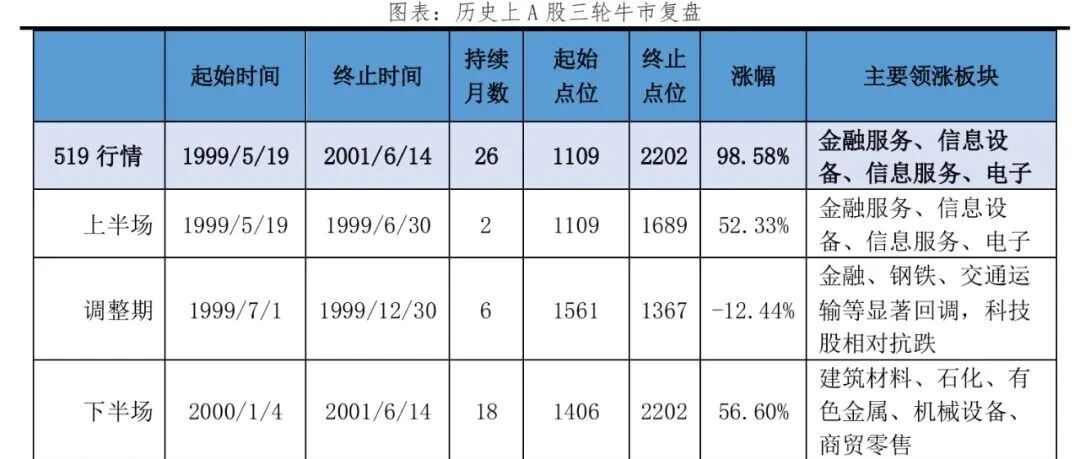
Core Viewpoint - The article discusses the unprecedented stimulus policies since late September 2024 that have ignited a "confidence bull market" in A-shares and Hong Kong stocks, exploring the patterns of previous bull markets and the potential trajectory of the current market [1][2]. Summary by Sections Historical Bull Markets - The article reviews three major bull markets in A-shares: the 519 market from 1999-2001, the cyclical bull from 2005-2007, and the reform bull from 2014-2015, analyzing their characteristics and outcomes [2][10]. 1999-2001 519 Market - Initiated during economic downturns with policy stimulus, ending due to profit inability to support valuation bubbles. The Shanghai Composite Index rose 98.6% over 26 months [3][15]. - The first half was driven by policy and valuation speculation, while the second half saw a surge due to economic recovery and tech stock performance, culminating in a peak in June 2001 [15][21]. 2005-2007 Cyclical Bull Market - This bull market was driven by strong economic fundamentals and the resolution of the split share structure, with the Shanghai Composite Index increasing by 513.6% over 28 months [4][28]. - The market experienced a three-phase structure: recovery from undervaluation, a brief adjustment, and a performance-driven surge, particularly in resource and financial sectors [31][35]. 2014-2015 Reform Bull Market - Triggered by economic slowdown and policy easing, this market saw the Shanghai Composite Index rise by 148.96% in 11 months, primarily driven by leverage and external capital inflows [5][47]. - The market transitioned from cyclical to growth stocks, with significant gains in technology and consumer sectors, but ended due to lack of fundamental support and regulatory tightening [51]. Key Discoveries from Historical Bull Markets - A bull market requires three conditions: policy shift, capital inflow, and low valuations, often starting amid controversy and ending in exuberance [6][53]. - Bull markets typically progress through three phases: policy-driven, capital-driven, and fundamentally driven, with the latter being crucial for sustainability [6][54]. - A-shares exhibit characteristics of short bull markets and long bear markets, with average bull market durations of 17.35 months compared to 27.12 months for bear markets [7][53]. Current "Confidence Bull Market" Analysis - The current bull market shares similarities with previous ones, starting during economic downturns and driven by policy shifts, with a focus on technology and liquidity [8][56]. - The market's sustainability hinges on continued policy support, technological innovation, and effective management of leverage to avoid extreme volatility [62][61].