
军工

Search documents
招商证券:1月市场或呈现结构性增量资金流入的格局 有望助力A股延续上行趋势
Zhi Tong Cai Jing· 2026-01-06 22:27
Core Viewpoint - The trend of RMB appreciation combined with the historical end-of-year and early-year period serves as a window for foreign capital to allocate into A-shares, with short-term expectations of net inflows contributing to incremental funds [1][2] Group 1: Market Trends - Historically, various types of funds show specific changes in January, with insurance and foreign capital typically positioning themselves at the beginning of the year, while financing funds tend to weaken towards the end of January [2] - The overall market in January is likely to present a structural inflow of incremental funds, which is expected to support the upward trend of A-shares and continue the spring rally, with a recommendation for large-cap style [1][2] Group 2: Monetary Policy and Interest Rates - The central bank's net injection in the open market was 700.9 billion yuan from December 29 to December 31, with 1.322 trillion yuan in reverse repos and 60 billion yuan in treasury cash deposits maturing in the upcoming week [2] - Money market interest rates are declining, while both short and long-term government bond yields are rising, with a decrease in the issuance scale of interbank certificates of deposit [2] Group 3: Fund Supply and Demand - The net inflow of funds in the secondary market is expanding, with a decrease in financing balance and net selling of financing funds amounting to 2.27 billion yuan [3] - There is a notable reduction in the issuance of new equity public funds, and significant shareholders are increasing their net reduction scale [3] Group 4: Market Sentiment - The trading activity of financing funds has weakened, leading to a decrease in equity risk premium, with turnover rates for various style indices and major industry categories generally declining [3] - The VIX index has risen, indicating a decrease in risk appetite in overseas markets [3] Group 5: Industry Preferences - In terms of industry preferences, sectors such as non-ferrous metals, defense and military industry, and household appliances have seen higher net inflows from various funds [3] - The broad-based ETF has primarily experienced net redemptions, with the largest redemptions occurring in the Shanghai Stock Exchange 50 ETF [3]

【公告全知道】商业航天+人形机器人+低空经济+军工+新能源车!公司商业航天火箭结构件业务已形成正式的合同订单
财联社· 2026-01-06 15:32
Group 1 - The article highlights significant announcements in the stock market, including "suspensions and resumption of trading, shareholding changes, investment wins, acquisitions, performance reports, unlocks, and high transfers" [1] - A company involved in commercial aerospace has established formal contract orders for rocket structural components, with major clients including Blue Arrow Aerospace, and has received small batch sample orders from clients like Zhiyuan Robotics [1] - Another company is focused on brain-computer interfaces, humanoid robots, multimodal AI, autonomous driving, AI chips, and cloud computing, and is optimizing its brain model while developing its own brain-computer interface system, having partnered with Leju Robotics to deliver a small number of robots equipped with the large model [1] - A company has signed a second fully automated OCS (Optical Switch) packaging production line order, indicating its involvement in commercial aerospace, chips, and CPO, with partnerships including Nvidia and Huawei HiSilicon [1]


2026年大类资产配置展望:守正出奇,于结构分化中掘金
CMS· 2026-01-06 12:46
- The report discusses the construction of a "ROIC Model" for interest rate predictions. The model calculates the implied ROIC of the bond market and compares it with the equity market's ROIC to estimate the interest rate midpoint. The formula used is: $ ROIC = (Risk-free rate + Equity risk premium) × Equity proportion + (Risk-free rate + Credit risk premium) × Debt proportion $ Here, the risk-free rate is represented by the 30-year government bond yield, and the credit risk premium is derived from AAA corporate bond spreads. The model uses data from A-share listed companies (excluding financials) and large-scale industrial enterprises to calculate ROIC values. The results show a long-term downward trend in both equity and bond market ROICs, with equity ROIC consistently higher by an average of 50 basis points over the past decade[51][52][56] - The "Multi-cycle Interest Rate Timing Strategy" is introduced, which employs kernel regression algorithms to identify support and resistance levels in interest rate trends. This strategy is applied to 5-year, 10-year, and 30-year government bond yields. The annualized returns for the strategy are 2.19%, 2.48%, and 3.26%, respectively, with maximum drawdowns of 0.72%, 0.97%, and 1.71%. The strategy demonstrates stable performance, with probabilities of achieving positive absolute and excess returns close to 100% since 2008[75][77][81] - A "Pure Bond CARRY Strategy" is also highlighted, which leverages dynamic leverage to enhance returns. The strategy allocates 140% to bonds when borrowing costs (R007) are below the 80th percentile of historical levels and 100% otherwise. Over the past decade, the strategy has delivered an annualized return of 5.56%, with a return-to-drawdown ratio of 0.92. In 2023-2025, the strategy achieved annual returns of 7.21%, 7.39%, and 2.25%, respectively, with excess returns of 84 basis points, 121 basis points, and 21 basis points[83][84][88] - The "Momentum and Fundamental Composite Factor" is used for sector rotation strategies. This factor combines "Net Profit Growth Rate (QoQ)" and "ROA TTM Growth Rate (QoQ)" to rank industries. Historical backtests from 2008 to 2025 show strong performance, with an average annualized return of 18.60% and an excess return of 8.49% over the benchmark. In 2025, industries such as electronics, computers, media, defense, non-ferrous metals, and new energy equipment ranked high in both valuation and fundamental improvement metrics, making them recommended sectors for Q1 2026[45][46][47] - The "PB-ROE Framework" is applied to identify undervalued industries. By comparing the PB and ROE levels of various sectors as of December 31, 2025, industries like non-bank financials, home appliances, agriculture, basic chemicals, and light manufacturing are identified as having relatively low PB but high ROE expectations. These sectors are considered undervalued and are recommended for investment in 2026[48][49][50]
兴业证券:95%个股仍待新高 市场或存在结构性机会
智通财经网· 2026-01-06 12:43
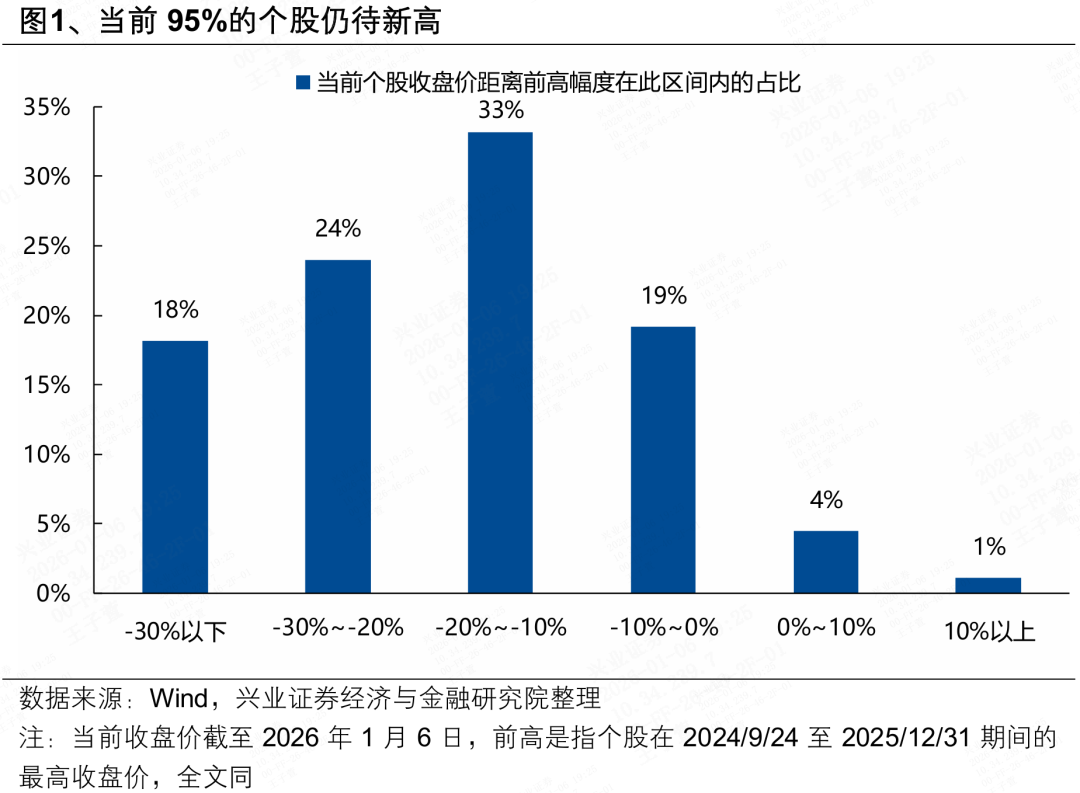
Core Viewpoint - As of January 6, 95% of individual stocks have not broken their previous highs, despite major indices reaching new highs, indicating potential structural opportunities in the market [1][2]. Group 1: Market Overview - Major indices such as the Shanghai Composite Index, All A-shares, CSI 300, and CSI 800 have all reached new highs, but only 5% of individual stocks have surpassed their previous highs [2]. - The previous high for individual stocks is defined as the highest closing price from September 24, 2024, to December 31, 2025, with most stocks still down by over 10% from these highs [2]. Group 2: Sector Performance - The sectors that have broken through previous highs are concentrated in a few segments, particularly in large financials represented by insurance, and sectors benefiting from price increases such as non-ferrous metals, chemicals, petrochemicals, and construction materials [1][5]. - Other sectors that have seen new highs include military, machinery, and home appliance components driven by commercial aerospace and robotics [1][5]. Group 3: Sectors Near Previous Highs - Sectors that have not yet broken their previous highs but are close include technology growth (commercial vehicles, semiconductors, communication equipment), cyclical industries (steel raw materials, renovation materials), and consumer sectors (animal health, textiles, agriculture) [10]. - Industries with significant gaps to their previous highs include technology growth (motors, software, batteries, photovoltaics), dividend sectors (electricity, white goods, banks), and consumer sectors (food and beverage, social services, retail) [13].

兴证策略张启尧团队:95%个股仍待新高
Xin Lang Cai Jing· 2026-01-06 12:26
Core Viewpoint - As of January 6, major indices such as the Shanghai Composite Index, All A, CSI 300, and CSI 800 have reached new highs, but 95% of individual stocks have not surpassed their previous highs, indicating a concentrated market rally driven by a few sectors [1][16]. Group 1: Market Performance - The overall market has shown a "continuous rise" since mid-December, primarily driven by a few sectors, with significant contributions from large financial stocks like insurance [4][17]. - The current market dynamics reveal that only 5% of stocks have broken through their previous highs, with most stocks still down by over 10% from their peaks [1][16]. Group 2: Sector Analysis - Industries that have surpassed previous highs are mainly concentrated in specific segments such as large financials (insurance), certain materials (non-ferrous metals, chemicals, oil and gas), and sectors related to commercial aerospace and robotics [6][20]. - Sectors that are close to their previous highs but have not yet surpassed them include technology growth (commercial vehicles, semiconductors), cyclical industries (steel raw materials, building materials), and consumer sectors (animal health, textiles) [9][25]. - Industries that remain significantly below their previous highs include technology growth (electric motors, software, batteries), dividend sectors (electricity, banking), and consumer sectors (food and beverage, retail) [13][27].
中国卫星:目前股价已处于历史最高点,公司股价已脱离基本面
Xin Lang Cai Jing· 2026-01-06 10:01
Core Viewpoint - The stock price of China Satellite has increased by 156.07% since December 3, 2025, significantly outperforming the 23.92% increase in the Shenwan Military Industry sector and the 5.31% increase in the Shanghai Composite Index, indicating a potential overreaction in market sentiment [1] Group 1: Stock Performance - The company's stock has shown a short-term increase that is markedly higher than both the industry and the Shanghai Composite Index [1] - The latest rolling price-to-earnings (P/E) ratio for the company is 2201.97 times, while the price-to-book (P/B) ratio is 19.92 times, both significantly exceeding the industry averages [1] - The Shenwan Military Industry sector has a latest rolling P/E ratio of 188.95 times and a P/B ratio of 5.03 times, indicating that the company's valuation is severely detached from its fundamentals [1] Group 2: Trading Activity - As of January 6, the stock turnover rate was 15.33%, with an average turnover rate of 15.08% over the previous five trading days, which is higher than the normal turnover rate [1] - The stock is currently at its historical peak, suggesting a potential for rapid price corrections due to market dynamics [1]

长城基金汪立:2026新开局,市场有望迈出关键一步
Xin Lang Cai Jing· 2026-01-06 08:47
Group 1: Market Overview - The A-share market exhibited a volatile adjustment pattern last week, with significant divergence among major indices and notable structural characteristics [1][7] - Technology applications showed strength, while the oil and petrochemical sectors experienced two consecutive weeks of gains; the military industry continued to gain traction, but the new energy sector saw a pullback [1][7] Group 2: Macro Analysis - The manufacturing PMI in December showed a seasonal rebound, reaching 50.1%, an increase of 0.9 percentage points from November, marking the first expansion since April [2][8] - Among 21 surveyed industries, 16 reported a PMI increase compared to November, driven by improved trade conditions, domestic policy adjustments, and energy supply stability [2][8] - The government has proactively issued new local government debt limits for 2026 and initiated significant investment plans totaling approximately 295 billion yuan to accelerate fund allocation [2][8] Group 3: Overseas Economic Data - Recent U.S. economic data exceeded expectations, with pending home sales in November rising by 3.3%, significantly above the anticipated 0.9% [3][9] - Initial jobless claims unexpectedly dropped to 199,000, lower than the forecast of 218,000, indicating a robust labor market [3][9] - The December FOMC meeting minutes indicated a hawkish stance, with most participants supporting potential rate cuts if inflation trends downward [3][9] Group 4: Investment Strategy - The Chinese stock market is expected to stabilize and surpass critical thresholds, supported by anticipated U.S. interest rate cuts and increased liquidity from new capital inflows [4][10] - The focus is on technology growth, non-bank financials, and cyclical assets, with a particular emphasis on AI and emerging market industrialization trends [4][10] - Investment opportunities include sectors such as internet, electronics, media, and manufacturing with global competitive advantages, as well as non-bank financials like insurance and brokerage firms [5][11]
淘气天尊:放量新高要谨慎,短线调整进入倒计时!(01.06)
Jin Rong Jie· 2026-01-06 08:26
Market Overview - The market opened higher on Tuesday, with the Shanghai Composite Index starting at 4026 points and the ChiNext Index at 3279 points, eventually closing at 4083 points and 3319 points respectively, indicating a strong upward trend [1] - A total of 4108 stocks rose, with 162 stocks increasing by over 9% and 807 stocks by over 3%, while 1222 stocks declined, showing a clear dominance of the bullish trend [1] Sector Performance - Key sectors such as non-ferrous metals, brokerage, insurance, chemicals, oil, military, and coal significantly boosted the index, while other sectors experienced limited gains [1] - The market showed signs of a "crazy phase," with a notable increase in trading volume, indicating that retail investors are actively entering the market [1] Investor Sentiment - Retail investors are reportedly chasing stocks based on perceived large inflows from institutional investors, which is a common tactic used by market leaders to influence sentiment [1] - The commentary suggests that investors should exercise patience and caution, particularly with stocks that have not yet seen significant gains [1] Technical Analysis - The market is currently facing short-term risks, with potential adjustments expected if the index approaches 4100 points or higher, which could lead to significant resistance [1] - The overall upward momentum of the index has exceeded expectations, but the breadth of individual stock gains has not met the same level of enthusiasm [1] Future Outlook - The market may experience a pullback if it opens lower in the following sessions, but there could still be opportunities for rebounds [1] - Investors are advised to wait for clearer signals of recovery and to manage their positions carefully, especially with stocks that have not yet participated in the rally [1]
港股国企ETF(159519)涨超0.8%,人民币升值与盈利预期成焦点
Sou Hu Cai Jing· 2026-01-06 06:15
Core Viewpoint - The Hong Kong Stock Exchange's state-owned enterprise ETF (159519) rose over 0.8%, driven by the appreciation of the Renminbi and profit expectations [1] Group 1: Market Trends - By 2026, the capital market is expected to feature a dual focus on "technological innovation + dividend assets" [1] - In terms of technological innovation, artificial intelligence and smart manufacturing are identified as core themes, with the "14th Five-Year Plan" elevating "AI+" to a national strategy, predicting that the smart economy will become a significant growth driver by 2030 [1] - The PB valuation of technology sectors such as electronics, communications, and computers has reached historical highs, indicating strong market pricing for cutting-edge technologies [1] Group 2: Dividend Assets - The cash dividends for the SSE 50 and CSI 300 constituent stocks are projected to reach CNY 10,116 billion and CNY 18,192 billion in 2024, respectively, with dividend payout ratios exceeding 40% [1] - The trend of high dividends is expected to continue under policy guidance [1] Group 3: Traditional Industry Upgrades - Traditional industries such as mining, metallurgy, chemicals, and machinery are anticipated to strengthen their global competitiveness, with an expected market space increase of CNY 10 trillion over the next five years [1] - The chemical industry has shown signs of profit improvement, with a ROE of 7.47% [1] Group 4: Defense and Infrastructure - The military industry is poised for growth due to accelerated national defense modernization, with a projected 7.2% year-on-year increase in the defense budget by 2025 [1] - The commercial aerospace market is expected to exceed CNY 2.3 trillion in scale [1] - The power grid equipment sector will benefit from the construction of new power systems, with average annual investments expected to increase during the "14th Five-Year Plan" period [1]
5日欧洲三大股指集体上涨 军工板块涨幅居前
Xin Lang Cai Jing· 2026-01-06 05:03
Group 1 - The core point of the article highlights the collective rise of Europe's three major stock indices, with the UK FTSE 100 index breaking the 10,000-point mark for the first time, closing up by 0.54% [1] - The French CAC40 index increased by 0.20%, while the German DAX index saw a more significant rise of 1.34% [1] - The military sector in Europe experienced notable gains, driven by the U.S. military action against Venezuela, with shares of Germany's largest arms manufacturer Rheinmetall and Sweden's Saab, the maker of the Gripen fighter jet, both rising over 5% [1]