农产品

Search documents
暴跌了,然后呢?
对冲研投· 2026-02-02 23:33
Core Viewpoint - The recent sharp decline in commodity prices is primarily driven by emotional panic rather than a collapse in the fundamental supply and demand dynamics of the commodities themselves [2][6]. Group 1: Causes of the Decline - The core reason for the market crash is the collapse of sentiment in precious metals, which led to a sell-off across various sectors, including non-ferrous metals like copper and aluminum [2][3]. - Two key news events acted as "triggers" for the market panic: the nomination of Kevin Warsh as the next Federal Reserve Chairman, raising concerns about the end of the "cheap money era," and the easing of geopolitical tensions between the U.S. and Iran, which reduced the "geopolitical risk premium" in oil prices [3][4]. - The market was already saturated with speculative positions and high leverage, which exacerbated the sell-off when negative news emerged, leading to forced liquidations and a vicious cycle of price declines [5][6]. Group 2: Sector Analysis - **Non-Ferrous Metals**: Despite the sharp declines, the fundamental support for copper and aluminum remains intact. Issues such as declining ore grades and limited new supply for copper persist, while demand from sectors like home appliances and electric vehicles is expected to rise [8][10]. - **Energy and Chemicals**: The oil and chemical sectors experienced significant declines due to the removal of geopolitical risk premiums and concerns over weak global oil demand. However, coal and salt chemicals showed resilience as their costs are more tied to domestic coal prices [11][12]. - **Black Metals**: The black metal sector is facing pressure from both weak seasonal demand and the negative sentiment from precious metals. However, the rate of inventory accumulation is not alarming, providing some buffer against drastic price drops [13]. - **Agricultural Products**: Agricultural commodities are less affected by the recent market turmoil, as their prices are primarily driven by domestic supply and demand factors, making them more resilient to macroeconomic fluctuations [14]. Group 3: Investment Strategy - Investors are advised to distinguish between emotional market reactions and the intrinsic value of commodities. The current market turmoil is seen as a temporary emotional response rather than a fundamental shift in value [15][20]. - The recommended strategy is to adopt a wait-and-see approach, avoiding aggressive positions until market volatility decreases and signs of stabilization appear [16][19]. - Preparation for future opportunities is essential, including reassessing the supply-demand dynamics of favored commodities and planning entry strategies [17][18].


锦州土特产年货大集 “锦绣农鲜”特色展区启幕
Xin Lang Cai Jing· 2026-02-02 23:09
Core Viewpoint - The "Jinzhou Year - Northeastern Specialty Products - Seeking New Year Flavor" 2026 Jinzhou Specialty Products Fair has officially opened, showcasing the high-quality development of Jinzhou's agricultural industry through over 30 unique agricultural products from 14 local quality agricultural enterprises [1]. Group 1: Event Overview - The event is held at the Jinzhou International Convention and Exhibition Center, featuring a special exhibition area called "Jin Xiu Nong Xian" [1]. - The fair aims to enhance holiday consumption and meet the public's demand for one-stop shopping and tasting of fresh products [1]. Group 2: Featured Products - The showcased products include "Liaoning Excellent Products" such as tender and crisp lily pickles, fresh and plump eggs listed in the national catalog of famous specialty agricultural products, and high-quality sea cucumbers from Linghai [1]. - Other notable products include alkaline hazelnuts, mixed grain dumpling flour, fresh fruits and vegetables, grain and oil, poultry and eggs, as well as deep-processed foods [1].
印度股指直线拉升!特朗普宣布:降低关税
Zhong Guo Ji Jin Bao· 2026-02-02 22:40
Group 1 - The core point of the news is the trade agreement between the United States and India, which involves reducing tariffs on Indian goods from 25% to 18%, easing tensions between the two countries [1][2][3] - The agreement will significantly lower the overall tax burden on many Indian products from 50% to 18%, particularly benefiting textiles and machinery [1][11] - India is expected to purchase over $500 billion worth of American energy, technology, agricultural products, coal, and other goods as part of the agreement [1] Group 2 - The announcement led to a surge in India's benchmark stock index Nifty 50 futures and a nearly 3% increase in the iShares MSCI India ETF listed in the U.S. [7] - The Indian rupee strengthened against the dollar, rising by 1% in offshore markets following the news [7] - High tariffs had previously impacted approximately 55% of India's exports to the U.S., affecting its ambition to become a manufacturing powerhouse [11]
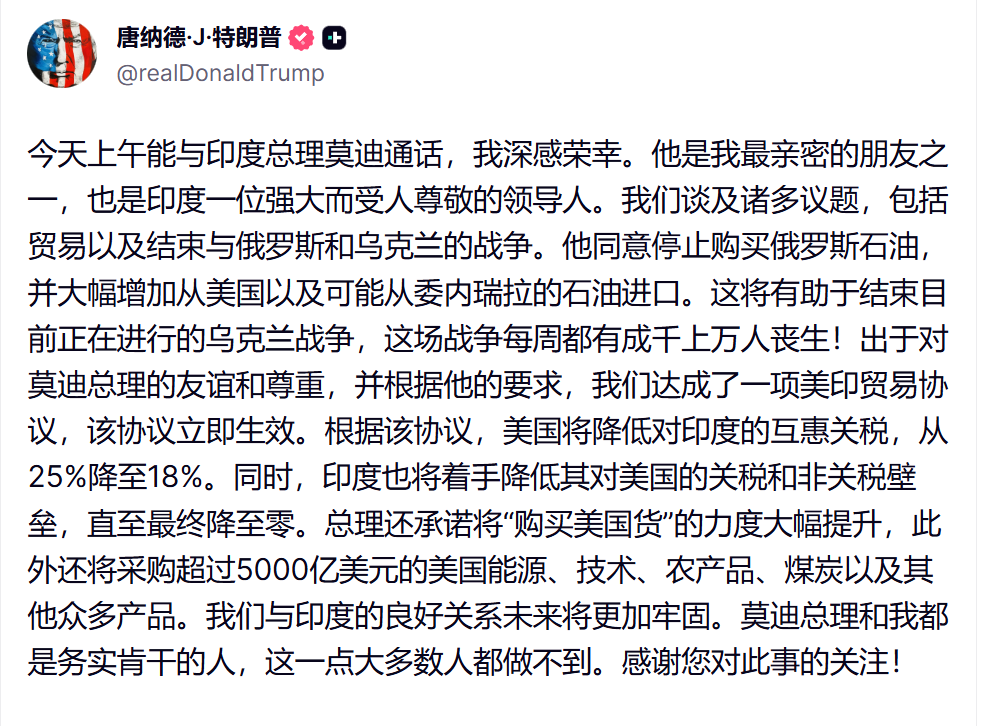
特朗普称莫迪同意停止购买俄罗斯石油
Sou Hu Cai Jing· 2026-02-02 20:07
Group 1 - The core point of the article is the announcement of a trade agreement between the United States and India, which includes significant tariff reductions and increased procurement of American products by India [4] Group 2 - The U.S. will reduce its "reciprocal tariffs" on India from 25% to 18%, while India will lower its tariffs and non-tariff barriers to potentially zero [4] - India is expected to significantly increase its purchases of U.S. products, including over $500 billion worth of energy, technology, agricultural products, coal, and more [4] - India has agreed to stop purchasing oil from Russia and will increase its oil imports from the U.S., with potential purchases from Venezuela as well [4]

特朗普宣布对印度降低关税
Xin Lang Cai Jing· 2026-02-02 17:14
Core Viewpoint - The article discusses a recent phone call between former President Trump and Indian Prime Minister Modi, focusing on a trade agreement and efforts to end the Russia-Ukraine conflict [1] Trade Agreement - The U.S. and India have reached a trade agreement where the U.S. will reduce tariffs from 25% to 18% [1] - India is expected to lower its tariffs and non-tariff barriers to zero [1] Energy Purchases - Modi has agreed to stop purchasing Russian oil and significantly increase oil purchases from the U.S. and potentially Venezuela [1] - The agreement includes a commitment from India to purchase over $500 billion worth of U.S. energy, technology, agricultural products, coal, and other goods [1]
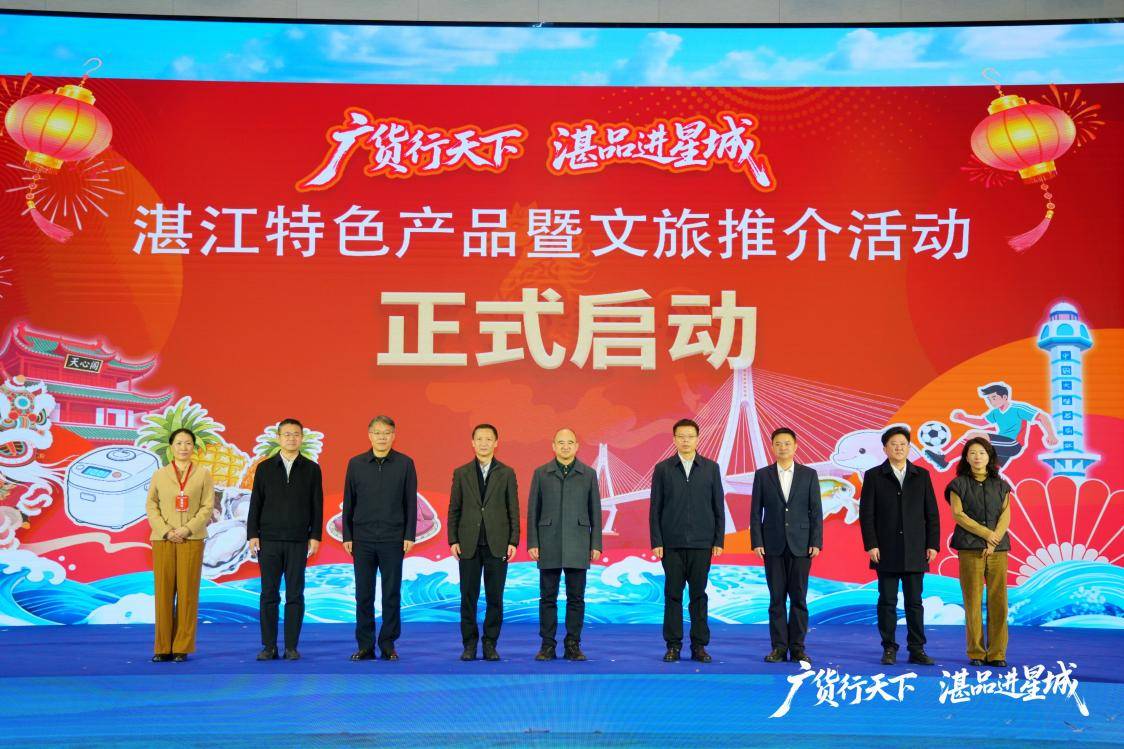
湛江“湛品”走进星城 粤湘携手拓市场促消费
Sou Hu Cai Jing· 2026-02-02 12:52
Core Viewpoint - The event "Guanghuo Hang Tianxia, Zhanpin Jin Xingcheng" aims to enhance economic, cultural, and tourism cooperation between Guangdong and Hunan provinces, leveraging Zhanjiang's quality agricultural products brand "Zhanpin" to stimulate regional market vitality and promote industrial collaboration [1][9]. Group 1: Event Overview - The event took place in Changsha, Hunan, and is part of a series of promotional actions to deepen cooperation between Guangdong and Hunan [1]. - Zhanjiang is recognized for its rich coastal resources and has been branded as "China's Seafood Capital" and "China's Golden Pomfret Capital" [3]. Group 2: Agricultural and Cultural Promotion - Zhanjiang has established the "Zhanpin" public brand, focusing on high-quality agricultural products, which has led to its recognition as one of the top 100 agricultural image brands in China [3]. - The event featured cultural performances that highlighted the deep cultural connections between Zhanjiang and Hunan, including traditional music and dance [3][5]. Group 3: Product Showcase and Culinary Experience - Multiple immersive experience zones were set up, showcasing signature products like golden pomfret, prawns, and volcanic sweet potatoes, along with cultural creative gifts [5]. - Renowned chefs from Guangdong and Hunan collaborated to create dishes that combined local seafood with Hunan cooking techniques, providing a unique culinary experience [5][7]. Group 4: Industry Collaboration and Agreements - The event facilitated "1+1" sales agreements between agricultural, fishery, and food industry representatives from Zhanjiang and Changsha, allowing quality "Zhanpin" products to enter the Changsha market [7]. - An interactive segment involving football associations from Zhanjiang and Changsha was included to promote grassroots exchanges and deepen friendships [7][8].
农业游说团体称,乌克兰1月份农产品出口量与去年12月持平,稳定在500万吨。
Xin Lang Cai Jing· 2026-02-02 12:22
农业游说团体称,乌克兰1月份农产品出口量与去年12月持平,稳定在500万吨。 ...

光期农产品:玉米、淀粉月报-20260202
Guang Da Qi Huo· 2026-02-02 11:08
Group 1: Report Industry Investment Rating - No relevant content found Group 2: Core Views of the Report - The January USDA report was bearish, causing a sharp decline in US corn prices. The report raised the corn production forecast to 17.021 billion bushels, reaching a record high. US corn yield was 186.5 bushels per acre, with increased area and high yield, leading to a 5% drop in US corn prices. Concerns about rising global supply continued to ferment, and the US corn quarterly inventory reached an all - time high [3]. - In the domestic market, as the Lunar New Year approached in January, the sales progress of damp corn in the production areas increased, causing the futures prices of near - month corn contracts to decline, and the far - month contracts also adjusted accordingly. As of January 29, the national weekly average corn price was 2,332 yuan/ton [4]. - The corn starch industry has been in continuous losses, with industry profits hovering around the break - even point, and the starch futures prices have been oscillating downward [10]. - After the New Year's Day, the pig price declined, and pig farming shifted from profit to loss. Pig - listed enterprises actively sold their pigs before the Spring Festival [12]. Group 3: Summary by Relevant Catalogs 0.1 - 0.7 Review - Wheat main - producing countries' production increased from a decrease. Sufficient global inventory overshadowed the market, and the expectation of a bumper wheat harvest in Argentina was continuously strengthened. The wheat price was at a 5 - year low. Factors affecting the wheat market in 2026 include the Fed's monetary policy, tariff policies and trade disputes, the progress of the Russia - Ukraine situation, the weather in wheat main - producing countries, and Russia's wheat production capacity and exports [5][6]. - The January USDA report was bearish for US corn. The carry - over inventory of US corn in the new year increased significantly, and the corn price fell to a 4 - month low and then oscillated upward. The US corn stock - to - use ratio increased, and the annual quote was at a low level. Factors affecting the US corn market in 2026 include the Fed's monetary policy, tariff policies and trade disputes, the weather in corn main - producing countries, and the US grain export sales situation [7]. - For DCE corn, the policy shifted from bullish to bearish. Near - month contracts first rose and then fell. Factors affecting the DCE corn market in 2026 include the impact of the macro - market and monetary policy on commodities, the corn production and sales patterns in main - producing countries such as the US and China, the role of China's import - restriction policy, the impact of the imported corn auction policy, and pig prices and feed deep - processing consumption [8]. - The corn starch industry has been in continuous losses at the beginning of the year, and the starch futures prices have been adjusted at a high level. Factors affecting the DCE corn starch market in 2026 include the impact of the macro - market and monetary policy on commodities, the impact of corn raw materials on starch quotes, the disturbance of starch by - product sales on starch quotes, and pig prices and feed deep - processing consumption [10]. - After the New Year's Day, the pig price declined, and the forward quote fell to a previous low. Factors affecting the DCE live pig market in 2026 include the impact of the macro - market and monetary policy on commodities, the impact of breeding losses on the industry scale, the impact of improved breeding efficiency on costs, and the impact of raw material price changes such as soybean meal and corn on pig prices [11]. - In 2025/2026, the wheat production in global main - producing countries recovered and increased. China's wheat inventory decreased, while the inventories of other main - producing countries increased. The global wheat production increase was greater than the consumption increase, and the carry - over inventory increased significantly. The wheat market in 2026 will continue to focus on geopolitics [13]. - The corn production in global main - producing countries increased. The inventories in South America and the EU decreased, and the carry - over inventory of new - season US corn increased significantly. The US corn production increased substantially, and the industry expects the soybean area to increase and the corn area to decrease in 2026 [14]. 1.0 - 1.10 Supply and Demand - After the USDA report, US corn led the decline, and wheat followed. The January report was bearish, and corn prices fell 5% on the report day. The low - price advantage of the US grain market gradually emerged, and the global grain supply was sufficient, with supply - side pressure continuing to affect the market [15][40]. - In 2025, the US corn area increased significantly, and the production reached a record high. Currently, the industry expects the soybean area to increase and the corn area to decrease in 2026 [21]. - In January, the USDA estimated the US corn yield to be 186.5 bushels per acre, and the US corn quarterly inventory reached an all - time high [27]. - In mid - January, bargain - hunting buyers entered the US corn market. Low - price corn promoted sales, and after the sales progress improved, the corn futures prices regained support [33]. - In 2025, China imported 2.65 million tons of corn from January to December. The monthly import volume of corn increased significantly from November to December. The industry expects that after the China - US talks, China's imports of grains from the US will resume and increase. In the second half of 2025, to stabilize corn prices, the China National Grain Reserves Corporation issued an announcement on the competitive sales of imported corn, increasing market supply. The 2024/2025 annual imports of substitutes such as sorghum, corn, and barley in China totaled about 20 million tons, a year - on - year decrease of nearly 40 million tons. In 2025/2026, China - US negotiations are expected to increase the imports of corn and sorghum, and the current industry generally expects the year - on - year increase in corn imports to be between 5 - 10 million tons, and the peak of the total increase in imports of substitutes such as sorghum, corn, and barley is expected to be 20 million tons [43]. - At the end of January, the wheat price in the main production areas was 2,525 yuan/ton, up 13 yuan/ton from the previous month and 5.38% year - on - year. After the New Year's Day, a total of 800,000 tons of competitive wheat was put on the market, and 565,300 tons were traded. The wheat market was supported by multiple factors and showed a slightly strong and oscillating trend [45]. - Currently, the corn starch operating rate is 59.99%. After the starch price increased, the enterprise order - signing slowed down. The expected profit of starch processing in Shandong is 12 yuan/ton. The corn starch price remained firm, and the low - price supply tightened [47][49]. - At the end of January, the national corn sales progress was 60%. The March contract first rose and then fell, and the long - position funds left the market, causing the futures price to oscillate at a high level [54]. - The port inventory has been at a low level. As of January 23, the inventory in the northern ports was 3.097 million tons lower year - on - year, and the inventory data was bullish [62]. 2.1 - 2.4 Outlook - In the first quarter, attention should be paid to the China - US procurement plan. It is expected that the procurement scale of agricultural products such as sorghum and corn will resume and increase in 2026 [70]. - The main corn 2603 contract first rose and then fell. Before the Spring Festival, long - position funds left the market, and the far - month contract futures prices entered a tug - of - war stage [72]. - The average inventory of feed enterprises is 31.93 days, a month - on - month increase of 1.95% and a year - on - year decrease of 2.21%. The downstream stocking before the Spring Festival drove the futures and spot prices to rebound [75]. - The corn futures prices are in a positive arrangement. After the March contract hit the 2,300 mark, it fell back. The corn market faces a directional choice around the Spring Festival. The short - term trend is that funds will shift from the March contract to the May and July contracts, and the far - month contracts face a directional choice. In the long term, the expectation of a bumper harvest, combined with increased imports and substitutes, will cause the corn futures prices to return to the oscillating range, and downstream procurement will determine the direction. The recommended operation is to stop profit on accumulated options and then wait and see [82]. Policy - The industry expects that the China - US negotiations in 2026 will progress smoothly, and China will increase the imports of grains such as sorghum and corn while importing soybeans [83]. - The wheat minimum purchase price competitive trading had a 50% transaction rate in the first week, and 200,000 tons were sold again on January 14, with a market transaction rate of 80.49% [83]. - On January 7, the Inner Mongolia Branch of the China National Grain Reserves Corporation conducted a competitive sales. It put 95,400 tons on the market, with an average premium of 62 yuan/ton. The imported corn was sold at a premium, and the bullish sentiment was transmitted to the futures market [83]. - According to customs data, in December 2025, the import volume of corn (885811) starch was 180,733 tons, a month - on - month decrease of 33.95% and a year - on - year decrease of 20.94%. The import amount was 358,000 US dollars, a month - on - month decrease of 21.87% and a year - on - year decrease of 1.08%. From January to December, the total import volume of corn (885811) starch was 5,248,226 tons, a year - on - year increase of 97.28%, and the total import amount was 6.5695 million US dollars, a year - on - year increase of 44.02%. In December 2025, the export volume of corn (885811) starch was 16,739,626 tons, a month - on - month decrease of 1.20% and a year - on - year increase of 75.60%. The export amount was 6.4769 million US dollars, a month - on - month increase of 0.78% and a year - on - year decrease of 23.23%. From January to December, the total export volume of corn (885811) starch was 213,444,099 tons, a year - on - year increase of 967.96%, and the total export amount was 81.7879 million US dollars, a year - on - year increase of 797.93% [83]. - After the New Year's Day, a total of 800,000 tons of competitive wheat was put on the market (200,000 tons per week for four weeks), and 565,300 tons were traded. The transaction rates of the four times were 50%, 80.49%, 71.64%, and 77.55% respectively [83].
养殖产业链日报:近月宽松明显-20260202
Guan Tong Qi Huo· 2026-02-02 11:04
Group 1: Report Industry Investment Rating - No relevant information provided Group 2: Core Viewpoints of the Report - The cyclical bottom of soybeans has emerged, and the subsequent decline space is limited. It is estimated that soybeans will continue to fluctuate [1] - Corn is expected to have wide - range fluctuations before the Spring Festival. If there is a large decline, consider buying on dips [1] - There is no obvious short - term driver for eggs. Due to a slight improvement in the marginal inventory compared to the second half of last year, it is not recommended to be overly bearish [2] - The darkest time for pigs around the Spring Festival has passed. Subsequently, attention should be paid to the regulation of sows to build a supply - demand balance sheet for the far - month period [4] Group 3: Summary by Related Categories Soybeans - In the Northeast soybean producing area, the spot market for low - protein soybeans is stable. The supply of high - protein soybeans is tight with the feature of high - quality and high - price. The price of 39% protein - content commercial soybeans in some areas is around 2.2 yuan per catty [1] - On February 2, 2026, at 14:00, China Grain Reserves Corporation planned to auction 60,608 tons of soybeans, all of which were sold. The reserve price was 4,050 yuan per ton, the average transaction price was 4,298 yuan per ton, and the premium was 210 - 310 yuan per ton [1] Corn - In the Northeast production area, after entering the twelfth lunar month, farmers' attitude of holding prices has loosened slightly, and the amount of corn on the market has improved slightly. In terms of demand, there is a rigid demand for stocking before the Spring Festival in the feed and deep - processing industries, but due to the relatively high price of dry corn, the inventory days of mainstream feed and deep - processing corn have increased to more than 30 days [1] Eggs - The current inventory of laying hens is still at a relatively high level in recent years. The old - hen culling rate has slowed down, and new - laying hens are gradually entering the market, resulting in the overall production capacity remaining high [2] Pigs - At the end of 2025, the inventory of breeding sows was 39.61 million, a decrease of 1.16 million or 2.9%. It was 101.6% of the normal reserve. The national pig slaughter in 2025 was 719.73 million, an increase of 17.16 million or 2.4%. The national pig inventory at the end of 2025 was 429.67 million, an increase of 2.24 million or 0.5% [2] - With the arrival of the Spring Festival in February, the pressure on the breeding side to sell pigs may be temporarily reduced. The supply of pigs is expected to decrease significantly. The pre - festival stocking provides short - term support, but the demand will decline after the Spring Festival [3] - In 2025, pig - related enterprises generally declined, with most enterprises suffering heavy losses and their stock prices falling sharply, which also had a certain pessimistic impact on the commodities [3]
盟商务口岸局助推兴安好物登上快手头部直播间,年货节热销破16万元
Sou Hu Cai Jing· 2026-02-02 10:30
Group 1 - The core event highlighted is the successful live streaming session by Kuaishou's top anchor, which resulted in significant sales of local agricultural products from Inner Mongolia, specifically 2,800 units of Fandatian rice and over 500 units of Kewai dried fruit, generating sales exceeding 160,000 yuan [1] - The "Harvest China" initiative, launched on January 26, aims to promote local products through a collaboration between the Inner Mongolia Autonomous Region's Commerce Department and Kuaishou, focusing on high-quality local goods [3] - The live streaming session effectively communicated the ecological and brand stories of Inner Mongolia's products, enhancing consumer perception and driving sales through a combination of local culture and product quality [5] Group 2 - The collaboration between government and enterprises is emphasized as a successful model for promoting agricultural products, allowing direct access to consumers while eliminating intermediaries, thus benefiting both consumers and farmers [5] - The Inner Mongolia Commerce Port Bureau plans to deepen strategic cooperation with Kuaishou to facilitate more live streaming events and increase traffic for local products, aiming to integrate local specialties with e-commerce for rural revitalization [5]