服务业

Search documents
前三季度全市经济运行稳中有进
Zheng Zhou Ri Bao· 2025-10-31 00:45
Economic Overview - The city's GDP for the first three quarters reached 11,189.8 billion yuan, with a year-on-year growth of 5.4% [1] - The primary industry added value was 153.1 billion yuan, growing by 2.9%; the secondary industry added value was 4,173.7 billion yuan, growing by 5.6%; and the tertiary industry added value was 6,863.0 billion yuan, growing by 5.3% [1] Industrial Performance - The agricultural sector showed stable growth, with total output value in agriculture, forestry, animal husbandry, and fishery increasing by 3.2% year-on-year [2] - The industrial economy saw an increase of 8.8% in the added value of above-scale industries, surpassing the provincial average by 0.4 percentage points [2] - Key industries such as automotive and electronics experienced significant growth, with respective increases of 19.2% and 11.8%, contributing 5.7 percentage points to the overall industrial growth [2] Service Sector Development - The service sector is developing well, with above-scale service industry revenue increasing by 10.4% year-on-year, exceeding the provincial average by 2.4 percentage points [2] - Nine out of ten major service industry categories reported year-on-year growth, with cultural, sports, and entertainment sectors growing by 12.1% and transportation and logistics by 9.4% [2] Investment and Consumption - Fixed asset investment grew by 4.5% year-on-year, with significant contributions from projects over 100 million yuan, which saw a 12.8% increase [3] - Private investment rose by 9.5%, higher than the provincial average, contributing 5.4 percentage points to overall investment growth [3] - Retail sales of consumer goods reached 4,903.9 billion yuan, with a year-on-year growth of 5.6%, driven by strong demand in sports and cultural products [3] Foreign Trade and Public Spending - The city's import and export volume reached 4,332.5 billion yuan, growing by 25.3% year-on-year, outpacing the provincial growth rate [4] - Public budget expenditures in key areas such as energy conservation and transportation saw significant increases, with growth rates of 71.4% and 49.2% respectively [4] Innovation and New Industries - The city is focusing on integrating technological and industrial innovation, with high-tech industries seeing added value growth of 10.2% [5] - New products such as lithium-ion batteries and electric vehicles have shown substantial production increases, with growth rates of 49.5% and 15.0% respectively [5][6] - E-commerce and new consumption models are rapidly emerging, with online retail sales increasing by 19.8% year-on-year [6]
中设股份:10月29日召开董事会会议
Mei Ri Jing Ji Xin Wen· 2025-10-30 23:13
Group 1 - Company Zhongshe Co., Ltd. (SZ 002883) announced on October 31 that its fourth board meeting was held on October 29, 2025, where it reviewed the proposal to amend the "Audit Committee Working Rules" [1] - For the first half of 2025, the company's revenue composition was 100% from the service industry [1] Group 2 - The news highlights the occurrence of "negative electricity prices" in multiple regions, raising questions about why power plants are reluctant to shut down despite not making profits from selling electricity [1]
发挥大市场优势、成就大市场机遇,王文涛谈“十五五”吸引外资工作
Shang Wu Bu Wang Zhan· 2025-10-30 06:26
Core Points - The Chinese government emphasizes the importance of foreign investment and its commitment to expanding openness, as highlighted by President Xi Jinping's meeting with international business representatives [1] - During the 14th Five-Year Plan period, China has maintained a stable level of foreign investment, with actual foreign capital utilization exceeding $720 billion and over 240,000 new foreign enterprises established [1] - The quality of foreign investment has improved, with high-tech industries accounting for over one-third of total foreign investment, and an increase in regional headquarters and R&D centers of multinational companies [1] Group 1 - The Chinese market has a significant advantage with over 1.4 billion people, and the middle-income group is expected to exceed 800 million in the next decade, indicating vast market potential [2] - The government plans to boost consumption and create a "Buy in China" brand to enhance both goods and services consumption [2] - There is a focus on developing new productive forces in industries such as artificial intelligence, biotechnology, and new energy, positioning China as a global innovation hub [2] Group 2 - The Chinese market is viewed as a major opportunity for foreign enterprises, with policies like the vehicle trade-in program benefiting foreign brands significantly [3] - The government aims to lower market access barriers and prioritize the opening of the service sector, including telecommunications, biotechnology, and foreign-owned hospitals [3] - Continuous optimization of services for foreign enterprises is planned, including the establishment of roundtable meetings to address corporate needs and enhance the "Invest in China" brand [3]
“十五五”规划学习体会:“十五五”规划建议的10个关键细节
KAIYUAN SECURITIES· 2025-10-30 06:11
Group 1: Key Achievements and Goals - The "14th Five-Year Plan" achieved significant milestones, marking a strong start for the new journey towards the second centenary goal[5] - The "15th Five-Year Plan" is positioned as a critical phase in achieving socialist modernization, emphasizing continuity in guiding ideology and urgency in addressing uncertainties[6] - The implicit economic growth target for the "15th Five-Year Plan" is around 5%, with a focus on maintaining growth within a reasonable range to reach the per capita GDP level of moderately developed countries by 2035[7][21] Group 2: Technological and Economic Strategies - The plan emphasizes enhancing self-reliance in technology, with specific measures to boost productivity and foster innovation in key sectors such as integrated circuits and advanced materials[8][36] - The strategy includes a focus on balancing supply and demand, with a significant emphasis on boosting domestic consumption and investing in human capital[9][41] - The plan aims to maintain reasonable investment growth, particularly in public services and infrastructure, with an estimated investment demand exceeding 5 trillion yuan for urban infrastructure upgrades[10][57] Group 3: Fiscal and Market Reforms - The plan highlights the need for sustainable fiscal policies and the activation of existing resources to enhance macroeconomic governance[11] - It calls for the establishment of a unified national market, addressing barriers to competition and promoting a more integrated economic environment[10][65] - The emphasis on expanding high-level openness and balancing imports and exports is aimed at fostering a more resilient economic structure[10][62]
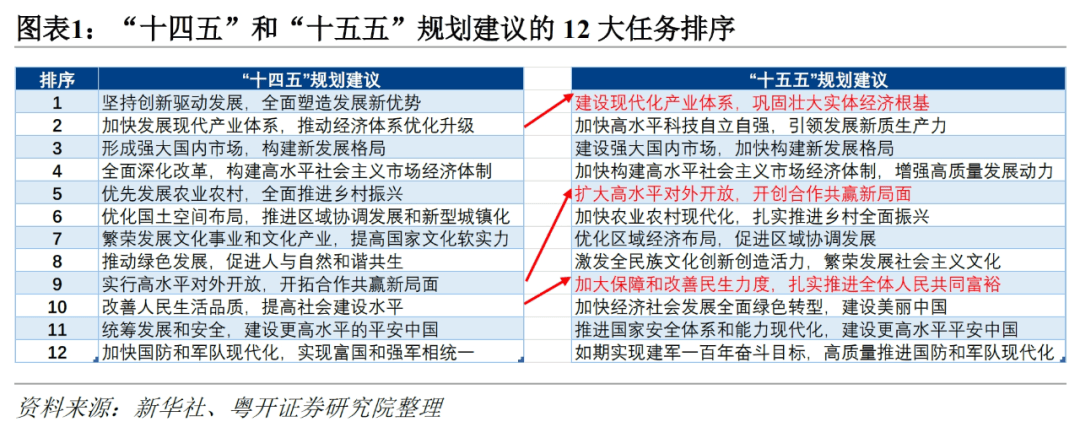
“十五五”,“建设现代化产业体系,巩固壮大实体经济根基”排首位
Ren Min Ri Bao· 2025-10-30 01:01
Core Viewpoint - The importance of the real economy is emphasized as a foundation for China's economic development and international competitiveness, particularly in the context of the "14th Five-Year Plan" and the upcoming "15th Five-Year Plan" [1][2][3]. Group 1: Importance of the Real Economy - The real economy is described as the foundation of a major country, with a strong emphasis on not allowing the economy to become detached from reality [2][3]. - The real economy serves as a "ballast" for economic operations, with significant labor demand across manufacturing, construction, agriculture, and services, absorbing over 400 million jobs, which accounts for 53% of the national employment population [3]. - Manufacturing is highlighted as a crucial pillar of the national economy, directly related to national strategic security, with China maintaining the world's largest manufacturing scale for 15 consecutive years, providing resilience against external uncertainties [3][4]. Group 2: Strategic Tasks for the "15th Five-Year Plan" - The strategic tasks for the "15th Five-Year Plan" include four main areas: 1. **Solid Foundation and Upgrading**: Optimizing and upgrading traditional industries, which account for over 80% of manufacturing, aiming to create approximately 10 trillion yuan in new market space over the next five years [4]. 2. **Innovation and New Industries**: Cultivating and expanding emerging and future industries, focusing on strategic emerging industries like new energy and new materials, and planning for quantum technology and biomanufacturing, with a goal of creating a scale equivalent to a new high-tech industry in the next decade [4]. 3. **Service Industry Development**: Promoting high-quality and efficient development of the service industry, enhancing the integration of modern services with advanced manufacturing and modern agriculture to meet people's needs and open new economic growth spaces [4]. 4. **Infrastructure Modernization**: Accelerating the construction of a modern infrastructure system, ensuring coordinated planning and development of new infrastructure to enhance connectivity and safety [5]. Group 3: Response to External Challenges - The real economy is positioned as a key element for navigating external uncertainties, with a call for leveraging technological advantages to transform into industrial strengths, ensuring that China's economy can withstand challenges and explore broader horizons [5].
万业企业:10月28日召开董事会会议
Mei Ri Jing Ji Xin Wen· 2025-10-29 14:54
Core Viewpoint - Wan Ye Enterprise (SH 600641) announced a temporary board meeting on October 28, 2025, to review the proposal for amending the company's articles of association [1] Company Summary - For the fiscal year 2024, Wan Ye Enterprise's revenue composition is as follows: Real estate accounts for 48.34%, manufacturing for 41.44%, services for 8.72%, and other businesses for 1.49% [1] - As of the report, Wan Ye Enterprise has a market capitalization of 18.5 billion yuan [1]

四大央行24小时密集议息:全球流动性变局下的创投新逻辑
Sou Hu Cai Jing· 2025-10-29 04:39
Core Insights - The coordinated actions of major central banks represent a significant shift in global monetary policy, impacting venture capital funding flows and industry opportunities since early 2021 [1][2] - The divergence in monetary policies among the Federal Reserve, European Central Bank, Bank of Japan, and Bank of Canada highlights the varying economic recovery rates across regions, influencing investment strategies [2][3] Monetary Policy Divergence - The Federal Reserve is expected to lower interest rates by 25 basis points due to a weak U.S. job market, while the European Central Bank maintains high service sector inflation at 3%, pausing rate cuts for the third consecutive time [2] - The Bank of Canada may follow the Fed with a second rate cut, but strong employment data suggests a potential pause, while the Bank of Japan delays rate hikes until January 2026 due to the new Prime Minister's stance [2][3] Impact on Venture Capital Markets - A potential Fed rate cut could lower the federal funds rate to a range of 4.25%-4.5%, reducing dollar financing costs and increasing the willingness of limited partners to invest in long-cycle sectors like hard technology and biomedicine [3][4] - Historical data shows that during the Fed's rate cut cycles from 2020 to 2023, global dollar venture capital fundraising grew by an average of 18% annually, with hard technology's share rising from 32% to 47% [3] Sector-Specific Opportunities - Two sectors likely to benefit from the Fed's anticipated rate cuts are capital-intensive industries such as low-altitude economy and energy storage, which see reduced financial costs and improved internal rates of return [4] - The depreciation of the dollar may enhance the purchasing power of U.S. markets for Chinese export products, with cross-border e-commerce financing increasing by 41% during the Fed's rate cut cycle in 2023 [4] Caution in Investment Strategies - The high service sector inflation in Europe suggests that inflation-sensitive sectors like retail and tourism may face profitability pressures, as evidenced by a decline in average gross margins for European dining projects [6] - Japan's delayed rate hikes favor domestic consumption upgrades, with investment in sectors like the silver economy and smart home appliances increasing by 29% during the low-rate period [6] Strategic Adjustments for Investors - The uncertainty surrounding the Bank of Canada's decisions reflects broader uncertainties in the global venture capital market, necessitating a focus on cash flow management for startups [6] - The conclusion of the central banks' rate decisions will not lead to a broad market rally but rather a restructuring of opportunities, emphasizing the need for entrepreneurs to adjust financing strategies based on regional monetary policies [8]

罗志恒:“十五五”规划建议的十二大看点
Sou Hu Cai Jing· 2025-10-29 04:05
Core Insights - The "15th Five-Year Plan" emphasizes quality development, technological self-reliance, and the importance of domestic consumption, particularly in the context of changing external circumstances and US-China competition [1][2][5] - The plan outlines 12 major tasks categorized into optimizing supply, expanding demand, and ensuring security, aiming for a higher level of supply-demand circulation [1][5] Comparison with Previous Plans - The assessment of future risks and uncertainties is more pronounced in the "15th Five-Year Plan," shifting from a focus on strategic opportunities to a dual emphasis on opportunities and risks [2] - The development goals have expanded from six to seven areas, highlighting quality development, technological self-reliance, and increased international influence [2][6] Task Prioritization - The "15th Five-Year Plan" prioritizes the modernization of the industrial system and places technological innovation second, reflecting the current international emphasis on openness [3][6] - The plan includes a clear structure with three main sections: achievements from the previous five years, specific tasks, and the role of party leadership [5][6] Economic and Social Development Goals - The plan sets seven key development goals, including significant improvements in quality development, technological self-reliance, and social welfare [16][17] - The nominal GDP growth target is set at an average of 5% per year, with a focus on increasing the resident consumption rate from 40% to 43% [17][18] Industrial and Technological Development - The plan emphasizes the construction of a modern industrial system as the foundation for economic development, with a focus on maintaining a reasonable proportion of manufacturing [21][23] - It highlights the importance of technological self-reliance and innovation, particularly in key sectors such as integrated circuits and advanced materials [28][29] Domestic Demand and Consumption - The plan stresses the need to expand domestic demand and enhance consumption, aiming to create a robust domestic market to counter external uncertainties [30][31] - It outlines strategies to increase disposable income and improve consumer confidence, alongside optimizing the supply structure to meet evolving consumer needs [30][31][33] Macro-Economic Governance - The plan calls for improvements in macro-economic governance, emphasizing the need for coordinated fiscal and monetary policies to support sustainable growth [34][35] - It advocates for a shift from traditional fiscal policies to a more proactive approach that enhances the efficiency of existing assets and promotes strategic investments [38][39]
\十五五\规划《建议》之解读
Bao Cheng Qi Huo· 2025-10-29 02:06
1. Report Industry Investment Rating No relevant content provided. 2. Core View of the Report The "15th Five-Year Plan" period is of great significance in the process of basically realizing socialist modernization. Boosting consumption and technological innovation will be the main drivers on the demand and supply sides respectively during the "15th Five-Year Plan" period. Policies conducive to expanding domestic demand and supporting technological innovation will continue to be promoted, and the relevant industries are expected to benefit from the policy advantages [3][4][20]. 3. Summary According to the Directory 3.1 "15th Five-Year Plan" 《Suggestions》 Main Content - The "15th Five-Year Plan" 《Suggestions》 has 15 parts and 61 articles, divided into three major sections. It positions the "15th Five-Year Plan" period as an important stage with a connecting role in the process of basically realizing socialist modernization [7]. - The development environment is characterized by both strategic opportunities and risks, with many uncertain and unpredictable factors. Internationally, the relationship between China and the United States is complex, but China has many favorable factors for shaping the external environment. Domestically, China has advantages such as a stable economic foundation, but also faces challenges such as unbalanced and insufficient development [7][8]. - The main goals include achieving significant results in high - quality development, greatly improving the level of technological self - reliance, and continuously improving people's living standards [9]. 3.2 Industry Construction - Prioritize optimizing and upgrading traditional industries to maintain the competitiveness of industries such as mining, metallurgy, and chemical engineering in the global division of labor. Cultivate and strengthen 4 strategic emerging industry clusters and 6 future industries [11]. - Expand the opening - up of the service industry to attract international capital and advanced business models, and moderately and ahead of time build new infrastructure to reserve development space [11]. 3.3 Technological Innovation - Strengthen original innovation and key core technology research in fields such as integrated circuits and industrial mother machines. Increase the proportion of basic research investment to achieve technological self - control [12]. - Promote the in - depth integration of technological innovation and industrial innovation, accelerate the transformation of scientific and technological achievements into productivity, and create new industries [12]. - Implement the "Artificial Intelligence +" action to lead the transformation of scientific research paradigms and empower various industries [12]. 3.4 Domestic Market - Adhere to the strategic basis of expanding domestic demand, combine improving people's livelihood and promoting consumption, and investment in objects and people. Promote the positive interaction between consumption and investment, supply and demand [13]. - Specific measures include boosting consumption (improving consumption scenarios and promoting residents' consumption ability), expanding effective investment (optimizing government investment and stimulating private investment), and removing obstacles to the construction of a unified national market [13][14]. 3.5 Macroeconomic Governance - Strengthen the coordination of fiscal and monetary policies, and maintain the continuity, effectiveness, and consistency of policies. Promote an economic development model driven by domestic demand and consumption [15]. - In fiscal and tax reform, improve the local tax and direct tax systems, and adjust the central - local fiscal relationship [15]. 3.6 Livelihood Security - Solve structural employment problems by strengthening the coordination between industry and employment, and promoting the healthy development of flexible employment [16]. - Improve the income distribution system to increase the income of low - income groups, expand the middle - income group, and form an olive - shaped distribution pattern [17]. - Improve the social security system, including pension and medical insurance, and focus on reducing the high - cost expenditures of residents in education, housing, etc. [17]. 3.7 Green Transformation - With the goal of achieving carbon peak by 2030, accelerate the construction of a new energy system and implement energy - saving and carbon - reduction reforms. The construction of the electricity market and carbon emission trading market is expected to accelerate [18]. - Reduce pollution emissions, strengthen pollution control, and promote the formation of a green production and lifestyle [18]. 3.8 Summary The "15th Five-Year Plan" 《Suggestions》 deploys strategic tasks and major measures in multiple fields. Boosting consumption and technological innovation will be the main focuses, and relevant industries are expected to benefit from policy support [19][20].
雷·达利欧的终极警告:一个国家,两种命运,美国经济对TOP 1%的“致命依赖”……
Sou Hu Cai Jing· 2025-10-29 00:50
Core Insights - Ray Dalio warns of a "fatal dependence" of the U.S. economy on the top 1% elite workforce, while the bottom 60% is being "eliminated" in terms of productivity [2][3] Structural Divisions - The U.S. economy can be understood through three interconnected dimensions of internal division [4] - The first division is productivity, which is the root of all subsequent issues [4] - Approximately 60% of American adults have reading skills at or below a sixth-grade level, rendering them nearly uncompetitive in a knowledge-driven economy [5][10] - This results in two distinct economic realities: a top tier of about 3 million "super producers" in tech, finance, and high-end services, and a large group of about 60% of the workforce whose traditional skills are rapidly depreciating due to automation [8][10] Wealth Disparity - The second division is wealth, which is a direct consequence of productivity disparities [12] - By 2025, the wealth of the top 0.1% of U.S. households is projected to exceed the combined wealth of the bottom 50% by 4.6 times, with the top 0.1% nearly doubling their wealth from 2020 to 2025 [14] - Wealth concentration occurs when the return on capital (r) consistently exceeds economic growth (g), leading to extreme inequality [14][16] Geographic Disparities - The third division is geographic, reflecting economic stratification across different regions [19] - Data shows that 22 states are in economic recession, 13 are stagnating, and only 16 are maintaining growth, with economic vitality concentrated in a few "super metropolitan areas" [19][21] - The concentration of AI talent and investment in regions like Silicon Valley and New York exacerbates this divide, creating "prosperity islands" versus "rust belts" [21][36] Historical Context - Dalio's analysis aligns with his "big cycle" theory, suggesting that the current internal divisions in the U.S. mirror historical patterns of empires in decline [23][25] - The U.S. faces over $35 trillion in national debt, severe internal conflict, and rising external competition, creating systemic risks that undermine economic resilience [25] Proposed Solutions - Dalio advocates for pragmatic reforms, including automation tax incentives linked to productivity, nationwide retraining programs, and policies encouraging labor mobility to high-growth areas [28] - In contrast, some economists argue for structural changes, such as higher progressive taxes and stronger regulations on large corporations to address wealth concentration [31] - The debate continues on whether the economic fractures are technical issues that can be optimized or structural problems requiring significant power redistribution [35][36]