航空

Search documents
港股异动丨航空股继续涨势 今年春运民航旅客运输量有望创历史新高
Ge Long Hui· 2026-01-20 02:04
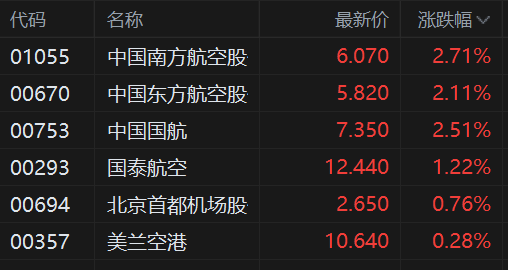
Group 1 - The core viewpoint of the news is that the Hong Kong aviation stocks continue to rise, driven by strong demand during the Spring Festival travel season, with predictions of increased passenger transport volume and flight operations [1] - China Southern Airlines rose nearly 3%, China Eastern Airlines increased by 2.11%, and Air China saw a 2.51% rise, reflecting positive market sentiment [2] - The Civil Aviation Administration forecasts that the national civil aviation passenger transport volume during the Spring Festival is expected to reach 95 million, averaging 2.38 million passengers per day, a year-on-year increase of approximately 5.3% [1] Group 2 - The Spring Festival is expected to create two peaks in passenger flow, particularly due to the later timing of the holiday this year, with a single-day peak potentially reaching 2.6 million passengers [1] - The aviation sector is highlighted as having investment opportunities based on three factors: low growth in aircraft introductions, structural improvement in aviation demand, and high seat occupancy rates indicating potential price elasticity [1] - The expected number of flights during the Spring Festival is 780,000, averaging 19,400 flights per day, which is a 5% year-on-year increase [1]



交通运输行业周报20260119:航空关注春运预售表现,重视顺丰估值修复机会
Guolian Minsheng Securities· 2026-01-20 00:30
Investment Rating - The report maintains a "Buy" rating for key companies in the transportation sector, including SF Holding, Spring Airlines, and China Eastern Airlines, among others [2][3]. Core Insights - The report highlights the recovery of the aviation industry as flight volumes increase, with a focus on the upcoming Spring Festival travel season and the performance of airline ticket pre-sales [6][29]. - SF Holding is noted for its high cash reserves and low valuation, suggesting a strong potential for valuation recovery in the near future [6][21]. - The logistics sector is seeing strong resource integration capabilities, with Shimon Logistics preparing for its upcoming IPO [46]. Summary by Sections 1. SF Holding: High Safety Margin and Low Valuation - SF Holding has substantial cash reserves, with cash accounting for 14.2%, 20.5%, and 16.2% of total market value from 2022 to 2024, providing a strong support for stock prices [9][12]. - The expected shareholder return rate for 2025E and 2026E is projected to reach 3.8%, with dividend yields of 2.57% and 2.88% respectively [12][15]. - The current PE ratio of SF Holding is at 18X, close to the market's historical low, indicating a potential for valuation recovery as market conditions improve [24][21]. 2. Aviation Tracking: Recovery from Off-Season - Domestic flight volumes increased to 89,086 flights from January 10 to January 16, 2026, a 2.7% rise compared to the previous week, reaching 112% of the 2019 levels [29][30]. - The average daily aircraft utilization rate rose to 7.89 hours, reflecting a 2.1% increase from the previous week [30]. - The upcoming Spring Festival is expected to see 5.39 billion railway passengers, a 5% increase year-on-year, which may positively influence airline ticket sales [6][29]. 3. Comprehensive Logistics Companies: Shimon Logistics IPO - Shimon Logistics has established a strong competitive advantage in the logistics sector, providing long-term services to leading global manufacturing companies [46][48]. - The company is expected to generate revenues of 9.2 billion yuan in 2025, despite a projected decline due to reduced demand from major clients [48][51]. - The logistics business is segmented into comprehensive supply chain services and trunk transportation services, with the former accounting for 76% of total revenue in the first half of 2025 [48][49]. 4. Continuous Improvement in the Express Delivery Industry - The express delivery sector saw a slight decline in revenue in November 2025, with a total of 1,376.5 billion yuan, down 3.7% year-on-year, while the volume increased by 5% [59][62]. - The average revenue per package in the express delivery industry was 7.62 yuan, reflecting a 1.9% increase from the previous month [62][69]. - Companies like SF Holding, Shentong, and Yunda are recommended for their strong performance and potential for price recovery in the express delivery market [80].

“四中心”引擎 制度型开放突破“十五五”启幕千年商都新纪元
Nan Fang Du Shi Bao· 2026-01-19 23:12
Core Viewpoint - The construction of an international consumption center city and high-quality foreign trade development are key supports for Guangzhou's economic stability and progress during the transition from the "14th Five-Year Plan" to the "15th Five-Year Plan" [4]. Group 1: Consumption Enhancement - Guangzhou's retail sales are projected to grow by 5.5% in 2025, following a 26% increase over the past five years [6]. - The "Yangcheng New Eight Scenic Spots" initiative aims to boost consumption through over 2,000 themed events, including international shopping festivals and gourmet weeks, generating over 900 billion yuan in sales [6][7]. - The city will continue to optimize the consumption environment by expanding the number of tax refund stores to 1,620 and enhancing cross-border payment options [7]. Group 2: Foreign Trade Growth - Guangzhou's foreign trade is expected to reach 1.2 trillion yuan in 2025, with a growth rate of 10.4%, driven by a 17.3% increase in trade with non-U.S. markets [8]. - The "New Three Samples" products have seen an export increase of nearly 70%, becoming a new growth engine for the economy [8][9]. - Key strategies for 2026 include diversifying markets, supporting leading enterprises, and enhancing new foreign trade formats [9]. Group 3: Open Upgrades - Guangzhou aims to enhance its high-level opening-up system, focusing on the Guangdong-Hong Kong-Macao Greater Bay Area and expanding the service industry [10]. - The city has established a robust open matrix, including one free trade zone and multiple national-level economic development zones [10][11]. - Future initiatives will include platform innovation, port upgrades, and leveraging the exhibition economy to stimulate industrial upgrades [11].
推动更高水平的消费与投资良性循环丨孙立坚专栏
2 1 Shi Ji Jing Ji Bao Dao· 2026-01-19 23:05
Economic Growth and Consumption - In 2025, China's GDP is projected to exceed 140 trillion yuan, marking a 5.0% increase from the previous year [1] - Retail sales of consumer goods are expected to surpass 50 trillion yuan, reaching 50,120.2 billion yuan, with a growth rate of 3.7%, accelerating by 0.2 percentage points compared to the previous year [1] - Final consumption expenditure is anticipated to contribute over 50% to GDP growth, with service retail sales increasing by 5.5% [2] Investment Trends - Fixed asset investment (excluding rural households) is projected to total 48,518.6 billion yuan, reflecting a 3.8% decline from the previous year [1] - Investment in the real estate sector is expected to decrease by 17.2%, while high-tech industries such as information services and aerospace manufacturing are projected to grow by 28.4% and 16.9%, respectively [2][3] - The investment structure is shifting, with a focus on effective investment rather than just total volume [3] Challenges and Reforms - Consumer confidence needs to be bolstered, as 62.3% of residents prefer to save more, indicating a cautious approach to spending [2] - There is a need for reforms in income distribution to increase labor compensation and expand the middle-income group [2] - The investment landscape is affected by three main factors: adjustments in the real estate market, the need to boost private sector confidence, and the transitional pains of traditional industries [2] Future Directions - The focus should shift from scale-oriented investment to efficiency-oriented investment, emphasizing the importance of legal frameworks to support the private economy [3] - China aims to leverage its vast domestic market to attract global resources and enhance industrial upgrades, while also promoting its digital economy [4] - A virtuous cycle of consumption, investment, and exports is essential for economic stability and growth, requiring precise financial resource allocation and a competitive environment [4]
推动更高水平的消费与投资良性循环
2 1 Shi Ji Jing Ji Bao Dao· 2026-01-19 22:35
Economic Growth and Consumption - In 2025, China's GDP is projected to exceed 140 trillion yuan, with a growth rate of 5.0% compared to the previous year [2] - Retail sales of consumer goods are expected to surpass 50 trillion yuan, reaching 50,120.2 billion yuan, with a year-on-year growth of 3.7%, accelerating by 0.2 percentage points from the previous year [2] - Final consumption expenditure is anticipated to contribute over 50% to GDP growth, with service retail sales increasing by 5.5% [2] Investment Trends - Fixed asset investment (excluding rural households) is projected to total 48,518.6 billion yuan, reflecting a decline of 3.8% year-on-year [2] - Investment in the first industry is expected to grow by 2.3%, while the second industry sees a growth of 2.5%, and the third industry experiences a decline of 7.4% [2] - Real estate development investment is forecasted to decrease by 17.2% [3] Consumer Behavior and Market Dynamics - The actual growth of per capita disposable income is projected at 5.0% in 2025, with over 200 million flexible employment individuals and 62.3% of residents preferring to save more [3] - There is a noticeable consumption disparity, with luxury goods booming in first-tier cities while smaller cities require further consumption stimulation [3] - High-end tourism is recovering rapidly, but some durable goods consumption still needs to be boosted [3] Structural Investment Focus - Future investment should shift from a "scale-oriented" approach to an "efficiency-oriented" strategy, emphasizing effective investments in high-tech industries such as information services and aerospace [4] - The need for reforms in income distribution, healthcare, and digital technology to enhance consumer spending potential is highlighted [3][4] External Market and Global Integration - China aims to leverage its vast domestic market to attract global resources and enhance industrial upgrades, similar to Germany's model of "hidden champions" [5] - The importance of establishing a virtuous cycle between consumption, investment, and exports is emphasized, requiring precise financial resource allocation and a conducive competitive environment [5] Future Outlook - The focus for the next five years includes enhancing consumer confidence, ensuring clear direction for entrepreneurs, and optimizing fund allocation [5] - The transformation of domestic demand into high-quality development momentum is crucial for navigating global challenges and achieving sustainable economic growth [5]

“降温”稳节奏不改趋势 五大主线锚定2026年投资方向
Zhong Guo Zheng Quan Bao· 2026-01-19 21:11
Group 1 - The A-share market has shown strong performance at the beginning of 2026, driven by a combination of market trends, seasonal factors, and recovery in overseas markets [1][2] - Recent market fluctuations are attributed to the implementation of counter-cyclical adjustment policies and profit-taking in popular sectors, which are considered healthy adjustments that do not alter the overall upward trend [1][2] - The macroeconomic environment is expected to support five key investment themes for the year: the artificial intelligence industry chain, high-dividend assets, anti-involution sectors, domestic demand expansion, and resource sectors [1][5] Group 2 - The spring market rally is historically supported by liquidity and valuation drivers, typically lasting around 57 days, with the current phase still in its early stages [2] - Positive performance in overseas markets, particularly in Japan and South Korea, has significantly boosted investor sentiment in the A-share market [2] - Recent adjustments in the A-share market, including changes in financing margin ratios, are aimed at curbing excessive leverage and maintaining a stable upward trend [2][3] Group 3 - Investment strategies must adapt to changing market conditions, emphasizing the importance of position management and avoiding excessive leverage [3][4] - Investors are encouraged to develop independent judgment capabilities to avoid speculative traps and focus on fundamental research [3][4] - The market is transitioning from a speculative phase to one driven by fundamentals, with a focus on true technological growth and value [3][4] Group 4 - Four strategic recommendations for the pre-Spring Festival period include maintaining moderate positions, adopting a barbell strategy for asset allocation, focusing on specific technology sectors, and enhancing individual stock fundamental research [4] - The artificial intelligence industry chain is expected to shift towards application opportunities in 2026, with a focus on sectors like media and computing [5] - High-dividend assets remain a stable investment choice, with sectors such as white goods, banking, and utilities providing low volatility and steady returns [5] Group 5 - The anti-involution sector is entering a phase driven by fundamentals, with industries like coal, steel, and lithium batteries expected to see improved performance due to industry consolidation [5] - The expansion of domestic demand should focus on new consumption areas such as health, sports, and travel, which are expected to benefit from policy support [5] - Resource sectors, particularly strategic and industrial metals, are anticipated to experience valuation recovery in 2026, presenting potential investment opportunities [5][6]
财信证券黄红卫: “降温”稳节奏不改趋势 五大主线锚定2026年投资方向
Zhong Guo Zheng Quan Bao· 2026-01-19 21:09
Group 1 - The A-share market has experienced a strong start in 2026, driven by a combination of market trend continuation, spring market catalysts, and a recovery in overseas markets [1][2] - Recent market fluctuations are attributed to the implementation of counter-cyclical adjustment policies and profit-taking in popular sectors, which are seen as a healthy adjustment that does not alter the overall upward trend [1][3] - The spring market typically lasts around 57 days, and historical data suggests that A-shares tend to perform well during this period, particularly in the technology growth sector [2][6] Group 2 - The current market environment necessitates an adjustment in investment logic, transitioning from a valuation recovery phase in 2025 to a profit-driven phase in 2026 [4] - Investors are advised to manage their positions carefully, avoiding excessive leverage and maintaining flexibility to respond to potential market volatility [4][5] - A focus on fundamental analysis is crucial, as the market is shifting from speculation to value, with regulatory measures aimed at guiding funds towards genuine technology and growth opportunities [4][6] Group 3 - Five key investment themes for 2026 have been identified: the artificial intelligence industry chain, high-dividend assets, anti-involution sectors, domestic demand expansion, and resource sectors [6][7] - The AI application sector is expected to present significant investment opportunities as it transitions from hardware to application, with a focus on media, computing, and internet sectors [6] - High-dividend assets remain a stable investment choice, with sectors like white goods, banking, and utilities expected to provide steady returns [6][7] Group 4 - The anti-involution sector is entering a phase driven by fundamentals, with industries like coal, steel, and solar energy expected to see performance improvements due to favorable market conditions [6][7] - The expansion of domestic demand should focus on new consumption areas such as health, sports, and travel, which are anticipated to benefit from recovering consumer spending [6][7] - Resource sectors, particularly strategic and industrial metals, are expected to experience valuation recovery, presenting potential investment highlights [7]
魏敏:消费提质、外贸增效、开放升级,千年商都开启新纪元
Nan Fang Du Shi Bao· 2026-01-19 16:00
Group 1 - The core viewpoint of the article emphasizes the importance of Guangzhou's economic development strategies during the "14th Five-Year Plan" and the transition into the "15th Five-Year Plan," focusing on enhancing domestic demand and building a modern industrial system [2][3] - The 2026 Guangzhou government work report outlines ten key areas for economic and social development, including deepening consumption potential, accelerating the construction of a modern industrial system, and promoting education and talent development [2] - The article highlights the role of the "International Consumption Center City" and high-quality foreign trade development as critical supports for Guangzhou's economic stability and growth [3][8] Group 2 - Guangzhou's retail sales and import-export indicators have shown growth rates exceeding national and provincial averages, contributing positively to the city's economic growth [6] - The city plans to implement special actions to boost consumption and enhance foreign trade quality, aiming to build a more resilient international trade center [7][8] - The "New Eight Scenic Spots of Consumption" initiative aims to stimulate new consumption trends through various promotional activities, with a projected retail sales growth of 5.5% in 2025 [9][10] Group 3 - In 2025, Guangzhou's foreign trade is expected to reach 1.2 trillion, with a growth rate of 10.4%, driven by strong performance in non-U.S. markets [11][12] - The city aims to diversify its market by expanding into non-U.S. markets and organizing procurement activities, while also supporting leading enterprises in the foreign trade sector [12] - Key measures for enhancing foreign trade include promoting new business models, improving export quality, and establishing national-level import trade innovation demonstration zones [12][13] Group 4 - Guangzhou is focusing on institutional openness to drive high-quality development, with plans to deepen service industry reforms and enhance connectivity with Hong Kong and Macau [13][14] - The city aims to upgrade its port facilities and improve the business environment to facilitate smoother internal and external circulation [14] - The article discusses the importance of the exhibition economy in promoting industrial upgrades and fostering a favorable ecosystem for trade and consumption [14]

港股公告掘金 | 康耐特光学与歌尔光学拟成立合资企业 拓展定制镜片在AI/AR/VR/MR眼镜的应用市场
Zhi Tong Cai Jing· 2026-01-19 15:24
Group 1: Major Developments - 康耐特光学 (02276) and 歌尔光学 plan to establish a joint venture to expand the application market for customized lenses in AI/AR/VR/MR glasses [1] - 圣贝拉 (02508) and 云迹科技 signed a strategic cooperation framework agreement to explore the deep integration and application of artificial intelligence and robotics in high-demand home care scenarios [1] - KKCG Maritime intends to initiate a voluntary conditional partial public acquisition offer to acquire 15.4% of 法拉帝 (09638) shares [1] - 远大医药 (00512) announced that the new drug application for the innovative radiolabeled drug TLX591-CDx has been accepted by the China National Medical Products Administration [1] - 艾美疫苗 (06660) received approval to conduct clinical trials for a 20-valent pneumococcal polysaccharide conjugate vaccine [1] - 中国东方航空股份 (00670) sold the 凯迪克大厦 in Shanghai and related assets to 东航置业 for approximately 134 million yuan [1] - 佑驾创新 (02431) signed a memorandum of understanding with India's leading automotive parts manufacturer STL [1] - 南山铝业国际 (02610) plans to develop electrolytic aluminum and related raw materials and supporting businesses [1] Group 2: Financial Performance - 顺丰控股 (06936) reported a total revenue of 27.339 billion yuan from its express logistics, supply chain, and international businesses in December, representing a year-on-year increase of 3.41% [2] - 美丽田园医疗健康 (02373) issued a profit warning, expecting adjusted net profit for 2025 to be no less than 380 million yuan, a year-on-year increase of at least 40% [2] - 中国太平 (00966) issued a profit warning, anticipating a year-on-year increase of approximately 215% to 225% in shareholder profit for the 2025 fiscal year [2] - 吉宏股份 (02603) issued a profit warning, expecting a net profit attributable to shareholders of approximately 273 million to 291 million yuan for 2025, a year-on-year increase of 50% to 60% [2] - 兖煤澳大利亚 (03668) reported a fourth-quarter coal sales volume of 10.8 million tons, a year-on-year increase of 4% [2] - 兖矿能源 (01171) reported a fourth-quarter commodity coal production of 46.51 million tons, a year-on-year increase of 4.4% [2] - 深圳控股 (00604) projected a total contract sales amount of approximately 13.311 billion yuan for 2025, a year-on-year decrease of 21.55% [2] - 上海石油化工股份 (00338) issued a profit warning, expecting a net loss attributable to shareholders of approximately 1.289 billion to 1.576 billion yuan for 2025, indicating a shift from profit to loss [2] - 上海石油化工股份 (00338) reported gasoline sales revenue of 24.656 billion yuan for 2025 [2]



如何认识5%与140万亿
Sou Hu Cai Jing· 2026-01-19 15:18
Group 1 - China's economy demonstrates resilience, achieving a GDP exceeding 140 trillion yuan with a growth rate of 5% for three consecutive years, supported by strong international competitiveness and diversified export markets [2][3] - The economic scale of 140 trillion yuan enhances China's capacity to respond to risks, providing a robust foundation for future growth and contributing significantly to global economic stability [3] - The transition from old to new economic drivers is evident, with the service sector's contribution to GDP rising from 56.8% in 2024 to 57.7% in 2025, and final consumption's contribution increasing from 44.5% to 52% [4] Group 2 - The high-tech and emerging industries are rapidly growing, with significant increases in value-added output in equipment manufacturing (9.2%) and high-tech manufacturing (9.4%), surpassing the overall industrial growth rate of 5.9% [4] - Challenges remain in the real estate market, requiring policy adjustments to stabilize the sector and address liquidity risks among real estate companies [5] - To boost consumption, a long-term mechanism is needed, focusing on income distribution and social security system optimization, alongside fiscal measures to encourage wage increases [5][6]