通信

Search documents
A股策略周报:节前博弈与长期布局如何权衡?-20260208
Ping An Securities· 2026-02-08 08:50
Core Viewpoints - The A-share market experienced fluctuations and adjustments last week, with small-cap stocks outperforming. The overall market sentiment declined due to sensitivity to labor market data and underwhelming earnings guidance from tech companies, leading to a 1.3% drop in the Shanghai Composite Index and a larger decline in the ChiNext Index, while the micro-cap index rose by 1.9% [2][11] - The U.S. manufacturing PMI returned to the expansion zone, while geopolitical tensions in the Middle East remain uncertain. The U.S. economy shows resilience, with the ISM manufacturing PMI rising significantly by 4.7 percentage points to 52.6% in January, although employment growth has not yet rebounded [2][3] - Domestic developments include high-level talks between China and Russia, as well as between China and the U.S., aimed at enhancing practical cooperation. The Chinese government is emphasizing proactive macroeconomic policies and has tightened regulations on virtual currencies [2][3] Recent Dynamics - The market calendar effect typically shows a balanced style before the Spring Festival, with small-cap growth stocks outperforming afterward. Historical data indicates that the average returns for major indices during the week before and after the festival are positive, with probabilities of positive returns ranging from 55% to 90% [2][3] - The report highlights that 18 out of 31 sectors achieved positive returns last week, with food and beverage, beauty care, and electric equipment sectors leading the gains, while sectors like non-ferrous metals and telecommunications saw significant declines [10][11] Market Performance - The A-share market saw a decrease in average daily trading volume to 2.41 trillion yuan, a 21.43% decline week-on-week. The financing balance also slightly decreased to 2.66 trillion yuan, with a net outflow of 5.62 billion yuan from equity ETFs [11][14] - The performance of major indices showed the Shanghai Composite Index down by 1.27%, the ChiNext Index down by 3.28%, and the STAR 50 Index down by 5.76%. In contrast, the micro-cap index saw a slight decline of 0.34% [11][14] Focus Areas - The report suggests focusing on sectors that may benefit from domestic demand recovery and technological upgrades, including technology growth sectors (TMT/innovative pharmaceuticals), advanced manufacturing sectors (new energy/military), and cyclical sectors (chemicals/non-ferrous metals/building materials) [2][3] - The report emphasizes the importance of aligning investment strategies with the long-term reform expectations under the "14th Five-Year Plan" and improving fundamentals [2][3]
华金证券:春季行情未完 持股过节
Xin Lang Cai Jing· 2026-02-08 07:05
Group 1 - The short-term performance of A-shares before the Spring Festival may influence the market after the holiday, with historical data showing that in 16 years since 2010, there were 9 instances where the Shanghai Composite Index rose or fell in the first five trading days before the festival and then moved in the opposite direction on the first trading day after the festival [8][2] - Economic and profit expectations during the Spring Festival may improve, with anticipated favorable data for travel and consumption, as well as a potential rebound in real estate sales due to low base effects and strong policy support [9][2] - Liquidity is expected to remain loose during the Spring Festival, with the central bank likely to increase net injections to counter seasonal tightening, and stock market funds may maintain a certain level before accelerating back after the holiday [9][2] Group 2 - After a short-term adjustment, technology growth and cyclical sectors are expected to outperform, supported by policy and industry trends, with historical patterns indicating that leading sectors may regain strength post-adjustment [10][3] - Current observations suggest that technology growth and certain cyclical industries are likely to remain dominant, driven by supportive policies and ongoing industry trends, particularly in commercial aerospace and AI [10][3] - The consumption sector's short-term rebound may be a result of valuation recovery, but its sustainability is uncertain due to weak consumer confidence and the absence of a profit turning point [11][3] Group 3 - Industry allocation recommendations suggest a balanced approach towards technology growth, certain cyclical sectors, and consumption, with specific industries like automotive, military, beauty care, machinery, and communication expected to perform well in 2025 [11][3] - The current sentiment towards growth sectors such as pharmaceuticals, automotive, and computing is relatively low, indicating potential for future gains [11][3] - Suggested low-entry allocations include sectors with upward policy and industry trends, such as electronics (semiconductors, AI hardware), media (AI applications, gaming), and healthcare [11][3]
——金融工程市场跟踪周报20260208:静待市场情绪提振-20260208
EBSCN· 2026-02-08 05:49
Quantitative Models and Factors Summary Quantitative Models and Construction Methods Model Name: Volume Timing Model - **Model Construction Idea**: The model uses volume signals to determine market timing[12] - **Model Construction Process**: - The model evaluates the volume timing signals for major indices as of February 6, 2026, and maintains a cautious view[24] - **Model Evaluation**: The model is currently signaling a cautious outlook for all major indices[24] Model Name: Momentum Sentiment Indicator - **Model Construction Idea**: The model uses the number of stocks with positive returns within an index to gauge market sentiment[24] - **Model Construction Process**: - Calculate the proportion of stocks in the CSI 300 index with positive returns over the past N days - The formula is: $ \text{CSI 300 Index N-day Upward Stock Proportion} = \frac{\text{Number of stocks with positive returns in the past N days}}{\text{Total number of stocks in the index}} $[24] - **Model Evaluation**: The indicator can quickly capture upward opportunities but may miss out on gains during sustained market exuberance and has limitations in predicting downturns[25] Model Name: Moving Average Sentiment Indicator - **Model Construction Idea**: The model uses the eight moving average system to determine the trend state of the CSI 300 index[32] - **Model Construction Process**: - Calculate the eight moving average values for the CSI 300 index closing prices with parameters 8, 13, 21, 34, 55, 89, 144, 233 - Assign values to the moving average indicator based on the moving average interval values - The formula is: $ \text{Indicator Value} = \begin{cases} -1 & \text{if interval value is 1/2/3} \\ 0 & \text{if interval value is 4/5/6} \\ 1 & \text{if interval value is 7/8/9} \end{cases} $[32] - **Model Evaluation**: The recent CSI 300 index is in a non-prosperous sentiment interval[32] Model Backtesting Results Volume Timing Model - **Signal**: Cautious for all major indices[24] Momentum Sentiment Indicator - **Current Value**: The indicator is above 60%, indicating high market sentiment[25] Moving Average Sentiment Indicator - **Current Value**: The CSI 300 index is in a non-prosperous sentiment interval[32] Quantitative Factors and Construction Methods Factor Name: Cross-sectional Volatility - **Factor Construction Idea**: The factor measures the cross-sectional volatility of index constituent stocks to assess the Alpha environment[36] - **Factor Construction Process**: - Calculate the cross-sectional volatility for the CSI 300, CSI 500, and CSI 1000 index constituent stocks - The formula is: $ \text{Cross-sectional Volatility} = \sqrt{\frac{1}{N-1} \sum_{i=1}^{N} (R_i - \bar{R})^2} $ where $ R_i $ is the return of stock i, and $ \bar{R} $ is the average return[37] - **Factor Evaluation**: The short-term Alpha environment has deteriorated, but the quarterly view shows a good Alpha environment for the CSI 300 and CSI 1000 indices[36] Factor Name: Time-series Volatility - **Factor Construction Idea**: The factor measures the time-series volatility of index constituent stocks to assess the Alpha environment[37] - **Factor Construction Process**: - Calculate the time-series volatility for the CSI 300, CSI 500, and CSI 1000 index constituent stocks - The formula is: $ \text{Time-series Volatility} = \sqrt{\frac{1}{T-1} \sum_{t=1}^{T} (R_t - \bar{R})^2} $ where $ R_t $ is the return at time t, and $ \bar{R} $ is the average return[40] - **Factor Evaluation**: The recent week shows an improvement in the Alpha environment for all indices[37] Factor Backtesting Results Cross-sectional Volatility - **CSI 300**: - Last quarter average: 2.17% - Last quarter percentile (2 years): 70.99% - Last quarter percentile (1 year): 74.07% - Last quarter percentile (6 months): 65.64%[37] - **CSI 500**: - Last quarter average: 2.48% - Last quarter percentile (2 years): 48.41% - Last quarter percentile (1 year): 53.97% - Last quarter percentile (6 months): 56.35%[37] - **CSI 1000**: - Last quarter average: 2.63% - Last quarter percentile (2 years): 66.53% - Last quarter percentile (1 year): 68.92% - Last quarter percentile (6 months): 66.14%[37] Time-series Volatility - **CSI 300**: - Last quarter average: 0.96% - Last quarter percentile (2 years): 58.02% - Last quarter percentile (1 year): 60.91% - Last quarter percentile (6 months): 47.94%[40] - **CSI 500**: - Last quarter average: 1.27% - Last quarter percentile (2 years): 50.00% - Last quarter percentile (1 year): 57.94% - Last quarter percentile (6 months): 60.32%[40] - **CSI 1000**: - Last quarter average: 1.22% - Last quarter percentile (2 years): 63.35% - Last quarter percentile (1 year): 71.31% - Last quarter percentile (6 months): 66.93%[40]
行业景气度跟踪报告(2026年2月):涨价品种出现分化,券商景气度高增
ZHESHANG SECURITIES· 2026-02-08 04:25
Upstream Sector - In the upstream cyclical products, there is a price divergence, with only gold prices rising while silver and other industrial metals have declined[1] - The PPI for coal mining and washing has improved, with a year-on-year growth of -8.9% in December, up from -11.80% in November[41] - Brent crude oil prices have decreased by 6.2% to $66.30 per barrel, while WTI crude oil prices fell by 4.7% to $62.14 per barrel[15] Midstream Sector - In the steel sector, iron ore and rebar prices have increased week-on-week, with rebar prices at 3,002 RMB per ton, up 1.6%[16] - The chemical products price index has decreased by 0.9% week-on-week, indicating a downward trend in major chemical product prices[16] - The shipping industry is experiencing a decline, with the Baltic Dry Index down by 5.6%[16] TMT Sector - The semiconductor sales cycle is on the rise, with a year-on-year growth of 22.9% in China[17] - The software industry has seen a cumulative profit growth of 7.3% year-on-year[17] - The film box office revenue in China has decreased by 69.11% year-on-year, indicating a significant drop in the media sector[17] Downstream Consumption - The price of Feitian Moutai has increased, supporting the strength of the liquor market[19] - The number of breeding sows in China has decreased by 2.9% year-on-year, indicating a decline in the agricultural sector[19] - The retail sales of consumer goods in December have shown a year-on-year decline of 0.9%[19] Financial and Real Estate Sector - The cumulative year-on-year decline in China's commercial housing sales area is 8.7%[20] - The cumulative year-on-year decline in real estate development investment is 17.2%[20] - The total trading volume in the two markets has increased, with the margin financing balance remaining high, indicating a robust brokerage environment[20]
金融产品周报:海外市场流动性有企稳迹象,情绪或会好转
Soochow Securities· 2026-02-08 03:24
Fund Size Statistics - The top three equity ETF types by fund size change are: Scale Index ETF (¥15.406 billion), Cross-border Industry Index ETF (¥6.624 billion), and Strategy Index ETF (¥5.384 billion) [9] - The bottom three equity ETF types by fund size change are: Theme Index ETF (-¥26.004 billion), Cross-border Scale Index ETF (-¥1.807 billion), and Cross-border Theme Index ETF (¥0.203 billion) [9] - The top three equity ETF products by fund size change are: CSI 500 ETF (¥2.832 billion), Chemical ETF (¥2.386 billion), and HuShen 300 ETF (¥2.229 billion) [9] - The bottom three equity ETF products by fund size change are: Communication ETF (-¥30.885 billion), Non-ferrous Metals ETF (-¥3.932 billion), and Gold Stock ETF (-¥2.963 billion) [13] Market Outlook - The macro timing model for February 2026 has a score of 0, indicating a historical 78.57% probability of the full A index rising in the following month, with an average increase of 3.37% [23] - A-shares are expected to experience a short-term volatile market, influenced by liquidity from overseas markets and the recent AI bubble discussions affecting tech growth stocks [23] - The recommendation is to adopt a balanced ETF allocation strategy due to the anticipated short-term fluctuations in the market [60]
海外市场流动性有企稳迹象,情绪或会好转
Soochow Securities· 2026-02-08 02:20
Fund Size Statistics - The top three equity ETF types by fund size change are: Scale Index ETF (¥15.406 billion), Cross-Border Industry Index ETF (¥6.624 billion), and Strategy Index ETF (¥5.384 billion) [9] - The bottom three equity ETF types by fund size change are: Theme Index ETF (-¥26.004 billion), Cross-Border Scale Index ETF (-¥1.807 billion), and Cross-Border Theme Index ETF (¥0.203 billion) [9] - The top three equity ETF products by fund size change are: CSI 500 ETF (¥2.832 billion), Chemical ETF (¥2.386 billion), and HuShen 300 ETF (¥2.229 billion) [9] - The bottom three equity ETF products by fund size change are: Communication ETF (-¥30.885 billion), Nonferrous Metals ETF (-¥3.932 billion), and Gold Stock ETF (-¥2.963 billion) [13] Market Outlook - The macro timing model for February 2026 has a score of 0, indicating a 78.57% probability of the full A index rising in the following month, with an average increase of 3.37% [23] - A-shares are expected to experience a short-term volatile market, influenced by liquidity from overseas markets and the recent AI bubble discussions affecting tech growth stocks [23] - The recommendation is to adopt a balanced ETF allocation strategy due to the anticipated short-term fluctuations in the market [60] Risk Assessment - Risks include potential model failure based on historical data, macroeconomic performance falling short of expectations, and unforeseen significant events [23]
福建:完善城市基础设施,加快福州、厦门地铁项目建设
Xin Lang Cai Jing· 2026-02-08 00:58
Group 1 - The core viewpoint of the article emphasizes the implementation of high-quality urban development initiatives by the Fujian Provincial Government, focusing on infrastructure enhancement [1] Group 2 - The plan includes accelerating the construction of metro projects in Fuzhou and Xiamen [1] - It aims to optimize the urban road network structure, addressing bottlenecks and enhancing urban freight networks [1] - There is a focus on strengthening parking and charging facilities [1] - The initiative promotes deep coverage of 5G, 5G-A, and gigabit optical networks, along with the development of data infrastructure [1] - The plan encourages the modernization and digital transformation of traditional infrastructure, including the construction of underground comprehensive utility tunnels [1] - It aims to enhance the modern water network to improve flood disaster defense, water resource allocation, and urban-rural water supply security [1] - The initiative also promotes the high-quality development of urban distribution networks [1]
看好2026年恒生指数!中信里昂,再出风水研报
券商中国· 2026-02-07 23:29
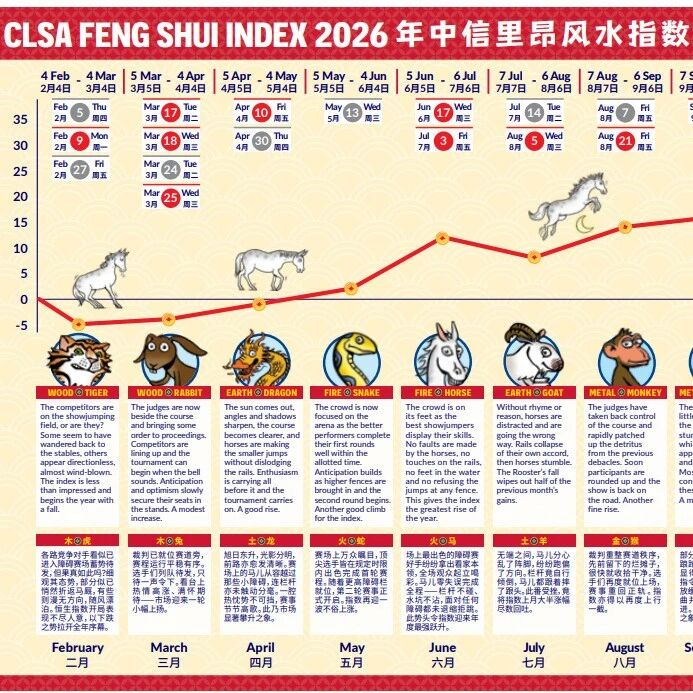
Core Viewpoint - The report from Citic Lyon emphasizes that 2026 will mark a departure from the hesitant trials of the Year of the Snake, with the Year of the Horse bringing a confident and powerful momentum to the market [5]. Market Predictions - The report provides a month-by-month forecast for the Hang Seng Index in 2026, predicting a poor start in February, followed by a series of upward movements from March to June, with the strongest performance expected in June. A significant decline is anticipated in December, before a rebound in January 2027 [5][6]. Industry Predictions - **Wood Sector**: Expected to be the strongest throughout the year, with a rebound anticipated towards the end of the year, benefiting agriculture and related industries [6]. - **Fire Sector**: Predicted to perform well, particularly in energy production and communication, but may face challenges in the last two months of the year due to excessive water influence [6]. - **Earth Sector**: Expected to have a moderate performance, with potential strength in construction materials like sand and cement, while real estate may struggle [6]. - **Metal Sector**: Forecasted to have a strong year, particularly in machinery manufacturing and construction steel, with a focus on innovation in financial products [6]. - **Water Sector**: Anticipated to be the weakest element, with stagnation expected in shipping and tourism, and limited growth in trade-related sectors [7]. Review of 2025 Predictions - The report reflects on the unpredictable nature of 2025, highlighting significant fluctuations in the Hang Seng Index, including unexpected declines and rebounds, aligning with earlier predictions of market behavior [8][10].

春季行情未完,持股过节
Huajin Securities· 2026-02-07 08:15
Group 1 - The report suggests maintaining a balanced allocation in technology growth, certain cyclical, and consumer sectors before the holiday, with potential outperformers including automotive, military, beauty care, machinery, and communication industries for the 2025 annual report performance [1][3] - The consumer sector's short-term rebound may be a valuation correction, with its sustainability under observation due to weak consumer confidence, lack of profit inflection points, and significant valuation recovery already observed [1][3][36] - Current valuations in growing sectors such as pharmaceuticals, automotive, computers, and machinery are relatively low, indicating potential for future growth [1][3] Group 2 - Historical analysis indicates that after adjustments in the spring market, leading sectors supported by policy and industry trends may regain their advantage, particularly technology growth and cyclical sectors [1][3][24] - The report highlights that sectors with strong annual report performance growth forecasts, such as automotive (471.5%), military (398.4%), beauty care (378.3%), machinery (275.6%), and communication (242.1%), are likely to perform well in the short term [1][3][32] - The consumer sector has shown a long-term downtrend since 2021, with six rebound instances averaging 21.56% in magnitude, driven by consumer confidence, low valuations, and profit growth [1][3][36]
星石投资周评:海外影响或逐步减弱
Xin Lang Cai Jing· 2026-02-07 07:57
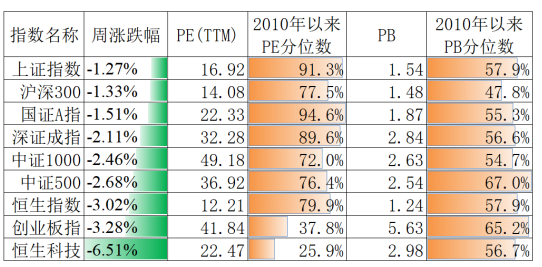
Market Overview - The market exhibited weak fluctuations with continued volume contraction from February 2 to February 6, influenced significantly by global factors, particularly concerns over tightening liquidity and changes in AI narratives, leading to a decline in risk appetite [1][16] - Defensive sectors such as consumer and financial performed relatively well, while previously high-performing technology growth and cyclical sectors experienced corrections, indicating a clear style shift [1][16] Index Performance - Major indices showed the following weekly changes: - Shanghai Composite Index: -1.27%, PE (TTM): 16.92, PB: 1.54 [18] - CSI 300: -1.33%, PE (TTM): 14.08, PB: 1.48 [18] - Shenzhen Component Index: -2.11%, PE (TTM): 32.28, PB: 2.84 [18] - ChiNext Index: -3.28%, PE (TTM): 41.84, PB: 5.63 [18] Sector Performance - The following sectors showed notable weekly performance: - Food and Beverage: +4.31%, PE (TTM): 22.20, PB: 4.03 [20] - Beauty and Personal Care: +3.69%, PE (TTM): 40.37, PB: 3.35 [20] - Power Equipment: +2.20%, PE (TTM): 41.48, PB: 3.45 [20] - Non-bank Financials and Non-ferrous Metals performed well, while traditional industries still need recovery [26] Key Influencing Factors - Earnings forecasts indicate a continued recovery in listed company profits, with 53.6% of 3,057 companies reporting positive forecasts as of January 31 [26] - Leverage funds slightly decreased, with the financing balance at 26,640.54 billion, down by 346 billion from January 30 [26][11] - Expectations of tightening overseas liquidity continue to grow, with the US dollar index rebounding above 97, leading to volatility in risk assets [12][27] - Mixed US economic data was reported, with the ISM manufacturing PMI rising to 52.6 from 47.9, while ADP employment data fell short of expectations, adding to labor market concerns [13][28] Future Outlook - Concerns over global liquidity tightening may have been priced in, with uncertainty remaining about whether the Federal Reserve will actually reduce its balance sheet this year [29] - The overall risk premium in the A-share market has returned to a historically low level, with limited upward space driven by valuations; corporate earnings will be crucial for market upward movement [29]