公用事业

Search documents
兼评10月企业利润数据:利润增速转负,新质生产力效益增势向好
KAIYUAN SECURITIES· 2025-11-27 15:20
Group 1: Profit and Revenue Trends - Cumulative profit of large-scale industrial enterprises from January to October 2025 increased by 1.9% year-on-year, down from 3.2% previously[3] - Cumulative revenue for the same period rose by 1.8% year-on-year, a decrease from 2.4%[3] - In October, revenue showed a significant decline of approximately -3.3% year-on-year, a drop of 6.4 percentage points from the previous value[3] - Profit in October fell sharply by 27.1 percentage points to -5.5% year-on-year, aligning with earlier predictions of declining profit growth[3] Group 2: Factors Affecting Profitability - The contribution to October's profit growth from industrial value added, PPI, and profit margin year-on-year was +4.7, -2.1, and -6.1 percentage points respectively[3] - Increased costs, particularly financial expenses, significantly impacted profitability, with costs per 100 yuan of revenue at 85.6 yuan, up by 0.1 yuan from the previous year[4] - The profit structure showed that the share of midstream profits continued to rise, with midstream equipment manufacturing at 39.5%[5] Group 3: Inventory and Economic Outlook - Nominal inventory increased by 0.9 percentage points year-on-year to 3.7%, marking two consecutive months of inventory growth[6] - The overall economic outlook suggests that Q4 profits will remain under pressure due to the fading low base effect, but new productivity trends are improving[6] - Attention should be given to fiscal policies and the potential for profit recovery linked to improvements in US-China trade relations[6]
1-10月工业企业利润点评:企业盈利的修复预期还在吗
Changjiang Securities· 2025-11-27 15:18
Group 1: Profit and Revenue Trends - In October, the profit growth rate of industrial enterprises turned negative at -5.5%, marking three consecutive months of negative growth[3] - The revenue growth rate also turned negative at -3.3% in October, indicating a significant decline in both profit and revenue[5] - The two-year compound growth rate for profits fell to -7.8%, reflecting ongoing pressure on profit recovery despite base effects being excluded[3] Group 2: Sector Performance - Mining sector profits decreased by 12.0%, while manufacturing profits fell by 9.2% in October[6] - State-owned enterprises saw profit growth slow to 3.6% in October, down from previous high growth rates[6] - The computer electronics and automotive sectors were among the top contributors to profit growth, collectively adding 2.6 percentage points to overall profits[6] Group 3: Inventory and Turnover Issues - By the end of October, the nominal growth rate of industrial product inventories rose to 3.7%, indicating increased inventory pressure[6] - The inventory turnover days increased to 20.4 days, and accounts receivable turnover days rose to 69.8 days, highlighting growing turnover pressures[6] Group 4: Future Outlook - There is potential for profit recovery in the first half of next year, supported by anticipated domestic demand policies and a possible global industrial cycle recovery due to U.S. Federal Reserve rate cuts[3] - The government is expected to implement framework policies to stabilize growth ahead of the upcoming Two Sessions[3]
华尔街展望明年美股前景:标普500目标位最高看至 8000点,AI与政策成关键变量
Zhi Tong Cai Jing· 2025-11-27 13:48
Group 1 - Major Wall Street banks have released their outlooks for the S&P 500 index for the end of 2026, with a general consensus that the index will continue to rise due to the ongoing AI investment wave, a shift to loose monetary policy, and expanding profit growth [1][2][8] - HSBC sets a target of 7500 points for the S&P 500 by the end of 2026, expecting a 12% growth in earnings per share for index constituents, driven by macroeconomic stability and the AI investment boom [2][3] - Societe Generale predicts the S&P 500 could reach 7300 points in 2026, with a potential range reflecting significant market volatility due to monetary policy uncertainty [4] Group 2 - Barclays raises its target for the S&P 500 to 7400 points, citing strong performance from large tech stocks and improving monetary and fiscal conditions, while warning of pressure on non-tech sectors due to rising inflation and unemployment [5][6] - UBS forecasts a target of 7500 points for the S&P 500, driven by strong corporate earnings growth of 14.4% in 2026, despite concerns over valuation risks related to AI stocks [8] - Morgan Stanley anticipates the S&P 500 will rise to 7800 points, supported by Fed rate cuts and efficiency gains from AI technology [11] Group 3 - Deutsche Bank presents the most optimistic outlook, setting a target of 8000 points for the S&P 500, driven by expected earnings growth of 14% and a broader market rally beyond the largest tech companies [12] - Morgan Stanley's strategy team emphasizes that the recent market sell-off is nearing its end, viewing it as an opportunity to position for a bullish 2026 [11] - JPMorgan highlights the K-shaped economic recovery, indicating that while large enterprises benefit from AI, the disparity in consumer confidence and spending may lead to market volatility [10]
近9000亿元!上交所最新发声
证券时报· 2025-11-27 10:18
Core Viewpoint - The Shanghai Stock Exchange (SSE) is actively promoting the development of the green and ESG bond market to support the green transformation of real enterprises and enhance the effectiveness of financing for the real economy [1][3]. Group 1: Market Development and Achievements - As of October 2025, the cumulative issuance scale of green bonds (including ABS) on the SSE has approached 900 billion yuan, with low-carbon transition bonds exceeding 80 billion yuan since their launch in 2022 [1]. - The market structure of SSE's green and low-carbon transition bonds is characterized by a diversified maturity profile, primarily mid-term, with issuers spanning key industries such as industrial, public utilities, and finance [1][4]. Group 2: Financing Mechanisms and Benefits - The financing mechanisms for green bonds and low-carbon transition bonds on the SSE are considered convenient, effectively meeting companies' financing needs in related fields [3]. - The SSE allows funds raised from green bonds to replace self-funded expenditures on green projects incurred in the previous 12 months, providing greater autonomy in choosing issuance timing and reducing financing costs [3]. Group 3: Secondary Market Innovations - The SSE has lowered the threshold for green bonds to be included as benchmark market-making securities, enhancing liquidity and pricing efficiency in the secondary market [4]. - The introduction of a science and technology innovation bond ETF has effectively reduced financing costs and could further stimulate market activity if similar products are launched in the green bond market [4]. Group 4: Future Directions and Recommendations - Participants at the symposium emphasized the importance of enhancing the flexibility of fund usage and management, as well as optimizing incentive policies to expand the depth and breadth of the green bond market [6]. - There is a call for a richer supply of green bonds to broaden investment choices, with expectations for more enterprises to issue green bonds on the SSE [6]. Group 5: Standards and Training - The understanding and application of green bond standards are becoming focal points, with suggestions for increased industry training and communication to enhance market participants' capabilities [7]. - Future innovations in bonds are encouraged to include areas such as biodiversity, climate adaptation, and carbon benefits to promote the development of the green finance system [7].


1-10月工企利润数据点评:原材料价格仍是当前工业企业盈利能力的主要拖累
Bank of China Securities· 2025-11-27 07:58
Profit and Revenue Performance - From January to October, industrial enterprises achieved a total profit of CNY 59,502.9 billion, a year-on-year increase of 1.9%, with growth slowing by 1.3 percentage points compared to the previous three quarters[1] - In October alone, profits fell by 5.5% year-on-year, marking a significant decline of 27.1 percentage points from September[1] - Revenue for the same period grew by 1.8% year-on-year, with the revenue-to-asset ratio at CNY 74.5 per CNY 100 of assets, slightly down by CNY 0.2 from the previous quarter[1] Cost and Profitability Analysis - Industrial enterprises' operating costs increased by 2.0% year-on-year, with the growth rate narrowing by 0.6 percentage points compared to the previous three quarters[1] - The operating profit margin for industrial enterprises remained stable at 5.3% from January to October[1] - The Producer Price Index (PPI) and the PPI for production materials both showed negative growth, declining by 2.7% and 3.2% respectively, indicating continued pressure on profitability[2] Sector Contributions and Challenges - The mining sector's profit contribution to industrial enterprises was negative, with a year-on-year profit decline of 27.8%, impacting overall profit growth by 4.7 percentage points[10] - Real estate investment decreased by 14.7% year-on-year, further dragging down fixed asset investment growth by 3.0 percentage points, highlighting a significant demand shortfall[3] - The coal mining and washing industry had an import price index of 73.7 in October, indicating ongoing negative growth and contributing negatively to overall profit growth by 4.2 percentage points[24]
把握红利港股ETF(159331)投资价值,连续分红15个月,关注港股通高股息板块防御属性
Mei Ri Jing Ji Xin Wen· 2025-11-27 06:42
Core Viewpoint - The Hong Kong Stock Connect high dividend sector exhibits defensive attributes in the current market environment, particularly as weakening economic data and a strengthening US dollar lead to decreased market risk appetite [1] Industry Performance - Traditional high dividend sectors such as banking have become the preferred choice for capital during market fluctuations due to their stable dividend capabilities and lower valuation levels [1] - Cyclical sectors like energy and utilities are also attracting allocation demand due to their stable earnings and high dividend yields [1] - If economic stimulus policies are intensified, certain high dividend cyclical industries may further benefit from expectations of earnings recovery [1] Investment Product - The Dividend Hong Kong Stock ETF (159331) tracks the Hong Kong Stock Connect high dividend index (930914), which selects 30 securities with continuous dividends, good liquidity, and outstanding dividend yields from the Hong Kong Stock Connect range [1] - This index primarily covers traditional high dividend industries such as finance, energy, and industrials, reflecting the overall performance characteristics of high dividend, low valuation sectors in the Hong Kong market [1] - Notably, the Dividend Hong Kong Stock ETF (159331) has distributed dividends for 15 consecutive months, making it noteworthy [1]
红利港股ETF(159331)飘红,市场聚焦高股息防御属性
Mei Ri Jing Ji Xin Wen· 2025-11-27 06:13
Core Viewpoint - The Hong Kong Stock Connect high dividend sector exhibits defensive attributes in the current market environment, particularly as economic data weakens and the US dollar index strengthens, leading to a decline in market risk appetite [1] Group 1: Market Environment - High dividend strategies are increasingly favored by funds during periods of market turbulence due to their stable dividend capabilities and lower valuation levels [1] - Traditional high dividend sectors such as banking have become preferred choices for risk-averse capital during market fluctuations [1] Group 2: Sector Performance - Cyclical sectors like energy and utilities are attracting allocation demand due to their stable earnings and high dividend yields [1] - If economic stimulus policies are intensified, certain high dividend cyclical industries may further benefit from expectations of earnings recovery [1] Group 3: Investment Products - The Hong Kong Dividend ETF (159331) tracks the Hong Kong Stock Connect High Dividend Index (930914), which selects 30 securities with a history of three consecutive years of dividends and ranks in the top 50 for dividend yield over the past year [1] - The index focuses on traditional industries such as banking and energy that exhibit stable dividend characteristics, reflecting the overall performance of high dividend investment targets through a pure dividend strategy [1]
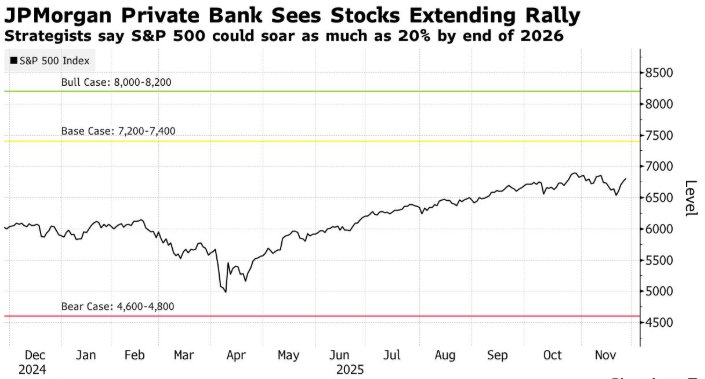
小摩反驳“AI泡沫论”,预测明年标普500有望涨20%至8200点!
Zhi Tong Cai Jing· 2025-11-27 05:05
Manoukian表示:"我们坚信,我们正处于一种更为结构性的转变之中,公共市场与私人市场的差异正变 得越来越小。如果想要以主题化的方式进行投资,避免涉足私人市场,那实际上就是将自己与人工智能 生态系统中最具活力和创新性的领域隔离开来。" 小摩乐观的预测一出,却恰逢华尔街因有关人工智能的种种担忧以及经济疲软的迹象而人心惶惶之际。 过去四天里,美股上涨了4%。这一涨势平息了那些警告称股市即将出现全面回调的看空者们的言论, 而如今,美股多头的乐观情绪又开始高涨起来。 对于小摩私人银行投资策略美国负责人Jacob Manoukian和全球投资策略的联合负责人Stephen Parker而 言,近期导致标普500指数从10月的纪录高位下跌多达5%的市场动荡,证实了市场并未处于通常与泡沫 相关的那种狂热状态之中。 Parker在周二的一次采访中表示:"我们的许多客户目前手头都有大量现金。对于这些客户而言,我们 与他们进行的为期12至18个月的交流内容是,这是一次绝佳的机会。我们将其视为一个买入良机,同时 我们也明白这并不一定就是最低点。" 该行认为,在2026年,技术和公用事业将是重点投资领域,因为这两类行业将受益于人 ...

结构性行情或将延续,踏准板块轮动节奏
British Securities· 2025-11-27 04:40
Market Overview - The A-share market is experiencing a structural divergence, with the Shanghai Composite Index closing down while the Shenzhen Component and ChiNext indices saw significant gains, indicating a "strong technology, weak large-cap" market structure [3][8] - The overall trading volume remains low, with total turnover at 17,833 billion, reflecting insufficient new capital inflow and a general lack of market enthusiasm [5][8] Sector Performance - The technology sector, particularly semiconductor chips, AI themes, and robotics, is highlighted as a key area for investment, alongside cyclical industries such as photovoltaics, batteries, and chemicals [3][9] - Consumer stocks, especially in food and beverage and retail, have shown strong performance, supported by government policies aimed at boosting consumption [6][8] - The pharmaceutical sector, including pharmaceutical commerce and innovative drugs, is noted for its potential rebound, driven by aging demographics and previous price declines that have already factored in policy impacts [7][8] Investment Strategy - The report suggests a focus on individual stocks rather than indices, advocating for a balanced allocation strategy and opportunistic buying during market dips [3][9] - Investors are encouraged to select stocks with strong earnings support while avoiding high-valuation stocks lacking performance backing [3][9]
晨星:上调长江基建集团(01038)公允价值至65港元 未来五年每股股息复合年增长3%
智通财经网· 2025-11-27 03:49
鉴于受监管公用事业的前景越来越好,回报率升高,该行将中期每股盈利预测平均上调2.4%。 晨星表示,未来五年每股盈利复合年增长6.3%,原因是受监管的回报率将提高,以反映自上一轮调整以 来资本成本的显著上升。允许的回报率通常每五年调整一次,高于政府债券收益率,而政府债券收益率 自疫情以来已大幅上涨。晨星预测,未来五年每股股息复合年增长率3%,该行预期管理层将控制股息 增长,从而使派息比率降至70%以下。 智通财经APP获悉,晨星发布研报称,上调长江基建集团(01038)公允价值3%至65港元,受惠于盈利预期 微增。该股目前被低估,预测市盈率15倍及股息率4.8%,中期前景稳健。 ...