
小金属

Search documents
金属、新材料行业周报:关税预期反复调整,金属价格波动放大-20251019
Shenwan Hongyuan Securities· 2025-10-19 08:32
Investment Rating - The report maintains a positive outlook on the metals and new materials industry, indicating a favorable investment rating [4]. Core Insights - The report highlights the volatility in metal prices due to fluctuating tariff expectations and geopolitical factors, particularly affecting copper and aluminum prices [4][30]. - The precious metals sector is expected to benefit from increased central bank purchases, particularly gold, as the current pricing environment favors safety over yield [22]. - Industrial metals like copper are projected to see price increases due to stable demand from infrastructure investments and AI data centers, despite short-term tariff impacts [4][30]. Weekly Market Review - The Shanghai Composite Index fell by 1.47%, while the Shenzhen Component Index dropped by 4.99% [5]. - The non-ferrous metals index decreased by 3.07%, underperforming the CSI 300 Index by 0.85 percentage points [5]. - Year-to-date, the non-ferrous metals index has risen by 69.59%, outperforming the CSI 300 Index by 54.87 percentage points [5][8]. Price Changes - Precious metals saw significant price increases, with COMEX gold rising by 5.76% and silver by 6.55% [4]. - Industrial metals experienced mixed results, with copper prices decreasing by 4.34% and aluminum by 1.19% [4][9]. - Lithium prices showed slight increases, while cobalt prices surged by 10.33% [4][14]. Supply and Demand Dynamics - Copper supply is expected to tighten due to production disruptions from incidents at major mines, with a projected 2.2% decrease in global copper supply [4][30]. - The aluminum sector is witnessing stable demand, with a shift towards peak consumption season anticipated [4][44]. - The steel industry is experiencing a decrease in production, while downstream demand is increasing, leading to a reduction in steel inventory [4][20]. Key Company Valuations - Notable companies in the precious metals sector include Zijin Mining, Shandong Gold, and Zhongjin Gold, with varying price-to-earnings (PE) ratios indicating differing market expectations [19]. - In the industrial metals sector, companies like Zijin Mining and Luoyang Molybdenum are highlighted for their growth potential, with projected earnings per share (EPS) growth [19][20].





美国政府停摆继续,信贷危机担忧升温,降息预期下金银价格持续新高
HUAXI Securities· 2025-10-18 15:22
Investment Rating - Industry Rating: Recommended [4] Core Views - The ongoing U.S. government shutdown and rising credit crisis concerns have led to expectations of interest rate cuts, resulting in sustained highs for gold and silver prices. COMEX gold rose by 5.76% to $4,267.90 per ounce, while COMEX silver increased by 6.55% to $50.63 per ounce. SHFE gold and silver also saw significant increases of 10.53% to 999.80 yuan per gram and 12,249.00 yuan per kilogram, respectively [1][2][30]. Summary by Sections Precious Metals - The gold-silver ratio fell by 0.74% to 84.30. SPDR Gold ETF holdings increased by 966,285.71 troy ounces, and SLV Silver ETF holdings rose by 1,452,401.60 ounces [1][30]. - The U.S. government shutdown has entered its 17th day, with significant economic impacts estimated at a weekly loss of $15 billion. The ongoing geopolitical tensions and the potential for further interest rate cuts are expected to support gold prices [3][45][46]. - The silver market is experiencing extreme tightness, leading to a historical "short squeeze" with leasing rates exceeding 35%. Global silver shortages are projected to reach approximately 3,660 tons in 2025, with industrial demand expected to grow due to AI-driven applications [7][47]. Base Metals - In the LME market, copper prices rose by 2.25% to $10,607.00 per ton, while aluminum increased by 1.18% to $2,778.50 per ton. Zinc and lead prices, however, saw declines [8][9]. - The supply of copper is expected to tighten due to production disruptions in major mines, with a projected reduction of 200,000 tons in Q4 2025. The macroeconomic environment remains supportive of copper prices, with expectations of continued U.S. dollar depreciation [10][11][21]. - Aluminum demand remains stable, with production expected to increase due to new projects. The profit margins for electrolytic aluminum are improving as raw material costs decline [12][22]. Minor Metals - Magnesium prices have decreased by 1.43% to 17,920 yuan per ton, while molybdenum prices rose by 3.28% to 283,500 yuan per ton due to increased demand from steelmaking [17][18]. - The market for vanadium remains under pressure, with prices declining as steel demand has not met expectations [18]. Investment Recommendations - The report suggests focusing on gold and silver stocks due to their expected performance in the current economic climate. Recommended stocks include Chifeng Jilong Gold Mining, Shandong Gold, and Zhongjin Gold [6][20][47].
深挖财报之2025Q3业绩预告分析:业绩预告中的高景气线索
Tianfeng Securities· 2025-10-17 10:20
Group 1 - The core conclusion indicates that the performance forecasts for Q3 2025 in the electronics and basic chemicals sectors are promising, with over 10 companies expecting a year-on-year profit growth exceeding 30% [1][9] - The electronics sector is expected to maintain high growth due to the AI wave, which is driving new demand for AI inference [1][12] - The basic chemicals sector is experiencing structural improvements due to supply constraints and demand support, with some industries already showing signs of recovery [1][24] Group 2 - As of October 15, 2025, the overall disclosure rate for Q3 2025 earnings forecasts across all A-shares is approximately 2.83%, with a positive forecast rate of about 83.06% [2][33] - Among the disclosed companies, the median year-on-year net profit growth rate is 71.2%, while the overall method shows a growth rate of 65.6% [2][45] - The sectors with the highest expected profit growth include non-ferrous metals (165.2%), agriculture, forestry, animal husbandry, and fishery (213.7%), and media (753.9%) [45][48] Group 3 - In the upstream materials sector, significant growth is noted in industrial metals (2150.1%), new metal materials (298.8%), and minor metals (365.7%) [3][48] - The midstream manufacturing sector shows high growth rates in batteries (130.8%), wind power equipment (212.7%), and other electronics (111.6%) [3][51] - In the downstream consumption sector, notable growth is observed in agricultural product processing (372.8%), chemical pharmaceuticals (251.4%), and gaming (753.9%) [3][48] Group 4 - The sectors with the highest positive forecast rates for Q3 2025 include comprehensive services, non-bank financials, and social services, all at 100% [1][41] - Conversely, the sectors with the lowest positive forecast rates include building materials, coal, and beauty care [1][41] - The report highlights that the electronics industry is benefiting from a strong demand for AI-related hardware, with significant growth in the electronic information manufacturing sector [12][18]


有色金属“领涨”,你也挖到矿了吗?
Xin Lang Ji Jin· 2025-10-17 09:38
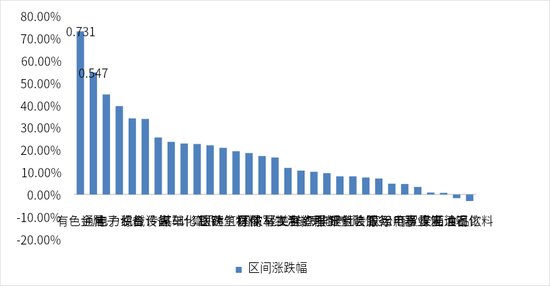
Core Insights - The article discusses the significant rise in the non-ferrous metals sector, driven by macroeconomic, industrial, and geopolitical factors, highlighting a "metal market boom" [1][3] - The Shenyin Wanguo non-ferrous metals industry index has seen a year-to-date increase of 73.14% as of October 16, 2025, leading among 31 primary industries [1][3] Industry Overview - Non-ferrous metals are defined as metals excluding iron, manganese, and chromium, categorized into five types: industrial metals, minor metals, energy metals, precious metals, and new metal materials [5] - The current market dynamics indicate a strong performance in the non-ferrous metals sector, with ongoing investment opportunities [10] Investment Strategies - Longview Fund's Chen Ziyang focuses on the non-ferrous metals sector, with a portfolio that includes leading companies in industrial metals, precious metals, minor metals, and new materials [5][12] - The Longview Cycle Select Fund has a significant allocation to non-ferrous metals, with top holdings reflecting a broad exposure to key segments [8][12] Market Drivers - Industrial metals are benefiting from a Federal Reserve interest rate cut cycle, which is expected to increase demand and prices, particularly for copper [11] - Minor metals like rare earths are gaining strategic importance due to recent export controls by the Ministry of Commerce, indicating a potential for value reassessment [13] - Energy metals are projected to enter a super cycle driven by the rapid growth of green industries, with demand for key metals expected to increase significantly by 2040 [13] Precious Metals Outlook - The price of gold is anticipated to remain strong, supported by central banks increasing their gold reserves amid a weakening dollar [14] - The article suggests that the current market conditions may present an opportune time for investors to consider gold investments [14]

小金属板块10月17日跌2%,东方锆业领跌,主力资金净流出21.86亿元
Zheng Xing Xing Ye Ri Bao· 2025-10-17 08:28
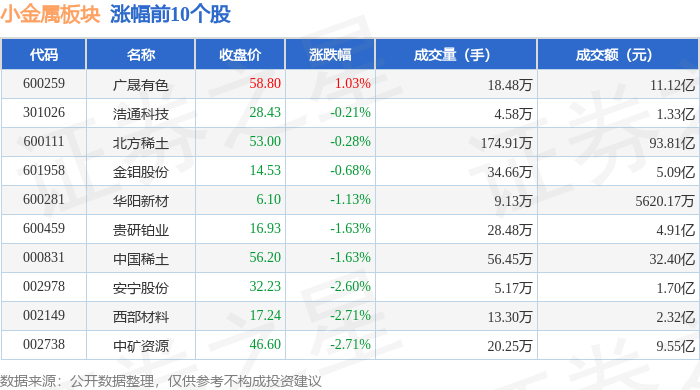
Market Overview - The small metals sector experienced a decline of 2.0% on October 17, with Dongfang Zirconium leading the drop [1] - The Shanghai Composite Index closed at 3839.76, down 1.95%, while the Shenzhen Component Index closed at 12688.94, down 3.04% [1] Individual Stock Performance - Guangsheng Nonferrous (600259) closed at 58.80, up 1.03% with a trading volume of 184,800 shares and a transaction value of 1.11 billion [1] - Dongfang Zirconium (002167) closed at 12.96, down 5.68% with a trading volume of 392,100 shares and a transaction value of 524 million [2] - The highest decline was seen in Dongfang Zirconium, which fell by 5.68% [2] Capital Flow Analysis - The small metals sector saw a net outflow of 2.186 billion from main funds, while retail investors contributed a net inflow of 1.784 billion [2][3] - The main funds showed a negative net flow in several stocks, including Guangsheng Nonferrous and Huayang New Materials [3] Trading Volume and Transaction Value - The trading volume for Guangsheng Nonferrous was 184,800 shares, while Dongfang Zirconium had a trading volume of 392,100 shares [1][2] - The transaction value for Guangsheng Nonferrous was 1.11 billion, and for Dongfang Zirconium, it was 524 million [1][2]


有色金属行业双周报(2025、10、03-2025、10、16):白银价格续创新高,国际金价突破4300美元-20251017
Dongguan Securities· 2025-10-17 07:54
Investment Rating - The report maintains a "Market Weight" rating for the non-ferrous metals industry, indicating that the industry is expected to perform within ±10% of the market index over the next six months [67]. Core Insights - Silver prices continue to reach new highs, with international gold prices surpassing $4,300 [2]. - As of October 16, 2025, the non-ferrous metals industry has seen a 3.35% increase over the past two weeks, outperforming the CSI 300 index by 3.83 percentage points, ranking 4th among 31 industries [3][13]. - The precious metals sector has risen by 6.04%, while the industrial metals sector has increased by 3.58% during the same period [18]. Market Review - As of October 16, 2025, the COMEX gold price closed at $4,344.30 per ounce, up $828.2 since early September, while the COMEX silver price reached $53.43 per ounce, an increase of $12.68 [6][35]. - The LME copper price stood at $10,620 per ton, with other industrial metals like aluminum at $2,796 per ton and nickel at $15,230 per ton [25][60]. - The rare earth price index was recorded at 204.65, down 22.28 from early September, indicating a need for caution regarding external risk sentiment [42][61]. Industry News - The Ministry of Commerce announced export controls on rare earth-related technologies to safeguard the global supply chain and address illegal acquisition issues [50]. - The World Gold Council noted that overall gold holdings remain low, suggesting potential for future price increases despite current market concerns [50]. Company Announcements - Shenghe Resources expects a net profit increase of 697% to 783% year-on-year for the first three quarters of 2025, driven by favorable market conditions for rare earth products [51][52]. - Northern Rare Earth anticipates a net profit increase of 273% to 287% for the same period, reflecting strong market demand and effective management strategies [53][54]. - Shandong Gold forecasts a net profit increase of 84% to 99% for the first three quarters of 2025, attributed to rising gold prices [57][58]. Investment Recommendations - The report suggests focusing on companies such as Zijin Mining (601899), Xinyi Silver (000426), and Chifeng Jilong Gold (600988) in the precious metals sector [60][63]. - For industrial metals, companies like Western Mining (601168) and Luoyang Molybdenum (603993) are recommended [60][63]. - In the rare earth sector, attention is drawn to Xiamen Tungsten (600549) and Northern Rare Earth (600111) [62][63].




【机构策略】预计四季度A股市场震荡上行的方向未发生改变
Zheng Quan Shi Bao Wang· 2025-10-17 01:28
Group 1 - A-share market experienced slight fluctuations with strong performance in banking, automotive, communication equipment, and coal sectors, while precious metals, small metals, wind power equipment, and steel sectors underperformed [1] - Market policy expectations are rising, and the potential for interest rate cuts by the Federal Reserve this year is expected to support the market [1] - The upcoming third-quarter reports are anticipated to show a rebound in profit growth across most industries due to a low base from last year, which will strengthen market confidence [1] Group 2 - A-share market saw a pullback after reaching highs, with increased recession expectations in the U.S. due to government "shutdown" and missing key economic data, raising the probability of interest rate cuts in October [2] - Domestic indicators show a continuous expansion in the core CPI for five months, and a decline in social financing and credit growth compared to last year, indicating signs of economic weakness in Q3 [2] - The market is expected to maintain an upward trend amidst a backdrop of improving economic fundamentals in Q4, although recent trading volumes have decreased, suggesting a cautious shift in funding [2] Group 3 - A-share market showed reduced trading volume and fluctuations, with a focus on dividend stocks, while the storage chip sector remained active despite adjustments in other sectors like precious metals and semiconductors [3] - The ongoing global AI investment trend, domestic "anti-involution" leading to performance improvement expectations, and increased liquidity from household savings entering the market are key factors supporting the current bull market [3] - The expectation for the A-share market to trend upwards in Q4 remains unchanged, bolstered by improved global liquidity conditions from potential Federal Reserve rate cuts [3]
A股:大盘精准收在3916.23点,不出意外的话,周五的剧本是这样的
Sou Hu Cai Jing· 2025-10-16 22:22
Market Overview - The Shanghai Composite Index closed at 3916.23 points, slightly up by 0.10%, while the Shenzhen Component fell by 0.25%, and the ChiNext Index rose by 0.38% [1] - The trading day exhibited a typical bottom-rebound pattern, with early gains but weak buying pressure, resulting in a trading volume of less than 2 trillion yuan, a decrease of approximately 7% from the previous trading day [1] - Over four thousand stocks closed in the red, indicating a notable decline in market activity, with funds concentrated in a few heavyweight sectors such as banking, coal, and liquor, while technology and resource sectors faced adjustments [1] Sector Performance - Banking stocks continued their steady rise, with CITIC Bank leading the gains [1] - Liquor stocks saw a late surge, with Shanxi Fenjiu taking the lead [1] - The coal sector maintained strong performance, with multiple related companies hitting the upper limit [1] - Conversely, sectors such as small metals, photolithography machines, and rare earth permanent magnets faced significant pressure, showing considerable declines [1] - Although there was some capital involvement in sectors like chips and solid-state batteries, the sustainability of this interest was weak, leading to rapid rotation of funds and increased short-term trading risks [1] Market Sentiment - The reduced trading volume reflects market sentiment, with both bulls and bears awaiting clearer signals [3] - The upcoming third-quarter earnings reports and the Federal Reserve's monetary policy meeting are contributing to the uncertainty, causing both institutions and retail investors to hesitate in increasing positions [3] - The APEC meeting's interactions between China and the U.S. may also release new information regarding trade and tariffs, influencing market dynamics [3] Strategic Recommendations - In the current transitional market state characterized by reduced volume and weak sustainability of hot sectors, maintaining a defensive position is advisable [3] - Short-term funds should control the impulse to chase highs, especially in the absence of a clear trend in hot sectors, while keeping flexible positions to respond to potential sudden opportunities [3] - Mid-term funds can focus on sectors with clear long-term logic, such as domestic substitution and new energy, waiting for policy or earnings-driven market expansions [3] - Overall, the market does not exhibit systemic risks but is experiencing temporary volume contraction due to multiple approaching events [3]
沪指窄幅震荡微涨0.1%,A500ETF易方达(159361)、沪深300ETF易方达(510310)等助力布局核心资产
Sou Hu Cai Jing· 2025-10-16 12:49
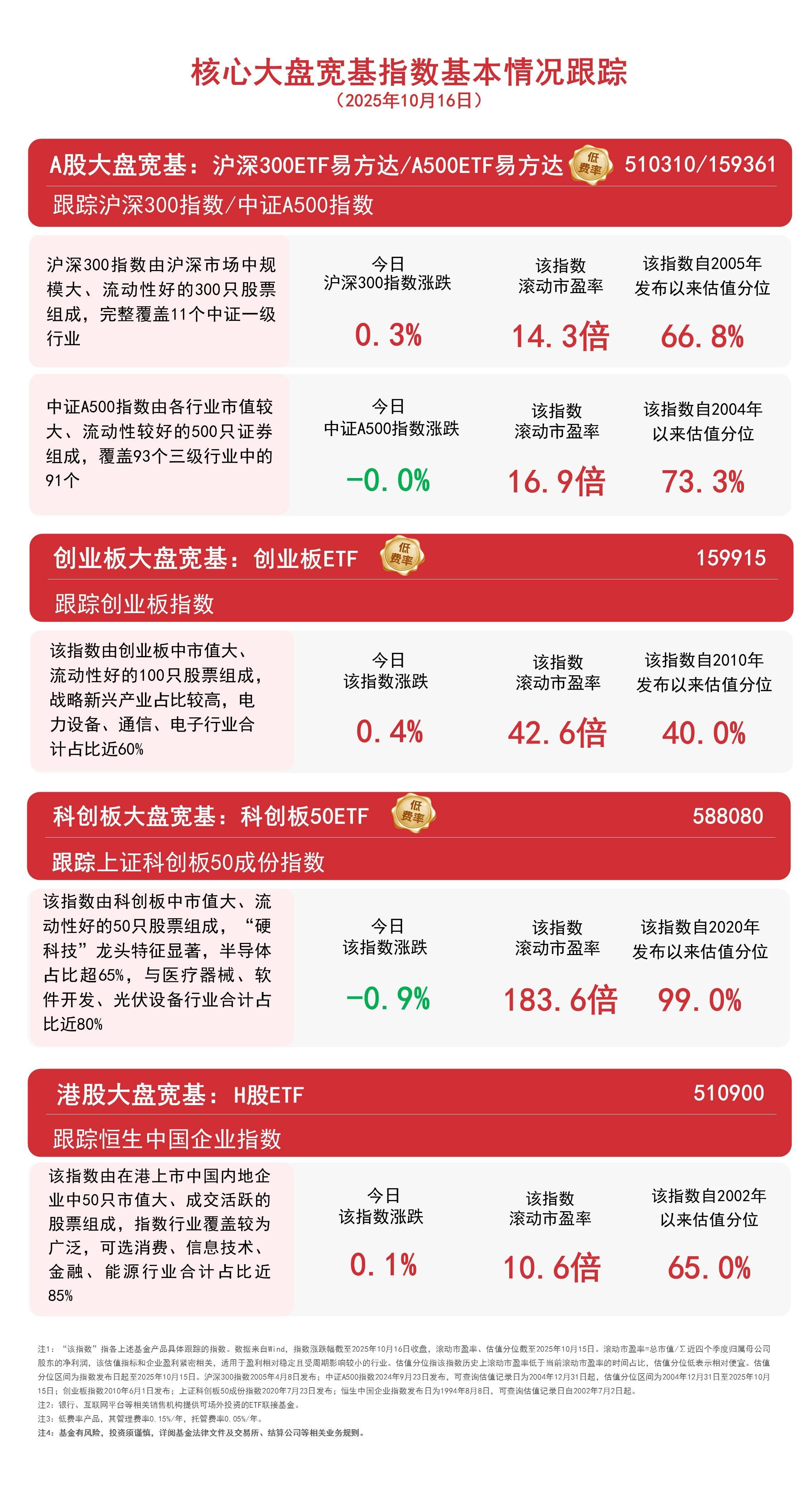
Group 1 - The A-share market showed mixed performance with the Shanghai Composite Index slightly up by 0.1%, maintaining above the 3900-point level [1] - Sectors such as insurance, coal mining and processing, port shipping, banking, liquor, and traditional Chinese medicine saw significant gains, while small metals, steel, wind power equipment, rare earth permanent magnets, and PEEK materials concepts experienced declines [1] - The CSI A500 Index fell by 0.04%, the CSI 300 Index rose by 0.3%, the ChiNext Index increased by 0.4%, the STAR Market 50 Index dropped by 0.9%, and the Hang Seng China Enterprises Index rose by 0.1% [1] Group 2 - The ChiNext ETF tracks the ChiNext Index, which consists of 100 stocks with high market capitalization and liquidity, with a significant proportion in strategic emerging industries, particularly in power equipment, telecommunications, and electronics, accounting for nearly 60% [3] - The STAR Market 50 ETF tracks the STAR Market 50 Index, composed of 50 stocks with high market capitalization and liquidity, prominently featuring "hard technology" leaders, with semiconductors making up over 65% and combined with medical devices and software development, accounting for 80% [3]
收评:主要股指宽幅整理 煤炭股领涨 金属股领跌
Xin Hua Cai Jing· 2025-10-16 10:28
Market Overview - The Shanghai and Shenzhen stock markets opened lower on October 16, with the Shenzhen Composite Index and ChiNext Index experiencing two unsuccessful attempts to rise before declining in the afternoon, resulting in a wide-ranging consolidation pattern [1] - The overall market showed a "two-eight" differentiation, with low P/E ratio stocks in coal, insurance, and banking sectors leading the gains, while small-cap stocks generally declined [1] Index Performance - The Shanghai Composite Index closed at 3916.23 points, up 0.10%, with a trading volume of approximately 869.3 billion yuan - The Shenzhen Composite Index closed at 13086.41 points, down 0.25%, with a trading volume of approximately 1061.9 billion yuan - The ChiNext Index closed at 3037.44 points, up 0.38%, with a trading volume of approximately 477.6 billion yuan - The Sci-Tech Innovation Board Index closed at 1625.45 points, down 0.97%, with a trading volume of approximately 197.9 billion yuan - The North Star 50 Index closed at 1488.71 points, down 1.30%, with a trading volume of approximately 17.7 billion yuan [1] Institutional Insights - According to Jifeng Investment Advisory, the market is undergoing a valuation recovery phase with the third-quarter report season beginning, suggesting that investors should focus on buying opportunities in leading industries after corrections [2] - Huaren Yunda Fund noted that the market is in a transitional phase of "policy expectation game + profit verification," with policies supporting the real estate demand expected to underpin the market [2] Policy Developments - The Ministry of Housing and Urban-Rural Development, along with nine other departments, issued a notice to promote the construction of smart city infrastructure and intelligent connected vehicle facilities, aiming to enhance urban digital governance [3] - The Minister of Transport emphasized the integration of artificial intelligence with transportation, planning to establish application centers and promote innovation in the sector [4] Market Risk Management - The Shanghai Gold Exchange issued a notice regarding the need for risk control due to significant fluctuations in international precious metal prices, urging members to enhance risk awareness and maintain market stability [5]