
不锈钢

Search documents
日度策略参考-20260126
Guo Mao Qi Huo· 2026-01-26 05:59
Report Industry Investment Ratings - Not provided in the given content Core Views - Policy cools market speculative sentiment, leading to stock index oscillations, but short - term adjustment space is limited, and long - term bulls can enter the market at appropriate times. Asset shortage and weak economy benefit bond futures, but the central bank warns of interest - rate risks. With the US suspending key mineral taxes, copper prices are oscillating strongly. Various factors influence different commodities, and specific trading strategies are recommended for each [1]. Summary by Industry and Variety Macro - finance - **Stock Index**: Policy cools speculative sentiment, causing oscillations. Short - term adjustment space is small, and long - term bulls can enter at opportune moments [1]. - **Treasury Bonds**: Asset shortage and weak economy are favorable, but the central bank warns of short - term interest - rate risks, and attention should be paid to the Bank of Japan's interest - rate decision [1]. Non - ferrous Metals - **Copper**: With the US suspending key mineral taxes, short - term concerns ease, and copper prices are oscillating strongly [1]. - **Alumina**: Industry drive is limited, but macro sentiment improves. Domestic supply is strong and demand is weak, and prices are expected to oscillate around the cost line [1]. - **Zinc**: The cost center is stable, and prices fluctuate in a range. Look for high - selling and low - buying opportunities [1]. - **Nickel**: Supply concerns persist due to various factors, and prices are strong in the short term. Long - term high inventory may have a suppressing effect. Short - term buying on dips is recommended [1]. - **Stainless Steel**: Supply concerns persist, raw material prices rise, and social inventory decreases slightly. Futures are at a high level, and there is a risk of a short squeeze. Short - term low - buying is recommended [1]. - **Tin**: Market sentiment improves. Although there is a negative news, supply increase in the first quarter is limited, and there is upward potential [1]. Precious Metals and New Energy - **Precious Metals**: Geopolitical risks and strong fundamentals support prices, but there is a risk of profit - taking during the Fed's meeting [1]. - **Platinum and Palladium**: Macro factors support prices in the short term, but fluctuations are large. In the long term, platinum has a supply - demand gap, and palladium tends to have a loose supply. Unilateral low - buying of platinum or a [long platinum, short palladium] arbitrage strategy is recommended [1]. - **Industrial Silicon and Polysilicon**: Northwest production increases, and Southwest production decreases. December production schedules for polysilicon and organic silicon decline [1]. - **Lithium Carbonate**: There are factors such as the off - season for new energy vehicles, strong energy - storage demand, and battery export rush [1]. Black Metals - **Rebar**: Expectations are strong, but spot is weak, and the rally momentum is insufficient. Unilateral long positions should be closed, and positive - spread positions can be considered [1]. - **Hot - Rolled Coil**: High production and inventory suppress price increases. Unilateral long positions should be closed, and positive - spread positions can be considered [1]. - **Iron Ore**: There is a sector rotation, but there is obvious upward pressure, and chasing long is not recommended [1]. - **Glass and Soda Ash**: There is a mix of weak reality and strong expectations. Supply may be affected by energy - consumption control and anti - involution. Short - term sentiment is warm, but medium - term supply is excessive [1]. - **Coking Coal and Coke**: The market is pessimistic about the coking coal 05 contract. After the first round of coke price increase fails, the price breaks through key supports, and the previous low - buying strategy may change [1]. Agricultural Products - **Palm Oil**: Main consumer countries start purchasing, and there may be production cuts and inventory reduction in the origin. It is expected to be strongly oscillating [1]. - **Soybean Oil**: Fundamentals are strong, and long - position allocation in oils is recommended. Consider the long Y - short O1 spread [1]. - **Rapeseed Oil**: There are negative factors, but it is difficult to fall smoothly due to the strength of soybean and palm oils. It is recommended to wait and see [1]. - **Cotton**: There is production expectation, and the purchase price supports the cost. Downstream demand has rigid replenishment needs. The market is in a state of "supported but lacking drive" [1]. - **Sugar**: There is a global surplus and increased domestic supply. There is a consensus on short - selling, and cost support is strong if prices fall [1]. - **Corn**: The selling progress in Northeast China is fast, and there is inventory - replenishment demand before the festival. The price is expected to oscillate [1]. - **Soybeans**: Brazil's harvest may bring selling pressure, and Argentina's dry weather may cause short - term speculation. The M05 is expected to be weakly oscillating [1]. - **Paper Pulp**: Affected by the macro decline, it falls but does not break the oscillation range. It is recommended to wait and see [1]. - **Logs**: Spot prices rebound, and the downward space for futures is limited. It is expected to oscillate between 760 - 790 yuan/m³ [1]. - **Hogs**: Spot prices stabilize, demand supports, and production capacity needs further release [1]. Energy and Chemicals - **Crude Oil**: OPEC+ suspends production increase, geopolitical tensions in the Middle East rise, and US cold weather boosts demand [1]. - **Asphalt**: Short - term supply - demand contradiction is not prominent, following crude oil. The "14th Five - Year Plan" construction demand may be false, and supply is sufficient, with high profits [1]. - **Natural Rubber**: There is strong raw - material cost support, and the synthetic - rubber price increase drives the sector [1]. - **BR Rubber**: There is strong support for butadiene, and the market's price - support atmosphere strengthens. It operates with high开工 and high inventory [1]. - **PTA and Short - Fibre**: The PX market drives the rise of chemicals, and there is a large inflow of funds. PTA production increases, and short - fibre prices follow costs [1]. - **Ethylene Glycol**: Overseas prices rebound, and Middle - East exports decrease. There is an increase in speculative demand [1]. - **Styrene**: The supply - demand fundamentals improve, and prices rebound. The price spread between styrene and benzene widens, and inventory decreases [1]. - **Urea**: Export sentiment eases, and there is limited upward space, but there is support from anti - involution and cost [1]. - **Methanol**: Import is expected to decrease due to the Iranian situation, but there is obvious downstream negative feedback. There are multiple factors in a multi - empty situation [1]. - **PVC**: Global production is expected to be low in 2026, but the fundamentals are poor. There may be a rush for exports, and capacity may be cleared [1]. - **Caustic Soda**: Macro sentiment fades, and the market focuses on fundamentals. Fundamentals are weak, and there is inventory - building pressure [1]. - **LPG**: February CP is expected to rise, and there is cost support. Inventory decreases, and the heating market is expected to start [1]. Others - **Container Shipping on European Routes**: It is expected to peak in mid - January. Airlines are cautious about resuming flights, and there is pre - festival inventory - replenishment demand [1].
有色早报-20260126
Yong An Qi Huo· 2026-01-26 03:09
Report Industry Investment Rating - Not mentioned in the report Core Viewpoints - The report maintains a bullish outlook on copper in the medium - term, expecting supply constraints and demand growth. For aluminum, overseas active restocking supports prices. Zinc has potential for a catch - up rise, and attention should be paid to reverse arbitrage opportunities. Nickel's short - term fundamentals are weak, with a policy - fundamentals game. Stainless steel follows nickel prices. Lead is expected to oscillate in a certain range, and short - term short - selling is recommended at high prices. Tin can be a long - position allocation in the first quarter, but may face downward fluctuations in the second half of 2026. Industrial silicon prices are expected to oscillate with costs in the short - term and at the cycle bottom in the long - term. Lithium carbonate may see a spot - futures resonance market [1][2][7] Summary by Metal Type Copper - **Price Movement**: Copper prices tested the 99,000 support level during the week and rose sharply on Friday night. The US's ability to siphon inventory is waning, but global consumption is strong, and copper has strong demand support. In China, pre - Spring Festival inventory accumulation may be faster, but post - festival destocking may also be rapid [1] - **Data Changes**: From January 19 - 23, the change in spot import profit was - 91.50, and the LME inventory increased by 3,450 [1] Aluminum - **Price Movement**: Aluminum ingot prices increased, and the LME 0 - 3M spread returned to negative. Aluminum ingot basis and downstream processing fees are low, but apparent demand has rebounded. Auto consumption in December was below expectations, but photovoltaic installation increased, and overseas restocking supports prices [2] - **Data Changes**: From January 19 - 23, Shanghai aluminum ingot prices increased by 370, and the LME inventory decreased by 2,000 [2] Zinc - **Price Movement**: Zinc prices increased. Supply - side TC is declining, and production is expected to increase in January. Demand is seasonally weak domestically, and the export window was open in December. The market is optimistic about zinc's catch - up rise, and attention should be paid to reverse arbitrage opportunities [5][7] - **Data Changes**: From January 19 - 23, Shanghai zinc ingot prices increased by 310, and the LME inventory decreased by 200 [5][6] Nickel - **Price Movement**: Nickel prices increased. Supply decreased slightly, demand is weak, and domestic inventory increased slightly. There is a game between short - term policies and fundamentals due to Indonesian policies [11][12] - **Data Changes**: From January 19 - 23, the change in spot import earnings was - 2,060.88, and the LME inventory decreased by 768 [11] Stainless Steel - **Price Movement**: Stainless steel prices were relatively stable. Supply is high, demand is mainly for rigid needs, and costs are stable. Inventory decreased slightly, and prices mainly follow nickel prices [13][14] - **Data Changes**: From January 19 - 23, 304 cold - rolled coil prices decreased by 100 [13][14] Lead - **Price Movement**: Lead prices are expected to oscillate between 17,100 - 17,600. Supply is increasing due to high profits, demand is weakening, and inventory is accumulating. Short - term short - selling at high prices is recommended [15][18] - **Data Changes**: From January 19 - 23, the Shanghai - Henan price difference increased by 25, and the LME inventory decreased by 3,250 [15][18] Tin - **Price Movement**: Tin prices oscillated upward. Supply recovery in the first quarter is uncertain, and demand has different trends in different sectors. It can be a long - position allocation in the first quarter, but may face downward pressure in the second half of 2026 [21] - **Data Changes**: From January 19 - 23, the change in spot import earnings was - 17,252.19, and the LME inventory increased by 40 [21] Industrial Silicon - **Price Movement**: Industrial silicon supply is shrinking, and short - term supply and demand are close to balance. Prices are expected to oscillate with costs in the short - term and at the cycle bottom in the long - term [23] - **Data Changes**: From January 19 - 23, the 421 Yunnan basis increased by 5, and the number of warehouse receipts increased by 96 [23] Lithium Carbonate - **Price Movement**: Lithium carbonate prices increased. The market was driven by production - halt expectations, and short - term supply and demand are close to balance. A spot - futures resonance market may occur [25] - **Data Changes**: From January 19 - 23, the SMM electric - grade lithium carbonate price increased by 6,500, and the number of warehouse receipts decreased by 730 [25]
远端预期引领镍价上涨
Yin He Qi Huo· 2026-01-26 02:49
1. Report Industry Investment Rating No relevant information provided. 2. Core Viewpoints of the Report - The rise in nickel prices is led by long - term expectations. Although the price has received regulatory attention after consecutive sharp increases and may experience corrections approaching the Spring Festival, the upward trend is not over, and a low - buying strategy is recommended. For stainless steel, the supply - demand is tight with cost support, and a low - buying strategy is also advised after price corrections [7][10]. 3. Summary by Related Catalogs 3.1 Spread Tracking and Inventory - **Nickel**: Global visible inventory reached 352,000 tons, increasing by 780 tons this week, with domestic social inventory up 2,784 tons and LME inventory down 2,044 tons. Jinchuan nickel is under tight supply, and its premium remains around 9,000 yuan/ton [18]. - **Stainless Steel**: Social inventory is decreasing, and warehouse receipts are expected to increase in the future. Supply - side raw material shortages, especially for hot - rolled products, may lead to a downward revision of cold - rolled production schedules. Demand - side pre - Spring Festival stocking has not started, but due to strong bullish sentiment, spot prices are rising with hoarding behavior [10][19]. 3.2 Fundamental Analysis 3.2.1 Nickel Supply and Demand - **Supply**: In 2025, refined nickel production increased by 17% year - on - year to 392,700 tons. Net imports were 59,000 tons, compared with a net export of 23,600 tons in the same period last year. Total supply was 450,000 tons, a 45% year - on - year increase. In January, high prices are expected to further boost production, and net imports are also expected to increase [27]. - **Demand**: From January to December, pure nickel consumption increased by 2% year - on - year to 291,000 tons. Electroplating demand is in the off - season, and overall consumption growth has slowed [30]. 3.2.2 Stainless Steel Raw Materials - **Nickel Ore**: Indonesia's nickel ore quota is tentatively set at 2.5 - 2.6 billion tons. Market sentiment for overseas nickel mines is positive, and prices are rising. The Indonesian government is still processing the approval of mining company work plans and budgets [31][32]. - **NPI**: NPI production is recovering, with prices rising and profit margins improving. Some production lines are switching from NPI to high - grade nickel ice due to falling NPI prices [33][34]. - **Chromium - Based Materials**: Chromium - based prices are rising. Zimbabwe will impose a 10% tax on chromium exports starting from January 1, 2026, leading to a continuous rebound in chromium ore prices [38][44]. - **Cost Estimation**: Estimated cold - rolled cash cost is around 14,400 yuan/ton, and integrated cost is about 13,900 yuan/ton [47]. 3.2.3 Stainless Steel Supply and Demand - **Supply**: In 2025, the combined stainless steel crude steel production of China and Indonesia is expected to be 45.06 million tons, a 4% year - on - year increase. In January, due to shortages of hot - rolled products, production schedules may be revised downward. China's stainless steel imports decreased by 21% year - on - year to 1.519 million tons, exports remained flat at 5.031 million tons, and net exports increased by 11% to 3.512 million tons [56]. - **Demand**: Shipbuilding production has a high growth rate, providing support for stainless steel demand. However, growth in other terminal sectors is not optimistic, especially in the real estate market [57][58]. 3.2.4 New Energy Automobiles - **Domestic Market**: In 2025, new energy vehicle production and sales were 16.626 million and 16.49 million respectively, a 29% and 28.2% year - on - year increase, with a penetration rate of 47.9%. In January 2026, the retail sales of new energy passenger vehicles decreased. Power battery production followed the trend of vehicle sales, and in January, the impact of export tax rebate reduction may mitigate the decline in battery production [63]. - **Global Market**: From January to November 2025, global new energy vehicle sales increased by 20.1% year - on - year to 18.39 million. European sales increased by 29.2% to 3.434 million, while US sales increased by 0.7% to 1.39 million. China's new energy vehicle exports from January to December 2025 were 2.583 million, a 103% year - on - year increase [68]. 3.2.5 Nickel Sulfate Market - **Production**: In 2025, nickel sulfate production decreased by 4.3% year - on - year to 354,000 nickel tons. Ternary precursor production increased by 6% to 903,000 tons, and ternary cathode material production increased by 19% to 686,000 tons. In January, demand slowed down, but prices followed the upward trend of refined nickel [70]. - **Raw Materials**: In 2025, Indonesia's MHP production increased by 41% to 444,000 tons, and high - grade nickel ice production decreased by 18% to 224,000 tons. Rising sulfur prices increased MHP production costs, but strong nickel sulfate demand boosted intermediate product prices and production [76]. 3.3 Trading Logic and Strategies - **Nickel**: For single - side trading, adopt a low - buying strategy after price corrections and stabilizations. For options, sell out - of - the - money put options [6]. - **Stainless Steel**: For single - side trading, buy at low prices after corrections and stabilizations. For arbitrage, take a wait - and - see approach [10].
不锈钢周报 2026/01/24:镍铁涨价趋势延续,继续看好估值上行-20260124
Wu Kuang Qi Huo· 2026-01-24 14:19
1. Report Industry Investment Rating No information provided in the report. 2. Core Viewpoints of the Report - The stainless - steel market was active in trading last week, with prices fluctuating more sharply. Due to the widening price difference between nickel and stainless steel, some nickel - iron production capacity shifted to high - grade nickel matte production with better profits, leading to a tight supply of nickel - iron and limited high - quality and tradable resources in the market. Also, the futures warehouse receipts were at a low level, resulting in a short - term structural supply shortage in the stainless - steel market, and the near - month contracts continued to strengthen. - Although downstream demand weakened before the Spring Festival, the enthusiasm of traders for stockpiling increased, and the social inventory continued to decline. - On Friday last week, market news indicated that the port logistics of the Indonesia Tsingshan Industrial Park might be suspected of monopoly. If the Indonesian government intervenes in the investigation later, the shipment of Tsingshan - related products may be affected, further increasing the uncertainty on the supply side of stainless steel. - Overall, the expectation of tight supply at the raw material end has not been reversed, the stainless - steel spot market shows a tight pattern, and the price center is expected to continue to move up in the later period, but the fluctuations may be large. The reference range for the main contract is 14,150 - 15,500 yuan/ton [12][15]. 3. Summary According to Relevant Catalogs 3.1. Weekly Assessment and Strategy Recommendation - **Market Data**: On January 23, the average price of cold - rolled stainless - steel coils in Wuxi was 14,600 yuan/ton, a month - on - month increase of 1.74%; the ex - factory price of 7% - 10% nickel - iron in Shandong was 1,035 yuan per nickel, a month - on - month increase of 1.97%; the average price of scrap stainless steel was 9,450 yuan/ton, a month - on - month decrease of 0.53%. The closing price of the stainless - steel main contract on Friday afternoon was 14,725 yuan/ton, a month - on - month increase of 3.15% [12]. - **Supply**: In January, the domestic cold - rolled stainless - steel production schedule was 1.4586 million tons. In December, the crude steel output was 2.8284 million tons, a month - on - month decrease of 220,200 tons, and the cumulative year - on - year increase from January to December was 6.48%. According to MYSTEEL sample statistics, the estimated output of 300 - series stainless - steel crude steel in December was 1.4043 million tons, a month - on - month decrease of 0.14%; the output of 300 - series cold - rolled steel in December was 736,000 tons, a month - on - month increase of 6.96% [12]. - **Demand**: From January to December 2025, the cumulative sales area of commercial housing in China was 881.0137 million square meters, a year - on - year decrease of 8.70%; in December, the single - month sales area of commercial housing was 93.9963 million square meters, a year - on - year decrease of 16.57%. In December, the year - on - year changes in the output of refrigerators, household freezers, washing machines, and air conditioners were 7%, 5.7%, - 9.6%, and - 4.4% respectively; the cumulative year - on - year increase in the fuel processing industry in December was 18.2% [12]. - **Inventory**: The total social inventory of stainless steel last week was 878,900 tons, a month - on - month decrease of 0.51%; on January 23, the futures warehouse receipt inventory was 38,900 tons, a month - on - month decrease of 7,180 tons. The social inventories of 200 - series, 300 - series, and 400 - series stainless steel last week were 132,400 tons, 599,500 tons, and 189,600 tons respectively, among which the inventory of 300 - series decreased by 0.48% month - on - month; the floating quantity of stainless steel last week was 42,900 tons, a month - on - month increase of 30.66%, and the unloading quantity was 83,700 tons, a month - on - month decrease of 18.88% [12]. - **Cost**: The ex - factory price of 7% - 10% nickel - iron in Shandong last week was 1,040 yuan per nickel, a month - on - month increase of 20 yuan per nickel. Ironworks in Fujian region currently have a profit of 39 yuan per nickel [12]. 3.2. Spot and Futures Market - **Price Changes**: On January 23, the average price of cold - rolled stainless - steel coils in Wuxi was 14,600 yuan/ton, a month - on - month increase of 1.74%; the ex - factory price of 7% - 10% nickel - iron in Shandong was 1,035 yuan per nickel, a month - on - month increase of 1.97%; the average price of scrap stainless steel was 9,450 yuan/ton, a month - on - month decrease of 0.53%. The closing price of the stainless - steel main contract on Friday afternoon was 14,725 yuan/ton, a month - on - month increase of 3.15% [20]. - **Market Quotes**: The market quotation of Foshan Delong was about - 675 yuan (- 177) higher than the main contract; the market quotation of Wuxi Hongwang was about - 325 yuan (- 127) higher than the main contract. The trading volume on the disk was 318,380 lots, a month - on - month increase of 21.80% [24]. - **Month - to - Month Spread**: The spread between contract 1 and contract 2 was reported at 0 (- 5), and the spread between contract 1 and contract 3 was reported at 45 (+ 55) [27]. 3.3. Supply Side - **Domestic Production**: In January, the domestic cold - rolled stainless - steel production schedule was 1.4586 million tons. In December, the crude steel output was 2.8284 million tons, a month - on - month decrease of 220,200 tons, and the cumulative year - on - year increase from January to December was 6.48%. The estimated output of 300 - series stainless - steel crude steel in December was 1.4043 million tons, a month - on - month decrease of 0.14%; the output of 300 - series cold - rolled steel in December was 736,000 tons, a month - on - month increase of 6.96% [32][35]. - **Indonesian Production and Imports**: It is estimated that the monthly output of stainless steel in Indonesia in December was 420,000 tons, a month - on - month decrease of 2.33%; according to MYSTEEL data, China's imports of stainless steel from Indonesia reached 121,400 tons in December, a month - on - month increase of 39.16% [38]. - **Export**: In December, the net export volume of stainless steel was 340,000 tons, a month - on - month increase of 15.96% and a year - on - year increase of 5.13%; from January to December, the cumulative net export volume was 3.1937 million tons, 8.06% higher than the net export volume of the same period last year [41]. 3.4. Demand Side - **Real Estate**: From January to December 2025, the cumulative sales area of commercial housing in China was 881.0137 million square meters, a year - on - year decrease of 8.70%; in December, the single - month sales area of commercial housing was 93.9963 million square meters, a year - on - year decrease of 16.57% [46]. - **Home Appliances and Other Industries**: In December, the year - on - year changes in the output of refrigerators, household freezers, washing machines, and air conditioners were 7%, 5.7%, - 9.6%, and - 4.4% respectively; the cumulative year - on - year increase in the fuel processing industry in December was 18.2%. In December, the output of elevators, escalators, and lifts was 133,000 units, a month - on - month increase of 0.76% and a year - on - year decrease of 4.32%; the automobile sales volume in December was 3.2722 million units, a month - on - month decrease of 4.57% and a year - on - year decrease of 6.20% [49][52]. 3.5. Inventory - **Total and Futures Inventory**: The total social inventory of stainless steel last week was 878,900 tons, a month - on - month decrease of 0.51%, and the previous forecast value was 860,000 tons. The inventory reduction level was slightly lower than expected, and the downstream's willingness to purchase goods was weak in the off - season. The futures warehouse receipt inventory last week was 46,100 tons, a month - on - month decrease of 14,483 tons [57]. - **Inventory by Series and Shipping Indicators**: The social inventories of 200 - series, 300 - series, and 400 - series stainless steel last week were 132,400 tons, 599,500 tons, and 189,600 tons respectively, among which the inventory of 300 - series decreased by 0.48% month - on - month; the floating quantity of stainless steel last week was 42,900 tons, a month - on - month increase of 30.66%, and the unloading quantity was 83,700 tons, a month - on - month decrease of 18.88% [60]. 3.6. Cost Side - **Nickel Ore**: In December, the import volume of nickel ore was 1.9928 million wet tons, a month - on - month decrease of 40.27% and a year - on - year increase of 31.13%. Currently, the quoted price of nickel ore with 1.5% nickel content is 54.0 US dollars per wet ton, and the port inventory is 12.7338 million wet tons, a month - on - month decrease of 3.52% [65]. - **Nickel - Iron**: The ex - factory price of 7% - 10% nickel - iron in Shandong last week was 1,040 yuan per nickel, a month - on - month increase of 20 yuan per nickel. Ironworks in Fujian region currently have a profit of 39 yuan per nickel [68]. - **Chromium Ore and High - Carbon Chromium Iron**: Last week, the quoted price of chromium ore was 56.25 yuan per dry ton, a month - on - month increase of 1.25 yuan per dry ton; the quoted price of high - carbon chromium iron was 8,450 yuan per 50 - base ton, a month - on - month increase of 50 yuan per 50 - base ton. In December, the output of high - carbon chromium iron was 887,200 tons, a month - on - month increase of 0.66% [71]. - **Profit Margin**: The current gross profit of the self - produced high - nickel - iron production line is 868 yuan per ton, and the profit margin reaches 6.32% [74].
青山集团:全球“镍矿和不锈钢老大”进军铝业和电池
Hua Er Jie Jian Wen· 2026-01-24 12:51
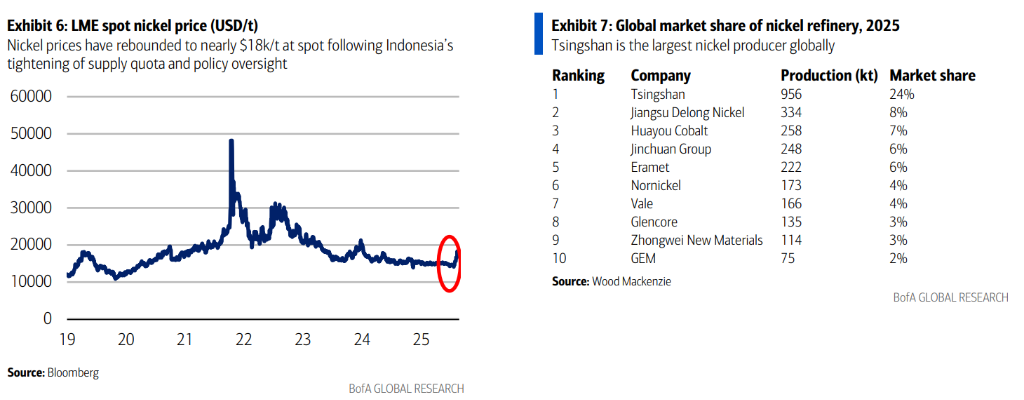
Core Viewpoint - Tsingshan Group, the world's largest stainless steel and nickel producer, is rapidly expanding its industrial footprint from its core nickel and stainless steel business into the aluminum and new energy battery sectors [1]. Group 1: Nickel and Stainless Steel Business - Tsingshan Group generated annual revenue of $56.5 billion and ranks 247th on the Fortune Global 500 list [1]. - The company holds a 25%-30% market share in the nickel industry, significantly influencing nickel price trends, which recently rebounded to nearly $18,000 per ton due to tightened supply quotas and regulatory policies in Indonesia [1]. - In 2023, Tsingshan's stainless steel production exceeded 16 million tons, maintaining its position as the largest producer [14]. Group 2: Expansion into Aluminum - Tsingshan is replicating its successful "mine-park-smelting" model from the nickel industry to the aluminum sector, with approximately 500,000 tons per year of primary aluminum capacity in Indonesia [8]. - The company is advancing large-scale joint ventures with Xinfa Group in Indonesia, with planned capacities exceeding 1 million tons per year [9]. - The completion of new power facilities necessary for these aluminum projects is expected to be delayed until mid-2027, potentially impacting actual production contributions [10]. Group 3: New Energy Battery Sector - Tsingshan's ambitions extend to battery manufacturing, with its subsidiary REPT Battero ranking among the top ten globally in battery installation capacity and fifth in energy storage battery shipments [11]. - The company is establishing a battery recycling network in partnership with GEM and Huayou Cobalt to complete its industrial chain [13]. - A memorandum of understanding was signed with Volkswagen Group in 2022 to establish upstream raw material joint ventures in Indonesia and China, ensuring supply chain security and cost reduction [12]. Group 4: Strategic Partnerships and Acquisitions - Tsingshan is enhancing its competitive edge in the stainless steel sector through acquisitions and collaborations, including the planned acquisition of POSCO's core stainless steel assets in China by 2025 [14]. - The company has registered nickel cathodes produced at its Dingxin plant as an LME delivery brand to strengthen its hedging capabilities against market volatility [15].

镍矿供应偏紧支撑,镍不锈钢价格高位震荡
Hua Tai Qi Huo· 2026-01-23 03:10
Report Industry Investment Rating - Not provided in the content Core Viewpoints of the Report - The tight supply of nickel ore supports the high - level volatility of nickel and stainless - steel prices. The nickel market is affected by macro - sentiment, supply expectations, and technical factors, while the stainless - steel market is influenced by cost support and weak downstream demand [1][3] - Due to high inventory and oversupply, nickel prices are expected to remain in a low - level volatile range, and stainless - steel prices are expected to maintain high - level volatility in the short term, with the need to focus on Indonesian policy implementation, downstream demand recovery, and inventory changes [3][4] Summary by Related Catalogs Nickel Variety Market Analysis - On January 22, 2026, the Shanghai nickel main contract opened at 143,140 yuan/ton and closed at 142,500 yuan/ton, a 1.15% change from the previous trading day. The trading volume was 588,698 (- 156,970) lots, and the open interest was 69,610 (- 6,282) lots [1] - The price movement of the Shanghai nickel main contract was driven by three factors: macro - sentiment and external market linkages, the continuous fermentation of the expectation of reduced Indonesian nickel ore quotas, and technical support at the 140,000 yuan/ton mark [1] - The nickel ore market was stable, with prices in a high - level consolidation phase after consecutive increases. There was no new public tender or large - scale transaction information. In Indonesia, the market was waiting for the possible increase of the February domestic trade benchmark price (HPM) [2] - The spot price of Jinchuan Group in the Shanghai market was 122,800 yuan/ton, up 100 yuan/ton from the previous day. The spot trading was average, and the spot premiums of various refined nickel brands were mostly stable [2] Strategy - Due to high inventory and oversupply, nickel prices are expected to remain in a low - level volatile range. The recommended strategy is mainly range - trading, with no suggestions for inter - period, inter - variety, spot - futures, or options trading [3] Stainless Steel Variety Market Analysis - On January 22, 2026, the stainless - steel main contract opened at 12,720 yuan/ton and closed at 14,650 yuan/ton. The trading volume was 389,457 (- 37,459) lots, and the open interest was 163,858 (- 4,171) lots [3] - The stainless - steel main contract showed a trend of rising and then falling, weakening after high - level volatility and slightly stabilizing at the end. The cost side had strong support, but downstream demand was weak, suppressing price increases [3] - The stainless - steel prices in the Wuxi and Foshan markets were 14,550 (+ 250) yuan/ton and 14,450 (+ 250) yuan/ton respectively, and the 304/2B premium was 80 - 180 yuan/ton [4] Strategy - In the short term, high inventory, weak spot demand, rising costs, and macro - policies create long - short contradictions. Stainless - steel prices are expected to maintain high - level volatility. The recommended strategy is mainly range - trading, with no suggestions for inter - period, inter - variety, spot - futures, or options trading [4]
瑞达期货不锈钢产业日报-20260122
Rui Da Qi Huo· 2026-01-22 09:23
1. Report Industry Investment Rating - No information provided 2. Core Viewpoints of the Report - The raw material supply of ferronickel will face contraction pressure due to the approaching rainy season in the Philippines, the decline in nickel ore grade, and the significant reduction of the RKAB plan in Indonesia next year [2] - The production profit of stainless steel plants has improved, but the increase in ferronickel prices has raised the cost support, and the increase in production is limited due to more maintenance at the end of the year [2] - Downstream demand is gradually entering the off - season, but stainless steel exports still maintain high growth, showing strong export demand resilience. The overall social inventory of stainless steel in the country maintains a seasonal decline [2] - Technically, the position increases and the price is strong, with a strong long - position atmosphere. It is expected that the stainless steel futures price will be adjusted strongly, with support at MA5 and a range of 14,500 - 15,500 yuan/ton [2] 3. Summary by Relevant Catalogs 3.1 Futures Market - The closing price of the stainless steel futures main contract is 14,650 yuan/ton, a decrease of 70 yuan/ton; the spread between the 02 - 03 contracts is 120 yuan/ton, a decrease of 40 yuan/ton [2] - The net long position of the top 20 futures holders is - 15,751 lots, a decrease of 2,188 lots; the position of the main contract is 163,858 lots [2] - The warehouse receipt quantity is 38,629 tons, an increase of 373 tons [2] 3.2 Spot Market - The price of 304/2B rolled cut - edge stainless steel in Wuxi is 15,050 yuan/ton, an increase of 250 yuan/ton; the market price of scrap stainless steel 304 in Wuxi is 9,750 yuan/ton, unchanged [2] - The basis of stainless steel is - 250 yuan/ton, a decrease of 425 yuan/ton [2] 3.3 Upstream Situation - The monthly electrolytic nickel output is 29,430 tons, an increase of 1,120 tons; the total monthly ferronickel output is 22,100 metal tons, a decrease of 800 metal tons [2] - The monthly import volume of refined nickel and alloys is 12,840.49 tons, an increase of 2,900.84 tons; the monthly import volume of ferronickel is 895,400 tons, a decrease of 9,700 tons [2] - The spot price of SMM1 nickel is 145,750 yuan/ton, an increase of 850 yuan/ton; the average price of ferronickel (7 - 10%) in the country is 1,050 yuan/ nickel point, unchanged [2] - The monthly output of Chinese ferrochrome is 757,800 tons, a decrease of 26,900 tons [2] 3.4 Industry Situation - The monthly output of 300 - series stainless steel is 1.7617 million tons, a decrease of 38,300 tons; the total weekly inventory of 300 - series stainless steel is 538,500 tons, a decrease of 2,000 tons [2] - The monthly export volume of stainless steel is 458,500 tons, a decrease of 29,500 tons [2] 3.5 Downstream Situation - The cumulative monthly new housing construction area is 534.567 million square meters, an increase of 43.9531 million square meters [2] - The monthly output of excavators is 33,600 units, an increase of 2,700 units; the monthly output of large and medium - sized tractors is 22,600 units, an increase of 700 units; the monthly output of small tractors is 9,000 units, unchanged [2] 3.6 Industry News - Trump's speech at Davos: Greenland is a core US security interest, the US will not seize it by force and seeks immediate negotiations. Later, Trump said that the US reached a "framework" agreement on Greenland with NATO and will not impose tariffs on Europe and Canada for the time being [2] - Canadian Prime Minister Carney's speech: The rules - based order is dead, and middle - power countries should unite to resist coercion from some major powers [2] - Trump said he may have selected a person to be the Fed chairman, hopes to be like Greenspan, and again hinted that Hassett is "out" [2]
有色早报-20260122
Yong An Qi Huo· 2026-01-22 02:16
Group 1: Report Industry Investment Rating - No relevant content provided Group 2: Report Core Views - For copper, the price pulled back in the second half of the week, and the market sentiment cooled. In the short - term, negative factors are released, but the price is expected to rise in the medium - term as the fundamentals feature limited supply and increasing demand [1] - For aluminum, the basis and downstream processing fees are low, with continuous inventory accumulation. Domestic demand has short - term support, and overseas active restocking may support the price [1] - For zinc, the domestic fundamentals are average, but the market is optimistic about its allocation flexibility, and attention should be paid to reverse arbitrage and positive arbitrage opportunities [2] - For nickel, the short - term fundamentals are weak, and there is a game between short - term policies and fundamentals [3] - For stainless steel, the fundamentals remain weak, and the price is mainly driven by nickel price in the short - term [3] - For lead, the price oscillates at a high level. Supply is expected to increase, demand is weakening, and the price is expected to oscillate between 17100 - 17600 next week [5] - For tin, the price fluctuates greatly, and is affected by capital sentiment. Short - term volatility may decline, and attention can be paid to internal - external positive arbitrage opportunities [8] - For industrial silicon, the supply - demand is balanced and loose. The price is expected to oscillate with cost in the short - term and at the bottom of the cycle in the medium - to long - term [11] - For lithium carbonate, the short - term supply - demand is close to balance. The absolute price is affected by futures market expectations and sentiment, and a spot - futures resonance market may occur [13] Group 3: Summary by Metal Copper - **Price and Inventory**: The copper price pulled back in the second half of the week. The LME inventory increased by 3100, and the SHFE warehouse receipts decreased by 2612 [1] - **Market Analysis**: US tariff issues and high inventories in the US triggered concerns. In the short - term, negative factors are released, and the inventory may accumulate faster before the Spring Festival but decline quickly after the festival. The medium - term outlook is positive [1] Aluminum - **Price and Inventory**: The aluminum price declined. The LME inventory increased by 24175, and the SHFE inventory remained unchanged [1] - **Market Analysis**: The basis and processing fees are low, and the inventory is accumulating. Domestic demand has short - term support from photovoltaic, and overseas active restocking may support the price [1] Zinc - **Price and Inventory**: The zinc price decreased. The LME inventory decreased by 450, and the SHFE inventory remained unchanged [2] - **Market Analysis**: Supply is affected by TC decline and smelter operations, and demand is weak. The market is optimistic about its allocation flexibility, and attention should be paid to arbitrage opportunities [2] Nickel - **Price and Inventory**: The nickel price dropped. The LME inventory decreased by 72 [3] - **Market Analysis**: Supply decreased slightly, demand is weak, and there is a game between short - term policies and fundamentals [3] Stainless Steel - **Price and Inventory**: The stainless steel price declined slightly. The inventory decreased slightly from a high level [3] - **Market Analysis**: Supply is high, demand is mainly for rigid needs. The price is mainly driven by nickel price in the short - term [3] Lead - **Price and Inventory**: The lead price oscillated at a high level. The inventory increased by 1.3 tons to 3.25 tons [5] - **Market Analysis**: Supply is expected to increase, demand is weakening, and the price is expected to oscillate between 17100 - 17600 next week [5] Tin - **Price and Inventory**: The tin price fluctuated greatly. The LME inventory increased by 250 [8] - **Market Analysis**: The price is affected by capital sentiment. Short - term volatility may decline, and attention can be paid to internal - external positive arbitrage opportunities [8] Industrial Silicon - **Price and Inventory**: The basis of different grades changed, and the warehouse receipts increased by 384 [11] - **Market Analysis**: Supply and demand are balanced and loose. The price is expected to oscillate with cost in the short - term and at the bottom of the cycle in the medium - to long - term [11] Lithium Carbonate - **Price and Inventory**: The price fluctuated. The warehouse receipts increased by 975 [13] - **Market Analysis**: The short - term supply - demand is close to balance. The absolute price is affected by futures market expectations and sentiment, and a spot - futures resonance market may occur [13]
《有色》日报-20260122
Guang Fa Qi Huo· 2026-01-22 01:52
Report Industry Investment Ratings No information about industry investment ratings is provided in the reports. Core Views Tin - Short - term tin prices are highly volatile due to market sentiment, so cautious participation is advised. In the medium - to - long - term, the supply side is gradually recovering, but considering the low elasticity of the supply side and the long - term narrative of the AI arms race, a low - buying strategy for tin prices is recommended [2]. Industrial Silicon - The spot price of industrial silicon is stable, and the futures price fluctuates, rising after a decline. The production in January and February is expected to decrease. The demand side is likely to decline slightly in January. The price of industrial silicon is expected to fluctuate, with the main price range between 8200 - 9200 yuan/ton. Attention should be paid to the changes in production on the demand side [3]. Polysilicon - The average spot price of polysilicon and the price of silicon wafers have declined. The demand expectation has improved, and component production may increase slightly, which is conducive to inventory digestion. However, polysilicon and silicon wafer prices are under pressure due to high inventory. The monthly average production in the first quarter is expected to drop to about 80,000 tons. The price may be supported at the 48,000 yuan/ton level, and even at 45,000 yuan/ton considering full - cost support [4]. Copper - Market speculative sentiment has eased, and copper prices fluctuated. Geopolitical factors affect market expectations of copper tariffs. The global visible inventory has reached a high level in recent years, and the return of COMEX copper inventory may ease the supply pressure in non - US regions. In the short term, copper prices may return to fundamental pricing, and in the long term, the price bottom center is expected to gradually rise. Attention should be paid to the CL premium and LME inventory changes, with support at 97500 - 98500 [5]. Zinc - Market speculative sentiment has eased, and zinc prices adjusted. The shortage of zinc ore supports prices, and the import window for zinc ore has opened. The supply pressure of refined zinc has been relieved. High zinc prices have suppressed demand, and the downstream operating rate has weakened. Zinc prices are expected to fluctuate in the short term, with support around 23,800. Attention should be paid to zinc ore TC and refined zinc inventory changes [9]. Aluminum - The alumina market showed a weak and volatile trend, with an oversupply situation. Alumina prices are expected to fluctuate widely around the industry's cash - cost line, with the main contract reference range of 2600 - 2900 yuan/ton. The aluminum market is in a high - level volatile pattern. Although macro and policy expectations are positive, the fundamentals are under pressure, with supply increasing and demand being suppressed. Aluminum prices are expected to remain volatile at a high level in the short term, with the main contract reference range of 23000 - 25000 yuan/ton [12]. Nickel - The nickel futures market was volatile. Macro factors and the situation of Indonesian nickel ore quotas affect the market. The overall spot transaction of refined nickel is average. The prices of nickel ore and nickel iron have increased. The demand for stainless steel in the off - season is weak, and the market cost is relatively limited. The inventory pressure has increased. The nickel price is expected to fluctuate widely, with the main contract reference range of 138000 - 148000 [13]. Aluminum Alloy - Cast aluminum alloy prices fluctuated at a high level, with cost being the main driving factor. The supply of scrap aluminum is still tight, and the fundamentals show a situation of weak supply and demand in the off - season. The social inventory has decreased slightly. The ADC12 price is expected to continue the high - level volatile pattern in the short term, with the main contract reference range of 22000 - 23500 yuan/ton [15]. Stainless Steel - Stainless steel prices showed a narrow - range fluctuation and then a late - session rally. Macro factors and raw material supply expectations affect the market. The raw material prices are expected to rise, the supply is relatively loose, and the demand is weak. The social inventory is decreasing, but the demand in the off - season is still insufficient. Stainless steel prices are expected to be strongly volatile in the short term, with the main contract reference range of 14200 - 15000 [16]. Lithium Carbonate - Lithium carbonate futures prices rose sharply. News about lithium concentrate auctions and mine supply fluctuations affected the market sentiment. The production is slightly increasing, and the supply is expected to decline during the pre - holiday maintenance period. The downstream demand shows certain resilience. Social inventory decreased last week. Lithium carbonate prices are expected to be strongly volatile in the short term, but chasing the rise requires attention to volatility and liquidity risks [20]. Summary by Directory Tin - **Spot Price and Basis**: SMM 1 tin rose 0.22% to 395,750 yuan/ton, and the LME 0 - 3 premium increased 14.82% to - 92.00 dollars/ton. The import loss was - 7117.93 yuan/ton, a decrease of 1.99% [2]. - **Monthly Fundamental Data**: In December, tin ore imports increased 16.81% to 17,637 tons, SMM refined tin production decreased 0.06% to 15,950 tons, and refined tin exports increased 41.84% to 2763 tons [2]. - **Inventory Changes**: SHEF inventory increased 37.69% to 9549.0 tons, and social inventory increased 36.07% to 10,175.0 tons [2]. Industrial Silicon - **Spot Price and Basis of Main Contracts**: The price of East China oxygen - passing SI5530 industrial silicon remained unchanged at 9250 yuan/ton, and the basis decreased 6.93% [3]. - **Monthly Fundamental Data**: National industrial silicon production decreased 1.15% to 39.71 million tons, and Xinjiang's production increased 6.46% to 25.29 million tons. The national operating rate decreased 0.35% to 64.59% [3]. - **Inventory Changes**: Xinjiang's factory - warehouse inventory increased 2.91% to 14.83 million tons, and social inventory increased 0.54% to 55.50 million tons [3]. Polysilicon - **Spot Price and Basis**: The average price of N - type granular silicon decreased 7.34% to 50,500 yuan/ton, and the N - type material basis increased 5.49% [4]. - **Monthly Fundamental Data**: Polysilicon production increased 0.79% to 11.55 million tons, and silicon wafer production decreased 19.26% to 43.90 million tons [4]. - **Inventory Changes**: Silicon wafer inventory decreased 5.53% to 24.78 million tons, and polysilicon warehouse receipts increased 1.54% to 4620.00 [4]. Copper - **Price and Basis**: SMM 1 electrolytic copper decreased 0.66% to 100,060 yuan/ton, and the LME 0 - 3 increased to 101.84 dollars/ton [5]. - **Fundamental Data**: In December, electrolytic copper production increased 6.80% to 117.81 million tons, and imports decreased 4.02% to 26.02 million tons. The domestic mainstream port copper concentrate inventory increased 7.81% to 69.04 million tons [5]. - **Inventory Changes**: Domestic social inventory increased 12.27% to 32.94 million tons, and SHFE inventory increased 18.26% to 21.35 million tons [5]. Zinc - **Price and Basis**: SMM 0 zinc ingot decreased 0.53% to 24,210 yuan/ton, and the import loss decreased to - 1851 yuan/ton [9]. - **Fundamental Data**: In December, refined zinc production decreased 7.24% to 55.21 million tons, and imports decreased 51.94% to 0.88 million tons [9]. - **Inventory Changes**: China's seven - region zinc ingot social inventory increased 3.13% to 12.20 million tons, and LME inventory decreased 0.40% to 11.2 million tons [9]. Aluminum - **Price and Spread**: SMM A00 aluminum increased 0.13% to 23,710 yuan/ton, and the alumina (Shandong) average price decreased 0.19% to 2560 yuan/ton [12]. - **Fundamental Data**: In December, alumina production decreased 1.08% to 743.94 million tons, and domestic electrolytic aluminum production decreased 3.97% to 363.66 million tons [12]. - **Inventory Changes**: China's electrolytic aluminum social inventory increased 2.60% to 74.90 million tons, and LME inventory increased 5.01% to 50.7 million tons [12]. Nickel - **Price and Basis**: SMM 1 electrolytic nickel decreased 0.99% to 144,900 yuan/ton, and the LME 0 - 3 decreased 2.15% to - 200 dollars/ton [13]. - **Cost and New - Energy Material Prices**: The cost of integrated MHP to produce electrowon nickel increased 1.09% to 112,237 yuan/ton, and the average price of battery - grade nickel sulfate decreased 0.22% to 33,375 yuan/ton [13]. - **Supply - Demand and Inventory**: China's refined nickel production increased 26.10% to 31,400 tons, and SHFE inventory increased 3.28% to 48,180 tons [13]. Aluminum Alloy - **Price and Spread**: The price of SMM aluminum alloy ADC12 remained unchanged at 23,850 yuan/ton, and the Foshan crushed primary aluminum scrap price difference increased 0.80% to 2509 yuan/ton [15]. - **Fundamental Data**: In December, the production of recycled aluminum alloy ingots decreased 6.16% to 64.00 million tons, and the production of primary aluminum alloy ingots increased 0.46% to 30.41 million tons [15]. - **Inventory Changes**: The weekly social inventory of recycled aluminum alloy ingots decreased 1.41% to 4.89 million tons [15]. Stainless Steel - **Price and Basis**: The price of 304/2B (Wuxi Hongwang 2.0 coil) increased 1.40% to 14,500 yuan/ton, and the price of Philippine laterite nickel ore 1.5% (CIF) increased 0.89% to 51 dollars/wet ton [16]. - **Fundamental Data**: China's 300 - series stainless steel crude steel production increased 0.92% to 176.32 million tons, and stainless steel imports increased 29.32% to 14.50 million tons [16]. - **Inventory Changes**: The 300 - series social inventory (Wuxi + Foshan) decreased 1.47% to 45.07 million tons [16]. Lithium Carbonate - **Price and Basis**: The average price of SMM battery - grade lithium carbonate increased 3.93% to 158,500 yuan/ton, and the average price of lithium spodumene concentrate CIF increased 2.52% to 2035 dollars/ton [20]. - **Fundamental Data**: In December, lithium carbonate production increased 4.04% to 99,200 tons, and demand decreased 2.50% to 130,118 tons [20]. - **Inventory Changes**: In December, lithium carbonate total inventory decreased 12.23% to 56,664 tons, and downstream inventory decreased 7.21% to 38,998 tons [20].
日度策略参考-20260121
Guo Mao Qi Huo· 2026-01-21 07:29
Report Industry Investment Ratings - Bullish: Palm oil, soybean oil [1] - Bearish: Industrial silicon [1] - Neutral: Most other industries are rated as "oscillating" [1] Core Views of the Report - Policy aims to achieve a "slow bull" in the stock market, with short - term oscillations in the stock index and long - term opportunities for long - position layout. Asset shortage and weak economy benefit bond futures, but short - term interest rate risks are signaled by the central bank [1]. - Different metals and commodities have various trends. For example, copper prices are in high - level oscillations, aluminum prices are falling from high levels, and nickel prices are in high - level oscillations with supply concerns and inventory constraints [1]. - Precious metals are supported by geopolitical and trade tensions, but the suspension of key - mineral tariff hikes by the US may cause price fluctuations. Platinum and palladium are expected to have wide - range oscillations in the short term, and a long - term strategy of buying platinum and shorting palladium can be considered [1]. - In the agricultural and energy - chemical sectors, different products are affected by factors such as supply - demand relationships, policies, and international situations, resulting in different price trends and investment strategies [1]. Summary by Related Catalogs Macro Finance - Stock index: Policy cools market speculation, with short - term oscillations and long - term opportunities for long - position layout [1] - Bond futures: Asset shortage and weak economy are beneficial, but short - term interest rate risks are signaled by the central bank, and the Japanese central bank's interest - rate decision should be monitored [1] Non - ferrous Metals - Copper: Downstream demand is under pressure, and with the suspension of key - mineral tariffs by the US, short - term copper - hoarding concerns are alleviated, and prices are in high - level oscillations [1] - Aluminum: Limited industrial drivers and weakening macro sentiment lead to aluminum prices falling from high levels [1] - Alumina: Supply exceeds demand in the domestic market, and prices are under pressure, but they are near the cost line and expected to oscillate [1] - Zinc: The cost center is stable, but inventory pressure is evident, and prices fluctuate within a range due to repeated macro sentiment [1] - Nickel: The 2026 RKAB target of Indonesian nickel ore is about 260 million wet tons, but the supply is still tight. Global nickel inventory accumulation may restrict price increases, and short - term prices are in high - level oscillations. Short - term long - position trading on dips is recommended, but over - chasing highs should be avoided [1] - Stainless steel: The price of raw - material nickel iron is rising, social inventory is slightly decreasing, and steel - mill production in January is increasing. Futures prices are in high - level oscillations, and short - term long - position trading on dips is recommended [1] - Tin: Short - term macro sentiment is repeated, and prices have corrected. However, due to the fragile supply of tin ore, there is still upward momentum, and low - buying opportunities should be monitored [1] Precious Metals and New Energy - Gold and silver: Geopolitical and trade tensions boost prices, and they are expected to be strong in the short term, but price fluctuations may be intense due to the suspension of key - mineral tariff hikes by the US [1] - Platinum and palladium: Geopolitical and trade tensions support prices, but the suspension of key - mineral tariff hikes by the US may suppress price drivers. Short - term wide - range oscillations are expected, and a long - term strategy of buying platinum and shorting palladium can be considered [1] Industrial and Building Materials - Industrial silicon: Production increases in the northwest and decreases in the southwest, and the planned production of polysilicon and organic silicon in December decreases [1] - Polysilicon: It is in the off - season for new energy vehicles, but energy - storage demand is strong, and there is a battery export rush with a large increase in price [1] - Lithium carbonate: Expectations are strong, but the spot market is weak, and the upward momentum is insufficient [1] - Rebar and hot - rolled coil: High production and inventory suppress price increases, and the transmission of futures price increases to the spot market is not smooth. Unilateral long positions should be closed, and cash - and - carry arbitrage can be considered [1] - Iron ore: There is obvious upward pressure, and chasing highs is not recommended [1] - Coke and coking coal: If the "capacity reduction" expectation continues to ferment, there may be room for price increases, but the actual increase is difficult to judge, and large fluctuations after a significant increase require caution [1] - Glass: Short - term market sentiment is warming, and supply - demand provides support, but medium - term supply exceeds demand, and prices are under pressure [1] - Soda ash: It follows glass prices, and medium - term supply - demand is looser, with prices under pressure [1] Agricultural Products - Palm oil: The purchasing rhythm of major consuming countries is starting, production areas are expected to reduce production and inventory, and with the possibility of biodiesel themes fermenting, prices are expected to oscillate strongly [1] - Soybean oil: It has a strong fundamental situation, and long - position allocation in oils is recommended, and a strategy of buying soybean oil and shorting other oils can be considered [1] - Rapeseed oil: Tariff - adjustment expectations for Canadian rapeseed and customs - clearance expectations for Australian rapeseed are bearish, but it is difficult to decline smoothly, and it is recommended to wait and see due to large recent price fluctuations [1] - Cotton: There is strong domestic new - crop production expectation, but the purchase price of seed cotton supports the cost of lint. Downstream operation rates are low, but yarn - mill inventory is not high, and there is rigid restocking demand. Future factors such as the central government's No.1 Document in the first quarter of next year, planting - area intentions, weather during the planting period, and peak - season demand should be monitored [1] - Sugar: There is a global surplus and an increase in domestic new - crop supply, and there is a consensus among short - sellers. If prices continue to fall, there is strong cost support, but there is a lack of continuous short - term fundamental drivers, and changes in the capital side should be monitored [1] - Corn: The grain - selling progress in Northeast China is fast, port inventory is low, and there is restocking demand before the festival. Short - term spot prices are firm, and futures prices are expected to oscillate within a range [1] - Soybeans: As the Brazilian harvest progresses, the CNF premium reflects the selling pressure of a bumper harvest. Dry weather in Argentina should be monitored, and short - term prices are expected to oscillate weakly [1] - Pulp: Affected by the decline in the commodity macro - environment, prices have fallen but remain within the oscillation range. Due to large short - term commodity - sentiment fluctuations, it is recommended to wait and see cautiously [1] - Logs: Spot prices have shown signs of bottom - rebounding, and the further decline in futures prices is limited. However, the January overseas offer has slightly decreased, and there is a lack of upward - driving factors, with prices expected to oscillate between 760 - 790 yuan/m³ [1] - Hogs: Spot prices are gradually stabilizing, demand provides support, and production capacity still needs to be further released [1] Energy and Chemicals - Crude oil: OPEC+ has suspended production increases until the end of 2026, the uncertainty of the Russia - Ukraine peace agreement, and US sanctions on Venezuelan oil exports affect prices [1] - Fuel oil: Short - term supply - demand contradictions are not prominent and follow crude - oil prices. The "14th Five - Year Plan" rush - work demand is likely to be falsified, and the supply of Marey crude oil is sufficient, with high asphalt profits [1] - Shanghai rubber: Raw - material cost support is strong, the futures - spot price difference has rebounded significantly, and mid - stream inventory has increased significantly [1] - BR rubber: There is a phased correction, high - price spot transactions are blocked, the cost of butadiene has strong bottom - support, overseas cracking - unit production capacity is cleared, and the domestic market is expected to benefit in the long term. The market will return to fundamental - driven in the short term [1] - PTA: The PX market has risen rapidly, and the market is expected to tighten in 2026. Domestic PTA maintains high - level operation, and the high gasoline spread supports aromatics [1] - Ethylene glycol: Two sets of MEG plants in Taiwan, China, plan to shut down next month. Prices have rebounded rapidly due to supply - side news, and downstream polyester operation rates are above 90% [1] - Short - fiber: Prices continue to closely follow cost fluctuations [1] - Styrene: The supply - demand fundamentals have improved, futures prices have rebounded rapidly, the Asian market has stabilized, and the price difference between styrene and benzene has widened, with inventory being depleted [1] - Urea: Export sentiment has eased, there is limited upward space due to insufficient domestic demand, and there is support from anti - involution and cost [1] - PVC: Global production is expected to be low in 2026, but the current fundamentals are poor. The cancellation of export tax - rebates may lead to a rush to export, and differential electricity prices in the northwest may force out inefficient production capacity [1] - LPG: The February CP is expected to rise, the cost of imported gas is strongly supported, the geopolitical conflict in the Middle East has cooled, inventory is being depleted, domestic PDH maintains high - level operation but is in deep loss, and the heating market is expected to start [1] Others - Container shipping on the European route: It is expected to peak in mid - January, pre - festival restocking demand still exists, and airlines are still cautious in their trial re - flights [1]