
批发零售业

Search documents
第一、第二、前三……蓄势赋能!“硬核”成绩单折射经济活力
Yang Shi Wang· 2025-07-19 03:37
Group 1: Economic Growth and Consumer Market - The total retail sales of consumer goods in China is expected to exceed 50 trillion yuan by 2025, with an average annual contribution rate of 60% to economic growth during the 14th Five-Year Plan period [3][5] - China's retail sales are approximately 80% of the US in absolute terms, but in terms of purchasing power, China's retail sales have surpassed that of the US [5] - The social consumption retail total has grown at an average rate of 5.5% over the past four years, highlighting the robust domestic market [3] Group 2: Trade and Foreign Investment - During the 14th Five-Year Plan, China's goods trade volume has crossed significant milestones, reaching 6.16 trillion USD in 2024, a 32.4% increase from the end of the 13th Five-Year Plan [12][21] - The actual use of foreign capital in China reached 708.73 billion USD by mid-2025, achieving the target set for the 14th Five-Year Plan six months ahead of schedule [18] - China's service trade is projected to exceed 1 trillion USD for the first time in 2024, ranking second globally [22] Group 3: Retail and Logistics Development - The value added by the wholesale and retail industry is expected to grow by 40% compared to the end of the 13th Five-Year Plan, reaching 13.8 trillion yuan in 2024 [27][25] - The logistics costs in China have decreased, with the total logistics costs as a percentage of GDP dropping from 14.7% to 14.1% over five years [28] - The number of legal entities in the wholesale and retail sector has surpassed 10 million, indicating a diversification and expansion of the retail landscape [29]


中部领跑,湖北省上半年GDP同比增长6.2%
Zheng Quan Shi Bao Wang· 2025-07-18 13:30
Economic Performance - Hubei province achieved a GDP of 29,642.61 billion yuan in the first half of 2025, with a year-on-year growth of 6.2% [1] - The growth rate accelerated by 0.4 percentage points compared to the same period last year, surpassing the national average by 0.9 percentage points [1] Sector Contributions - The primary industry added value was 1,914.07 billion yuan, growing by 3.3% [1] - The secondary industry added value was 11,544.28 billion yuan, growing by 6.4% [1] - The tertiary industry added value was 16,184.26 billion yuan, also growing by 6.4% [1] Investment and Consumption - The province has 19,250 construction projects, an increase of 7.1% [2] - Project investment (excluding real estate) grew by 9.8%, exceeding the national average by 3.2 percentage points [2] - Manufacturing investment increased by 12.5%, higher than the national average by 5.0 percentage points [2] Retail and Real Estate - Retail sales in the wholesale and retail sector grew by 5.9% and 8.7%, respectively [2] - Home appliance and furniture retail sales surged by 30.8% and 63.0%, respectively, supported by the old-for-new policy [2] - Real estate sales area and new construction area increased by 5.9% and 5.6%, respectively [2] Emerging Industries - High-tech manufacturing added value grew by 14.4%, contributing 27.5% to the industrial output [3] - Production of computers, smartphones, optical fibers, and lithium-ion batteries increased by 31.5%, 19.9%, 25.7%, and 62.1%, respectively [3] Tourism and External Trade - Total tourist visits and tourism revenue grew by 14.7% and 16.0%, respectively [3] - Hubei's total import and export value exceeded 400 billion yuan, reaching 402.31 billion yuan, with exports and imports growing by 38.5% and 7.4%, respectively [3][4] - The export structure improved, with mechanical and electrical products accounting for 50.7% of total exports, growing by 26.8% [4]
高质量完成“十四五”规划丨消费、外贸外资、对外投资成效如何?——国新办发布会聚焦中国“十四五”时期商务高质量发展成就
Xin Hua Wang· 2025-07-18 13:10
Group 1: Consumption Market - The total retail sales in China are expected to exceed 50 trillion RMB this year, with an annual growth rate of 5.5% from 2020's 39.1 trillion RMB to a projected 48.3 trillion RMB in 2024 [2] - Consumption contributes approximately 60% to economic growth, solidifying China's position as the world's second-largest consumer market [2] - The service consumption expenditure is projected to grow at an annual rate of 9.6% from 2020 to 2024 [2] Group 2: Trade Development - China's goods trade volume has crossed significant milestones, reaching over 6 trillion USD in 2024, marking a 32.4% increase from 2020 [4] - The service trade has also seen growth, with the scale surpassing 1 trillion USD, positioning China as the second-largest globally [4] - The proportion of high-tech product exports in goods trade is expected to reach 18.2% in 2024, indicating an ongoing optimization and upgrade in trade [5] Group 3: Foreign Investment - By June 2023, China had utilized 708.73 billion USD in foreign investment, surpassing the target of 700 billion USD set for the "14th Five-Year Plan" [6] - The proportion of foreign investment in high-tech industries has increased to 34.6% in 2024, up 6 percentage points from 2020 [6] - Over 60 key "Invest in China" events have been held, promoting China as a favorable destination for multinational investments [7]
今年社零总额有望超50万亿元,“十五五”如何促消费扩内需
Di Yi Cai Jing· 2025-07-18 05:38
Group 1 - The core viewpoint of the articles highlights the significant changes and improvements in China's consumption market during the "14th Five-Year Plan" period, characterized by expansion, quality enhancement, renewal, and openness [1] - The total retail sales of consumer goods in China are expected to exceed 50 trillion yuan in 2024, with an average annual growth rate of 5.5% from 2020 to 2024, solidifying China's position as the world's second-largest consumer market [1][2] - The retail sector's added value is projected to reach 13.8 trillion yuan in 2024, marking a 40% increase from the end of the "13th Five-Year Plan" and accounting for over 10% of GDP, while also creating 135 million jobs [3] Group 2 - The development of new consumption models is emphasized, including digital consumption and quality e-commerce, which are expected to drive innovation and growth in the sector [2] - The logistics costs as a percentage of GDP have decreased from 14.7% to 14.1% over the past five years, indicating improved efficiency in the supply chain and logistics sector [3] - The government plans to continue enhancing the modern commercial circulation system and reduce logistics costs further to support economic circulation and development in the upcoming "15th Five-Year Plan" [3]
商务部:现代商贸流通体系建设取得积极成效 总体体现为“一升一降”
news flash· 2025-07-18 04:16
Core Insights - The Ministry of Commerce has reported significant progress in the construction of a modern commercial circulation system since the start of the 14th Five-Year Plan, driven by modern supply chains and high-quality development in the wholesale and retail sectors [1] Group 1: Economic Performance - The wholesale and retail sector's added value is projected to reach 13.8 trillion yuan in 2024, marking a 40% increase compared to the end of the 13th Five-Year Plan, making it the second largest sector after manufacturing [1] - The sector's contribution to GDP will exceed 10%, reaching a historical high, and it is expected to create 135 million jobs [1] - In the first half of this year, the added value of the wholesale and retail sector grew by 5.9% year-on-year, indicating a sustained growth momentum [1] Group 2: Cost Reduction - The total logistics costs as a percentage of GDP have decreased from 14.7% five years ago to 14.1% [1] - Comprehensive logistics costs for key enterprises have been reduced by 10% [1]
加拿大6月失业率意外下降 加央行本月料按兵不动
news flash· 2025-07-11 12:43
Group 1 - The unemployment rate in Canada unexpectedly decreased to 6.9% in June, with job growth primarily in part-time positions [1] - The number of new jobs added in June was 83,100, marking the first net increase since January [1] - Employment gains were noted in the wholesale retail, healthcare, and social assistance sectors [1] Group 2 - The positive employment data may lead the Bank of Canada to maintain its policy interest rate unchanged during the monetary policy decision on July 30 [1] - Upcoming inflation data for June will further assist the central bank in making its decision [1]
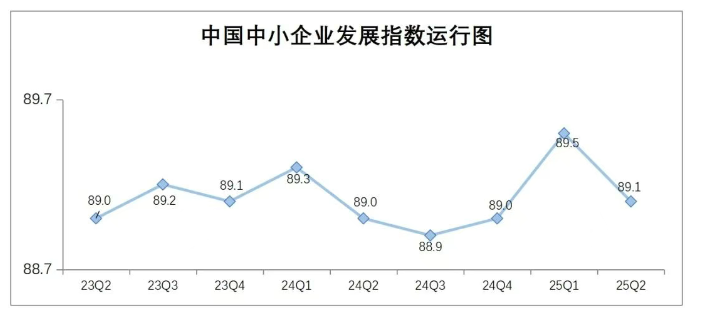
中国中小企业协会:2025年二季度中国中小企业发展指数为89.1 较上季度下降0.4个点
智通财经网· 2025-07-10 12:55
Core Viewpoint - The China Small and Medium Enterprises Development Index (SMEDI) for Q2 2025 is reported at 89.1, a decrease of 0.4 points from the previous quarter, but higher than the levels in 2023 and 2024. Overall, costs for SMEs have slightly decreased [1]. Industry Summary - The wholesale and retail industry index remained stable at 89.0, while seven other industries, including construction, transportation, real estate, social services, information transmission, and accommodation and catering, saw declines in their indices [2][3]. - The overall index for Q2 2025 is 89.1, down from 89.5 in Q1 2025, with all sub-indices showing a decrease, including macroeconomic sentiment, comprehensive operation, market, cost, funding, labor, input, and efficiency indices [4][5]. Regional Summary - The indices for the eastern, central, and western regions are 90.1, 89.7, and 88.6 respectively, all showing declines from the previous quarter, while the northeastern region saw a slight increase of 0.1 points to 81.5 [4]. Key Characteristics of SMEs - Business confidence is low, with the macroeconomic sentiment index at 98.2, down 0.8 points from the previous quarter, reflecting a decline across all surveyed industries [5]. - Market demand is contracting, as indicated by a market index of 81.2, which is a decrease of 0.3 points from the previous quarter [5]. - Funding conditions are tightening, with the funding index at 100.6, down 0.2 points, and six out of eight industries reporting declines in their funding indices [5]. - Labor supply is increasing while demand is decreasing, with the labor index at 105.9, down 0.1 points, and seven industries reporting a drop in labor demand [5]. - Investment willingness among enterprises is declining, with the input index at 82.3, down 0.6 points, particularly in construction, social services, and accommodation and catering sectors [5]. - Costs for enterprises have slightly decreased, with the cost index at 111.8, down 0.2 points, although the wholesale and retail sector saw a slight increase in costs [5]. - Efficiency has also declined, with the efficiency index at 74.2, down 0.3 points, and six industries reporting a decrease in their efficiency indices [6].
6月经济数据前瞻:经济或呈现低波运行
Huachuang Securities· 2025-07-04 12:15
Economic Overview - The GDP growth rate for Q2 is expected to be around 5.3%, close to Q1's 5.4%[3] - Industrial production growth for Q2 is projected at approximately 5.9%[3] - Retail sector growth is anticipated to rebound to about 6.8% in Q2, up from 5.8% in Q1[3] Production Insights - June's industrial growth rate is estimated at 6.0%[11] - The PMI production index for June increased to 51%, indicating expansion[4] - The wholesale growth rate for automobiles in June is expected to be 14.1%[4] Demand and Investment Trends - Social retail sales growth is projected to decline to around 4.6% in June, influenced by holiday timing and promotional activities[20] - Fixed asset investment growth for the first half of the year is expected to be around 3.4%, with manufacturing investment at 8.1% and real estate investment at -11.2%[16] - Real estate sales area growth is anticipated to be -8.0% in June[17] Trade and Price Dynamics - Export growth for June is expected to be approximately 3.5%, while imports are projected to grow by 1%[14] - CPI for June is forecasted to be around 0% year-on-year, with PPI expected to remain at -3.3%[9][10] Financial Sector Outlook - New social financing in June is estimated at 3.8 trillion yuan, an increase of 600 billion yuan year-on-year[5] - M2 money supply growth is expected to be around 7.9% in June[5]
青年失业率三连降!三大有利因素支撑就业形势总体稳定
Hua Xia Shi Bao· 2025-06-17 14:02
Core Viewpoint - The overall employment situation in China remains stable, with a slight decrease in the urban survey unemployment rate to 5.0% in May, reflecting the resilience of the job market amid economic challenges [1][2][4]. Employment Situation - The average urban survey unemployment rate from January to May was 5.2%, with May's rate showing a 0.1 percentage point decrease from the previous month [1]. - The unemployment rate for local and migrant workers was both recorded at 5.0%, while the rate for migrant agricultural workers was slightly lower at 4.9% [1]. - The unemployment rate in 31 major cities was also 5.0%, indicating a consistent trend across urban areas [1]. Economic Factors Supporting Employment - Economic growth and favorable industrial development have contributed to the stability of employment, supported by effective employment policies [2][4]. - In May, the industrial added value and service production index grew by 5.8% and 6.2%, respectively, maintaining overall stability compared to April [4]. - The retail and accommodation sectors showed significant growth, with production indices increasing by 8.4% and 6.2%, respectively, compared to the previous month [4]. Policy Measures - The government has implemented robust employment stabilization policies, focusing on both enterprise support for job creation and individual employment subsidies [5]. - These policies aim to balance labor supply and demand by incentivizing companies to hire and enhancing individual employability [5]. - Future efforts will focus on vocational training and improving labor market matching to promote full employment and enhance job quality [5]. Youth Employment - The youth unemployment rate has shown a continuous decline for three months, indicating a positive trend in youth employment [6]. - Despite this progress, challenges remain regarding the overall pressure on youth employment and structural issues that need ongoing policy attention [6][7]. - Initiatives targeting college graduates have been intensified, with various measures introduced to support their employment [7]. Importance of Stable Employment - Stable employment for youth is crucial for personal development, family financial security, and overall economic sustainability [8].

顶压前行的中国经济持续释放活力
Zhong Guo Qing Nian Bao· 2025-06-17 08:44
Economic Overview - The overall economic operation in May is stable and shows progress, characterized by five keywords: stable growth, steady operation, continuous improvement, accumulating momentum, and resilience [1] Industrial Performance - In May, the industrial production showed steady growth with a year-on-year increase of 5.8% in the added value of large-scale industries, supported by advancements in high-end, intelligent, and green development [2] - The consumption market saw a significant rebound, with the total retail sales of consumer goods increasing by 6.4% year-on-year, accelerating by 1.3 percentage points from the previous month [2] Consumer Trends - The policy of replacing old consumer goods has effectively stimulated consumer potential, leading to rapid growth in sales of related products. Retail sales of household appliances, communication equipment, cultural office supplies, and furniture increased by 53%, 33%, 30.5%, and 25.6% respectively [2] - Emerging consumption models such as live streaming sales and instant retail are maturing, while sectors like the silver economy and low-altitude economy are developing rapidly, indicating new growth points in consumer economics [2] Foreign Trade - In May, the total import and export value reached 38,098 billion yuan, showing a year-on-year growth of 2.7%. The trade structure continues to optimize, with private foreign trade enterprises demonstrating strong market expansion capabilities [3] Employment Situation - The urban survey unemployment rate in May was 5%, a decrease of 0.1 percentage points from the previous month, with the youth unemployment rate declining for three consecutive months [4] - The stable employment situation is supported by steady economic growth, favorable macro policies, and the development of industries with significant employment capacity [4] Future Employment Strategies - To address employment pressures, it is essential to enhance vocational skills training, improve labor supply and demand matching, and promote quality employment to ensure economic stability and social harmony [6] Economic Stability and Support - The economic fundamentals remain strong, with stable growth momentum and high-quality development trends unchanged. The macro policy toolbox is well-stocked, allowing for dynamic adjustments to ensure continued economic stability [7][8]