
非银

Search documents
中信证券:预计下半年港股的业绩增速将迎来拐点
3 6 Ke· 2025-09-19 00:57
Core Viewpoint - The Hong Kong stock market showed signs of stabilization and positive growth in the first half of 2025, with net profit margins and ROE remaining at high levels, indicating robust operational efficiency [1] Industry Performance - The technology, pharmaceutical, and raw materials sectors exhibited high prosperity, supporting the overall performance of the Hong Kong stock market in the first half of 2025 [1] - Non-bank and certain consumer sectors also reported favorable performance, while the energy, public utilities, real estate, and most consumer sectors continued to face performance pressures [1] Future Outlook - The earnings outlook for the Hong Kong stock market is optimistic, with expectations of a turning point in earnings growth for the second half of 2025 [1] - It is anticipated that the raw materials, healthcare, and technology sectors will maintain their high prosperity, with upward revisions in expectations [1] - Sectors that experienced low prosperity in the first half, such as energy and essential consumer goods, are expected to see a reversal in performance in the second half of 2025 [1]

Gangtise投研日报 | 2025-09-18
Xin Lang Cai Jing· 2025-09-17 23:03
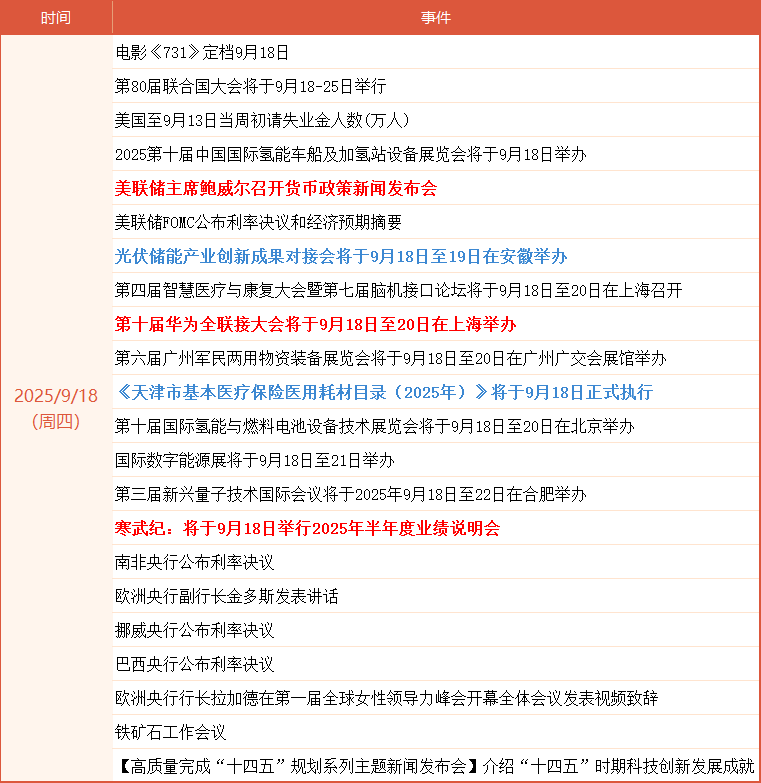
Group 1: Key Events and Announcements - The 80th United Nations General Assembly will be held from September 18 to 25 [1] - The 2025 China International Hydrogen Energy Vehicle and Hydrogen Station Equipment Exhibition will take place on September 18 [1] - The 2025 Tianjin Basic Medical Insurance Medical Consumables Catalog will be officially implemented on September 18 [1] Group 2: Market Performance - On September 17, the top-performing sectors included: - Foldable screens with a rise of 4.81% - Lithium iron phosphate with an increase of 4.47% - Covalent organic framework materials up by 3.88% [3] - The hottest industries on September 17 included electronics, retail, and new energy, with heat values of 76, 73, and 70 respectively [3] Group 3: High-end Manufacturing and New Energy - The robotics industry is experiencing breakthroughs, with a supply chain opportunity where a Zhejiang company has secured over 50% of Tesla's dexterous hand orders, expecting to produce 80,000 micro lead screws by 2025 [4] - In the new energy vehicle sector, a certain brand's high-end models are projected to account for 7.2% of sales by 2025, with overseas sales showing strong performance [4] Group 4: Consumer Sector - In the food and beverage industry, a certain beer brand has high-end products making up 60-70% of its sales, with innovative products contributing 15% [5] - The pet food market is growing, with online sales reaching 2.34 billion yuan in August, marking an 8% increase [6] Group 5: Financial Sector - A regional bank has maintained the highest ROE among listed banks for five consecutive years, with a projected dividend yield of 5.2%-5.4% for 2025 [8] - Insurance companies are accelerating their transformation, with a significant increase in the proportion of dividend insurance in new policies [8] Group 6: Important Company Announcements - Anke Biotechnology's subsidiary has received approval for a key clinical trial for a CAR-T cell therapy product [9] - NIO Inc. has completed a $1.16 billion equity issuance, including American Depositary Shares at a price of $5.57 each [11]

十大券商策略:“慢牛”行情延续,多维择时模型持续看多A股
Ge Long Hui A P P· 2025-09-15 00:39
Group 1: Market Overview - Global stock indices mostly rose last week, with the Asia-Pacific market leading, as the Hang Seng Tech Index surged by 5.3% [1] - The A-share market exhibited a V-shaped trend, with the Shenzhen Component Index and the ChiNext Index both increasing by 2.1% [1] Group 2: Brokerage Strategies - CITIC Securities emphasizes that the current market rally is largely related to overseas exposure, recommending a focus on resources, new productive forces, and overseas expansion [1] - Huatai Securities' multi-dimensional timing model has achieved a cumulative return of 40.41% this year, continuing to favor A-shares, particularly in sectors like liquor, precious metals, banking, and oil [2] - Everbright Securities maintains a bullish outlook on the bull market, focusing on TMT sectors, citing reasonable market valuations and new positive factors emerging [2] Group 3: Capital Flows and Market Sentiment - CICC notes an acceleration of southbound capital inflows into Hong Kong stocks, with the Hang Seng Index surpassing 26,000 points, and suggests that fundamental structures remain a stable choice [3] - Xinda Securities identifies September as a watershed for fast and slow bull markets, indicating that the current bull market may have policy catalysts that could lead to a significant bull market [4] Group 4: Sector Focus - CITIC Jiantou highlights the importance of focusing on sectors with strong fundamentals, such as AI, new energy, and innovative pharmaceuticals, while also monitoring inflation trends [5] - Huaxi Securities believes that the A-share "slow bull" market will continue, with high-growth sectors likely to benefit from policy support and increased capital inflows [6] - Dongwu Securities recommends actively positioning in the AI industry chain, particularly in segments that may serve as "call options" due to potential breakthroughs [7] Group 5: Emerging Technologies - Galaxy Securities reports that the satellite internet sector is poised for growth, with advancements in satellite communication transitioning from "connectivity" to "intelligence," reshaping the industry [8]
十大券商一周策略:市场上涨趋势大概率延续,聚焦高景气赛道
Zheng Quan Shi Bao· 2025-09-14 22:27
Group 1 - The core viewpoint emphasizes the need to evaluate fundamentals from a global exposure perspective as more Chinese companies shift from domestic to global markets, particularly in manufacturing [1] - The current market rally is largely driven by companies linked to overseas supply chains, indicating a structural market trend rather than a domestic economic cycle [1] - The average daily trading volume is expected to stabilize around 1.6 to 1.8 trillion yuan, suggesting that recent emotional premiums have been absorbed [1] Group 2 - The logic behind the rise of the Chinese stock market is sustainable, with expectations for new highs in A/H shares due to accelerated economic transformation and reduced uncertainties [2] - The decline in opportunity costs for stocks, driven by a sinking risk-free return system, is leading to increased asset management demand and new capital inflows [2] - Institutional reforms aimed at improving investor returns are positively influencing market sentiment and valuations [2] Group 3 - The market presents broad opportunities, with a "transformation bull" characterized by both emerging technology expansion and traditional sector valuation recovery [3] - Key sectors to watch include internet, media, innovative pharmaceuticals, electronics, semiconductors, and consumer brands, alongside cyclical commodities like non-ferrous metals and chemicals [3] - Long-term stability and monopolistic assumptions remain crucial, with recommendations for sectors like brokerage, insurance, banking, and telecommunications [3] Group 4 - Historical analysis shows that after a "volume peak," upward trends often continue, albeit at a slower rate, indicating that current market fluctuations may not signal a reversal [4] - The positive spiral of profitability and incremental capital remains intact, suggesting that the liquidity-driven bull market narrative is still valid [4] - Investors are encouraged to maintain a "bull market mindset" and focus on industry leaders despite short-term market volatility [4] Group 5 - The recovery in M1 growth and narrowing M2-M1 gap indicates a trend of household savings moving towards equity markets, suggesting ongoing capital inflows [5] - The U.S. labor market's unexpected weakness and expectations of multiple Fed rate cuts are influencing market dynamics, prompting a focus on high-growth sectors like software and communication equipment [5] Group 6 - The focus on fundamental factors is expected to return as the market enters a slow bull phase, with a need for a turnaround in deflationary trends to attract foreign investment [7] - Key sectors include AI, livestock farming, new energy, new consumption, innovative pharmaceuticals, and basic chemicals [7] Group 7 - The market is entering a phase of rotation and expansion, with a focus on sectors driven by economic trends rather than merely seeking undervalued stocks [8] - September is traditionally a strong month for sector rotation, providing opportunities for identifying new growth areas [8] Group 8 - The improvement in fundamentals is expected to spread economic prosperity across more sectors, moving beyond just a few high-performing industries [9] - Recommendations include focusing on resource sectors and domestic demand recovery in food and tourism as well as long-term benefits for insurance and brokerage firms [9] Group 9 - The A-share market is likely to continue its upward trend, supported by favorable global liquidity conditions and domestic capital inflows [10] - The focus on AI and new productive forces is expected to drive market dynamics, with attention to sectors benefiting from supply-demand improvements [10] Group 10 - The stock market's upward trajectory is supported by reasonable valuations and emerging positive factors, including the potential for a Fed rate cut and a rebound in public fund issuance [11] - Key sectors for September include power equipment, communication, computing, electronics, and automotive industries, with a focus on TMT as a potential mainline [12] Group 11 - The "slow bull" market is expected to continue, with high-growth sectors being prioritized as the market adapts to ongoing policy support and potential capital inflows [13] - The upcoming policy meetings and the increasing capital expenditure in the AI sector are anticipated to positively influence market sentiment [13]
【十大券商一周策略】市场上涨趋势大概率延续,聚焦高景气赛道
券商中国· 2025-09-14 16:00
Group 1 - The core viewpoint emphasizes the need to evaluate the fundamentals of companies from a global exposure perspective rather than a domestic economic cycle perspective, as more Chinese companies shift towards global markets [2] - The current market trend is driven by "smart money" and structural market dynamics, suggesting a strategy that minimizes volatility and avoids broadening exposure [2] - The average daily trading volume is expected to stabilize around 1.6 to 1.8 trillion yuan, indicating the digestion of recent emotional premiums [2] Group 2 - The logic supporting the rise of the Chinese stock market is sustainable, with expectations for new highs in A/H shares due to accelerated transformation and reduced uncertainties in economic development [3] - The decline in opportunity costs for the stock market, driven by a sinking risk-free return system, is leading to an explosion in asset management demand and new capital inflows [3] - Institutional changes and timely economic policies are crucial for boosting market valuations and improving perceptions of Chinese assets [3] Group 3 - The Chinese market presents broad opportunities, with a "transformation bull market" encompassing both structural and traditional sectors, including emerging technologies and valuation recovery in established companies [4] - Key sectors to watch include internet, media, innovative pharmaceuticals, electronics, semiconductors, and consumer brands, alongside cyclical sectors like non-ferrous metals and chemicals [4] - Long-term stability and monopolistic assumptions remain important, with recommendations for sectors such as brokerage, insurance, banking, and telecommunications [4] Group 4 - The market is currently experiencing a "volume peak," which historically indicates a continuation of upward trends, although the pace may slow [5][6] - The positive spiral of index profitability and incremental capital remains intact, suggesting that the liquidity-driven bull market narrative is still valid [6] - Investors are advised to maintain a "bull market mindset," as trends once established are difficult to reverse [6] Group 5 - High M1 growth and narrowing M2-M1 differentials indicate a trend of residents moving savings into equity markets, with a focus on high-prosperity sectors like software and communication equipment [7] - The expectation of three interest rate cuts by the Federal Reserve has heightened interest in the A-share market, particularly in sectors poised for recovery [7] Group 6 - The focus on high-prosperity sectors and inflation improvement is crucial as the market transitions into a slow bull phase, with a need for fundamental support [8] - Key industries to monitor include AI, pig farming, new energy, new consumption, innovative pharmaceuticals, and basic chemicals [8] Group 7 - The market is entering a phase of rotation and expansion, with a focus on sectors driven by prosperity and industrial trends [9] - September is traditionally a strong month for industry rotation, providing opportunities for new growth directions [9] Group 8 - The improvement of fundamentals is expected to spread prosperity across more sectors, moving beyond just growth versus value discussions [10] - Key areas for investment include upstream resources, capital goods, and domestic demand-related sectors like food and tourism [10] Group 9 - A-shares are likely to continue a volatile upward trend, supported by global liquidity conditions and domestic capital flows [11] - The AI sector is anticipated to be a primary driver of market performance, with significant potential for growth [11] Group 10 - The market is expected to maintain an upward trajectory, supported by reasonable valuations and emerging positive factors like the potential for a Federal Reserve rate cut [13] - Key sectors for September include power equipment, communication, computing, electronics, and automotive [13] Group 11 - The "slow bull" market in A-shares is expected to continue, with high-prosperity sectors being the primary focus [14] - The upcoming policy changes and the ongoing AI investment trends are likely to provide further market support [14]

A股分析师前瞻:“慢牛”行情或延续,高景气赛道仍是首选
Xuan Gu Bao· 2025-09-14 14:08
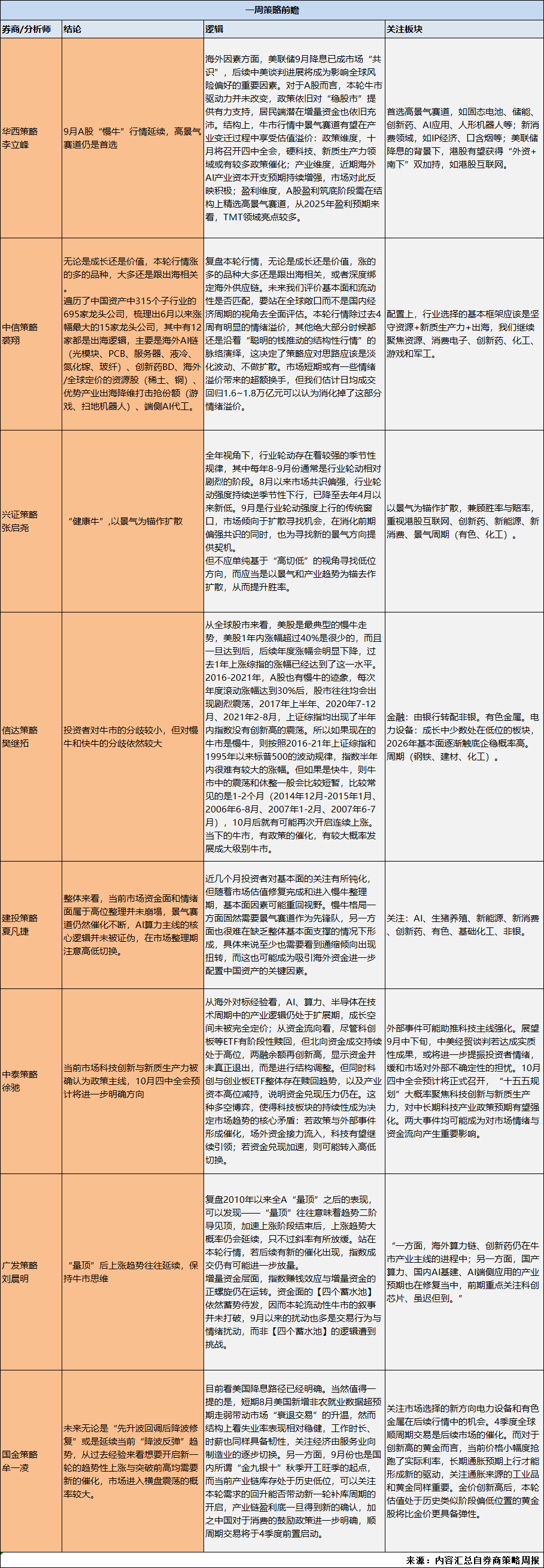
Group 1 - The core viewpoint is that the A-share market is experiencing a "slow bull" trend, with high-growth sectors being the preferred choice for investment [1][2] - Policy support is expected to strengthen with the upcoming Fourth Plenary Session in October, particularly in hard technology and new productivity sectors [1][2] - Recent increases in overseas AI industry capital expenditure are positively influencing market sentiment [1][2] Group 2 - A total of 12 out of the 15 leading companies with the highest gains since June are linked to overseas expansion, particularly in the AI supply chain and innovative pharmaceuticals [2][3] - The market consensus has been strong since August, but the intensity of sector rotation has decreased to a new low since April of the previous year [2][3] - The focus should be on high-growth sectors such as solid-state batteries, energy storage, and innovative pharmaceuticals, while also considering new consumption trends [1][2] Group 3 - The current market sentiment is characterized by a high degree of volatility, with a potential for a significant upward trend if new catalysts emerge [3][4] - The upcoming October meeting is anticipated to clarify the direction of the "14th Five-Year Plan," likely emphasizing technological innovation and new productivity [3][4] - The market is expected to see a shift towards cyclical trades as the economy transitions from service to manufacturing sectors [4]
长城基金汪立:市场情绪仍偏强,关注科技成长核心方向
Xin Lang Ji Jin· 2025-09-10 08:38
Group 1 - The A-share market is currently experiencing volatility, with expectations of limited downside in the near term, but potential for significant fluctuations as the market digests recent gains [1] - Two possible market scenarios are identified: continued thematic speculation with a need for adjustment in the TMT sector, or increasing selling pressure leading to a prolonged downtrend [1] - The current market sentiment remains strong, suggesting a likelihood of sector rotation within growth industries, while relatively cheap consumer and low-position sectors may lack short-term momentum [1] Group 2 - Liquidity support remains, but significant selling pressure from the previous week indicates a need for market consolidation before seeking new upward opportunities [2] - A potential rebalancing between large and small caps is anticipated, with growth styles expected to outperform value styles in the near term [2] - Key investment themes to focus on include technology rotation (e.g., new energy, innovative pharmaceuticals, robotics), interest rate cut trades (e.g., non-bank financials), and sectors benefiting from inflation stabilization (e.g., materials, chemicals) [2]
A股分析师前瞻:结构上或将在景气板块内部有所切换
Xuan Gu Bao· 2025-09-07 23:44
Group 1 - The core viewpoint of the article emphasizes a positive outlook on the A-share market, suggesting a "slow bull" or "healthy bull" market trend, supported by favorable policies and increasing long-term capital inflows [1][2] - Analysts from Huaxi Strategy highlight that recent adjustments in the A-share market are primarily due to profit-taking and structural trading, with historical data indicating limited pullback duration and magnitude during bull markets [1][2] - The market is expected to benefit from the anticipated interest rate cuts by the Federal Reserve, which could strengthen the RMB and attract foreign capital into Chinese assets [1][2] Group 2 - The strategy team from Xingzheng suggests that the market has experienced extreme structural differentiation, necessitating short-term volatility for digestion and consolidation, with a focus on structural adjustments rather than position adjustments [2][3] - Dongcai Strategy indicates an increased probability of wide fluctuations in the A-share index, with potential internal shifts within prosperous sectors, benefiting from the U.S. rate cut expectations and a weaker dollar [1][3] - The analysis from Citic Strategy points out that the current market adjustment is driven by accelerated previous gains and extreme structural differentiation, recommending a focus on sectors with growth potential and cyclical opportunities [2][3]

金鹰基金:资金博弈加剧市场波动 外围流动性改善添底气
Xin Lang Ji Jin· 2025-09-01 06:37
Group 1 - The A-share market experienced high volatility with increased trading volume, driven by policy support and mid-term performance catalysts, particularly in real estate, agriculture, and power equipment sectors [1] - The ChiNext index showed strong performance, with average daily trading volume rising to 2.98 trillion yuan, indicating a shift in market dynamics [1] - The market style favored growth sectors over cyclical, consumer, and financial sectors, with technology growth leading the gains [1] Group 2 - Jin Ying Fund suggests focusing on sectors with potential for future profit improvement, including technology, innovative pharmaceuticals, non-bank financials, and non-ferrous metals [2] - In the technology sector, AI is at a high emotional trading point, with both domestic and overseas developments being encouraged, particularly in AI applications and advanced semiconductor processes [2] - The military industry may see rotation opportunities due to upcoming events like the September 3 military parade and the formulation of the 14th Five-Year Plan [2] Group 3 - As the market strengthens, non-bank financial sectors such as brokerage, insurance, and financial IT are expected to see improvements in both valuation and performance [2] - With expectations of a Federal Reserve rate cut and a dual easing of overseas monetary and fiscal policies by 2026, sectors benefiting from external demand, such as innovative pharmaceuticals and non-ferrous metals, may present investment opportunities [2] - The focus on policy-driven industries like photovoltaics is anticipated to strengthen in the future, reflecting a shift away from internal competition [2]
A股大概率将延续震荡上行走势,但需关注短期波动风险
Mei Ri Jing Ji Xin Wen· 2025-09-01 00:50
Group 1 - The current market trading sentiment has entered an overheated phase, with a noticeable tendency for crowding, necessitating attention to the deterioration of trading structure [1] - The TMT sector's crowding is approaching a warning line, indicating that low-heat sectors like consumption and cyclical industries may offer higher cost-performance ratios in the next market phase [1] - The first half of 2025 is expected to see revenue and net profit turn positive year-on-year, marking a clear turning point in the profit cycle and a mild recovery path for companies [1] Group 2 - The A-share market is likely to continue a volatile upward trend, but short-term volatility risks should be monitored [2] - Future focus areas include short-term rebound opportunities, mid-to-long-term themes such as "anti-involution" concepts driven by improved supply-demand dynamics, and dividend assets with safety margins [2] - The domestic consumption sector, particularly service consumption under supportive policies, presents investment value, with a recommendation to focus on undervalued targets [2] Group 3 - Coal prices have risen significantly since July due to a shift from a loose supply-demand balance to a slightly tighter one [3] - Although recent prices have shown some easing, strict safety regulations and production checks are expected to limit supply increases, leading to a gradual stabilization and potential recovery of coal prices [3] - Leading companies in the coal sector are managing costs effectively, showing strong profit resilience, with expectations of volume and price increases in the second half of the year [3]