消费

Search documents
持股过节:蓄力新高12
CAITONG SECURITIES· 2025-09-28 09:10
Core Insights - The report emphasizes a strategic shift towards large financial and consumer sectors, indicating a positive outlook for the market with a projected increase in the Shanghai Composite Index by over 10% to above 3800 points [6][9] - The report identifies three main driving forces for the market: old economy cycles, new technology, and new consumer trends, suggesting a robust market environment in the fourth quarter [6][10] Group 1: Old Economy and Cyclical Trading - The report notes that the Producer Price Index (PPI) has reached a bottom, indicating a favorable environment for trading in non-ferrous metals and a potential soft landing for the economy [3][10] - It highlights the positive impact of domestic stabilization and policy expectations on sectors such as coal, steel, and renewable energy [3][10] - The report suggests that large financial institutions, including internet finance, brokerage firms, and insurance companies, are likely to benefit from these trends [3][10] Group 2: New Economy and Technology - The report discusses the benefits of AI and overseas expansion for technology sectors, emphasizing the importance of hardware performance and application sentiment [3][10] - It identifies key areas such as North American computing power, semiconductor equipment, and AI chips as critical for performance release [3][10] - The report also highlights the significance of liquidity in innovative pharmaceuticals related to technology exports [3][10] Group 3: New Economy and Consumer Trends - The report emphasizes the importance of consumer sentiment and service consumption, identifying sectors such as pet economy, IP toys, and travel as key areas of focus [3][10] - It categorizes consumer spending into emotional resources, emotional resolution, and emotional release, indicating a diverse range of opportunities in the consumer market [3][10] Group 4: National Holiday Market Dynamics - The report analyzes the market behavior around the National Day holiday, indicating a pattern of volume adjustments and potential for gains post-holiday [4][11] - It notes a high success rate for holding stocks before and after the holiday, with a 67% success rate for the two days before and an 80% success rate for the five days after [4][11] - The report suggests that the market may experience a shift in style, with small-cap stocks gaining momentum post-holiday [4][11] Group 5: Fund Flows and Market Sentiment - The report indicates that leverage funds typically flow out before the holiday and return afterward, suggesting a cyclical pattern in fund movements [4][11] - It highlights that the risk of missing out on gains by exiting the market may outweigh the risks of remaining invested [4][11] - The report concludes that the overall market sentiment remains positive, with expectations for continued inflows into equity markets [6][9]
A股,出现什么信号,牛市才会止步?
Sou Hu Cai Jing· 2025-09-28 04:21
Core Viewpoint - The discussion centers around the increasing probability of a new round of fiscal stimulus, suggesting that a shift in market style is beginning to take root, with expectations for a turning point in fiscal policy and prices [1] Group 1: Market Dynamics - There is a noticeable divergence in the market, with indices performing well but individual stocks showing mixed results, particularly in the technology sector, which has been driven by a few companies in the ChiNext board [1] - The extreme rise in technology stocks may lead to increased caution among investors, as the perception of risk grows, prompting a potential shift from technology to traditional sectors such as liquor, consumer goods, and cyclical industries [1] Group 2: Short-term Style Shift - A short-term style shift is anticipated, particularly in traditional industries that have been undervalued, as fiscal policies aimed at stimulating consumption may come into play [2] - The potential for a temporary rally in traditional sectors cannot be entirely dismissed, given the prolonged stagnation in CPI [2] Group 3: Technology Sector Resilience - Even if a style shift occurs, it is viewed as a temporary interlude, with technology stocks likely to remain strong and not lose their leading position in the market [4] - Historical examples suggest that technology has been the driving force behind major market rallies, indicating that a fundamental shift away from technology is unlikely [4] Group 4: Importance of Technology - The current bull market is heavily reliant on technology, which has reached a market capitalization share of 25%, highlighting its growing significance in the A-share market [4] - The emphasis on technology reflects a broader understanding that sustainable wealth creation and future growth depend on technological advancements rather than traditional sectors alone [4]

早盘直击|今日行情关注
申万宏源证券上海北京西路营业部· 2025-09-26 03:15
Core Viewpoint - The A-share market is currently experiencing a period of consolidation, with the main board showing sideways movement while the ChiNext and tech indices continue to trend upwards, driven by demand for AI and computing power [1] Group 1: Market Performance - The main board's Shanghai Composite Index has entered a consolidation phase, while the ChiNext Index and the STAR 50 Index are on an upward trend [1] - A-shares experienced a brief correction in September, but this was not a one-sided decline; the Shanghai Composite Index remained stable while the ChiNext Index continued to rise [1] Group 2: Future Outlook - The market is expected to see a reallocation of focus among sectors, which is a normal phenomenon during the upward trend and will not affect the mid-term outlook [2] - The Shanghai Composite Index has surpassed its previous high of 3731 points from 2021, indicating potential for other lagging indices like the CSI 300 and ChiNext to catch up [2] Group 3: Sector Highlights - In September, the technology sector may experience some differentiation, with opportunities for low-performing sectors such as robotics, new energy, and military industries to rebound [2] - Traditional industries like finance and consumer sectors, which have previously lagged, also present opportunities for recovery [2]

北证A股:聚焦“专精特新”主阵地,政策红利驱动系统性重估,中长期配置价值明确
Soochow Securities· 2025-09-26 01:17
Policy Insights - The Beijing Stock Exchange (BSE) will implement a new code system starting October 9, 2025, enhancing its market recognition and independent status as China's third-largest stock exchange[3] - Since its inception, the BSE has raised a total of 1.47 billion CNY through refinancing, with an average of 24.5 million CNY per project[4] - The BSE has introduced a "small, fast, flexible, and diverse" review mechanism for mergers and acquisitions, with the first major asset restructuring case processed in May 2025[4] Supply Side - As of September 22, 2025, the BSE has 276 listed companies, with 70% classified as specialized, refined, and innovative enterprises[4] - The average net profit of new three-board listed companies increased from 44.61 million CNY in January 2024 to 69.27 million CNY in August 2025, indicating a solid pipeline for quality listings[4] Investment Trends - The average market capitalization of BSE's constituent stocks is approximately 3.3 billion CNY, significantly lower than other A-share segments, leading to a higher turnover rate of 8.05% as of September 22, 2025[5] - Public funds' holdings in the BSE reached 22.4 billion CNY by Q2 2025, a 76% increase from the end of 2024, with active funds growing by 118%[5] Valuation and Recommendations - As of September 23, 2025, the price-to-earnings (PE) ratios for BSE, ChiNext, Sci-Tech Innovation Board, and Main Board are 52, 45, 77, and 14 respectively, indicating room for valuation growth[5] - Investment focus is recommended on high-quality companies across various sectors, including advanced manufacturing and new energy[5] Risk Considerations - Key risks include policy changes, liquidity issues, and potential underperformance in corporate earnings[5]
曾称“坚决不碰”科技股,林园还是买了!坦言“愁到睡不着觉”
Feng Huang Wang Cai Jing· 2025-09-26 00:02
Core Insights - Lin Yuan, Chairman of Shenzhen Lin Yuan Investment, has shifted his stance on technology stocks, which he previously stated he would "never touch," and has made a small investment in them [1][2] - The investment in technology stocks was described as a passive action to meet the market value requirements for participating in the new stock subscription on the STAR Market [1][2] Group 1 - Lin Yuan's recent investment in technology stocks is minimal and was not a proactive decision but rather a necessity to comply with new subscription rules [1] - The decision to invest in the STAR Market has caused Lin Yuan considerable distress, as he adheres to a full investment strategy and prefers sectors with stable profitability and monopolistic characteristics [2] - The new regulations effective from October 1, 2024, require private equity funds to hold at least 6 million yuan in STAR Market stocks to participate in offline subscriptions, aiming to enhance long-term value focus [2]

Doo Financial|债市波动与融资压力:美港股企业盈利前景观察
Sou Hu Cai Jing· 2025-09-25 15:48
Core Viewpoint - Recent volatility in the global bond market has significantly impacted corporate financing costs and profitability outlooks in the US and Hong Kong stock markets, leading to a heightened focus on how companies balance growth with financial stability [1][3][5] Group 1: Impact on US Stock Market - The high interest rate environment poses particular challenges for growth-oriented and highly leveraged companies, as rising financing costs compress profit margins, especially for tech and startup firms reliant on capital market funding [3] - Companies with strong cash flow and low debt ratios, particularly industry leaders, demonstrate greater resilience against interest rate fluctuations, highlighting a divergence in investor focus on financial stability and sustainable long-term profitability [3] Group 2: Impact on Hong Kong Stock Market - The Hong Kong stock market faces a dual situation: while overall valuation levels are low and some companies remain attractive for financing, the market's sensitivity to international capital and US dollar interest rates amplifies pressures on companies through financing channels [3] - High-leverage real estate and certain traditional industries are more adversely affected by bond market volatility, whereas new economy and consumer sectors with policy support and cash flow advantages may strengthen their competitive positions amid these challenges [3] Group 3: Long-term Trends and Strategies - As global bond market volatility and interest rate uncertainty increase, corporate profitability will increasingly depend on internal cash flow and continuous innovation [3] - Key strategies for companies to mitigate bond market risks and stabilize profits include optimizing capital structures, enhancing operational efficiency, and leveraging supportive policy environments [3][5] - Companies with robust financials and core competitive advantages are more likely to navigate economic cycles successfully and achieve valuation premiums in the long run [5]

[9月25日]指数估值数据(牛市中遇到回调怎么办;红利指数估值表更新;指数日报更新)
银行螺丝钉· 2025-09-25 14:00
Core Viewpoint - The market is experiencing style rotation, with growth styles currently performing strongly while value styles are lagging behind. The recent rise in the ChiNext index indicates a shift in market dynamics, suggesting potential investment opportunities in growth sectors [4][10][11]. Market Performance - The market saw a rise during the day, reaching a peak of 4.1 stars, but closed at 4.2 stars, indicating a slight pullback [1][2]. - Large-cap stocks showed minor gains, while small-cap stocks experienced slight declines [3]. - The growth style overall is on the rise, with significant increases in the ChiNext index recently, which had been undervalued for a long time [4][7][8]. Valuation Insights - The ChiNext index is approaching a price-to-earnings (P/E) ratio of approximately 45 times, indicating it is nearing overvaluation [9]. - Value styles, such as free cash flow and Hong Kong-Shanghai dividend stocks, have seen increases, with the latter rising 7-8% this year, marking the fifth consecutive year of growth [12][13]. - The average turnover rate in A-shares is significantly high, suggesting that many retail investors hold stocks for less than a month, which may not be sufficient to weather market corrections [42][43]. Investment Behavior - Historical data shows that during bull markets, it is common to experience pullbacks, and the market often exhibits a pattern of sharp rises followed by corrections [18][24]. - Attempting to time the market by selling before a correction and buying back at lower prices is challenging and often leads to missed opportunities [27][28]. - Frequent trading and chasing market trends can significantly reduce investor returns, with studies indicating that high turnover rates correlate with lower average profits [52]. Long-term Investment Strategy - Long-term stock and fund investments are closely tied to valuation and earnings growth, with valuation primarily affecting short-term returns and earnings growth driving long-term performance [44][46]. - Investors are encouraged to focus on controlling costs and enhancing revenue, akin to running a business, to achieve better investment outcomes [49][50]. Dividend and Cash Flow Indices - The article includes a valuation table for various dividend and free cash flow indices, providing insights into their earnings yields, P/E ratios, and other financial metrics for reference [51][65].

8月经济数据偏弱,美联储如期降息25BP
Capital Securities· 2025-09-24 13:11
Economic Data - In August, the industrial added value of large-scale enterprises grew by 5.2% year-on-year, below the expected 5.75%[3] - The export delivery value of large-scale industrial enterprises recorded a decline of 0.4% year-on-year, marking the first negative growth this year[3] - From January to August, fixed asset investment cumulative year-on-year growth decreased by 1.1 percentage points to 0.5%, with manufacturing and infrastructure investment growth slowing to 5.1% and 5.4% respectively[3] Consumer Spending - In August, the total retail sales of consumer goods increased by 3.4% year-on-year, with restaurant income rising by 2.1%[20] - Retail sales of household appliances and audio-visual equipment fell by 14.4%, while communication equipment sales dropped by 7.6%[20] Monetary Policy - The Federal Reserve lowered the federal funds rate target range by 25 basis points to 4.00%-4.25%, with expectations of an additional 50 basis points cut by year-end[24] - The Fed's shift in focus from inflation control to "full employment" indicates a change in monetary policy strategy[24] Market Reactions - Following the Fed's rate cut, U.S. Treasury yields rose, and the dollar index strengthened, while gold and U.S. stock prices initially fell before rebounding[26] - The domestic stock market showed clear trends, with the STAR 50 index rising by 1.84% and the ChiNext index increasing by 2.34%[32] Future Outlook - Structural monetary policy tools are expected to be emphasized in Q4, with potential fiscal policy support anticipated if consumer spending does not meet expectations during the upcoming National Day holiday[35] - Risks include unexpected adjustments in monetary policy, insufficient fiscal policy support, and unforeseen changes in the global environment[36]
港股互联网板块爆发,港股通互联网ETF(513040)、恒生科技ETF易方达(513010)受资金关注
Mei Ri Jing Ji Xin Wen· 2025-09-24 12:09
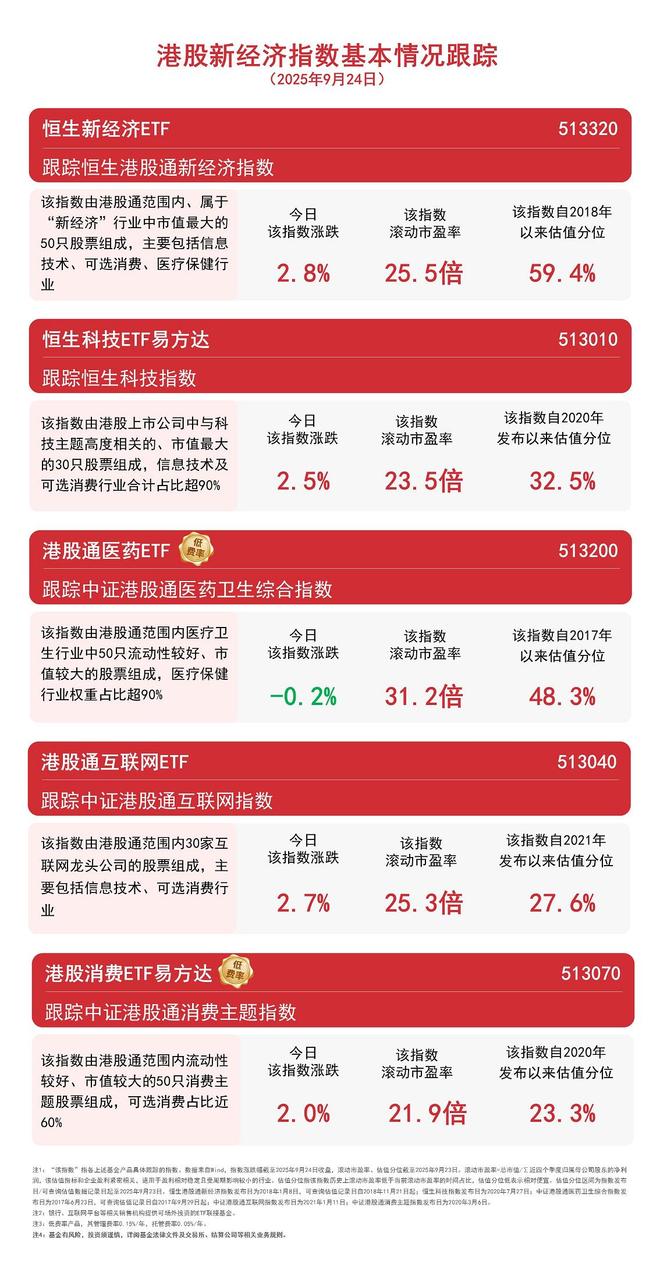
Group 1 - The Hang Seng Hong Kong Stock Connect New Economy Index rose by 2.8%, while the CSI Hong Kong Stock Connect Internet Index increased by 2.7% [1] - The Hang Seng Technology Index and the CSI Hong Kong Stock Connect Consumer Theme Index rose by 2.5% and 2.0% respectively, whereas the CSI Hong Kong Stock Connect Pharmaceutical and Health Comprehensive Index fell by 0.2% [1] - Recent ETF products have attracted significant capital, with the E Fund Hang Seng Technology ETF (513010) seeing a net inflow of over 4 billion yuan over 20 consecutive trading days, and the Hong Kong Stock Connect Internet ETF (513040) experiencing a net inflow of approximately 2.4 billion yuan over 32 consecutive trading days [1] Group 2 - Alibaba announced a collaboration with NVIDIA at the 2025 Alibaba Cloud Conference, focusing on Physical AI, which includes data synthesis, model training, environmental simulation reinforcement learning, and model validation testing [1] - Analysts suggest that with the continuous iteration of AI large model capabilities and the increasing penetration of AI applications, the underlying AI-related assets in the Hong Kong internet sector are expected to be revalued as their scale continues to expand, indicating significant medium to long-term allocation value [1]
七成浮盈、最高回报超10倍,机构溢价争抢港股IPO基石投资份额
Di Yi Cai Jing· 2025-09-24 07:48
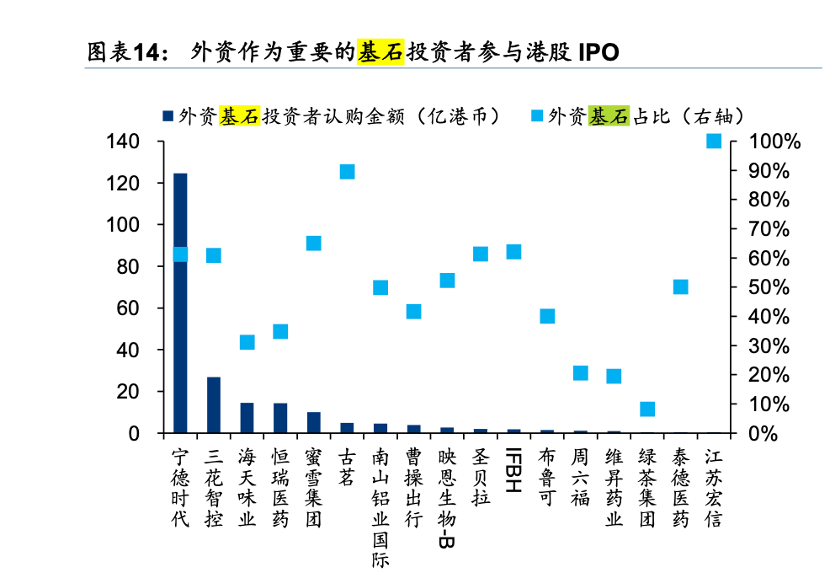
Core Viewpoint - The cornerstone investment in Hong Kong IPOs has shifted from being overlooked to a competitive and premium-seeking environment, with demand significantly exceeding supply [1][4]. Group 1: Investment Trends - The cornerstone investment participation in Hong Kong IPOs has surged, with an average of 5.35 cornerstone investors per company in 2025, a nearly 290% increase from 1.37 last year [1][2]. - The recent IPO of Botai Vehicle Networking Technology Co., Ltd. attracted cornerstone investments totaling 4.66 billion HKD, representing over 40% of the total fundraising [2]. - Large IPO projects are particularly favored, with notable examples like CATL attracting 23 cornerstone investors with a total subscription amount of 203.71 billion HKD, accounting for 66% of the total fundraising [3]. Group 2: Investor Composition - The number of cornerstone investors has increased to 289 this year, with significant contributions from professional investment institutions and listed companies [5]. - Market-oriented funds and listed companies have become major players, with 93 investment institutions contributing 302.06 billion HKD, making up approximately 66.82% of the total cornerstone investment [5][9]. - Foreign investors have played a crucial role, accounting for over 210 billion HKD in subscriptions, which is about half of the total cornerstone investment amount [9]. Group 3: Investment Returns - Over 77% of cornerstone investors are currently in profit, with some projects yielding returns exceeding tenfold [1][10]. - Notable high-return sectors include innovative pharmaceuticals, with companies like Yaojie Ankang-B seeing a price increase of over 1155% from the subscription price [12][13]. - The overall trend indicates that the majority of cornerstone investors are experiencing gains, with 42 out of 54 companies having current market prices above the average subscription price [11].