债券

Search documents
法国30年期国债收益率升至2009年以来最高水平
Xin Lang Cai Jing· 2025-12-19 12:18
Core Viewpoint - The yield on French 30-year government bonds has reached its highest level since 2009, influenced by a report from the German central bank predicting stronger economic performance in Germany, which negatively impacted long-term bond performance [1] Group 1: Bond Yield Changes - The yield on French 30-year government bonds increased by 7 basis points to 4.525% [1] - The yield on French 10-year government bonds rose by 6 basis points to 3.614%, nearing a nine-month high [1] - The yield on German 30-year government bonds climbed by 6 basis points to 3.55%, marking the highest level since 2011 [1] Group 2: Economic and Political Context - The increase in bond yields follows a statement from French Prime Minister Sébastien Lecornu indicating that the budget proposal will not be voted on before the end of the year [1]
国债与企业债的风险等级有何不同?
Sou Hu Cai Jing· 2025-12-19 09:04
以上信息由金融界利用AI助手整理发布。金融界是国内专业的金融信息服务平台,致力于为用户提供 全面、及时、准确的财经资讯与金融知识内容,覆盖债券、股票、基金、宏观经济等多个领域,助力用 户提升对金融市场的认知水平。免责声明:本文内容根据公开信息整理生成,不代表发布者及其关联方 的官方立场或观点,亦不构成任何形式的投资建议。请您对文中关键信息进行独立核实,自主决策并承 担相应风险。 发行主体的信用资质是决定债券风险等级的核心因素。国债的发行主体为国家,其信用基础是国家主权 信用,具有极强的稳定性和可靠性。根据2025年修订的《预算法》及相关财政法规,国债的发行规模、 兑付安排纳入国家财政预算管理,受到严格的制度约束与保障。而企业债的发行主体为各类法人企业, 其信用水平完全依赖于企业自身的经营状况、财务实力及市场竞争力。企业的生产经营易受行业周期波 动、宏观经济环境变化、市场需求调整等因素影响,因此企业债的信用风险显著高于国债。 还款来源的稳定性差异进一步放大了二者的风险等级区别。国债的还款资金主要来源于国家财政收入, 包括税收收入、国有资产收益等,这类收入具有规模庞大、来源广泛且稳定性强的特点,能够为国债的 按时 ...
公募基金观察月报(2025年11月)——股债两市同步承压,债券型、股票型基金收益均下行
Sou Hu Cai Jing· 2025-12-19 08:55
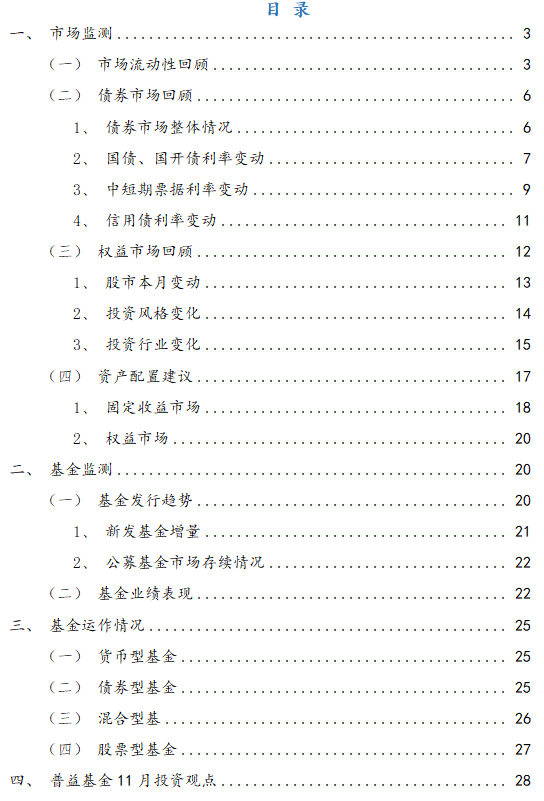
Market Liquidity Review - In November, the People's Bank of China (PBOC) announced a moderately accommodative monetary policy to maintain liquidity and support credit growth, with a total of 10 trillion yuan in Medium-term Lending Facility (MLF) operations and 15 trillion yuan in reverse repos conducted during the month [2][3] - The overall liquidity in November was tight but balanced, influenced by short-term factors such as tax payments and increased government bond supply, yet the PBOC's actions helped stabilize liquidity [9] Bond Market Review Overall Situation - The bond market indices showed a mixed performance in November, with government bonds under pressure due to liquidity concerns and weakened expectations for short-term easing, while credit bonds performed relatively better [10] Government and Policy Bonds - The yields on government bonds increased across various maturities, with the 1-year to 10-year yields rising by 2 to 6 basis points, reflecting reduced expectations for interest rate cuts [12][14] Short-term Notes - The yields on short-term notes generally increased, influenced by liquidity pressures and credit risk events in the real estate sector [17] Credit Bonds - The average yield for AAA-rated corporate bonds rose by 5 basis points to 1.95%, while AA+ rated bonds increased by 2 basis points to 2.01%, indicating a slight tightening of credit spreads [21] Equity Market Review - In November, major stock indices experienced a decline, with the Shanghai Composite Index down by 1.67% and the Shenzhen Component Index down by 2.95%, reflecting a market correction after earlier gains [26][27] - The market showed significant sector performance divergence, with defensive sectors performing better compared to growth sectors, which faced profit-taking [28][36] - The valuation of major indices generally declined, with the ChiNext index experiencing a notable drop in valuation [33] Asset Allocation Recommendations Fixed Income Market - The fixed income market is expected to remain stable, with the PBOC's accommodative stance likely to support liquidity, while the economic recovery process needs further consolidation [44][45] Equity Market - The A-share market is anticipated to continue its structural trends, with potential for recovery in defensive sectors and technology growth stocks, depending on policy signals and liquidity improvements [46][70] Fund Issuance Trends - In November, the number of newly issued funds increased to 136, reflecting a recovery in issuance driven by the end of holiday effects and interest in defensive sectors [47][48] - The net asset value of funds decreased by 236 billion yuan month-on-month, with stock funds showing a year-on-year increase despite a decline in recent months [48] Fund Performance - Most fund types experienced declines in November, with commodity funds performing relatively well due to rising gold prices, while equity funds faced significant losses amid market corrections [54][65]

美债持仓新变化:中国再度减持 持仓创2008年以来最低纪录
Mei Ri Jing Ji Xin Wen· 2025-12-19 08:43
英国的持有规模位居第二,持仓增加了132亿美元,达到8779亿美元。 中国是第三大美国国债持有者,10月所持美债从7005亿美元降低至6887亿美元,单月降幅为118亿美 元。从2022年4月起,中国的美债持仓一直低于1万亿美元。 加拿大持仓则骤降567亿美元,至4191亿美元。美国这个近邻今年来大买大抛,月波动超过500亿美元已 是常态。 由于对外国抛售的担忧,美债持有量数据今年受到了额外关注。但美国财政部长贝森特经常驳斥所谓 的"抛售美国"言论。他此前表示:"我们最近看到了非常、非常强劲的外国需求。我们的国库券拍卖从 未如此稳固,特别是来自海外买家的需求。" 据参考消息援引新加坡《联合早报》网站12月19日报道,美国财政部18日公布最新数据,显示外国投资 者持有的美国国债今年10月下降,尽管包括日本和英国在内的一些国家增加了头寸。持仓规模排名第三 的中国,10月减持美国国债118亿美元,至6887亿美元,创2008年以来的最低纪录。 日本是美国国债最大的海外持有人,其持仓增加107亿美元,达到1.2万亿美元,达到2022年7月以来最 高水平。 近几个月日本持续增持美债。有业内人士分析,日本的持续买入美债可 ...

两位数回报之后,新兴市场:新的避险天堂,还是短暂繁荣?
智通财经网· 2025-12-19 08:31
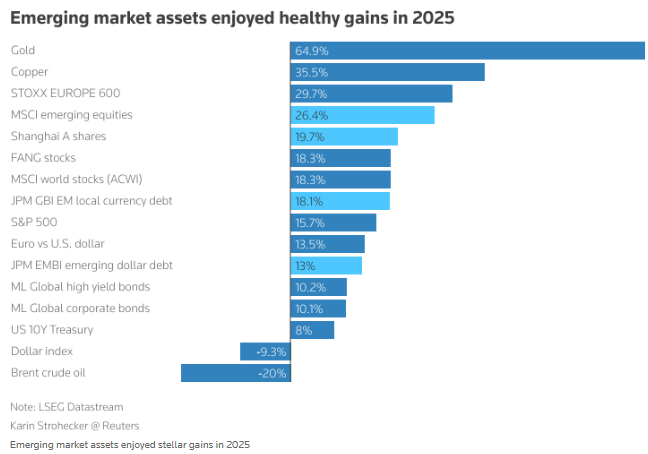
Core Insights - Emerging markets are expected to deliver double-digit returns in 2025, despite global uncertainties, as investors anticipate a repeat of this year's performance [1] - The combination of sound policies and favorable conditions has contributed to the stability of emerging market assets amid geopolitical tensions [1] Group 1: Market Dynamics - The return of former President Trump has created market volatility, yet his erratic trade policies have made emerging markets appear more stable [2] - Investors are diversifying their portfolios beyond the U.S., seeking global diversification due to years of capital outflows from emerging markets [2] - Significant changes in the fundamentals of emerging markets have occurred, with countries like Turkey, Nigeria, and Egypt implementing reforms that have led to improved economic conditions [2] Group 2: Credit Ratings and Resilience - Emerging markets have shown resilience, with a second consecutive year of net credit rating upgrades, indicating improving fundamentals [3] - Emerging market central banks have demonstrated independence and sound policy-making, enhancing their credibility compared to the U.S. Federal Reserve [3] - The cautious monetary policies in emerging markets have led to strong performance of local currency bonds, with returns around 18% this year [3] Group 3: Opportunities Amid Uncertainty - Political uncertainties in countries like Hungary, Brazil, and Colombia may present opportunities for investors, as potential policy changes could create market movements [4] - Despite risks from the U.S. economy, emerging markets are less sensitive to U.S. economic fluctuations than in the past [7] - A recent survey indicates that pessimism towards emerging markets has vanished, with net sentiment reaching historical highs [7]
日本10年期新发国债收益率升至2%
Sou Hu Cai Jing· 2025-12-19 06:56
Group 1 - The yield on Japan's newly issued 10-year government bonds rose to 2%, the highest level since May 2006 [1] - On the same day, the yield reached 1.76%, marking a new high since June 2008 [3] - The highest successful bid yield for the 20-year government bond auction was 2.833%, up from 2.684%, the highest level in approximately 26 years since July 1999 [3] Group 2 - Market concerns regarding Prime Minister Fumio Kishida's expansionary fiscal policies are leading to fears of worsening fiscal conditions, resulting in a sell-off of Japanese government bonds [3] - The Tokyo stock market experienced a significant decline, with the Nikkei 225 index dropping 3.22%, the largest decline since early April of this year [3] - The Japanese yen also depreciated on the same day as the bond sell-off occurred [3]

日本国债:12月19日午盘下跌,加息周期或继续
Sou Hu Cai Jing· 2025-12-19 06:04
Core Viewpoint - Japanese government bond prices fell due to expectations of further interest rate hikes by the Bank of Japan, indicating a continuation of the tightening cycle [1] Group 1: Economic Indicators - The Bank of Japan's hawkish signals suggest that the tightening cycle will persist, impacting bond prices negatively [1] - Despite concerns over tariff policies, overall corporate profits are expected to remain at high levels, contrasting with the previous month when the central bank was worried about downward pressure on manufacturing profits [1]
20年期日本国债收益率创纪录新高
Jing Ji Guan Cha Wang· 2025-12-19 05:11
Core Insights - The yield on 10-year Japanese government bonds has risen by 4.5 basis points to 2.010%, marking the highest level since 1999 [1] - The yield on 20-year Japanese government bonds has increased by 3 basis points to 2.965%, setting a new record high [1]
日度策略参考-20251219
Guo Mao Qi Huo· 2025-12-19 02:45
1. Report's Industry Investment Ratings - **Bullish**: BR Rubber [1] - **Bearish**: Industrial Silicon, Palm Oil [1] - **Neutral (Oscillation)**: Bonds, Agricultural Products, Alumina, Zinc, Stainless Steel, Tin, Precious Metals (Gold, Silver, Platinum, Palladium), Rebar, Hot - Rolled Coil, Iron Ore, Manganese Ore, Ferrosilicon, Glass, Soda Ash, Coking Coal, Coke, Soybeans, Rapeseed Oil, Cotton, Sugar, Wheat, Corn, Pulp, Logs, Live Pigs, Crude Oil, Fuel Oil, Bitumen, Ethylene Glycol, Benzene - Naphtha, Urea, Propylene, PVC, Caustic Soda, LPG, Container Shipping to Europe [1] 2. Core Views of the Report - In the short term, the stock index is expected to continue its weak trend, but the market adjustment since mid - November has opened up space for the upward movement of the stock index next year [1] - Asset shortage and weak economy are beneficial to bond futures, but the central bank has recently warned about interest - rate risks [1] - The market sentiment is volatile, and there are opportunities to go long at low levels for some products [1] 3. Summary by Industry Macro - Financial - **Stock Index**: Short - term weak operation, long - term upward potential. Investors can gradually establish long positions during the adjustment period [1] - **Bonds**: Asset shortage and weak economy are favorable, but short - term interest - rate risks are warned. Pay attention to the Bank of Japan's interest - rate decision [1] Non - Ferrous Metals - **Aluminum**: High - level wide - range oscillation due to limited industrial drive and fluctuating macro sentiment [1] - **Alumina**: Weak domestic fundamentals, short - term price rebound but limited upward drive [1] - **Zinc**: Fundamentals improved, cost center shifted up, but price is under pressure. Pay attention to low - buying opportunities [1] - **Nickel**: After a sharp decline, there is a demand for position - reduction repair. Short - term trading is recommended, and the long - term supply of primary nickel is in surplus [1] - **Stainless Steel**: Short - term trading is recommended, waiting for opportunities to sell on rallies [1] - **Tin**: Short - term oscillation, long - term bullish. Pay attention to low - buying opportunities during corrections [1] Precious Metals and New Energy - **Precious Metals**: Supported by the cooling of the US CPI in November, but short - term volatility risks need to be vigilant [1] - **Industrial Silicon**: Bearish due to increased production in the northwest, reduced production in the southwest, and decreased production schedules of polysilicon and organic silicon in December [1] - **Polysilicon**: There is an expectation of capacity reduction in the long - term, marginal improvement in terminal installation in the fourth quarter, and strong price - holding and low - delivery willingness of large enterprises [1] - **Lithium**: In the traditional peak season of new energy vehicles, with strong energy - storage demand, increased production on the supply side, and the potential to break through previous highs [1] Ferrous Metals - **Rebar and Hot - Rolled Coil**: Roll over and take profits on cash - and - carry positions. Valuation is not high, and short - selling is not recommended [1] - **Iron Ore**: Near - month contracts are restricted by production cuts, but far - month contracts have upward potential [1] - **Manganese Ore and Ferrosilicon**: Prices are under pressure due to weak direct demand, high supply, and inventory accumulation [1] - **Glass and Soda Ash**: Supply and demand provide support, valuation is low, but short - term price fluctuations are strong [1] - **Coking Coal and Coke**: After a decline, there are signs of stabilization. Pay attention to winter - storage replenishment by downstream enterprises this week [1] Agricultural Products - **Palm Oil**: Short - term short - selling is recommended due to continuous negative high - frequency data and high pressure on the origin [1] - **Soybeans**: Pay attention to the negative impact of imported soybean auctions on the supply side [1] - **Rapeseed Oil**: It is recommended to short the 05 contract as the near - term raw - material shortage theme is expected to be exhausted [1] - **Cotton**: The market is currently supported but lacks a driving force. Pay attention to relevant policies and market conditions in the future [1] - **Sugar**: There is a consensus on short - selling, but there is strong cost support below. Pay attention to changes in the capital side [1] - **Wheat and Corn**: The short - term decline is limited by farmers' price - holding sentiment and downstream stocking demand before the Spring Festival [1] - **Pulp**: Unilateral trading is recommended to wait and see, and consider the 1 - 5 reverse spread [1] - **Logs**: The 01 contract is expected to oscillate weakly as it approaches the delivery month [1] - **Live Pigs**: Production capacity still needs to be further released [1] Energy and Chemical Industry - **Crude Oil and Fuel Oil**: Affected by OPEC+ production - suspension, the uncertainty of the Russia - Ukraine peace agreement, and US sanctions on Venezuelan oil exports [1] - **Bitumen**: Follows crude oil in the short term, with high profit and possible falsification of the 14th - Five - Year Plan's rush - demand [1] - **BR Rubber**: Bullish due to improved cost - side support, increased sales, and high operating rates [1] - **PTA and Short - Fiber**: The PTA device operates at a high load, and short - fiber prices follow costs closely [1] - **Ethylene Glycol**: Prices decline due to inventory accumulation and weakening cost support [1] - **Benzene - Naphtha**: There is slight cost - side support, but overall production economy is negative, and inventory is high [1] - **Urea, Propylene, PVC, and Caustic Soda**: Prices oscillate due to factors such as supply - demand imbalance, cost changes, and reduced anti - involution sentiment [1] - **LPG**: The market is affected by geopolitical factors, and prices oscillate after a decline. Pay attention to the impact of natural gas on near - month prices [1] Other - **Container Shipping to Europe**: The price increase in December was less than expected, and the supply of shipping capacity was relatively loose [1]
2025年我国债券市场回顾及2026年前瞻
Sou Hu Cai Jing· 2025-12-19 02:43
Group 1: 2025 Bond Market Review - The bond market in 2025 is characterized by a rational correction of previously overdrawn expectations, with the 10-year government bond yield fluctuating between 1.60% and 1.90% throughout the year [2][3] - The market is divided into five phases, reflecting various economic and policy changes, including adjustments in monetary policy and external trade tensions [2][3][4] Group 2: Phases of the Bond Market in 2025 - Phase 1 (January to March): The bond market starts high with yields around 1.60%, but experiences downward pressure due to disappointing PMI data and cautious market sentiment, leading to a significant adjustment in short-term rates [3][4] - Phase 2 (Late March to Early April): The yield adjusts to around 1.90%, with some recovery as the central bank shifts to net injections, but external trade tensions lead to a drop in yields to 1.63% [4][5] - Phase 3 (Mid-April to June): The market experiences narrow fluctuations around 1.65% as trade tensions ease, but yields rise again due to policy changes and market reactions to economic data [5][6] - Phase 4 (July to September): The bond market faces upward adjustments in yields due to stock market performance and regulatory changes, with significant fluctuations in response to economic data [7][8] - Phase 5 (October to December): The market sees a mix of cautious sentiment and external trade tensions, with yields fluctuating as the central bank resumes bond purchases [9][10] Group 3: 2026 Economic and Bond Market Outlook - The macroeconomic policy for 2026 is expected to remain supportive, with a focus on domestic demand and technological advancements, while external uncertainties persist [11][12] - The fiscal policy is projected to maintain an expansionary stance, with a deficit rate of around 4% and total fiscal expansion estimated at 15.8 trillion yuan, an increase from 2025 [12][13] - The monetary policy is likely to continue its supportive role, with expectations of 1-2 reserve requirement ratio cuts, but less room for interest rate reductions compared to 2025 [14][15] Group 4: Bond Market Characteristics in 2026 - The bond market is anticipated to exhibit "low interest rates + high volatility + a floor and ceiling" characteristic, with the 10-year government bond yield expected to range between 1.60% and 2.10% [17][18] - The market is expected to face challenges from liquidity and regulatory changes, with a potential weakening of the "asset shortage" narrative [16][17] - Investment strategies should focus on short to medium-term bonds and consider leveraging opportunities in the long end of the yield curve [19]