
煤炭

Search documents
可转债周报20260307:油价走强后,转债或将如何受影响?-20260311
Changjiang Securities· 2026-03-11 10:08
1. Report Industry Investment Rating There is no information about the report industry investment rating in the provided content. 2. Core View of the Report - Historically, during periods when geopolitical factors drove oil prices above $100 per barrel, convertible bonds showed a pattern of initial adjustment followed by recovery. Large - cap and low - price convertible bonds had better defensive properties, while small - cap and high - price convertible bonds had higher elasticity during the recovery phase [2][4]. - In the week, the A - share market oscillated weakly, with the large - cap style dominant, and cyclical energy sectors such as oil and gas were strong. The convertible bond market also declined, with large - cap bonds relatively more resistant to decline, and trading volume contracted. Valuations were compressed overall when viewed by market price range, while implied volatility remained at a high level. Oil and gas and home appliance sectors were superior in structure, and some bonds with forced redemption announcements had top - ranking gains [2][4]. - The primary issuance of convertible bonds was stable. The game of redemption clauses intensified significantly, with many bonds expected to trigger forced redemption. High attention should be paid to the risk of valuation compression of high - premium convertible bonds [2][4]. 3. Summary According to Relevant Catalogs 3.1 Oil Price and Convertible Bond Performance - International crude oil prices have effectively exceeded $100 per barrel three times in history. The current rise in oil prices due to the tense situation between the US and Iran may have an impact on inflation and other macro - fields and suppress risk assets. The $100 mark is of symbolic significance to investors [11]. - The three times when oil prices exceeded $100 were in 2008, 2011, and 2022. The core driving factors were different each time. The rise in 2008 was related to capital inflows into US dollar assets and market speculation; in 2022, it was due to supply contraction caused by geopolitical conflicts; in 2011, it was due to the active joint production cuts of oil - producing countries and the demand support from major economies' recovery. During the high - oil - price periods in 2008 and 2022, major stock indices and convertible bond indices both weakened, but convertible bond indices showed better defensive properties with smaller declines [15]. - The current oil price increase due to the US - Iran conflict has a similar "supply contraction" mechanism to the period of the Russia - Ukraine conflict. During the Russia - Ukraine conflict, convertible bonds first adjusted and then recovered. Large - cap and low - price convertible bonds were more resistant to decline during the adjustment, while small - cap and high - price convertible bonds showed greater upward elasticity during the recovery [19]. 3.2 Market Theme Weekly Review - From March 2, 2026, to March 6, 2026, the equity market weakened overall, and cyclical sectors performed well. Shale gas, combustible ice, and natural gas in the energy direction performed relatively well, while the Sora concept (text - to - video), Kuaishou concept in the AI Internet direction, and the National Large - scale Fund holdings and photoresist in the semiconductor direction were under pressure [21]. 3.3 Market Weekly Tracking 3.3.1 Main Stock Indices - The main A - share stock indices weakened overall. The Shanghai Composite Index performed relatively well, while the ChiNext Index was relatively weak. In terms of style, large - cap indices were dominant, and small - and medium - cap and science - innovation indices performed weakly. The average daily trading volume of the market expanded, and the net outflow of main funds also increased slightly [24]. - Cyclical energy sectors such as oil and gas, petrochemicals, coal, and power and new - energy equipment were strong, while sectors such as media, Internet, non - metallic materials, and electronics were weak. Trading volume was mainly concentrated in the electronics, metal materials and mining, and power and new - energy equipment sectors. Most sectors' trading volume recovered, and the average daily trading volume of the oil and gas petrochemical sector increased by more than 163% week - on - week [28][29]. - The market sector congestion was still significantly differentiated. The congestion of cyclical directions such as petroleum, petrochemicals, coal, and agriculture, forestry, animal husbandry, and fishery increased, while that of sectors such as basic chemicals, building materials, and electronics decreased [32]. 3.3.2 Convertible Bond Market - From March 2, 2026, to March 7, 2026, the convertible bond market oscillated and weakened slightly. The small - cap convertible bond index performed relatively weakly, while the large - cap index was relatively strong. Trading volume contracted slightly [34]. - Valuations were stretched overall when divided by parity range, with significant stretching in the 90 - 100 yuan, 110 - 120 yuan, and 130 - 140 yuan parity ranges, and significant compression in the 120 - 130 yuan parity range. When divided by market price range, valuations were compressed overall, with stretching in the 110 - 120 yuan and 120 - 130 yuan market price ranges and significant compression in the 130 - 140 yuan market price range [37]. - The balance - weighted implied volatility of the convertible bond market oscillated and strengthened, remaining at a historical high. The median market price of convertible bonds oscillated and declined, still higher than the high point in August 2025 [40]. - Convertible bonds in the home appliance and petroleum and petrochemical sectors performed relatively well. Trading volume was mainly concentrated in the basic chemicals, power equipment, and electronics sectors, with the combined trading volume of these three sectors accounting for more than 36% [44]. - Most individual convertible bonds weakened. Only 65 convertible bonds had a price increase of 0% or more, accounting for 16.8% of the total number of outstanding convertible bonds in the market. Among the top five convertible bonds in terms of cross - week price increase during the conversion period were Hongbai Convertible Bond, Shouhua Convertible Bond, Hangyu Convertible Bond, Yitian Convertible Bond, and Shengxun Convertible Bond. Among the top five in terms of cross - week price decline were Liyang Convertible Bond, Songlin Convertible Bond, Fuxin Convertible Bond, Weidao Convertible Bond, and Dongshi Convertible Bond. Two of the top five convertible bonds with price increases had announced forced redemption [46]. 3.4 Convertible Bond Issuance and Clause Tracking 3.4.1 Issuance - From March 2, 2026, to March 7, 2026, two convertible bonds, Xianghe Convertible Bond and Tonglian Convertible Bond, were open for subscription. Xianghe Convertible Bond was issued by Xianghe Industrial, with a debt rating of A+ and an issuance scale of 400 million yuan. Tonglian Convertible Bond was issued by Tonglian Precision, with a debt rating of AA - and an issuance scale of 576 million yuan [50]. - Five listed companies updated their convertible bond issuance plans. Two were in the stage of passing the listing committee review, two were in the stage of board of directors' proposal, and one was in the stage of passing the general meeting of shareholders. The total scale of projects in the exchange acceptance stage and later stages reached 8.646 billion yuan [51][52]. 3.4.2 Clause - related Announcements - **Downward Revision**: Three convertible bonds announced that they were expected to trigger downward revision, with a market - value - weighted average PB of the underlying stocks of 3.1; one convertible bond announced not to conduct downward revision, with a market - value - weighted average PB of 2.6; three convertible bonds proposed downward revision, with a market - value - weighted average PB of 3.1 [55][56][57]. - **Redemption**: Thirteen convertible bonds announced that they were expected to trigger redemption; no convertible bond announced not to redeem in advance; three convertible bonds announced early redemption [60].
黑色产业链日报-20260311
Dong Ya Qi Huo· 2026-03-11 09:58
Report Summary 1. Report Industry Investment Rating No investment rating information is provided in the report. 2. Core Views - **Steel**: After the Two Sessions, real - estate policies are mainly stable with limited stimulus. Market expectations have returned to fundamentals. Steel exports face pressure, hot - rolled coil inventory is high, and the pressure from warehouse receipts is large. Insufficient inventory reduction may lead to price declines, and the rebound height is limited [3]. - **Iron Ore**: Against the backdrop of war concerns and domestic policy support, tightened spot liquidity has pushed prices higher, but the fundamentals show a seasonal weakening in both supply and demand. Supply pressure persists, and the expectation of steel mill production cuts is rising under stagflation risks, leading to inventory accumulation. If the Strait of Hormuz is blocked, the contraction in iron ore demand from Gulf countries may far exceed the reduction in Iranian supply. Coupled with only a seasonal rebound in shipping costs, the upside space is limited [21]. - **Coking Coal and Coke**: Domestic coal mines are in the resumption stage, and Mongolian coal customs clearance has recovered rapidly, resulting in large supply pressure. The short - term surplus contradiction of coking coal has intensified. The cost of coking coal for coke has loosened, and coking profits have expanded slightly. The rise in chemical product prices has improved comprehensive profits, and coke enterprise operations are expected to increase. From March to April, it is the verification period for terminal demand. The late Spring Festival has led to a slow resumption of work, and the uncertainty of the Middle East route has suppressed steel exports. The overall downward pressure on the black series is large, and the bottom of coking coal and coke has support but limited elasticity [31]. - **Ferroalloys**: In the short term, the cost support for ferroalloys is gradually strengthening, but the weak downstream steel terminal demand and high plate inventory pressure may limit the upward space for ferroalloys [50]. - **Soda Ash**: Supply - side maintenance may gradually increase, which will affect production in stages. In terms of supply and demand, the rigid demand is currently stable but weak. There may be unexpected disturbances on the supply side, which may affect soda ash production in stages. The inventory performance is better than expected. If the futures price rises, there is some restocking space for middle - stream players such as those involved in futures - cash arbitrage, but due to limited demand elasticity, the price increase space is expected to be limited. The downward price space needs inventory accumulation to open up. In the long - term, the high - supply expectation remains unchanged, and we need to wait for further accumulation of industrial contradictions. In addition to the fundamentals, the overall valuation of soda ash and glass is not high, and there may be an impact from other sectors [64]. - **Glass**: Currently, the glass production and sales are temporarily weak, and the market is still in the recovery stage. The daily melting volume of float glass has dropped to around 148,000 tons, but the high inventory in the middle - stream has always been a risk concern in the market. Once a negative feedback occurs, the spot pressure will be very large, and the downstream may not be able to bear it. Secondly, there are continuous news about ignition and cold - repair, and there are many new lines in Shahe waiting to be ignited. The expectation of supply recovery and high middle - stream inventory limit the upside of glass, and the demand needs to be verified. In addition to the fundamentals, macro and sentiment factors also need to be considered, and there may be an impact [87]. 3. Summary by Directory Steel - **Futures Prices**: On March 11, 2026, the closing prices of rebar 01, 05, and 10 contracts were 3170, 3115, and 3144 yuan/ton respectively, and those of hot - rolled coil 01, 05, and 10 contracts were 3292, 3269, and 3278 yuan/ton respectively [4]. - **Spot Prices**: On March 11, 2026, the rebar summary price in China was 3317 yuan/ton, and the hot - rolled coil summary price in Shanghai was 3250 yuan/ton [9][11]. - **Price Spreads**: The 01 - 05 month spread of rebar was 55 yuan/ton, and that of hot - rolled coil was 23 yuan/ton on March 11, 2026 [4]. Iron Ore - **Futures Prices**: On March 11, 2026, the closing prices of 01, 05, and 09 contracts were 740.5, 787.5, and 758.5 yuan/ton respectively [22]. - **Spot Prices**: On March 11, 2026, the price of Rizhao PB powder was 772 yuan/ton [22]. - **Fundamentals**: As of March 6, 2026, the daily average pig iron output was 227.59 tons, the 45 - port desilting volume was 311.08 tons, and the 45 - port inventory was 17117.86 tons [26]. Coking Coal and Coke - **Futures Prices**: On March 11, 2026, the 09 - 01 month spread of coking coal was - 214 yuan/ton, and that of coke was - 94 yuan/ton [35]. - **Spot Prices**: On March 11, 2026, the ex - factory price of Anze low - sulfur main coking coal was 1450 yuan/ton, and the ex - factory price of Jinzhong quasi - first - grade wet coke was 1280 yuan/ton [38]. - **Profits**: The on - site coking profit was - 28 yuan/ton on March 11, 2026 [35]. Ferroalloys - **Silicon Iron**: On March 10, 2026, the silicon iron basis in Ningxia was 4 yuan/ton, and the silicon iron 01 - 05 month spread was 58 yuan/ton [51]. - **Silicon Manganese**: On March 11, 2026, the silicon manganese basis in Inner Mongolia was 84 yuan/ton, and the silicon manganese 01 - 05 month spread was 106 yuan/ton [52]. Soda Ash - **Futures Prices**: On March 11, 2026, the closing prices of 05, 09, and 01 contracts were 1255, 1322, and 1357 yuan/ton respectively [65]. - **Spot Prices**: On March 11, 2026, the market price of heavy soda ash in North China was 1280 yuan/ton [65]. Glass - **Futures Prices**: On March 11, 2026, the closing prices of 05, 09, and 01 contracts were 1112, 1225, and 1283 yuan/ton respectively [88]. - **Production and Sales**: On March 6, 2026, the production - sales ratio in Shahe was 131, in Hubei was 100, in East China was 92, and in South China was 100 [89].
每日商品期市纵览-20260311
Dong Ya Qi Huo· 2026-03-11 09:51
Report Industry Investment Rating No relevant content provided. Core Viewpoints - The global market risk preference has risen due to the signal of easing in the Middle East situation, but there are still uncertainties in the short - term, and most markets are expected to be volatile [2]. - The prices of various commodities are affected by multiple factors such as geopolitical situations, supply - demand relationships, and cost changes, and different commodities have different trends and influencing factors [1][2][3]. Summary by Category Financial Futures - **Stock Index**: The short - term is expected to be mainly volatile due to factors such as geopolitical risks and the need to wait for more positive policy signals after the Two Sessions [2]. - **Treasury Bonds**: Although the short - term export and import data are good, it is difficult to change the overall economic judgment. The value of treasury bonds has risen after the decline, and the negative impact from the Middle East has not completely dissipated [2]. Non - Ferrous Metals - **Platinum and Palladium**: The long - term upward basis still exists, but in the short - term, the risk of postponed interest - rate cut expectations needs to be vigilant [3]. - **Gold and Silver**: The prices are affected by factors such as the Fed's monetary policy expectations, geopolitical situations, and trade policy uncertainties. Attention should be paid to the Middle East situation and US CPI, PCE data [3][4]. - **Copper**: The price increase is mainly driven by short - covering. The global macro - environment is complex, and both supply and demand are affected by multiple factors [4]. - **Aluminum**: The short - term price is dominated by the war situation and fluctuates sharply [5]. - **Alumina**: The short - term spot price has rebounded, but the medium - to - long - term surplus pattern remains unchanged. Attention should be paid to the release of new production capacity in March [6]. - **Cast Aluminum Alloy**: It has a strong follow - up relationship with Shanghai Aluminum, and there is strong support below [7]. - **Zinc**: The supply may be affected by the Iran situation and energy costs, and the demand side has inventory pressure. The short - term metal price may be suppressed [7]. - **Nickel and Stainless Steel**: The supply of Indonesian wet - process production lines is volatile, and stainless steel is supported by the peak - season expectation [8]. - **Tin**: The supply is tight, and the demand is starting to resume work. The high inventory suppresses the price, and attention should be paid to the inventory - reduction speed and the development of the Iran situation [8]. - **Lithium Carbonate**: The short - term demand is affected by the Middle East situation, but the long - term downstream demand growth logic remains unchanged [9]. - **Industrial Silicon and Polysilicon**: The industry is at the bottom of the current production - capacity cycle, and attention should be paid to the "anti - involution" process and the marginal optimization of the supply - demand structure [9]. - **Lead**: The current supply - demand is weak, and the price is expected to fluctuate. Attention should be paid to the possible negative feedback on the market during the delivery week and the implementation of secondary lead delivery [10][11]. Black Metals - **Rebar and Hot - Rolled Coil**: After the Two Sessions, the real - estate policy is mainly stable, and the steel export faces pressure. The high inventory of hot - rolled coils may lead to price decline [12]. - **Iron Ore**: The price is relatively strong due to the tight liquidity of spot goods, but the fundamental supply - demand is seasonally weak. The upside space is limited [12]. - **Coking Coal and Coke**: The supply pressure is large, and the overall black - metal series has downward pressure, but there is support at the bottom [13]. - **Ferrosilicon and Silicomanganese**: The short - term cost support is gradually strengthening, but the upward space may be limited due to weak downstream demand and high inventory of plates [14]. Energy and Chemicals - **Crude Oil**: The market focuses on the Middle East situation. The development of the US - Iran situation and the subsequent navigation of the Strait of Hormuz are crucial [15]. - **Fuel Oil**: The Asian fuel - oil market remains strong due to supply tightening, increased ship demand, and other factors [15]. - **Asphalt**: The price will follow the cost - end crude oil, and the short - term geopolitical disturbance is the core factor [16]. - **LPG**: The price follows the crude oil, and the Middle East situation needs to be continuously tracked [16]. - **Plastics**: The short - term supply pressure is limited, and the supply - demand pattern is relatively good [17]. - **Urea**: The US - Iran war may break the current weak balance of domestic urea [17]. - **Soda Ash**: The supply may be affected by maintenance, and the inventory performance is better than expected. The price space is limited [18]. - **Glass**: The production and sales are currently weak, and the high inventory in the middle reaches restricts the price increase [19]. - **Caustic Soda**: The supply is sufficient, the demand is weak, and the market is in a supply - strong and demand - weak pattern, showing a weak - oscillating trend [20]. Agricultural Products - **Hogs**: The current market is mainly affected by the weak post - Spring Festival demand, and the price has limited upward and downward space [21]. - **Oilseeds**: The price is supported by factors such as planting - cost increase, export improvement, and biodiesel boost. The domestic market will follow the performance of US soybeans in the short - term [21]. - **Oils**: The market is expected to be range - bound, and attention can be paid to the weakening of the price differences between rapeseed oil and soybean oil, and rapeseed oil and palm oil [22]. - **Cotton**: The domestic supply - demand tightening expectation supports the price, but the high price difference between domestic and foreign cotton exerts pressure on the upside [23]. - **Eggs**: The short - term demand improvement supports the price to be strong in oscillation, but the upside space is limited [24]. - **Red Dates**: The market focus is on the demand side. The price may remain in a low - level oscillation due to the loose domestic supply - demand [24].
一只金融龙虾!AlphaClaw来了
机器之心· 2026-03-11 09:39
Core Viewpoint - The article discusses the emergence of AlphaClaw, a financial research AI tool developed by Entropy Technology, which aims to enhance the efficiency of financial analysts by automating complex research workflows and providing actionable insights [3][6][30]. Group 1: AlphaClaw Overview - AlphaClaw is designed specifically for financial professionals, evolving from a Q&A AI assistant to a fully autonomous AI analyst capable of executing complex investment research tasks [6][30]. - It integrates with the AlphaEngine platform, providing access to a vast database of financial research and data, which distinguishes it from other AI tools like OpenClaw [30][33]. Group 2: Key Features and Use Cases - One of the standout features allows users to extract investment philosophies from extensive documents, such as the Berkshire Hathaway shareholder meeting transcripts, and apply these insights to current market analyses [9][11][13]. - AlphaClaw can assist fundamental investors by transforming their unique stock-picking ideas into quantifiable strategies without requiring coding skills, thus bridging the gap between qualitative insights and quantitative analysis [18][22]. - During earnings season, AlphaClaw can generate performance reviews in the user's writing style, significantly reducing the time analysts spend on report writing [25][28]. Group 3: Data and Security - The tool's effectiveness is attributed to its access to a comprehensive database that includes research reports, meeting minutes, and industry insights, ensuring that analyses are grounded in relevant data [32][34]. - AlphaClaw employs a "Local-First" architecture, prioritizing data security by ensuring that sensitive investment strategies remain confidential and are not used for training AI models [36][42]. Group 4: Future Implications - The article emphasizes that AlphaClaw is not merely a research assistant but a tool that enables analysts to focus on higher-value tasks by automating routine processes [39][40]. - The CEO of Entropy Technology highlights the goal of empowering professional investors to function as a "one-person research team," suggesting a shift in how investment research is conducted in the AI era [41][47].







山煤国际20260310
2026-03-11 08:12
Summary of Shanxi Coal International Conference Call Company Overview - **Company**: Shanxi Coal International - **Industry**: Coal Production and Trade Key Points Production and Sales Targets - The target for raw coal production in 2026 is set at **35 million tons**, with sales expected to be between **26 to 27 million tons**. The company anticipates maintaining this production and sales level over the next two years [2][3] Impact of Indonesian Coal Policies - The company expects limited impact from Indonesian coal policy changes on its overall import volume for 2026, despite a decline in imports starting from May 2025 [2][3] Domestic Coal Business Strategy - The company will not significantly increase its domestic coal business to compensate for potential import shortfalls, maintaining a stable approach to its domestic operations [4] Customer Demand and Service Offerings - There is a trend among downstream customers to substitute domestic coal for some imported coal. The company plans to provide comprehensive services, including production, supply, sales, trade, and transportation, to meet this demand [5] Production Flexibility - The company does not foresee significant flexibility in increasing raw coal production beyond the target of **35 million tons** in the near term [5][6] Production and Sales Rate - The current production and sales rate stands at approximately **80%**. The main factor affecting this rate is the company's strategy of comprehensive washing of raw coal to maximize resource utilization. Future improvements are expected through advancements in washing technology [6] Resource Expansion Strategy - The company is actively monitoring three new resource auctions in Shanxi province and plans to participate. Evaluation criteria for bidding include coal type, quality, geological conditions, and return on investment [7] Capital Expenditure and Dividend Policy - Future capital expenditures are planned to be controlled within **1.2 to 1.5 billion yuan**. The company aims to maintain a dividend payout ratio of no less than **60%** from 2024 to 2026 [9] Coal Price Outlook - Domestic coal prices are expected to have upward potential, targeting a range of **700 to 800 yuan/ton**. Key factors influencing this outlook include reductions in Indonesian coal supply, domestic demand, and the enforcement of coal production capacity policies [10][11] Current Projects and Restructuring - The restructuring plan for Hequ Open-pit Coal Industry is still in progress, with no significant updates or approvals received yet [6] M&A and Asset Injection Plans - The company currently has no plans for mergers, acquisitions, or asset injections [8]

粤开市场日报-20260311
Yuekai Securities· 2026-03-11 08:02
Market Overview - The A-share market showed a mixed performance today, with the Shanghai Composite Index rising by 0.25% to close at 4133.43 points, and the Shenzhen Component Index increasing by 0.78% to 14465.41 points. The ChiNext Index, however, fell by 1.37% to 1401.08 points, while the Growth Enterprise Market Index rose by 1.31% to 3349.53 points. Overall, 2055 stocks rose, 3284 stocks fell, and 145 stocks remained unchanged, with a total trading volume of 25084 billion yuan, an increase of 1105 billion yuan compared to the previous trading day [1][10]. Industry Performance - Among the Shenwan first-level industries, coal, electric equipment, basic chemicals, and public utilities saw the highest gains, with increases of 2.53%, 2.43%, 2.08%, and 1.67% respectively. Conversely, the comprehensive, defense military industry, and media sectors experienced declines of 1.98%, 1.37%, and 1.17% respectively [1][10]. Concept Sector Performance - The leading concept sectors today included photovoltaic inverters, lithium battery electrolytes, selected chemical raw materials, selected chemical fibers, power batteries, major infrastructure central enterprises, sodium-ion batteries, energy storage, lithium battery anodes, central enterprise coal, high transfer, cultivated diamonds, selected coal mining, solid-state batteries, and lithium batteries [2].
A股三大指数收涨,港股蔚来大涨14%,美团、网易、京东健康跌超2%
2 1 Shi Ji Jing Ji Bao Dao· 2026-03-11 07:54
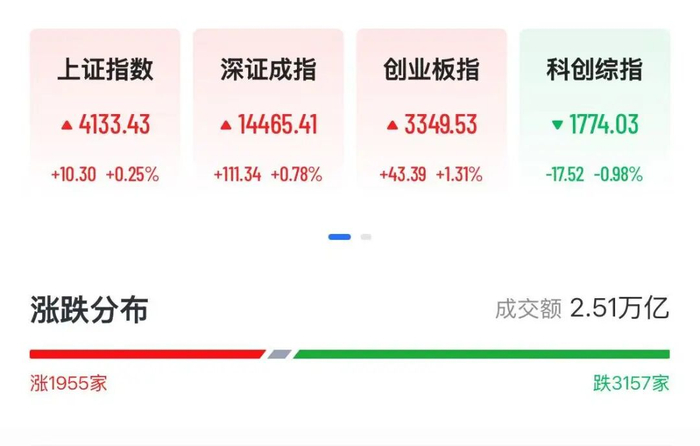
Market Overview - On March 11, the three major indices collectively rose, with the ChiNext Index initially increasing over 2% before retreating, while the Sci-Tech Innovation Index fell by 0.98%. Over 3,200 stocks in the market declined [1][2]. Index Performance - Shanghai Composite Index closed at 4,133.43, up by 10.30 points or 0.25% - Shenzhen Component Index closed at 14,465.41, up by 111.34 points or 0.78% - ChiNext Index closed at 3,349.53, up by 43.39 points or 1.31% - Sci-Tech Innovation Index closed at 1,774.03, down by 17.52 points or 0.98% - The total trading volume reached 2.51 trillion yuan, with 1,955 stocks rising and 3,157 stocks falling [2]. Sector Performance - The energy storage and lithium mining sectors were active throughout the day, with green energy concepts experiencing a surge. Green power stocks saw consecutive gains, and energy-saving wind power stocks hit the daily limit [2]. - The chemical sector saw a strong rally, particularly in coal and salt chemicals, with stocks like Jinniu Chemical and Zhongyan Chemical hitting the daily limit. The ongoing geopolitical conflict in the Middle East has pushed up international oil prices, supporting chemical product costs [2]. - The chemical fiber sector collectively rose, with companies like Zhongfu Shenying increasing over 14%. The price of spandex was raised, with increases of 2,000 yuan/ton for Taihe New Materials and 3,000 yuan/ton for Huahai Spandex reported [2]. Coal Sector - The coal sector experienced fluctuations, with Huadian Energy achieving consecutive gains. Other companies like China Coal Energy and Yanzhou Coal Mining also saw increases [3]. Downward Trends - The small metals sector declined, with companies like Xianglu Tungsten and Zhongtung High-tech dropping over 5%. The gas turbine sector also weakened, with stocks like Jereh and Tunan falling collectively [3]. - The "lobster" concept stocks saw a collective decline, with companies like Kunlun Wanwei and Qingyun Technology dropping over 4% [4]. Hong Kong Market - In the Hong Kong market, the Hang Seng Index fell by 0.21% and the Hang Seng Tech Index decreased by 0.14%. Most popular tech stocks declined, with Meituan, NetEase, and JD Health dropping over 2%. However, automotive stocks surged, with NIO rising over 14% and other companies like Li Auto and Xpeng increasing over 4%. NIO reported a quarterly operating profit of 1.25 billion yuan, marking the company's first quarterly profit [7].



中煤能源股价涨5.06%,新沃基金旗下1只基金重仓,持有3.5万股浮盈赚取2.97万元
Xin Lang Cai Jing· 2026-03-11 05:43
Group 1 - China Coal Energy Co., Ltd. experienced a stock price increase of 5.06%, reaching 17.65 CNY per share, with a trading volume of 978 million CNY and a turnover rate of 0.63%, resulting in a total market capitalization of 234.015 billion CNY [1][4]. - The company, established on August 22, 2006, and listed on February 1, 2008, operates primarily in coal, coal chemical, and coal mining equipment manufacturing sectors. The revenue composition is as follows: coal business 81.03%, coal chemical business 12.48%, coal mining equipment 6.24%, other businesses 6.00%, financial services 1.57%, and other supplementary activities 0.63% [1][4]. Group 2 - New沃 Fund has a significant holding in China Coal Energy, with its New沃 Domestic Demand Growth Mixed A Fund (012143) holding 35,000 shares, accounting for 4.74% of the fund's net value, ranking as the ninth largest holding. The estimated floating profit for the day is approximately 29,700 CNY [2][5]. - The New沃 Domestic Demand Growth Mixed A Fund was established on September 9, 2021, with a current size of 7.2042 million CNY. Year-to-date returns are 1.4%, ranking 6201 out of 8890 in its category, while the one-year return is 13.6%, ranking 5249 out of 8159. Since inception, the fund has incurred a loss of 47.97% [2][5]. Group 3 - The fund manager of New沃 Domestic Demand Growth Mixed A Fund is Liu Shen, who has been in the position for 4 years and 89 days. The total asset size under management is 9.1945 million CNY, with the best fund return during the tenure being -47.12% and the worst being -48.21% [3][6].

中煤能源股价涨5.06%,万家基金旗下1只基金重仓,持有159.88万股浮盈赚取135.9万元
Xin Lang Cai Jing· 2026-03-11 05:43
Core Viewpoint - China Coal Energy Co., Ltd. has shown a significant increase in stock price, rising by 5.06% to 17.65 CNY per share, with a trading volume of 979 million CNY and a market capitalization of 234.015 billion CNY [1][4]. Company Overview - China Coal Energy Co., Ltd. is located at 1 Huangsi Street, Chaoyang District, Beijing, established on August 22, 2006, and listed on February 1, 2008 [1][4]. - The company's main business segments include coal business (81.03% of revenue), coal chemical business (12.48%), coal mining equipment manufacturing (6.24%), other businesses (6.00%), financial services (1.57%), and supplementary income (0.63%) [1][4]. Fund Holdings - Wanji Fund has a significant holding in China Coal Energy, with its fund Wanji Xinli (519191) reducing its stake by 219.87 million shares, now holding 159.88 million shares, which represents 3.71% of the fund's net value, ranking as the tenth largest holding [2][5]. - The fund has achieved a floating profit of approximately 1.359 million CNY from its investment in China Coal Energy [2][5]. Fund Performance - Wanji Xinli (519191) was established on January 24, 2014, with a current size of 537 million CNY. Year-to-date returns are 20.36%, ranking 276 out of 8,890 funds; the one-year return is 32.34%, ranking 2,681 out of 8,159 funds; and since inception, the return is 216.79% [2][5]. Fund Manager Information - The fund manager of Wanji Xinli is Huang Hai, who has been in the position for 5 years and 171 days. The total asset size managed is 2.709 billion CNY, with the best return during the tenure being 78.19% and the worst being -23.78% [3][6].
中煤能源股价涨5.06%,长城基金旗下1只基金重仓,持有4.95万股浮盈赚取4.21万元
Xin Lang Cai Jing· 2026-03-11 05:43
Core Viewpoint - China Coal Energy Co., Ltd. has shown a significant increase in stock price, rising by 5.06% to 17.65 CNY per share, with a trading volume of 977 million CNY and a market capitalization of 234.015 billion CNY [1][4]. Company Overview - China Coal Energy Co., Ltd. is located at 1 Huangsi Street, Chaoyang District, Beijing, established on August 22, 2006, and listed on February 1, 2008 [1][4]. - The company's main business segments include coal business (81.03% of revenue), coal chemical business (12.48%), coal mining equipment manufacturing (6.24%), other businesses (6.00%), financial services (1.57%), and supplementary activities (0.63%) [1][4]. Fund Holdings - The Great Wall Fund has a significant holding in China Coal Energy, with the Great Wall State-Owned Enterprises Select Mixed Fund A (019277) holding 49,500 shares, unchanged from the previous period, representing 5.39% of the fund's net value, making it the second-largest holding [2][5]. - The fund was established on October 24, 2023, with a current size of 11.4024 million CNY, achieving a year-to-date return of 15.35%, ranking 654 out of 8,890 in its category, and a one-year return of 31.42%, ranking 2,779 out of 8,159 [2][5]. Fund Manager Performance - The fund manager, Shuwenyu, has a tenure of 10 years and 308 days, managing assets totaling 144 million CNY, with the best fund return during the tenure being 76.71% and the worst being 2.91% [3][6].