
公用事业

Search documents
沪指围绕4000点震荡蓄势,后市关注结构性机会
British Securities· 2025-11-10 02:15
Market Overview - The A-share market is currently experiencing fluctuations around the 4000-point mark, with the Shanghai Composite Index showing signs of consolidation after previous rebounds, leading to reduced attractiveness for new capital due to valuation corrections in some sectors [3][4][13] - The market is characterized by a lack of strong catalysts following the completion of Q3 reports and the interim results of Sino-US trade talks, resulting in a cautious stance from investors [3][4][13] Sector Analysis - **Chemical Sector**: The chemical industry is showing signs of recovery from a cyclical low, with significant growth in earnings for companies in agricultural chemicals, fluorine chemicals, and electronic chemicals due to policy support and increasing demand [8][9] - **New Energy Sector**: Stocks in the new energy sector, including batteries and photovoltaic equipment, are expected to rebound, driven by ongoing global efforts to achieve carbon neutrality and the anticipated demand for lithium batteries and solar energy [9][10] - **High Dividend Stocks**: High dividend yield stocks, particularly in banking and public utilities, continue to attract investor interest, providing a safety margin during market volatility [12][14] Investment Strategy - Investors are advised to focus on structural opportunities rather than fixating on the index level, with a balanced allocation strategy recommended across technology growth, high dividend defensive sectors, and cyclical styles [4][14] - Specific investment themes include technology growth areas such as AI, semiconductors, and robotics, as well as cyclical sectors like photovoltaic, battery, and rare earth industries, which are expected to benefit from policy changes and improving profitability [4][14]
A+H板块持续扩容 AH溢价呈现分化
Zheng Quan Ri Bao· 2025-11-09 16:04
Core Insights - The "A+H" market has expanded significantly this year, with 16 A-share companies listed in Hong Kong, raising a total of 1,040 million HKD, accounting for 48% of the total IPO fundraising in the Hong Kong market this year [1] - The performance of newly listed H-shares has shown divergence, with A-share premiums remaining mainstream but exhibiting a trend of differentiation [2] A-H Premium Analysis - As of November 9, the Hang Seng AH Premium Index stood at 118.42, a historical low, compared to a peak of 155.58 in early 2024 [2] - Among the 16 newly listed "A+H" stocks, there are both large-cap companies like Ningde Times and smaller firms like Xiamen Jihong Technology [2] - A total of 174 institutions participated as cornerstone investors in these 16 "A+H" stocks, including international investors like Morgan Stanley and local venture capital firms [2] - Historically, the AH premium phenomenon has existed, with 30 out of 166 A+H companies having an A-share premium rate exceeding 100% [2] Sector-Specific Premium Trends - Certain sectors have seen a significant narrowing of AH premium rates, such as the semiconductor industry, where Shanghai Fudan Microelectronics Group's A-share premium rate has dropped over 100 percentage points [3] - Innovative pharmaceutical companies have experienced valuation increases in the Hong Kong market, with Rongchang Bio's H-share price surging 476.74% this year, outperforming A-shares by over 200 percentage points [3] - High-dividend consumer stocks are also gaining favor, with Qingdao Beer’s AH premium rate falling to 35.61%, significantly below the average for the consumer staples sector [3] Valuation Dynamics - The price differences between A and H shares reflect varying investor valuations, as both markets are influenced by different investor bases [4] - The low AH premium index is attributed to continuous inflows of southbound capital, which reached a net purchase of 12,986.97 million HKD this year, altering traditional pricing logic in the Hong Kong market [5] - The ongoing valuation recovery in the Hong Kong market, particularly for state-owned enterprises and high-dividend sectors, is contributing to the narrowing gap between H and A shares [5]


市场震荡蓄势,不断试探4000点:——策略周专题(2025年11月第1期)
EBSCN· 2025-11-09 13:14
Group 1 - The A-share market experienced a general upward trend this week, with the Shanghai Composite Index showing the best performance at a gain of 1.1%, while the Small and Medium-sized Enterprises Board Index had the worst performance with a decline of 0.6% [1][10][12] - The valuation of the Wind All A Index is currently at the 89.2 percentile since 2010, indicating a relatively high valuation level [1][10][16] - The sectors of power equipment, coal, and oil and petrochemicals performed relatively well, with respective gains of 5.0%, 4.5%, and 4.5% [1][12][54] Group 2 - The market style this week leaned towards value, with large-cap value stocks showing a gain of 2.3%, while large-cap growth stocks only gained 0.3% [12][51] - The market is currently in a bull phase, but short-term fluctuations are expected due to influences from overseas markets, including the volatility of the US stock market [3][23][24] - The overall market valuation is at a relatively high level, with the PE-TTM valuation of the Wind All A Index at 22.2 times, which may lead to increased market divergence [23][24][36] Group 3 - Recent economic data shows that China's goods trade maintained a steady growth trend, with a year-on-year increase of 3.6% in the first ten months of 2025 [2][20] - The import and export values for October were 3.7 trillion yuan, with exports decreasing by 0.8% and imports increasing by 1.4% [2][20] - The three major memory manufacturers have suspended DDR5 pricing, which may impact the supply chain [2][21] Group 4 - The report suggests focusing on defensive and consumer sectors in the short term, while continuing to pay attention to TMT and advanced manufacturing sectors in the medium term [34][36] - The TMT sector is expected to become a main line in the mid-term due to liquidity-driven market conditions, while advanced manufacturing may gain attention if the market shifts to a fundamental-driven phase [36][38]


下周A股领涨板块可能大变样?别错过这些重要事件
Mei Ri Jing Ji Xin Wen· 2025-11-09 05:23
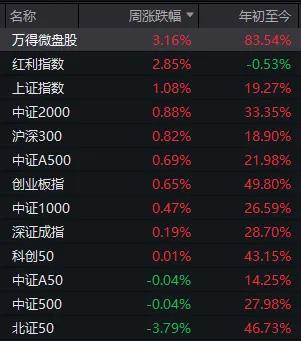
Core Viewpoint - The A-share market experienced a rebound during the week of November 3 to 7, maintaining a high-level fluctuation pattern, with micro-cap and dividend stocks performing notably well while other indices showed mixed results [1][3]. Market Performance - The performance of major indices for the week and year-to-date is as follows: - Wind Micro-Cap Index: Weekly increase of 3.16%, Year-to-date increase of 83.54% - Dividend Index: Weekly increase of 2.85%, Year-to-date decrease of 0.53% - Shanghai Composite Index: Weekly increase of 1.08%, Year-to-date increase of 19.27% - CSI 2000: Weekly increase of 0.88%, Year-to-date increase of 33.35% - CSI 300: Weekly increase of 0.82%, Year-to-date increase of 18.90% - ChiNext Index: Weekly increase of 0.65%, Year-to-date increase of 49.80% - CSI 1000: Weekly increase of 0.47%, Year-to-date increase of 26.59% - Shenzhen Component Index: Weekly increase of 0.19%, Year-to-date increase of 28.70% - Sci-Tech 50: Weekly increase of 0.01%, Year-to-date increase of 43.15% - CSI 50: Weekly decrease of 0.04%, Year-to-date increase of 14.25% - CSI 500: Weekly decrease of 0.04%, Year-to-date increase of 27.98% - North Exchange 50: Weekly decrease of 3.79%, Year-to-date increase of 46.73% [2]. Stock Movement - The number of stocks that rose during the week increased slightly compared to the end of October, but overall, the market remained mixed with both gains and losses [5]. - On November 7, the number of stocks that rose was 2,977, while 2,423 stocks fell, compared to 2,861 rising and 2,523 falling on October 31 [6]. Sector Rotation - The market saw sector rotation due to the narrow fluctuation of indices without significant volume breakthroughs, with recent hot sectors experiencing ups and downs, while long-term low-performing sectors showed signs of recovery [7]. - The leading sectors for the week included power generation, chemicals, and certain regional stocks, while the sectors that declined were primarily those that had performed well in the previous week, such as pharmaceuticals and AI applications [7]. Investment Recommendations - Short-term investment advice suggests a balanced allocation towards sectors with upward policy and industry trends, such as new energy (wind power, energy storage, solid-state batteries), machinery (robots), non-ferrous metals, media (gaming), computing (AI applications), and pharmaceuticals [10]. - Sectors that may benefit from the "14th Five-Year Plan" and potential marginal improvements in fundamentals include consumption (food, retail), military (commercial aerospace), electronics (AI hardware), and communications (computing power) [10]. External Demand Concerns - There is a growing discussion regarding the weakening of external demand, which may lead to increased focus on domestic demand themes in the upcoming week [12]. - In October, China's total import and export value was 3.7 trillion yuan, a slight increase of 0.1%, with exports at 2.17 trillion yuan, down 0.8%, marking the first negative growth in monthly export growth since the second half of this year [12][13]. Upcoming Events - Important upcoming events include the China Robot Industry Development Conference on November 10, the International Summit on Battery New Energy Industry in Suzhou on November 11, and the World Power Battery Conference on November 12, among others [17].

英国森特理克集团据称正探索融资选项
Ge Long Hui A P P· 2025-11-08 23:17
Core Insights - SSE PLC is exploring financing options, including a potential stock issuance that could raise several billion pounds [1] Company Summary - SSE PLC is considering various financing strategies to enhance its capital structure [1] - The company is specifically looking into the possibility of raising significant funds through a stock sale [1]
基金研究周报:高位轮动,低估值景气改善板块走强(11.3-11.7)
Wind万得· 2025-11-08 22:33
Market Overview - The A-share market showed a steady upward trend last week (November 3 to November 7), with the Shanghai Composite Index closing at 3997.56 points, up 1.08% [2] - Structural differentiation continues, with growth sectors performing poorly while value styles, particularly the CSI Dividend Index, rose by 2.23% [2] - The micro-cap stock index surged by 3.46%, indicating strong market activity, while the market is consolidating around the 4000-point mark [2][7] Industry Performance - The average increase of Wind's first-level industry indices was 0.76%, with energy, industrials, and utilities leading the performance, while healthcare, consumer discretionary, and information technology faced significant pressure [11] - High valuation sectors weakened, while low valuation sectors with improving conditions strengthened [11] Fund Issuance and Performance - A total of 41 funds were issued last week, including 21 equity funds, 9 mixed funds, 9 bond funds, and 2 QDII funds, with a total issuance of 26.5 billion units [16] - The Wind All Fund Index rose by 0.11%, with the ordinary equity fund index down by 0.06% and the mixed equity fund index up by 0.06% [6] Global Market Context - The Hang Seng Index was a standout performer, rising by 1.29%, while major global indices, including the NASDAQ, S&P 500, and Dow Jones, experienced declines [3] - Commodity markets showed significant divergence, with natural gas surging by 4.85% and iron ore dropping by 4.58% [3]

天风证券:连续三年跑输的行业 哪些明年反转概率较大?
Zhi Tong Cai Jing· 2025-11-08 09:48
Core Viewpoint - The report from Tianfeng Securities indicates that industries with prolonged weak performance tend to exhibit a "prolonged decline" characteristic, with defensive sectors like environmental protection, public utilities, and transportation more likely to underperform in the long term [1][2] Industry Analysis - Industries that have underperformed for three consecutive years and are nearing their historical longest underperformance periods include beauty care, basic chemicals, and social services [4] - The construction materials, electrical equipment, and food and beverage sectors have been underperforming for a duration close to their historical longest periods, with a difference of about one year [4] - Industries that have underperformed for three consecutive years but have a higher probability of outperforming in the fourth year include food and beverage, agriculture, forestry, animal husbandry, social services, and biomedicine [2][4] Defensive Sector Characteristics - The public utility sector exhibits a typical public utility attribute, characterized by weak cycles and low beta, showing low elasticity during bull markets, as evidenced in the bull markets of 2006-2007, Q1-Q3 of 2009, and H2 of 2014 to H1 of 2015 [3] - The trend of negative excess returns in public utility sectors is attributed to small-cap stocks lacking both offensive characteristics in bull markets and stable dividend attributes, leading to a divergence between industry leaders and small-cap stocks [3] - The independent market performance of leading stocks in the public utility and environmental sectors since 2017 is driven by the revaluation of dividend assets in a low-interest-rate environment, with stable earnings and high dividends contributing to a stronger "moat" and scale effect for these leaders [3] Statistical Insights - An analysis of the Shenwan first-level industries from 2007 to 2025 reveals that the probability of an industry underperforming for three consecutive years is inversely related to the conditional probability of it outperforming in the fourth year [2]

Alliant Energy(LNT) - 2025 Q3 - Earnings Call Transcript
2025-11-07 16:02
Financial Data and Key Metrics Changes - The company reported third quarter ongoing earnings of $1.12 per share, achieving over 80% of the midpoint of the 2025 earnings guidance [14] - The 2025 ongoing earnings guidance range has been narrowed to $3.17-$3.23 per share, trending towards the upper half of this range [16] - The 2026 earnings guidance is projected at $3.36-$3.46 per share, representing a 6.6% increase over the 2025 midpoint [8][16] - The annual common stock dividend target for 2026 is set at $2.14 per share, a 5.4% increase from the 2025 target of $2.03 per share [8][16] Business Line Data and Key Metrics Changes - The company completed construction of energy storage projects totaling 175 MW and advanced gas path projects to enhance efficiency [7] - The contracted demand from four data centers totals 3 GW, leading to a projected 50% peak demand growth by 2030 [9] - The capital expenditure plan has been increased by 17% to $13.4 billion, with a projected compound annual growth rate of 12% from 2025-2029 [8][17] Market Data and Key Metrics Changes - The company is experiencing significant load growth opportunities, particularly from data centers, which are expected to drive earnings growth [4][5] - The Iowa retail construct stabilizes electric-based rates for customers, providing a win-win outcome for existing customers [10] - The company has received regulatory support for its plans, including approvals for rate reviews and investments in renewable energy projects [11][22] Company Strategy and Development Direction - The company is focused on customer-centric investments and maintaining affordability and reliable service [4] - The strategy includes proactive community engagement and unlocking potential for customers and communities [10][12] - The company aims to provide competitive rates for both new and existing customers through economic development success and cost controls [12] Management's Comments on Operating Environment and Future Outlook - Management expressed confidence in achieving earnings growth driven by data center expansions and load growth plans [9][25] - The company is committed to maintaining a strong balance sheet to support future growth opportunities [41] - Management highlighted the importance of timing in load growth and the potential for upside beyond current guidance [29][39] Other Important Information - The company has successfully refinanced $300 million of debt and issued $725 million in junior subordinated notes to support its financing plans [18][19] - The company is actively pursuing regulatory approvals for various projects, including wind and natural gas facilities [22][23] Q&A Session Summary Question: Demand ramp and earnings trajectory - Management indicated that the 7%-8% growth is conservative and could be higher with additional load growth [29] Question: Equity dilution impact on earnings growth - Management confirmed that equity dilution is a significant factor affecting the earnings growth forecast [30] Question: Regulatory framework in Iowa and earned returns - Management explained that Iowa's new regulatory construct provides certainty for earning authorized returns, with potential upside for outperformance [32] Question: Incremental load opportunities and updates - Management stated that they are in active negotiations for additional load and will provide updates regularly [36][67] Question: Tax credits and cash flow replacement - Management confirmed confidence in generating tax credits and maintaining cash flow through 2030 [40][42] Question: Load growth starting point for 2026 - Management indicated that the starting point for load growth in 2026 is modest, with significant ramp-up expected in subsequent years [43] Question: Probability of conversion for remaining pipeline - Management expressed high confidence in the conversion of remaining pipeline opportunities, emphasizing the company's strong position in Iowa and Wisconsin [48][52]

Brookfield Infrastructure Partners(BIP) - 2025 Q3 - Earnings Call Transcript
2025-11-07 15:02
Financial Data and Key Metrics Changes - Brookfield Infrastructure Partners generated third quarter Funds from Operations (FFO) of $654 million or $0.83 per unit, a 9% increase compared to the previous year, driven by strong organic growth [3][4] - The company maintained a well-capitalized balance sheet with liquidity totaling $5.5 billion at the end of the third quarter [8] Segment Performance Changes - Utilities segment generated FFO of $190 million, slightly ahead of the prior year, benefiting from inflation indexation and over $450 million of capital added to the rate base [3][4] - Transport segment's FFO was $286 million, lower than last year due to asset sales, but slightly ahead when adjusted for capital recycling initiatives [4] - Midstream segment generated FFO of $156 million, a 6% increase over the same period last year, driven by strong customer activity levels [5] - Data segment's FFO was $138 million, representing a more than 60% increase compared to the prior year, driven by strong organic growth and contributions from acquisitions [6] Market Data and Key Metrics Changes - The company completed a $700 million corporate issuance of medium-term notes at a weighted average interest rate of approximately 4%, priced at the tightest credit spreads in its history [7] - The company is on track to achieve $3 billion in asset sale proceeds over the next 12-18 months, with significant sales already completed [11] Company Strategy and Development Direction - The company has secured six new investments totaling over $1.5 billion, including a $1.3 billion New Zealand natural gas infrastructure operation and a $1 billion South Korean industrial gas business [9][10] - The company is focusing on AI-related infrastructure, expecting to deploy up to $500 million annually into this sector [14] - The outlook for Brookfield Infrastructure remains favorable, with expectations for FFO per unit growth to inflect higher due to new investments and macroeconomic trends [12][14] Management's Comments on Operating Environment and Future Outlook - Management noted a significant increase in capital deployment opportunities, particularly in the data sector, despite rising competition [17] - The company remains confident in its ability to source the best opportunities due to its global franchise and access to significant capital [17] - Management highlighted the potential for substantial growth in AI infrastructure, which is seen as a $7 trillion opportunity [14] Other Important Information - The company is contemplating an ATM program for BIPC shares to increase liquidity, with a focus on avoiding dilution to existing shareholders [21][22] - The company is exploring public market exits for its assets, depending on market conditions [26] Q&A Session Summary Question: Thoughts on rising competition for capital deployment opportunities - Management acknowledged increased competition but emphasized their distinct advantage due to global reach and capital access [17] Question: Timing and success metrics for LP unit repurchases - Management indicated that the program is still under consideration, focusing on increasing liquidity without diluting existing shareholders [21][22] Question: Future public market exits for assets - Management confirmed that public markets remain a potential exit strategy, contingent on favorable market conditions [26] Question: Investment thesis for CenterSquare - Management expressed optimism about continued growth and expansion opportunities within the CenterSquare platform [28][29] Question: Organic growth rates in data businesses - Management reported that organic growth in data businesses is tracking slightly ahead of underwriting assumptions, with significant future project potential [46][47]

基于财报盈利增速的行业配置模型
Xiangcai Securities· 2025-11-07 11:47
Quantitative Models and Construction - **Model Name**: Industry Allocation Model Based on Profit Growth Rate **Model Construction Idea**: The model uses profit growth rate as the primary criterion for industry selection, supplemented by valuation and trading crowding metrics as risk indicators[7][27][29] **Model Construction Process**: 1. **Profit Growth Metrics**: - Single-quarter net profit year-on-year growth rate - Marginal change in single-quarter net profit year-on-year growth rate Formula for marginal change: $ \text{Marginal Change} = \text{2025 Q3 Single-quarter YoY Growth} - \text{2024 Q3 Single-quarter YoY Growth} $[15][29] 2. **Valuation Metric**: - Historical PE_TTM percentile (2020 to present) is used to measure valuation levels across industries[18][21][29] 3. **Trading Crowding Metric**: - Standard deviation of turnover rate over the past three months is calculated to assess trading crowding[6][24][29] 4. **Comprehensive Scoring**: - Each metric is ranked, and weights are assigned: - Profit growth metrics: 0.3 each - Risk metrics (valuation and trading crowding): 0.2 each Formula for comprehensive scoring: $ \text{Comprehensive Score} = 0.3 \times \text{Net Profit YoY Growth} + 0.3 \times \text{Marginal Change} + 0.2 \times \text{Valuation Percentile} + 0.2 \times \text{Turnover Rate Std Dev} $[31][32] **Model Evaluation**: The model effectively identifies industries with high profit growth and moderate risk levels, providing actionable allocation recommendations[7][27][32] Model Backtesting Results - **Industry Allocation Model**: - Portfolio return: 2.38% - Benchmark (Wind All A Index) return: 0.63% - Excess return: 1.75%[7][32] Quantitative Factors and Construction - **Factor Name**: Profit Growth Rate **Factor Construction Idea**: Measures industry profitability through single-quarter net profit growth and marginal changes in growth rates[7][29] **Factor Construction Process**: 1. Single-quarter net profit year-on-year growth rate 2. Marginal change in single-quarter net profit year-on-year growth rate Formula: $ \text{Marginal Change} = \text{2025 Q3 Single-quarter YoY Growth} - \text{2024 Q3 Single-quarter YoY Growth} $[15][29] **Factor Evaluation**: Effectively captures industries with strong profitability and growth momentum[7][29] - **Factor Name**: Valuation Percentile **Factor Construction Idea**: Uses historical PE_TTM percentiles to compare valuation levels across industries[18][21] **Factor Construction Process**: 1. Calculate PE_TTM for each industry 2. Determine historical percentile (2020 to present) for PE_TTM values[18][21] **Factor Evaluation**: Provides a standardized comparison of valuation levels across industries, mitigating biases from absolute PE differences[21][29] - **Factor Name**: Turnover Rate Standard Deviation **Factor Construction Idea**: Measures trading crowding by assessing the volatility of turnover rates over the past three months[6][24] **Factor Construction Process**: 1. Calculate daily turnover rates for each industry over the past three months 2. Compute standard deviation of turnover rates[6][24] **Factor Evaluation**: Identifies industries with extreme trading behaviors, serving as a risk indicator[6][24] Factor Backtesting Results - **Profit Growth Rate Factor**: - Steel: 203.31% YoY growth, 380.75% marginal change[10][15] - Electronics: 57.42% YoY growth, 59.99% marginal change[10][15] - Media: 58.63% YoY growth, 82.75% marginal change[10][15] - Defense: 29.52% YoY growth, 83.60% marginal change[10][15] - Utilities: 17.77% YoY growth, 19.81% marginal change[10][15] - **Valuation Percentile Factor**: - Steel: 99.72%[21][29] - Electronics: 98.94%[21][29] - Media: 90.40%[21][29] - Defense: 97.10%[21][29] - Utilities: 55.31%[21][29] - **Turnover Rate Standard Deviation Factor**: - Steel: 50.48%[6][29] - Electronics: 96.51%[6][29] - Media: 84.50%[6][29] - Defense: 82.79%[6][29] - Utilities: 25.21%[6][29]