
房地产行业

Search documents
【广发宏观贺骁束】高频数据下的10月经济:价格篇
郭磊宏观茶座· 2025-11-01 00:25
Core Viewpoint - The article discusses the mixed performance of various commodity prices in October, highlighting the resilience of the non-ferrous metals sector amid macroeconomic factors such as the Federal Reserve's interest rate cuts and supply disruptions from Indonesia [1][4]. Group 1: Commodity Price Trends - The BPI index recorded 870 points as of October 30, reflecting a 0.6% increase from the end of September, with energy prices down 0.6% and non-ferrous metal prices up 2.2% month-on-month [1][4]. - In the domestic market, prices of thermal coal and coking coal futures saw significant increases of 9.2% and 19.1% respectively, while chemical products, cement, and glass prices showed notable declines of -1.9%, -3.1%, and -10.6% respectively [8][10]. - The South China comprehensive index remained flat month-on-month, with a year-on-year average decrease of 0.3% compared to a previous increase of 6.0% [8]. Group 2: Real Estate Market - The second-hand housing price index in major cities continued to adjust, with declines of -1.2%, -0.7%, -1.7%, and -0.9% in Beijing, Shanghai, Guangzhou, and Shenzhen respectively as of October 20 [10]. Group 3: Emerging Industries - Prices in emerging sectors such as storage chips and lithium carbonate remained strong, while the photovoltaic industry saw a price decline, with the photovoltaic industry composite index (SPI) down 0.5% month-on-month [2][11]. - The DXI index, representing the semiconductor (DRAM) industry, surged by 93.5% month-on-month, indicating a robust outlook for the memory sector [2][11]. Group 4: Shipping and Logistics - In the export shipping sector, the China Container Freight Index (CCFI) fell by 6.1% month-on-month, while the WCID container freight indices for routes to Los Angeles and New York increased by 5.5% and 8.9% respectively [13]. - The average value of the road logistics price index showed a year-on-year decrease of 0.1%, indicating a gradual decline from the peak observed in June [15]. Group 5: Food Prices - Food prices exhibited mixed trends, with the average wholesale price of pork declining by 7.8% and key vegetable prices rising by 13.6% month-on-month [3][15].


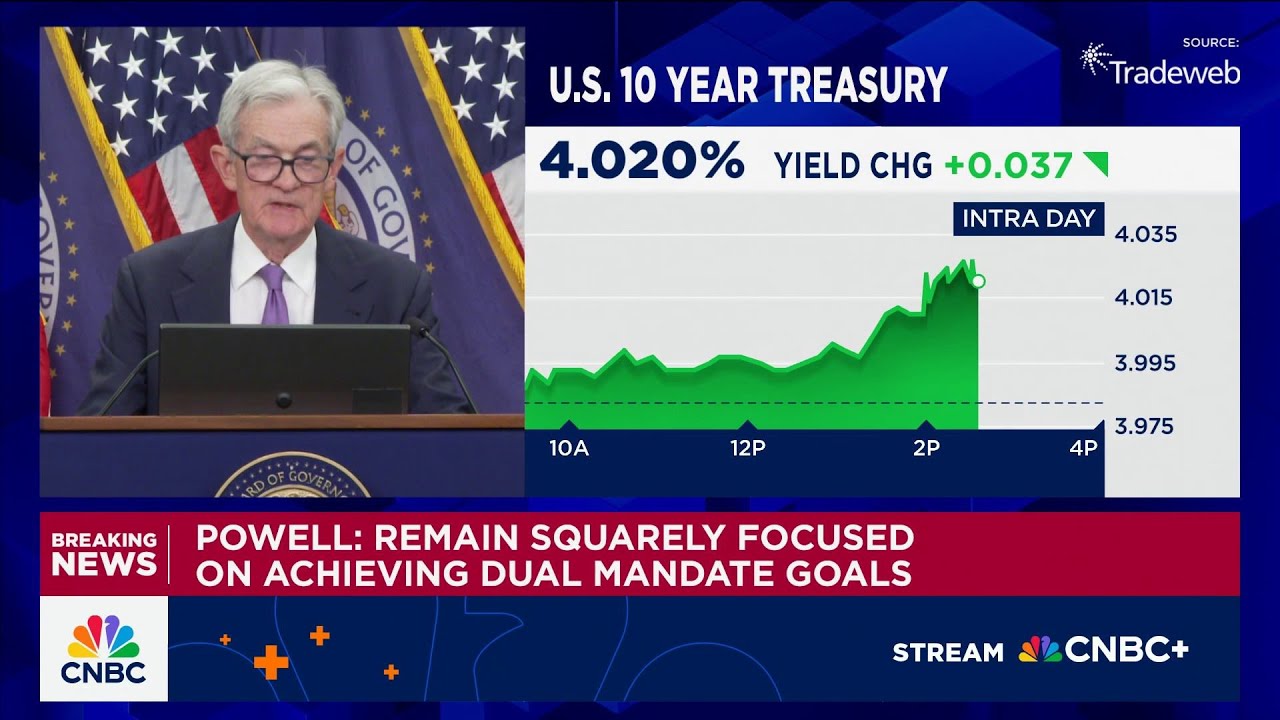
Fed Chair Powell: Downside risks to employment have risen in recent months
Youtube· 2025-10-29 18:57
Economic Outlook - The labor market is gradually cooling, and inflation remains elevated, prompting the Federal Open Market Committee to lower the policy interest rate by a quarter percentage point [2] - Economic activity is expanding at a moderate pace, with GDP growth at 1.6% in the first half of the year, down from 2.4% the previous year [3] - Growth in economic activity may be firmer than expected, driven by stronger consumer spending, although business investment continues to expand and the housing sector remains weak [4] Labor Market - The unemployment rate has remained low, but job gains have significantly slowed, reflecting a decline in labor force growth due to lower immigration and participation [5][6] - Layoffs and hiring remain low, with perceptions of job availability and hiring difficulty declining, indicating a softer labor market [6] Inflation Trends - Inflation has eased from mid-2022 highs but remains elevated, with total PCE prices rising 2.8% over the past year, including core PCE prices [7] - Disinflation is continuing for services, while inflation expectations have increased due to tariffs, although long-term expectations align with the 2% inflation goal [8] Monetary Policy - The Federal Reserve's monetary policy actions are focused on promoting maximum employment and stable prices, with the target range for the federal funds rate lowered to 3.75% to 4% [9] - The impact of higher tariffs is contributing to increased prices in certain goods, leading to higher overall inflation [9] - There is a reasonable expectation that inflationary effects may be short-lived, but there is a risk that they could become persistent, which needs to be managed [10]
“十五五”规划建议的18个新提法,释放了哪些重要信号?
Mei Ri Jing Ji Xin Wen· 2025-10-29 15:24
Group 1 - The "15th Five-Year Plan" emphasizes the importance of technological innovation, mentioning "technology" 46 times and "innovation" 61 times, aiming to create a favorable environment for original and disruptive innovations [2] - The plan proposes to gradually increase the basic pension for urban and rural residents, highlighting the focus on improving people's livelihoods and promoting common prosperity [2][29] - New strategic technologies such as quantum technology, biomanufacturing, hydrogen energy, and artificial intelligence are identified as future economic growth points, with a focus on their commercialization during the "15th Five-Year Plan" period [3][4] Group 2 - The plan suggests establishing a risk-sharing mechanism for future industry investments, recognizing the uncertainties in technology and market conditions [5][6] - It proposes a new national system to tackle key technologies in areas like integrated circuits and advanced materials, emphasizing the need for collective efforts from various market entities [7] - The plan includes measures to enhance public service spending to boost consumer capacity, indicating a shift towards improving the consumption environment [9][10] Group 3 - The plan aims to peak coal and oil consumption, aligning with the broader goal of achieving carbon peak by 2030, necessitating a transition to a new energy system [12][13] - It emphasizes the need for proactive macroeconomic policies to stabilize growth, employment, and expectations, particularly in light of the challenges posed by traditional economic drivers [14][15] Group 4 - The plan highlights the importance of expanding service trade and optimizing market access, particularly in the service sector, to enhance international competitiveness [18][21] - It focuses on promoting green trade and intermediate goods trade, which are seen as vital for stabilizing foreign trade and aligning with global environmental goals [19][20] Group 5 - The plan includes initiatives to enhance food security through a new round of grain production capacity improvement actions, aiming for a significant increase in grain output [23][24] - It emphasizes the need for efficient land use in rural areas, addressing the mismatch between idle land and the demand for construction land to support rural development [25][26] Group 6 - The plan proposes to expand free education and explore extending compulsory education, which is expected to alleviate educational burdens and improve human capital development [27][28] - It aims to optimize the supply of affordable housing to meet the basic housing needs of urban wage earners and disadvantaged families, marking a shift towards a more inclusive housing policy [30][31]

上实发展:10月28日召开董事会会议
Mei Ri Jing Ji Xin Wen· 2025-10-28 17:40
Group 1 - The company, Shanghai Shimao Development, announced the convening of its 23rd temporary board meeting of the 9th session on October 28, 2025, via communication methods [1] - The meeting reviewed the "2025 Third Quarter Report" and other documents [1] - For the first half of 2025, the company's revenue composition was entirely from the real estate sector, accounting for 100.0% [1] Group 2 - The A-share market has surpassed 4000 points, marking a significant resurgence after a decade of stagnation [1] - The technology sector is reshaping the market dynamics, indicating the emergence of a "slow bull" market pattern [1]

华联期货周报:中国前三季度GDP增长5.2%美国通胀低于预期-20251026
Hua Lian Qi Huo· 2025-10-26 13:09
Report Industry Investment Rating No relevant content provided. Core View of the Report - In Q3 2025, China's GDP grew 4.8% year-on-year and 1.1% quarter-on-quarter, with cumulative GDP growth of 5.2% in the first three quarters, indicating overall economic stability during structural adjustment [4]. - The tertiary industry (services) had a prominent supporting role, with a 5.6% year-on-year increase in added value in Q3, while the secondary and primary industries also showed growth [4]. - Exports remained resilient, consumption recovered moderately, and fixed - asset investment faced marginal pressure. Net exports contributed 24.5% to GDP growth in Q3, and retail sales showed a 3.0% year-on-year increase in September [4]. - Structural transformation deepened, with new - quality productivity accelerating implementation. The proportion of equipment and high - tech manufacturing in industrial added value increased, and the "Three New" economies continued to grow [4]. - In September 2025, real estate investment, new construction, and construction area declined year - on - year, but the completion end improved. Industrial production showed a strong recovery, with a 6.5% year - on - year actual increase in industrial added value [5]. - US inflation in September was lower than expected, strengthening the market's consensus that inflation is on a downward path and increasing the probability of Fed rate cuts [5]. Summary by Relevant Catalogs National Economic Accounting - GDP quarterly and annual growth rates of different industries from 2023 to 2025 are presented, showing the performance of various sectors, such as agriculture, industry, and services [7]. - The contribution rates and pulling effects of the three industries on GDP growth are analyzed through figures from 2013 - 2025 [8][9][12]. - The contribution of each component of GDP is detailed, including industries like agriculture, industry, and services from 2023 to 2025 [13]. Industry - Industrial added value data of different industries from 2019 - 2025 show the growth trends of industries such as mining, manufacturing, and high - tech industries [20][22]. - The production volume of major industrial products from 2024 - 2025 is provided, including energy, industrial raw materials, and finished products [24]. - Electricity generation data, including daily average and year - on - year growth rates, as well as the performance of thermal, hydro, and wind power, are presented [28]. - Industry electricity consumption data from 2024 - 2025 show the consumption situation of different industries, with some industries like manufacturing and high - tech manufacturing showing growth [31][32]. - Industrial enterprise profit data from January - August 2025 show the profit performance of different industries, with some industries like manufacturing and power supply showing growth and others like mining showing decline [35][39]. - Industrial enterprise inventory data as of August 2025 show that the overall finished - product inventory is stable with a slight decline, and the inventory of the mining industry has decreased significantly [46]. Price Index - In September 2025, China's CPI decreased 0.3% year - on - year, with food prices falling and non - food prices rising. The CPI components' year - on - year and month - on - month data from 2024 - 2025 are also provided [51][52]. - In September 2025, China's PPI decreased 2.3% year - on - year, with the decline narrowing. The PPI of different production and living materials and major industries from 2024 - 2025 are presented [58][61]. - The year - on - year and month - on - month changes in industrial producer purchase prices from 2024 - 2025 are provided, showing price changes in different material categories [62][63].
南财快评|“十五五”坚持高质量发展,科技与内需双轮驱动
2 1 Shi Ji Jing Ji Bao Dao· 2025-10-24 05:47
Group 1: Economic Development and Planning - The 14th Five-Year Plan has achieved high completion rates and quality improvements despite challenges such as the pandemic and external pressures, with key macro indicators like GDP and employment meeting or nearing targets [2] - The upcoming 15th Five-Year Plan emphasizes high-quality development, with a focus on technological self-reliance and expanding domestic demand as crucial support for achieving socialist modernization [3][4] Group 2: Technological Innovation and Education - The 15th Five-Year Plan will prioritize technology-driven and innovation-led development, aiming for breakthroughs in key areas such as artificial intelligence, chips, aerospace, and biomedicine [4] - The plan highlights the integration of education, technology, and talent development to foster a sustainable innovation capability [4] Group 3: Domestic Demand and Economic Stability - The emphasis on "new demand leading new supply" reflects a focus on stimulating consumption and investment, which is expected to enhance the stability and sustainability of economic growth [5] - The strategy to strengthen domestic circulation aims to boost internal demand, thereby reducing the impact of external uncertainties on the economy [5] Group 4: Foreign Trade and Cooperation - The plan calls for expanding high-level opening-up and promoting trade innovation, with a focus on diversifying trade partners and enhancing the competitiveness of export products [6] - Continued efforts to deepen bilateral and regional cooperation, including the implementation of the RCEP, are expected to enhance the resilience of China's foreign trade [6] Group 5: Real Estate Sector Transformation - The real estate sector is transitioning towards long-term high-quality development, with a focus on meeting residents' demands for improved housing quality [7] - The emphasis on "high-quality" housing supply indicates a shift from the previous "three highs" model, aiming for sustainable growth in the real estate market [7] Group 6: Macroeconomic Policy and Support - The ongoing macroeconomic policies will focus on stabilizing employment, businesses, and market expectations to support economic recovery [8] - Coordinated fiscal and monetary policies are expected to enhance economic growth and structural optimization during the 15th Five-Year Plan [8]

ST中迪:10月22日召开董事会会议
Mei Ri Jing Ji Xin Wen· 2025-10-23 11:04
Core Viewpoint - ST Zhongdi announced the convening of its 11th second temporary board meeting on October 22, 2025, to discuss the dismissal of the vice president and other matters [1] Company Summary - For the first half of 2025, ST Zhongdi's revenue composition was 99.87% from the real estate industry and 0.13% from other sources [1] - As of the report date, ST Zhongdi's market capitalization was 1.6 billion yuan [1]

日股新高下的央行警告:早期过热迹象显现 紧盯美国政策风险
智通财经网· 2025-10-23 09:03
Core Insights - The Bank of Japan has indicated early signs of overheating in the domestic stock market and warned that uncertainties in U.S. trade policy could lead to significant market corrections, impacting financial institutions [1] - The Nikkei 225 index reached a historical high, rising nearly 24% this year, following the election of Japan's first female Prime Minister, Sanae Takaichi [1] - The financial system report highlighted that foreign hedge funds have increased leverage in Japanese Government Bond (JGB) trading, which may amplify market volatility [1] Group 1 - The financial system report's "heat map" indicates that stock prices are marked as "red," suggesting overheating, while other asset categories remain "green," showing no significant deviations [2] - Real estate prices are also on the rise, particularly in core urban areas, driven by increased investment demand from foreign investors [2] - The Bank of Japan maintains that the overall financial system is stable, with banks having sufficient capital and stable financing capabilities to withstand various risks [2] Group 2 - Data from the Real Estate Economic Institute shows that the average price of newly built apartments in the Tokyo metropolitan area increased by 20.4% year-on-year from April to September [3] - The Bank of Japan ended its aggressive stimulus program last year and raised short-term interest rates to 0.5% in January, believing it is close to achieving a 2% inflation target [3] - The Bank of Japan's Governor Kazuo Ueda emphasized a cautious approach to future rate hikes due to uncertainties regarding the impact of U.S. tariffs on the Japanese economy [3]
炸锅!美经济学家摊牌:2028年前30年房贷利率锁死6%-6.5%,想买房的人要熬到何时?
Sou Hu Cai Jing· 2025-10-22 03:23
Core Viewpoint - The chief economist of the Mortgage Bankers Association predicts that the 30-year fixed mortgage rates will stabilize between 6% and 6.5% by the end of 2028, primarily due to increasing government deficits and economic pressures [1][3]. Group 1: Mortgage Rates and Predictions - The average mortgage rate has remained above 6% for the past three years, currently at 6.27% [4]. - The MBA's economic research team forecasts that mortgage rates will stay above 6% until 2028, despite potential short-term rate cuts by the Federal Reserve [8]. - Some institutions are slightly more optimistic, predicting rates may dip below 6% by the end of 2026, but experts remain skeptical [5]. Group 2: Housing Market Dynamics - Despite high interest rates, the volume of home sales is expected to slightly increase, with an estimated 5 million homes sold next year, up from 4.8 million this year, due to increased housing supply [10]. - National home prices are predicted to decline for several quarters before gradually recovering by the end of 2027 [12]. - Regional disparities in housing prices are significant, with states like Florida and Colorado experiencing price drops due to increased supply, while states like New York and Illinois see faster price increases due to limited supply [13]. Group 3: Financial Burdens on Homebuyers - The current median monthly mortgage payment is approximately $2,067, which, while slightly lower than peak levels, remains significantly higher than five years ago [14]. - Many buyers are shifting to adjustable-rate mortgages (ARMs) or FHA loans to reduce monthly payments [15]. - Rising property taxes and homeowners' insurance add to the financial strain on both prospective and current homeowners [16][17].

港股、海外周观察:多事之秋,反弹不畅
Soochow Securities· 2025-10-20 09:23
Group 1 - The report indicates that recent events suggest short-term volatility in the Hong Kong stock market may not have ended, but the long-term upward trend remains unchanged [1] - Economic data, US-China tariff news, US tech earnings, and the Fourth Plenary Session are expected to influence trading patterns and styles in the Hong Kong market [1][2] - The technology sector is facing increased volatility risks, with US tech earnings impacting the trading rhythm of Chinese tech stocks [1][2] Group 2 - The report highlights that the US stock market showed resilience despite concerns over US-China tensions and credit worries, with the Nasdaq leading gains at 2.1% [1][4] - Federal Reserve Chairman Powell's dovish stance suggests a likelihood of maintaining the current policy path, with a potential rate cut in October being the optimal solution [1][5] - The report notes that the average win rate for October over the past decade is low, while the advantages of November and December are relatively prominent [1][23] Group 3 - The report discusses the ongoing US government shutdown, which has entered its third week, potentially exacerbating negative impacts on the economy [3] - Concerns over credit quality in regional banks have emerged, but these are viewed as isolated incidents rather than indicative of a broader liquidity crisis [2][3] - The report emphasizes the importance of monitoring US-China trade relations, as further escalation could negatively impact the US economy and inflation risks [3][4] Group 4 - The report notes that developed markets saw an increase of 1.4% while emerging markets declined by 0.3% during the week [4][12] - The Hang Seng Tech Index fell by 8.0%, and the Hang Seng Index dropped by 4.0%, with public utilities leading sector gains [4][12] - The report highlights significant inflows into financials and non-essential consumer sectors, while the information technology sector experienced outflows [4][12] Group 5 - The report indicates that global stock ETFs saw a net inflow of $446.43 billion, with the US stock ETFs leading at $231.7 billion [7][49] - The technology sector was the top recipient of inflows among global stock ETFs, while the communication sector experienced the most significant outflows [7][51] - The report also notes that institutional investors marginally increased their holdings in gold, with significant inflows into major gold ETFs [6][54]



