
水泥

Search documents
福建水泥录得5天3板
Zheng Quan Shi Bao Wang· 2025-12-01 02:42
Group 1 - Fujian Cement has experienced a significant stock performance, achieving three trading halts within five trading days and a cumulative increase of 26.77% [2] - The stock's turnover rate reached 36.92%, with a trading volume of 45.8 million shares and a transaction amount of 365 million yuan as of 9:52 AM [2] - The latest total market capitalization of the stock in the A-share market is 3.776 billion yuan [2] Group 2 - As of November 28, the margin trading balance for Fujian Cement is 408 million yuan, with a financing balance of 408 million yuan, reflecting a decrease of 8.78 million yuan or 2.11% from the previous trading day [2] - Over the past five days, the margin trading balance has decreased by 19.77 million yuan, representing a decline of 4.63% [2] - Fujian Cement Co., Ltd. was established on November 27, 1993, with a registered capital of 458.2484 million yuan [2] Group 3 - The stock's daily performance data shows fluctuations, including a 9.99% increase on November 28 and a 10% increase on November 25, alongside various changes in turnover rates and net capital inflows [2] - The stock has seen a mix of positive and negative daily changes, with notable declines on November 21 (-6.80%) and November 19 (-9.02%) [2] - The net capital inflow on November 28 was 91.63 million yuan, indicating strong investor interest on that day [2]


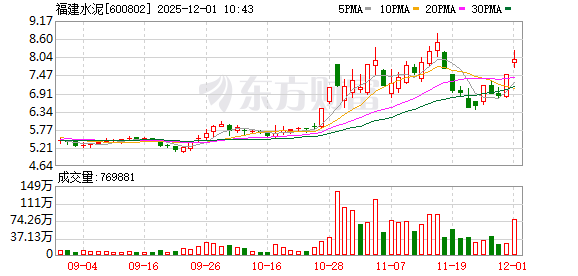
5天3板!水泥+区域政策预期概念联动,福建水泥9:50涨停,背后逻辑揭晓
Jin Rong Jie· 2025-12-01 02:04
Group 1 - Fujian Cement has achieved three consecutive limit-up trading days within five days, indicating strong market interest [1] - The stock reached a trading limit at 9:50 AM today, with a transaction volume of 352 million yuan and a turnover rate of 9.65% [1] - Market attention is focused on the regional policy expectations and the sector's interconnected effects, leading to increased interest in local stocks [1] Group 2 - The recent performance of Fujian local stocks has been active, contributing to the volatility of related stocks [1] - Investors are advised to be cautious of high-risk chasing in rapidly fluctuating stocks and to maintain rational investment strategies [1]
中国大宗商品:数据更新;刷新盈利预期,主要反映市价变动-China Commodities_ Data update; refreshing earnings estimates, mainly to reflect mark to market price changes
2025-12-01 00:49
Summary of Earnings Estimates for China Commodities Industry Overview - The report focuses on the **China commodities** sector, specifically covering various sub-sectors including steel, coal, cement, aluminum, copper, gold, EV metals, paper, and agriculture. Key Points in Earnings Estimates Revisions - **General Update**: Earnings estimates for China commodities have been refreshed to reflect mark-to-market price changes for Q3 2025 and the current quarter. Target price changes range from -5% to +5%, with investment ratings remaining unchanged. The changes are not viewed as material, and the overall investment thesis remains intact [1][2]. Steel Sector - **Baosteel and Maanshan-H/A**: Earnings estimates cut by 3% to 5%. Loss estimates for Angang-H/A increased by 4% for 2025E [9]. Coal Sector - **Shenhua-H/A, Yankuang-H/A, Chinacoal-H/A**: Earnings estimates updated by -3% to +5% for 2025-27E based on recent coal price trends. Chinacoal-H/A target price adjusted to HK$6.5 from HK$6.4, maintaining a Sell rating [9]. Cement Sector - **CNBM, WCC, BBMG-H/A, Conch-H/A, CRBMT**: Earnings estimates updated by -5% to +3% for 2025-27E, reflecting recent unit gross profit trends [9]. Aluminum Sector - **Chalco-H/A and Hongqiao**: Earnings estimates adjusted by -5% to +5% for 2025-27E based on mark-to-market aluminum and alumina prices. Hongqiao target price fine-tuned to HK$20.0 from HK$19.6, maintaining a Neutral rating [9]. Base Metals (Copper and Gold) - **Zijin-H/A, JXC-H/A, CMOC-H/A, MMG, Zhaojin**: Earnings estimates updated by -5% to +5% for 2025-27E to reflect mark-to-market prices of copper and other metals [9]. EV Metals - **Huayou and GEM**: Earnings estimates adjusted by -3% to +5% for 2025-27E based on mark-to-market nickel/cobalt prices and cathode spreads. Huayou's target price fine-tuned to Rmb32.6 from Rmb32.4, maintaining a Sell rating [9]. Paper Sector - **ND Paper and Sun Paper**: Earnings estimates updated by 0% to 2% for 2025-27E to reflect mark-to-market paper prices [10]. Agriculture Sector - **Hog and Feed Coverage**: Earnings estimates revised by -5% to +3% for companies like Wens, New Hope, Haid, and Dabeinong, incorporating mark-to-market hog and feed prices. For animal health and conventional seeds, estimates revised by -5% to -2% [10][13]. Target Price Methodologies and Risks - **Cement Companies**: Target prices based on historical P/B vs. ROE correlations. Key risks include weaker-than-expected construction demand and slower unauthorized cement capacity exit [14]. - **Base Metals**: Target prices based on historical P/B vs. ROE correlations. Key risks include lower commodity prices and operational risks [14]. Additional Insights - The report emphasizes the importance of considering these estimates as part of a broader investment decision-making process, highlighting potential conflicts of interest due to Goldman Sachs' business relationships with covered companies [3]. This summary encapsulates the key updates and insights from the earnings estimates for the China commodities sector, providing a comprehensive overview of the changes and their implications for investors.






非洲水泥十问十答
2025-12-01 00:49
Summary of African Cement Market Conference Call Industry Overview - The African cement market shows significant disparities in per capita consumption, with North Africa at approximately 500-600 kg, much higher than East and Southern Africa at around 100 kg, but lower than China's level of over 1,000 kg. Future overall demand in Africa could reach 700-800 million tons [1][2] - The current market price for cement in Africa ranges from $100 to $250 per ton, which is several times higher than in China. However, the capacity utilization rate is only 50%-60%, constrained by infrastructure, energy costs, and transportation conditions [1][3] Key Players and Market Dynamics - Chinese enterprises hold less than 10% market share in Africa, with Huaxin Cement and Western Construction as key representatives. Their entry is primarily profit-driven and is not expected to significantly disrupt the supply environment in the short term, as evidenced by the case in Mozambique where profitability remains strong [1][5] - Local leading companies like Dangote Group and BUA Group are diversifying their operations to reduce reliance on the cement industry, venturing into sugar, salt, chemicals, infrastructure, energy, food, real estate, and port sectors [1][6] Company Performance - Huaxin Cement has established a production capacity of nearly 20 million tons in Africa, while Western Construction has less than 10 million tons. Huaxin's overseas sales are expected to exceed 8 million tons by mid-2025, with a gross profit per ton of 190 RMB, while Western's sales are over 4 million tons with a slightly higher gross profit of over 200 RMB [1][7] - European companies like Lafarge are gradually exiting the African market, shifting their strategic focus to green building materials, aiming to reduce traditional building materials revenue to below 50% by 2030 [1][8][9] Market Potential and Challenges - The demand growth rate for cement in Africa aligns closely with regional GDP growth, estimated at 3-4%. The market capacity is projected to reach 250 million tons by 2024 [2] - The entry of Chinese companies into the African market presents significant cost-reduction and efficiency-enhancement potential, with improvements in profit margins observed after acquisitions, such as a 50% profit increase following Huaxin's acquisition of a Zambian company [3][10] Regional Insights - Nigeria, as West Africa's largest cement consumer, has a current capacity utilization rate of about 60%. Huaxin's project in Nigeria is expected to meet domestic demand and serve surrounding countries, with favorable energy costs aiding in production cost reduction [1][11] - Ethiopia is identified as a core market for Western Construction, with a rapidly growing economy and a low urbanization rate of around 20%, indicating strong future demand for building materials [1][12] Currency Fluctuations - Currency fluctuations in Africa have impacted Chinese enterprises, with annual losses estimated between 100 million to 200 million RMB due to currency depreciation in countries like Tanzania, South Africa, Nigeria, and Zambia. However, companies are mitigating these effects through increased currency exchange frequency and exploring hedging strategies [1][13][14]


年底5元以下低价股捡漏,7只潜力股推荐,跨年黑马等你选
Sou Hu Cai Jing· 2025-11-30 18:37
Group 1: Consumer Sector - The government has implemented substantial measures to boost consumption, focusing on smart products, green energy, and products for the elderly [1] - The fourth round of "trade-in" subsidies is accelerating, targeting home appliances, digital products, and home decoration, with a deadline for consumers to act by December 31 [1] Group 2: Alcohol and Pharmaceutical E-commerce - A company specializing in both liquor and pharmaceutical e-commerce has seen revenue growth of nearly 30%, with high gross margins due to increased demand during year-end banquets [1] - The pharmaceutical e-commerce segment benefits from stricter regulations, providing a competitive edge, while innovative drugs are in phase three clinical trials, indicating strong cash flow and a low price-to-earnings ratio compared to peers [1] Group 3: Prepared Dishes and New Retail - A company focused on prepared dishes and new retail is experiencing rapid market growth, with the market size exceeding 600 billion, although its actual revenue contribution is only over 10% [3] - The main business remains traditional retail with lower gross margins, and new production facilities for prepared dishes will not be operational until 2026, posing risks for large investments [3] Group 4: Healthcare Sector - Companies specializing in cold medicine are expected to see revenue spikes during the flu season, with over 40% of their revenue coming from this period, but they have low R&D investment, limiting long-term growth potential [3] Group 5: Elderly Care and AI Medical Services - A company focusing on elderly care and AI medical services has seen over 50% revenue growth in community care and rehabilitation, with AI diagnostic systems implemented in numerous grassroots hospitals [5] - The company has high R&D investment compared to industry averages, but its diverse business lines contribute limited short-term profits, making it suitable for long-term investment [5] Group 6: Private Hospitals and Smart Medical Services - A company operating in private hospitals, smart medical services, and coal has seen over 30% revenue growth in private hospitals, with stable cash flow from coal operations [6] - The company has a diversified risk profile but lacks a core growth engine, making it suitable for conservative investors [6] Group 7: High-end Manufacturing - The high-end manufacturing sector is receiving strong policy support, with a focus on industrial mother machines, which are expected to modernize by 2027 [6] - A company producing CNC machines has reported over 60% profit growth in the first three quarters, with a nearly 40% year-on-year increase in industrial mother machine revenue [6] Group 8: New Energy and Digital Economy - The new energy and digital economy sectors are experiencing explosive growth, with data trading becoming a national focus and data center capacity reaching 500 PB [8] - The company involved in data business has seen revenue double, with stable cash flow from cement operations and lower valuations compared to peers, indicating potential for increased profitability if the data business model is successful [8]

长江大宗2025年12月金股推荐
Changjiang Securities· 2025-11-30 10:45
Group 1: Metal Sector - Huaxi Nonferrous is expected to see net profit growth from CNY 6.58 billion in 2024 to CNY 11.40 billion in 2026, with a PE ratio decreasing from 37.28 to 21.52[10] - The company has a projected capacity increase to 0.6 million tons of tin and 1 million tons of antimony by 2027, benefiting from resource consolidation trends in Guangxi[12] Group 2: Construction Materials - Huaxin Cement's net profit is forecasted to rise from CNY 24.16 billion in 2024 to CNY 36.73 billion in 2026, with a PE ratio dropping from 17.21 to 11.32[10] - The company has diversified its growth strategy, focusing on overseas markets and stabilizing its aggregate business[28] Group 3: Transportation - ZTO Express is projected to achieve net profits of CNY 88.17 billion in 2024, increasing to CNY 104.11 billion by 2026, with a PE ratio improving from 13.39 to 11.34[10] - The "anti-involution" measures in the express delivery sector have led to a recovery in profitability, with significant improvements in average ticket prices since August 2025[33] Group 4: Energy Sector - ChuanTou Energy's net profit is expected to grow from CNY 45.08 billion in 2024 to CNY 52.59 billion in 2026, with a PE ratio decreasing from 15.93 to 13.65[10] - The company benefits from its stake in Yalong River Hydropower, which contributes significantly to its earnings[73] Group 5: Chemical Sector - Yara International's net profit is projected to increase from CNY 9.50 billion in 2024 to CNY 39.34 billion in 2026, with a PE ratio decreasing from 42.50 to 10.27[10] - The company is positioned as a leader in overseas potash mining, with significant reserves in Laos[49]




华新水泥(6655.HK):三季度归母净利润同比增长120.73% 海外多业务发展持续取得进展
Ge Long Hui· 2025-11-29 21:18
Core Insights - The company reported a significant increase in net profit attributable to shareholders, with a year-on-year growth of 120.73% in Q3, driven by rising domestic cement prices, reduced costs, and strong overseas performance [1] - The completion of the equity transfer for Nigerian assets marks a strategic expansion, with the transaction valued at approximately $773.86 million, enhancing the company's international footprint [2] - The management is committed to shareholder returns, distributing a cash dividend of 0.46 CNY per share, totaling approximately 956.34 million CNY, which represents 40% of the net profit for the year [3] Financial Performance - In Q3, the company achieved a revenue of 8.986 billion CNY, a 5.95% increase year-on-year, and a net profit of 900 million CNY, reflecting a 120.73% increase [1] - For the first three quarters, the company reported a total revenue of 25.033 billion CNY, up 1.27% year-on-year, and a net profit of 3.449 billion CNY, which is a 64.95% increase [1] - The company’s non-recurring net profit for Q3 was 866 million CNY, marking a 125.96% increase year-on-year [1] Strategic Developments - The company has made significant progress in its overseas operations, with multiple projects completed in Zimbabwe, Zambia, South Africa, and Tanzania, enhancing production capacity [2] - The acquisition of 100% equity in a Brazilian aggregate company further strengthens the company's international presence [2] - New production lines are under construction in Malawi and Mozambique, indicating ongoing expansion efforts [2] Shareholder Engagement - The management has shown confidence in the company's future by purchasing 195,300 shares in the secondary market [3] - The proposed dividend distribution reflects a strong commitment to sharing the company's growth with shareholders [3] Profit Forecast - The company forecasts net profits attributable to shareholders of 2.969 billion CNY, 3.312 billion CNY, and 3.671 billion CNY for the years 2025 to 2027 [3] - A target price of 18.34 HKD is set for 2026, based on a PE ratio of 10.5 times, indicating a positive outlook for the company's valuation [3]
每周高频跟踪 20251129:聚焦政策预期博弈-20251129
Huachuang Securities· 2025-11-29 15:12
Report Industry Investment Rating - Not provided in the given content Core Viewpoints - In the fourth week of November 2025, industrial production continued to decline, accelerating the destocking of some investment products. Combined with the increase in upstream costs, the apparent volume and price improved, but the sustainability of price increases needs to be verified by subsequent demand [3][36] - In terms of inflation, the monthly average of pork prices continued to decline, while vegetable prices rebounded from a decline with a relatively large overall monthly increase. Food prices in November may have accelerated their month - on - month increase [3][36] - For the bond market in December, there are few highlights in the off - season data of the fundamentals. The focus is on the tone of the Politburo meeting and the Central Economic Work Conference. The PMI in November is expected to rise slightly seasonally but may still be below the boom - bust line [3][37] Summary by Directory Inflation - related - Food prices stopped falling and rebounded. From November 23rd to 28th, the average wholesale price of pork in China decreased by 0.26% month - on - month with a narrowing decline, and vegetable prices increased by 1.23% month - on - month. The 200 - index of agricultural product wholesale prices and the wholesale price index of basket products increased by 0.48% and 0.55% respectively [9] Import and Export - related - The CCFI index weakened slightly, and the SCFI stopped falling and rebounded. This week, the CCFI index decreased by 0.1% month - on - month, and the SCFI increased by 0.7% month - on - month. The North American route supply - demand relationship was balanced, with the freight rate on the West Coast route falling by 0.8% and that on the East Coast route rising by 1.8% [12] - From November 17th to 23rd, the container throughput and cargo throughput at ports increased by 5.4% and decreased by 0.6% month - on - month respectively, and increased by 12.8% and 0.7% year - on - year respectively last week. As of this week, the monthly average year - on - year increase was 10% and 4.4% respectively, better than in October [12] - The BDI and CDFI indices continued to rise. This week, the demand for coal shipping increased, and the North American grain cargo supported the market. The available shipping capacity was tight, pushing up the freight rates [12] Industry - related - Coal prices changed from rising to falling. This week, the price of thermal coal (Q5500) at Qinhuangdao Port decreased by 1.44% month - on - month. The terminal enterprises mainly purchased long - term contract coal, and the acceptance of high - price market coal was low. The increase in origin coal prices made imported coal more advantageous, leading to a decline in port coal prices [18] - The increase in rebar prices narrowed. The spot price of rebar (HRB400 20mm) increased by 0.6% month - on - month. Terminal demand further declined, and the inventory of steel mills decreased faster [18] - The asphalt operating rate rebounded slightly. This week, the asphalt plant operating rate increased by 3.0 percentage points month - on - month to 27.8%, remaining at a low level [18] - Copper prices stopped falling and rebounded. This week, the average prices of Yangtze River non - ferrous copper and LME copper increased by 0.8% and 1.3% month - on - month respectively. The rising probability of the Fed's interest rate cut in December and the tight supply supported the high - level shock of copper prices [23] - The glass futures price stopped falling and rebounded. The spot transaction price center of glass moved down, the trading situation improved, and the market inventory decreased slightly, but the overall fundamental demand was still weak, and the glass price was expected to fluctuate within a narrow range [23] Investment - related - The decline in cement prices narrowed. This week, the weekly average of the cement price index decreased by 0.06% month - on - month, with a narrower decline than the previous week. The increase in raw material costs and stable market demand strengthened the price - increasing willingness of cement enterprises [27] - New home sales continued to rise month - on - month. From November 21st to 27th, the transaction area of new homes in 30 cities was 2.127 million square meters, a month - on - month increase of 9.5% and a year - on - year decrease of 32.6%, indicating a brewing end - of - month sprint but with a slightly lower intensity than the same period [28] - Second - hand home sales continued to decline. From last Friday to this Thursday, second - hand home sales decreased by 0.5% month - on - month and 15.2% year - on - year. Affected by the high base effect after the "924" policy last year, the year - on - year decline in November may remain around - 15%, similar to that in October [28] Consumption - related - From November 1st to 23rd, passenger car retail sales decreased year - on - year. The high - base effect after the "old - for - new" policy last year had a large impact on the year - on - year reading, but there was still a positive growth of about 14% compared with the same period in 2023 [30] - Crude oil prices increased slightly. As of November 28th, Brent crude oil and WTI crude oil prices increased by 1.0% and 0.8% month - on - month respectively. The increasing expectation of the Fed's interest rate cut and the weakening expectation of OPEC+ production increase boosted oil prices [30]
高频:地产销售依旧偏弱,电影票房明显回升
CAITONG SECURITIES· 2025-11-29 11:33
Report Industry Investment Rating No information provided in the content. Core Viewpoints - This week's main concerns include a slight rebound in the week-on-week new home sales in 20 cities, a widening year-on-year decline, and only Hangzhou's new home sales were higher than the same period last year. Overall, the real estate sales remained weak. Commodity prices mostly rose, the production remained stable with a differentiated performance in the operating rates. The box office was significantly higher than the seasonal level due to the release of popular movies, which concentratedly reflected the viewing demand [2]. - The year-on-year decline in new home sales widened this week. The week-on-week growth rate of the new home transaction area in 20 cities tracked by Wind was 3.08%, and the year-on-year decline was 33.38%. Specifically, the new home transactions decreased week-on-week, and the year-on-year decline widened. The new home transaction area in second-tier cities was slightly weaker than the previous period, while those in first-tier and third - fourth - tier cities were stronger than the previous period. The year-on-year decline widened significantly, and the new home transaction areas in all tiers of cities were much weaker than the same period last year [2]. - In terms of investment and production, most commodity prices rose. The price of rebar increased slightly, with robust demand, steel mills reducing production, and merchants reluctant to sell, which supported the price increase. The cement price increased slightly as the weather improved, construction accelerated, and manufacturers pushed up the price, but the demand support was limited. The glass futures price rose, with an enhanced expectation of supply contraction, solid cost support, and short - term improvement in production and sales. The asphalt price decreased slightly due to the seasonal shrinkage of demand, sufficient supply, and weakened cost - end support [2]. - In industrial production, the operating rates showed a differentiated performance. The operating rates of petroleum asphalt and automobile tires increased, the operating rate of coking enterprises increased slightly, while the operating rates of steel blast furnaces and PTA decreased, and the operating rate of polyester filament decreased slightly [2]. - In terms of consumption, the travel momentum was strong. The subway ridership, domestic flights, automobile consumption, and box office were higher than the seasonal levels [2]. - In terms of inflation, the pork price decreased, the vegetable price and oil price increased. This week, the vegetable price increased due to cold weather and rainfall leading to vegetable production reduction and poor supply connection. The crude oil price increased, driven by the expected production cut by OPEC+, the decline in US production, and geopolitical risks [2]. - In terms of exports, the SCFI and BDI increased this week. The transportation demand on the East Coast of the United States route rebounded, shipping companies promoted freight rate increases, and the operating cost provided support [2]. Summary by Directory 1. Real Estate Sales: New Home Sales Remained Weak Year-on-Year - From November 21st to November 27th, the new home transactions decreased week-on-week, and the year-on-year decline widened. The week-on-week growth rate of the new home transaction area in 20 cities tracked by Wind was 3.08%, and the year-on-year decline was 33.38%. Among them, the new home transaction area in second-tier cities was slightly weaker than the previous period, while those in first-tier and third - fourth - tier cities were stronger than the previous period. The year-on-year decline widened significantly, and the new home transaction areas in all tiers of cities were much weaker than the same period last year [2][7]. - In terms of key cities, from a week-on-week perspective, except for Beijing (-32.88%), Shenzhen (-28.09%), and Hangzhou (-1.38%), the new home transactions in other key cities were significantly stronger than the previous period. From a year-on-year perspective, except for Hangzhou (18.73%), the new home transaction areas in other key cities were much weaker than the same period last year [7]. - From November 21st to November 27th, the second - hand home transactions showed a differentiated week-on-week performance, and the year-on-year decline widened. In key cities, from a week-on-week perspective, except for Hangzhou (-1.46%) and Shenzhen (-7.75%), the second - hand home transaction areas in other key cities were stronger than the previous period. From a year-on-year perspective, the second - hand home transaction areas in all key cities decreased significantly compared with the same period last year [7]. 2. Investment: Commodity Prices Mostly Rose - In terms of investment, most commodity prices rose this week. The prices of rebar and cement increased slightly, the glass futures price rose, and the asphalt price decreased slightly [31]. 3. Production: Operating Rates Showed a Differentiated Performance - In production, the operating rates showed a differentiated performance this week. The operating rates of petroleum asphalt and automobile tires increased, the operating rate of coking enterprises increased slightly, while the operating rates of steel blast furnaces and PTA decreased, and the operating rate of polyester filament decreased slightly [39]. 4. Consumption: Travel Momentum was Strong - In terms of consumption, the subway ridership, domestic flights, automobile sales, and box office were higher than the seasonal levels [49]. 5. Exports: SCFI Increased, BDI Increased - In terms of exports, the SCFI index increased slightly, the BDI index increased, the port cargo throughput decreased, and the CRB spot index decreased slightly this week [55]. 6. Prices: Pork Price Decreased, Vegetable Price Increased, Oil Price Increased - In terms of prices, the pork price decreased slightly, the vegetable price increased, the oil price increased, and the rebar price increased slightly [60].
房地产及建材行业双周报:建材基本面及业绩整体有所修复-20251128
Dongguan Securities· 2025-11-28 11:31
房地产及建材行业 房地产-标配(维持) 建材材料-标配(维持) 房地产及建材行业双周报(2025/11/14-2025/11/27) 行 业 双 周 SAC 执业证书编号: 申万房地产行业指数走势 房地产周观点:中指院:10月百城二手住宅均价为13268元/平,环比下 跌0.84%,同比下跌7.60%,在高挂牌量及预期偏弱影响下,二手房价格 下行压力仍较大。新建住宅均价为16973元/平,环比上涨0.28%,同比 上涨2.67%。截至10月末,全国商品房销售面积累计同比下跌6.8%,全 国商品住宅销售面积累计同比下跌7%,降幅相比9月末分别扩大1.3个百 分点和扩大1.4个百分点。全国商品房销售金额同比下降9.6%,全国商 品住宅销售金额同比下降9.4%,降幅进一步扩大。从房企三季报业绩来 看,行业整体亏损程度相比二季末进一步扩大。整体来看,行业基本面 仍处于"磨底"阶段。我们认为,未来一段时间,加码政策出台及行业 基本面站稳回升的进程,将主导板块行情走势。中长期来看,行业发展 将从"高杠杆、高周转"转向"品质、服务、可持续",并以城市更新 释放存量潜力。在行业大洗牌及出清背景下,更看好经营稳健的头部央 国企 ...