
消费

Search documents
港股流动性显著改善,普涨行情再现!哪些板块值得投?
Mei Ri Jing Ji Xin Wen· 2025-09-05 06:08
Group 1 - The Hong Kong stock market has seen a significant improvement in liquidity, with accelerated inflow of both domestic and foreign funds [1] - Year-to-date net purchases by southbound funds have exceeded 1 trillion HKD, supported by the expectation of interest rate cuts by the Federal Reserve [1] - Three liquidity-positive factors are highlighted: a gradual decline in interbank lending rates in Hong Kong post-month-end, continuous inflow of southbound funds favoring quality Chinese assets, and the Fed's potential restart of the rate-cutting cycle benefiting non-USD currencies [1] Group 2 - The Hong Kong stock market is home to numerous leading companies in popular sectors such as technology, internet, pharmaceuticals, automotive, and consumer goods [1] - Despite potential short-term market sentiment fluctuations, long-term benefits are anticipated for various sectors due to technological breakthroughs and improved liquidity [1] Group 3 - Relevant ETFs include: - Hong Kong Stock Connect Technology ETF (159101): focuses on new consumption, innovative pharmaceuticals, hardware and software, and new energy vehicles [2] - Hang Seng Technology Index ETF (513180): targets technology leaders and new energy vehicles [2] - Hang Seng Internet ETF (513330): concentrates on leading internet companies in Hong Kong [2] - Hang Seng Pharmaceuticals ETF (159892): focuses on innovative pharmaceuticals and contract research organizations (CROs) in Hong Kong [2]
资产配置日报:有点超预期2.0-20250904
HUAXI Securities· 2025-09-04 15:35
Market Overview - On September 4, the stock market experienced significant declines, with the Shanghai Composite Index and CSI 300 dropping by 1.25% and 2.12% respectively[1] - The total trading volume for the day was 2.58 trillion yuan, an increase of 186.2 billion yuan compared to the previous day[2] Investor Sentiment - A heightened risk-averse sentiment was observed, leading to a significant outflow of 11 billion yuan from stock ETFs, indicating a shift towards safer investments[2] - The implied volatility of the CSI 300 ETF increased by 3.65%, reflecting a stronger emotional response to market declines[2] Sector Performance - The technology sector, which had previously seen concentrated investment, faced a sharp decline, with the top 1% of stocks accounting for 20% of total trading volume, indicating extreme market behavior[3] - Key sectors such as solid-state batteries and energy storage are attracting attention as potential high-growth themes amidst the downturn in technology stocks[3] Hong Kong Market - The Hang Seng Index and Hang Seng Tech Index fell by 1.12% and 1.85% respectively, with semiconductor and pharmaceutical sectors leading the declines[4] - Southbound capital saw a net inflow of 700 million HKD, with notable investments in companies like UBTECH and Xiaomi, while others like Kuaishou and Tencent faced outflows[4] Bond Market Dynamics - Despite the stock market's decline, the bond market did not see a corresponding recovery, with 10-year and 30-year government bond yields rising by 0.6bp and 1.5bp to 1.75% and 2.01% respectively[5] - The bond market's performance is hindered by banks' profit-taking behavior as the end of the quarter approaches, leading to a divergence in bond yields based on bank participation[6] Policy Implications - The central bank's recent actions, including a 1 trillion yuan reverse repo, were viewed as neutral by the market, suggesting that stronger monetary policy measures may be needed to shift the current bearish sentiment in the bond market[7] - The cautious sentiment in the domestic commodity market continues, with black commodities under pressure, while lithium carbonate and iron ore showed slight gains of 1.0% and 1.7% respectively[8] Risk Factors - Potential risks include unexpected adjustments in monetary policy, liquidity changes, and fiscal policy shifts that could impact market stability[12]
【广发宏观陈礼清】宽度下降后的叙事流转:大类资产配置月度展望
郭磊宏观茶座· 2025-09-04 14:56
Core Viewpoint - The macroeconomic environment since August 2025 has been characterized by a strong performance in high-growth sectors, particularly in China's technology stocks, alongside a backdrop of rising global bond yields and shifting currency dynamics [1][3][4]. Group 1: Asset Performance - In August 2025, major asset performances ranked as follows: Sci-Tech 50 > ChiNext Index > CSI 300 > Gold > Hang Seng Tech > Dow Jones > LME Copper > European Stocks > NASDAQ > Hang Seng Index > RMB > 0 > China Bond > Nanhua Composite > USD > Crude Oil > Long VIX [1][14]. - Risk assets generally rose in August, with notable performance in Chinese assets, a concurrent appreciation of the RMB, and pressure on government bonds [2][14]. - The domestic equity market saw a broad increase, with the Wind All A Index rising by 10.9% in August, while the 10-year government bond yield increased by 13.4 basis points to 1.84% [2][27]. Group 2: Macro Trading Themes - The primary macro trading themes since August 2025 include a "high-growth narrative" led by the Sci-Tech 50 and ChiNext Index, a "rate cut trade" in the U.S. following downward revisions in employment data, and a rise in "risk aversion" reflected in increasing global bond yields [3][57]. - The U.S. employment data revision has opened a window for potential Fed rate cuts, influencing various asset classes to align with this "rate cut trade" [3][57]. Group 3: Economic Indicators - The macroeconomic indicators show that the U.S. hard data has remained stable while soft data has slightly improved since August, contrasting with Europe and Japan, where economic outlooks are mixed [4][70]. - China's economic indicators suggest a slowdown, with an estimated actual GDP growth of approximately 4.76% for August, aligning with seasonal economic characteristics [4][70]. Group 4: Real Estate Market - The real estate market in China has shown a narrowing year-on-year decline in sales, with second-hand housing performing better than new homes, indicating a trend of "price for volume" [2][42]. - The rental yield in major cities has remained above the 30-year government bond yield, although the leading margin has narrowed compared to previous periods [2][42]. Group 5: Market Volatility and Sentiment - The volatility in the market has seen a decrease in August, with the number of daily ranking changes among 19 asset classes dropping from 124 to 114 [15][62]. - The VIX index has shown signs of recovery, indicating increased market uncertainty and potential adjustments in global risk assets [15][63].


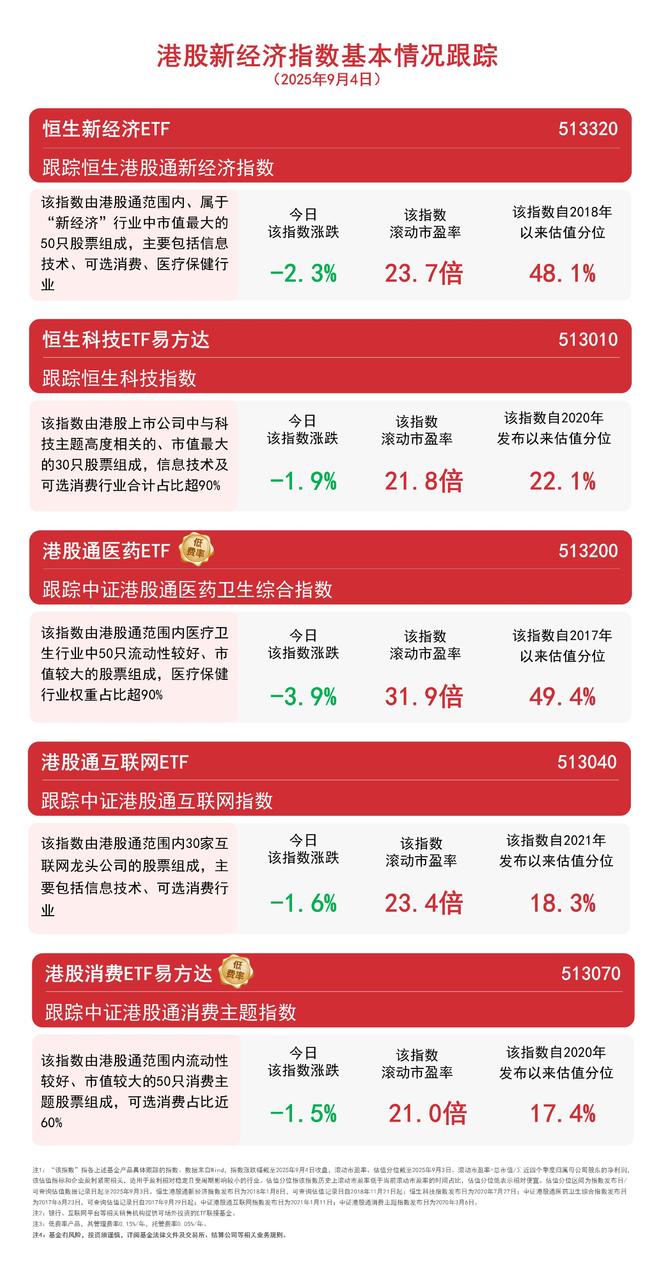
港股科技板块回调获资金连续“抢筹”,恒生科技ETF易方达(513010)近一周净流入达12亿元
Mei Ri Jing Ji Xin Wen· 2025-09-04 13:32
Core Viewpoint - The Hong Kong stock market has experienced a decline in various indices, particularly in the technology and healthcare sectors, while there has been a notable increase in fund inflows into related ETFs, indicating a potential shift in investor sentiment towards these sectors despite the overall downturn [1]. Group 1: Market Performance - The CSI Hong Kong Stock Connect Consumer Theme Index fell by 1.5% [1] - The CSI Hong Kong Stock Connect Internet Index decreased by 1.6% [1] - The Hang Seng Technology Index dropped by 1.9% [1] - The Hang Seng Hong Kong Stock Connect New Economy Index declined by 2.3% [1] - The CSI Hong Kong Stock Connect Healthcare Comprehensive Index saw a decrease of 3.9% [1] Group 2: Fund Inflows - Despite the market downturn, the Hang Seng Technology ETF managed by E Fund (513010) recorded a net inflow of 1.2 billion yuan over the past week [1] - The latest scale of the product reached nearly 16.5 billion yuan, marking a historical high [1]
申万宏源策略市场点评:“慢”演绎了,更要理解“牛”的纵深
Shenwan Hongyuan Securities· 2025-09-04 12:53
Core Insights - The report indicates that the recent short-term adjustment in the A-share market is due to a combination of factors, including a rapid rise in the market since late June and the need for market expectations to be re-anchored, leading to a potential impulse adjustment [1] - Despite the short-term adjustments, the report maintains an optimistic outlook, suggesting that high-growth sectors will continue to increase over time, with significant improvements expected in the midstream manufacturing sector around mid-2026 [1] - The report anticipates that 2026 may witness the first effective rebound in profitability and double-digit growth in net profit for the past five years across the A-share market, driven by structural improvements in fundamentals [1] Market Trends - The report highlights that the channel for residents to increase equity allocation will become smoother over time, with public funds issued in 2020-21 nearing their net asset value [1] - Although the broad market indices are currently adjusting, nearly half of the stocks are still rising, indicating a maintained profit-making effect, which is beneficial for institutional net value returns [1] - The report suggests that the market's slowdown could lead to increased clues about economic recovery and enhanced market elasticity, forming a solid foundation for sustained market growth [1] Structural Selection - The report emphasizes that the potential mainline structures for future investments are domestic technological advancements and advanced manufacturing, which are expected to yield high returns, although key catalysts are still awaited [1] - Key economic indicators to watch in September and October include the ongoing demand for computing power and the progress of Tesla's Optimus product, as well as potential demand highlights in certain cyclical products [1] - The report notes that the Hong Kong stock market currently offers better value than the A-share market, reflecting a more optimistic economic trend with fewer bullish expectations [1]

[9月3日]指数估值数据(大盘波动;股票基金如何判断估值;增量版指数估值表已上线)
银行螺丝钉· 2025-09-03 14:01
Market Overview - The overall market has experienced a decline, closing at 4.3 stars [1] - Large, medium, and small-cap stocks have all decreased, with small-cap stocks showing greater volatility [2] - The STAR Market and securities indices have seen significant declines [3] - The STAR 50 index rose to an overvalued position in the past two weeks before experiencing a pullback [4][5] - Consumer sectors have also shown signs of decline [6] - Hong Kong stocks have exhibited smaller fluctuations compared to A-shares, with Hong Kong dividends remaining relatively strong [7][8] - Recent global stock market fluctuations have indirectly impacted both A-shares and Hong Kong stocks [9] Global Market Influence - Last week, global stock markets saw a downturn, particularly in Europe, while A-shares managed to rise [10] - This week, global markets continued to decline, with Hong Kong stocks showing slight gains and A-shares experiencing minor drops [11] - Fluctuations in overseas markets have affected the performance of RMB assets, although RMB assets have shown less volatility due to valuation advantages [12][13] Investment Strategies - For index funds, it is easier to determine if a stock or fund is overvalued or undervalued by referring to daily published index valuation tables [14][15] - The valuation table categorizes indices into green (undervalued), yellow (fairly valued), and red (overvalued) [17][18] - Being in the undervalued range does not imply that the index will not experience fluctuations [19][20] - Regular investments in undervalued areas can help average down costs, leading to potential gains when market conditions improve [23] Fund Management Insights - Active funds present more challenges in valuation as fund managers do not disclose current holdings, only showing them in quarterly reports [28] - Investors can assess active funds by understanding the manager's investment style or industry focus [29][30] - Active funds often have performance benchmarks, which may change to reflect the manager's actual investment direction [36][37] - A diversified active fund portfolio can reference overall market valuations for investment decisions [40][41] Tools and Resources - The "Today’s Star" mini-program has expanded its percentile valuation table for indices, allowing users to purchase corresponding index funds [43] - Users can filter by categories such as broad-based, strategy, industry, theme, and global indices for targeted investments [43] Investor Mindset - Mature investors understand the importance of establishing a suitable investment framework, recognizing that market fluctuations are unpredictable [45] - Continuous learning and rational decision-making are essential to mitigate emotional impacts on investments, with a stable mindset being key to achieving sustained returns [45]

Interbrand发布《2025中国最佳品牌排行榜》
Zheng Quan Ri Bao Wang· 2025-09-03 08:48
Core Insights - The report by Interbrand highlights that the total brand value of the top brands in China for 2025 is 34,278.02 billion yuan, reflecting a year-on-year growth of 1.68% [1] - The distribution of brands across industries remains consistent with 2024, with 23 brands from the finance and consumer sectors and 9 from the technology sector [1] - The report identifies three key dimensions driving brand value enhancement: AI technology, multi-brand combinations, and international expansion [1][2] AI Technology - Companies are transitioning AI from a symbolic representation to a strategic application, enhancing core value identification and differentiation [1] - AI empowers brands in content and marketing, utilizing user profiling and consumer behavior analysis to uncover latent user needs [1] - The integration of AI facilitates a comprehensive approach from demand insight to product development and automated brand marketing [1] Multi-Brand Combinations - The traditional logic of brand matrices focused on price and category coverage, but the current approach emphasizes user-centric collaboration [2] - Brands are now addressing specific user pain points through a "scene-composite" strategy, optimizing overall matrix efficiency and maximizing brand potential in niche markets [2] - This shift allows brands to deepen their engagement in segmented scenarios and target precise demographics [2] International Expansion - Chinese brands are moving away from a "one-size-fits-all" strategy in internationalization, focusing on localized approaches while maintaining global brand consistency [2] - The report emphasizes the importance of integrating into local ecosystems to achieve symbiosis with local markets [2] - Brands are developing targeted strategies based on the significance of target markets, competitive landscapes, and opportunity spaces [2] Future Outlook - Despite external challenges and uncertainties, Chinese brands are positioned at a critical juncture for transformation from quantitative to qualitative growth [2] - AI capabilities are expected to enhance brand precision, while multi-brand strategies will solidify market presence [2] - The report anticipates that Chinese brands will showcase diverse brand profiles in increasingly segmented markets in the foreseeable future [2]
港股消费ETF(159735)涨近1%,中升控股涨超9%,机构:消费领域呈现出鲜明的结构性机遇
2 1 Shi Ji Jing Ji Bao Dao· 2025-09-03 02:30
Group 1 - The core viewpoint of the articles highlights a strong performance in the Hong Kong stock market, particularly in the consumer sector, with significant gains in various consumer-related stocks and ETFs [1][2] - The Hong Kong Consumer ETF (159735) has attracted over 62 million yuan in capital in the past five days, indicating robust investor interest [2] - The Zhejiang Shaoxing government is set to introduce a consumption policy aimed at boosting local spending, with over 100 million yuan allocated for initiatives in sectors like dining and retail [2] Group 2 - Huatai Securities reports that the consumer sector is experiencing structural opportunities driven by new demands and scenarios, with significant growth in emotional and personalized products like trendy toys and beauty items [3] - The report emphasizes the integration of services and products, reshaping the "people-goods-scene" relationship and expanding consumption boundaries [3] - GF Securities notes that the liquor industry is entering a mid-cycle layout window, with expectations for a recovery in demand following a four-year adjustment period, highlighting the sector's attractive valuation [3]

沪深港通新规实施后特大单抢筹个股分析
Xin Lang Cai Jing· 2025-09-03 01:30
自2024年8月19日起,沪深港交易所将实施新的交易信息披露机制,旨在提升市场透明度和投资者信 心。根据最新公告,沪股通交易日结束后,将对外披露当日的沪股通成交总额、成交笔数、ETF成交 额,以及前十大成交活跃证券及其成交额。同时,这些数据还将按月和年度汇总,进一步加强市场数据 的可获取性和可分析性。 2023年9月2日的交易数据显示,特大单买入的前20只个股引起了市场的广泛关注。这些个股的买入情况 反映了机构投资者的最新偏好与市场热点,成为投资者决策的重要参考依据。根据交易所提供的数据, 特大单买入的个股主要集中于科技、消费和医药等领域,显示出市场对相关行业持续看好的趋势。 在特大单卖出的个股方面,9月2日的数据同样展示了市场的动态变化。此次卖出榜单中,行业分布较为 均匀,但以消费和金融类股票为主,显示部分投资者在短期内可能选择锁定利润或调整持仓策略。此类 卖出行为也反映了市场的流动性,以及投资者对市场前景的不同判断。 来源:市场资讯 (来源:ETF炼金师) 此外,沪深股通和港股通的成交情况也值得关注。9月2日的数据显示,沪深股通十大成交股吸引了较大 的资金流入,表明外资对A股市场的持续关注和信心。相比之下 ...
申万宏源:A股Q2利润占比提升明显的行业主要集中在周期与制造业
智通财经网· 2025-09-02 22:49
Core Viewpoint - The report from Shenwan Hongyuan indicates that by Q2 2025, the global trade environment will be increasingly complex, with escalating tariff conflicts and geopolitical risks. However, domestic advancements in technology, particularly in artificial intelligence, are driving progress in the tech industry, while some sectors are beginning to recover from a downturn [1][2]. Group 1: Industry Performance - The advanced manufacturing sector is in the process of bottoming out, with capital expenditure showing a continuous decline for six consecutive quarters, but signs of improvement in profitability are emerging [2][3]. - The TMT (Technology, Media, and Telecommunications) sector continues to exhibit high prosperity, supported by industry trends and policy backing, with the electronic industry performance on the rise due to overseas demand [2][3]. - The cyclical industries are experiencing significant performance differentiation, with some sectors like non-ferrous metals showing high return on equity (ROE) while others like coal and construction are still facing negative growth [3][4]. - The pharmaceutical sector may have reached its bottom, with a narrowing decline in revenue and net profit, and ROE beginning to recover from low levels [3][4]. - The financial and real estate sectors show structural differentiation, with non-bank financials recovering while real estate continues to decline [3][4]. Group 2: Profit Structure and Trends - A-share profits are increasingly concentrated in manufacturing and cyclical industries, with Q2 2025 net profits totaling 4.83 trillion yuan, where financial real estate accounts for over 50% and cyclical industries contribute about a quarter [4][5]. - The report highlights that industries with improved financial indicators are primarily in high-prosperity electronic sectors and those in the bottom reversal phase, while sectors like food and beverage and coal show deterioration across key financial metrics [4][5]. Group 3: Supply and Demand Dynamics - Most industries are experiencing negative growth in employee numbers, indicating a continuous supply clearing process [5][6]. - The report notes that many manufacturing sectors are below historical supply cycles, with some industries like photovoltaic equipment and real estate showing low new capacity but high inventory levels [6][7]. - Demand-side indicators show that sectors with rising fixed asset turnover and high contract liability growth are primarily in military, electronics, and export manufacturing, indicating potential recovery in these areas [7][8]. Group 4: International Market Performance - Approximately two-thirds of industries with significant overseas revenue have seen an increase in their overseas income share, with many maintaining higher gross margins than their domestic counterparts [8][9]. - Industries with high overseas revenue are experiencing marginal improvements in their fundamentals, particularly in the TMT sector and some renewable energy areas [8][9]. Group 5: Dividend Trends - The mid-term dividend phenomenon continues, with banks announcing a total of 237.29 billion yuan in mid-term dividends, alongside significant dividends from sectors like oil and gas, telecommunications, and non-bank financials [9][10]. Group 6: Valuation and Investment Opportunities - The report identifies sectors with potential for reversal opportunities, particularly in pharmaceuticals, banking, and AI applications, with a focus on those currently in a low price-to-book (PB) and low ROE state [9][10]. - The electric equipment sector is noted for its value proposition, with ongoing improvements in fundamentals and supply clearing expected to continue into 2026 [10][11].