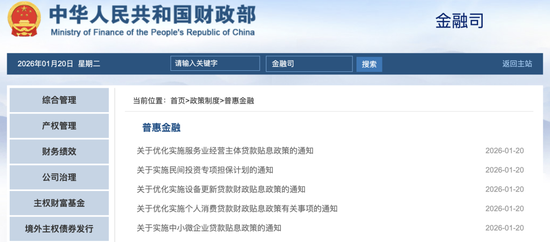
制造业

Search documents
2025年12月经济数据点评:总量趋稳,结构有亮点
Changjiang Securities· 2026-01-20 09:10
1. Report Industry Investment Rating - No relevant content provided. 2. Core Views of the Report - In 2025, the annual economic growth rate reached the target of 5%. Consumption and exports' contribution to GDP growth increased, while investment's contribution declined. Looking ahead to 2026, the real GDP growth rate is expected to be around 4.8%, showing a "first down then up" trend due to the high base effect. [2][7] - The bond market's pricing of the fundamentals may still exhibit an asymmetry of "being insensitive to positive news and sensitive to negative news." The view of a weak and volatile long - term bond market in the near term is maintained, and the recovery window may come later in the first quarter. [2][7] 3. Summary by Related Catalogs 3.1 2025 Economic Data Overview - The Q4 real GDP in 2025 was 4.5% year - on - year, meeting expectations, and the annual cumulative year - on - year growth rate successfully achieved the target of 5%. In December 2025, the year - on - year growth rate of industrial added value above designated size rose by 0.4 pct to 5.2%, higher than the expected 4.9%; the year - on - year growth rate of social retail sales dropped by 0.4 pct to 0.9%, lower than the expected 1.5%; the cumulative year - on - year growth rate of fixed asset investment dropped by 1.2 pct to - 3.8%, worse than the expected - 2.4%. [4] 3.2 Economic Growth Drivers - Consumption and exports' contribution to GDP growth increased to 2.6% and 1.64% respectively, while investment's contribution declined to 0.77%. There was still price pressure. The Q4 real GDP growth rate was 4.5% year - on - year, down 0.3 pct from Q3, and it declined quarter by quarter throughout the year, reaching the lowest level since 2023. The price level improved quarter by quarter, with the GDP deflator's year - on - year growth rate dropping to around - 0.67%, and the nominal GDP growth rate was 3.8% year - on - year, showing marginal improvement but remaining at a low level. [7] 3.3 Industrial Sector - In December, the industrial added value was 5.2% year - on - year, 0.4 pct higher than the previous value, and 0.49% month - on - month. The year - on - year growth rate of export delivery value turned positive to 3.2%. The service industry production index was 5% year - on - year, 0.8 pct faster than the previous month. By sector, the mining industry was a major drag, with its year - on - year growth rate dropping by 0.9 pct to 5.4%, while the manufacturing industry's year - on - year growth rate increased by 1.1 pct to 5.7%. High - end manufacturing maintained a high growth rate, with the year - on - year growth rates of pharmaceutical manufacturing, special equipment manufacturing, and computer and communication equipment manufacturing accelerating by 4.6, 3.4, and 2.6 pct respectively. The output of high - tech products such as industrial robots and integrated circuits maintained a high month - on - month growth rate. In 2025, the added value of high - tech manufacturing increased by 9.4% compared to the previous year, contributing 26.1% to the growth rate of industrial added value above designated size. [7] 3.4 Investment Sector - The decline in fixed asset investment widened. Real estate investment continued to decline due to the drag of housing prices, and infrastructure and manufacturing investment weakened overall against the backdrop of enterprises' concentrated debt repayment, debt reduction, and "anti - involution." In December, the month - on - month growth rate of fixed asset investment dropped to - 15.0%, and the month - on - month decline of private investment was about - 17.2%. Real estate investment's month - on - month decline widened to - 37.5%, the sales area decreased by 16.6% year - on - year, and the sales volume decreased by 24.2% year - on - year. The prices of commercial residential buildings in 70 large and medium - sized cities generally decreased month - on - month, and the year - on - year decline widened. The insufficient funds of real estate enterprises still restricted construction starts and completions, but the new construction area stabilized, and the cumulative year - on - year decline narrowed. Infrastructure investment continued to decline, with the month - on - month growth rate of broad - based infrastructure investment at - 15.9%, and the "crowding - out effect" of debt reduction may still have had an impact. In 2025, the cumulative year - on - year growth rate of manufacturing investment was 0.6%, but in December, the month - on - month growth rate was - 10.5%, indicating that enterprises were cautious about investment against the "anti - involution" background. The capacity utilization rate of the manufacturing industry increased from 74.1% in Q1 to 75.2% in Q4. [7] 3.5 Consumption Sector - The growth rate of social retail sales declined, and residents' income and expenditure continued to slow down. In December, the year - on - year growth rate of social retail sales dropped to 0.9%, the lowest since March 2023. The off - season effect was evident, with commodity retail (0.7%) and catering (2.2%) remaining at low levels, and the year - on - year growth rate of catering above designated size at - 1.1%. The effect of the "trade - in" subsidy may have weakened, and consumption of household appliances (- 18.7%), furniture (- 2.2%), and automobiles (- 5.0%) remained under pressure. However, the retail sales of communication equipment (20.9%) maintained a high growth rate. In Q4, the real cumulative year - on - year growth rate of residents' per capita disposable income dropped by 0.2 pct to 5%, and the year - on - year growth rate of consumption expenditure dropped by 0.3 pct to 4.4%. [7] 3.6 Outlook for 2026 - The real GDP growth rate is expected to be around 4.8% in 2026, showing a "first down then up" trend due to the high base effect. On the investment side, the Central Economic Work Conference in December last year proposed to "stabilize and reverse the decline of investment." This year, the investment growth rate is expected to stop falling and stabilize with the support of the concept of "investing in people" and "two important" projects. On the production and demand side, the transformation of old and new driving forces is accelerating, and service consumption, high - end manufacturing, and exports may maintain their resilience. [2][7]
一图了解哪些纳税人适用增值税期末留抵退税政策
蓝色柳林财税室· 2026-01-20 08:35
Group 1 - The article discusses the tax refund policies for different industries, specifically focusing on manufacturing, real estate, and other sectors, detailing eligibility criteria and application processes for VAT refunds [4][6][10] - For manufacturing and certain service industries, taxpayers can apply for VAT refunds if their sales in the relevant sectors exceed 50% of total sales, calculated over the previous 12 months [4][5] - Real estate developers can apply for a refund of 60% of the newly increased VAT credits if they meet specific conditions regarding their VAT credits over a six-month period [6][10] Group 2 - Other industries not covered by the previous categories can also apply for VAT refunds, with a refund rate of 60% for the first 100 million yuan of newly increased VAT credits and 30% for amounts exceeding that [10][11] - The article outlines the calculation formulas for determining the refundable VAT amounts based on the increase in VAT credits compared to previous periods [8][11] - It emphasizes the importance of maintaining accurate records of VAT invoices and other documentation to support refund applications [4][6]


2025年12月经济数据点评:规上工增超预期增长,全年经济目标顺利实现
KAIYUAN SECURITIES· 2026-01-20 08:12
Report Summary 1. Report Industry Investment Rating No information provided regarding the report industry investment rating. 2. Core Viewpoints of the Report - In December 2025, after policy support, the endogenous driving force of the economy bottomed out and rebounded, with industrial added - value growing more than expected. The full - year economic target was successfully achieved, and in 2026, the economy is expected to have a good start under a series of policy layouts [3][5]. - The 10 - year Treasury bond target range is 2 - 3%, with a central value of around 2.5% [5]. 3. Summary by Relevant Catalogs 3.1 December 2025 Economic Data Highlights - **Industrial Added - Value**: In December 2025, the year - on - year growth of industrial added - value of large - scale industries was 5.2%, 0.4 percentage points higher than the previous value, and the month - on - month growth was 0.49%, 0.05 percentage points higher than the previous value. It exceeded market expectations, in line with the PMI data. Policy support, pre - holiday inventory replenishment, and the recovery of export orders promoted the growth [3]. - **Consumption and Exports**: Retail sales of consumer goods increased by 0.9% year - on - year in December, 0.4 percentage points lower than the previous value, while exports increased by 6.6% year - on - year, 0.7 percentage points higher than the previous value, showing a continuous differentiation trend [4]. - **Investment**: The cumulative year - on - year decrease in fixed asset investment was 3.8%, 1.2 percentage points lower than the previous value. Real estate development investment decreased by 17.2% year - on - year in 2025, and the real estate climate index continued to decline, putting continuous pressure on the investment side [4]. 3.2 Structural Highlights in the Transformation of New and Old Driving Forces - **Investment Structure**: Investment in high - tech service industries increased by 3.5% year - on - year, accounting for 5.6% of total service industry investment, 0.6 percentage points higher than the same period in 2024 [5]. - **New Quality Productivity Industries**: The cumulative year - on - year growth of the added - value of large - scale high - tech manufacturing industries was 9.4%, the highest since 2022, contributing 26.1% to the growth of all large - scale industries [5]. - **Equipment Manufacturing Industry**: The added - value of large - scale equipment manufacturing industries increased by 9.2% year - on - year in 2025, accounting for 36.8% of the total added - value of large - scale industries, 2.2 percentage points higher than the previous year, and has exceeded 30% for 34 consecutive months [5]. 3.3 Bond Market Views - **Fundamentals**: The falsification of the under - expected economic recovery, combined with possible broad credit and broad fiscal policies at the beginning of 2026, will accelerate the cyclical recovery [5]. - **Broad Monetary Policy**: If there is a broad monetary policy (such as reserve requirement ratio cuts, interest rate cuts, bond purchases), it will be a reduction opportunity, similar to 2025 [5]. - **Inflation**: Inflation is rising. Attention should be paid to whether the month - on - month increase of PPI can remain positive [5]. - **Funds Rate**: If the month - on - month inflation continues to rise, there is a possibility of tightened funds, and the yields of short - term bonds will also start to rise [5]. - **Real Estate**: Real estate is not used as a means to stabilize growth this time. Similar to the situation in the United States after 2008, real estate is a lagging indicator and may bottom out after the recovery of various economic indicators and the rise of the stock market [5]. - **Bonds**: The target range of the 10 - year Treasury bond is 2 - 3%, with a central value of around 2.5% [5].
财政部:对相关科技创新类贷款给予财政贴息,央行同时提供再贷款支持
Bei Jing Shang Bao· 2026-01-20 08:00
Core Viewpoint - The Ministry of Finance emphasizes the importance of enhancing key industries through fiscal and financial collaboration to support technological innovation [1] Group 1: Fiscal and Financial Support - The Ministry of Finance will provide fiscal subsidies for loans related to technological innovation [1] - The central bank will offer re-lending support to facilitate these initiatives [1] Group 2: Industry Transformation - There is a focus on promoting new technological transformations in the manufacturing sector [1] - The initiative aims to accelerate the digital transformation of small and medium-sized enterprises [1] Group 3: Development Goals - The strategy aims to foster intelligent, green, and integrated development [1] - The overall goal is to solidify and expand the foundation of the real economy [1]
2026年宏观经济与资产配置前瞻——专访西部证券首席宏观分析师边泉水
Sou Hu Cai Jing· 2026-01-20 07:53
Economic Outlook - In 2026, China's economy is expected to be in a phase of restorative growth, supported by expanding domestic demand, continued policy easing, and rising prices [1][5] - The nominal GDP growth is projected to improve significantly due to inflation recovery, positively impacting the income of households, businesses, and the government [2][3] - The shift from old to new industries is anticipated to become more pronounced, with new industries contributing increasingly to economic growth [3][5] Industry Changes - The transition from traditional industries to new productive forces is highlighted, with the "three new" economy (new industries, new business formats, and new models) expected to account for over 18% of GDP by 2024 [3][5] - The real estate sector is undergoing adjustments, returning to a focus on residential attributes, while new engines of economic growth are emerging from innovative sectors [3][5] Policy Implications - Macroeconomic policies will focus on balancing short-term and long-term needs, with a more proactive fiscal policy and moderately accommodative monetary policy expected [4][5] - The emphasis on domestic demand as a strategic foundation for economic development is reinforced, with initiatives to boost consumption and income for urban and rural residents [4][5] Investment Opportunities - The A-share market is expected to see a more balanced style in 2026, with market catalysts shifting from liquidity to price earnings [8][9] - Structural opportunities are anticipated in cyclical and high-end manufacturing sectors, which have begun to show signs of recovery [9][10] - The AI and new productive forces are identified as key engines for future economic development, with significant contributions expected from emerging and future industries [5][12]


新晋万亿之城进击AI,“斜杠青年”温州下一站
2 1 Shi Ji Jing Ji Bao Dao· 2026-01-20 07:17
Core Viewpoint - Wenzhou is emerging as a "slash city" with a projected GDP exceeding 1 trillion yuan by 2025, marking it as China's 28th trillion-yuan city and the third in Zhejiang province, while also aiming to become a national leader in AI application development [1][2]. Economic Growth and Development Goals - Wenzhou's GDP has grown at an average annual rate of 6.5% during the 14th Five-Year Plan, moving from 30th to 28th in national GDP rankings, and its resident population increased from 9.57 million to 9.85 million [3]. - The city aims to significantly enhance its urban agglomeration capabilities and establish itself as a key regional center in the southeast coastal area, as outlined in the 15th Five-Year Plan [2][5]. Innovation and AI Development - Wenzhou is focusing on innovation as a key driver for its future growth, with R&D expenditure increasing by an average of 14% annually over the past five years, and the area of incubators expanding over tenfold [5]. - The city plans to embed AI across various sectors, including manufacturing, energy, healthcare, finance, and tourism, to create a nationally recognized "AI demonstration application city" [3][8]. Strategic Planning and Infrastructure - The city will develop a comprehensive "3412" work system to integrate data, algorithms, and computing power, promoting widespread data collection and application [8]. - Wenzhou aims to build a robust AI industry ecosystem, including 6 million square meters of incubation space and focusing on key areas such as intelligent driving and smart manufacturing [8]. Urban and Regional Development - Wenzhou is enhancing its urban agglomeration to amplify the effects of technology, industry, and capital clustering, aiming for high-quality development and integration of urban and rural areas [10][11]. - The city is leveraging its unique advantages, including its global trade network, to extend its influence into Southeast Asia and other international markets [11].
展望全球人工智能2026年演进新局
Xin Hua She· 2026-01-20 06:53
Technology - The competition in AI large models will continue into 2026, with companies like OpenAI, Google, and DeepMind releasing larger or more efficient models [2] - AI models are making progress in spatial understanding, aiming to develop capabilities in semantics, physics, geometry, and dynamic interactions [2] - By 2026, 40% of enterprise applications are expected to embed task-oriented AI agents, a significant increase from less than 5% in 2025 [2] Industry - The combination of digital twins and AI agents is reshaping product design processes, marking a strategic opportunity for "smart manufacturing" [4] - By 2026, 40% of manufacturers with production scheduling systems are predicted to upgrade to AI-driven scheduling for autonomous resource management [4] - The shift from traditional manufacturing to "smart manufacturing" is expected to enhance market perception, product innovation, and international competitiveness for Chinese enterprises [4] Energy - The energy pressure from AI applications will remain high, with global data center electricity demand expected to double by 2030, reaching approximately 945 terawatt-hours [5] - The global green AI data center market is projected to reach $67.6 billion by 2026 and could grow to about $123 billion by 2035 [5] - China is focusing on sustainable resource and engineering systems to support AI development through supply capacity and green low-carbon initiatives [5] Governance - 2026 is anticipated to be a critical year for the acceleration of global AI governance measures, shifting focus from conceptual debates to compliance and cross-border collaboration [7] - The EU's AI Act, set to be implemented in phases starting August 2026, will be the first comprehensive regulation of AI globally [7] - China's AI governance path is becoming clearer, with a focus on improving legal frameworks and ethical guidelines to promote healthy AI development [7]
——12月经济数据点评:基本面延续偏弱,通胀回升是亮点
Shenwan Hongyuan Securities· 2026-01-20 05:45
Group 1 - The core viewpoint of the report indicates that China's GDP growth rate for 2025 reached 5%, aligning with market expectations, but the economy still faces challenges such as weak domestic demand and external disturbances [1][3] - The report highlights a significant decline in fixed asset investment driven by the real estate sector, with a year-on-year decrease of 17.2% in real estate investment for December 2025 [3][12] - Consumer spending showed limited improvement, with retail sales growth for the year at 3.7%, down 0.3 percentage points from the previous month, primarily affected by declines in automobile sales and dining [3][24] Group 2 - Industrial value-added growth for December 2025 was reported at 5.9%, a decrease of 0.1 percentage points from November, indicating a divergence in production chains, with traditional sectors like steel and cement continuing to contract [3][6] - Inflation showed signs of recovery, with the Consumer Price Index (CPI) rising to 0.8% year-on-year in December, supported by an increase in food prices, particularly vegetables due to adverse weather conditions [3][10] - Fixed asset investment continued to decline, with a cumulative year-on-year decrease of 3.8% in December, reflecting a broader trend of reduced investment across various sectors [3][12]
重磅利好!财政部最新发布
Xin Lang Cai Jing· 2026-01-20 05:30
Core Viewpoint - The Ministry of Finance has announced several significant policies aimed at stimulating economic growth, including the extension of the personal consumption loan interest subsidy policy until the end of 2026 [1][10]. Personal Consumption Loan Subsidy Policy - The implementation period for the personal consumption loan interest subsidy policy has been extended to December 31, 2026, with the new period set from September 1, 2025, to December 31, 2026 [2][12]. - The policy now includes credit card installment payments with an annual subsidy rate of 1% [3][12]. - The previous limits on subsidy amounts have been removed, allowing for greater flexibility in consumer spending [3][13]. Equipment Update Loan Subsidy Policy - The subsidy for fixed asset loans related to equipment updates is set at 1.5% for a maximum period of 2 years [4][14]. - The policy supports a wider range of industries, including construction, aviation, and digital technology, and is effective until December 31, 2026 [5][14]. Small and Micro Enterprises Loan Subsidy Policy - A subsidy of 1.5% is available for fixed asset loans to small and micro private enterprises, with a maximum loan size of 50 million yuan [6][17]. - The policy targets key industries such as new energy vehicles, medical equipment, and artificial intelligence, and is set to last for one year with potential extensions [6][17]. Service Industry Loan Subsidy Policy - The service industry loan subsidy policy has been extended to December 31, 2026, with increased subsidy limits for new loans [7][18]. - The policy now includes additional sectors such as digital and green industries, expanding the scope of support [7][18]. Private Investment Special Guarantee Plan - A special guarantee plan for private investment has been established with a total quota of 500 billion yuan over two years [8][19]. - The plan supports loans for equipment purchases, technological upgrades, and various service sectors, with banks bearing at least 20% of the loan risk [8][19]. Financial Support and Innovation - The central government will provide funding to reduce re-guarantee fees and encourage innovative financing models [9][21]. - A total of 50 billion yuan will be injected into the guarantee fund to enhance support for private enterprises and promote balanced regional development [9][21].
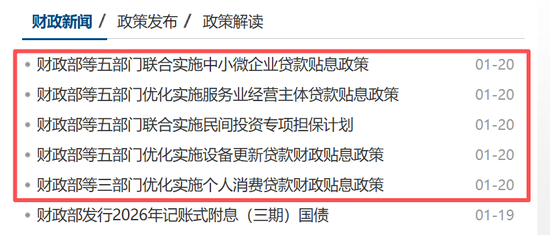
财政部连发“大礼包”!信用卡账单分期业务纳入贴息支持范围
Xin Lang Cai Jing· 2026-01-20 05:30
Core Viewpoint - The Ministry of Finance has issued five notifications aimed at supporting small and micro enterprises, personal consumption, equipment upgrades, private investment, and service industry loans through interest subsidies and guarantees. Group 1: Small and Micro Enterprises Loan Subsidy - The notification on small and micro enterprises loan interest subsidies provides a 1.5% annual subsidy on eligible fixed asset loans, with a maximum loan amount of 50 million yuan per entity, effective from January 1, 2026, for a period of up to two years [3][9] - The policy is initially set for one year, with the possibility of extension based on future evaluations [3][9] Group 2: Personal Consumption Loan Subsidy - The personal consumption loan subsidy policy has been extended to December 31, 2026, allowing eligible residents to benefit from interest subsidies on consumption loans taken between September 1, 2025, and December 31, 2026 [3][10] - The scope of support has been expanded to include credit card installment payments, with an annual subsidy rate of 1% [10] - Restrictions on the maximum subsidy amount per transaction and per borrower have been lifted, while maintaining an annual cap of 3,000 yuan per borrower [10] Group 3: Equipment Upgrade Loan Subsidy - The equipment upgrade loan subsidy offers a 1.5% interest subsidy on fixed asset loans for equipment upgrades, applicable for loans issued until December 31, 2026, with a maximum duration of two years [11] - The support scope has been broadened to include various sectors such as construction, aviation, and digital technology, emphasizing high-end, intelligent, green, and digital equipment upgrades [11] Group 4: Private Investment Guarantee Plan - The private investment guarantee plan has a total quota of 500 billion yuan, to be implemented over two years, targeting loans for small and micro enterprises involved in equipment purchases, technological upgrades, and various service sectors [12] - Eligible enterprises must not be listed as abnormal operation or untrustworthy entities and must meet specific operational criteria [12] Group 5: Service Industry Loan Subsidy - The service industry loan subsidy policy has been extended to December 31, 2026, with new loans issued during this period eligible for a 1% interest subsidy, with a maximum loan amount of 10 million yuan per entity [13] - The support scope has been expanded to include additional sectors such as digital, green, and retail, alongside existing categories like health and tourism [13]