
有色金属冶炼

Search documents
铜供应忧虑推升智利17亿美元冶炼厂投资热度
Wen Hua Cai Jing· 2025-10-14 01:05
10月13日(周一),智利国有企业ENAMI负责人称,铜买家对供应链多元化的需求或将助力该企业为17亿美元的 冶炼厂项目筹集资金。 ENAMI旗下拥有70年历史的Hernan Videla Lira冶炼厂升级计划长期面临盈利能力与融资前景的质疑。 随着全球其他高效冶炼厂争夺有限精矿资源,矿商为精矿冶炼支付的加工精炼费已经破零,迫使部分海外冶炼厂 停产。 但ENAMI负责人Ivan Mlynarz表示,盈利能力并非潜在投资者的唯一考量。 "在当今地缘逻辑与动态格局下,以及我们如何保障全球供应链安全的背景下,该项目具有极强的吸引 力,"Mlynarz在LME周(LME Week)开幕前表示。这场全球金属行业年度盛会于本周一在伦敦拉开帷幕。"多家 企业正从这一角度审视该项目。" 智利仅占全球冶炼产能的6%。 ENAMI去年关闭了近乎淘汰的Hernan Videla Lira冶炼厂,目前认为重启该厂对帮助智利中小生产商进入全球市场 至关重要。 ENAMI表示计划于2025年底启动初期建设,五年后投产,年产阴极铜24万吨。 Mlynarz透露,包括矿企、大宗商品贸易商和银行在内的17家公司已表示有意出资支持该冶炼厂,以 ...

美联储保尔森支持今年再降息两次,9月原油产量增长
Dong Zheng Qi Huo· 2025-10-14 00:47
Report Industry Investment Ratings No relevant content provided. Core Views of the Report The report offers a comprehensive analysis of various financial and commodity markets, presenting insights into market trends, influencing factors, and corresponding investment suggestions. It takes into account factors such as policy changes, supply - demand dynamics, and geopolitical events to assess market conditions and risks [1][2][3]. Summary by Directory 1. Financial News and Reviews 1.1 Macro Strategy (Gold) - Gold prices soared over 3% to above $4100, reaching a new high. The market's bullish sentiment was high, with funds flowing into gold. The short - term market sentiment dominated the trend, and market volatility increased as gold prices entered uncharted territory [13]. - Investment advice: Gold prices are strong in the short term, and market volatility intensifies [14]. 1.2 Macro Strategy (Foreign Exchange Futures - US Dollar Index) - Fed official Anna Paulson hinted at two more 25 - basis - point rate cuts this year, believing that tariffs have a controllable impact on inflation. This dovish stance led to a short - term weakening of the US dollar index [16]. - Investment advice: The US dollar is expected to weaken in the short term [17]. 1.3 Macro Strategy (Stock Index Futures) - On Monday, the A - share market showed three unexpected features: a sharp gap - down opening, shrinking trading volume despite strong dip - buying意愿, and significant divergence between the Sci - tech Innovation and ChiNext boards. - Investment advice: Balance the allocation of various stock index contracts to cope with the rapidly rotating market [21]. 1.4 Macro Strategy (US Stock Index Futures) - Fed official Paulson supports two more 25 - basis - point rate cuts this year. The AI sector remains the main driving force for the index's rise [22][23]. - Investment advice: Pay attention to the negotiation progress and look for opportunities to enter the market on dips [24]. 1.5 Macro Strategy (Treasury Bond Futures) - China's September import and export growth exceeded expectations. The stock market's bullish sentiment remained unchanged, and it is expected that the bond market will fluctuate in the short term [27]. - Investment advice: The bond market will fluctuate in the short term. After the new regulations on fund fees are implemented, there will be opportunities to buy on dips [28]. 2. Commodity News and Reviews 2.1 Agricultural Products (Sugar) - Overnight, the external market fell more than 3%. However, as Brazil's peak crushing season passes and the Northern Hemisphere enters a new crushing season, the downward space for ICE raw sugar is not optimistic [32]. - Investment advice: Due to the impact of the external market decline, Zhengzhou sugar is in a weak downward trend, but it is not recommended to short aggressively [33]. 2.2 Agricultural Products (Soybean Meal) - China's September soybean imports reached a record high for the same period. As of October 10, soybean inventory continued to rise, but soybean meal inventory decreased due to the drop in oil mill operating rates during the holiday [36]. - Investment advice: It is expected that the prices of domestic and foreign futures will fluctuate temporarily. Continue to monitor the planting situation of new Brazilian soybeans and the development of Sino - US relations [37]. 2.3 Agricultural Products (Soybean Oil/Rapeseed Oil/Palm Oil) - From October 1 - 10, Malaysia's palm oil production increased by 6.59% month - on - month. The domestic palm oil inventory decreased by 0.83% month - on - month but was still higher than last year [39][40]. - Investment advice: Look for opportunities to buy palm oil on dips, and pay attention to Indonesia's biodiesel policy and October production [40]. 2.4 Agricultural Products (Red Dates) - On October 13, the price of red dates in the Hebei Cuierzhuang market stabilized. The futures price of the main contract CJ601 closed slightly higher [41]. - Investment advice: It is recommended to wait and see. Focus on the price negotiation in the production area and the acquisition progress [42]. 2.5 Black Metals (Steam Coal) - India's coal production in September decreased year - on - year. Although coal prices rebounded in the short term, the seasonal weakness from October to November is difficult to change [44]. - Investment advice: Coal prices are expected to continue to decline [44]. 2.6 Black Metals (Iron Ore) - India's GPIL plans to expand its iron ore mine. Short - term policy factors may support ore prices, but terminal demand is weak, and the short - term upward space is limited [45]. - Investment advice: Pay attention to short - term policy impacts, but the short - term upward space is limited [46]. 2.7 Agricultural Products (Corn Starch) - Corn starch companies' theoretical profits have turned positive. It is expected that the spot rice - flour price difference will continue to narrow in the long - term [47]. - Investment advice: Consider short - term opportunities to short the spot rice - flour price difference [47]. 2.8 Agricultural Products (Corn) - On October 13, domestic corn prices continued to decline. The corn market has entered the production - area pricing stage, and the current price is unlikely to have bottomed out [48]. - Investment advice: Hold existing short positions and avoid early entry for long positions [48]. 2.9 Non - Ferrous Metals (Polysilicon) - The US government stopped a large - scale solar project. The spot price of polysilicon is expected to remain stable in October. The PS2511 contract is significantly discounted, and light - position long positions can be considered [52]. - Investment advice: Consider light - position long positions in the PS2511 contract and pay attention to the PS2511 - PS2512 reverse arbitrage opportunity [52]. 2.10 Non - Ferrous Metals (Industrial Silicon) - The US imposed high tariffs on Angolan industrial silicon. The price floor of industrial silicon is more definite, and it is recommended to buy on dips [54]. - Investment advice: Consider buying industrial silicon on dips, but be cautious when chasing up [54]. 2.11 Non - Ferrous Metals (Lead) - As of October 13, the social inventory of lead ingots decreased. Due to short - term supply - demand mismatch, Shanghai lead may fluctuate upward [56]. - Investment advice: Look for buying opportunities on pullbacks and beware of delivery risks [56]. 2.12 Non - Ferrous Metals (Zinc) - As of October 13, the domestic zinc inventory increased. The global visible inventory is rising marginally. The Shanghai zinc is expected to fluctuate widely [57]. - Investment advice: It is recommended to wait and see. Consider medium - term positive arbitrage opportunities [58]. 2.13 Non - Ferrous Metals (Copper) - The accident at El Teniente copper mine will affect production until 2026. The short - term copper price is likely to fluctuate upward [63]. - Investment advice: Buy copper on pullbacks and wait and see for arbitrage [63]. 2.14 Non - Ferrous Metals (Nickel) - Indonesia requires nickel mining companies to submit 2026 production plans. Nickel ore prices are expected to rise in Q4. It is recommended to buy on dips after sentiment is released [67]. - Investment advice: Look for opportunities to buy nickel on dips after sentiment is released [67]. 2.15 Non - Ferrous Metals (Lithium Carbonate) - Australia is considering a key minerals agreement with the US. The short - term lithium price may fluctuate narrowly. It is recommended to short on rallies [70]. - Investment advice: Short lithium carbonate on rallies and pay attention to the LC2511 - 2512 reverse arbitrage opportunity [70]. 2.16 Energy and Chemicals (Liquefied Petroleum Gas) - Trump's tariff statement brought uncertainty. The profit of PDH is unsustainable. It is recommended to short the PDH profit on the right - hand side [74]. - Investment advice: Look for opportunities to short the PDH profit on the right - hand side [74]. 2.17 Energy and Chemicals (Crude Oil) - OPEC's September crude oil production increased. The short - term market sentiment has recovered, but the upward space is limited [75]. - Investment advice: The short - term upward space for crude oil prices is limited [76]. 2.18 Energy and Chemicals (PX) - On October 13, the PX price fell. It is expected to follow the oil price and fluctuate downward [77]. - Investment advice: PX is expected to fluctuate downward following the oil price [79]. 2.19 Energy and Chemicals (Asphalt) - In September, domestic asphalt production increased. The supply - demand fundamentals are unlikely to have a continuous mismatch [81]. - Investment advice: It is recommended to wait and see [82]. 2.20 Energy and Chemicals (PTA) - On October 13, the PTA spot price declined. The short - term PTA price is expected to fluctuate downward, and the PTA - oil price spread may widen passively [83]. - Investment advice: PTA is expected to fluctuate downward, and the PTA - oil price spread may widen passively [85]. 2.21 Energy and Chemicals (Methanol) - On October 13, the methanol price in Taicang increased. The short - term methanol price is likely to rise but with limited upward space [86]. - Investment advice: The short - term methanol price is likely to rise, but the upward space is limited [86]. 2.22 Energy and Chemicals (Styrene) - As of October 13, the inventory of styrene in Jiangsu ports decreased. It is not recommended to expand the styrene - benzene spread [87]. - Investment advice: Do not expand the styrene - benzene spread [87]. 2.23 Energy and Chemicals (Bottle Chips) - On October 13, bottle chip factories lowered their export prices. The supply - demand contradiction may accumulate in the fourth quarter [91]. - Investment advice: Pay attention to the factory's resumption of production and the new device's commissioning [91]. 2.24 Energy and Chemicals (Caustic Soda) - On October 13, the price of liquid caustic soda in Shandong increased locally. It is necessary to be cautious when bottom - fishing [94]. - Investment advice: Be cautious when bottom - fishing caustic soda [94]. 2.25 Energy and Chemicals (Pulp) - On October 13, the price of imported wood pulp showed differentiation. The pulp market is expected to fluctuate downward [96]. - Investment advice: The pulp market is expected to fluctuate downward [96]. 2.26 Energy and Chemicals (Urea) - The utilization rate of compound fertilizer production capacity decreased. It is not recommended to be overly bearish on urea after the UR2601 contract falls below 1600 yuan/ton [100]. - Investment advice: Do not be overly bearish on urea after the UR2601 contract falls below 1600 yuan/ton [100]. 2.27 Energy and Chemicals (PVC) - On October 13, the PVC powder market price fluctuated slightly. Pay attention to macro changes [101]. - Investment advice: Pay attention to macro changes [101]. 2.28 Energy and Chemicals (Soda Ash) - As of October 13, the inventory of soda ash manufacturers increased. It is recommended to short soda ash on rallies [102]. - Investment advice: Short soda ash on rallies and pay attention to supply - side disturbances [102]. 2.29 Energy and Chemicals (Float Glass) - On October 13, the price of float glass in the Shahe market decreased. It is recommended to consider the arbitrage opportunity of going long on FG2601 and shorting SA2601 [105]. - Investment advice: Consider the arbitrage opportunity of going long on FG2601 and shorting SA2601 [105].
豫光金铅股价涨5.21%,南方基金旗下1只基金位居十大流通股东,持有705.22万股浮盈赚取486.6万元
Xin Lang Cai Jing· 2025-10-13 05:36
Core Insights - Yuguang Gold Lead Co., Ltd. experienced a stock price increase of 5.21%, reaching 13.94 CNY per share, with a trading volume of 8.82 billion CNY and a turnover rate of 5.97%, resulting in a total market capitalization of 151.99 billion CNY [1] Company Overview - Yuguang Gold Lead, established on January 6, 2000, and listed on July 30, 2002, is located in Jiyuan City, Henan Province. The company specializes in non-ferrous metal smelting, chemical raw material sales, precious metal smelting, and the sale of gold and silver products [1] - The revenue composition of Yuguang Gold Lead includes: silver products (25.90%), copper products (25.75%), lead products (21.74%), gold products (21.38%), antimony products (1.66%), zinc products (1.65%), other products (1.27%), and sulfuric acid (0.66%) [1] Shareholder Insights - Among the top ten circulating shareholders of Yuguang Gold Lead, a fund under Southern Fund, the Southern CSI 1000 ETF (512100), increased its holdings by 134.61 thousand shares in the second quarter, bringing its total to 705.22 thousand shares, which accounts for 0.65% of the circulating shares. The estimated floating profit today is approximately 4.866 million CNY [2] - The Southern CSI 1000 ETF (512100) was established on September 29, 2016, with a latest scale of 649.53 billion CNY. Year-to-date returns stand at 27.87%, ranking 2028 out of 4220 in its category; over the past year, returns are at 34.65%, ranking 1427 out of 3855; since inception, returns are at 13.16% [2]

文字早评2025/10/13:宏观金融类-20251013
Wu Kuang Qi Huo· 2025-10-13 02:33
Report Industry Investment Rating No relevant content provided. Core Viewpoints of the Report - After a period of continuous rise, high - level hot sectors such as AI have recently shown divergence, with funds shifting between high - and low - valued stocks and rapid rotation. Market risk appetite has decreased. Although short - term indices face uncertainty due to Sino - US tariff concerns, in the long - run, the policy support for the capital market remains unchanged, and the mid - to long - term strategy is to go long on dips [4]. - In the fourth quarter, the supply - demand pattern of the bond market may improve. With the current market in a situation of weak domestic demand recovery and improved inflation expectations, the bond market is expected to remain volatile. Attention should be paid to the stock - bond seesaw effect. If the stock market cools down and the allocation power gradually increases, the bond market is expected to recover [8]. - For precious metals, it is recommended to go long on dips, especially pay attention to the rising opportunities of silver prices [10]. - For most metals and non - metals, the impact of Trump's tariff threat on China is uncertain. Some metals are affected by short - term market sentiment, while in the long - run, their prices are supported by fundamentals. For example, copper and aluminum prices may rebound if the trade situation is only a short - term shock [13][15]. - For black building materials, although the new tariff statement may impact the commodity market, the overall macro - environment is gradually turning loose. The short - term weak reality is difficult to reverse, and attention should be paid to policy strength as the Fourth Plenary Session approaches [33]. - For energy chemicals, most products are affected by supply - demand fundamentals and macro - factors. Some products are recommended to wait and see, while others suggest short - term trading strategies based on market conditions [56][58]. - For agricultural products, factors such as supply - demand relationships, seasonal characteristics, and trade policies affect prices. For example, the pig price is expected to be stable in the north and decline in the south, and the soybean price is expected to fluctuate in a range [77][83]. Summary by Related Catalogs Macro - financial Stock Index - **Market News**: China responded to the US threat of imposing tariffs on China. The Nasdaq Golden Dragon China Index fell 6.1%, and most popular Chinese concept stocks declined. The Ministry of Industry and Information Technology plans to strengthen technological research on high - end computing chips, and Shanghai aims to develop emerging industries [2]. - **Strategy**: After continuous rises, high - level hot sectors have shown divergence. Sino - US tariff concerns have disturbed the market in the short - term, but the policy support for the capital market remains unchanged in the long - run, suggesting a long - on - dips strategy [4]. Treasury Bond - **Market News**: Bond prices declined on Friday. Trump announced additional tariffs on Chinese imports and export controls on software. The central bank conducted reverse repurchase operations and had a net withdrawal of funds [5]. - **Strategy**: The recent Sino - US trade dispute has reduced risk appetite, which is beneficial for the bond market's recovery. However, the uncertainty of tariff progress remains high. In the fourth quarter, attention should be paid to the fundamentals and institutional allocation power. The bond market is expected to remain volatile [8]. Precious Metals - **Market News**: Gold prices rose, and silver prices showed mixed performance. The uncertainty of US trade and economic policies has increased the demand for gold. The shortage of London silver spot is expected to continue [9]. - **Strategy**: It is recommended to go long on precious metals on dips, especially focus on silver. The reference operating ranges for Shanghai gold and silver are provided [10]. Non - ferrous Metals Copper - **Market News**: Trump's tariff threat led to a sharp decline in copper prices after a short - term rise. LME copper inventory decreased, and domestic inventory increased [12]. - **Strategy**: The tariff threat is uncertain. Fundamentally, copper supply is expected to tighten, and if the trade situation is a short - term shock, there may be buying opportunities after the price decline [13]. Aluminum - **Market News**: The Sino - US trade situation caused aluminum prices to decline after a rise. Inventory increased slightly, and the market trading was dull [14]. - **Strategy**: If the tariff threat is short - term, market sentiment may recover. The supply - demand relationship of aluminum is expected to support the price, and the price is expected to fluctuate within a certain range [15]. Zinc - **Market News**: Zinc prices showed a slight decline. Domestic inventory increased slightly, and the export window opened [16][17]. - **Strategy**: Domestic zinc production was normal during the holiday. The low level of registered LME zinc warrants poses a structural risk. Short - term, Shanghai zinc is expected to oscillate at a low level with increased risk volatility [18]. Lead - **Market News**: Lead prices rose slightly. LME lead inventory decreased significantly, and domestic inventory decreased [19]. - **Strategy**: Similar to zinc, short - term, Shanghai lead is expected to oscillate at a low level with increased risk volatility due to the trade situation and market sentiment [19]. Nickel - **Market News**: Nickel prices were affected by the Sino - US trade friction. The cost of nickel ore and nickel iron remained stable, and the price of MHP was high [20]. - **Strategy**: Short - term, the trade friction may reduce market risk appetite, but the impact on nickel prices is relatively small. In the long - run, factors such as US easing expectations and domestic policies will support nickel prices. It is recommended to wait and see in the short - term and go long on dips if the price drops significantly [21]. Tin - **Market News**: Tin prices declined due to the Sino - US trade friction. The supply of tin ore is tight, and the demand in some downstream industries is in the peak season [22]. - **Strategy**: Short - term, the trade friction may reduce market risk appetite, but the tin market is in a tight supply - demand balance. It is recommended to wait and see, and the price is expected to remain high and volatile [23]. Carbonate Lithium - **Market News**: The spot price of carbonate lithium was stable, and the price of lithium concentrate decreased slightly [24]. - **Strategy**: The demand for lithium batteries has led to a reduction in social inventory, but the expected supply increase restricts the upside space of lithium prices. Attention should be paid to macro - environment changes and supply - demand expectations [25]. Alumina - **Market News**: The alumina index declined, and the spot price in Shandong decreased. The overseas price increased, and the import window is approaching closure [26][27]. - **Strategy**: The price of ore has short - term support but may be under pressure after the rainy season. The over - capacity situation in the alumina smelting industry is difficult to change in the short - term. It is recommended to wait and see, and pay attention to supply - side policies and Fed monetary policy [28]. Stainless Steel - **Market News**: Stainless steel prices rose, and the social inventory decreased. The prices of raw materials remained stable [29]. - **Strategy**: The stainless steel market is caught between cost support and weak demand. If the price of nickel iron continues to rise, stainless steel prices may rise in a volatile manner [29]. Cast Aluminum Alloy - **Market News**: Aluminum alloy prices followed the trend of aluminum prices, rising first and then falling. The cost support was relatively strong, and the inventory situation was mixed [30]. - **Strategy**: The cost of aluminum has decreased, and the delivery pressure of near - month contracts is relatively high. However, with the improvement of downstream consumption and the reduction of raw material supply, the price is expected to have support [31]. Black Building Materials Steel - **Market News**: The prices of rebar and hot - rolled coil showed different trends. The inventory of rebar increased, and the demand was weak during the National Day holiday [33]. - **Strategy**: The tariff policy may impact the steel market through the overall commodity sentiment. The short - term weak demand situation is difficult to reverse, and attention should be paid to policy strength as the Fourth Plenary Session approaches [33]. Iron Ore - **Market News**: Iron ore prices rose slightly. The supply of overseas mines was stable, and the demand for iron ore was affected by the production of steel mills [34][35]. - **Strategy**: The supply of iron ore may decline slightly, and the demand is affected by the production of steel mills. The new tariff statement may impact the price, and different trading strategies should be adopted according to the development of the trade situation [37]. Glass and Soda Ash - **Glass**: - **Market News**: Glass prices rose, and the inventory increased. The buying enthusiasm of downstream customers was relatively high [38]. - **Strategy**: It is recommended to be bullish in the short - term and pay attention to policy trends [38]. - **Soda Ash**: - **Market News**: Soda ash prices declined slightly, and the inventory decreased. The market trading was stable [39]. - **Strategy**: The domestic soda ash market is expected to remain stable in the short - term [39]. Manganese Silicon and Ferrosilicon - **Market News**: The prices of manganese silicon and ferrosilicon declined slightly. The market was affected by Trump's tariff statement [40]. - **Strategy**: The black building materials sector may first decline and then rebound. Manganese silicon and ferrosilicon are expected to follow the trend of the black building materials sector, and it is recommended to look for opportunities to go long on dips [43][44]. Industrial Silicon and Polysilicon - **Industrial Silicon**: - **Market News**: Industrial silicon prices rose slightly. The supply and demand situation was relatively stable, and the cost support was relatively strong [45]. - **Strategy**: The short - term price is expected to oscillate. In the long - run, the price is expected to rise due to factors such as reduced supply in the southwest region and increased cost [48]. - **Polysilicon**: - **Market News**: Polysilicon prices declined. The supply was relatively high, and the demand was weak [49]. - **Strategy**: The short - term price is under pressure due to high inventory and weak demand. In the long - run, the supply - demand pattern may improve after the maintenance of leading manufacturers in November [50]. Energy Chemicals Rubber - **Market News**: Rubber prices declined due to the US tariff statement. The weather in Thailand may affect rubber production, and the tire开工率 decreased during the National Day holiday [52][54]. - **Strategy**: It is recommended to wait and see or operate short - term according to the trend. A hedging strategy of buying RU2601 and selling RU2511 is suggested [56]. Crude Oil - **Market News**: Crude oil prices declined, and the inventory of refined oil products showed different trends [57]. - **Strategy**: It is recommended to wait and see in the short - term and adopt a range - trading strategy of going long on dips and shorting on rallies [58]. Methanol and Urea - **Market News**: The prices of methanol and urea showed similar trends. The supply was relatively high, and the demand was weak during the holiday [59][60]. - **Strategy**: It is recommended to wait and see as the short - term fundamental situation is weak, but the downside space is limited [59][60]. Pure Benzene and Styrene - **Market News**: The prices of pure benzene and styrene declined. The supply of pure benzene was relatively wide, and the inventory of styrene increased [61]. - **Strategy**: The BZN spread has room for upward repair. The price of styrene may stop falling with the arrival of the seasonal peak season [62]. PVC - **Market News**: PVC prices declined. The supply was relatively high, and the demand was weak. The inventory increased [63]. - **Strategy**: The domestic supply - demand situation is weak, and it is recommended to go short on rallies in the medium - term [64]. Ethylene Glycol - **Market News**: Ethylene glycol prices declined. The supply was relatively high, and the inventory increased [65]. - **Strategy**: It is recommended to go short on rallies as the supply is expected to increase in the fourth quarter and the valuation is relatively high [66]. PTA - **Market News**: PTA prices declined. The supply was affected by device maintenance, and the demand was relatively stable [67][68]. - **Strategy**: It is recommended to wait and see as the supply is in a de - stocking pattern, but the processing fee space is limited, and the demand terminal shows signs of weakness [69]. p - Xylene - **Market News**: p - Xylene prices declined. The supply was relatively high, and the inventory increased [70]. - **Strategy**: It is recommended to wait and see as the p - Xylene market is in a situation of high supply and low demand, and the valuation is relatively low [71]. Polyethylene (PE) - **Market News**: PE prices declined. The upstream开工率 increased, and the inventory decreased [72]. - **Strategy**: The price of PE is expected to oscillate upward as the cost support exists, the inventory is decreasing, and the demand is expected to increase in the seasonal peak season [73]. Polypropylene (PP) - **Market News**: PP prices declined. The upstream开工率 decreased slightly, and the inventory situation was mixed [74]. - **Strategy**: The supply - demand situation is weak, and the inventory pressure is relatively high. The price is affected by factors such as planned production capacity and seasonal demand [75]. Agricultural Products Pig - **Market News**: Pig prices declined in most regions. The supply was relatively abundant, and the demand was relatively weak [77]. - **Strategy**: The supply pressure in the fourth quarter is relatively large, but the risk for the Spring Festival has been partially released. It is recommended to reduce short positions and pay attention to positive spreads opportunities [78]. Egg - **Market News**: Egg prices were stable. The supply was relatively large, and the demand was affected by the economic environment [79]. - **Strategy**: It is recommended to be bearish on the near - term and wait for opportunities to go short after the price rebounds in the medium - term [81]. Soybean Meal and Rapeseed Meal - **Market News**: CBOT soybean prices declined, and domestic soybean meal prices rose. The supply of soybeans was relatively high [82]. - **Strategy**: The domestic supply pressure is relatively large. In the medium - term, it is recommended to go short on rallies, and in the short - term, the price is expected to fluctuate in a range [83]. Edible Oils - **Market News**: The export volume of Malaysian palm oil increased in October. The price of domestic edible oils declined due to the decline of crude oil prices and weak market sentiment [84]. - **Strategy**: It is recommended to wait and see in the short - term and go long on dips in the medium - term as the supply - demand situation is expected to tighten [85]. Sugar - **Market News**: Sugar prices declined. The production of sugar in Brazil increased in the first half of September [88]. - **Strategy**: It is recommended to go short on rallies in the fourth quarter as the supply of sugar is expected to increase [89]. Cotton - **Market News**: Cotton prices rose slightly. The Sino - US trade conflict resumed, and the demand in the "Golden September and Silver October" season was weak [90]. - **Strategy**: The short - term cotton price is expected to decline due to weak fundamentals and macro - negative factors [91].
国泰海通|金工:量化择时和拥挤度预警周报
国泰海通证券研究· 2025-10-12 13:40
Market Overview - Short-term market may experience adjustments due to high liquidity levels, with the liquidity shock indicator for the CSI 300 index at 1.36, lower than the previous week's 1.86, indicating current market liquidity is 1.36 times the average level over the past year [1] - The PUT-CALL ratio for the SSE 50 ETF has decreased to 0.85 from 0.91, suggesting reduced caution among investors regarding the short-term performance of the SSE 50 ETF [1] - The five-day average turnover rates for the SSE Composite Index and Wind All A are at 1.34% and 1.91%, respectively, maintaining trading activity levels consistent with the past [1] Macroeconomic Factors - The RMB exchange rate fluctuated last week, with onshore and offshore rates showing weekly declines of -0.06% and -0.17% respectively [1] - The official manufacturing PMI for China in September was reported at 49.8, slightly above the previous value of 49.4 but below the consensus expectation of 49.95; the S&P Global China Manufacturing PMI was at 51.2, up from 50.5 [1] Event-Driven Analysis - U.S. stock markets experienced significant declines, with the Dow Jones, S&P 500, and Nasdaq indices reporting weekly returns of -2.73%, -2.43%, and -2.53% respectively, influenced by strong statements from former President Trump regarding potential tariff increases on imports [2] - China's Ministry of Commerce announced the implementation of export control measures on certain rare earth items and technologies, adding 14 foreign entities to a list of unreliable entities [2] Technical Analysis - The Wind All A index broke above the SAR indicator on September 11, indicating a potential upward trend [3] - The market score based on the moving average strength index is currently at 198, placing it in the 71.9% percentile for 2023 [3] - The sentiment model score is at 2 out of 5, indicating weak market sentiment, while the trend model signal is positive and the weighted model signal is negative [3] - The A-share market showed a downward trend last week, with the SSE 50 index down 0.47%, CSI 300 down 0.51%, and the ChiNext index down 3.86% [3] Factor Crowding Observation - The crowding degree for small-cap factors continues to decline, with a score of 0.08; low valuation factors at -0.31; high profitability factors at -0.18; and high growth factors at 0.19 [4] - Industry crowding degrees are relatively high in sectors such as non-ferrous metals, power equipment, comprehensive, communication, and electronics, with non-ferrous metals and steel showing significant increases [4]

郴州伟宇技术服务有限公司成立 注册资本10万人民币
Sou Hu Cai Jing· 2025-10-12 06:18
Core Viewpoint - Recently, Chenzhou Weiyu Technology Service Co., Ltd. was established with a registered capital of 100,000 RMB, focusing on various services related to new materials, metal processing, and environmental consulting [1] Company Overview - The legal representative of the company is Cao Jinxin [1] - The registered capital of the company is 100,000 RMB [1] Business Scope - The company engages in a wide range of activities including: - New material technology promotion services - Ore selection and mineral washing processing - Common non-ferrous metal smelting - Precious metal smelting - Non-ferrous metal rolling processing - Solid waste management - Production waste metal recycling - Recyclable resource processing - Technical services, development, consulting, exchange, transfer, and promotion [1] - Additional activities include: - Non-metal waste and debris processing - General cargo warehousing services (excluding hazardous chemicals) - Sales of metal ores and non-metallic minerals and products - Sales of new metal functional materials and high-performance non-ferrous metals and alloys - Leasing services (excluding licensed leasing services) - Environmental consulting services - Metal surface treatment and heat treatment processing - Rare earth metal smelting - Management of certain non-drug precursors [1] - The company also engages in import and export activities and domestic trade agency services [1]
最新!伊朗方面发声 提及霍尔木兹海峡!原油、有色金属大跌的原因找到了
Qi Huo Ri Bao· 2025-10-12 00:07
Group 1: Iran's Negotiation Stance - Iran's Foreign Minister Zarif emphasized that negotiations with the U.S. must be based on equality and mutual respect, focusing solely on nuclear issues [1][2] - Zarif rejected U.S. demands to relinquish all 60% enriched uranium in exchange for a six-month delay in sanctions, calling it unreasonable and unacceptable [1][2] - Iran is open to negotiations if a reasonable and balanced proposal is presented that safeguards the interests of the Iranian people [2] Group 2: Trade Tensions Impacting Oil Prices - Global commodity markets are under pressure from escalating trade tensions, leading to significant declines in both crude oil and base metals [3][4] - WTI crude oil futures fell to $58.90 per barrel, a decrease of 4.24%, marking the lowest point since May [3] - The decline in oil prices is attributed to a combination of factors, including reduced geopolitical risks and a shift in focus back to fundamental supply and demand dynamics [3][4] Group 3: Supply and Demand Dynamics in Oil Market - Seasonal demand fluctuations are impacting oil prices, with a typical decline in consumption following the summer peak [4] - OPEC+ has increased production by approximately 1.5 million barrels per day since April, contributing to supply pressures [4] - EIA forecasts indicate significant inventory build-up in late 2025 and early 2026, with average daily accumulations expected to reach 2.6 million barrels in Q4 2025 [4] Group 4: Outlook for Oil Prices - Analysts predict further declines in oil prices due to ongoing supply increases and weakening demand, with expectations of prices fluctuating between $55 and $65 per barrel [5] - The impact of U.S. tariff policies on oil prices remains a critical factor to monitor in the coming weeks [5] Group 5: Base Metals Market Trends - Base metals, particularly copper and tin, experienced significant declines, influenced by renewed trade tensions [6][7] - Despite recent downturns, the fundamentals for certain metals remain strong, with tight supply conditions for copper due to production adjustments by mining companies [6][7] - The overall performance of the base metals market is expected to be driven by macroeconomic factors, with potential support from improved market liquidity due to anticipated interest rate cuts [6][7]
安泰科:9月中国电解铝行业呈现“成本下降,利润增长”态势
智通财经网· 2025-10-10 10:44
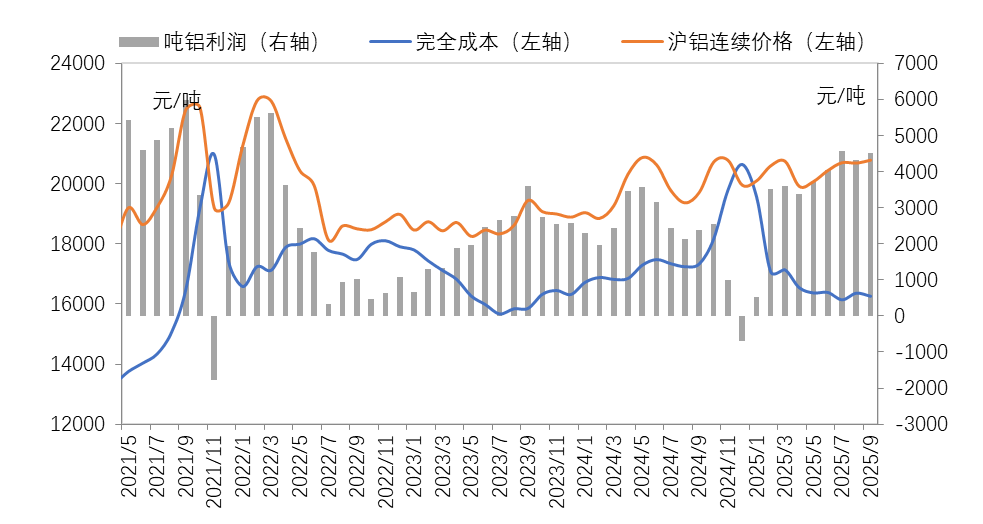
Core Insights - The Chinese electrolytic aluminum industry is expected to experience a trend of "cost reduction and profit growth" by September 2025 [1] Cost Analysis - The weighted average total cost of electrolytic aluminum (including tax) in September was 16,262 yuan/ton, a decrease of 103 yuan/ton or 0.6% month-on-month, and a decrease of 1,080 yuan/ton or 6.2% year-on-year [1] - Despite increases in electricity and anode costs, the decline in alumina prices had a more significant impact, leading to an overall reduction in costs [1] - The average spot price of alumina during the procurement period in September was 3,138 yuan/ton, down 134 yuan/ton or 4.1% month-on-month [1] Electricity and Anode Pricing - The comprehensive tax-inclusive electricity price for the electrolytic aluminum industry was 0.388 yuan/kWh, an increase of 0.006 yuan/kWh month-on-month due to rising coal prices [1] - The average price of prebaked anodes rose above 5,000 yuan/ton in September, driven by increased raw material costs and strong export demand [1] Profitability - The average price of electrolytic aluminum in September reached 20,789 yuan/ton, an increase of 99 yuan/ton month-on-month [1] - The estimated average profit for the month was 4,527 yuan/ton, an increase of 202 yuan/ton month-on-month, with a sales profit margin of 21.8%, indicating sustained profitability across the industry [1]
金融期货早评-20251010
Nan Hua Qi Huo· 2025-10-10 06:17
金融期货早评 宏观:国内需求端仍是核心症结 【市场资讯】1)中国商务部连发四则公告,事关稀土、锂电池、超硬材料等出口管制。2) 美国政府关门难解:参院七次否决拨款案,特朗普威胁砍民主党项目,共和党领袖否认要 动"大招"。3)美国劳工统计局准备在政府关门期间发布 9 月 CPI 数据。4)贝森特已面完 11 名美联储主席候选人,4 个人最有希望。美联储理事巴尔强调通胀风险、称降息需谨慎, 华尔街日报:凸显美联储内部分歧。美联储"三把手"威廉姆斯:支持今年进一步降息,并 不认为经济处于衰退边缘。5)美国财长贝森特:赤字比降至 5 开头,希望几年后降至 3 开头。 【核心逻辑】国内方面,国庆假期人员出行整体表现不弱。假期第六天,全社会跨区域人 员流动量 29819.42 万人次,环比增长 2.4%,同比增长 7%;假期前半程交通出行人数再创 新高,水路、民航旅客发送量亦实现增长。不过,国庆假期整体出行情况或不及五一假期。 整体来看,后续经济修复的关键仍需聚焦居民需求端。当前,供需两端政策正逐步推进, 后续或仍有增量政策出台,以推动物价平稳回升。需注意的是,政策出台的关键触发因素 或为经济数据超预期下滑,且政策基调仍 ...
锌:海外延续去库,伦锌表现偏强
Zheng Xin Qi Huo· 2025-10-10 02:46
Group 1: Report Industry Investment Rating - No relevant content provided Group 2: Core Views of the Report - Macro: On October 9th, some senior Fed officials preferred to keep interest rates unchanged last month, highlighting concerns that high inflation still threatens the US economy. Despite a 25 - basis - point rate cut in September, the Fed meeting minutes showed that "a few" FOMC members would have supported keeping rates unchanged as inflation might stay above the target. The rise in inflation this year has "stalled" progress towards the 2% target, and some members worried about a rise in long - term inflation expectations if inflation doesn't return to the target in time [6]. - Fundamentals: Driven by LME zinc, SHFE zinc has risen slightly recently, mainly due to optimistic macro sentiment and continuous inventory reduction overseas. In the short - term, domestic smelters prefer domestic zinc concentrates due to better profits, leading to a decrease in domestic concentrate processing fees and an increase in imported concentrate processing fees. The large inventory difference between domestic and overseas has widened the refined zinc import loss, and attention should be paid to the opening of the refined zinc export window. In the long - term, on the supply side, domestic smelters' operating rates have increased, and refined zinc output has expanded, leading to a rapid increase in domestic social inventories. Overseas, high - cost smelters are under great loss pressure due to the record - low long - term processing fees, resulting in production cuts and continuous reduction of LME inventories. The widening import loss of refined zinc reflects the different situations between domestic and overseas smelting. Globally, the cyclical supply of zinc ore is gradually becoming looser. Although the transmission from ore production increase to smelting expansion is delayed by overseas smelter production cuts, considering the sufficient domestic smelting capacity, the increase in global zinc ore output will eventually lead to an increase in refined zinc production. On the demand side, it remains relatively stable, mainly maintaining the existing volume. With supply increasing and demand stable, there is a tendency of oversupply in the long - term zinc supply - demand balance [6]. - Strategy: The pattern of a stronger overseas and weaker domestic market continues. The import loss of refined zinc has widened close to the point of opening the export window. The outflow of domestic refined zinc can help stop the LME inventory reduction. It is still advisable to consider short - selling on rallies for long - term positions [6]. Group 3: Summary of Each Section in the Table of Contents Part 2: Industrial Fundamental - Supply Side - **Zinc Concentrate Output**: In July 2025, global zinc concentrate output was 1.0762 million tons, a year - on - year increase of 10.28%. The 2025 international long - term zinc ore TC price is set at $80/ton, a record low and half of the previous year. However, the 2024 long - term TC was overestimated, and the marginal loosening trend of zinc ore supply remains unchanged [8]. - **Zinc Concentrate Imports and Processing Fees**: From January to August 2025, China's cumulative imports of zinc concentrates were 3.5033 million physical tons, a year - on - year increase of 44.02%. The increase in imports has pushed up processing fees. As of September 26th, the imported concentrate processing fee was reported at $115.9/ton, and the domestic concentrate processing fee was 3,650 yuan/ton, showing a differentiation between domestic and imported processing fees [11]. - **Smelter Profit Estimation**: The profit of domestic smelters using domestic concentrates is still good, while that of using imported concentrates has turned into a loss due to the domestic - overseas price ratio [14]. - **Refined Zinc Output**: In July 2025, global refined zinc output was 1.1963 million tons, a year - on - year increase of 6.7%. In September 2025, domestic refined zinc output was 587,200 tons, a year - on - year increase of nearly 20%. The poor profit of imported concentrates and the tightening of recycled zinc raw materials led to a month - on - month decrease in output [17]. - **Refined Zinc Import Profit and Imports**: From January to August 2025, China's cumulative net imports of refined zinc were 222,400 tons. The refined zinc import window is currently closed, and the import loss has widened to over 4,000 yuan/ton. Attention should be paid to the opening of the export window [20]. Part 3: Industrial Fundamental - Consumption Side - **Refined Zinc Initial - Stage Consumption**: In August 2025, domestic galvanized sheet output was 2.31 million tons, a year - on - year increase of 4.52%. The apparent consumption of galvanized products is relatively low, indicating weak actual demand and active destocking of hidden inventories in the industrial chain [25]. - **Refined Zinc Terminal Consumption - Infrastructure and Real Estate**: From January to August 2025, the cumulative year - on - year growth rate of infrastructure investment (excluding power) decreased. The back - end of the real estate market has stabilized at a low level, but front - end indicators such as new construction and construction are still weak [27]. - **Refined Zinc Terminal Consumption - Automobiles and Home Appliances**: In August 2025, domestic automobile production was 2.815 million vehicles, a year - on - year increase of 12.95%. With consumer loan interest subsidies and the release of a new round of national subsidies, home appliance consumption is expected to remain resilient [29]. Part 4: Other Indicators - **Inventory**: There is a differentiation in absolute inventory levels between domestic and overseas. Attention should be paid to the outflow of domestic inventory to supplement LME inventory [32]. - **Spot Premium**: As of October 8th, the LME 0 - 3 zinc premium was reported at a premium of $59.11/ton. Due to low LME inventory, the spot premium has increased. The domestic spot premium is low. On September 30th, abnormal trading of the near - month contract (Contract 10) near the closing led to abnormal price differences [35]. - **Exchange Positions**: As of October 3rd, the net long position of LME zinc investment funds was 28,894 lots. The weighted position of SHFE zinc has recently stabilized [37].