
有色金属

Search documents
去金留铜,工业有色剥离“周期躁动”?天弘中证工业有色金属主题指数基金(A类:017192/C类:017193)锚定制造业核心引擎
Xin Lang Cai Jing· 2026-02-26 09:21
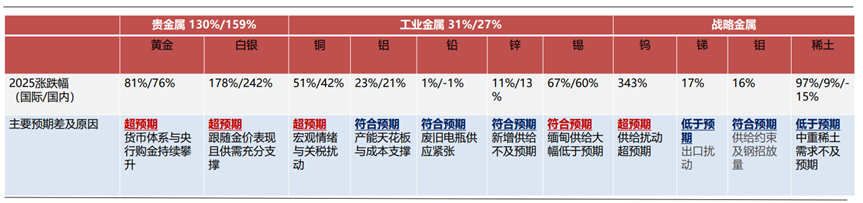
Core Viewpoint - The traditional narrative surrounding non-ferrous metals is evolving, with industrial metals transitioning from being seen as "macro volatility buyers" to "manufacturing upgrade sellers" [1] Group 1: Market Dynamics - The differentiation within the non-ferrous metals sector is evident, with precious metals driven by risk aversion and interest rate expectations, while industrial metals reflect manufacturing recovery and supply constraints [2] - Copper, as a benchmark for industrial metals, has shown a 31% increase, aligning with its 34.4% weight in the index, indicating a bullish stance on the resilience of Chinese manufacturing [2][3] Group 2: Index Composition - The Industrial Non-Ferrous Metals Index (H11059) has undergone a "genetic surgery" by excluding precious metals, thus eliminating financial attributes and risk sentiment interference, allowing investment logic to focus on the real economy [3] - The index focuses solely on industrial metals directly related to manufacturing activity, such as copper, aluminum, rare earths, tungsten, molybdenum, and titanium, ensuring its value fluctuations are tied to tangible economic indicators [3][4] Group 3: Weight Distribution - The index features a clear weight distribution, with copper at 34.4%, aluminum at 21.8%, and rare earths at 13.6%, highlighting copper's role as a key indicator of global industrial activity [4] - The remaining 25% includes strategic metals like lead, zinc, tin, molybdenum, and tungsten, which support sectors such as military, high-temperature alloys, and semiconductors, distinguishing this index from traditional non-ferrous indices [4] Group 4: Index Rules - The index has specific rules to prevent over-reliance on any single mining giant, with individual sample weights capped at 15% and the top five samples combined not exceeding 60% [5] - For diversified mining companies that produce both copper and gold, a strict weight limit of 3% is imposed to maintain the index's industrial purity [7] Group 5: Investment Accessibility - The Tianhong Industrial Non-Ferrous Metals Index Fund offers a user-friendly investment option without the need for a stock account, allowing purchases through mainstream platforms with a minimum investment of 1 yuan [8] - The fund supports automatic investment strategies to smooth out volatility, making it suitable for long-term investors looking to capitalize on upward trends in industrial metals [9]

突然爆了!老登资产席卷全球
Ge Long Hui A P P· 2026-02-26 08:41
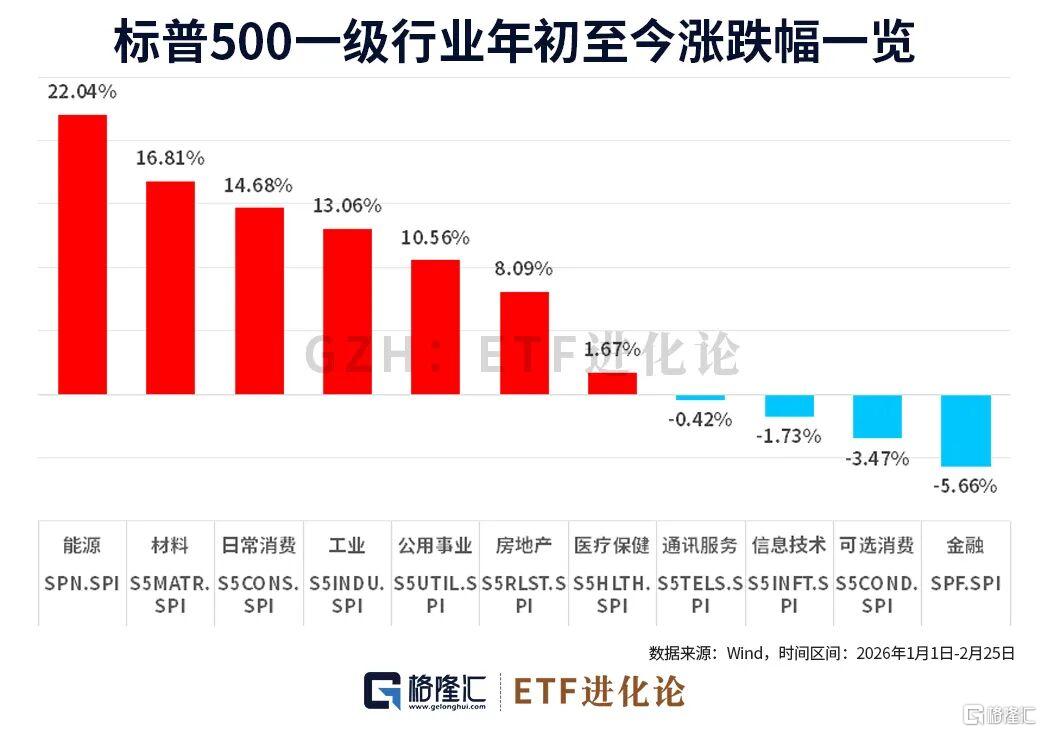
Group 1 - Nvidia's Q4 performance has exceeded expectations, leading to a surge in AI hardware stocks in the A-share market, with semiconductor ETFs in China and South Korea nearing their daily limit up, and electricity-related ETFs rising by 3% and 2.9% respectively [1] - A significant shift is occurring where technology growth is increasingly reliant on physical assets, marking a departure from the previous dominance of financial assets over physical assets [2][3] - The HALO concept, which combines heavy assets with low obsolescence, is gaining traction, indicating a paradigm shift in investment strategies towards assets that are less susceptible to technological changes [2][3] Group 2 - The rise in physical asset values is driven by geopolitical tensions and resource nationalism, which have made these assets more valuable as a safe haven compared to software and light asset industries [4] - The South Korean stock market has seen unprecedented growth, with the composite index surpassing 6000 points for the first time and achieving a year-to-date increase of 49.67% [4][5] - A-share market trends reflect a similar "physical asset supremacy," with significant gains in sectors such as construction materials, non-ferrous metals, and petrochemicals [7] Group 3 - ETFs with high physical asset content have dominated the performance charts, with several indices, including semiconductor and oil and gas resources, showing gains of over 25% year-to-date [10] - In the first two trading days of the year, A-share financing clients purchased a total of 57.5 billion yuan, indicating strong capital inflow into physical assets [13] - The top sectors for net buying include electronics, non-ferrous metals, and power equipment, highlighting investor interest in HALO stocks [17][18] Group 4 - High inflows into HALO-focused ETFs have been observed, with significant net purchases in gold, semiconductor materials, and electricity equipment ETFs [20] - The macroeconomic environment is favoring heavy asset industries, as manufacturing PMI has rebounded, surpassing service sector PMI [22] - Tech giants are projected to spend approximately $1.5 trillion on capital expenditures from 2023 to 2026, with $650 billion expected this year alone, indicating a strong focus on infrastructure investments [22]
2月26日连板股分析:行情高速轮动 情绪复苏初现曙光
Xin Lang Cai Jing· 2026-02-26 08:33
Core Insights - The market is experiencing a rapid rotation of themes, with a notable recovery in sentiment as evidenced by 61 stocks hitting the daily limit up, and 9 stocks in a continuous rise, including 4 stocks with three or more consecutive limit ups [1] Group 1: Market Performance - A total of 61 stocks reached the daily limit up, with 9 stocks in a continuous rise, and 4 stocks achieving three or more consecutive limit ups [1] - The limit-up rate for stocks in consecutive rises was 22.22%, excluding ST and delisted stocks [1] Group 2: Sector Analysis - The market is characterized by a high-speed rotation of themes, with strong performance in AI-related sectors such as computing power leasing, generator concepts, PCB, and optical fiber cables, leading to over 30 related stocks hitting the limit up [1] - The cyclical sector showed signs of adjustment, but still maintained strong activity, with companies like Jinzhengdai and Chengxing Co. achieving three consecutive limit ups in the chemical sector [1] Group 3: Notable Stocks - YN Energy Holdings achieved a significant milestone by becoming the first stock to break through five consecutive limit ups since February 2026, marking an important moment for overall sentiment recovery [1] - AI-related technology stocks performed strongly, with companies like Huasheng Tiancai and Taijia Co. achieving two limit ups in four days, while core stock Runze Technology surged over 17% [1] - Other notable performances include Falsheng in the optical fiber cable sector achieving four consecutive limit ups, and Tiangrun Industrial in the generator concept sector achieving two limit ups in three days [1]
宏观利好共振,有色板块迎投资窗口? 从“硬资产轮动”到有色重估:机构眼中的2026主线
Sou Hu Cai Jing· 2026-02-26 07:46
Core Viewpoint - The precious metals market, represented by gold and silver, has shown a strong upward trend since the Spring Festival, driven by "hedging" and "stagflation trading" dynamics [1] Group 1: Hedging Logic - Global macro uncertainties are providing fundamental support for the prices of non-ferrous metals, including precious metals [4] - The reversal of U.S. tariff policies, with the Supreme Court ruling against large-scale tariffs from the Trump administration, has led to increased trade friction and market risk aversion [4] - Geopolitical uncertainties, such as the lack of progress in Russia-Ukraine negotiations and U.S.-Iran tensions, are heightening global risk aversion, prompting investors to diversify into "hard assets" like precious metals and copper [5] Group 2: Stagflation Trading - Recent U.S. economic data indicates a slowdown, with projected GDP growth for 2025 at 2.2%, down from 2.8% in 2024, marking the lowest growth since 2021 [6] - The Personal Consumption Expenditures (PCE) price index for December 2025 is expected to rise by 3.0%, significantly above the Federal Reserve's 2% inflation target, raising concerns about stagflation [6] - Stagflation, characterized by stagnant economic growth and high inflation, typically benefits commodities due to their inflation-hedging properties [7] Group 3: Focus on Non-Ferrous Core Assets - As the market transitions into a "profit-driven growth phase" by 2026, the strong cyclical nature of non-ferrous metals is expected to manifest, presenting revaluation opportunities [8] - The ongoing issuance of the Silver Hua Zhongzheng Non-Ferrous Metal ETF Connect (Class A: 026458; Class C: 026459) offers a convenient investment tool for investors seeking exposure to core assets in the non-ferrous sector [8] - The CSI Non-Ferrous Metal Index, as of February 24, 2026, shows significant representation across various sectors, including copper (29.6%), gold (14.9%), aluminum (14.7%), rare earths (8.3%), and lithium (6.5%) [10]

中信证券敖翀:有色牛市还很长,阶段性回调就是进场机会
Xin Lang Cai Jing· 2026-02-26 07:11
Core Viewpoint - The long-term trend in the non-ferrous metals industry is not over, but short-term risks are rapidly accumulating, suggesting a cautious investment strategy of "holding but not blindly chasing highs" [1] Investment Strategy - Investors are advised to consider reducing positions if prices rise too quickly, as adjustments may present better entry opportunities [1] - Stock selection should align with market phases: during established trends, leading companies show the strongest certainty; risk-tolerant investors may focus on growth companies with a "volume increase and price rise" logic [1] Trading Opportunities - Attention should be given to "divergent" trading opportunities, where commodity prices continue to rise while stock prices do not, indicating potential phase-based layout windows [1]

广西百色工业总产值突破2500亿元
Zhong Guo Jing Ji Wang· 2026-02-26 06:13
Core Insights - In 2025, Baise City aims to achieve a 14.3% growth in industrial investment, with total industrial output value exceeding 250 billion yuan, marking a 106.7% increase from 2020 [1] Group 1: Industrial Investment and Economic Growth - Baise City is focusing on innovation-driven strategies and project construction to expand industrial investment and optimize service guarantees [1] - The city has introduced over 290 key industrial projects, completing industrial investments totaling 100 billion yuan, primarily in sectors such as non-ferrous metals, new energy, new materials, energy conservation and environmental protection, equipment manufacturing, and timber processing [1] - During the "14th Five-Year Plan" period, Baise added 459 new industrial enterprises and initiated over 330 major industrial projects, with more than 260 projects completed and put into operation, achieving an average annual investment growth of 16.3% [1] Group 2: Modern Industrial System and Energy Efficiency - Baise is committed to modernizing its industrial system by enhancing traditional industries through high-end, intelligent, and green transformations [2] - The city has cultivated 6 national-level specialized and innovative "little giant" enterprises and 46 provincial-level specialized and innovative small and medium-sized enterprises [2] - Energy consumption per unit of output value in large-scale industrial units has decreased by 22.6%, with high-energy-consuming industries seeing a 21.4% reduction [2] - The city has established 4 provincial-level intelligent manufacturing benchmarks, 21 intelligent factories, and 24 digital workshops [2]
股市面面观丨节后A股市场稳步回暖,钢铁、有色领涨有何动力?
Xin Hua Cai Jing· 2026-02-26 05:52
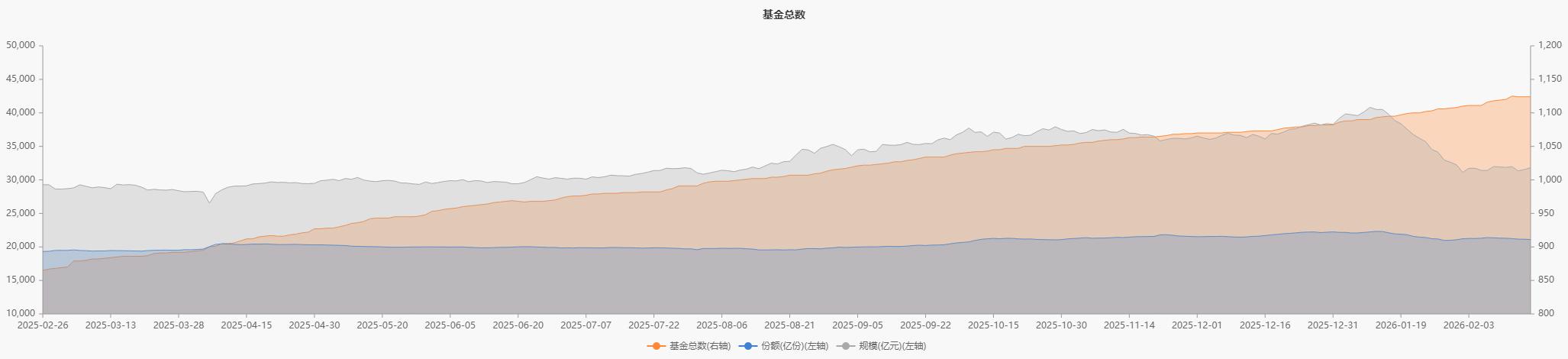
Market Overview - The A-share market has shown a significant recovery since the holiday, with the Shanghai Composite Index rising by 1.6%, the Shenzhen Component Index by 2.66%, and the ChiNext Index by 2.41% as of February 25 [1] - The average stock price in the A-share market increased by 1.62%, reaching 30.07 yuan per share, surpassing the 30 yuan mark [1] - Trading volume has also rebounded, with the first trading day post-holiday seeing a turnover of 2.2 trillion yuan, which further increased to 2.46 trillion yuan on the following day, exceeding the average daily turnover of approximately 2.09 trillion yuan before the holiday [1] Leverage and Fund Inflow - Leveraged funds have actively entered the market post-holiday, with net financing purchases reaching 338.9 billion yuan on the first trading day, marking the second-highest level of the year [2] - On February 25, net financing purchases amounted to 236.4 billion yuan, bringing the total for the two trading days to 575.3 billion yuan, surpassing the net selling scale before the holiday [2] - Prior to the holiday, the A-share market experienced a decline in financing balance from 2.722 trillion yuan to 2.572 trillion yuan, a drop of 150 billion yuan due to risk aversion among investors [2] ETF Market Stability - The A-share stock ETF market saw a rapid decline in late January, dropping from over 4 trillion yuan to around 3.1 trillion yuan, but has stabilized since February [2] - As of February 25, the asset scale of stock ETFs was reported at 3.18 trillion yuan, maintaining a steady state [2] Sector Performance - Among the 31 first-level industries, the steel, non-ferrous metals, building materials, oil and petrochemicals, and basic chemicals sectors showed the highest growth rates post-holiday, with the steel sector leading at a 7.19% increase [4][5] - Other notable sectors included non-ferrous metals at 6.90%, building materials at 6.56%, oil and petrochemicals at 5.73%, and basic chemicals at 5.68% [5] Economic Outlook and Policy Impact - Market participants have noted an increased expectation for macroeconomic recovery, particularly with the anticipation of stable growth policies being reflected in the A-share market [6] - Analysts predict that a series of investment-promoting policies will be implemented, leading to accelerated infrastructure investment in the first half of 2026 [6] - The market is expected to shift from "policy expectations" to "earnings realization" as companies begin to disclose their annual reports for 2025 and subsequent quarterly reports for 2026, which will serve as key market indicators [7]
”沪七条“利好铜铝需求!有色金属ETF天弘(159157)盘中净申购超7000万份
Sou Hu Cai Jing· 2026-02-26 05:50
Group 1 - The industrial non-ferrous metals sector is experiencing fluctuations, with related ETFs showing a decline, specifically the Tianhong Non-Ferrous Metals ETF (159157) which fell by 0.68% during trading, with a transaction volume of 204 million yuan and a turnover rate of 9.07% [1] - The Tianhong Non-Ferrous Metals ETF has seen a net subscription of over 70 million units during the trading session, marking it as the top performer in the Shenzhen market. Over the past eight trading days, it has attracted a net inflow of 1.075 billion yuan, reaching a total fund size of 2.265 billion yuan as of February 25, 2026, a new high since its listing [1] - The ETF covers a wide range of sectors including copper, aluminum, gold, and rare earths, providing exposure to precious metals (safe-haven), strategic metals (growth), and industrial metals (recovery), which allows for better capturing of the beta trends across the entire sector [1] Group 2 - The industrial non-ferrous metals sector is influenced by multiple news factors, including the Shanghai government's new real estate policies aimed at boosting the market, which is expected to positively impact the demand for copper and aluminum [2] - The U.S. plans to set reference prices for critical minerals, including germanium and gallium, leading to a reassessment of the value of scarce minerals in the market [2] - Zimbabwe's announcement to suspend lithium concentrate exports, along with increased mineral controls in countries like Indonesia and the Democratic Republic of Congo, has heightened global supply chain tensions, while post-Spring Festival recovery in downstream enterprises is gradually releasing inventory demand, supporting metal prices [2]
关注重磅会议日历效应布局窗口,资金布局大宽基机遇,中证A500ETF(159338)上一交易日净流入超1.5亿元
Mei Ri Jing Ji Xin Wen· 2026-02-26 05:23
Group 1 - The core viewpoint of the article highlights the historical calendar effect on A-shares around the Two Sessions, driven by market expectations for stable growth policies and active financing transactions [1] - Industries such as basic chemicals, non-ferrous metals, and building materials are expected to perform well before and after the Two Sessions, with a higher probability of price increases [1] - Following the conclusion of the Two Sessions, the implementation of stable growth policies is anticipated to further enhance the performance of cyclical sectors, leading to higher average returns [1] Group 2 - Compared to the CSI 300, the CSI A500 emphasizes industry balance and leading companies in specific sectors, offering a more diversified style and higher growth exposure, which provides a better Beta base during industrial structural upgrades [1] - The historical performance of the CSI A500 index shows a significant increase of 464.28% since its base date, outperforming the CSI 300 index, which increased by 361.15%, resulting in an excess return of 103.13% [1] - As of the mid-2025 report, the number of accounts for the Guotai CSI A500 ETF is the highest in its category, being more than three times that of the second-ranked ETF, indicating a growing interest among investors in the CSI A500 ETF (159338) [1]
股指持续回升
Hua Tai Qi Huo· 2026-02-26 05:07
FICC日报 | 2026-02-26 股指持续回升 市场分析 地产松绑。宏观方面,上海市五部门联合印发《关于进一步优化调整本市房地产政策的通知》("沪七条"),自2026 年2月26日起施行。新政重点调减限购政策:非沪籍居民购买外环内住房社保年限从3年降至1年,缴纳社保满3年 可增购1套;持居住证满5年可购1套,无需社保。公积金家庭贷款最高额度可达到324万元。只要沪籍家庭新购住 房是其名下唯一住房,即可暂免征收房产税。美国贸易代表格里尔近日表示,将继续推进对中国履行中美第一阶 段经贸协议情况301调查,并可能采取关税措施。海外方面,美国商务部表示,将对从印度、印度尼西亚和老挝进 口的晶硅太阳能电池组件征收反补贴税,理由是其生产商受益于政府补贴,削弱美国本土产品竞争力。 指数上涨。现货市场,A股三大指数震荡走强,上证指数涨0.72%收于4147.23点,创业板指涨1.41%。行业方面, 板块指数涨多跌少,钢铁、有色金属、建筑材料、房地产、基础化工行业涨幅超2%,仅银行、传媒行业收跌。市 场延续放量,当日沪深两市成交额超2万亿元。海外方面,美国三大股指全线收涨,纳指涨1.26%报23152.08点。 IC增仓 ...