生猪养殖

Search documents
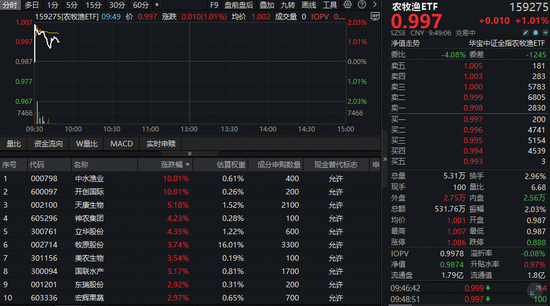
能繁母猪存栏量重回4000万头以下!农牧渔板块开盘大涨,全市场唯一农牧渔ETF(159275)盘中涨超2%!
Xin Lang Ji Jin· 2025-11-24 02:02
Core Viewpoint - The agricultural, animal husbandry, and fishery sector experienced a significant rise in stock prices, particularly in the ETF that tracks this sector, indicating a positive market sentiment and potential investment opportunities in the industry [1][4]. Market Performance - The agricultural and fishery ETF (159275) opened with a price increase of over 2% at one point, closing with a gain of 1.01% [1]. - Key stocks in the sector, including Zhongshui Fishery and Kaichuang International, reached their daily limit, while Tiankang Biological and others saw increases of over 4% [1]. Industry Insights - The Ministry of Agriculture and Rural Affairs held a meeting indicating stable development in livestock production, with the number of breeding sows falling below 40 million by the end of October [1]. - Huaxi Securities noted that pig prices are at low levels, close to industry cash costs, and that capacity reduction is exceeding expectations, suggesting potential for future price increases [1][3]. Price Trends - Current prices for fat pigs have dropped below 12 yuan per kilogram, and weaned piglet prices are around 200 yuan each, indicating that the industry is facing significant losses [3]. - Historical trends suggest that when prices are at such low levels, the industry is likely to undergo market-driven capacity reductions, which could lead to long-term price increases [3]. Valuation and Investment Opportunities - The agricultural and fishery sector may present a favorable investment opportunity, with the ETF's price-to-book ratio at 2.54, which is relatively low compared to historical data [3]. - The ETF (159275) is noted for its high exposure to the pig farming sector, with a 40.25% allocation, making it a key vehicle for investors looking to capitalize on this market [5]. Future Outlook - Guoxin Securities predicts that the official capacity control will improve cash flow for leading companies, potentially transforming them into dividend-paying stocks [4]. - The poultry farming sector is expected to see limited supply fluctuations, with leading companies likely to achieve higher cash flow and dividend returns as demand recovers [4].

生猪产能去化加速,板块迎来配置机遇
2025-11-24 01:46
生猪产能去化加速,板块迎来配置机遇 20251123 目前生猪板块正处于新一轮的起点,进入了去产能的逻辑。自 2025 年 6 月以 来,行业逐步从政策炒作转向稳定发展,并在 10 月份加速了去产能进程。农 业农村部数据显示,10 月份能繁母猪存栏量已降至 4,000 万头以下,相比 9 月份下降了 0.9%。这一趋势表明行业正在加速去化。 2025 年下半年的猪价走势如何? 2025 年下半年猪价持续低迷。尽管市场上曾有部分观点看好下半年猪价,但 我们一直持悲观态度。从数据来看,今年头部猪企出栏增速显著,全年出栏增 速达 20%,绝对值增加了 3,400 多万头。而去年(2024 年)仅为 5%左右, 增加约 800 万头。这种快速增长导致供给压力巨大,加之需求端未见显著变化, 10 月份能繁母猪数量加速下降,预计下降速度可能会维持在每月环比 0.9%至 1%左右,行业将逐步进入产能去化加速的阶段。市场情绪非常 悲观。 当前行业环境下,应选择成本低、具有扩张潜力、资产负债率低且现金 流强劲的公司作为投资标的。推荐牧原股份和温氏股份,小型企业如天 康、德康、神农、巨星和丽华也值得关注。年底是政策密集出台期,对 ...
加强生猪产能综合调控,加快构建供需动态适配
Xuan Gu Bao· 2025-11-23 14:57
公司方面,据中证报表示,A股相关概念股有海大集团、罗牛山等。 *免责声明:文章内容仅供参考,不构成投资建议 *风险提示:股市有风险,入市需谨慎 据中证报报道,11月21日,农业农村部部长韩俊主持召开部常务会议。会议要求,要加强生猪产能综合 调控,加快构建供需动态适配、规模结构合理、产业链协同提升的生猪产业高质量发展格局。 要加强生产和市场监测预警,动态调整全国能繁母猪正常保有量目标,提早开展逆周期调节,防止出现 大的波动。要全链条提高生猪产业竞争力,健全现代生猪良种繁育体系,深入开展养殖业节粮行动,优 化生猪屠宰加工布局,积极推动粪肥无害化处理和资源化利用,切实抓好非洲猪瘟等重大动物疫病常态 化防控。要引导大型生猪企业提质增效、稳健发展,支持中小养殖场户发展适度规模养殖。 中证报指出,生猪产业已被明确为"现代化大产业"的重要组成部分,国家支持产业向规模化、标准化、 智能化、现代化发展。我国将用5-10年时间,基本形成产出高效、产品安全、资源节约、环境友好、调 控有效的生猪产业高质量发展新格局。我国生猪养殖产业正从传统养殖向现代化、可持续化转型,通 过"种源、高效、绿色、智能"四大核心方向的协同推进,构建起更加 ...
农产品研究跟踪系列报告(183):生猪行业反内卷有序推进,看好海内外牧业大周期反转
Guoxin Securities· 2025-11-23 14:57
Investment Rating - The report maintains an "Outperform" rating for the agricultural products sector, particularly focusing on the livestock industry and its cyclical recovery [1][4]. Core Insights - The livestock industry is experiencing a reversal of internal competition, which is expected to support long-term pig prices. As of November 21, the price of live pigs was 11.67 CNY/kg, with a week-on-week decrease of 0.4% [1]. - The beef market is entering a new price increase phase, with the average price of beef at 66.38 CNY/kg, showing a year-on-year increase of 8% [2]. - The report emphasizes the importance of leading companies in the livestock sector, suggesting that their cash flow will improve due to official capacity control measures [3]. Summary by Sections 1. Weekly Overview and Data Summary - The report provides a weekly summary of agricultural product data, highlighting trends in livestock prices and supply dynamics [12]. 2. Fundamental Tracking 2.1 Swine - The swine industry is seeing orderly progress in reversing internal competition, which is expected to stabilize profitability [13]. 2.2 White Chicken - A slight increase in supply is noted, with attention on seasonal consumption recovery [13]. 2.3 Yellow Chicken - Supply remains at a low level, with potential benefits from improved domestic demand [13]. 2.4 Eggs - The egg market faces significant mid-term supply pressure, with wholesale prices at 3.63 CNY/jin, down 28% year-on-year [13]. 2.5 Beef - A new round of beef price increases is anticipated, with a focus on the upward trend in the beef cycle for 2025 [13]. 2.6 Raw Milk - The report suggests that the de-stocking of dairy cows may accelerate in Q4, potentially leading to a price turning point for raw milk [13]. 2.7 Soybean Meal - Short-term supply is expected to be ample, while medium-term demand and supply dynamics are projected to strengthen [13]. 2.8 Corn - Domestic supply and demand balance is tightening, with prices expected to maintain a moderate upward trend [13]. 2.9 Sugar - Short-term increases in imports are noted, with attention on the rhythm of arrivals and fluctuations in crude oil prices [13]. 2.10 Rubber - Prices are expected to stabilize in the short term, with a positive outlook for the medium term [13]. 2.11 Palm Oil - Short-term performance is weak, with medium-term policy support being a focus [13]. 2.12 Cotton - Inventory pressure is neutral, with demand still needing recovery [13]. 2.13 Red Dates - Limited demand recovery is noted, with attention on weather conditions in new production areas [13]. 3. Market Trends - The report discusses market trends and price movements across various agricultural products, indicating a complex interplay of supply and demand factors [12].





农林牧渔行业周报第39期:10月能繁降至4000万头以下,推荐生猪养殖-20251123
HUAXI Securities· 2025-11-23 14:56
Investment Rating - The industry rating is "Recommended" [3] Core Views - The report highlights that the national breeding sow inventory has fallen below 40 million heads as of the end of October, indicating a significant reduction in production capacity. This situation presents a left-side layout opportunity in the pig farming sector [2][12] - The report emphasizes that the pig farming industry is currently in a loss-making state, with average losses per self-bred pig reaching 135.9 yuan and 234.63 yuan for purchased piglets. However, proactive and reactive capacity reduction measures are expected to accelerate, leading to a potential increase in domestic pig prices in the medium to long term [2][12] - The report suggests that the future trend in the pig industry will focus on "quality improvement and efficiency enhancement," with the gradual elimination of backward production capacity and an increase in market share for financially sound and low-cost producers [2][12] Summary by Sections 1. Weekly Insights - The Ministry of Agriculture and Rural Affairs held a meeting to promote the revitalization of the seed industry, emphasizing the importance of enhancing responsibility and focusing on high-quality development during the 14th Five-Year Plan period. The meeting also highlighted the revolutionary role of genetically modified technology in improving yield [11] 2. Market Review - The agricultural sector index decreased by 3.45% during the week from November 17 to November 21, with the pig farming sector experiencing price fluctuations close to cash costs [14][19] 3. Key Agricultural Product Data Tracking - The average price of live pigs was reported at 11.72 yuan/kg, down 1.50% week-on-week. The average price of pig feed was 2.6 yuan/kg, reflecting a 0.78% increase [26][51]


晚报 | 11月24日主题前瞻
Xuan Gu Bao· 2025-11-23 14:48
明日主题前瞻 1、算力 | 日前,谷歌在其全员大会上披露了未来AI基础设施的宏伟目标,计划"每6个月将算力容量翻倍",并在未来4到5年内实现"1000倍能力提升",谷歌 云AI基础设施负责人Vahdat强调,AI基础设施竞争是整个AI竞赛中最关键、也最昂贵的部分。他指出,谷歌的任务不是比谁花得更多,而是要构建更可靠、 更高性能、更具扩展性的基础设施。 点评:分析认为,本周谷歌接连发布Gemini3通用AI模型与Nano Banana Pro专业图像生成模型,实现双产品AI革新,现象级多模态模型的推出有望进一步提 升算力与存力的需求。谷歌CEO皮查伊近日指出,计算能力供应是当前的核心瓶颈。与此同时,英伟达数据中心业务的强劲增长,直接印证了人工智能和大 型模型训练对高性能计算的巨大渴求,显著减缓了市场对AI泡沫预期破裂的风险。机构认为,AI正逐步推动基础设施投资与商业模式形成闭环,看好AI产 业链业绩上修与估值提升机遇以及AI需求带动下的投资机遇。 2、存储 | 11月23日,长鑫存储正式发布其最新DDR5产品系列,最高速率达8000Mbps,最高颗粒容量24Gb,并同步推出覆盖服务器、工作站及个人电脑全 领域的 ...

产能去化逐步显现,10月全国能繁降至4000万头以下:农林牧渔
Huafu Securities· 2025-11-23 13:29
Investment Rating - The industry rating is "Outperform the Market" indicating that the overall return of the industry is expected to exceed the market benchmark index by more than 5% in the next 6 to 12 months [78]. Core Insights - The report highlights a gradual reduction in production capacity in the pig farming sector, with the number of breeding sows in China dropping below 40 million as of October, reflecting a decrease of over 350,000 from September [2][35]. - The report suggests that the recent losses in pig farming, combined with capacity control policies, are likely to enhance expectations for production capacity reduction, which may lead to a long-term increase in pig prices [2][35]. - The report recommends focusing on companies such as TianKang Biological, Muyuan Foods, Wens Foodstuff Group, and Dekang Agriculture [2][35]. Summary by Sections Pig Farming - Pig prices initially declined but showed slight recovery later in the week, with an average price of 11.62 CNY/kg as of November 21, reflecting a week-on-week decrease of 0.04 CNY/kg [11]. - The average weight of pigs sold increased to 128.81 kg, up by 0.33 kg week-on-week, driven by improved weight gain due to lower temperatures [24][35]. - The report indicates that the industry is currently facing losses, but the expected reduction in production capacity may lead to higher long-term price stability for quality pig farming companies [35]. Cattle Farming - Short-term prices for beef cattle have slightly decreased, with the price of fattened bulls at 25.58 CNY/kg, down 0.16% week-on-week, while calf prices increased to 32 CNY/kg, up 0.63% week-on-week [38]. - The report notes that the supply of beef cattle is expected to tighten in the medium to long term, with prices anticipated to enter an upward cycle between 2026 and 2027 [38]. Dairy Farming - The price of raw milk is currently at a low point, recorded at 3.03 CNY/kg, which is a 31% decrease from the peak [39]. - The ongoing losses in the dairy sector are expected to continue driving production capacity reduction, with a potential stabilization and recovery in raw milk prices anticipated as supply contracts [39]. Poultry Farming - The report indicates a decrease in the enthusiasm for restocking broiler chickens, with the price of white feather broilers at 7.15 CNY/kg, showing a slight increase of 0.03 CNY/kg week-on-week [46]. - The price of chicken eggs averaged 6.25 CNY/kg, down 0.24 CNY/kg week-on-week, with expectations for future price recovery due to supply constraints from ongoing avian influenza outbreaks [46][49]. Agricultural Products - The report notes a correction in soybean meal prices following the USDA report, with spot prices at 3070 CNY/ton, down 28 CNY/ton week-on-week [62]. - The report emphasizes the importance of monitoring actual soybean purchases and planting weather in South America for future price movements [62].
农业重点数据跟踪周报:生猪产能去化或加速,宠物内销增长亮眼-20251123
CAITONG SECURITIES· 2025-11-23 12:47
Core Insights - The report maintains a positive outlook on the agricultural sector, particularly in the pig farming and pet food industries, highlighting potential growth opportunities and ongoing challenges in supply and pricing [2][4][6]. Pig Farming - The pig farming sector is experiencing a downward trend in prices, with the average price of live pigs at 11.60 CNY/kg as of November 20, reflecting a week-on-week decrease of 2.11% [29][30]. - The number of breeding sows has decreased, with a reported month-on-month decline of 0.77% in October, indicating ongoing supply pressures [20][6]. - Profitability remains a concern, with losses reported at -135.90 CNY per head for self-bred pigs and -234.63 CNY per head for purchased piglets as of November 21 [33][38]. Poultry Farming - The poultry sector is seeing a rise in white chicken prices, with an average price of 7.15 CNY/kg as of November 21, up 0.42% week-on-week [39][36]. - The outbreak of avian influenza in overseas markets is creating uncertainty in the supply chain, which may benefit the white feather chicken industry in the long term [36][37]. Animal Health - The animal health industry is expected to rebound as demand for biological products increases, driven by a recovery in livestock profitability and inventory levels [44]. - Recent developments in vaccine research, particularly for African swine fever, are anticipated to stimulate interest in the sector [44]. Seed Industry - The prices of key agricultural commodities such as wheat and corn have shown slight increases, with wheat averaging 2505 CNY/ton and corn at 2280 CNY/ton as of November 21 [47]. - The report emphasizes the importance of enhancing food security and promoting the adoption of biotechnology in the seed industry [47]. Pet Industry - The pet food market is experiencing robust growth in domestic sales, with e-commerce sales up 19% year-on-year in October [55]. - Notable performance during the Double Eleven shopping festival indicates a strong market presence for domestic brands, with significant sales increases reported for several companies [56]. - Export figures for pet food show a decline, with October exports at 772 million CNY, down 15.9% year-on-year, but the impact of tariff disruptions is expected to be limited [54][52].


行业周报:生猪能繁去化加速,我国暂停进口日本水产利多国内水产板块-20251123
KAIYUAN SECURITIES· 2025-11-23 12:19
Investment Rating - The investment rating for the agriculture, forestry, animal husbandry, and fishery industry is "Positive" (maintained) [1] Core Views - The demand for pork is expected to support prices as the year-end peak season approaches, despite a decline in prices due to overproduction and accelerated culling of sows [3][12] - The suspension of imports of Japanese seafood is beneficial for the domestic aquaculture sector, as it reduces competition and supports local prices [4][18] - The pet industry is experiencing growth driven by consumer upgrades and increased domestic production, with significant market potential projected for the coming years [22] Summary by Sections Weekly Observation - The culling of breeding sows has accelerated, with the national average price of live pigs at 11.62 yuan/kg as of November 21, 2025, down 0.01 yuan/kg week-on-week and down 4.75% year-on-year [11][12] - The average weight of pigs slaughtered is 128.81 kg, showing a slight increase week-on-week [11] - Cold weather is expected to boost pork consumption, providing support for prices during the peak season [12] Weekly Insights - The pig farming sector is facing losses, leading to accelerated culling of sows. Recommended stocks include Muyuan Foods, Wens Foodstuff Group, and others [22] - The feed sector is benefiting from strong demand, with domestic production expected to improve due to recovery in livestock numbers [22] - The pet market is projected to grow significantly, with a focus on domestic brands due to rising consumer preferences and tariff barriers [22] Market Performance (November 17-21) - The agricultural sector outperformed the market by 0.45 percentage points, with the Shanghai Composite Index down 3.90% and the agricultural index down 3.45% [24] - The fishery sector led gains, with notable increases in stocks such as Zhongshui Fishery (+61.05%) and others [24][30] Price Tracking (November 17-21) - The average price of live pigs was 11.64 yuan/kg, down 0.09 yuan/kg from the previous week, while the price of piglets increased to 19.15 yuan/kg [35] - The price of corn futures rose slightly to 2183.00 yuan/ton, while soybean meal futures decreased to 2427.00 yuan/ton [46][50]

白猪巨头纷纷转身,黑猪背后隐藏的百亿棋局
Xin Lang Cai Jing· 2025-11-22 12:13
Core Insights - The black pig industry in China is emerging as a key direction for transformation amid high costs and market volatility in the pig farming sector, driven by consumer demand for high-quality and flavorful food [1][3] Group 1: Market Trends - The scale of black pig farming has been expanding, with an expected output of 21.8 million heads in 2024 and a market share increase from less than 3% a decade ago to around 7% currently [3] - The average price of black pig meat is projected to reach 65-70 yuan per kilogram by 2025, with some premium products exceeding 100 yuan per pound [3][4] - The expansion of sales channels, including e-commerce platforms and fresh supermarkets, is creating broader market opportunities for black pig products [3] Group 2: Breeding Innovations - Breeding is fundamental to the development of the pig industry, requiring a balance between meeting internal production needs and providing quality genetic resources for the industry [4] - Joint breeding initiatives are essential for improving breeding standards, with successful examples from countries like Denmark highlighting the importance of resource sharing and data connectivity [4] - Recent advancements in genetic improvement and the application of technologies like whole-genome selection have reduced breeding cycles from 36 months to 18 months, supporting the growth of the black pig industry [4] Group 3: Production and Quality Management - Balancing scale and quality is a critical challenge for enterprises, as excessive focus on scale can lead to genetic degradation and loss of flavor, while complete free-range farming may not meet market demand [5] - Welfare farming practices are not only ethical but also enhance meat quality by optimizing the farming environment and reducing stress on the pigs [7] Group 4: Industry Collaboration - The development of the black pig industry relies on collaboration across breeding, farming, processing, and sales, as demonstrated by the establishment of the "Black Pig Alliance" in Anhui [8] - The diversification of black pig products from traditional items to ready-to-eat meals is expected to see pre-prepared dishes account for 25% of processed products by 2025, driving consumption growth [8] Group 5: Technological Advancements and Market Expansion - The application of technologies such as gene editing and digital management is anticipated to lead to breakthroughs in disease resistance, growth efficiency, and meat quality [9] - By 2026, the national output of black pigs is expected to exceed 32 million heads, with hybrid varieties making up over 60% of the total [9] - The potential for consumption growth in lower-tier cities and rural areas is gradually being realized, positioning black pigs to transition from a niche market to a mainstream choice [9]