
有色金属冶炼

Search documents
美国二季度GDP增速上修,阿根廷谷物出口免税政策结束
Dong Zheng Qi Huo· 2025-09-26 00:42
Report Industry Investment Ratings No relevant content provided. Core Views of the Report - The US economy showed resilience in Q2 with an upward - revised GDP growth rate, which led to a short - term rebound in the US dollar index. The bond market at the end of September is more likely to fluctuate rather than decline unilaterally. In the commodity market, different products have different trends due to various factors such as policy changes, supply - demand relationships, and seasonal factors [1][2][3] Summary According to Relevant Catalogs 1. Financial News and Reviews 1.1 Macro Strategy (Gold) - Fed official Goolsbee said the job market is cooling while inflation is rising. Trump plans to increase tariffs on kitchenware and other products starting from October 1, 2025. The US Q2 GDP growth rate was revised up to 3.8%. Gold prices fluctuated and rose with increased intraday volatility. Short - term gold prices are expected to remain high, but there is a risk of correction due to profit - taking [9][10][11] 1.2 Macro Strategy (US Stock Index Futures) - Trump plans to impose 100% tariffs on brand and patented drugs and 25% tariffs on imported heavy - duty trucks from October 1, 2025. The US Q2 GDP growth rate was revised up to 3.8%, and the August durable goods orders increased by 2.9% month - on - month. The market's expectation of interest - rate cuts decreased, and the risk appetite declined. Short - term US stocks are expected to continue to adjust [13][15][16] 1.3 Macro Strategy (Foreign Exchange Futures - US Dollar Index) - The number of initial jobless claims in the US last week dropped to the lowest level since July. Fed official Bowman believes that the weakening job market justifies further interest - rate cuts. The US Q2 GDP growth rate was revised up to 3.8%, indicating economic resilience and leading to a short - term rebound in the US dollar index [18][19][20] 1.4 Macro Strategy (Treasury Bond Futures) - The central bank's deputy governor supports the implementation of offshore bond repurchase business in Hong Kong. The central bank conducted 4835 billion yuan of 7 - day reverse repurchase operations on September 25, with a net withdrawal of 35 billion yuan. The bond market at the end of September is more likely to fluctuate, and it is expected to continue to find the bottom in the first half of October and may stabilize and rise in the second half [22][23][24] 2. Commodity News and Reviews 2.1 Agricultural Products (Soybean Meal) - In August 2025, the national industrial feed production increased both month - on - month and year - on - year. Argentina resumed the export withholding tax on grains and other agricultural products. The USDA will release the quarterly inventory report on September 30. After the end of Argentina's export tax - exemption policy, the prices of domestic and foreign futures contracts stabilized and are expected to resume a fluctuating trend [26][27][29] 2.2 Agricultural Products (Soybean Oil/Rapeseed Oil/Palm Oil) - From September 1 - 25, 2025, the export volume of Malaysian palm oil increased by 11.31% month - on - month. Argentina resumed the export tax on grains and by - products. The global oil market rebounded, and the trading focus may return to the US biofuel policy. It is recommended to control positions before the National Day holiday [30][31][32] 2.3 Black Metals (Rebar/Hot - Rolled Coil) - In mid - September 2025, the daily output of key steel enterprises' crude steel decreased by 0.6% month - on - month, while the daily output of pig iron increased by 0.7% and that of steel products increased by 5.4%. As of September 25, the inventory of five major steel products decreased slightly. The steel price is expected to continue to fluctuate and rebound before the holiday [33][34][35] 2.4 Agricultural Products (Red Dates) - The physical inventory of 36 sample points of red dates decreased slightly. The futures price of the main contract closed higher. The supply in Xinjiang is normal, and the demand in the distribution areas is stable. The price is under pressure due to high inventory and weak consumption, and the fundamentals are bearish [37][38] 2.5 Agricultural Products (Corn Starch) - The consumption of corn and corn starch by starch sugar products decreased this week. The opening rate of North China's starch plants increased, and the inventory decreased seasonally. The downstream demand is weak, but the price of the 11 - contract has rebounded recently. It is recommended to widen the price difference between corn and starch at low prices [39][40] 2.6 Agricultural Products (Corn) - As of September 24, 2025, the corn inventory of 96 major corn processing enterprises decreased by 9.49%. The old - crop inventory is decreasing, and the 11 - contract is relatively strong, while the far - month contracts are weak. The new corn is expected to have a good harvest, and the price is expected to be bearish in the medium term [40][41] 2.7 Black Metals (Steam Coal) - On September 25, the price of steam coal in the northern port market remained stable. The market trading was dull, and the price increase was limited. After the pre - holiday replenishment, the coal price is expected to remain in a fluctuating range around the long - term agreement price [42] 2.8 Black Metals (Iron Ore) - The Baniaka iron ore project in Gabon made key progress. The iron ore price continued to fluctuate. Steel mills maintained low - volume replenishment before the holiday, and the price was supported. The fundamentals are in a dilemma, and the price is expected to remain in a fluctuating range [44] 2.9 Non - Ferrous Metals (Polysilicon) - GCL Technology revised the subscription agreement for issuing new shares. The price of polysilicon increased this week, and the production in October is expected to increase. The supply - demand situation is tight, and the price is expected to be difficult to fall in October. The prices of silicon wafers and battery cells increased, but the component price remained stable. The short - term component price is expected to fluctuate [45][46][47] 2.10 Non - Ferrous Metals (Industrial Silicon) - China announced new climate goals. Last week, there were no new furnace openings or closures. The southern silicon plants may reduce production in late October. The inventory is expected to increase slightly in September - October and decrease slightly in November - December. It is recommended to go long on industrial silicon at low prices [49][50] 2.11 Non - Ferrous Metals (Nickel) - Indonesia announced the conditions for 190 mines to resume operations. The nickel ore price is firm, and the MHP price is strong. The global pure nickel inventory is high, and the nickel price lacks upward momentum. However, there are potential supply disturbances, and the low - valued nickel price has long - term bullish allocation value. It is recommended to pay attention to the positive spread opportunity [51][52] 2.12 Non - Ferrous Metals (Lead) - On September 24, the LME lead 0 - 3 spread was at a discount of $40.08 per ton. The downstream enterprises continued to stock up before the holiday, and the lead ingot social inventory continued to decline. The LME lead price fluctuated narrowly, and the Shanghai lead price strengthened. The lead price is expected to fluctuate upward [53][54] 2.13 Non - Ferrous Metals (Zinc) - Galvanized sheet enterprises plan to maintain normal production during the National Day holiday. As of September 25, the seven - region zinc ingot inventory decreased. The LME zinc price rebounded, and the Shanghai zinc price has support before the holiday. It is recommended to wait and see on the long - short side, and pay attention to the positive spread opportunity [55][56][57] 2.14 Non - Ferrous Metals (Lithium Carbonate) - The battery - grade lithium carbonate project of Tibet Zabuye Salt Lake was officially put into production. The market is currently in a strong de - stocking reality. The price is expected to be under pressure before the actual resumption of production, and it may enter a downward channel after the demand peak. It is recommended to adopt a bearish strategy [58] 2.15 Energy Chemicals (Liquefied Petroleum Gas) - As of September 25, the weekly commercial volume of Chinese LPG increased slightly, and the inventory of sample enterprises increased while the port inventory decreased. The price is expected to remain in a low - level fluctuation range [59][60][61] 2.16 Energy Chemicals (PX) - On September 25, the PX price increased. Some domestic PX plants may postpone maintenance and expand production in Q4, and the PTA maintenance plan in Q4 increased. The PX inventory is expected to change from de - stocking to stocking. The price is expected to fluctuate in the short term [63][64] 2.17 Energy Chemicals (PTA) - The spot price of PTA increased, and the basis remained stable. The terminal orders increased slightly, and the PTA inventory is expected to decrease slightly in September - October and increase in November. The price is expected to fluctuate, and a band - trading strategy is recommended [65][66][67] 2.18 Energy Chemicals (Natural Gas) - As of September 19, the US natural gas inventory increased by 75 Bcf week - on - week. The natural gas price is expected to be supported in early winter but may be under pressure later. The European natural gas inventory accumulation rate slowed down, and the price may rebound in the short term. It is recommended to wait and see [68][69] 2.19 Energy Chemicals (Caustic Soda) - On September 25, the price of liquid caustic soda in Shandong had sporadic changes. The supply is sufficient, and the demand is average. The price is expected to weaken in the later stage. The downward space of the futures price is limited [70][71] 2.20 Energy Chemicals (Pulp) - The price of imported wood pulp in the spot market was mostly stable. The futures price of the main contract continued to rise. The fundamentals of pulp are not good, and the price is expected to fluctuate weakly [72][73][74] 2.21 Energy Chemicals (PVC) - The price of domestic PVC powder market fluctuated strongly. The futures price fluctuated strongly, but the downstream procurement was not active. The fundamentals are weak, but the low valuation makes it difficult for the price to fall further. The impact of domestic policy support should be monitored [75] 2.22 Energy Chemicals (Styrene) - This week, the output of Chinese styrene decreased slightly. The styrene price fluctuated narrowly, and the basis weakened. The price is expected to fluctuate and consolidate [76][77][79] 2.23 Energy Chemicals (Carbon Emissions) - China announced the 2035 carbon - reduction target, and the "National Carbon Market Development Report (2025)" was released. The trading volume of the national carbon market did not increase significantly, and the price stabilized. The supply - demand structure is balanced and loose, and the CEA price is expected to fluctuate weakly in the short term [80][81][82] 2.24 Shipping Index (Container Freight Rate) - Hapag - Lloyd announced a price increase starting from October 15. The European line futures price continued to be strong. The price increase may not be implemented, and the price is expected to be affected by funds and sentiment. It is recommended to wait and see or go short lightly [83][84]
经常HUI企 中银护航|跨境汇款电子审单,中行与企业实现双赢
Qi Lu Wan Bao Wang· 2025-09-25 14:39
Core Viewpoint - The article highlights the proactive measures taken by the Bank of China Liaocheng Branch to enhance cross-border financial services for import and export enterprises, particularly through the implementation of electronic document review for cross-border remittances, which significantly improves efficiency and reduces processing time for businesses [1][2]. Group 1: Business Impact - The implementation of the electronic document review service allows enterprises to save approximately 1.1 hours per transaction, enhancing operational efficiency [2]. - From January to August 2025, the enterprise processed 178 cross-border remittance transactions through the Bank of China’s corporate online banking, totaling $1.025 billion [2]. - The new service alleviates pressure on bank counter operations, shifting from manual entry to key information review, thus saving labor costs and improving processing time by about 25 minutes per transaction [2]. Group 2: Bank's Role and Strategy - The Bank of China Liaocheng Branch actively implements policies from the State Administration of Foreign Exchange to optimize foreign exchange management and enhance service quality for cross-border trade [1]. - The bank aims to leverage technology to create a win-win situation for both enterprises and the bank, enhancing service quality and operational efficiency [2].
智通港股解盘 | 巨头矿难全球铜供需缺口扩大 欧美被加关税中国车企带来机遇
Zhi Tong Cai Jing· 2025-09-25 12:30
Market Overview - The Hong Kong stock market experienced fluctuations, with the Hang Seng Index closing down 0.13% amid tensions from the latest US-China talks [1] - Alibaba's significant investment in AI has positively impacted technology stocks, contributing to the rise of the Hang Seng Technology Index [1] Key Companies and Performance - Contemporary Amperex Technology Co., Ltd. (CATL) saw its stock rise nearly 6%, reaching a historical high with a market capitalization exceeding 1.8 trillion yuan, surpassing Kweichow Moutai [2] - Companies like Luoyang Molybdenum, China Nonferrous Mining, and Jiangxi Copper all experienced stock increases of over 8% due to supply concerns following an incident at the Grasberg copper mine [3] - BYD reported a 200% year-on-year increase in sales in Europe, while other Chinese automakers like Leap Motor and Xpeng also saw significant stock gains [4][5] Industry Trends - The copper supply-demand gap is widening, with Freeport McMoRan warning of potential contract non-fulfillment due to a mudslide at the Grasberg mine [3] - The price of rare earth metals has surged, with dysprosium prices reaching $840 per kilogram, three times higher than in April, indicating a strong market for rare earths [7] Company Developments - Kingsoft Cloud announced a share placement to raise approximately HKD 27.6 billion, with 80% allocated for AI business expansion [8] - The company reported Q2 revenue of 2.35 billion yuan, with a year-on-year growth of 24.2% and a significant increase in AI revenue [9]
锌风险管理报告
Nan Hua Qi Huo· 2025-09-25 12:02
Report Overview - Report Title: Nanhua Futures Zinc Risk Management Report - Date: September 25, 2025 - Research Team: Nanhua Non-ferrous Metals Research Team [1] Report Industry Investment Rating - Not provided in the given content Core Views - The zinc price rebounded slightly following the broader market in the previous trading session. The supply side remains in a surplus state. On the mine side, due to the internal and external price ratio, domestic mines have a significant price advantage, and the increase in domestic processing fees slowed down in September. Overseas mines have seen a substantial increase this year, showing a loose supply situation. In terms of imports, due to the weak production capacity of overseas smelters, the increase in overseas refined zinc is limited, while zinc ore imports are at a multi-year high. On the demand side, the inventory in seven domestic regions continues to accumulate, and no peak-season phenomenon has been observed. In the short term, affected by typhoons, the downstream operating rate is expected to decline slightly. The LME inventory continues to decrease, and the pattern of stronger overseas and weaker domestic zinc prices in terms of inventory is becoming more obvious. In terms of trading strategies, the internal and external reverse arbitrage can continue to wait and see as the LME inventory approaches its extreme value. Currently, the internal and external positive arbitrage logic for zinc ingots prevails. In the short term, the price will mainly fluctuate based on macroeconomic factors and consumption [3]. Summary by Relevant Catalogs Zinc Price Volatility and Risk Management Recommendations - **Zinc Price Volatility**: The latest zinc price is 22,045, with a predicted range of 21,000 - 23,500. The current volatility is 7.74%, and the current volatility's historical percentile is 3.0% [2]. - **Risk Management Recommendations**: - **Inventory Management**: For those with high finished product inventory worried about price drops, it is recommended to short the main Shanghai zinc futures contract at a hedging ratio of 75% with an entry range of 22,700. There is no current recommendation for Shanghai zinc options [2]. - **Raw Material Management**: For those with low raw material inventory worried about price increases, it is recommended to long the main Shanghai zinc futures contract at a hedging ratio of 50% with an entry range of 21,700. There is no current recommendation for Shanghai zinc options [2]. Core Contradictions - The zinc price rebounded slightly following the broader market. The supply side is in surplus, with domestic mines having a price advantage and overseas mines having a large increase. The increase in overseas refined zinc is limited, and zinc ore imports are high. The domestic inventory is accumulating, and the downstream operating rate may decline slightly due to typhoons. The LME inventory is decreasing, and the price pattern is stronger overseas and weaker domestically. The internal and external positive arbitrage logic prevails, and the price will mainly fluctuate in the short term [3]. Factors Affecting the Market - **Likely Positive Factors**: - Overseas inventory is continuously decreasing (high probability, medium impact) [4]. - The Fed cuts interest rates more than expected (low probability, high impact) [4]. - The mine processing fee decreases (low probability, medium impact) [4]. - **Likely Negative Factors**: - Demand is weak, and peak-season consumption falls short of expectations (medium probability, medium impact) [6]. - Domestic inventory accumulates (medium probability, medium impact) [6]. - Import volume exceeds expectations year-on-year (low probability, low impact) [6]. Market Data - **Zinc Spot Prices**: The average price of SMM 0 zinc is 21,870 yuan/ton, up 50 yuan or 0.23% daily. The average price of SMM 1 zinc is 21,800 yuan/ton, up 50 yuan or 0.23% daily [7]. - **Zinc Futures Prices**: The main Shanghai zinc futures contract closed at 22,045 yuan/ton, up 185 yuan or 0.85% daily. The LME zinc closed at 2,938 US dollars/ton, up 49.5 US dollars or 1.71% daily [7]. - **Zinc Futures Inventory**: The total Shanghai zinc warehouse receipts are 56,583 tons, down 774 tons or 1.35% daily. The total LME zinc inventory is 44,400 tons, down 1,375 tons or 3% daily [7]. Other Data - **LME Zinc Position and Warehouse Receipt Data**: - **LME Zinc Position**: The distribution of long and short positions in different ranges is provided [19]. - **LME Zinc Warehouse Receipts**: The number of warehouse receipt holders in different ranges is provided [19]. - **Zinc Concentrate Processing Fees**: A comparison of domestic and imported zinc concentrate processing fees is presented [21].
A股午评:创业板指涨2.22% AI硬件、AI应用概念股爆发
2 1 Shi Ji Jing Ji Bao Dao· 2025-09-25 04:54
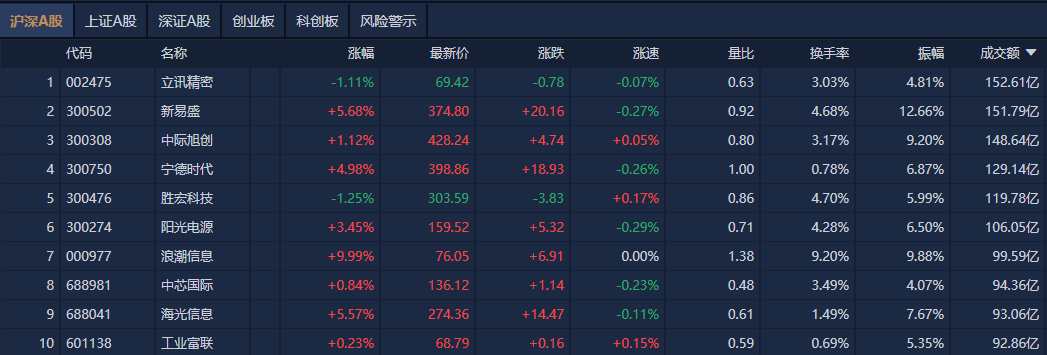
Market Performance - The market experienced fluctuations in the early session, with the Shanghai Composite Index rising by 0.16%, the Shenzhen Component Index increasing by 1.14%, and the ChiNext Index climbing by 2.22% [1] Sector Highlights - AI hardware and application sectors saw significant gains, with Inspur Information hitting the daily limit and reaching a historical high, while Huajin Technology also touched the daily limit and set a new high [1] - The non-ferrous metal sector was active, with several stocks, including Northern Copper, reaching the daily limit [1] - Controlled nuclear fusion concept stocks experienced a rally, with Hezhong Intelligent achieving two limits in four days, and Haheng Huaton hitting the daily limit [1] Trading Volume - The total trading volume in the Shanghai and Shenzhen markets reached 1.54 trillion yuan, an increase of 134.8 billion yuan compared to the previous trading day [3] Individual Stock Performance - Lixun Precision had a trading volume exceeding 15.2 billion yuan, leading the market, followed by Xinyi Sheng and Zhongji Xuchuang, with significant trading volumes as well [3]


文字早评2025/09/25星期四:宏观金融类-20250925
Wu Kuang Qi Huo· 2025-09-25 01:38
Industry Investment Rating No relevant content provided. Core Views - After a continuous rise, high - level hot sectors like AI have shown divergence, with funds switching between high - and low - level stocks and rapid rotation. Short - term index faces uncertainty, but in the long - term, the policy supports the capital market, so the idea is to go long on dips [4]. - In the bond market, considering the weak repair of domestic demand and the expected loose funds, interest rates are expected to decline, but in the short - term, it may be in a volatile pattern due to the stock - bond seesaw effect [6]. - For precious metals, as the Fed's key figures still have a dovish monetary policy stance after the September interest - rate meeting, it is recommended to go long on dips [8]. - In the black sector, there is a short - term risk of downward correction, especially after the National Day holiday, but in the future, it may gradually have the cost - performance for long - term allocation, and the key time point may be around the "Fourth Plenary Session" in mid - October [37]. Summaries by Catalog Macro - financial Stock Index - **Market Information**: It is expected that China's annual automobile sales will reach 40 million units during the "15th Five - Year Plan" period; six departments prohibit the addition of cement clinker and flat glass production capacity; Alibaba will cooperate with NVIDIA in Physical AI and plans to increase investment in AI infrastructure; the chip mania triggered by AI has spread to the storage chip field [2]. - **Strategy View**: After a continuous rise, high - level hot sectors like AI have shown divergence, and short - term index faces uncertainty, but in the long - term, it is advisable to go long on dips [4]. Treasury Bond - **Market Information**: On Wednesday, the main contracts of TL, T, TF, and TS all declined. The central bank will conduct a 600 - billion - yuan MLF operation, and the winning yields of the Ministry of Finance's 2 - period treasury bonds are lower than the valuation. The central bank conducted a 401.5 - billion - yuan 7 - day reverse repurchase operation, with a net withdrawal of 17 billion yuan [5]. - **Strategy View**: The economic data in August continued to slow down. Although the central bank maintains a loose attitude towards funds, the bond market may be volatile in the short - term, and interest rates are expected to decline in the long - term [6]. Precious Metals - **Market Information**: Domestic and foreign gold and silver prices showed different trends. The US real estate data was strong, putting short - term pressure on precious metals, but the Fed's key figures had a dovish stance [7]. - **Strategy View**: It is recommended to go long on dips for precious metals, with reference operating ranges for Shanghai gold and silver given [8]. Non - ferrous Metals Copper - **Market Information**: On Wednesday, LME copper rose significantly, and the supply - side disturbances stimulated the price. LME copper inventory decreased, and domestic copper inventory also changed [10]. - **Strategy View**: Although the Fed's attitude is relatively hawkish in the short - term, if the interest - rate cut process advances, the market sentiment may not be significantly suppressed. Copper prices are expected to be strong in the short - term [11]. Aluminum - **Market Information**: On Wednesday, LME aluminum rebounded, and the increase in copper prices drove the sentiment in the aluminum market. Domestic and foreign aluminum inventories changed, and the downstream procurement sentiment improved [12]. - **Strategy View**: Although the Fed's statement is not as dovish as expected, the aluminum price has strong support below and may rise in the short - term [13]. Zinc - **Market Information**: On Wednesday, the Shanghai zinc index rose slightly. The domestic and foreign zinc inventories changed, and the import profit and loss of zinc ingots were negative [14][15]. - **Strategy View**: The zinc ore surplus has eased, and the Fed's monetary policy has cooled the sentiment in the non - ferrous metal sector. The Shanghai zinc is expected to be weak in the short - term [15]. Lead - **Market Information**: On Wednesday, the Shanghai lead index fell slightly. The domestic and foreign lead inventories decreased, and the price difference between refined and scrap lead was 75 yuan/ton [16]. - **Strategy View**: The raw material shortage restricts the production of primary lead, while the profit of recycled lead has improved. The domestic lead ingot inventory has decreased, and the Shanghai lead is expected to be strong in the short - term [16]. Nickel - **Market Information**: On Wednesday, the nickel price fluctuated. The nickel ore and nickel iron prices were stable, and the price of MHP increased slightly [17]. - **Strategy View**: In the short - term, the high inventory of refined nickel may drag down the nickel price, but in the long - term, it is recommended to go long on dips, and the operating ranges for Shanghai nickel and LME nickel are given [17]. Tin - **Market Information**: On September 24, the Shanghai tin main contract rose. The supply of tin ore was tight, and the downstream demand was in the peak season [18]. - **Strategy View**: The short - term supply and demand of tin are in a tight balance, and the tin price is expected to be volatile. It is recommended to wait and see [18]. Carbonate Lithium - **Market Information**: On Wednesday, the carbonate lithium continued to fluctuate. The price of the LC2511 contract decreased, and the spot price was stable [19]. - **Strategy View**: The current strong demand supports the bottom, but the supply recovery expectation suppresses the upside. It is recommended to pay attention to the supply, demand, and market sentiment [19]. Alumina - **Market Information**: On September 24, the alumina index rose. The domestic and foreign prices and inventories changed, and the import window opened [20]. - **Strategy View**: The ore price has short - term support, but the alumina production capacity is in excess. It is recommended to wait and see, and the operating range for the domestic main contract is given [21][22]. Stainless Steel - **Market Information**: On Wednesday, the stainless - steel main contract rose slightly. The spot price was stable, and the inventory decreased [23]. - **Strategy View**: The domestic leading steel mills have a strong willingness to support prices, but the consumption has not improved significantly. It is expected to be volatile in the short - term [24]. Cast Aluminum Alloy - **Market Information**: As of Wednesday afternoon, the AD2511 contract rebounded. The inventory increased, and the downstream procurement was mainly for rigid demand [25]. - **Strategy View**: The downstream of cast aluminum alloy is transitioning from the off - season to the peak season, but the price is under pressure due to the delivery pressure, and the support comes from the cost of scrap aluminum [26]. Black Building Materials Steel - **Market Information**: The prices of rebar and hot - rolled coil futures rose. The inventory of rebar decreased, while that of hot - rolled coil increased slightly [28]. - **Strategy View**: The commodity market was in a good mood, but the demand for steel was weak. If the demand cannot be effectively repaired, steel prices may decline. It is necessary to pay attention to the policy trends of the "Fourth Plenary Session" [29]. Iron Ore - **Market Information**: The iron - ore main contract rose slightly. The overseas iron - ore shipment decreased, the iron - water output increased, and the port inventory decreased slightly [30][31]. - **Strategy View**: In the short - term, the iron - water output is still strong, and the iron - ore price is expected to be volatile. It is necessary to observe the downstream demand recovery and inventory reduction speed [31]. Glass and Soda Ash - **Glass** - **Market Information**: The glass main contract rose significantly. The inventory decreased, and the positions of long and short increased and decreased respectively [32]. - **Strategy View**: The policy and price increase of some enterprises pushed up the glass price, but the terminal demand was weak. It is recommended to pay attention to the policy and be bullish in the short - term [33]. - **Soda Ash** - **Market Information**: The soda - ash main contract rose. The inventory decreased, and the positions of long and short changed [34]. - **Strategy View**: The domestic soda - ash market is stable, the production is expected to increase slightly, and the demand is flat. It is expected to be in a volatile pattern in the short - term [34]. Manganese Silicon and Ferrosilicon - **Market Information**: On September 24, the main contracts of manganese silicon and ferrosilicon rebounded. The spot prices were stable, and the price differences changed [35]. - **Strategy View**: The black sector may have a short - term downward correction risk, but in the long - term, it may be suitable for long - term allocation. Manganese silicon and ferrosilicon are likely to follow the black - sector market [36][37]. Industrial Silicon and Polysilicon - **Industrial Silicon** - **Market Information**: The industrial - silicon main contract rose. The weighted contract positions decreased, and the spot price was stable [38]. - **Strategy View**: The supply and demand of industrial silicon have not changed significantly. It is recommended to pay attention to the supply - demand improvement and policy changes [39][40]. - **Polysilicon** - **Market Information**: The polysilicon main contract rose. The weighted contract positions decreased, and the spot price changed slightly [41]. - **Strategy View**: The polysilicon price is affected by policies and fundamentals. It is expected to be volatile in the short - term, and there is a risk of decline if expectations are not met [42]. Energy - Chemical Rubber - **Market Information**: Typhoon "Hagasa" is a positive factor, while the EU's delay in implementing anti - deforestation laws reduces positive factors. The operating rates of tire enterprises and the inventory of natural rubber changed [44][46]. - **Strategy View**: It is recommended to have a long - term bullish view and a short - term neutral or slightly bullish view, and go long on dips with quick entry and exit [48]. Crude Oil - **Market Information**: The INE main crude - oil futures and related refined - oil futures rose. The gasoline inventory in Singapore increased, while the diesel, fuel - oil, and total refined - oil inventories decreased [49]. - **Strategy View**: It is recommended to be long on crude oil, as the current price is undervalued, and if the geopolitical premium reappears, the oil price may rise [50]. Methanol - **Market Information**: The prices of methanol in different regions and the main contract changed. The 1 - 5 price difference was in a low - level shock [51]. - **Strategy View**: The supply of methanol decreased, and the demand improved marginally, but the high inventory still suppresses the price. It is recommended to wait and see [52][53]. Urea - **Market Information**: The spot price of urea in Shandong was stable, while that in Henan decreased. The main contract price and price differences changed [54]. - **Strategy View**: The supply of urea increased, and the demand was weak. The urea price is expected to have no large - scale unilateral trend. It is recommended to wait and see or go long on dips [54]. Pure Benzene and Styrene - **Market Information**: The cost, spot, and futures prices of pure benzene and styrene changed. The supply, demand, and inventory also changed [55]. - **Strategy View**: The BZN price difference is expected to repair, and it is recommended to go long on the pure - benzene US - South Korea price difference on dips [56]. PVC - **Market Information**: The PVC01 contract rose. The cost was stable, the production and demand changed, and the inventory increased [57]. - **Strategy View**: The supply of PVC is strong, the demand is weak, and the export expectation is weak. It is recommended to go short on rallies [59]. Ethylene Glycol - **Market Information**: The EG01 contract rose. The supply and demand loads decreased, and the port inventory increased slightly [60]. - **Strategy View**: The supply of ethylene glycol is high, and it is expected to accumulate inventory in the fourth quarter. It is recommended to go short on rallies, but beware of the risk of unfulfilled weak expectations [61]. PTA - **Market Information**: The PTA01 contract rose. The supply and demand loads decreased, and the inventory increased slightly [62]. - **Strategy View**: The supply of PTA has many unexpected maintenance situations, and the demand is under pressure. It is recommended to wait and see [63]. p - Xylene - **Market Information**: The PX11 contract rose. The load of PX decreased, and the inventory decreased [64]. - **Strategy View**: The PX load is high, and it is expected to accumulate inventory. It is recommended to wait and see and pay attention to the terminal and PTA valuation recovery [65]. Polyethylene (PE) - **Market Information**: The PE main contract rose. The upstream operating rate increased, the inventory increased, and the downstream operating rate increased slightly [66]. - **Strategy View**: The PE price is expected to fluctuate upward, as the cost has support, and the demand may improve seasonally [67]. Polypropylene (PP) - **Market Information**: The PP main contract rose. The upstream operating rate was stable, the inventory decreased in some places and increased in others, and the downstream operating rate increased slightly [68]. - **Strategy View**: The supply of PP has pressure, and the demand is in a seasonal rebound. The overall inventory pressure is high, and there is no prominent short - term contradiction [70]. Agricultural Products Live Pigs - **Market Information**: The domestic pig prices showed different trends. The supply of standard pigs is abundant, and the pig prices may be stable or decline today [72]. - **Strategy View**: The current spot price of pigs may decline slightly, and the futures price may continue to be weak. It is recommended to go short on the near - month contract and do reverse arbitrage [73]. Eggs - **Market Information**: The national egg prices were mainly stable, with a few adjustments. The supply was stable, and the egg prices may be stable or decline today [74]. - **Strategy View**: The spot price of eggs is expected to decline, and the near - month futures price is weak. It is recommended to wait and see in the short - term and pay attention to buying the far - month contract after the price decline [75]. Soybean and Rapeseed Meal - **Market Information**: The US soybean price decreased slightly, and Argentina temporarily cancelled the export tax, which is negative for the international soybean prices. The domestic soybean meal price decreased slightly, and the inventory changed [76][77]. - **Strategy View**: The domestic supply of soybean meal has pressure, and the global soybean supply is loose. The soybean meal market is expected to be in a range - bound pattern [78]. Oils and Fats - **Market Information**: The export and production of Malaysian palm oil changed, and the export, production, and inventory of Indonesian palm oil also changed. The domestic three major oils rebounded [79]. - **Strategy View**: The oils and fats are expected to be strong in the medium - term, and it is recommended to buy on dips after the price stabilizes [80]. Sugar - **Market Information**: The Zhengzhou sugar futures price rebounded. The spot prices of different regions were stable, and the production of the next crushing season in Brazil, Thailand, and India is expected to increase [81][82]. - **Strategy View**: The sugar price is expected to decline in the long - term, but it is recommended to wait and see before the National Day [83]. Cotton - **Market Information**: The Zhengzhou cotton futures price fluctuated. The spot price decreased, and the inventory and operating rates of the downstream industry changed [84].
力勤资源(02245)股东将股票由中国民生银行转入香港上海汇丰银行 转仓市值8.68亿港元
智通财经网· 2025-09-25 00:25
Core Viewpoint - The recent performance of Likin Resources (02245) shows significant growth in both revenue and profit, driven by increased production and operational efficiency in its projects [1] Financial Performance - For the first half of 2025, Likin Resources reported revenue of approximately 18.1466 billion HKD, representing a year-on-year increase of 66.8% [1] - The profit attributable to the company's shareholders was around 1.426 billion HKD, which is a 143.0% increase compared to the previous year [1] - Earnings per share stood at 0.92 HKD [1] Production and Operational Highlights - The growth in revenue and profit is primarily attributed to a significant increase in the production of hydrometallurgical products such as nickel hydroxide and pyrometallurgical products like nickel iron [1] - The increase in production is linked to the full operational capacity of the ONC project and the output release from the KPS project [1] - The company has optimized its product structure and implemented refined cost control management, along with technological improvements to enhance production processes and profitability [1]

恒邦股份:截至2025年9月19日,公司的股东人数为56229户
Zheng Quan Ri Bao Wang· 2025-09-24 09:13
证券日报网讯恒邦股份(002237)9月24日在互动平台回答投资者提问时表示,截至2025年9月19日,公 司的股东人数为56229户。 ...

营收近千亿国企拟更名!
中国能源报· 2025-09-24 06:44
9月23日豫光金铅公告称,公司间接控股股东济源资本运营集团有限公司,将持有的公 司控股股东河南豫光金铅集团有限责任公司100%股权,无偿划转至实际控制人济源产 城融合示范区国有资产监督管理局,同时控股股东河南豫光金铅集团有限责任公司更名 为"河南豫光集团有限公司"。 公告显示,本次无偿划转系根据《济源示范区区管国企深化改革和产业化转型总体方案》 规定实施, 划转完成后,公司控股股东仍为豫光集团,实际控制人仍为济源国资局, 不 涉及要约收购。 豫光金铅称,本次划转不会导致控股股东和实际控制人变更,对公司财务状况、资产价值 及持续经营能力无影响,亦不损害中小股东利益。后续事项包括权益变动报告书披露及持 续信息披露义务。 本次划转前,资本运营集团通过豫光集团间接持有豫光金铅3 2 2 7 9 9 7 3 7股股份,占公司股 份总数的29 . 6 1%;划转后,资本运营集团不再直接或间接持有公司股份。 End 欢迎分享给你的朋友! 出品 | 中国能源报(c n e n e rg y) 编辑丨闫志强 中国企业联合会、中国企业家协会近日发布的"中国企业500强"榜单显示, 河南豫光金铅 集团有限责任公司 以9 0 2亿元 ...


鲍威尔称美股估值较高,俄罗斯讨论柴油出口禁令
Dong Zheng Qi Huo· 2025-09-24 00:45
1. Report Industry Investment Ratings No relevant content provided. 2. Core Views of the Report - Overall, the report analyzes various financial and commodity markets, including macro - strategy, black metals, non - ferrous metals, and energy chemicals. It provides insights into market trends, influencing factors, and offers corresponding investment suggestions for each sector [1][2][3]. 3. Summary by Related Catalogs 3.1 Financial News and Comments 3.1.1 Macro Strategy (Gold) - Trump plans to impose strong tariffs on Russia, and Powell emphasizes employment and inflation risks. Gold prices are driven up by Fed's potential rate - cut expectations and Trump's tariff sanctions, but there is a risk of correction before the National Day holiday in China [13][14]. - Investment advice: Pay attention to the risk of price correction in the short term [15]. 3.1.2 Macro Strategy (Foreign Exchange Futures - US Dollar Index) - Three Fed officials think setting an inflation target range is more beneficial. Trump believes Ukraine can retake all its territory, and Powell says US stocks are "valued quite high". The US dollar index is expected to be weak in the short term [16][17][18]. - Investment advice: The US dollar index is expected to weaken in the short term [19]. 3.1.3 Macro Strategy (Stock Index Futures) - Wang Yi meets with US congressmen, and China's education reaches the average level of high - income countries. The A - share market shows a V - shaped reversal with increased trading volume, and the technology sector remains resilient. Short - term attention should be paid to trading volume changes [20][21]. - Investment advice: Consider moderate profit - taking [22]. 3.1.4 Macro Strategy (US Stock Index Futures) - Fed officials have different views on interest rate cuts. US September Markit manufacturing and services PMI decline. Powell mentions that the stock market is over - valued, and there may be short - term fluctuations, but the overall outlook is still positive [23][24][27]. - Investment advice: Although valuation concerns may cause short - term disturbances, maintain a bullish view overall [28]. 3.1.5 Macro Strategy (Treasury Bond Futures) - The central bank conducts 276.1 billion yuan of 7 - day reverse repurchase operations, with a net withdrawal of 1.09 billion yuan on the day. The bond market is in a weak sentiment, and short - term trading should follow a range - bound strategy [29]. - Investment advice: Adopt a range - bound trading strategy in the short term and avoid chasing up [31]. 3.2 Commodity News and Comments 3.2.1 Agricultural Products (Soybean Meal) - Domestic soybean mills' operating rates and soybean crushing volumes during the National Day holiday are reported, and some mills in Guangdong stop production due to a typhoon. Argentina suspends export taxes on grains and oilseed meals, affecting the market [32][33]. - Investment advice: Wait and see for now, and pay attention to whether M2601 can be effectively supported at 2900 [34]. 3.2.2 Agricultural Products (Soybean Oil/Rapeseed Oil/Palm Oil) - Malaysia's palm oil production from September 1 - 20 decreases. Argentina's tax - exemption policy impacts the global oil market, but short - term oversold rebound opportunities can be considered [35][36][37]. - Investment advice: Consider short - term oversold rebound opportunities in the P2601 contract, but control positions [37]. 3.2.3 Agricultural Products (Pigs) - Muyuan Co., Ltd. establishes an overseas business team. The pig market is in a negative feedback stage, with the short - term trend following the spot market and a medium - long - term view of shorting on rebounds [38]. - Investment advice: Short on rebounds unilaterally and continuously monitor reverse spreads [39]. 3.2.4 Agricultural Products (Corn) - Northeast corn spot prices continue to decline. With the approaching of the new corn season, the market expects a bumper harvest and normal listing, and the mid - term view is bearish [40]. - Investment advice: Hold existing short positions [40]. 3.2.5 Black Metals (Rebar/Hot - Rolled Coil) - The total new contracts signed by five major construction central enterprises in the first eight months exceed 4.7 trillion yuan, and the average construction machinery operating rate in August is 43.42%. Steel prices are range - bound with limited upward and downward space [41][42]. - Investment advice: Expect a range - bound rebound before the holiday, but the space is limited [43]. 3.2.6 Agricultural Products (Corn Starch) - China's corn starch exports in August decline. The price of raw corn stops falling, and the export demand is not expected to have a significant positive impact on the fundamentals [44]. - Investment advice: The long - term supply - demand situation of starch is bearish for the corn - starch price spread, but pay attention to potential changes in the regional price spread after the large - scale listing of Northeast corn [44]. 3.2.7 Agricultural Products (Red Dates) - Red dates in Xinjiang are growing normally, and the futures price of the main contract CJ601 shows a small increase. The price is expected to be range - bound, and attention should be paid to the development of jujube fruits in the production area and the purchasing situation in the sales area [45][46]. - Investment advice: The futures price is expected to be range - bound, and pay attention to the development of jujube fruits and purchasing situation [46]. 3.2.8 Non - Ferrous Metals (Alumina) - An electrolytic aluminum project in Indonesia is expected to start in stages by the end of 2025. The alumina market has an oversupply problem, and the import pressure is increasing [47][48]. - Investment advice: Short on rallies [49]. 3.2.9 Non - Ferrous Metals (Polysilicon) - A photovoltaic component tender sets a price limit. Polysilicon prices are expected to be range - bound, and the spot price is not expected to fall in October. The component price is expected to be range - bound, and the terminal demand may decline [50][51][52]. - Investment advice: The polysilicon price is expected to be range - bound between 50,000 - 57,000 yuan/ton in the short term, and consider going long at the current level [53]. 3.2.10 Non - Ferrous Metals (Industrial Silicon) - China's silicon wafer exports in August increase. The market is expected to accumulate inventory in September - October and reduce inventory in November - December. The strategy of going long on dips has a higher probability of success [54][55]. - Investment advice: Go long on dips, but be cautious when chasing up [55]. 3.2.11 Non - Ferrous Metals (Nickel) - High US tariffs disrupt the stainless - steel market. The nickel market has potential supply - side disturbances, and the low - valued nickel has long - term investment value. Consider positive spreads [56]. - Investment advice: The global nickel inventory is high, but low - valued nickel has long - term investment value. Consider positive spreads [56]. 3.2.12 Non - Ferrous Metals (Copper) - India initiates an anti - dumping investigation on Chinese copper cables. The macro - support for copper prices weakens, but the inventory accumulation pressure eases. Copper prices are expected to continue to be range - bound at a high level [57][61]. - Investment advice: Adopt a wait - and - see strategy for single - sided trading, and be cautious during the holiday. Also, wait and see for arbitrage [61]. 3.2.13 Non - Ferrous Metals (Lithium Carbonate) - A company plans to issue bonds for debt refinancing, and a lithium carbonate project is put into production. The market is in a de - stocking stage, and the price may fall after the demand peak [62][63][64]. - Investment advice: Adopt a bearish strategy, be cautious when shorting in the short term, and consider shorting on rebounds in the medium term [64]. 3.2.14 Non - Ferrous Metals (Lead) - The LME lead shows a deep contango. The domestic lead market has improved demand, and the social inventory has reached an inflection point. The price is expected to be range - bound and bullish [65]. - Investment advice: Try to go long on dips for single - sided trading and consider positive spreads for arbitrage [65]. 3.2.15 Non - Ferrous Metals (Zinc) - The LME zinc shows a backwardation, and some zinc alloy enterprises in Guangdong stop production due to a typhoon. The market has a potential soft - squeeze risk, and the domestic zinc price is affected. Consider positive spreads [66][67]. - Investment advice: Adopt a wait - and - see strategy for single - sided trading, consider positive spreads for arbitrage, and maintain a positive - spread strategy for domestic - foreign trading [67]. 3.2.16 Energy Chemicals (Crude Oil) - US API crude oil inventory decreases, and Russia discusses the possibility of a diesel export ban. Oil prices are range - bound [68][69]. - Investment advice: Wait for new market drivers as oil prices are range - bound [70]. 3.2.17 Energy Chemicals (Carbon Emissions) - The closing price of CEA on September 23 increases, but the market volume does not expand significantly. The price is expected to be range - bound and bearish [70][71]. - Investment advice: Expect a further decline in the short term [71]. 3.2.18 Energy Chemicals (Caustic Soda) - The price of caustic soda in Shandong varies. The supply is stable, and the demand is weak. The price is expected to be stable in the short term [72][73][74]. - Investment advice: The spot price is falling, but the downward space of the futures price may be limited [74]. 3.2.19 Energy Chemicals (Pulp) - The price of imported wood pulp is basically stable. The market is expected to be range - bound and bearish [75][76]. - Investment advice: The market is expected to be range - bound and bearish [76]. 3.2.20 Energy Chemicals (PVC) - The price of PVC powder in China decreases. The market is weak, but the low valuation makes it difficult for the price to fall further. Pay attention to domestic policy support [77]. - Investment advice: The PVC fundamentals are weak, but the low price limits further decline. Pay attention to domestic policy support [77]. 3.2.21 Energy Chemicals (Styrene) - China's pure benzene import data in August is reported. The pure benzene and styrene markets are range - bound and bearish. The supply of styrene is affected by maintenance, and the demand has short - term resilience [78][79]. - Investment advice: Pay attention to how to solve the inventory contradiction after the peak season, and the industrial chain profit may be further compressed [80]. 3.2.22 Energy Chemicals (Bottle Chips) - The export price of bottle chips decreases, and the market trading volume is acceptable. The demand may be over - drawn in the short term, and the long - term demand is weak. Pay attention to production cuts and new capacity [81][82][83]. - Investment advice: The demand may be over - drawn in the short term, and pay attention to production cuts and new capacity [83]. 3.2.23 Energy Chemicals (PX) - The PX price continues to fall. The supply may increase in Q4, and the demand is weak. The price is expected to be range - bound and bearish [84][85]. - Investment advice: The price is expected to be range - bound and bearish in the short term [86]. 3.2.24 Energy Chemicals (Urea) - Urea import and export data in August is reported. The supply pressure exists, and the demand is weak. The inventory is increasing. Pay attention to policy support [87][88][89]. - Investment advice: The urea futures price is expected to be under pressure, and it is recommended that strategic reserve buyers make dispersed purchases [89]. 3.2.25 Energy Chemicals (PTA) - The PTA spot price decreases, and the market trading is normal. The demand is weak, and the inventory accumulation is postponed. The price is expected to be range - bound and bearish [90][91]. - Investment advice: The price is expected to be range - bound and bearish in the short term [92]. 3.2.26 Energy Chemicals (Soda Ash) - The soda ash market in Shahe is normal, and the futures price falls. The supply is high, and the demand is stable. The price is expected to be shorted on rallies [93]. - Investment advice: Adopt a short - on - rallies strategy and pay attention to supply - side disturbances [94]. 3.2.27 Energy Chemicals (Float Glass) - The price of float glass in Shahe is stable. The market is weak, and the 01 contract has a high premium over the spot price. Consider a long - glass 2601 and short - soda ash 2601 arbitrage strategy [95][96]. - Investment advice: Consider a long - glass 2601 and short - soda ash 2601 arbitrage strategy [96]. 3.2.28 Shipping Index (Container Freight Rate) - The world's first China - Europe Arctic container express route is launched. The spot container freight rate is falling, and the 10 - month contract price may decline slightly. Consider short - term arbitrage opportunities [97][98]. - Investment advice: Consider taking profit on the 10 - month contract on dips, pay attention to low - long opportunities for the 12 - month contract after a significant decline, and consider short - term positive spreads for the 12 - 02 contract [98].