钢铁

Search documents
山东钢铁股份有限公司关于《2025年度估值提升计划暨提质增效重回报行动方案》的年度评估报告
Shang Hai Zheng Quan Bao· 2026-02-27 21:01
Core Viewpoint - Shandong Steel Co., Ltd. has successfully turned losses into profits in 2025, achieving a net profit of approximately 571 million yuan, compared to a loss of 2.891 billion yuan in the previous year, marking a year-on-year profit increase of about 2.991 billion yuan [1] Group 1: Financial Performance - In 2025, the company produced 15.76 million tons of pig iron, 18.25 million tons of crude steel, and 17.71 million tons of finished steel products [1] - The estimated net profit for the year is around 571 million yuan, with a net profit attributable to shareholders of approximately 100 million yuan, a significant turnaround from the previous year's loss [1] Group 2: Operational Efficiency - The company has implemented a "1+6+N" reform system, achieving breakthroughs in key areas, including the integration of the R&D system and the comprehensive management of steelmaking operations [2] - The company has improved operational efficiency, with a year-on-year increase of 790,000 tons in production and a 14.4% increase in per capita steel production [2] Group 3: Product Management - The company has accelerated its product management efforts, with a 33.9% year-on-year increase in sales of key products and a 21.4 percentage point increase in direct supply to end-users [3] - The company has developed 201 new users and expanded into 33 new markets, achieving a price reduction of 62 yuan per ton [3] Group 4: Technological Innovation - The company has focused on technological innovation, launching several new product development projects and establishing an AI department for digital transformation [4] - The company has initiated 20 "AI+Steel" application projects to enhance operational efficiency and cost control [4] Group 5: Governance and Compliance - The company has strengthened its governance structure, holding 13 board meetings and 5 shareholder meetings in 2025, with all resolutions effectively executed [5] - The company has completed reforms to its supervisory board and updated its internal management systems to enhance compliance and governance [6] Group 6: Value Management - The company has initiated a share buyback program, repurchasing 57,338,400 shares, which is 0.5359% of its total share capital, and has seen its controlling shareholder increase their stake [8] - The company has completed the acquisition of 100% of Laiwu Steel Group Yingshan Steel Co., Ltd., optimizing its product structure and enhancing competitiveness [8] Group 7: Investor Relations - The company has enhanced its investor relations management, conducting performance briefings and engaging with investors through various platforms to communicate its value and operational improvements [9] - The company has disclosed 104 announcements related to board resolutions and share buybacks, ensuring accurate and timely information dissemination [9]

资源股与科技股双线开花A股三大股指马年首周收涨
Zhong Guo Zheng Quan Bao· 2026-02-27 20:43
Market Overview - The A-share market experienced a collective rise in the first trading week after the Spring Festival, with the three major indices closing higher as of February 27, 2023 [1][2] - The daily trading volume remained active, with an average daily turnover exceeding 2.2 trillion yuan, reflecting a more than 15% increase compared to the previous week [2][3] Sector Performance - Resource and technology sectors were the main focus, with significant gains observed in steel, non-ferrous metals, communication, and electronics [1][3] - The steel sector led with a weekly increase of 12.27%, while non-ferrous metals and basic chemicals also showed strong performance [3] Capital Flow - There was a notable inflow of funds into both resource and technology sectors, with the electronic sector seeing a net inflow of nearly 60 billion yuan over five trading days, the highest among all sectors [4] - Non-ferrous metals followed closely with a net inflow of 43.11 billion yuan [4] Price Trends and Market Sentiment - Price increases are viewed as a key driver for market sentiment and sector performance, with expectations that this trend will continue into March and April [5][6] - Analysts suggest that the market's focus may shift towards cyclical stocks and value stocks as the year progresses, driven by improving corporate earnings and price trends [5][6] Investment Recommendations - Investors are advised to focus on growth and cyclical sectors, particularly in oil and gas, non-ferrous metals, electric grid equipment, energy storage, and petrochemicals [1][7] - Specific areas of interest include AI-related sectors, human-shaped robots, and industries benefiting from rising commodity prices [7]
7.4到6.84,升值幅度较大,国内通胀及资产价格或将受到影响
Sou Hu Cai Jing· 2026-02-27 14:52
Group 1 - The offshore RMB to USD exchange rate reached a high of 6.8267, marking a significant appreciation of over 2% within two months, leading to a depreciation of USD holdings by approximately 6% for those who held USD last year [1][3] - The appreciation of the RMB is attributed to the weakening of the USD, driven by the Federal Reserve's interest rate cuts and a criminal investigation into its chairman, which has impacted the dollar's strength [3][4] - China's economic resilience, with a trade surplus of approximately $1.2 trillion in 2025, has contributed to the demand for RMB as companies convert their USD earnings into RMB for operational needs [3][4] Group 2 - Importing companies are benefiting from the RMB appreciation, as it reduces costs for products priced in USD, leading to increased net profits for firms like Shanghai Laishi and others in the paper industry [6] - Conversely, traditional export-oriented industries, such as textiles and toys, face increased pressure as their products become more expensive in international markets, potentially losing orders to competitors in Southeast Asia [7] - The real estate market is experiencing a nuanced impact, with core assets in major cities seeing increased foreign investment, while smaller cities struggle with high inventory and weak demand [8] Group 3 - The People's Bank of China has responded to the rapid appreciation of the RMB by lowering the foreign exchange risk reserve requirement for forward foreign exchange transactions from 20% to 0%, aiming to stabilize the currency [10] - Companies are encouraged to manage exchange rate risks through forward contracts, which have become more accessible due to reduced costs for banks following the policy change [10] - Investors are advised to focus on high-quality assets that benefit from cost reductions and asset revaluation rather than engaging in speculative trading [10]


山东钢铁(600022)披露2026年度估值提升计划暨提质增效重回报行动方案,2月27日股价上涨1.14%
Sou Hu Cai Jing· 2026-02-27 14:49
Core Viewpoint - Shandong Steel has announced a comprehensive valuation enhancement plan aimed at improving operational efficiency and shareholder returns due to its long-term undervaluation, as indicated by its stock price being below net asset value for 12 consecutive months [1]. Group 1: Company Performance - As of February 27, 2026, Shandong Steel's stock closed at 1.77 yuan, up 1.14% from the previous trading day, with a total market capitalization of 18.937 billion yuan [1]. - The stock opened at 1.76 yuan, reached a high of 1.82 yuan, and a low of 1.73 yuan, with a trading volume of 5.63 billion yuan and a turnover rate of 2.96% [1]. Group 2: Valuation Enhancement Plan - The valuation enhancement plan includes initiatives focused on value creation and management, such as deepening systemic reforms, improving operational efficiency, cost reduction, product structure optimization, innovation, green digital transformation, corporate governance, capital operations, cash dividends, share buybacks, and investor relations management [1]. - The company will regularly assess the implementation effects of the plan and provide specific updates during annual performance briefings [1]. - The plan does not constitute a commitment to the company's performance or stock price [1].
港股风向标|科技权重止跌恒指放量反弹 机构看好顺周期涨价机会
Sou Hu Cai Jing· 2026-02-27 14:36
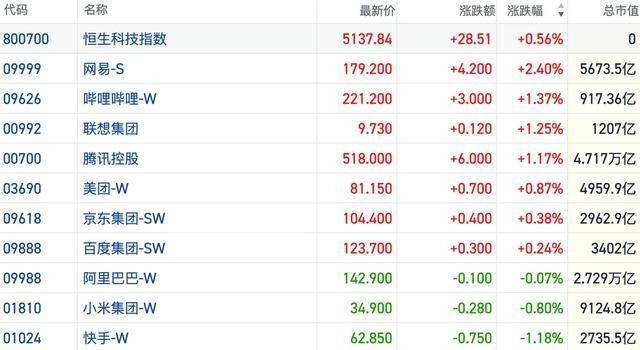
Market Overview - The Hong Kong stock market showed signs of recovery, with the Hang Seng Index rising by 0.95% to close at 26,630 points, while the Hang Seng China Enterprises Index and the Hang Seng Tech Index increased by 0.51% and 0.56% respectively [1][2]. Technology Sector Performance - Major tech stocks led the market rebound, with Tencent's stock price reaching 530 HKD during the day. Other tech companies such as NetEase, Meituan, JD.com, and Baidu also saw positive performance [2][3]. Stock Performance Data - Notable stock performances included: - Tencent Holdings (00700) at 518.00 HKD, up by 6.00 HKD (+1.17%), with a total market capitalization of 4.717 trillion HKD - NetEase (09999) at 179.20 HKD, up by 4.20 HKD (+2.40%), with a market cap of 567.35 billion HKD - Meituan (03690) at 81.15 HKD, up by 0.70 HKD (+0.87%), with a market cap of 495.99 billion HKD [3]. Sector Movements - Other sectors such as banking, real estate, and coal also showed strength, while power, steel, and oil stocks were active [4]. - Conversely, sectors like aviation, consumer electronics, and building materials experienced declines [4]. Market Dynamics - The overall trading volume in the Hong Kong market was 288.42 billion HKD, indicating increased liquidity. Short selling amounted to 36.55 billion HKD, representing 12.67% of the total trading volume, highlighting ongoing market divergence [4]. - The market is experiencing rapid rotation of hot and cold sectors, with cyclical stocks like steel and rare earths gaining strength, while AI-related sectors such as storage and chips faced declines [5][7]. Policy Implications - Recent meetings by the Central Political Bureau emphasized the need for more proactive macro policies to expand domestic demand and optimize supply, which may provide further support for the market [7]. A-Share Market Correlation - The A-share market mirrored the performance of the Hong Kong market, with a total trading volume of approximately 24,880.24 billion HKD, showing a decrease of about 504.22 billion HKD from the previous trading day. Over 3,200 stocks rose, particularly in the cyclical sector [8].

行业ETF风向标丨恒生科技ETF半日成交近35亿元 4只稀土ETF半日涨幅超2.5%
Mei Ri Jing Ji Xin Wen· 2026-02-27 13:52
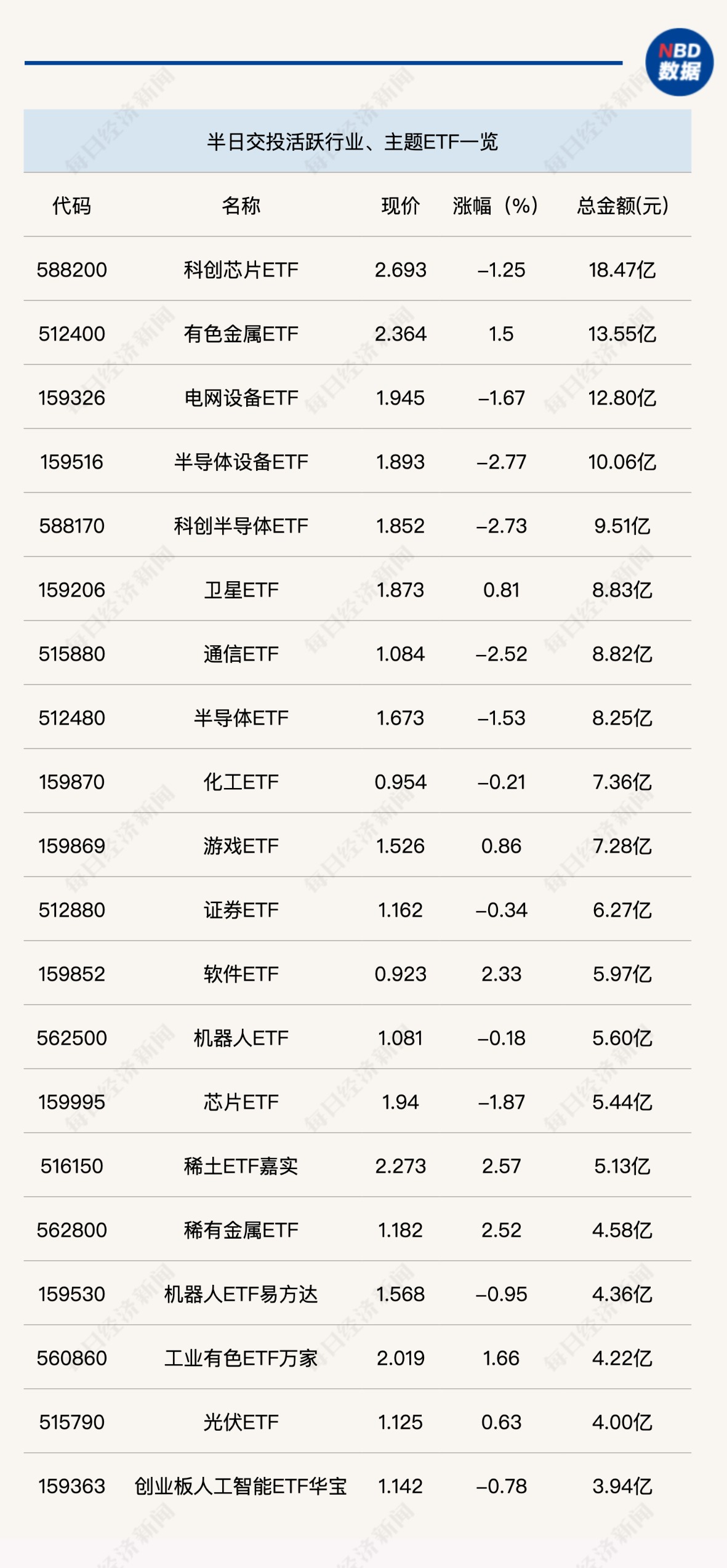
Core Viewpoint - The trading activity of various ETFs, particularly in the technology and materials sectors, remains robust, with significant transaction volumes reported for both domestic and cross-border ETFs. Group 1: Domestic ETFs - The active trading of domestic ETFs includes the following: - Sci-Tech Chip ETF (588200) with a trading volume of 1.847 billion yuan and a price decrease of 1.25% [2] - Nonferrous Metals ETF (512400) showing a trading volume of 1.355 billion yuan and a price increase of 1.5% [2] - Power Grid Equipment ETF (159326) with a trading volume of 1.280 billion yuan and a price decrease of 1.67% [2] - Other notable ETFs include Semiconductor Equipment ETF (159516) with a trading volume of 1.006 billion yuan and a price decrease of 2.77% [2], and Sci-Tech Semiconductor ETF (588170) with a trading volume of 0.951 billion yuan and a price decrease of 2.73% [2]. Group 2: Cross-Border ETFs - The cross-border ETF market shows significant activity, particularly: - Hang Seng Technology ETF (513130) with a trading volume of 3.451 billion yuan and no price change [4] - Hang Seng Technology Index ETF (513180) with a trading volume of 2.749 billion yuan and a price increase of 0.15% [4] - Hong Kong Securities ETF (513090) with a trading volume of 2.158 billion yuan and a price decrease of 1.06% [4]. Group 3: Rare Earth ETFs - Rare Earth ETFs are experiencing notable performance: - Rare Earth ETF (159713) increased by 2.7% with a trading volume of 0.173 billion yuan [6] - The ETF tracks the China Securities Rare Earth Industry Index, which reflects a high concentration of companies involved in rare earth mining, processing, and trading [7]. - The index's major constituents include: - Northern Rare Earth (600111) with a weight of 14.90% [8] - Goldwind Technology (002202) with a weight of 7.08% [8] - Xiamen Tungsten (600549) with a weight of 6.81% [8].
3月金股报告:指数震荡,风格再平衡
ZHONGTAI SECURITIES· 2026-02-27 13:44
Core Insights - The report anticipates a fluctuating upward trend in the index, with a primary focus on style rebalancing [4][5] - The A-share market has shown signs of recovery after initial volatility, with significant performance differences among major indices [5][6] Domestic Policy and Market Liquidity - The People's Bank of China conducted a 600 billion MLF operation and net injected 300 billion, marking the 12th consecutive month of increased liquidity to ensure reasonable liquidity before and after the Spring Festival [2] - The strengthening of the RMB has stabilized expectations for cross-border capital flows [2] Sector Performance - In the technology sector, midstream high-end manufacturing has led the gains, particularly in defense, machinery, and power equipment, driven by geopolitical tensions and domestic equipment renewal cycles [2] - In the cyclical sector, building materials, steel, and coal have outperformed, with glass fiber leading due to supply-side optimization and demand from AI and new energy [3] - Conversely, the non-ferrous metals sector has seen a pullback due to fluctuating expectations around U.S. Federal Reserve interest rate cuts and geopolitical disturbances [3] Market Trends and Historical Context - Historical data from 2010 to 2025 indicates a high probability of the Shanghai Composite Index rising in the month following the Spring Festival, particularly after a month of adjustment or fluctuation [6] - The report suggests that the market is likely to follow a "diffusion" model of industry rotation rather than a dramatic style switch, with a focus on moderate rebalancing [6] Investment Strategy - The report recommends focusing on "supply constraints + visible profits" as dual main lines, particularly in midstream high-end manufacturing [6] - The core trading logic around the AI chain continues to revolve around profit visibility and supply shortages, with a cautious approach to market liquidity [6] - Opportunities for Chinese manufacturing to expand overseas are highlighted, particularly in sectors like power equipment and engineering machinery [6] Recommended Stocks - The March stock selection includes a mix of sectors such as central enterprise dividend ETFs, hospitality, electronics, military, machinery, beverages, and communications [10]





恐慌AI?近期科技股波动,基金业绩分化
Guo Ji Jin Rong Bao· 2026-02-27 13:19
Group 1 - The core concern among investors is the fear of AI technology replacing traditional industries, leading to a significant market adjustment, particularly in high-growth sectors [1][3] - Recent market data shows a notable decline in tech stocks, with the Nasdaq index dropping 1.18% and Nvidia's stock falling over 5% despite exceeding earnings expectations [1][3] - In contrast, traditional cyclical and resource stocks have performed well, with sectors like steel and non-ferrous metals leading gains in the A-share market [1][4] Group 2 - There is a divide in market sentiment regarding AI, with some fearing it will disrupt traditional industries, while others believe it will lead to iterative upgrades rather than outright disruption [3][6] - The performance of traditional sectors has outpaced high-growth sectors this year, with non-ferrous metals and construction materials showing significant gains of over 25% and 20%, respectively [4] - The recent volatility in the AI sector has led to a decline in the value of several funds heavily invested in AI applications and semiconductor sectors [4][7] Group 3 - Experts suggest that the current AI panic is a short-term risk release and does not alter the long-term trends of technological revolution and industrial upgrading [6][7] - The ongoing tech wave is expected to continue, driven by technological iteration and real industrial demand, with a distinction between structural bubbles and trend growth [7][8] - Investment opportunities in AI-driven computing power remain favorable, with expectations for significant market value increases in domestic computing power as companies adapt to new business models [8]

方大特钢:持股5%以上股东减持股份计划公告
Zheng Quan Ri Bao· 2026-02-27 13:12
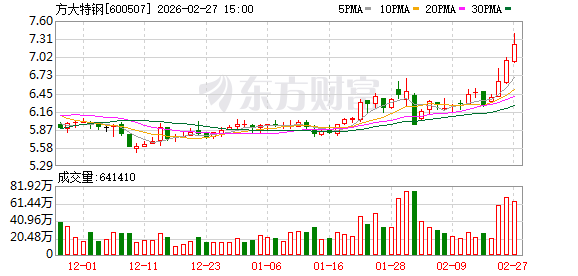
Core Viewpoint - Fangda Special Steel announced a share reduction plan by shareholder Xu Huigong, who holds 116,824,114 shares, representing 5.05% of the company's total share capital [2] Group 1 - Xu Huigong plans to reduce his holdings by up to 23,131,800 shares, which is no more than 1% of the company's total share capital [2] - The reduction will take place within three months, starting from March 23, 2026, to June 22, 2026, following a 15 trading day period after the announcement [2]

ETF日报:在“反内卷”政策推进下,煤炭行业有望继续受益
Xin Lang Cai Jing· 2026-02-27 13:03
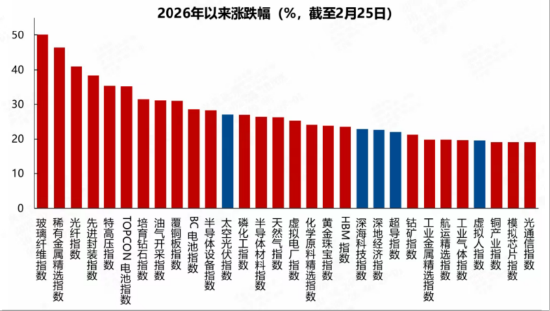
Core Viewpoint - The main theme in the capital market since the beginning of 2026 has been "price increases," which has permeated various industries and become a focal point for market transactions [10] Group 1: Market Performance - The A-share market showed divergence today, with the Shanghai Composite Index rising by 0.39% in the afternoon, while the ChiNext Index fell by over 1% [1] - The total trading volume in the Shanghai and Shenzhen markets was 2.51 trillion yuan, slightly lower than the previous trading day [1] Group 2: Price Increase Trends - Since the beginning of the year, 25 out of the top 30 concept indices have been related to the "price increase" logic, indicating a broadening trend across various sectors including oil and gas, chemicals, construction materials, and technology [10] - The "price increase" is expected to be a core factor driving market style diffusion throughout the year, reflecting industry prosperity [10] Group 3: Steel Sector Insights - The steel ETF has shown strong performance, with a cumulative increase of 10.64% this week, driven by both supply and demand catalysts [13] - Demand-side factors include favorable real estate policies in key cities, while supply-side factors indicate a contraction in 2026, leading to an accelerated phase of industry consolidation [13][14] - The steel sector is currently viewed as a bottoming area with significant elasticity potential, as low inventory levels could lead to price increases if demand catalyzes [14] Group 4: Rare Metals Surge - Rare metals such as tungsten and rare earths have seen a collective surge, with several stocks hitting historical highs, driven by four main factors [5][6] - The first factor is a dramatic increase in spot prices, with tungsten prices reaching 1.0225 million yuan per ton, up 3.7 times from the previous year [6] - The second factor is a tightening supply side, with mining quotas and environmental regulations limiting production capacity [6] - The third factor is the explosive demand from emerging industries, particularly in sectors like photovoltaics and semiconductors [6] - The fourth factor involves a global reassessment of critical mineral strategies, which has added a "safety premium" to these commodities [7] Group 5: Coal Sector Developments - The coal ETF rose by 2.82% today, influenced by production halts during the Spring Festival and ongoing reductions in Indonesian coal output [18] - The coal market is expected to benefit from policies aimed at reducing production capacity, with potential upward price elasticity if market conditions exceed expectations [19] - The coal sector is viewed as having room for a rebound, especially as other commodities have seen significant price increases [19]