医药生物

Search documents
中证1000ETF(159845)开盘一小时成交额超5亿元,远超同标的指数产品,盘中探底回升翻红
Sou Hu Cai Jing· 2025-12-05 02:46
Group 1 - A-shares experienced a collective decline on December 5, with the Shanghai Composite Index down by 0.15% [1] - The small-cap growth index showed activity, with the CSI 1000 ETF (159845) rebounding to gain 0.10% [1] - Among the top 50 weighted stocks in the CSI 1000 ETF, notable gainers included Yingliu Holdings up by 5.1%, Zhongtung High-tech up by 4.13%, and Huicheng Environmental up by 3.58% [1] Group 2 - The CSI 1000 ETF saw a net inflow of 243 million yuan over the last five trading days and 298 million yuan over the last ten days, with a current scale of 44.345 billion yuan [1] - The trading volume for the CSI 1000 ETF reached 501 million yuan today, significantly exceeding similar index products, with an average daily trading volume of 830 million yuan over the past week, indicating good liquidity [1] - The article from Wang Jiang emphasized the need to enhance the inclusiveness and adaptability of the capital market as part of building a strong financial nation [2]
广东资本市场五年蝶变 “科技叙事”逻辑日益清晰
2 1 Shi Ji Jing Ji Bao Dao· 2025-12-04 22:40
过去五年,对于广东资本市场而言,是一段"含科量"持续跃升、产融结合深度推进、"科技叙事"逻辑日 益清晰的蝶变历程。 "十四五"期间,广东新增IPO上市公司255家,其中科技型企业占比超95%;融资金额超过2400亿元,占 全国总融资额近15%;"首单""首例"密集涌现,标杆示范效应持续放大……广东资本市场以服务新质生 产力为核心,推动科技与资本深度融合,IPO向新兴板块集聚,债券融资规模稳步增长,私募股权精准 滴灌,制度赋能科技金融生态体系加速成型。 从"硬科技"企业的上市培育到未来产业的超前布局,从落实制度保障再到创新金融工具,广东正以一场 静水流深的变革,书写着资本市场支持科技创新自立自强的"广东样本"。 资本市场"含科量"加速提升 "含科量"成为衡量广东资本市场成色的关键指标。"十四五"期间,广东新增IPO上市公司255家,占全国 总量的17.43%,全国各省市排名第一,体现了其资本市场的活跃度和规模。 然而,更为关键的指标是其结构优化,注册制改革的深入推进,使得多层次资本市场体系的定位愈发精 准,新兴板块成为承载广东"硬科技"的主战场。在新增IPO中,科技型企业数量达到243家,占比高达 95.29% ...
金融工程日报:沪指震荡微跌,大消费走弱,机器人产业链爆发-20251204
Guoxin Securities· 2025-12-04 14:11
- The report does not contain any quantitative models or factors for analysis[1][2][3]
主力资金丨出手超24亿元,这只龙头股获资金爆买!
Zheng Quan Shi Bao Wang· 2025-12-04 11:44
(原标题:主力资金丨出手超24亿元,这只龙头股获资金爆买!) 6个行业获主力资金净流入。 此外,还有天孚通信、宁德时代、航天发展、长川科技等主力资金净流入金额居前,均超5亿元。 25个主力资金净流出的行业中,电子行业主力资金净流出56.69亿元,居首;电力设备行业主力资金净流出金额超38亿元,有色金属、医药生物和 基础化工等行业净流出均超18亿元,居前列。 两只人形机器人概念股受青睐 从个股来看,50股主力资金净流入均超1亿元,其中18股净流入金额均超2亿元。 两只人形机器人概念股获主力资金大幅抢筹。龙头股三花智控主力资金净流入24.25亿元,居首;该股今日上涨7.51%,成交额达144.82亿元。巨 轮智能涨停,主力资金净流入8.62亿元,居次席,净流入额创2025年9月2日以来新高。 据证券时报·数据宝统计,今日(12月4日)沪深两市主力资金净流出214.71亿元,其中创业板净流出93.48亿元,沪深300成份股净流出31.92亿元。 行业板块方面,申万一级9个行业上涨,机械设备行业涨幅居首,达0.9%;电子、国防军工、通信和有色金属行业涨幅居前。22个下跌行业中, 综合行业跌2.11%,居首。美容护理、 ...



大幅跑赢!新核心资产崛起
Ge Long Hui· 2025-12-04 10:57
Group 1 - The core viewpoint of the article highlights the emergence of new core assets, particularly the CSI A500 index, which has significantly outperformed other indices in 2025, achieving an 18.5% increase compared to 15.5% for the CSI 300 and 10.8% for the SSE 50 [1][12] - The year 2023 is pivotal for China's economic growth, transitioning towards high-tech manufacturing, green energy, and digital services, aligning with national development strategies that support these emerging industries [2] - Capital is increasingly concentrated in sectors recognized as new core assets, with foreign investment favoring industries that align with China's long-term economic transformation [3] Group 2 - Key sectors attracting significant net inflows include electric equipment (new energy), automotive, electronics, and biomedicine, while traditional sectors like food and beverage and real estate see relatively flat or negative capital flows [4][5] - Fund managers are adjusting their portfolios by reducing holdings in traditional consumer sectors while increasing investments in mid-cap manufacturing firms, indicating a strategic shift towards new core assets [5][6] - The CSI A500 ETF has gained substantial market recognition, with a total scale of 193.794 billion yuan and a year-to-date increase of 20.84%, reflecting strong institutional interest [6][7] Group 3 - The CSI A500 index demonstrates higher earnings elasticity, with a cumulative profit growth of 1.67% and a quarterly growth of 3.81% across all sectors, while the technology sector shows a remarkable quarterly profit growth of 30.1% [10] - The index's structure is more balanced compared to other broad indices, with a reduction in weight for traditional sectors and a more even distribution between traditional value and emerging growth industries [11][12] - The CSI A500's performance is attributed to its structural advantages in emerging industries, providing a combination of market elasticity and profit quality, solidifying its position as a representative of new core assets [13] Group 4 - The valuation of the CSI A500 index is currently at a TTM P/E ratio of 16.4, which is not excessively high compared to its historical performance and growth expectations [16][17] - The index's valuation reflects its growth potential, supported by continuous capital inflows, and is relatively attractive compared to global growth-style indices like the NASDAQ and S&P 500 [17][18] - The long-term investment value of the CSI A500 index is expected to become more prominent, especially for investors who are optimistic about China's industrial upgrades and can tolerate some volatility for higher growth potential [18][22]
港股午后拉升,恒生科技ETF易方达(513010)、港股通互联网ETF(513040)受资金关注
Mei Ri Jing Ji Xin Wen· 2025-12-04 10:54
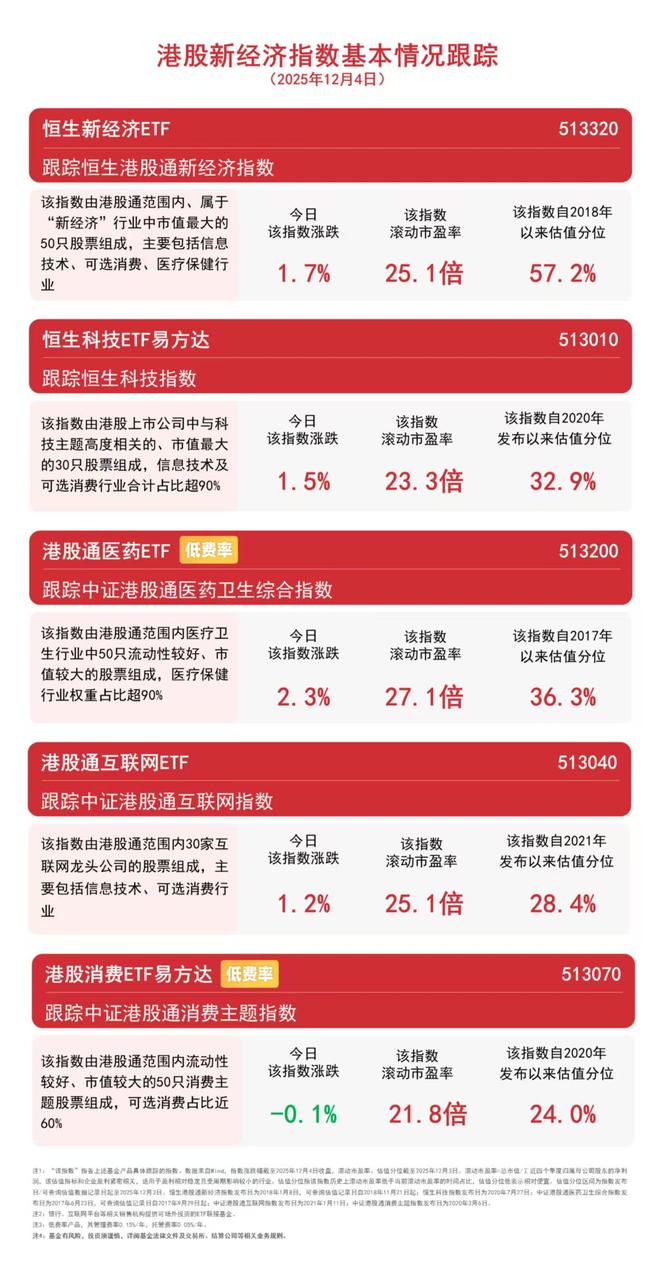
Market Performance - The Hong Kong stock market saw a rise in the afternoon, with sectors such as semiconductors, hardware equipment, and pharmaceuticals leading the gains [1] - The CSI Hong Kong Stock Connect Healthcare Index increased by 2.3%, the Hang Seng Stock Connect New Economy Index rose by 1.7%, the Hang Seng Technology Index went up by 1.5%, and the CSI Hong Kong Stock Connect Internet Index gained 1.2% [1] - The CSI Hong Kong Stock Connect Consumer Theme Index experienced a slight decline of 0.1% [1] Fund Inflows - According to Wind data, the Hang Seng Technology ETF (513010) and the Hong Kong Stock Connect Internet ETF (513040) saw net inflows of 620 million yuan and 190 million yuan, respectively, over the past week [1] Strategic Insights - CITIC Securities highlighted that the "14th Five-Year Plan" emphasizes the construction of a modern industrial system and accelerating high-level technological self-reliance, which may lead to new policy support for strategic emerging industries such as new energy, new materials, aerospace, and quantum technology [1] - Looking ahead to 2026, the Hong Kong stock market is expected to benefit from the internal catalysts of the "14th Five-Year Plan," with recommendations for investors to focus on investment opportunities in AI-related sectors and consumer electronics [1]
CPO概念延续涨势,创业板指涨超1%,创业板ETF(159915)等产品受资金关注
Sou Hu Cai Jing· 2025-12-04 10:41
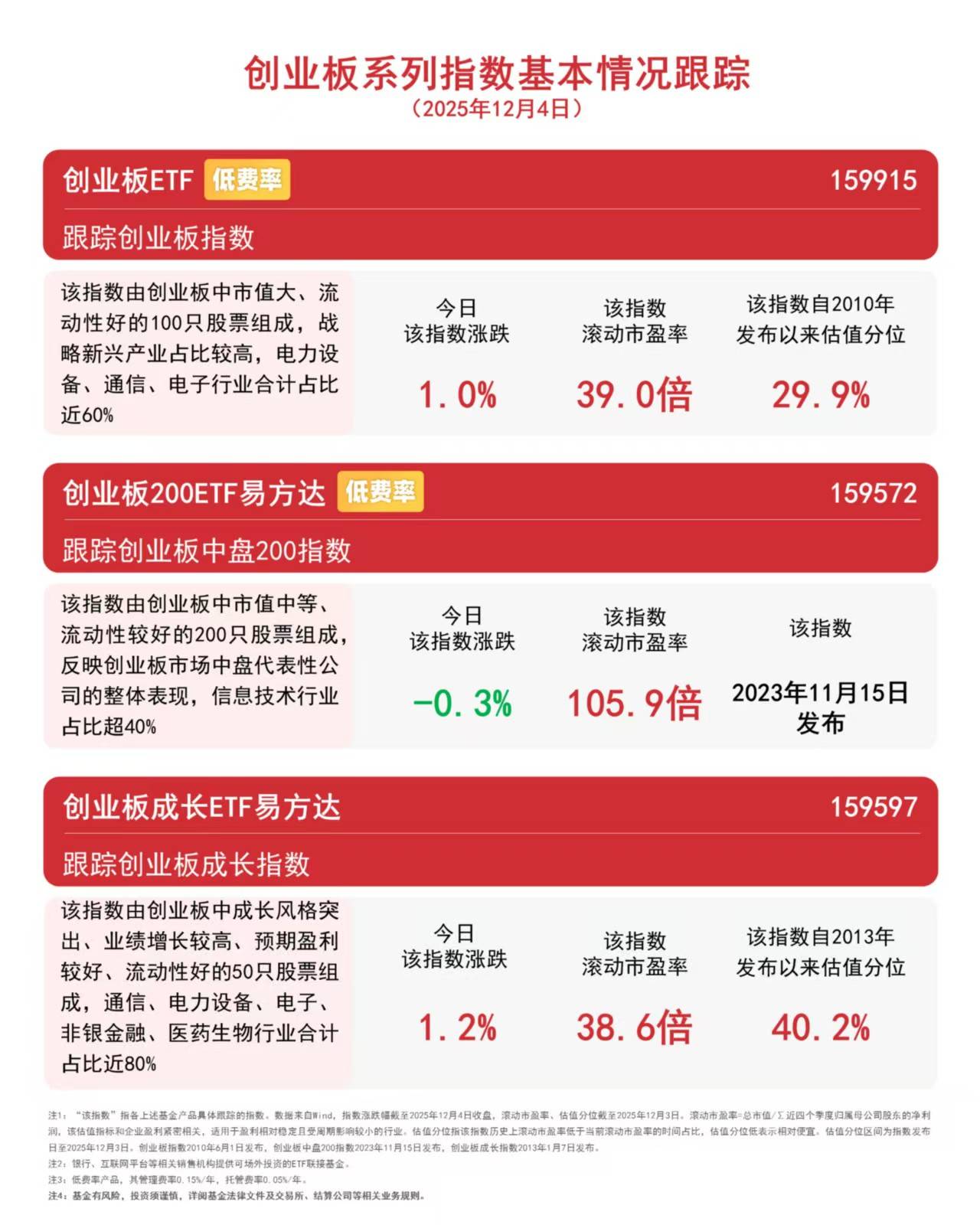
Core Viewpoint - The article discusses various ETFs tracking the ChiNext Index, focusing on their low fee rates and the composition of the underlying indices, which include high market capitalization and liquidity stocks from emerging industries. Group 1: ChiNext ETF Overview - The ChiNext Index consists of 100 stocks with high market capitalization and liquidity, primarily from emerging industries, with nearly 60% of the index represented by the power equipment, communication, and electronics sectors [2]. - The rolling price-to-earnings (P/E) ratio of the ChiNext Index is reported at 39.0 times, with an estimated increase since its inception [2]. Group 2: ChiNext 200 ETF - The E Fund ChiNext 200 ETF tracks the ChiNext Mid-Cap 200 Index, which includes 200 stocks with medium market capitalization and good liquidity, reflecting the overall performance of mid-cap companies in the ChiNext market [2]. - The information technology sector accounts for over 40% of this index, and the rolling P/E ratio is noted at 105.9 times, with a slight decline of 0.3% reported [2]. Group 3: ChiNext Growth ETF - The E Fund ChiNext Growth ETF tracks the ChiNext Growth Index, composed of 50 stocks characterized by strong growth potential, good liquidity, and favorable earnings expectations [2]. - The sectors of communication, power equipment, electronics, non-bank financials, and pharmaceuticals make up nearly 80% of this index, with a rolling P/E ratio of 38.6 times and an increase of 1.2% noted [2].

12月4日深港通医疗(983035)指数跌0.53%,成份股一脉阳光(02522)领跌
Sou Hu Cai Jing· 2025-12-04 10:36
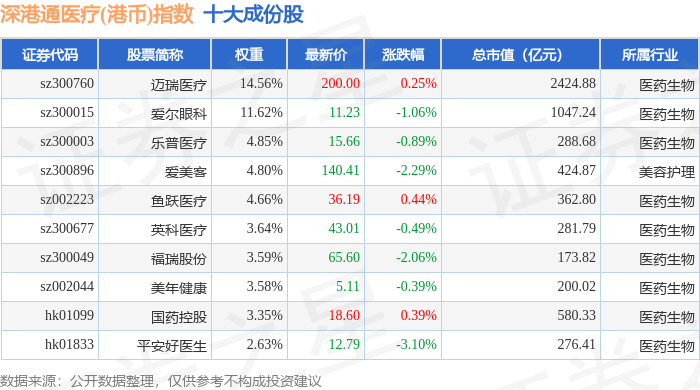
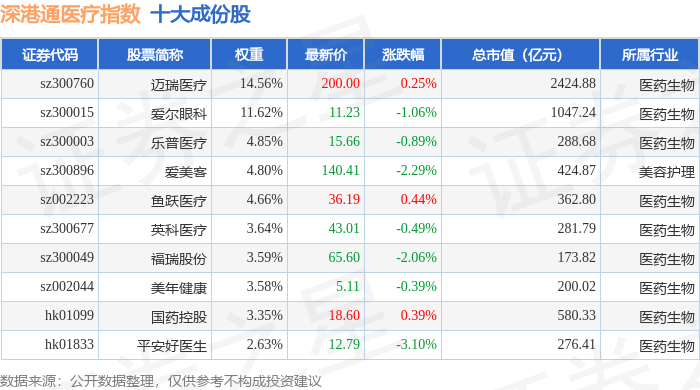
证券之星消息,12月4日,深港通医疗(983035)指数报收于4472.99点,跌0.53%,成交59.38亿元,换 手率0.69%。当日该指数成份股中,上涨的有18家,微创机器人-B以5.48%的涨幅领涨,下跌的有38家, 一脉阳光以7.29%的跌幅领跌。 深港通医疗(983035)指数十大成份股详情如下: | 证券代码 | 股票简称 | 权重 | 最新价 | 涨跌幅 | 总市值(亿元) | | 所属行业 | | --- | --- | --- | --- | --- | --- | --- | --- | | sz300760 | 迈瑞医疗 | 14.56% | 200.00 | 0.25% | | 2424.88 | 一 医药生物 | | sz300015 | 爰尔眼科 | 11.62% | 11.23 | -1.06% | | 1047.24 | 医药生物 | | sz300003 | 乐普医疗 | 4.85% | 15.66 | -0.89% | | 288.68 | 医药生物 | | sz300896 | 爱美客 | 4.80% | 140.41 | -2.29% | S | 424.87 | 美 ...
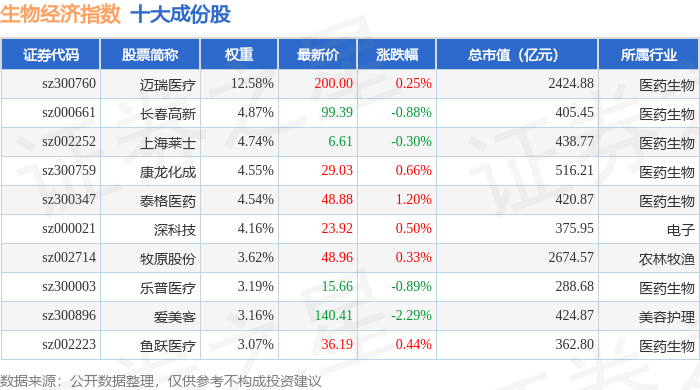
12月4日生物经济(970038)指数跌0.2%,成份股华兰疫苗(301207)领跌
Sou Hu Cai Jing· 2025-12-04 10:36
Core Viewpoint - The Biotech Economy Index (970038) closed at 2117.66 points, down 0.2%, with a trading volume of 10.477 billion yuan and a turnover rate of 0.98% on December 4 [1] Group 1: Index Performance - The index had 17 stocks that rose, with Xinlitai leading at a 3.4% increase, while 33 stocks fell, with Hualan Biological leading the decline at 5.75% [1] - The top ten constituent stocks of the Biotech Economy Index are primarily in the pharmaceutical and biotechnology sectors, with Mindray Medical holding the largest weight at 12.58% and a market capitalization of 242.49 billion yuan [1] Group 2: Capital Flow - On the same day, the main funds saw a net outflow of 459 million yuan, while retail investors had a net inflow of 428 million yuan [3] - The detailed capital flow for specific stocks shows that Hongri Pharmaceutical had a net inflow of 38.07 million yuan from main funds, while it experienced a net outflow of 59.67 million yuan from retail investors [3] Group 3: Index Adjustment - The Biotech Economy Index underwent adjustments, adding 9 new stocks and removing 9 stocks [4] - New additions include Chaoyan Co., Kanghua Biotechnology, and Yingke Medical, while notable removals include Wens Foodstuffs and Hongri Pharmaceutical [4]




12月4日深港通医疗(港币)(983036)指数跌0.57%,成份股一脉阳光(02522)领跌
Sou Hu Cai Jing· 2025-12-04 10:36
资金流向方面,深港通医疗(港币)(983036)指数成份股当日主力资金净流出合计3.3亿元,游资资金净 流入合计979.64万元,散户资金净流入合计3.2亿元。成份股资金流向详情见下表: 证券之星消息,12月4日,深港通医疗(港币)(983036)指数报收于4382.53点,跌0.57%,成交65.4亿 元,换手率0.69%。当日该指数成份股中,上涨的有18家,微创机器人-B以5.48%的涨幅领涨,下跌的有 38家,一脉阳光以7.29%的跌幅领跌。 深港通医疗(港币)(983036)指数十大成份股详情如下: | 深港通医疗(港币)指数 十大成份股 | | --- | | 证券代码 | 股票简称 | 权重 | 最新价 | 涨跌幅 | 总市值(亿元) | 所属行业 | | --- | --- | --- | --- | --- | --- | --- | | sz300760 | 迈瑞医疗 | 14.56% | 200.00 | 0.25% | 2424.88 | 医药生物 | | sz300015 | 爰尔眼科 | 11.62% | 11.23 | -1.06% | 1047.24 | 医药生物 | | sz3 ...