
城投

Search documents
8月信用债投资策略思考
Minsheng Securities· 2025-07-28 11:56
Group 1 - The credit bond market is expected to experience strong fluctuations in August due to multiple factors, including the upcoming Politburo meeting and the end of the temporary period for "reciprocal tariffs" between China and the US on August 14, which may affect market sentiment [1][11] - The overall trend of credit bonds is likely to remain stable in the short term, with limited downward potential, as the central bank's supportive stance continues to provide backing for the bond market [1][11] - After recent adjustments, credit bond spreads are still compressing, and institutional investors are expected to gradually enter the market, driven by the current "asset shortage" environment [1][11] Group 2 - The supply of credit bonds is not expected to increase significantly, with the growth of sci-tech bonds potentially offsetting the reduction in local government bonds, but overall net supply is likely to remain constrained [2][14] - The weighted coupon rate of sci-tech bonds is below 2%, indicating a scarcity of high-yield assets, which maintains a strong demand for credit bonds in the market [2][14] - The investment value of credit bonds has improved after a significant adjustment, particularly for mid-to-high-grade short- to medium-term credit varieties, which are now yielding above 10% historical levels [19][20] Group 3 - Manufacturing, new infrastructure, and consumption are expected to be key areas of policy focus in the second half of the year, with various measures likely to be introduced to support these sectors [22][23] - The macroeconomic data for the first half of 2025 shows a resilient economy, with GDP growth of 5.3% and industrial output growth of 6.4%, indicating a stable economic environment for credit bonds [22][23] - The government is likely to implement more policies to regulate the competitive order in the new energy vehicle industry, which may improve cash flow for upstream suppliers [24][29]
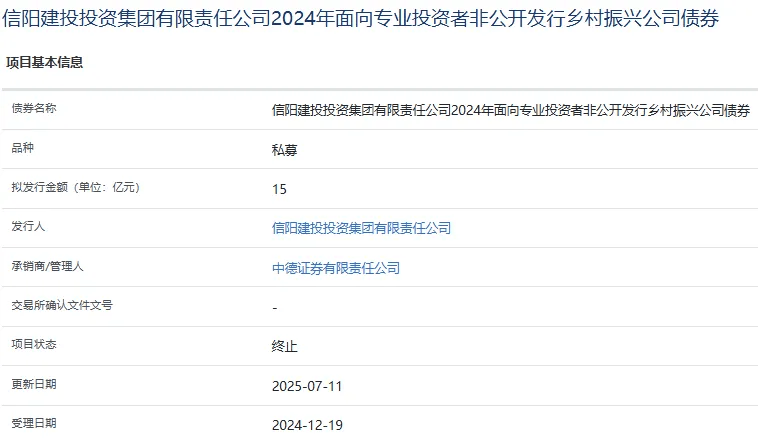
15亿乡村振兴债终止,信阳建投四次累计54亿融资折戟
Sou Hu Cai Jing· 2025-07-21 10:40
Core Viewpoint - The bond issuance project of Xinyang Construction Investment Group Co., Ltd. for 1.5 billion yuan has been terminated, marking the fourth failed financing attempt in 2025, indicating significant liquidity pressure on the company [1][3]. Financing Status - The company planned to issue 1.5 billion yuan in rural revitalization bonds, but the project status has been updated to "terminated" [2]. - This termination is part of a broader trend, with a total of 5.42 billion yuan in financing projects halted within five months, including a 1.2 billion yuan green corporate bond and a 1.22 billion yuan water supply contract asset-backed plan [3]. Liquidity Pressure - Xinyang Construction Investment has shown signs of liquidity stress, with nine commercial bills overdue in the first half of 2025, amounting to 360 million yuan [3]. - The company is listed among 889 firms with multiple overdue bills, which may affect its ability to secure future financing [3][4]. Debt Structure - As of the end of 2024, the company's total bond issuance reached 17.4 billion yuan, with new issuances of 7.58 billion yuan and repayments of only 4.41 billion yuan during the same period [4]. - Short-term debt is particularly concerning, with short-term borrowings at 3.11 billion yuan and current liabilities totaling 5.73 billion yuan, of which over 65% are bonds payable [4]. Guarantee Risks - The company has a significant guarantee network, with 87 guarantees totaling 17.01 billion yuan and 72 external guarantees amounting to 7.54 billion yuan, some of which are already overdue [5]. - Restricted assets amount to 6.87 billion yuan, representing 33.1% of net assets, further limiting financing options [5]. Cash Flow Challenges - The company reported a net cash flow from operating activities of -2.33 billion yuan in 2024, worsening from -680 million yuan in 2023, indicating reliance on external financing [6]. - Investment cash flow has been negative for four consecutive years, reaching -560 million yuan in 2024 [6]. Financial Performance - In 2024, the company achieved operating revenue of 1.97 billion yuan with a net profit of 90 million yuan, resulting in a net profit margin of 4.7% [6]. - The first quarter of 2025 saw a 121.4% increase in operating revenue to 470 million yuan, but net profit fell by 22.1% to 14.29 million yuan, highlighting a disconnect between revenue growth and profitability [7].

一级市场发行以主权债和城投行业为主,二级市场小幅上涨
Guoyuan Securities2· 2025-07-21 09:46
1. Report Industry Investment Rating - Not provided in the given content 2. Core View of the Report - The primary market issuance of Chinese offshore bonds last week was mainly dominated by sovereign bonds and the urban investment sector, while the secondary market showed a slight increase. The US Treasury yields fluctuated, and there were various macroeconomic events and data changes both in the US and China [1][4] 3. Summary by Relevant Catalogs 3.1 Primary Market - Last week, 17 Chinese offshore bonds were issued in the primary market, with a total scale of approximately $2.61 billion, mainly from sovereign bonds and the urban investment industry [1][6] - The Ministry of Finance of China issued 3 senior bonds totaling 6 billion RMB, which was the largest issuance scale last week [1][8] - Chengdu Tianfu Dagang Group issued a $200 million senior unsecured guaranteed bond with a coupon rate of 7%, which was the newly issued bond with the highest pricing last week [8] - Due to strong market demand, Swire Properties issued 3 green bonds totaling 3.5 billion RMB, with coupon rates of 2.60%, 2.85%, and 3.45%, and the final subscription was over 6 times [8] 3.2 Secondary Market 3.2.1 Performance of Chinese US Dollar Bond Index - Last week, the Chinese US dollar bond index (Bloomberg Barclays) rose 0.23% week - on - week, while the emerging market US dollar bond index fell 0.04%. The investment - grade index of Chinese US dollar bonds was at 195.7587, with a weekly increase of 0.23%; the high - yield index was at 161.005, with a weekly increase of 0.2% [10] - The Chinese US dollar bond return index (Markit iBoxx) rose 0.22% week - on - week. The investment - grade return index was at 237.1, with a weekly increase of 0.21%; the high - yield return index was at 240.0892, with a weekly increase of 0.31% [4] 3.2.2 Performance of Different Industries of Chinese US Dollar Bonds - In terms of industries, the healthcare and communication sectors led the gains, while the real estate and essential consumer sectors led the losses. The healthcare sector's yield decreased by 414.4 bps, and the communication sector's yield decreased by 30.9 bps. The real estate sector's yield increased by 1.3 Mbps, and the essential consumer sector's yield increased by 11.3 bps [19] 3.2.3 Performance of Different Ratings of Chinese US Dollar Bonds - According to Bloomberg's comprehensive rating, investment - grade names all rose, with the weekly yield of A - rated names decreasing by 5.7 bps and that of BBB - rated names decreasing by 4.1 bps. Most high - yield names fell, with the yield of BB - rated names decreasing by 5.7 bps, the yield of DD+ to NR - rated names increasing by about 120.1 bps, and the yield of unrated names increasing by 346.0 bps [21] 3.2.4 Hot Events in the Bond Market Last Week - Zhengrong Real Estate Holding Co., Ltd. failed to repay the principal of RMB 647 million and bond interest of RMB 13 million of the due debt [22] - China Fortune Land Development Co., Ltd. announced that as of June 30, 2025, the cumulative amount of debt restructuring of financial debts in its "Debt Restructuring Plan" through signing and other means was approximately RMB 192.669 billion [23] - Shanghai Shimao Co., Ltd. announced that 149,902,564 shares held by its shareholder, Tibet Shimao Enterprise Development Co., Ltd., accounting for 3.9962% of the company's total share capital, were frozen [24] 3.2.5 Subject Rating Adjustments Last Week - Zhejiang Seaport Group's long - term issuer rating was A, and the rating outlook was stable. The reason was that its IDR and outlook were consistent with Fitch's internal assessment of the credit status of the Zhejiang provincial government [26] - Everbright Bank's long - term domestic and foreign currency deposit rating was Baa2, and the rating outlook was stable. Moody's expected the bank to maintain stable asset quality, capitalization, profitability, and liquidity in the next 12 - 18 months [26] - FWD Group's issuer rating was upgraded from Baa2 to Baa1, and the rating outlook was stable. The upgrade reflected the improvement of its profitability and capital generation ability [26] 3.3 US Treasury Bond Quotes - The table shows the quotes of 30 US Treasury bonds with maturities over 6 months, sorted by yield to maturity from high to low [27] 3.4 Macro Data Tracking - As of July 18, the 1 - year US Treasury yield was 4.0633%, down 0.24 bps from last week; the 2 - year yield was 3.8691%, down 1.59 bps; the 5 - year yield was 3.9465%, down 2.62 bps; the 10 - year yield was 4.4155%, up 0.62 bps [32] 3.5 Macro News - In the US, the CPI in June increased by 2.7% year - on - year, in line with market expectations; the PPI in June was flat month - on - month, and the May data was revised up to a 0.3% increase; the number of initial jobless claims last week decreased by 7,000 to 221,000; retail sales in June increased by 0.6% month - on - month, higher than market expectations [29][30][33][34] - The US House of Representatives passed two cryptocurrency bills; President Trump said that drug tariffs might be introduced by the end of the month; the US Trade Representative's Office launched a 301 investigation against Brazil; the selection process for the next Fed Chairman has officially started [35][36][37][38] - Japan's exports to the US decreased year - on - year for the third consecutive month in June; in the first half of the year, China's GDP was 66.05 trillion RMB, a year - on - year increase of 5.3%; China's social financing scale increment in the first half of the year was 4.74 trillion RMB more than the same period last year; China's goods trade import and export value increased by 2.9% year - on - year in the first half of the year [40][41][42][43] - China's youth unemployment rate (excluding students) aged 16 - 24 in June dropped to 14.5%; Shanghai residents' per capita disposable income in the first half of the year reached 46,805 RMB, ranking first; the retail sales of the national passenger car market from July 1 - 13 increased by 7% year - on - year [44][45][47] - The housing prices in Chinese cities decreased month - on - month in June, and the year - on - year decline continued to narrow; the Dealer Association completed the registration of panda bonds worth 153.5 billion RMB in the first half of the year, a year - on - year increase of 165% [48][49]
2025年上半年城投行业运行回顾与下阶段展望:净融资连续4个月为负,警惕
Sou Hu Cai Jing· 2025-07-19 14:22
Key Points - The urban investment bond market in the first half of 2025 experienced a significant decline, with issuance reaching 2.77 trillion yuan, a year-on-year decrease of 12.15%, marking a three-year low. The net financing was negative at -1200.04 billion yuan, with four consecutive months of net outflow from March to June, the longest duration in history and the earliest occurrence within the year [1][22][37] - The overall issuance interest rate decreased to 2.40%, down 0.41 percentage points year-on-year. However, the decline in interest rates for lower-rated urban investment bonds was minimal, with AA- rated bonds even experiencing an increase [6][30] - The average maturity of issued bonds extended to 3.89 years, reflecting a trend towards longer-term financing. The broad and narrow definitions of refinancing ratios reached 97.57% and 94.13%, respectively, indicating a high reliance on refinancing [6][35] - Trading volume in the urban investment bond market decreased by nearly 15% year-on-year, with trading spreads compressing compared to the end of 2024 [40] - Both key and non-key regions experienced net outflows, with non-key regions showing a deeper level of outflow. In 13 provinces, the refinancing ratio reached 100%, with 10 of these being key provinces [7][43] - Credit risk in the urban investment sector showed slight improvement, with fewer default events reported. However, the overall credit quality remains a concern, as evidenced by the downgrades in certain provinces [8][11] - For the second half of 2025, the expected issuance scale is projected to be between 2.34 trillion and 2.50 trillion yuan, with a potential for continued negative net financing in certain months. The refinancing ratio is anticipated to remain high, and the hierarchy of financing entities may continue to rise [9][10] - The urban investment sector is facing significant challenges, including high debt pressures and the need for effective policy optimization to support financing cycles and economic development. The ongoing transformation of urban investment entities is critical, with a focus on balancing debt resolution and business expansion [10][11][12]

2025年上半年城投行业运行回顾与下阶段展望:净融资连续4个月为负,警惕退平台加速风险显性化
Zhong Cheng Xin Guo Ji· 2025-07-18 09:33
Group 1: Report Industry Investment Rating - Not mentioned in the provided content Group 2: Core Views of the Report - In H1 2025, the issuance scale of urban investment bonds hit a three - year low, with negative net financing for four consecutive months from March to June. The credit risk of urban investment bonds slightly converged, and credit ratings were mainly upgraded. It is expected that the issuance scale from July to December will be about 2.4 trillion yuan, and the net outflow may exceed 100 billion yuan [2][12]. - The current urban investment financing policy is strict, and it is necessary to optimize the policy to support new investment space. Although the "package debt resolution" has achieved results, urban investment enterprises still face heavy debt pressure. The "14th Five - Year Plan" period will bring new opportunities and challenges to the urban investment industry, but enterprises face problems such as weak asset liquidity. The "platform exit" of urban investment may lead to new problems, and it is necessary to guide and regulate the transformation [7][8][9]. - The credit spread of urban investment bonds still has room for compression. It is recommended to allocate high - quality enterprise targets in strong regions and pay attention to new issuers of bonds during the transformation [11]. Group 3: Summary by Relevant Catalogs I. Five Characteristics of the Urban Investment Bond Market Operation in H1 2025 - **Issuance scale at a three - year low, negative net financing at home and abroad**: The issuance scale was 2.77 trillion yuan, a year - on - year decrease of 12.15%. The net financing was - 120.004 billion yuan, with four consecutive months of net outflows from March to June. The overseas issuance scale decreased by 12.29% year - on - year, and the net outflow was 34.484 billion yuan. Only provincial and AAA - rated urban investment entities had positive net financing [2][17][18]. - **Overall decline in issuance interest rates, small decline for weak - quality bonds**: The weighted average issuance interest rate was 2.40%, a year - on - year decrease of 0.41 percentage points. The decline of weak - quality and low - level entities was less than that of stronger ones, and the AA - level entities' interest rates increased [30]. - **Long - term issuance trend, high proportion of debt replacement**: The weighted average term was 3.89 years, a year - on - year increase of 0.24 years. The proportion of private placement bonds rose to the first place. The broad and narrow debt replacement ratios reached 97.57% and 94.13% respectively [37]. - **Decline in trading volume, compression of trading spreads**: The trading volume decreased by 14.86% year - on - year, and the trading spreads compressed compared with the end of 2024 [42]. - **Deeper net outflows in non - key regions**: 13 provinces had a 100% debt replacement ratio, with 10 being key provinces. Jilin and Chongqing issued project - construction urban investment bonds. Key provinces had a total net outflow of 36.308 billion yuan, and non - key provinces had a total net outflow of 83.696 billion yuan [45]. II. Slight Convergence of Urban Investment Credit Risks, Upward - Adjusted Credit Ratings - **Convergence of non - standard default risks, decline in commercial bill overdue times**: There were 3 non - standard default events in H1, all trust product over - dues in Henan, Shandong, and Shaanxi. By May, 52 urban investment enterprises were on the commercial bill overdue list, with 100 times on the list, a year - on - year decrease of 10 enterprises and 17 times [56]. - **Upward - adjusted credit ratings, mainly in Shanghai, Hunan, and Guangdong**: 25 urban investment platforms had 44 rating adjustments. 14 entities had upward - adjusted main body ratings, and 2 had downward - adjusted ones. 27 bond items were upgraded, and 2 were downgraded [58]. - **Significant decline in abnormal trading volume and scale, frequent in Shandong and Guizhou**: 157 urban investment entities had 576 abnormal trades, with a scale of 23.332 billion yuan, a year - on - year decrease of 76.34%. Shandong and Guizhou had relatively large abnormal trading scales [60]. III. High Maturity and Put - Option Pressures, Difficult to Reverse the Net Outflow Trend, Expected Issuance Scale of about 2.4 Trillion from July to December - **Maturity and put - option scale of about 2.58 trillion from July to December**: By the end of June, the maturity scale was about 1.85 trillion yuan, and the put - option scale was 72.7022 billion yuan (assuming a 70% put - option ratio). Heilongjiang, Gansu, and Yunnan had relatively high maturity pressures [64]. - **Slight decline in the proportion of early redemption, more than half of bonds in Liaoning were redeemed early**: In H1, 700 bonds were redeemed early, with a total scale of 126.284 billion yuan, a year - on - year decrease of 11%. The proportion of early redemption to the total maturity scale was 4.36%, a slight year - on - year decrease. Liaoning had a high early - redemption proportion of 54.39% [68]. - **Expected issuance scale of about 2.4 trillion from July to December, net outflow may exceed 100 billion**: It is expected that there may still be months with negative net financing from July to December, with a total net outflow of about 100 - 150 billion yuan. The issuance scale is expected to be between 2.34 trillion and 2.50 trillion yuan. The debt replacement ratio will remain high, and the financing entity level may continue to move up [5][70][72]. IV. Follow - up Concerns and Investment Strategies (1) Follow - up Concerns - **Optimize financing policies**: The current policies are too strict. It is necessary to optimize policies from the perspective of ensuring financing cycles and economic development, such as refining "list - based management" and relaxing "government letter" requirements [7]. - **Accelerate debt replacement and relieve pressure**: Although the "package debt resolution" has achieved results, urban investment enterprises still face heavy debt pressure. It is recommended to accelerate debt replacement and include some operating debts and government arrears in the replacement scope [8]. - **Seize development opportunities during the "14th Five - Year Plan" period**: Urban investment enterprises face problems such as weak asset liquidity. They need to seize opportunities during the "14th Five - Year Plan" period, integrate resources, and control investment impulses [9]. - **Guide and standardize urban investment transformation**: The "platform exit" of urban investment may lead to new problems. Local governments need to guide the transformation direction and strengthen policy connection [10]. (2) Investment Strategies - The macro - environment is favorable for the bond market. The yield center may decline in H2 2025. The credit spread of urban investment bonds has room for compression. It is recommended to allocate high - quality targets in strong regions and pay attention to new issuers during the transformation [11][80].
2025年上半年一级发行跟踪
Si Lu Hai Yang· 2025-07-18 05:52
1. Report Industry Investment Rating No information provided in the content. 2. Core View of the Report - The issuance and net financing of non - financial credit bonds in the first half of 2025 showed a downward trend, with the issuance of urban investment bonds also decreasing, and the net financing gap expanding. The financing cost has been declining. Different regions and cities have significant differences in issuance, net financing, and financing costs. The issuance volume of industrial holding industry decreased in the first half of 2025, ranking second [1][26]. 3. Summary by Related Content 3.1 Overall Situation of Non - financial Credit Bonds and Urban Investment Bonds - In the first half of 2025, the issuance of non - financial credit bonds was 6.82 trillion yuan, a year - on - year slight decrease of 1.02%, and the net financing was about 1.01 trillion yuan, a year - on - year decrease of 14.88%. The issuance of urban investment bonds was about 2.615 trillion yuan, accounting for 38.33% of the total non - financial credit bond issuance, with a net financing of - 815.54 million yuan [1]. - Since 2019, the issuance cost of urban investment bonds has been declining. In 2024, the weighted average coupon rate dropped below 3%, and in the first half of 2025, it further dropped below 2.5% (about 2.44%) [1]. - The net financing of urban investment bonds has shown a negative trend since Q4 2023, with fluctuations. In the first half of 2025, the net financing turned negative year - on - year, with a decline of 268% [3]. 3.2 Regional Analysis of Urban Investment Bonds 3.2.1 Provincial - level Analysis - In terms of issuance volume, Jiangsu, Shandong, and Zhejiang ranked in the top three, but their issuance volumes in Q2 2025 decreased quarter - on - quarter. Hunan and Hubei had significant quarter - on - quarter growth in Q2 2025. Since 2024, Jiangsu has seen the most obvious decline in single - quarter issuance volume [8]. - In terms of net financing, there are significant differences and large changes among provinces. Jiangsu has seen the most obvious reduction in bond volume since the debt resolution. Shandong and Guangdong have shown "reverse expansion". Most provinces' net financing decreased quarter - on - quarter in Q2 2025 [10][12]. - In terms of financing cost, since 2025, it has been in a downward trend. In Q2 2025, only Guizhou, Gansu, Qinghai, Inner Mongolia, and Heilongjiang had a weighted average coupon rate above 3%. There were 18 provinces with a yield above 2.5% in Q2 2025, 2 less than in Q1 [12]. 3.2.2 Prefecture - level City Analysis - In Q2 2025, there were 30 cities with an issuance volume of over 10 billion yuan, and Qingdao was the only city with an issuance volume of over 40 billion yuan in Q2 and over 100 billion yuan in the first half of 2025. In the first half of 2025, the issuance volumes of major cities declined significantly. Among the top 20 cities in issuance volume, Xi'an had the most obvious year - on - year increase, while regions with a decline of over 30% included Suzhou, Changzhou, Huzhou, and Xuzhou [15]. - In the first half of 2025, 102 cities achieved positive net financing, 2 more than the previous year. Guangzhou and Qingdao were the only two cities with a net financing scale of over 10 billion yuan. Among other cities with a large net financing scale, Taizhou, Shangrao, Zhengzhou, and Shijiazhuang turned from negative to positive, while Zhuhai, Fuzhou, and Weifang had obvious declines [19]. - Nanjing and Chengdu had a financing gap of over 10 billion yuan, and their year - on - year declines were large. Most cities with large financing gaps saw a significant expansion of the gap, and Xiamen, Quanzhou, and Zhuzhou turned from positive to negative [21]. - In Q2 2025, only Baoshan, Anshun, Laibin, Liaocheng, and Tongren could offer a yield of over 4%. There were 28 cities with a coupon rate of over 3%, 3 less than in Q1. Only Zhangjiakou, Weihai, Guilin, Liuzhou, Xiangtan, Harbin, and Dezhou saw a quarter - on - quarter increase in the weighted coupon rate [23]. 3.3 Industrial Holding Industry - In 2023, the issuance volume of the industrial holding industry exceeded that of the power industry, ranking first. In 2024, it continued to rank first, with the total issuance volume reaching a record high of about 1.28 trillion yuan. In the first half of 2025, it dropped to second place, and the total volume was close to 46% of that in 2024. In terms of net financing, it reached 35.18 billion yuan in 2024, a year - on - year increase of 245%. In the first half of 2025, the net financing was about 17.18 billion yuan, nearly half of that in 2024. The financing cost has also been declining, dropping below 2.2% in the first half of 2025 [26].
信用周观察系列:信用债行情还有多少空间
HUAXI Securities· 2025-07-14 03:02
1. Report Industry Investment Rating No relevant content provided in the report. 2. Core Viewpoints of the Report - Since July, the allocation demand for credit bonds from funds, other product categories, and insurance has increased. Credit spreads have mostly narrowed or remained flat due to strong demand, with 1Y varieties showing strong resistance to decline and lower-rated bonds performing better than higher-rated ones [1][10][11]. - Currently, both credit bond coupons and credit spreads are at low levels, and the market trend is more dependent on institutional allocation demand. It is necessary to closely monitor institutional behavior, buying sentiment, and the potential compression space of credit spreads [1][12]. - Overall, the supply - demand pattern in July is favorable for credit bonds, and there is still a small amount of compression space for credit spreads. Specific strategies include focusing on short - to medium - duration bonds with credit rating sinking, and high - grade 10Y bonds have relatively large potential compression space for credit spreads [3][22]. - In the bank capital bond market, although the spread protection is thin, there is still compression space. Long - duration bonds of large banks and 2 - 3 year bonds of small and medium - sized banks are recommended [5]. 3. Summary by Related Catalogs 3.1. Credit Bond Market Overview - From July 1 - 11, funds' net purchase of credit bonds reached 88.5 billion yuan, a year - on - year increase of 39.1 billion yuan. Other product categories and insurance had net purchases of 31.3 billion and 15.2 billion yuan respectively, with year - on - year increases of 7.8 billion and 5 billion yuan [1][11]. - From July 7 - 11, with the convergence of funds and the rotation of negative factors, the bond market fluctuated upwards. Credit bonds, due to strong allocation demand, saw most credit spreads narrow or remain flat [10]. 3.2. Factors Affecting Credit Bond Market 3.2.1. Institutional Behavior - Fund net trading volume of credit bonds is a sensitive indicator related to credit spread trends. Maintaining a daily net purchase of over 500 million yuan helps keep credit spreads low. From July 7 - 10, the rolling 5 - day net purchase was 1 - 1.4 billion yuan, but it dropped to 740 million yuan on the 11th, and was below 500 million yuan on the 10th and 11th [2][12]. 3.2.2. Buying Sentiment - The TKN成交占比 is used to measure buying sentiment. A stable TKN成交占比 above 75% indicates good buying sentiment. From July 7 - 11, as yields rose, the TKN成交占比 declined, with three days below 70%, but the rolling 5 - day average was around 70% [2][16]. 3.2.3. Potential Compression Space of Credit Spreads - By observing the position of credit spreads relative to the mean - 2 times the standard deviation, it is found that currently, each variety still has a small amount of compression space, with 10Y varieties having relatively large potential [3][22]. 3.3. Specific Bond Types Analysis 3.3.1. Urban Investment Bonds - From July 1 - 13, urban investment bonds had a net financing of 28.8 billion yuan. The primary market issuance sentiment was good, with the proportion of full - subscription multiples over 3 times remaining at 61%. The issuance rate of long - term bonds decreased significantly, with the 10 - year average dropping to 2.14% [30][32]. - In the secondary market, short - term bonds were resistant to decline, while the yields of 3 - 10Y bonds increased. The trading activity decreased, and Shenzhen Metro had many high - valuation transactions [35][38]. 3.3.2. Industrial Bonds - From July 1 - 13, industrial bond issuance and net financing increased year - on - year. The issuance sentiment weakened slightly, and the proportion of long - term issuance over 5 years decreased significantly. The buying sentiment in the secondary market weakened, and the trading duration increased [40][42]. 3.3.3. Bank Capital Bonds - From July 7 - 13, several banks issued secondary capital bonds and perpetual bonds. In the secondary market, yields generally rose, spreads showed differentiation, and low - grade, short - duration bonds performed better. Currently, credit spreads are at relatively low levels, but there is still compression space [45][46]. 3.3.4. TLAC Bonds - By comparing the yields of 3Y, 5Y, and 10Y AAA - secondary capital bonds with TLAC bonds, the spreads are analyzed. As of July 11, 2025, the 3Y, 5Y, and 10Y spreads were 3.1bp, 3.8bp, and 1.4bp respectively, indicating that 10 - year TLAC bonds are more cost - effective [53]. 3.3.5. Commercial Financial Bonds - Since 2021, the valuation of 3Y AAA commercial financial bonds has generally followed the trend of interest - rate bonds, with a stable spread center. As of July 11, the credit spread was 14bp, at a relatively low level [57].
聚焦主业优化配置 一批地方国资加速划转科创、产业类资产
Zhong Guo Jing Ying Bao· 2025-07-13 09:58
Group 1 - The core viewpoint of the articles highlights the trend of local state-owned enterprises accelerating the divestiture of technology and industrial assets to enhance focus on core responsibilities and facilitate regional industrial upgrades and high-quality development [1][2][4] - The announcement from Shaoxing Binhai New Area Development Group indicates the transfer of various technology-related assets to Shaoxing Binhai New Area Technology Industry Development Co., which includes stakes in companies involved in new energy technology and talent development [2][5] - The divestiture of assets is seen as a means to improve the management efficiency of state-owned assets and broaden financing channels through new entities capable of issuing technology innovation bonds [2][3] Group 2 - Since May, 25 state-owned enterprises have announced asset transfers, covering multiple provinces, indicating a widespread trend in asset divestiture across the country [4] - Specific examples include the transfer of 100% equity stakes in various subsidiaries by local investment groups, demonstrating a pattern of capital operation among city investment companies [4][5] - The asset transfers often involve a variety of entities, including parent companies, local finance departments, and newly established investment companies, reflecting a diverse approach to asset management [5][6] Group 3 - Industry experts suggest that traditional city investment companies, while historically focused on infrastructure, are now exploring paths for technological innovation and the development of emerging industries [6][7] - The emphasis is on building investment and operational capabilities for technology innovation projects and leveraging state-owned enterprises' financial strength to establish industry investment guiding funds, particularly for technology innovation [7]
从轻轨烂尾到AI突围:柳州化债的赌与救
Sou Hu Cai Jing· 2025-07-04 06:43
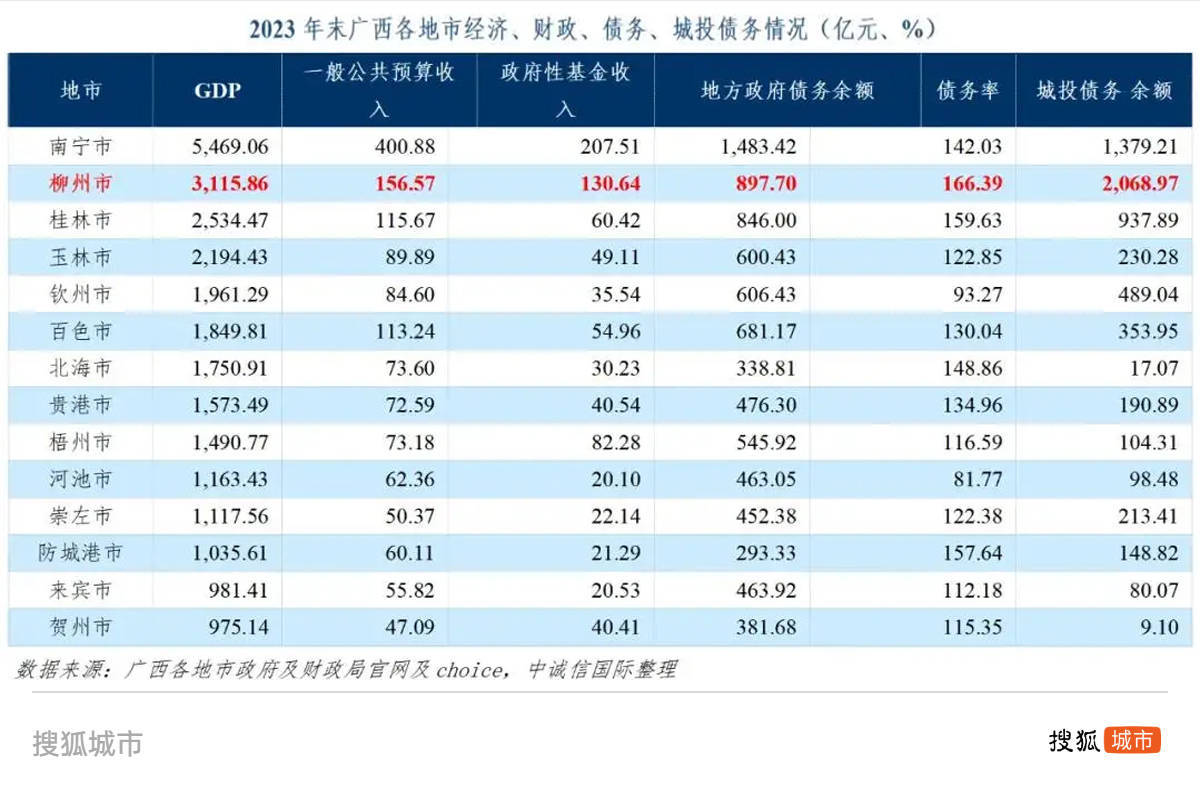
Core Viewpoint - The Guangxi Autonomous Region is mobilizing efforts to support Liuzhou in addressing its severe local debt crisis, which has escalated due to a combination of industrial decline and aggressive urban construction policies [1][14]. Summary by Sections Liuzhou's Debt Situation - Liuzhou's local government debt reached 1,042.7 billion yuan by the end of last year, with 788.4 billion yuan attributed to the municipal level [3]. - The city has a debt ratio of 166.39%, the highest among major cities in Guangxi [2]. - Liuzhou's financing platforms have accumulated significant hidden debts, with a total of 2,159.02 billion yuan in interest-bearing liabilities [3]. Financial Challenges - In 2024, Liuzhou's fiscal revenue is projected to be 149 billion yuan, a 4.8% decrease from 2023, while expenditures are expected to rise by 21.7% to 462 billion yuan [4]. - The city's government fund income is anticipated to drop by 53.6% to 60.66 billion yuan, exacerbating the financial strain [4]. Historical Context of Debt Accumulation - Liuzhou's debt issues stem from a history of structural imbalances, characterized by industrial stagnation and aggressive urban development [5]. - The city was once a major automotive hub, but production has declined significantly since 2017, leading to a drop in industrial output [8]. Political and Economic Implications - The debt crisis is not only a financial issue but also reflects deeper political and governance challenges within Liuzhou [14]. - The Guangxi government has proposed a comprehensive debt resolution plan, emphasizing the need for political support alongside financial measures [14]. Future Prospects and Strategies - The Guangxi government has committed to a three-year plan to help Liuzhou achieve a positive financial cycle, focusing on asset revitalization and risk prevention [14]. - Liuzhou aims to leverage artificial intelligence and manufacturing integration as a key strategy for economic recovery, with a target to exceed 100 billion yuan in AI-related industry output by 2027 [15][16].
2025信用月报之六:下半年信用债怎么配-20250702
HUAXI Securities· 2025-07-02 13:52
Group 1: Report Summary - Investment Rating: Not provided in the report - Core View: In the second half of 2025, credit bond investment should focus on three elements: the trend of funds and interest rates, the supply - demand pattern of credit bonds, and the cost - effectiveness of different varieties. Interest rates may continue to decline in a volatile manner, making the coupon value of credit bonds prominent, but the valuation volatility may increase. The overall supply of credit bonds may be difficult to expand, and the configuration demand may weaken from August to December. Different investment strategies are recommended for different periods and varieties [1][18] Group 2: 1. Steady Coupon as the Foundation, Grasp the Trading Rhythm 1.1. Short - to Medium - Duration Credit Spread Compression for Coupon Income, Seize Phased Opportunities in Long - Duration Bonds - H1 2025 Review: The credit bond market experienced an increase in yields and a widening of credit spreads from January to mid - March, followed by a rotation of the market to medium - to long - duration and then ultra - long - duration bonds from April to June. The main factors in the first quarter were the tight funds and the change in wealth management scale. In mid - to late March, the bond market recovered, driven by supply shrinkage and the cost - effectiveness of varieties. From April to June, the market was affected by interest rate fluctuations and the shift of the funds' central point [12][13] - June 2025 Highlights: The long - duration credit bond market was activated, mainly due to the compression of short - to medium - duration credit spreads to historical lows and the increased demand from funds, insurance, and other products. The scale of credit bond ETFs increased by 7.7 billion yuan in June, which also drove the demand for some long - duration component bonds [14][16] - H2 2025 Outlook: Interest rates may continue to decline in a volatile manner. The supply of credit bonds may be difficult to expand, with the decrease in urban investment bonds offset by the increase in industrial bonds. The wealth management scale usually increases significantly in July but weakens from August to December. The rectification of wealth management's net - value smoothing methods may suppress the demand for ultra - long - duration and low - rated medium - to long - duration bonds. It is recommended to increase positions in July, take profits in August, and reduce credit bond positions from August to December, switching to inter - bank certificates of deposit and interest - rate bonds [18][19][21] - Variety Cost - Effectiveness: The 10Y high - grade credit bonds have relatively large potential for credit spread compression. As of June 30, the credit spreads of 10Y high - grade medium - term notes are still 8 - 11bp higher than the average. Short - to medium - duration credit spread compression may still be the dominant strategy. Bonds with a yield of 2.0% - 2.2% in the 1 - 3 - year AA and AA(2) categories have high allocation value. High - grade 5 - year bonds can be considered when the credit spread adjusts to the mean + 1 standard deviation [22][30][35] 1.2. Grasp the Trading Rhythm of Bank Capital Bonds 1.2.1. Difficult for Bank Capital Bond Supply to Expand in H2 2025 - H1 2025 Review: The supply of bank capital bonds increased slightly. The net financing of secondary capital bonds increased year - on - year, while that of perpetual bonds decreased. The city commercial banks increased their issuance scale, while the supply from rural commercial banks was weak [39] - H2 2025 Outlook: The demand for new capital bonds from the Big Four banks may decrease after the capital injection in June. Although small and medium - sized banks may increase issuance if the cost is low, the overall net supply is difficult to expand [40] 1.2.2. Narrower Bandwidth for Band - Trading in Bank Capital Bonds, Reverse Trading May Yield Higher Win - Rates - H1 2025 Review: The yields of bank capital bonds showed differentiation. The yields of 1 - 5Y large - bank bonds generally increased, while those of 10Y secondary capital bonds and 1 - 4Y small - and medium - bank bonds mostly decreased. The credit spreads of most varieties compressed, with short - duration and low - grade bonds performing better [44] - H2 2025 Outlook: The bank capital bonds still have trading opportunities following interest - rate bonds, but the credit spread compression space is limited. Reverse trading (increasing positions during adjustments) may have a higher win - rate. The 4 - year and 6 - year bonds have higher riding yields and better holding experiences [50][51] Group 3: 2. Urban Investment Bonds: Negative Net Financing in H1, a Historical First - H1 2025 Supply: The supply of urban investment bonds shrank, with negative net financing for the first time in history. From January to June, the issuance was 2.9464 trillion yuan, a year - on - year decrease of 382.9 billion yuan, and the net financing was - 71.7 billion yuan, a year - on - year decrease of 218.5 billion yuan, mainly due to the tightening of bond - issuing policies [55] - Issuance Characteristics: The overall issuance sentiment was good, with a high proportion of over - subscribed issuances. The proportion of 3 - 5 - year issuances increased, while that of within - 1 - year issuances decreased. The issuance interest rates decreased overall, with greater declines in short - to medium - term bonds [55][56] - Regional Differences: The net financing performance of urban investment bonds varied by region. Most regions had negative net financing, mainly affected by district - level and park - level platforms. Guangdong and Shandong had relatively high positive net financing, while Jiangsu, Hunan, and Chongqing had large negative net financing [58] - Yield and Credit Spread: The yields of urban investment bonds generally decreased in H1, with high - grade long - duration and AA - low - grade bonds performing better. The credit spreads of all maturities and grades narrowed, with low - grade bonds performing more strongly [62][63] - Secondary Market: Since mid - March, the buying interest in the secondary market has been high, with a high proportion of TKN transactions and low - valuation transactions. There was a trend of increasing duration in transactions, and the proportion of AA(2) low - grade transactions remained high [66] Group 4: 3. Industrial Bonds: Supply Increase, Longer Durations in Both Primary and Secondary Markets - H1 2025 Supply: The issuance and net financing of industrial bonds increased year - on - year. From January to June, the issuance was 3.8718 trillion yuan, a year - on - year increase of 309.2 billion yuan, and the net financing was 1.0788 trillion yuan, a year - on - year increase of 40 billion yuan. The new regulations on science and technology innovation bonds contributed to the increase in issuance [18] Group 5: 4. Bank Capital Bonds: Low - Rated Bonds Perform Better, Weak Trading Sentiment - H1 2025 Performance: The yields of bank capital bonds showed differentiation, with short - duration and low - rated bonds performing better. The credit spreads of most varieties compressed, with 1 - 4Y small - and medium - bank capital bonds and 1 - 3Y AA - perpetual bonds having significant spread compression [44] - Trading Rhythm: The trading bandwidth of large - bank long - duration capital bonds has been narrowing, making band - trading more difficult. Reverse trading may be a better strategy. The 4 - year and 6 - year bonds have higher riding yields [48][51]