
家电

Search documents
中信建投:铜价与汇率冲击再起
Di Yi Cai Jing· 2026-01-27 02:14
中信建投证券研报认为,2026年面临铜价中枢上移与人民币升值的双重考验,其对家电龙头盈利的冲击 整体可控。过往经验看,顺价是化解成本压力最为有效的核心手段。国补落地下需求有支撑,元旦后提 价存共识。凭借强大的终端定价权、成熟的成本传导机制以及完善的汇率风险管理体系,龙头企业有能 力穿越周期波动,维持盈利模型的稳健。当前家电板块估值处于历史低位,兼具稳健增长与高分红特 性,配置价值凸显。(本文来自第一财经) (家电网® HEA.CN) ...

广东中山将携智造优品、特色风物与文旅魅力亮相太阳宫 续写香山与上海百年佳话
Jie Fang Ri Bao· 2026-01-27 01:41
Core Viewpoint - The event "Guangdong Goods Go Global: Zhongshan Department Store Enters Shanghai" showcases Zhongshan's manufacturing prowess and cultural charm, aiming to continue the legacy of the Xiangshan business community in Shanghai [1] Group 1: Event Overview - The event took place from January 31 to February 2 at Shanghai's Ruihong Xintiandi Sun Palace, featuring exhibitions, interactive activities, performances, and investment promotion [1] - It is guided by the Guangdong Provincial Department of Industry and Information Technology and hosted by the Zhongshan Municipal Government [1] Group 2: Highlights of Zhongshan Products - The Zhongshan Quality Products area is the core highlight, focusing on categories such as home appliances, furniture, consumer electronics, clothing, daily chemicals, food, and cultural tourism [2] - The event features themed areas like "Charming Zhongshan," "Intelligent Manufacturing Zhongshan," and "Cultural Tourism Zhongshan," showcasing the latest achievements in technology innovation and quality of life [2] Group 3: Interactive and Online Engagement - On-site activities include consumer lotteries, photo opportunities, and performances of traditional Guangdong music, enhancing the cultural experience for attendees [2] - Online marketing efforts involve live streaming and collaboration with major e-commerce platforms like Tmall and Douyin to promote "Zhongshan Manufacturing" [2]
A股三大指数集体低开,沪指跌0.18%
Feng Huang Wang Cai Jing· 2026-01-27 01:41
Market Overview - A-shares opened lower with all three major indices declining: Shanghai Composite Index down 0.18%, Shenzhen Component Index down 0.23%, and ChiNext Index down 0.09% [1] Institutional Insights - Huaxi Securities suggests that the current market is in the mid-stage of a "slow bull" trend, with the Shanghai and Shenzhen 300 Index currently at mid-levels compared to previous bull markets in 2007, 2015, and 2021 [2] - The risk premium for the Shanghai and Shenzhen 300 Index is at 5.27%, indicating potential for further market growth as historical lows were around 2.5% [2] - Recommended sectors for investment include technology (AI computing, applications, robotics, space photovoltaics), industries benefiting from "de-involution" and price increases (chemicals, non-ferrous metals), and sectors with high growth in annual performance forecasts (electronics, machinery, pharmaceuticals) [2] Sector Analysis - CITIC Securities reports that the home appliance sector will face pressure in Q4, with a focus on the national subsidy policy adjustment in 2026 targeting core categories and rural markets [3] - The subsidy will cover six major home appliance categories with a 15% subsidy for first-level energy efficiency, with an initial allocation of 62.5 billion yuan aimed at rural markets [3] - JD.com is investing 30 billion yuan to implement a program expected to reach 30-40 million rural residents, positioning the rural market as a key growth area for 2026 [3] Lithium Battery Sector - CITIC Jinpu indicates that lithium battery inflation is beginning, with clear price trends in rigid capacity segments, although upper limits remain uncertain [4] - The current lithium cycle is compared to the previous photovoltaic cycle, suggesting that price increases have not negatively impacted demand, leading to simultaneous volume and price growth across the industry [4] - Price adjustments are expected to be driven by capacity expansion rather than demand contraction, with stock prices likely to follow the trend of volume and price increases in the industry [4]
A股开盘:沪指跌0.18%、创业板指跌0.09%,有色金属、光伏设备板块调整
Jin Rong Jie· 2026-01-27 01:38
Market Overview - On January 27, A-shares opened slightly lower, with the Shanghai Composite Index down 7.39 points, a decline of 0.18%, closing at 4125.22 points [1] - The Shenzhen Component Index fell by 32.86 points, a decrease of 0.23%, closing at 14283.78 points [1] - The CSI 300 Index decreased by 1.79 points, down 0.04%, closing at 4705.17 points [1] - The ChiNext Index dropped by 3.13 points, a decline of 0.09%, closing at 3316.02 points [1] - The K-50 Index fell by 2.73 points, down 0.18%, closing at 1530.07 points [1] Company News - Zijin Mining plans to acquire all issued common shares of Allied Gold Corporation at a price of CAD 44 per share, totaling approximately CAD 5.5 billion (about RMB 28 billion) [2] - Li Tong Electronics expects a net profit attributable to shareholders of RMB 270 million to RMB 330 million for 2025, representing a year-on-year increase of 996.83% to 1240.57% [2] - China Rare Earth anticipates a net profit of RMB 143 million to RMB 185 million, recovering from a loss of RMB 287 million in the same period last year [2] - Conch Cement plans to use temporarily idle funds to purchase structured deposits with a maximum daily balance of RMB 30 billion and invest in bank wealth management products with a maximum daily balance of RMB 20 billion [2] Industry Insights - Silver products accounted for only 4.54% of Silver's total revenue, with sales of RMB 20.23 billion in the first half of 2025 [3] - Chunzhong Technology expects a net profit of RMB 265 million to RMB 290 million for 2025, a growth of 208.86% to 238.00% year-on-year [3] - Duofu expects a net profit of RMB 20 million to RMB 28 million for 2025, recovering from a loss of RMB 30.8 million in the previous year [3] - Dongfang Risen anticipates a net loss of RMB 2.3 billion to RMB 2.9 billion for 2025, compared to a loss of RMB 3.436 billion in the previous year [3] Hot Topics - The "Star Computing" seminar revealed that Guoxing Aerospace successfully deployed the Qwen3 model to a space computing center, marking the first time a general model has been deployed in orbit [6] - Amazon Web Services (AWS) announced a 15% price increase for its EC2 machine learning capacity blocks, reflecting a significant shift in cloud computing pricing logic amid AI resource shortages [7] - The price of black tungsten concentrate rose by 11.43% to RMB 536,000 per ton, while ammonium paratungstate increased by 12.06% to RMB 790,000 per ton [9] - The U.S. government has signed a non-binding letter of intent with USA Rare Earth for a total of approximately USD 1.6 billion, leading to a significant increase in the company's stock price [10]

金融界财经早餐:商务部发声!优化实施消费品以旧换新;交易所接连出手“降温”,涉白银、锡、铜等期货;白银、黄金“高台跳水”;人形机器人“组团”上春晚(1月27日)
Jin Rong Jie· 2026-01-27 01:38
Company News - Zijin Mining announced a cash acquisition of Allied Gold Corporation at a price of 44 CAD per share, totaling approximately 5.5 billion CAD (about 28 billion RMB) [9] - Zhejiang Wen Internet reported a stock price increase of 69.57% from January 5 to January 26, indicating potential market overreaction and risks of a rapid decline [9] - Tongling Nonferrous Metals announced a stock price deviation of 20.72% over two trading days, with normal production and operational conditions [9] - Crystal Clear Technology plans to acquire 100% of Easy Charge Technology through a combination of stock issuance and cash payment, pending necessary approvals [10] - Xingyu Co., Ltd. submitted an application for H-share listing on the Hong Kong Stock Exchange [10] - JD Infrastructure Development submitted an A1 application to the Hong Kong Stock Exchange, managing assets totaling approximately 121.5 billion RMB [10] - Guoxing Aerospace revealed its "Star Computing" plan, involving a network of 2,400 reasoning satellites and 400 training satellites for high-speed data transmission [11] - Evert announced plans to acquire shares of Shanghai Shengpu Fluid Equipment Co., Ltd., with stock suspension effective from January 27 [11] - Yushu Technology's humanoid robots will participate in the 2026 Spring Festival Gala, marking a significant industry collaboration [11] - Tensu Zhixin released a roadmap for its fourth-generation architecture, aiming to surpass NVIDIA's Rubin architecture by 2027 [11] - Anta Sports agreed to purchase 43.01 million shares of PUMA SE for a total consideration of approximately 1.507 billion euros (about 12.278 billion RMB) [12] - Alibaba launched the Qwen3-Max-Thinking model, boasting over one trillion parameters and competitive performance [12] - Tencent's CEO emphasized a decentralized AI strategy for WeChat, focusing on user needs and privacy [12] Industry Insights - The humanoid robot market is projected to exceed traditional rotary transformer markets, with an expected market size of 6.15 billion RMB by 2030 and 47.1 billion RMB by 2035 [6] - The sodium battery industry is at a critical commercialization stage, with major players like CATL launching mass-produced sodium batteries [6] - The satellite communication sector is experiencing rapid growth, with a 40% increase in the satellite communication index over the past two months [6] - The domestic tourism market is seeing a 300% increase in booking numbers compared to last year, driven by various travel preferences [6] - The commercial aerospace sector in Hainan is expanding, with a budget of approximately 220 million RMB for upcoming launch tasks [6] - The production and delivery pace of the C919 aircraft is set to increase, with a target of at least 28 deliveries in 2026 [7]



中国超大规模市场优势持续显现
Jing Ji Wang· 2026-01-27 01:37
Group 1: Economic Growth and Consumer Trends - In 2025, China's total retail sales of consumer goods exceeded 50 trillion yuan, reaching 50.1 trillion yuan, with a growth rate of 3.7% [1] - The contribution rate of consumption to economic growth reached 52%, highlighting its role as a main engine for economic development [1] - The retail sales of durable goods, such as home appliances, communication equipment, and furniture, grew by 11%, 20.9%, and 14.6% respectively, driven by the policy of replacing old consumer goods [2] Group 2: New Consumption Patterns - New consumption types, including digital, green, and health consumption, are on the rise, with online retail sales of physical goods increasing by 5.2% [2] - The penetration rate of new energy passenger vehicles reached 53.9%, indicating a shift towards sustainable consumption [2] - Rural consumption retail sales reached 6.8 trillion yuan, growing by 4.1%, outpacing urban growth by 0.5 percentage points [2] Group 3: Import and Export Developments - In 2025, China imported 18.48 trillion yuan, maintaining its position as the world's second-largest import market for 17 consecutive years [4] - China's trade partnerships expanded, with imports from over 130 countries and regions increasing by 7% compared to 2024 [4] - The "Belt and Road" initiative is enhancing trade opportunities, with positive impacts on exports of electronic components and machinery to partner countries [4] Group 4: Future Initiatives and Policies - In 2026, the Ministry of Commerce aims to stabilize foreign trade and promote service market openness, focusing on quality and efficiency [5] - The government plans to implement more practical measures to support foreign trade, investment, and consumption, including signing free trade agreements with 31 countries [7] - The emphasis will be on expanding domestic demand and enhancing consumer spending through initiatives like the "Buy in China" campaign [7][8]
出政策办活动优场景 促消费今年继续加力
Ren Min Ri Bao· 2026-01-27 01:36
Core Viewpoint - The Chinese government is focusing on boosting consumption and expanding investment in 2026, following a stable performance in 2025, with a target to enhance consumer spending and improve the business environment [2][3]. Group 1: Consumption Promotion - In 2025, the total retail sales of consumer goods reached 50.1 trillion yuan, a year-on-year increase of 3.7%, with consumption contributing 52% to economic growth, up by 5 percentage points [3]. - The government plans to implement policies and activities to enhance consumer spending, including optimizing the "trade-in" program for durable goods like automobiles and home appliances [4]. - The service sector saw a retail sales growth of 5.5%, with significant increases in cultural, recreational, and travel services, indicating a strong demand for service consumption [4]. Group 2: Investment and Trade - In 2025, foreign trade maintained resilience, with total imports and exports reaching 45.47 trillion yuan, a 3.8% increase year-on-year, and over 780,000 enterprises engaged in foreign trade [5]. - The number of newly established foreign enterprises exceeded 70,000, marking a 19.1% increase, with foreign investment absorption reaching 747.69 billion yuan, of which high-tech industries accounted for 32.3% [5]. - The government aims to enhance foreign investment policies and support foreign enterprises in participating in consumption and procurement activities [6]. Group 3: International Cooperation - China signed 24 free trade agreements with 31 countries and regions, covering 45% of total goods trade, and is actively participating in global trade discussions [7][9]. - The Belt and Road Initiative saw trade with partner countries reach 23.6 trillion yuan, a 6.3% increase, with significant investments in various sectors [7]. - China is committed to deepening cooperation with developing countries and enhancing participation in international economic negotiations [8].
财信宏观深度|价格趋势确立,牛市行至中局——2026年物价走势与A股策略研判
Xin Lang Cai Jing· 2026-01-27 01:28
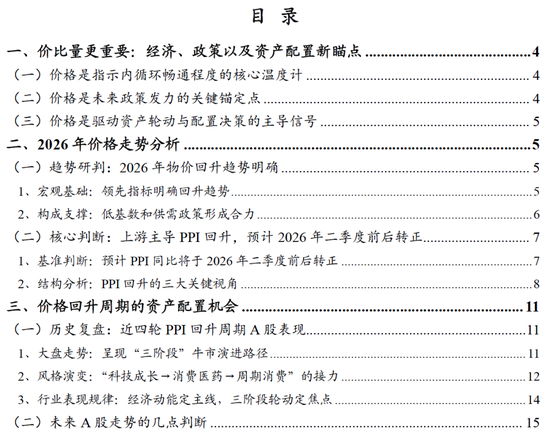
Group 1 - The focus of macroeconomic analysis is shifting from "quantity" to "price," with "price" becoming a key variable for observing the internal circulation of the economy, predicting policy directions, and driving asset rotation [9][10][14] - Price signals are crucial for activating the "price-profit-income-consumption" positive cycle, which is essential for understanding economic vitality and guiding policy [10][11][14] - The report predicts that the Producer Price Index (PPI) will enter an upward cycle in 2026, primarily driven by upstream industries, fundamentally reshaping profit patterns and market styles [8][15][28] Group 2 - The analysis indicates a clear upward trend in prices for 2026, supported by macroeconomic indicators such as narrowing supply-demand gaps and improving financial liquidity [17][18][19] - The report highlights that the PPI is expected to turn positive around the second quarter of 2026, with structural characteristics emphasizing the role of upstream industries [28][31][32] - The low base effect and supportive supply-demand policies are anticipated to create a combined force that will support moderate price increases in 2026 [25][26] Group 3 - Historical analysis shows that the PPI's transition from negative to positive corresponds with three stages of bull market evolution, with distinct patterns in market performance and sector rotation [49][52][58] - The report identifies a clear rotation in market styles during bull markets, transitioning from technology growth to consumer healthcare and then to cyclical consumption [58][66] - The report emphasizes that the leading sectors during these cycles reflect the core drivers of economic growth and strategic focus, with upstream industries like coal, oil, and metals expected to lead the recovery [36][66] Group 4 - The current market is in the second phase of a bull market, with expectations for reduced return forecasts for 2026, as historical trends indicate diminishing returns in later stages [69] - The focus for the first half of the year will remain on new productive forces, particularly in sectors like computing, electronics, military, and power equipment, driven by the AI technology revolution [70] - The report suggests that while the valuation of technology sectors is high, the potential for profit recovery remains a key driver for performance in these areas [70]
河南捧出新春“消费盛宴”
Zheng Zhou Ri Bao· 2026-01-27 01:12
Group 1 - The "Enjoy Spring Festival · Enjoy Henan" consumption season will take place from January to March, focusing on revitalizing consumption, New Year goods consumption, and scenario-based consumption [1] - The event aims to create a vibrant atmosphere with measures that promote inclusivity, quality upgrades, and a joyful environment, integrating multiple business formats and scenarios [1] - Activities will be organized to promote high-quality Henan products, launching the first wave of New Year consumption [1] Group 2 - Shopping maps will be released to enhance the gathering effect of commercial areas, encouraging extended business hours and special night promotions [2] - Local culinary offerings will be highlighted, promoting Henan cuisine and creating a "Henan Flavor 18" brand IP matrix [2] - Collaborative efforts among commerce, culture, and tourism sectors will be made to promote local products and tourism activities, including the "Winter Tour Central Plains" campaign [2] Group 3 - A series of consumer-friendly policies will be introduced, including the issuance of 200 million yuan in "Enjoy Henan" Spring Festival consumption vouchers [3] - Incentives for purchasing new energy vehicles and household appliances will be provided, along with promotional activities for dining and entertainment [3] - Zhengzhou has been selected as a pilot city for a lottery program linked to invoices, aimed at boosting consumer spending during holidays [3]
税收大数据显示 2025年我国消费呈现新亮点 家电、手机等消费热度上升
Yang Guang Wang· 2026-01-27 01:09
Group 1 - In 2025, the consumption market in China shows new highlights with strong demand in home appliances, mobile phones, and new energy vehicles, alongside a surge in inbound tourist spending [1] - Retail sales revenue for home appliances such as refrigerators, kitchenware, and communication devices increased by 17.4%, 12.9%, and 18.6% year-on-year respectively [1] - The sales volume and revenue of new energy passenger vehicles grew by over 20% year-on-year in 2025 [1] Group 2 - The number of outbound tourists applying for tax refunds increased by 305% year-on-year, with the number of tax refund stores reaching 12,930 nationwide [1] - Sales and tax refund amounts for tax refund goods nearly doubled year-on-year, indicating a significant boost in inbound consumption [1] - New consumption models characterized by culture, tourism, digital services, sports, and health are emerging, with internet life service platforms and food delivery sales increasing by 9.4% and 13.3% year-on-year respectively [2] Group 3 - The aging population is driving demand for silver economy services, with spending on elderly care, social assistance, and nursing home services increasing by 24.9%, 23.1%, and 15.4% year-on-year respectively [2] - The diverse highlights of the 2025 consumption market reflect the effectiveness of targeted consumption stimulus policies, promoting quality and diversified consumption structures [2]