
服务业

Search documents
宏观数据“goldilocks”下地缘与流动性扰动加大
HTSC· 2026-02-02 07:24
Economic Growth - In January, the US manufacturing PMI rose by 0.1 percentage points to 51.9, while the services PMI remained flat at 52.5, both slightly below expectations[2] - The Q3 GDP growth rate was revised up by 0.1 percentage points to 4.4%, exceeding the expected 4.3%, primarily due to an upward revision in intellectual property and a narrowing drag from net exports[2] - Real personal spending in November remained flat at 0.3%, with the Redbook retail index showing high year-on-year growth in December and January[2] Financial Conditions - Goldman Sachs' financial conditions index eased by 10 basis points in January, driven by a weaker dollar, narrowing credit spreads, and rising US stock prices[3] - The S&P 500 index increased by 1.4% in January, while corporate credit spreads narrowed by 5 basis points to 0.96%[3] - The US dollar index fell by 1.2% to 97.1 as of January 30[3] Inflation - The December core CPI increased by 0.2%, which was below expectations, with a marginal rise of 0.16 percentage points from November[4] - Inflation expectations rose in January, with 2-year and 10-year TIPS inflation expectations increasing by 54 basis points and 9 basis points to 2.84% and 2.34%, respectively[4] Labor Market - December's non-farm payrolls added only 50,000 jobs, below the expected 70,000, with the unemployment rate dropping by 0.1 percentage points to 4.4%[5] - The labor force participation rate decreased by 0.1% to 62.4%, while average hourly earnings rose by 0.3% month-on-month[5] - Job openings showed signs of improvement, with a notable decrease in WARN notices indicating layoffs in December[5] Risks - There are concerns regarding the speed of weakening in the US labor market and the potential for liquidity tightening to be less than expected[6]
徐州未能晋级万亿GDP之城
21世纪经济报道· 2026-02-02 05:35
Core Viewpoint - Xuzhou is approaching the trillion-yuan GDP milestone, with a reported GDP of 953.7 billion yuan in 2024, generating expectations for its 2025 target [1][3] Economic Performance - In 2025, Xuzhou's GDP reached 995.72 billion yuan, growing by 5.8% year-on-year, which is below the 6% target but exceeds the national average growth rate of 5.0% [6] - The primary industry added value was 79.25 billion yuan, growing by 3.0%; the secondary industry added value was 365.63 billion yuan, growing by 3.5%; and the tertiary industry added value was 550.85 billion yuan, growing by 8.0% [6] Industrial Growth - Xuzhou's industrial output value increased by 6.8% in 2025, with significant growth in chemical fiber manufacturing (10.5%), agricultural and sideline food processing (13.1%), and electrical machinery and equipment manufacturing (18.6%) [6] - High-tech manufacturing in Xuzhou grew by 9.0%, outpacing the overall industrial growth by 2.2 percentage points [6] Investment Trends - Fixed asset investment in Xuzhou fell by 11.9% year-on-year, which is significantly lower than the national average decline of 3.8% [7] - Investment in the primary industry decreased by 27.4%, the secondary industry by 11.5%, and the tertiary industry by 11.9% [7] Consumer Spending - Retail sales of consumer goods in Xuzhou grew by 5.5% year-on-year in 2025, with notable increases in food (18.5%), clothing (15.5%), and communication equipment (11.5%) [7] Income Levels - The per capita disposable income in Xuzhou reached 42,230 yuan in 2025, growing by 4.9% year-on-year, with urban residents earning 48,978 yuan (4.3% growth) and rural residents earning 30,639 yuan (5.6% growth) [7]


【数据发布】2026年1月中国采购经理指数运行情况
中汽协会数据· 2026-02-02 05:03
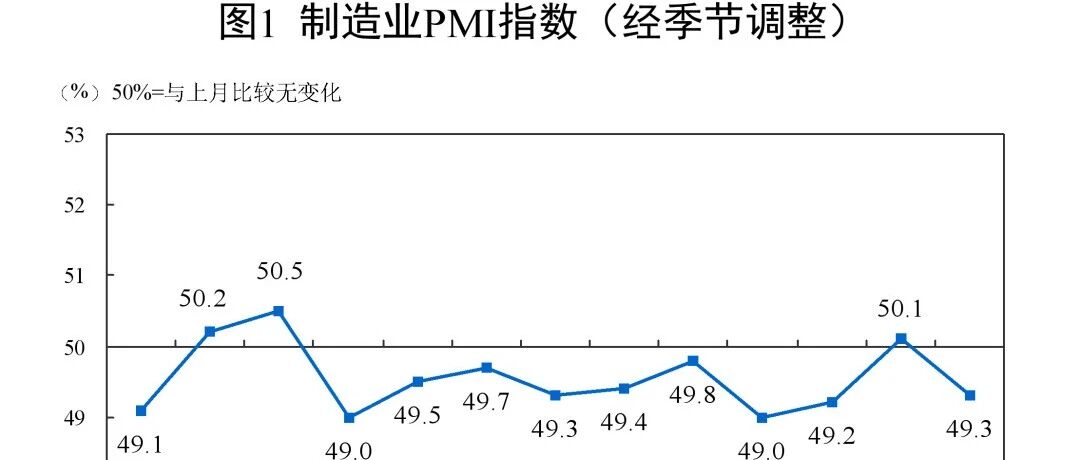
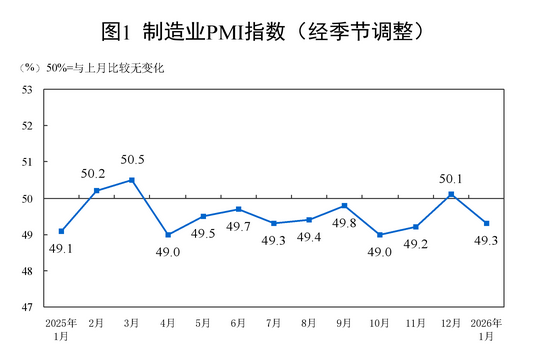
Group 1: Manufacturing PMI Overview - In January, the Manufacturing Purchasing Managers' Index (PMI) was 49.3%, a decrease of 0.8 percentage points from the previous month, indicating a decline in manufacturing activity [1] - Large enterprises had a PMI of 50.3%, down 0.5 percentage points, while medium and small enterprises had PMIs of 48.7% and 47.4%, down 1.1 and 1.2 percentage points respectively, both below the critical point [3] - The production index was 50.6%, down 1.1 percentage points, indicating continued expansion in manufacturing production [3] - The new orders index was 49.2%, down 1.6 percentage points, suggesting a slowdown in market demand [3] - The raw materials inventory index was 47.4%, down 0.4 percentage points, indicating a continued decrease in major raw material inventories [3] - The employment index was 48.1%, down 0.1 percentage points, reflecting a slight decline in employment conditions within manufacturing [3] - The supplier delivery time index was 50.1%, down 0.1 percentage points, indicating that supplier delivery times continued to accelerate [4] Group 2: Non-Manufacturing PMI Overview - In January, the Non-Manufacturing Business Activity Index was 49.4%, a decrease of 0.8 percentage points from the previous month [6] - The construction industry business activity index was 48.8%, down 4.0 percentage points, while the service industry business activity index was 49.5%, down 0.2 percentage points [8] - The new orders index for non-manufacturing was 46.1%, down 1.2 percentage points, indicating a decline in market demand [13] - The input prices index was 50.0%, down 0.2 percentage points, indicating stable input prices for non-manufacturing enterprises [13] - The sales prices index was 48.8%, up 0.8 percentage points, suggesting a narrowing decline in sales prices [13] - The employment index was 46.1%, stable from the previous month, indicating stable employment conditions in non-manufacturing [13] - The business activity expectation index was 56.0%, down 0.5 percentage points, remaining in a high optimism range [14] Group 3: Comprehensive PMI Overview - In January, the Comprehensive PMI Output Index was 49.8%, a decrease of 0.9 percentage points, indicating a general slowdown in production and business activities compared to the previous month [18]
【权威解读】国家统计局服务业调查中心首席统计师霍丽慧解读2026年1月中国采购经理指数
中汽协会数据· 2026-02-02 05:03
1月份中国采购经理指数有所回落 ——国家统计局服务业调查中心首席统计师霍丽慧 (三)大型企业PMI继续高于临界点。 大型企业PMI为50.3%,仍位于扩张区间,大型企业支撑作 用持续显现;中、小型企业PMI分别为48.7%和47.4%,比上月下降1.1个和1.2个百分点,景气水平有所 回落。 (四)高技术制造业持续领跑。 高技术制造业PMI为52.0%,连续两个月位于52.0%及以上较高水 平,相关行业发展态势持续向好。装备制造业PMI为50.1%,保持在扩张区间。消费品行业和高耗能行 业PMI分别为48.3%和47.9%,景气水平有所回落。 (五)企业预期保持乐观。 生产经营活动预期指数为52.6%,继续高于临界点。从行业看,农副食 品加工、食品及酒饮料精制茶等行业生产经营活动预期指数连续两个月位于56.0%以上较高景气区间, 相关企业对近期行业发展信心较强。 解读2026年1月中国采购经理指数 2026年1月31日国家统计局服务业调查中心和中国物流与采购联合会发布了中国采购经理指数。对 此,国家统计局服务业调查中心首席统计师霍丽慧进行了解读。 1月份,制造业采购经理指数、非制造业商务活动指数和综合PMI产 ...

未知机构:国海银行资产配置1月PMI点评景气度有所回落非制造业持续扩张-20260202
未知机构· 2026-02-02 02:10
Summary of Conference Call Notes Industry Overview - The overall economic sentiment in China has declined, with the composite PMI output index at 49.8% (↓0.9pp) indicating a contraction in economic activity [1] - Manufacturing PMI stands at 49.3% (↓0.8pp), below Bloomberg's expectation of 50.1% [1][2] - Non-manufacturing PMI is at 49.4% (↓0.8pp), also below Bloomberg's expectation of 50.3% [1][2] Manufacturing Sector Insights - Manufacturing supply and demand indices have decreased: - Production index at 50.6% (↓1.1pp), indicating continued expansion [4] - New orders at 49.2% (↓1.6pp) and new export orders at 47.8% (↓1.2pp), showing a decline in demand [4] - Price indices show signs of recovery: - Main raw material purchase price index at 56.1% (↑3.0pp) and factory price index at 50.6% (↑1.7pp), with the latter exceeding the critical point for the first time in 20 months [4] - Large enterprises maintain expansion with PMI at 50.3% (↓0.5pp), while medium and small enterprises show contraction at 48.7% (↓1.1pp) and 47.4% (↓1.2pp) respectively [4] - Market expectations remain generally positive with a production and business activity expectation index at 52.6% (↓2.9pp), still above the critical point [4] - Specific industries such as agricultural and food processing have maintained high activity levels, with expectation indices above 56.0% for two consecutive months [4] Non-Manufacturing Sector Insights - The construction industry has entered a contraction phase due to factors like low temperatures and the upcoming Spring Festival, with a business activity index at 48.8% (↓4.0pp) [5] - New orders index at 40.1% (↓7.3pp) and business activity expectation index at 49.8% (↓7.6pp), marking the latter's first drop into contraction since March 2020 [5] - Input prices have risen to 52.0% (↑1.1pp) for four consecutive months, while sales prices at 48.2% (↑0.8pp) and employment index at 41.1% (↑0.1pp) show varying degrees of recovery [5] - Service sector shows slight decline with a business activity index at 49.5% (↓0.2pp) [6] - Financial services, capital markets, and insurance sectors remain active with indices above 65.0%, while the real estate sector's index has dropped below 40.0%, indicating weak sentiment [6]
2026年1月中国采购经理指数为49.3%
Guo Jia Tong Ji Ju· 2026-02-02 01:16
一、中国制造业采购经理指数运行情况 原材料库存指数为47.4%,比上月下降0.4个百分点,表明制造业主要原材料库存量继续减少。 从业人员指数为48.1%,比上月下降0.1个百分点,表明制造业企业用工景气度略有回落。 1月份,制造业采购经理指数(PMI)为49.3%,比上月下降0.8个百分点,制造业景气水平有所回落。 从企业规模看,大型企业PMI为50.3%,比上月下降0.5个百分点,仍高于临界点;中、小型企业PMI分 别为48.7%和47.4%,比上月下降1.1个和1.2个百分点,低于临界点。 从分类指数看,在构成制造业PMI的5个分类指数中,生产指数和供应商配送时间指数均高于临界点, 新订单指数、原材料库存指数和从业人员指数均低于临界点。 生产指数为50.6%,比上月下降1.1个百分点,仍高于临界点,表明制造业生产活动保持扩张。 新订单指数为49.2%,比上月下降1.6个百分点,表明制造业市场需求有所放缓。 三、中国综合PMI产出指数运行情况 供应商配送时间指数为50.1%,比上月下降0.1个百分点,仍高于临界点,表明制造业原材料供应商交 货时间持续加快。 二、中国非制造业采购经理指数运行情况 1月份,非制 ...
2026年1月PMI数据点评:PMI环比回落,建筑业业务活动预期降至临界以下
KAIYUAN SECURITIES· 2026-02-02 01:14
事件点评 2026 年 02 月 02 日 PMI 环比回落,建筑业业务活动预期降至临界以下 固定收益研究团队 ——2026 年 1 月 PMI 数据点评 陈曦(分析师) 王帅中(联系人) 春节假期叠加供需矛盾或为制造业 PMI 超预期回落的原因。制造业生产指数为 50.6%,制造业生产保持扩张;制造业新订单指数为 49.2%,环比下降 1.6pct, 重回收缩区间。制造业生产淡季回落,供需矛盾或进一步压制生产端扩产。同时 也需要考虑 12 月超预期增长后可能的回调。 短期内市场内需不足或将持续。制造业新订单指数为 49.2%,环比下降 1.6pct, 重回收缩区间,制造业需求有所放缓;非制造业新订单指数为 46.1%,环比下降 1.2pct,连续 33 个月处于收缩区间。建筑业、服务业新订单指数均处于收缩区间, 短期内市场内需不足或将持续。 价格方面呈现积极信号,反内卷限制物价下行,市场选择一些类别开始涨价。 主要原材料购进价格指数和出厂价格指数分别为56.1%和50.6%,环比提升3.0pct 和 1.7pct,出厂价格指数近 20 个月来首次升至扩张区间,制造业市场价格总体 水平改善,需持续重视"通胀正 ...
1月份中国采购经理指数有所回落
Guo Jia Tong Ji Ju· 2026-02-02 01:05
Group 1: Manufacturing Sector - The manufacturing Purchasing Managers' Index (PMI) decreased to 49.3% in January, indicating a decline in economic sentiment compared to the previous month [1][2] - The production index remained above the critical point at 50.6%, suggesting continued expansion in manufacturing production, while the new orders index fell to 49.2%, indicating a drop in market demand [2] - Large enterprises maintained a PMI of 50.3%, indicating ongoing expansion, while small and medium-sized enterprises saw declines in their PMIs to 48.7% and 47.4%, respectively [3] - High-tech manufacturing continued to lead with a PMI of 52.0%, reflecting a positive development trend in this sector [3] - The price indices for major raw materials and factory prices rose to 56.1% and 50.6%, respectively, indicating an overall improvement in market price levels [2] Group 2: Non-Manufacturing Sector - The non-manufacturing business activity index fell to 49.4%, reflecting a decrease in overall economic sentiment in this sector [1][4] - The service industry business activity index was at 49.5%, with significant activity in financial services, while the real estate sector's index dropped below 40.0%, indicating weak sentiment [4] - The construction industry experienced a notable decline, with its business activity index at 48.8%, influenced by adverse weather and the upcoming holiday [4] - Despite the decline in current activity, the service industry business activity expectation index rose to 57.1%, indicating increased confidence among service sector enterprises [4] Group 3: Composite PMI - The composite PMI output index was recorded at 49.8%, showing a slight decrease from the previous month, indicating a general slowdown in production and business activities [1][5] - The manufacturing production index and non-manufacturing business activity index were 50.6% and 49.4%, respectively, contributing to the overall composite PMI output index [5]
1月PMI点评:从以价换量到以量换价?
Changjiang Securities· 2026-02-01 23:30
丨证券研究报告丨 固定收益丨点评报告 [Table_Title] 从"以价换量"到"以量换价"?——1 月 PMI 点评 报告要点 [Table_Summary] 2026 年 1 月,制造业 PMI 回落 0.8pct 至 49.3%,非制造业景气度也回落至荣枯线以下,弱于 季节性水平。产需走弱,库存积压;春节临近,后续消费需求能否顺利消化库存仍有待观察。 总体来看,稳增长的方式或从"以价换量"转向"以量换价",基本面的改善仍需长期性修复,但不 乏亮点:一是大宗商品涨价带动整体价格回升,二是装备制造和高端技术制造业持续释放增长 潜力。而企业利润修复能否持续,还需观察原料成本和产成品价格的动态均衡。预计债市或对 偏弱数据有所反应但难以走出持续修复行情,近期我们维持债市震荡的观点。 分析师及联系人 %% %% research.95579.com 1 [Table_Author] SAC:S0490524080003 SFC:BVN394 赵增辉 马玮健 请阅读最后评级说明和重要声明 %% %% 2026 年 1 月,制造业 PMI 回落 0.8pct 至 49.3%,低于万得一致预期;非制造业商务活动指数 为 ...
1月制造业生产保持扩张 金融市场活跃度较高
Zhong Guo Zheng Quan Bao· 2026-02-01 20:53
● 本报记者 连润 国家统计局1月31日发布的数据显示,1月份,制造业采购经理指数(PMI)为49.3%,比上月下降0.8个 百分点,其中,生产指数为50.6%,高于临界点,制造业生产保持扩张。非制造业商务活动指数为 49.4%,从行业看,货币金融服务、资本市场服务、保险等行业商务活动指数均高于65.0%,金融市场 活跃度较高。 出厂价格指数升至临界点以上 "1月份,部分制造业行业进入传统淡季,加之市场有效需求仍显不足,制造业PMI为49.3%,景气水平 较上月下降。"国家统计局服务业调查中心首席统计师霍丽慧表示。 从分项指数看,价格指数双双回升。霍丽慧分析,1月份,受近期部分大宗商品价格上涨等因素影响, 主要原材料购进价格指数和出厂价格指数分别为56.1%和50.6%,比上月上升3.0个和1.7个百分点,其中 出厂价格指数近20个月来首次升至临界点以上,制造业市场价格总体水平改善。 从非制造业看,霍丽慧表示,1月份,受建筑业等行业景气度下降等因素影响,非制造业商务活动指数 为49.4%,比上月下降0.8个百分点,非制造业总体景气水平有所回落。(下转A02版) 高技术制造业持续领跑。1月份,高技术制造业PMI ...