
汽车

Search documents
马斯克越做越大,真正值钱的是什么?
3 6 Ke· 2026-02-28 01:01
Core Insights - The article emphasizes the interconnectedness of Elon Musk's ventures, including Tesla, SpaceX, and xAI, highlighting their collective potential to create a significant data network and infrastructure for AI development [1][10][21]. Group 1: Business Overview - SpaceX and xAI are expected to have a combined valuation of $1.25 trillion, significantly higher than OpenAI's recent valuation of $840 billion, indicating a premium of nearly $400 billion [1][18]. - Tesla is expanding its production capabilities with plans to approve Full Self-Driving (FSD) in Europe by March and to mass-produce Cyber Cabs by April, which will enhance data collection for AI training [1][3][21]. Group 2: Data Collection and Utilization - The closed-loop system relies on data collected from various sources: Tesla vehicles gather road traffic data, Cyber Cabs collect urban operational data, robots gather indoor interaction data, factories collect manufacturing process data, and satellites collect global environmental data [10][12]. - Each data source contributes to a comprehensive network that feeds back into AI training, creating a positive feedback loop that enhances AI capabilities [10][11]. Group 3: Infrastructure and Competitive Advantage - The article discusses the need for computational power to support AI learning, noting that traditional ground-based data centers face limitations, while space-based data centers could provide continuous power and cooling advantages [12][13]. - Musk's combination of SpaceX's launch capabilities, Starlink's satellite network, and Tesla's manufacturing efficiency creates a unique competitive advantage that is difficult for others to replicate [13][21]. Group 4: Future Definition and Market Position - The article argues that the true value lies in defining the future of AI infrastructure rather than merely competing in application layers, positioning Musk's ventures as foundational to the AI industry's growth [18][20][22]. - By controlling the infrastructure necessary for AI operation, Musk's companies are not just selling products but are establishing a toll road for future AI developments, thereby securing a dominant market position [21][22].

美股2月收官:道指月线10连涨!中概指数累跌5.88%,台积电涨超13%,AMD暴跌逾15%
Ge Long Hui A P P· 2026-02-28 00:57
Core Viewpoint - In February, the U.S. stock market showed mixed performance, with the Dow Jones Industrial Average rising by 0.17% for a ten-month consecutive increase, while the Nasdaq Composite and S&P 500 indices fell by 3.38% and 0.87%, respectively [1] Group 1: Market Performance - The Dow Jones Industrial Average recorded a cumulative increase of 0.17% in February, marking a ten-month consecutive rise [1] - The Nasdaq Composite index experienced a cumulative decline of 3.38% in February [1] - The S&P 500 index also saw a cumulative decrease of 0.87% during the same period [1] Group 2: Individual Stock Performance - Notable stock performances in February included TSMC, which rose by 13.32%, Walmart by 7.39%, ExxonMobil by 8.57%, Berkshire Hathaway B by 5.08%, and Apple by 1.91% [1] - Conversely, significant declines were observed in AMD, which fell by 15.43%, Amazon by 12.24%, Meta by 9.54%, Microsoft by 8.52%, Nvidia by 7.29%, Google A by 7.76%, Tesla by 6.48%, and Broadcom by 3.55% [1] Group 3: Market Capitalization - The top ten companies by market capitalization in the U.S. stock market currently include Nvidia, Apple, Google A, Google C, Microsoft, Amazon, TSMC, Meta, Broadcom, and Tesla [1]


A股频现溢价定增,传递多重信号
Zhong Guo Zheng Quan Bao· 2026-02-28 00:39
Core Viewpoint - The recent trend of premium placements in the A-share market indicates a shift towards long-term value investment, with high-quality companies in favorable sectors attracting capital attention [5][7]. Group 1: Premium Placements - Numerous listed companies have seen their actual issuance prices exceed the base price by over 20%, indicating a strong market interest in premium placements [1]. - For instance, Guangdian Measurement announced a share issuance at 24.01 CNY per share, with a premium of 29.09% over the base price of 18.60 CNY [1]. - Fengshen Co. issued shares at 6.85 CNY per share, representing a 125% premium over its base price [2]. Group 2: Industry Insights - The automotive industry has a significant number of companies engaging in premium placements, including Jianghuai Automobile and Beiqi Blue Valley [3]. - Beiqi Blue Valley's issuance price was set at 7.56 CNY per share, with a premium of 15.77% over the base price [3]. - Jianghuai Automobile's recent issuance had a price of 49.88 CNY per share, reflecting a premium of 23.93% over its base price [4]. Group 3: Market Dynamics - The high premium phenomenon in the placement market is attributed to a combination of policy, industry, and capital dynamics, with a focus on long-term value rather than short-term price fluctuations [4][5]. - Institutional investors are increasingly prioritizing long-term industry value and growth potential, leading to a supply-demand imbalance for quality assets [4][5]. - The trend indicates a structural shift in the market, where premium placements may become the norm for high-quality projects, while lower-quality projects may still follow traditional discount logic [6][7].



美股收低,英伟达重挫4.2%,“中国金龙”跌1.81%,金银油大涨
Di Yi Cai Jing Zi Xun· 2026-02-28 00:19
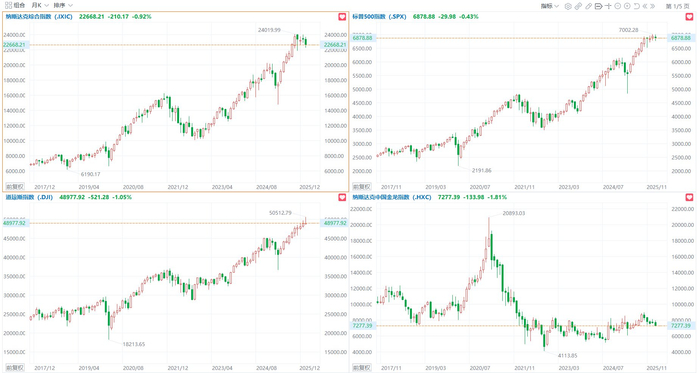
Market Overview - The US stock market closed lower on Friday, with both financial and technology stocks under pressure due to multiple uncertainties including AI disruptions, disappointing inflation data, and rising geopolitical risks [2][3] - The S&P 500 and Nasdaq indices recorded their largest monthly declines in a year, with all three major indices showing significant weekly weakness [2] Index Performance - The Dow Jones Industrial Average fell by 521.28 points, a decline of 1.05%, closing at 48,977.92 points; the S&P 500 dropped by 29.98 points, down 0.43%, closing at 6,878.88 points; the Nasdaq decreased by 210.17 points, a 0.92% drop, closing at 22,668.21 points [2][3] - For the week, the Dow fell 1.31%, marking the largest weekly decline since mid-November last year, while the Nasdaq and S&P 500 dropped by 0.95% and 0.44%, respectively [3] Sector Performance - The technology sector continued to drag down index performance, with Nvidia experiencing a significant drop of 4.2%, following a previous day's decline of 5.5%, indicating investor caution regarding the uncertainty of AI-related capital expenditures and return cycles [3] - Other notable stock movements included Tesla down 1.49%, Microsoft down 2.24%, and Apple down 3.21%, while Google-A, Amazon, and Google-C saw slight increases [3][4] Economic Data - The US Labor Department reported that the Producer Price Index (PPI) for January rose by 0.5% month-over-month, exceeding market expectations of 0.3%, with a year-over-year increase of 2.9%, still above the Federal Reserve's 2% inflation target [5] - Core PPI, excluding volatile food and energy prices, increased by 0.8% month-over-month, significantly higher than the expected 0.3%, and up from 0.6% in December [5] Market Sentiment - Market sentiment remains cautious as higher-than-expected inflation data exacerbates weak sentiment and may delay expectations for a dovish shift from the Federal Reserve this year [6] - Defensive sectors such as consumer staples, healthcare, and utilities showed relative strength, while cyclical growth sectors faced significant pressure [6] Individual Stock Highlights - Netflix shares surged by 13.8% after exiting the Warner Bros. Discovery acquisition battle, gaining investor support [7] - Dell Technologies saw a significant increase of 21.9%, as the company projected that AI-optimized server business revenue would double by fiscal year 2027 and committed to increasing shareholder returns [8] Bond Market - Despite the hot inflation data, the bond market saw buying interest, with the 10-year US Treasury yield falling by 5.5 basis points to 3.962%, marking the first drop below 4% since late November [8]

新浪财经隔夜要闻大事汇总:2026年2月28日
Xin Lang Cai Jing· 2026-02-27 23:39
Market - US stock market closed down with the Dow Jones falling over 500 points, and all three major indices recorded weekly declines. The Dow, Nasdaq, and S&P 500 dropped by 1.05%, 0.92%, and 0.43% respectively [2] - UBS downgraded the US stock market rating due to concerns over a weakening dollar, high valuations, and rising policy risks [2] - The Producer Price Index (PPI) for January rose more than expected, with core PPI increasing by 0.8% month-on-month, indicating persistent inflation [2] Company - Dell's stock surged by 21.93% after strong revenue forecasts, while Nvidia's stock fell by 4.16% despite exceeding earnings expectations due to concerns over the sustainability of AI spending [3] - Paramount has reached a final merger agreement to acquire Warner Bros. Discovery, valuing the company at $110 billion, with the deal expected to close in Q3 2026 [33] - Trump Media is considering spinning off its social platform Truth Social into an independent company, marking a significant shift for the firm [31] - TPG disclosed a £44 million exposure to the troubled UK lender Market Financial Solutions (MFS), indicating a small percentage of its overall loan exposure [37] Macro - US companies disclosed stock buyback plans totaling $233 billion in February, marking the highest level for the month in history [12] - The SEC announced new regulations requiring foreign company executives to disclose stock trades promptly, aligning with US standards [14] - The US government is facing over 2,000 lawsuits for tariff refunds following a Supreme Court ruling declaring many tariffs unconstitutional [17]

马斯克和比尔·盖茨的恩怨,比宫斗剧还长
汽车商业评论· 2026-02-27 23:06
Core Viewpoint - The article discusses the ongoing feud between Elon Musk and Bill Gates, highlighting their conflicting views on investment ethics and climate change, particularly in relation to Tesla and Gates' short position against the company [4][9][10]. Group 1: Background of the Feud - The conflict was reignited by a tweet referencing Gates' admission of infidelity, which Musk interpreted as a moral failing, linking it to Gates' short position on Tesla [4][6][9]. - Gates acknowledged his past mistakes regarding his relationships and his association with Jeffrey Epstein, which has drawn public scrutiny [8][9]. - Musk's comment about "karma" suggests he believes Gates' personal issues are a form of retribution for his financial actions against Tesla [6][9]. Group 2: Investment Strategies and Ethical Concerns - Short selling is described as a financial strategy that profits from a company's decline, which Musk views as morally contradictory for someone claiming to care about climate change while betting against a leading company in sustainable energy [5][10]. - Gates held a $500 million short position against Tesla, which he later regretted as it resulted in a loss of $1.5 billion [18][19]. - Musk criticized Gates for his hypocrisy, questioning how someone can advocate for climate solutions while profiting from the failure of a company dedicated to those solutions [20][21]. Group 3: Impact on Tesla and Market Dynamics - The feud has intensified alongside Tesla's stock performance, with Musk accusing Gates of undermining investor confidence through his short position [26][27]. - In 2025, Tesla's sales declined for the second consecutive year, with a significant drop in Cybertruck sales, leading to a price reduction to stimulate demand [49][51]. - The article notes a concerning trend of talent loss within Tesla, with key project managers leaving the company, which could further impact its market position and innovation [44][47][48].

默茨“ChinaTravel”刷新欧洲对华认知
Xin Lang Cai Jing· 2026-02-27 22:32
Group 1 - German Chancellor Merz's visit to China marks his first official trip since taking office, highlighting the importance of Sino-German relations as both countries are major global economies [1][3] - The visit included interactions with advanced technologies, such as humanoid robots, which have garnered significant interest from European media, showcasing China's rapid development in AI and robotics [2] - A delegation of 30 German business leaders accompanied Merz, expressing intentions to expand investments in China and deepen collaborative research, particularly in AI and new energy vehicles [2] Group 2 - The visit faced some criticism from Western media, which attempted to frame the trip around trade deficits and dependency issues, despite acknowledging China's economic advancements [3] - Merz emphasized the importance of the Sino-German relationship, advocating for free trade and cooperation, which could lead to a more balanced consensus within the EU regarding China [3] - The signing of cooperation agreements in various sectors during the visit reflects practical outcomes and a commitment to enhancing bilateral ties [2]
北极星股价跌4.87%至60.74美元,创60日新低
Xin Lang Cai Jing· 2026-02-27 22:21
Company Overview - Polaris Industries (PII.N) stock price fell by 4.87% to $60.74 on February 27, 2026, reaching a 60-day low of $60.22 during the day [1] - The current price-to-earnings ratio (TTM) for Polaris is -7.43, indicating pressure on profitability [4] - Despite maintaining a dividend yield of 4.43%, the combination of technical and market sentiment pressures has weakened valuation support [4] Technical Analysis - The stock has confirmed a technical bear market since mid-January 2026, with prices consistently falling below the 60-day and 120-day moving averages [1] - As of February 27, the stock is trading below all major moving averages, with a death cross pattern between the 60-day and 120-day moving averages, reinforcing bearish signals and increasing selling pressure [1] Industry Context - The automotive sector, to which Polaris belongs, experienced an overall decline of 2.21% on the same day, while major U.S. indices also saw significant drops (Dow Jones down 1.05%, Nasdaq down 0.92%) [2] - The systemic decline in the industry and market has amplified individual stock volatility, particularly affecting manufacturing stocks that are sensitive to performance [2] Market Activity - On February 27, Polaris had a trading volume of $61.46 million, with a turnover rate of 1.78% and a volume ratio of 1.19, indicating increased trading activity but predominantly driven by selling [3] - The stock has seen a cumulative decline of 8.43% over the past five days, which may have triggered stop-loss orders from some investors, exacerbating the downward movement [3]
A股频现溢价定增 传递多重信号
Zhong Guo Zheng Quan Bao· 2026-02-27 20:43
Core Viewpoint - The recent trend of premium placements in the A-share market indicates a shift towards long-term value investment, with high-quality companies that align with national strategies and possess core competitiveness attracting capital interest [1][3][5] Group 1: Premium Placements - Numerous listed companies have seen their actual issuance prices exceed the issuance floor price by over 20% [1] - For instance, Guangdian Measurement announced a share issuance at 24.01 CNY per share, representing a 29.09% premium over the floor price of 18.60 CNY [1] - Wind Power Co. also reported a share issuance at 6.85 CNY per share, with a premium of 25% over its floor price [2] Group 2: Industry Insights - The automotive industry has a significant number of companies engaging in premium placements, including Jianghuai Automobile and Beiqi Blue Valley [2][3] - Beiqi Blue Valley's issuance price was set at 7.56 CNY per share, with a premium of 15.77% over the floor price [2] - Jianghuai Automobile's issuance price was 49.88 CNY per share, reflecting a 23.93% premium over its floor price [3] Group 3: Market Dynamics - The high premium phenomenon in the placement market is attributed to a convergence of policy, industry, and capital factors, leading to a supply-demand imbalance for quality projects [3] - Institutional investors are increasingly focusing on long-term value rather than short-term price discounts, indicating a maturation of the A-share market [3][4] - The trend suggests a structural shift where premium placements may become the norm for high-quality projects, while lower-quality projects may still follow traditional discount logic [4][5]
2799辆“盐城造”汽车启航出海
Xin Lang Cai Jing· 2026-02-27 20:32
Core Insights - The article highlights the successful loading of 2,799 new "Yue Da Kia" cars onto the Korean roll-on/roll-off ship "Glo Champion," marking a significant achievement for Binhai Port in enhancing its role as a hub for automobile exports [1][2] - The operation was completed in approximately 15 hours, showcasing the port's efficient service capabilities and the collaborative efforts of various stakeholders [1][2] Group 1: Operational Efficiency - Binhai Port has established a "one-stop" inspection and clearance mechanism involving customs, border inspection, and maritime authorities to streamline the export process, significantly reducing waiting times for ships [2] - The port's dedicated automobile storage area spans 453,500 square meters, with a static storage capacity of 26,300 vehicles, providing robust support for ongoing export operations [2] Group 2: Strategic Goals - The port aims to facilitate the export of 100,000 "Made in China" vehicles this year, reflecting its ambition to expand its global market reach [2] - The successful loading operation is seen as a testament to Binhai Port's growing status as a key maritime hub for automobile exports in the coastal region [2]