房地产

Search documents
1月份制造业采购经理指数有所回落
Xin Hua Cai Jing· 2026-01-31 06:59
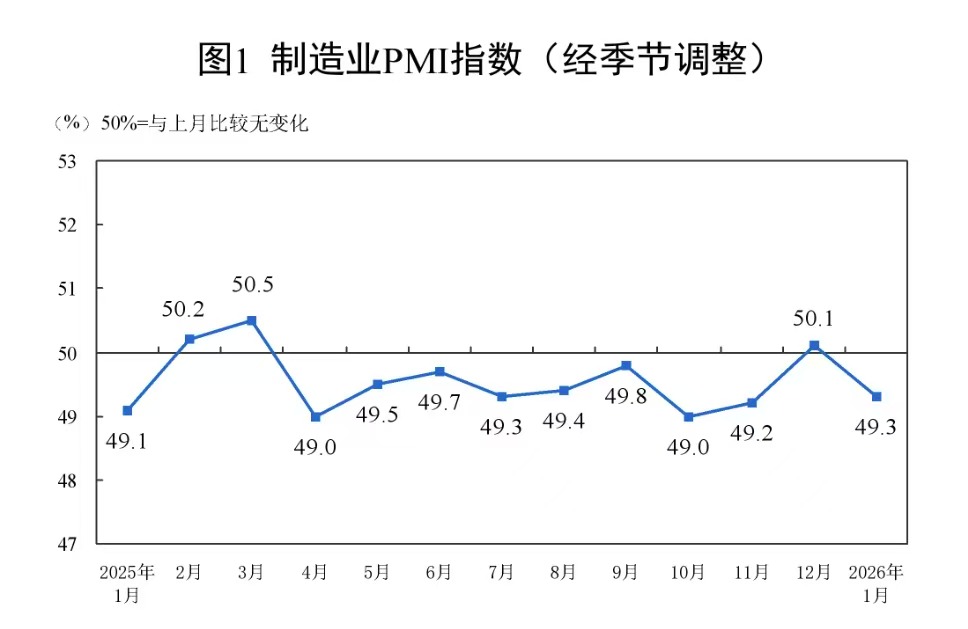
Group 1: Manufacturing Sector - The manufacturing Purchasing Managers' Index (PMI) for January is 49.3%, indicating a decline from the previous month [1][2] - The production index remains above the critical point at 50.6%, showing continued expansion in manufacturing production [2] - New orders index is at 49.2%, reflecting a decrease in market demand [2] - Certain industries, such as agricultural processing and aerospace, show strong production and new orders indices above 56.0%, while sectors like automotive and fuel processing are below the critical point [2] - Price indices for raw materials and factory output have risen, with the raw material purchase price index at 56.1% and the factory price index at 50.6%, marking an improvement in overall market prices [2] Group 2: Large vs. Small Enterprises - Large enterprises have a PMI of 50.3%, indicating continued expansion, while medium and small enterprises have PMIs of 48.7% and 47.4%, respectively, showing a decline [3] - High-tech manufacturing leads with a PMI of 52.0%, indicating a positive development trend [3] - Consumer goods and high-energy industries show lower PMIs of 48.3% and 47.9%, respectively, indicating a downturn in these sectors [3] Group 3: Non-Manufacturing Sector - The non-manufacturing business activity index is at 49.4%, reflecting a decrease from the previous month [4] - The service sector's business activity index is at 49.5%, with financial services showing high activity levels above 65.0%, while the real estate sector is below 40.0% [4] - The construction sector's business activity index has dropped to 48.8%, indicating a significant decline in activity due to seasonal factors [4] Group 4: Composite PMI - The composite PMI output index is at 49.8%, indicating a slowdown in overall business activities compared to the previous month [5] - The manufacturing production index is at 50.6%, while the non-manufacturing business activity index is at 49.4%, contributing to the composite index's decline [5]
A股:今晚2好1坏,国务院出利好政策,放量3.2万亿小涨,明天怎么走?
Sou Hu Cai Jing· 2026-01-31 06:52
一边是银行、保险、白酒、房地产这些"大家伙"在拼命护盘拉升;另一边,半导体、消费电子这些前阵子的明星板块却崩了,科创50指数更是暴跌超过 3%。 这感觉就像一场激烈的拔河比赛,两边的巨人在角力,大盘被拉扯得来回震荡。 更巧的是,盘后国务院办公厅立马送来了促进服务消费的利好政策, 直接给今天异动的白酒、消费板块送上了"助攻"。 那么问题来了,在这种极度分裂、消息交织的关头,明天周五的A股,到底会往哪边走去? 是权重股继 续带队冲锋,还是中小盘题材股迎来反弹? 今天是2026年1月29日,星期四。 A股市场的表现让很多投资者直呼"看不懂"。 上证指数全天就像被一根线牵着,早盘反复震荡,下午一度尝试上冲4170 点,但尾盘又回落了,最终收在4157.98点,微涨0.16%。 最关键的是这个量能,沪深两市合计成交金额达到了3.2万亿元,这是一个非常高的交易量水平。 但如此巨大的资金博弈之下,指数仅仅涨了6个点,这种"放量滞涨"的迹象,让不少技术派投资者心里打起了鼓。 所有信息仅供参考,不构成对任何人投资建议,据此入市,风险自负,股市有风险,入市需谨慎! 今天A股的走势,用一个词形容就是"撕裂"。 大盘指数费了半天劲, ...

*ST中地2025年净资产转正夯实摘帽基础 重组收官后轻装上阵
Zheng Quan Ri Bao Zhi Sheng· 2026-01-31 04:39
Core Viewpoint - The company, China Communications Real Estate Co., Ltd. (*ST Zhongdi*), has announced its 2025 performance forecast, indicating a significant improvement in its net assets due to the completion of a major asset restructuring, despite still being in a loss position. This positions the company to apply for the removal of its delisting risk warning from the stock exchange [1][2]. Financial Performance - As of the end of 2025, the company's equity attributable to shareholders is expected to be approximately 1.25 billion yuan, a substantial improvement from the previous year's negative value [1]. - The improvement in net assets is attributed to the completion of a major asset sale and related transactions, fundamentally optimizing the company's asset-liability structure [1]. Asset Restructuring - The major asset restructuring aimed to divest high-debt and heavy-asset real estate operations, significantly reducing the company's historical burdens and achieving positive net assets [1]. - The completion of the asset transfer has shifted the company's delisting risk from a "structural issue" to a "procedural issue," allowing for potential operational recovery and strategic transformation [1]. Accounting Adjustments - The company has corrected prior accounting errors related to the classification of certain financial reporting items, which does not affect cash flow, operating income, or net profit [2]. - The adjustments reflect a normalization of accounting practices following the complex asset restructuring, rather than indicating new losses or operational deterioration [3]. Future Outlook - The company plans to shift its focus towards light asset businesses such as property services and asset management, which are expected to provide stable cash flows and lower leverage [3]. - The current phase is seen as a "value reassessment point" following risk clearance, with the company moving from a "high-risk state" back to a "normal operating track" [3]. - Future attention will be on whether the company will formally apply to remove the delisting warning and the profitability of its light asset businesses [3].
结合存量房地产盘活 旅居产业将多层次拉动内需
Zheng Quan Ri Bao Wang· 2026-01-31 04:15
Core Viewpoint - The State Council's plan aims to accelerate the cultivation of new growth points in service consumption, focusing on key and potential areas, particularly through the development of travel and residential destination cities, and revitalizing idle rural land and properties [1] Group 1: Revitalization of Stock Real Estate - The real estate market is transitioning to a stock era, with strategies focusing on controlling new supply, reducing inventory, and optimizing supply [2] - Current revitalization efforts are directed towards three main transformations: converting properties into affordable rental housing or talent apartments, repurposing for new consumption formats like cultural and creative parks or elderly communities, and supporting rural revitalization through the development of rural homestays and leisure agriculture [2] - The plan encourages local governments to support land use and service facility construction for travel projects, providing new solutions for idle properties located in scenic and rural areas [2] Group 2: Multi-layered Demand Stimulation - The integration of stock real estate revitalization with the travel industry is expected to stimulate domestic demand on multiple levels, including investment in property renovations and infrastructure for travel destinations [4] - Travel consumption encompasses high-value services such as accommodation, wellness, and experiences, which can drive related industries like renovation, home services, and cultural tourism, thereby fostering new growth points [4] - Data from Yunnan indicates significant growth in travel-related activities, with a 54.9% increase in travel numbers and substantial job creation and income growth for local households [4] Group 3: Key Implementation Strategies - Successful policy implementation requires three key actions: enhancing policy coordination to address planning and land use bottlenecks, innovating financial support to attract long-term capital, and fostering professional management to improve service quality and project sustainability [5]
去年查处违法广告超4.4万件罚款2.52亿,十起案例公布
Xin Lang Cai Jing· 2026-01-31 04:03
Core Viewpoint - In 2025, the National Market Supervision Administration handled a total of 44,521 advertising violation cases, imposing fines totaling 252 million yuan, effectively strengthening consumer rights protection. Group 1: Advertising Violations - Guangzhou Jianmei Health Technology Co., Ltd. was fined 600,000 yuan for false advertising claims regarding eye health products, including misleading statements about preventing myopia and promoting false endorsements from international ophthalmologists [1]. - Nala Zun Tuo (Guangzhou) Dairy Co., Ltd. faced a fine of 450,000 yuan for advertising camel milk powder with false claims related to health benefits and misleading promotional content [2]. - Jingdezhen Yuxin Yicai Ceramics Co., Ltd. was fined 287,200 yuan for misleading consumers by falsely advertising ceramic tableware as being produced in Jingdezhen [3]. - Inner Mongolia Caozhilou Biotechnology Co., Ltd. was fined 200,000 yuan for advertising organic perilla seed oil with unverified health claims [4]. - Chongqing Linhui Tai Business Information Consulting Co., Ltd. was fined 160,000 yuan for promoting various health products with exaggerated claims about their efficacy [5]. - Hangzhou Qingbi Brand Management Co., Ltd. was fined 190,000 yuan for advertising eye health patches with unsubstantiated claims about restoring vision [6][7]. - Anhui Kangqiao Real Estate Co., Ltd. was fined 150,000 yuan for misleading advertising related to real estate development [8]. - Shandong Chengshi Chengshi E-commerce Co., Ltd. was fined 105,000 yuan for advertising unapproved medical devices and making false health claims [9]. - Songyuan Anorectal Hospital was fined 100,000 yuan for misleading advertising regarding its medical qualifications [10]. - Yunnan Yuyao Biological Pharmaceutical Co., Ltd. was fined 100,000 yuan for violating advertising regulations for prescription drugs [10]. Group 2: Regulatory Actions - In 2025, the National Market Supervision Administration launched a nationwide campaign to rectify advertising market order, focusing on key areas such as healthcare, pharmaceuticals, medical devices, food, and children's vision protection [10].
统计局:1月官方制造业PMI为49.3% 比上月下降0.8个百分点
Guo Jia Tong Ji Ju· 2026-01-31 02:39
Group 1: Manufacturing PMI Overview - In January, the Manufacturing Purchasing Managers' Index (PMI) was 49.3%, a decrease of 0.8 percentage points from the previous month, indicating a decline in manufacturing activity [1][12] - Large enterprises had a PMI of 50.3%, down 0.5 percentage points, remaining above the critical point; small and medium-sized enterprises had PMIs of 48.7% and 47.4%, down 1.1 and 1.2 percentage points respectively, both below the critical point [1][15] - The production index was 50.6%, down 1.1 percentage points but still indicating expansion; the new orders index was 49.2%, down 1.6 percentage points, showing a slowdown in market demand [1][14] - The raw materials inventory index was 47.4%, down 0.4 percentage points, indicating a continued decrease in inventory levels; the employment index was 48.1%, down 0.1 percentage points, suggesting a slight decline in employment levels [1][14] Group 2: Non-Manufacturing PMI Overview - In January, the Non-Manufacturing Business Activity Index was 49.4%, a decrease of 0.8 percentage points from the previous month [2][12] - The construction industry Business Activity Index was 48.8%, down 4.0 percentage points, while the services industry Business Activity Index was 49.5%, down 0.2 percentage points [2][16] - The new orders index was 46.1%, down 1.2 percentage points, indicating a decline in market demand; the construction new orders index was 40.1%, down 7.3 percentage points [2][16] - The input prices index was 50.0%, indicating stability in input prices; the construction input prices index was 52.0%, up 1.2 percentage points, while the services input prices index was 49.7%, down 0.4 percentage points [2][3] Group 3: Price and Employment Trends - The sales price index was 48.8%, up 0.8 percentage points, indicating a narrowing decline in sales prices; the construction sales price index was 48.2%, up 0.8 percentage points, and the services sales price index was 48.9%, also up 0.8 percentage points [3] - The employment index for non-manufacturing was 46.1%, stable from the previous month, indicating stable employment conditions; the construction employment index was 41.1%, up 0.1 percentage points, while the services employment index was 47.0%, unchanged [3][16] - The business activity expectation index was 56.0%, down 0.5 percentage points but still indicating optimism among non-manufacturing enterprises; the construction expectation index was 49.8%, below the critical point, while the services expectation index was 57.1%, up 0.7 percentage points [3][16] Group 4: Comprehensive PMI Overview - The Comprehensive PMI Output Index was 49.8%, down 0.9 percentage points, indicating a slowdown in overall production and business activities compared to the previous month [4][12] - The manufacturing production index was 50.6%, while the non-manufacturing business activity index was 49.4%, contributing to the overall decline in the Comprehensive PMI [17]
国家统计局:1月PMI呈现分化特征 高技术制造业保持较高景气
智通财经网· 2026-01-31 01:59
Group 1: Manufacturing Sector - The manufacturing Purchasing Managers' Index (PMI) decreased to 49.3% in January, indicating a decline in economic sentiment compared to the previous month [2] - The production index remains above the critical point at 50.6%, suggesting continued expansion in manufacturing production, while the new orders index fell to 49.2%, indicating a drop in market demand [2] - Large enterprises maintain a PMI of 50.3%, indicating ongoing expansion, while small and medium-sized enterprises saw PMIs of 48.7% and 47.4%, respectively, reflecting a decline in economic activity [3] - High-tech manufacturing continues to lead with a PMI of 52.0%, indicating a positive development trend, while consumer goods and high-energy industries show lower PMIs of 48.3% and 47.9% [3] - The price indices for major raw materials and factory prices increased to 56.1% and 50.6%, respectively, indicating an overall improvement in manufacturing market prices [2] Group 2: Non-Manufacturing Sector - The non-manufacturing business activity index fell to 49.4% in January, reflecting a decrease in overall economic sentiment [4] - The service sector's business activity index decreased slightly to 49.5%, with financial services and capital market services showing high activity levels above 65.0%, while the real estate sector dropped below 40.0% [4] - The construction sector's business activity index fell significantly to 48.8%, influenced by adverse weather and the upcoming holiday, indicating a notable decline in construction activity [4] Group 3: Composite PMI - The composite PMI output index is at 49.8%, down 0.9 percentage points from the previous month, indicating a slowdown in overall business activities [5] - The manufacturing production index and non-manufacturing business activity index are reported at 50.6% and 49.4%, respectively, contributing to the composite PMI's decline [5]
国家统计局:1月份非制造业商务活动指数为49.4% 比上月下降0.8个百分点
Mei Ri Jing Ji Xin Wen· 2026-01-31 01:56
Core Viewpoint - In January, the non-manufacturing business activity index decreased to 49.4%, down 0.8 percentage points from the previous month [1] Industry Summary - The construction industry business activity index fell to 48.8%, a decrease of 4.0 percentage points from the previous month [1] - The service industry business activity index decreased to 49.5%, down 0.2 percentage points from the previous month [1] - Within the service sector, monetary financial services, capital market services, and insurance industries all reported business activity indices above 65.0% [1] - Conversely, wholesale, accommodation, and real estate industries had business activity indices below the critical point [1]
国家统计局:1月份制造业采购经理指数(PMI)为49.3%
Xin Lang Cai Jing· 2026-01-31 01:56
Group 1: Manufacturing PMI Overview - In January, the Manufacturing Purchasing Managers' Index (PMI) was 49.3%, a decrease of 0.8 percentage points from the previous month, indicating a decline in manufacturing activity [1] - Large enterprises had a PMI of 50.3%, down 0.5 percentage points, while medium and small enterprises had PMIs of 48.7% and 47.4%, down 1.1 and 1.2 percentage points respectively, both below the critical point [1] - The production index was 50.6%, down 1.1 percentage points but still above the critical point, indicating continued expansion in manufacturing production [1] - The new orders index was 49.2%, down 1.6 percentage points, suggesting a slowdown in market demand for manufacturing [1] - The raw materials inventory index was 47.4%, down 0.4 percentage points, indicating a continued decrease in major raw material inventories [1] Group 2: Non-Manufacturing PMI Overview - In January, the Non-Manufacturing Business Activity Index was 49.4%, a decrease of 0.8 percentage points from the previous month [2] - The construction industry business activity index was 48.8%, down 4.0 percentage points, while the service industry business activity index was 49.5%, down 0.2 percentage points [2] - The new orders index for non-manufacturing was 46.1%, down 1.2 percentage points, indicating a decline in market demand [2] - The input prices index was 50.0%, down 0.2 percentage points, indicating stable input prices for non-manufacturing activities [3] - The sales prices index was 48.8%, up 0.8 percentage points, indicating a narrowing decline in overall sales prices [3] Group 3: Employment and Expectations - The employment index for manufacturing was 48.1%, down 0.1 percentage points, indicating a slight decline in employment conditions [2] - The employment index for non-manufacturing was 46.1%, stable compared to the previous month, indicating stable employment conditions [3] - The business activity expectation index for non-manufacturing was 56.0%, down 0.5 percentage points but still in a high optimism range [3] Group 4: Composite PMI Overview - The Composite PMI Output Index was 49.8% in January, down 0.9 percentage points, indicating a general slowdown in production and business activities compared to the previous month [5]
国家统计局:1月份中国制造业采购经理指数为49.3%
Di Yi Cai Jing· 2026-01-31 01:45
Group 1: Manufacturing PMI - In January, the Manufacturing Purchasing Managers' Index (PMI) is at 49.3%, a decrease of 0.8 percentage points from the previous month, indicating a decline in manufacturing activity [3][6] - Large enterprises have a PMI of 50.3%, down 0.5 percentage points, remaining above the critical point; while medium and small enterprises have PMIs of 48.7% and 47.4%, down 1.1 and 1.2 percentage points respectively, both below the critical point [6] - The production index is at 50.6%, down 1.1 percentage points but still indicates expansion in manufacturing production [6] - The new orders index is at 49.2%, down 1.6 percentage points, suggesting a slowdown in market demand for manufacturing [6] - The raw materials inventory index is at 47.4%, down 0.4 percentage points, indicating a continued decrease in major raw material inventories [6] - The employment index is at 48.1%, down 0.1 percentage points, reflecting a slight decline in employment conditions in manufacturing [6][7] Group 2: Non-Manufacturing PMI - In January, the Non-Manufacturing Business Activity Index is at 49.4%, a decrease of 0.8 percentage points from the previous month [8] - The construction industry business activity index is at 48.8%, down 4.0 percentage points, while the service industry business activity index is at 49.5%, down 0.2 percentage points [8] - The new orders index for non-manufacturing is at 46.1%, down 1.2 percentage points, indicating a decline in market demand [8] - The input prices index is at 50.0%, down 0.2 percentage points, indicating stable input prices for non-manufacturing activities [8] - The sales prices index is at 48.8%, up 0.8 percentage points, indicating a narrowing decline in overall sales prices [9] - The employment index for non-manufacturing is at 46.1%, remaining stable, with the construction employment index at 41.1%, up 0.1 percentage points [10] Group 3: Composite PMI - The Composite PMI Output Index is at 49.8%, down 0.9 percentage points, indicating a general slowdown in production and business activities compared to the previous month [10]