电商

Search documents
阿里巴巴-W早盘涨超4% 中金公司维持买入评级
Xin Lang Cai Jing· 2026-01-14 02:57
Core Viewpoint - Alibaba's stock price increased by 4.38% to HKD 166.90, with a trading volume of HKD 15.029 billion, indicating positive market sentiment towards the company following a report from CICC [1] Group 1: Financial Performance - Alibaba Cloud's revenue for Q3 FY26 accelerated year-on-year growth to 36%, with external revenue increasing by 32%, reflecting strong performance in the cloud computing segment [1] - The company's e-commerce CMR growth slowed to 2%, while flash sales EBITA losses narrowed to HKD 24 billion, indicating pressure on overall profitability but a clear strategic investment rhythm [1] Group 2: Strategic Initiatives - CICC highlighted that Alibaba is significantly increasing its capital expenditure budget, focusing on self-developed core hardware and leveraging a global infrastructure network with 29 regions and 92 availability zones for scalable deployment [1] - The forecast for Alibaba Cloud's revenue suggests a compound annual growth rate (CAGR) exceeding 30% over the next three years, driven by ongoing investments in AI infrastructure [1] Group 3: Investment Outlook - CICC maintains a "Buy" rating for Alibaba, emphasizing the long-term growth potential driven by the dual engines of "consumption + AI" [1]


美国政府批准向中国出口英伟达H200芯片丨新鲜早科技
2 1 Shi Ji Jing Ji Bao Dao· 2026-01-14 02:29
Group 1: Technology Industry Developments - The U.S. government has approved NVIDIA to export its AI chip H200 to China, which is expected to restart shipments to Chinese customers, with the U.S. Department of Commerce overseeing the approval and security review, and charging approximately 25% fees on related transactions [1] - ByteDance has raised its option price from $200.41 to $226.07, marking a nearly 13% increase since last August, and over a fourfold increase from $44 in 2019 [2] - Meta Platforms plans to cut about 10% of jobs in its Reality Labs department to shift resources from virtual reality products to AI wearable devices, with layoffs expected to occur this week [2] - OpenAI has agreed to acquire the AI health application Torch for approximately $100 million in equity, which will help enhance its ChatGPT with personalized health assistant features [3] - Xiaomi's Air engineering model has been revealed, designed to compete directly with the iPhone Air, featuring a 6.59-inch screen and a thickness of only 5.5mm [6] Group 2: Company Financials and Projections - KuaLing AI reported a monthly revenue exceeding $20 million in December 2025, with an annual recurring revenue (ARR) surpassing $240 million [5] - Yonyou Network expects a net loss of between 1.3 billion to 1.39 billion yuan for 2025, although it anticipates a reduction in losses compared to the previous year [8] - Zhongwen Online forecasts a net loss of 580 million to 700 million yuan for 2025, attributed to increased investment in its overseas short drama business, which is currently in a loss phase [10] Group 3: Strategic Initiatives and Collaborations - Baichuan Intelligence's CEO Wang Xiaochuan announced plans for an IPO in 2027, emphasizing the mismatch between current valuations and commercialization capabilities in the AI large model sector [4] - Pinduoduo is quietly testing a new business called "Billion Supermarket" within its app, leveraging its established subsidy system to attract price-sensitive consumers [4] - Arm Holdings has expanded its collaboration with Tsinghua University to enhance teaching, research, and AI talent development, including financial support for research resources [7] Group 4: Startup Investments - K2 Lab, founded by a former vice president of DingTalk, has completed a seed round financing of several million yuan, which will be used for product development and building an AI-native team for content e-commerce [11]



美国政府批准向中国出口英伟达H200芯片丨科技风向标
2 1 Shi Ji Jing Ji Bao Dao· 2026-01-14 02:22
Group 1: Technology Industry Developments - The U.S. government has approved NVIDIA to export its H200 AI chips to China, which is expected to restart shipments to Chinese customers, with the U.S. Department of Commerce overseeing the approval and charging approximately 25% fees on related transactions [2] - ByteDance has raised its option price from $200.41 to $226.07, marking a nearly 13% increase since August 2022, and over a fourfold increase from $44 in 2019 [3] - Meta Platforms plans to cut about 10% of jobs in its Reality Labs department to shift resources from virtual reality products to AI wearable devices [3] - OpenAI has agreed to acquire the AI health application Torch for approximately $100 million, which will help integrate personalized health assistant features into ChatGPT [4] Group 2: Company Financial Forecasts - Yonyou Network expects a net loss of between 1.3 billion to 1.39 billion yuan for 2025, although it anticipates a reduction in losses compared to the previous year [10] - Chinese Online forecasts a net loss of 580 million to 700 million yuan for 2025, attributed to increased investment in its overseas short drama business, which is currently in a loss phase [11] Group 3: New Business Initiatives - Pinduoduo is quietly testing a new business called "Billion Supermarket" within its app, leveraging its established subsidy system to attract price-sensitive consumers [5][6] - K2 Lab, founded by a former DingTalk vice president, has completed a seed round financing of several million yuan, which will be used for product development and AI capabilities [12]
002131,4连板
Xin Lang Cai Jing· 2026-01-14 02:21
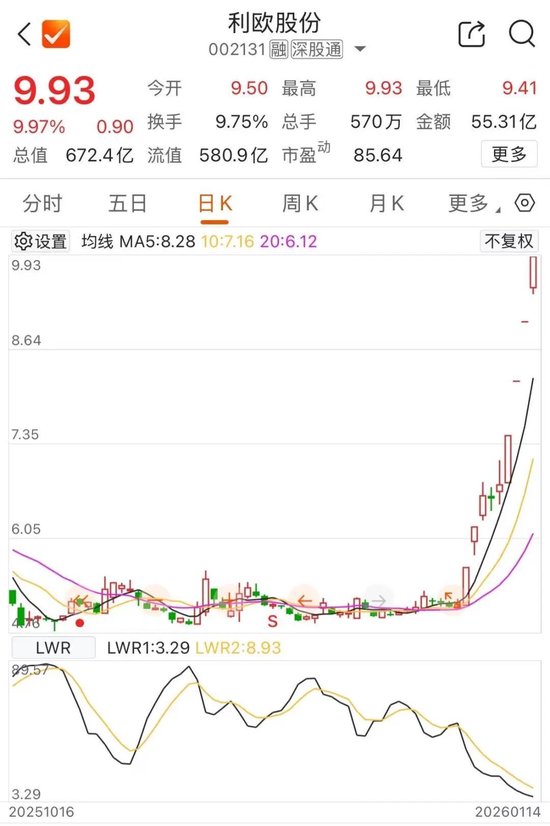
Market Overview - On January 14, the A-share major indices rose in early trading, with the Shanghai Composite Index up by 0.77%, the Shenzhen Component Index and the ChiNext Index both increasing by over 1%, and the Sci-Tech Innovation Board Index rising by over 2% [1][6] - The precious metals sector led the gains, while the commercial aerospace sector experienced the largest declines [1][6] Sector Performance - The AI e-commerce and GEO concepts showed strong performance, with Liou Co., Ltd. (002131) achieving a four-day consecutive rise, Sanjiang Shopping (three-day consecutive rise), and both Guangyun Technology and Zhidema reaching the daily limit [1][6] - The storage chip sector saw significant fluctuations, with Baiwei Storage rising over 10% during trading, and companies like Guokai Microelectronics, Jiangbolong, Demingli, and Lankai Technology also experiencing gains [4][8] Notable Stocks - Baiwei Storage (佰维存储) rose by 9.93% to 148.82, Guokai Microelectronics (国科微) increased by 9.29% to 133.44, and Jiangbolong (江波龙) rose by 3.77% to 286.90 [5][9] - Other notable stocks included Blue Arrow Electronics (蓝箭电子) up by 9.14%, and Demingli (德明利) up by 3.56% [5][9] Strategic Partnerships - Google announced a collaboration with Walmart and other major retailers to introduce AI shopping features on its Gemini platform [3][8]



国信证券晨会纪要-20260114
Guoxin Securities· 2026-01-14 01:54
Group 1: Company Overview - The report highlights the strong growth of Laopu Gold (06181.HK), with a revenue of 12.354 billion yuan in the first half of 2025, representing a year-on-year increase of 251%, and a net profit of 2.268 billion yuan, up 286% [7][9] - Laopu Gold focuses on high-end gold jewelry retail, utilizing traditional craftsmanship, and has a high gross margin of 41.2% in 2024 and 38.1% in the first half of 2025 [7][9] - The company operates 41 stores across 16 cities, including one in Singapore, with a significant increase in single-store revenue, which reached an average of 207 million yuan in 2024, up 120.28% year-on-year [7][9] Group 2: Market Trends and Demand - The demand for gold jewelry is expected to grow due to the rising trend of self-consumption and the integration of fashion and value in gold products, driven by innovative design and craftsmanship [8] - The report notes that the high-end consumer market remains resilient, providing a favorable environment for brands like Laopu Gold [8] - The anticipated long-term increase in gold prices is expected to further boost demand for gold jewelry, benefiting companies with strong gross margins [8] Group 3: Financial Projections and Investment Recommendations - Laopu Gold is projected to achieve net profits of 4.84 billion yuan, 6.545 billion yuan, and 8.107 billion yuan from 2025 to 2027, with corresponding price-to-earnings ratios of 22.4, 16.6, and 13.4 [9] - The report recommends a target stock price range of 788.38 to 855.93 HKD per share for Laopu Gold, maintaining an "outperform" rating [9] - The company is expected to continue expanding its product offerings and membership base, as well as its international presence, to drive future growth [9] Group 4: Industry Insights - The public utility and environmental protection sectors are experiencing a decline in photovoltaic and wind power generation utilization rates, emphasizing the importance of "environmental + resource" investment logic [10][12] - The report discusses the increasing demand for metals due to geopolitical tensions and supply chain security concerns, which have driven up prices for industrial metals [11][12] - The report suggests that the environmental sector is entering a mature phase, with significant cash flow improvements and a focus on investment opportunities in the "quasi-public utility" space [12]
沪指微幅低开,商业航天概念回调
Di Yi Cai Jing Zi Xun· 2026-01-14 01:43
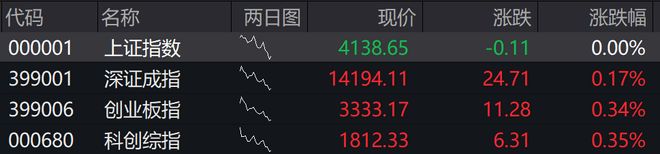
Market Overview - The Shanghai Composite Index opened slightly lower, while the Shenzhen Component Index, ChiNext Index, and STAR Market Index opened higher by 0.17%, 0.34%, and 0.35% respectively [1] - The Shanghai Composite Index is currently at 4138.65, down by 0.11% [2] - The Shenzhen Component Index is at 14194.11, up by 24.71 points or 0.17% [2] - The ChiNext Index is at 3333.17, up by 11.28 points or 0.34% [2] - The STAR Market Index is at 1812.33, up by 6.31 points or 0.35% [2] Sector Performance - AI applications and commercial aerospace themes experienced a pullback, while sectors such as memory storage, ultra-high voltage, medical services, precious metals, and AI wearable concepts were active [2] - Debon Securities resumed trading with a limit-up, as the company plans to voluntarily terminate its stock listing through a shareholder resolution [2] Company Highlights - Baiwei Storage opened over 9% higher, with a forecasted net profit increase of 427.19% to 520.22% year-on-year for 2025 [3][4] - Debon Securities saw a limit-up price of 15.44, reflecting a significant market interest following its announcement [3] Hong Kong Market - The Hang Seng Index opened 0.46% higher, with the Hang Seng Tech Index rising by 0.42% [4][5] - Notable gainers among constituent stocks include Haidilao, which rose over 5%, and Nongfu Spring, Hansoh Pharmaceutical, and China Biologic Products, which increased by over 3% [4][5]

京东集团-SW(09618):25Q4前瞻:Q4国补退坡影响带电增速,外卖单量稳健亏损环比改善
CMS· 2026-01-14 01:37
Investment Rating - The report maintains a "Strong Buy" rating for JD Group with a target price range of HKD 125 to 150, while the current stock price is HKD 117.4 [2][5]. Core Insights - JD Group's total revenue is expected to see a slight year-on-year increase in Q4 2025, with a projected Non-GAAP net profit of approximately 480 million yuan [1][5]. - The report highlights that the decline in revenue growth for the electric category is due to the reduction of national subsidies and a high comparative base from the previous year, while daily necessities and third-party (3P) revenues are expected to maintain double-digit growth [1][5]. - The report expresses a long-term positive outlook on the company's growth resilience under its self-operated model and strong supply chain bargaining power, which is expected to enhance profit margins [1][5]. Financial Data and Valuation - For the fiscal years 2023 to 2027, the projected main revenue (in million yuan) is as follows: 1,084,662 (2023), 1,158,819 (2024), 1,305,167 (2025E), 1,361,675 (2026E), and 1,419,895 (2027E), with year-on-year growth rates of 4%, 7%, 13%, 4%, and 4% respectively [2][6]. - The Non-GAAP net profit projections are: 35,200 (2023), 47,827 (2024), 26,428 (2025E), 32,720 (2026E), and 50,951 (2027E), with significant fluctuations in growth rates [2][6]. - The report indicates a P/E ratio forecast of 8.7 (2023), 6.4 (2024), 11.6 (2025E), 9.4 (2026E), and 6.0 (2027E) [2][9]. Stock Performance - The stock has shown an absolute performance of 9.1% over the past month, 17.6% over six months, and 20.0% over the past year [4]. - Relative performance indicates a 6.0% outperformance over one month, 2.4% over six months, but a 9.8% underperformance over the past year [4]. Business Segment Insights - The report notes that the new business segment is expected to reduce losses in Q4, with improvements in delivery volume and user experience (UE) for the food delivery service [1][5]. - The report anticipates that the food delivery business will continue to improve in 2026, with a focus on enhancing user experience [1][5]. Shareholder Information - The total share capital is 3,188 million shares, with 2,865 million shares listed in Hong Kong [3]. - The major shareholder, Max Smart Limited, holds a 9.6007% stake in the company [3]. Financial Ratios - The report provides key financial ratios, including a return on equity (ROE) of 17.8% and a debt-to-asset ratio of 57.3% [3][9]. - The projected earnings per share (EPS) for the years 2023 to 2027 are 8.34, 14.27, 5.85, 9.26, and 14.87 respectively [2][9].

当心!有商家用AI生成商品宣传图,致实物与图不符
Zhong Guo Xin Wen Wang· 2026-01-14 01:08
来源:法制日报 商家用AI生成商品宣传图引流卖货 这样的"照骗"并非个例。《法治日报》记者近日调查发现,随着AI生成技术在电商领域的快速渗透,不 少商家开始使用AI生成的图片、视频作为商品宣传素材,凭借精美视觉效果吸引消费者下单。但这类 商品宣传往往隐藏"货不对板"的问题——AI生成图过度美化商品外观、夸大功能细节,导致实物与宣传 图差异显著。加之商品详情页缺乏真实信息披露,一定程度上损害消费者知情权和选择权,相关消费纠 纷数量持续攀升。 实物与宣传图差异明显 居住在重庆市的于女士未曾想到,等待4个月的"梦中情偶",最后换来的却是一肚子气。 2025年7月,喜欢收集玩偶挂饰的她在某购物平台上看到一款暹罗猫造型的毛绒挂件,在宣传图里,小 家伙和她养的暹罗猫外形简直一模一样。 "当时,店铺页面显示的销量高达3.9万件,商品评论区里多是'还原度超高'的返图,我立刻就下单 了。"于女士说。下单后,面对的是漫长的预售等待。半个月过去,她忍不住向客服询问发货进度,客 服回复说"商品正在打样,要还原图片的85%以上,还得经过四五轮调整"。 于女士心想,正所谓慢工出细活,于是继续耐心等待。 2025年11月5日,于女士的手机 ...
十个勤天、许翠花登顶,天猫报告揭秘年度十大破亿“新势力”品牌
Guan Cha Zhe Wang· 2026-01-14 00:54
Core Insights - Tmall's 2025 New Brand Development Report indicates that over 150,000 quality new merchants launched brands on Tmall in the past year, marking a historical high for brand creation [1] - The number of brands achieving over 100 million yuan in sales in their opening year increased by over 40% year-on-year [1] - Among new brands established within three years, 276 achieved over 100 million yuan in annual sales, and 5,026 surpassed 10 million yuan [1] Industry Breakdown - The top ten industries with the most new brands achieving over 10 million yuan in sales include apparel, home appliances, home decoration, 3C digital products, health, sports and outdoor, maternal and infant products, home goods, food and fresh produce, and jewelry [1] - Notable brands that achieved over 100 million yuan in sales on Tmall in 2025 include Tenko Qintian, Tongpin, Xu Cuihua, Kutaike, Xiaoban Furniture, Junpei, LiberLive, Juequling, PANE, and CrzYoga, each leading in their respective niche markets [1][4] Regional Insights - The cities with the highest number of new merchants include Guangzhou, Shenzhen, Jinhua, Hangzhou, Quanzhou, Xiamen, Wuhan, Xuzhou, Dongguan, and Zhengzhou, with Guangzhou leading for three consecutive years [4] - In 2025, over 18,000 new merchants opened stores in Guangzhou, doubling the number from 2023 [4] Strategic Initiatives - Tmall plans to implement a "supporting excellence" strategy in 2025, focusing on brands with originality and creativity that can drive consumer demand and retain users [8] - Different support policies are provided based on the stage of new brands, including the "Blue Star Plan" for new merchants and the "Treasure New Brand" initiative to help brands grow from 1 to 10 [8] - The report also identifies 50 blue ocean opportunity sectors for 2026, including smart robots, AI glasses, skin science, personalized makeup, and more, indicating significant growth potential in these areas [8]

美股高位回调,金融股遭“信用卡利率上限”重击!摩根大通、Visa跌超4%,CPI黏性制约降息预期、分析师警示二次通胀风险
Jin Rong Jie· 2026-01-14 00:29
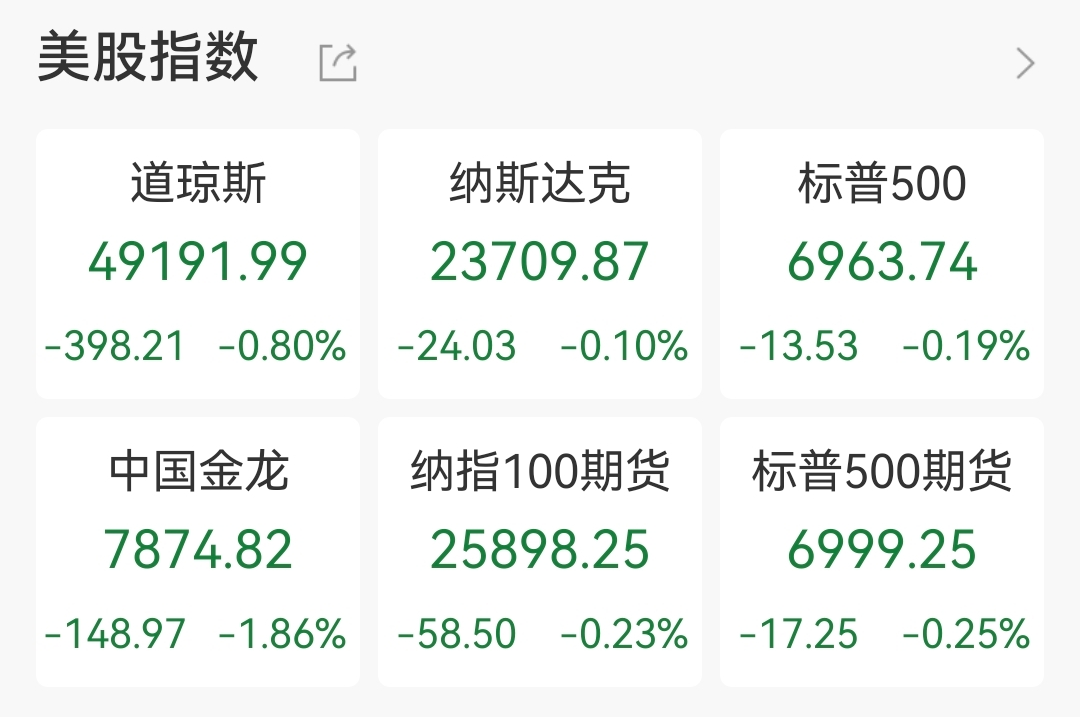
Market Overview - On January 13, U.S. stock markets experienced a correction, with all three major indices closing lower. The Dow Jones Industrial Average fell by 398.21 points, a decline of 0.8%, closing at 49,191.99 points. The S&P 500 index decreased by 0.19%, ending at 6,963.74 points, while the Nasdaq Composite index slightly dropped by 0.1%, closing at 23,709.87 points [1][2]. Sector Performance - The technology sector showed a mixed performance, with a notable divergence. Intel was a standout performer, with its stock price rising over 7%, reaching a nearly two-year high. AMD also saw a 6.39% increase, contributing to a 0.95% rise in the Philadelphia Semiconductor Index, which achieved a record closing high [2]. - Conversely, major tech giants like Meta, Amazon, and Microsoft experienced declines of over 1%, while Tesla saw a slight drop of 0.39%. The Nasdaq 100 index for U.S. tech giants ultimately fell by 0.22%, indicating internal discrepancies regarding earnings expectations and industry policies [3]. Financial Sector Challenges - The financial sector faced dual pressures from disappointing earnings and policy concerns. JPMorgan Chase reported adjusted revenues of $46.77 billion and net profits of $13 billion for Q4 2025, exceeding market expectations. However, weak performance in investment banking, with revenues of $2.35 billion down 5% year-over-year, was a significant shortfall [5][6]. - The announcement of a proposed 10% cap on credit card interest rates by President Trump raised concerns about potential impacts on bank profits and consumer credit availability. This led to a 4.23% drop in JPMorgan's stock, with Visa and Mastercard also declining by 4.41% and 3.79%, respectively. The S&P 500 financial sector fell by 1.84%, and the KBW Bank Index decreased by 1.3%, marking the largest two-day drop since mid-November [6]. Chinese Stocks Performance - Chinese stocks continued to face pressure, with the Nasdaq China Golden Dragon Index declining by 1.86%. Most stocks in this sector were in the red, with notable declines from companies like WeRide and Pony.ai, which fell over 10% and 9%, respectively. Pinduoduo dropped 5.4%, while NIO and Xpeng saw declines exceeding 3%. Alibaba was one of the few exceptions, rising slightly by 0.42% [6]. Commodity Market Highlights - In the commodities market, silver prices surged, reaching a historical high of $89.12 per ounce, with COMEX silver futures also setting records. The global silver market is expected to face a supply-demand gap exceeding 100 million ounces in 2025, continuing a trend of supply shortages for the fifth consecutive year [8]. - Gold prices experienced a mild pullback, settling around $4,588 per ounce, while international oil prices rose to their highest levels since October, with WTI crude oil increasing by 2.77% to $61.15 per barrel due to geopolitical risks [10].