制药

Search documents
国泰海通:特朗普关税被否 后续如何演绎?
Zhi Tong Cai Jing· 2026-02-22 00:26
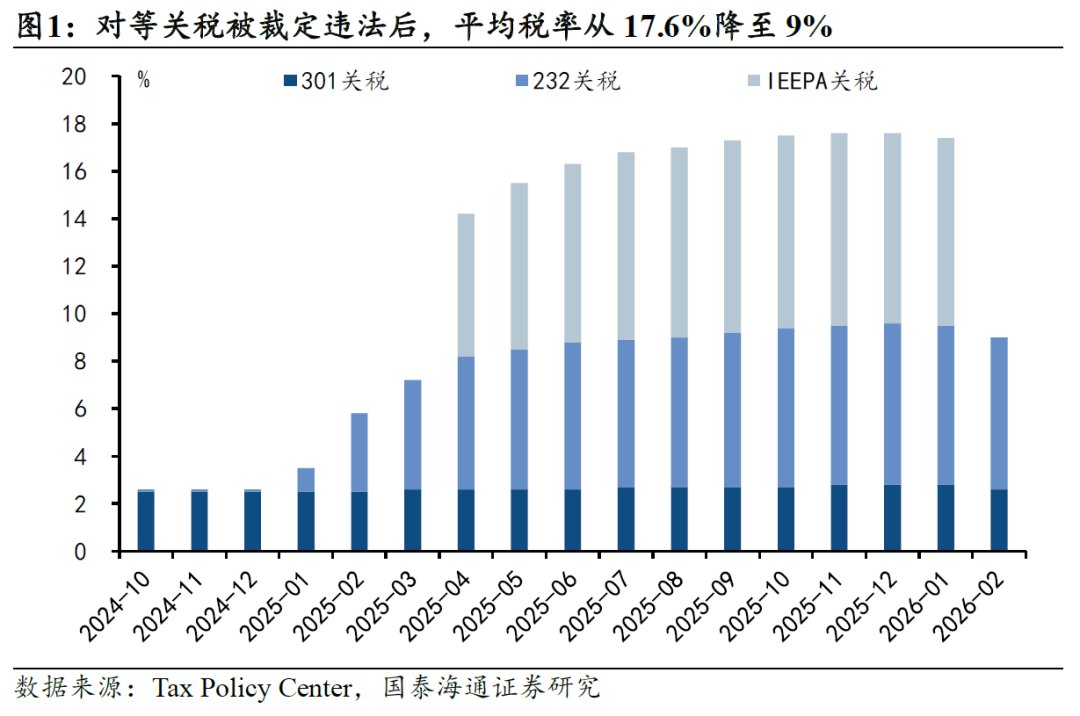
Core Viewpoint - The U.S. Supreme Court ruled that the Trump administration's imposition of reciprocal tariffs under the IEEPA was illegal, leading to Trump's announcement of a temporary 10% global import tariff under the Trade Act of 1974, which raises policy uncertainty and inflation risks [1][3]. Group 1: Short-term and Long-term Tariff Adjustments - The temporary tariff under Section 122 will maintain the current tariff rates, as the average tariff rate drops from 17.6% to 9% after the ruling [1]. - The 232 and 301 tariffs will serve as long-term adjustments, with the 232 tariffs already applied to various sectors including automotive and steel, impacting approximately 20% of U.S. imports [2][3]. Group 2: Inflation Risks and Corporate Behavior - The risk of re-inflation remains high, as companies may lack the incentive to seek refunds on tariffs already passed to consumers, potentially keeping prices stable [3]. - Exporters have absorbed some tariff costs, minimizing the impact on product prices, which could allow them to raise prices further if tariffs are reduced [3]. Group 3: Fiscal Impact and Debt Pressure - The reciprocal tariffs accounted for nearly 60% of U.S. tariff revenue, raising concerns about fiscal impacts; however, short-term financing pressures are manageable even with potential refunds of approximately $170 billion [4]. - In the medium term, the implementation of 232 and 301 tariffs will need close monitoring, as the elimination of reciprocal tariffs could triple net bond financing needs, increasing supply pressure [4][5]. Group 4: Market Reactions and Policy Uncertainty - Market expectations had anticipated the Supreme Court's decision, leading to increased volatility in the dollar and U.S. Treasury bonds, although the extent of this volatility is expected to be limited [6]. - The uncertainty surrounding new tariff measures may prompt more aggressive policy tools from Trump, which could further influence market dynamics and asset pricing [6].


最高法院裁决倒计时!特朗普关税长期存续或成定局?
Jin Shi Shu Ju· 2025-11-03 09:22
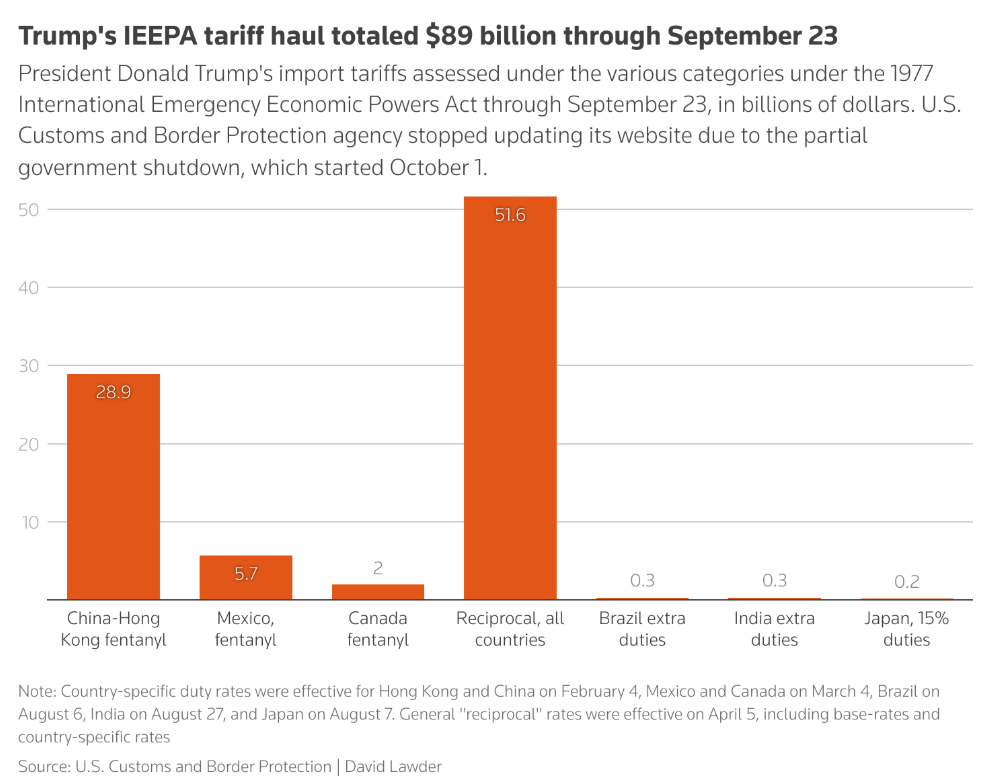
Core Points - The U.S. Supreme Court is set to hear arguments regarding the legality of Trump's global tariffs, which are expected to persist regardless of legal authorization [1][2] - Lower courts have ruled that Trump overstepped his authority by imposing tariffs under the International Emergency Economic Powers Act (IEEPA) [2] - The outcome of the Supreme Court's decision could significantly impact Trump's ability to impose tariffs as a means of punishing countries over non-trade political issues [2] Group 1: Tariff Legislation and Authority - The Supreme Court consists of six conservative and three liberal justices, and has previously supported Trump in major rulings [2] - If the Supreme Court rules against Trump, he may resort to other legal frameworks for imposing tariffs, such as the Trade Act of 1974 and the Tariff Act of 1930 [3] - Trump's administration views tariffs as a cornerstone of economic policy, and businesses should plan accordingly [3] Group 2: Trade Negotiations and Agreements - Trump's tariff policies have reportedly led to significant concessions from major trading partners like Japan and the EU, aimed at reducing the U.S. trade deficit [4] - The U.S. Trade Representative's office has announced final framework trade agreements with Vietnam, Malaysia, Thailand, and Cambodia, locking in tariff rates between 19% and 20% [4] - South Korea has agreed to a $350 billion investment plan in exchange for tariff reductions on automobiles and other goods [4] Group 3: Financial Implications and Revenue - As of September 7, the total import tariffs collected under IEEPA reached $89 billion, contributing to a net customs revenue increase of $118 billion for the fiscal year ending September 30 [8] - The reliance on tariff revenue poses significant political and economic risks, complicating future tariff reductions for any administration [8] - The potential need to refund over $100 billion in tariff revenue could create challenges for the U.S. Customs and Border Protection [8] Group 4: Inflation and Cost Management - Importers have largely absorbed the costs of tariffs, which has limited consumer price increases but has also reduced profit margins [9] - The Oxford Economics Institute estimates that tariffs have increased the Consumer Price Index (CPI) growth rate by 0.4 percentage points, pushing inflation above the Federal Reserve's target [9] - Companies are facing significant cost impacts, with over $35 billion in tariff-related costs disclosed ahead of the third-quarter earnings season [9]
特朗普关税施压,德国8月对美出口跌至四年新低
Feng Huang Wang· 2025-10-09 12:44
Core Insights - Germany's exports to the U.S. have declined for five consecutive months, reaching the lowest level in nearly four years due to U.S. tariff policies [1] - In August, German exports to the U.S. fell by 2.5% month-on-month to €10.9 billion, and year-on-year, there was a dramatic drop of 20% [1] - Conversely, imports from the U.S. increased by 3.4% month-on-month to €8 billion, with an annual growth of nearly 8% [1] Trade Balance - Overall, Germany's trade balance improved in August, with total exports amounting to €129.7 billion, a month-on-month decrease of 0.5% and a year-on-year decrease of 0.7% [3] - Imports totaled €112.5 billion, showing a month-on-month decline of 1.3% but a year-on-year increase of 3.5% [3] - The trade surplus for August expanded to €17.17 billion, marking the second consecutive month of increase, although it is down 21.6% compared to the same month last year [3] EU vs Non-EU Trade - The trade surplus is primarily driven by intra-EU trade, with exports to EU member states at €72.5 billion and imports at €58.8 billion, resulting in a significant intra-EU surplus [3] - Exports to the EU decreased by 2.5% month-on-month, while imports from the EU fell by 1.9% [3] - In contrast, trade with non-EU countries showed a deficit, with exports to non-EU countries at €57.1 billion and imports at €53.7 billion [3] UK Trade Impact - In the non-EU market, imports from the UK have significantly declined, with German exports to the UK dropping by 6.5% month-on-month to €6.5 billion [4]
日本宇部欲扩大特化品业务
Zhong Guo Hua Gong Bao· 2025-06-30 02:32
Core Viewpoint - Ube Industries is restructuring its basic chemicals business by investing in specialty chemicals while reducing or exiting basic chemicals production [1][2] Group 1: Business Restructuring - Ube Industries will cease production of ammonia and related products at its main plant in Ube, Japan, by March 2028, which is over two years earlier than the current mid-term plan [1] - Production of caprolactam and polyamide materials will stop by March 2027, with the Ube plant focusing on specialty chemicals such as polyimides, separation membranes, ceramics, pharmaceuticals, and high-purity chemicals thereafter [1] - The subsidiary in Thailand will stop producing cyclohexanone, caprolactam, and ammonium sulfate, and will close one of its two polyamide production lines [1] Group 2: Expansion in Specialty Chemicals - A new plant in Louisiana, USA, has broken ground and is expected to be completed by 2026, producing 100,000 tons/year of dimethyl carbonate (DMC) and 40,000 tons/year of ethyl methyl carbonate (EMC), marking the largest investment in the production base [2] - DMC and EMC are used as electrolyte solvents for lithium-ion batteries and in semiconductor manufacturing processes [2] Group 3: Sustainability Goals - Ube expects to achieve its greenhouse gas reduction target of a 50% decrease from 2013 levels ahead of schedule by 2028 [2] - The company plans to leverage stable earnings from its specialty chemicals business to quickly offset losses from the restructuring [2] - By 2030, Ube will continue to focus on growth strategies, including active investment in specialty business management resources and enhancing global management while making further progress in sustainability management [2]
“互换大气污染物总量指标”为区域高质量发展和高水平保护注入新动能
Zhong Guo Huan Jing Bao· 2025-06-27 00:14
Core Viewpoint - The recent agreement between Chengdu's Wenjiang District and Qingbaijiang District to exchange air pollutant emission quotas is a strategic move to optimize environmental capacity while supporting economic development and improving air quality [1][2]. Group 1: Agreement Details - Wenjiang District exchanged 90 tons of volatile organic compounds (VOCs) for 60 tons of nitrogen oxides (NOx) from Qingbaijiang District, facilitating the efficient matching of emission quotas with construction projects [1]. - The exchanged NOx quotas will support major projects with a total investment exceeding 3 billion yuan, while the VOC quotas will back projects totaling approximately 15 billion yuan [1]. Group 2: Mechanism and Benefits - The new "bulk exchange" mechanism, introduced by the recent regulations, allows districts meeting specific air quality standards to optimize their emission quotas based on actual development needs [1][2]. - This mechanism simplifies the process of securing necessary emission quotas, significantly accelerating the implementation of air-related construction projects [2]. Group 3: Regional Implications - The practice in Chengdu serves as a model for other regions facing environmental capacity constraints, encouraging them to explore similar quota exchange systems [2]. - Effective implementation of the exchange mechanism requires thorough preliminary research to assess the impact on local air quality, ensuring compliance with air quality standards [2][3]. Group 4: Governance and Oversight - Strengthening policy guidance and clear communication regarding the exchange process is essential for the successful operation of the quota exchange mechanism [3]. - There is a need for comprehensive monitoring and regulation to prevent fraudulent activities during the exchange process, ensuring the integrity of environmental quality improvements [3]. Group 5: Economic and Environmental Value - The quota exchange mechanism highlights the dual value of emission quotas, emphasizing the importance of proactive emission reduction efforts even in areas with surplus environmental capacity [3]. - This approach not only meets local development needs but also opens new economic growth opportunities through market transactions and regional exchanges [3].
中信建投划四大投资主线,A股将迎“黄金窗口期”
2 1 Shi Ji Jing Ji Bao Dao· 2025-06-19 09:36
Core Insights - The Chinese capital market is gaining unique attractiveness due to its reform dividends and institutional resilience amidst global financial market volatility [1] - The introduction of new policies is fundamentally reshaping the capital market ecosystem, transitioning from a financing market to an investment and wealth management market [1] - Analysts predict a steady advancement of the Chinese macro economy and an upward shift in the valuation center of the A-share market in the second half of 2025 [1][5] Group 1: Economic Outlook - The macroeconomic environment is expected to improve with the gradual elimination of uncertainties following significant progress in US-China trade negotiations [2] - China's long-term economic prospects remain positive, supported by advancements in technology and industrial upgrades [2] - Five key highlights for the macro economy in the second half of 2025 include new consumption innovations, trends in de-globalization, manufacturing upgrades, expansionary fiscal policies, and steady institutional openness [2] Group 2: Investment Strategies - Investment strategies should focus on four main lines: consumer sectors driven by domestic demand, technology sectors with a focus on innovation, industrial sectors promoting manufacturing upgrades, and defensive dividend sectors [3] - The A-share market is expected to experience a moderate upward trend due to quality improvements amid strict regulations [4] - A-shares are projected to undergo a phase of volatility followed by upward movement, with external factors like the fading "tariff shock" influencing market dynamics [5] Group 3: Asset Allocation - Investors are advised to maintain dividend assets as core holdings while actively exploring new investment opportunities in emerging sectors [6] - Suggested new investment areas include new consumer products, humanoid robots, artificial intelligence, and innovative pharmaceuticals [6]

第一次!贝森特称“7月9日关税大限”可延期,还点名了“欧洲”,民主党议员直言“TACO的味道”
Hua Er Jie Jian Wen· 2025-06-12 00:33
Core Insights - The U.S. government has signaled a willingness to extend the deadline for tariff negotiations, indicating flexibility in its trade policy for countries engaging in good faith talks [1][2] - The European Union anticipates that trade negotiations with the U.S. will continue beyond the July 9 deadline, aiming for a preliminary agreement on principles before the deadline [2][3] Group 1: U.S. Trade Policy Developments - U.S. Treasury Secretary Mnuchin acknowledged the possibility of extending the tariff deadline for countries like the EU that are negotiating in good faith [1] - President Trump expressed a willingness to extend the July 8 deadline but deemed it "not very necessary," revealing ongoing trade discussions with approximately 15 countries [1][2] Group 2: Market Reactions and Investor Sentiment - The announcement from Mnuchin has reignited hope among investors betting on the "TACO trade," which suggests that the Trump administration may backtrack on its aggressive tariff policies [2] - Following Trump's initial tariff announcements in April, the S&P 500 index experienced a significant drop of over 12% within four days, marking the largest decline since the onset of the COVID-19 pandemic [2] Group 3: EU's Position and Negotiation Challenges - The EU is preparing for extended negotiations with the U.S., focusing on key sectors such as steel, aluminum, automotive, pharmaceuticals, semiconductors, and civilian aircraft [3] - Current U.S. tariffs cover approximately €380 billion (about $434 billion) of EU exports, representing around 70% of the EU's total exports to the U.S. [3]
不断反转!特朗普关税战遭司法拉锯战,最高法院将“终结一切”?
Di Yi Cai Jing· 2025-05-30 06:03
Core Viewpoint - The Trump administration is currently facing multiple lawsuits challenging its tariff measures, with at least seven legal challenges underway [1][2]. Group 1: Legal Proceedings - The U.S. Court of International Trade ruled that the International Emergency Economic Powers Act (IEEPA) does not grant the president unlimited authority to impose tariffs, leading to a historic decision to potentially abolish various tariffs [4]. - Following this ruling, the Trump administration quickly filed an appeal to the U.S. Court of Appeals, seeking to suspend the decision, indicating a willingness to escalate the matter to the Supreme Court if necessary [5]. - The appeals court has temporarily stayed the lower court's ruling, allowing for further legal debate, with a timeline set for submissions from both parties [4][5]. Group 2: Tariff Policy and Alternatives - The Trump administration is exploring alternative legal avenues to implement tariffs, including invoking the Trade Expansion Act of 1962, which allows for tariffs on specific goods [6]. - Despite the challenges, the administration's trade advisors have indicated that they may pursue other methods to impose tariffs, even if they lose the current legal battles [6]. - The ongoing legal disputes and potential alternative tariff measures could prolong uncertainty in trade policy, impacting market reactions and economic conditions [2][6]. Group 3: International Reactions - The Chinese government has criticized the U.S. tariffs as unilateral measures that violate World Trade Organization principles, indicating a broader international discontent with U.S. trade practices [7].