印染产品

Search documents
应急部发布春节前后工贸企业典型事故:督促各地深刻吸取教训
Nan Fang Du Shi Bao· 2026-02-10 14:13
Core Viewpoint - The Ministry of Emergency Management has released a series of typical accident cases in industrial and trade enterprises to guide and urge regions and companies to learn from these lessons, effectively prevent major safety risks, and curb various accidents [1] Group 1: Accident Cases - On February 7, 2023, an explosion at a small illegal workshop in Shanxi Province resulted in 8 deaths and 3 injuries, prompting the State Council's Safety Committee to oversee the investigation and accountability [1] - On February 18, 2022, an explosion at Huaye Foundry in Guangdong caused 3 deaths and 2 serious injuries due to improper installation and operation of an oxygen lance, leading to a primary and secondary explosion [2] - On February 18, 2024, an explosion at Asia-Pacific Light Alloy in Jiangsu resulted in 5 deaths and 13 injuries due to a failure to install safety components, leading to a catastrophic aluminum liquid leak and explosion [3] - On February 5, 2014, a poisoning incident at Embraco in Beijing resulted in 3 deaths when workers improperly used sulfuric acid for cleaning, leading to the release of hydrogen sulfide gas [4] - On February 15, 2025, a dust explosion at Qianbaiwei Food Ingredients in Shandong caused 5 deaths due to metal sparks igniting dust during equipment installation [5] - On January 10, 2023, a poisoning incident at Fuqiang Hongtai Dyeing in Zhejiang resulted in 3 deaths and 3 injuries due to the release of hydrogen sulfide gas from improperly managed acidic wastewater [6] - On December 27, 2023, a carbon monoxide poisoning incident at a hot pot restaurant in Shanxi injured 23 people due to inadequate ventilation and improper combustion of the cooking equipment [7] Group 2: Lessons Learned - Companies must improve risk identification and safety management, especially during the resumption of operations after holidays, to prevent accidents [1][2][3][4][5][6][7] - There is a need for strict adherence to operational protocols and safety measures, including proper installation of safety devices and conducting thorough safety checks [2][3][4][5][6] - The importance of training employees on safety awareness and emergency response to prevent the escalation of accidents is highlighted [4][5][6][7]
满弓劲发 奋楫争先
Xin Lang Cai Jing· 2026-01-19 19:14
Core Viewpoint - The article emphasizes the vigorous project construction and economic development efforts by the Xinjiang Production and Construction Corps (XPCC) in the new year, focusing on high-quality development and the implementation of major projects across various sectors [1][2][3]. Group 1: Project Construction and Economic Growth - The XPCC is prioritizing project construction as a key economic strategy, aiming to convert intentions into agreements and agreements into tangible projects, thereby driving real economic growth [2][3]. - Significant projects, such as the AI Innovation Center in Urumqi with an investment of 800 million yuan, are underway, showcasing a commitment to digital transformation and innovation [2]. - The XPCC has set ambitious targets for fixed asset investment growth, aiming for a 20% year-on-year increase and a 15% increase in the first quarter [2][3]. Group 2: Innovation and Industrial Development - The XPCC is focusing on high-end, intelligent, green, and cluster-based development, with a strategy to enhance industrial innovation and competitiveness through targeted investment in key industries [5][6]. - The completion of projects like the high-performance electrode foil production line, expected to generate 2 billion yuan in output, illustrates the commitment to advancing new materials and technology [5]. - In 2025, the XPCC achieved a 76% increase in fixed asset investment, indicating a strong momentum in industrial growth [5][6]. Group 3: Infrastructure and Public Welfare - The XPCC is actively improving infrastructure to enhance public welfare, with projects like the G3036 highway expected to significantly reduce travel time and boost local economies [8][9]. - A focus on urban development is evident, with plans for 55 key projects in the Baiyang City area, covering various public service sectors [10]. - The XPCC aims to strengthen the social safety net and improve living standards through continued investment in public welfare projects [10].
国金证券:新的主线正在浮出水面 把握当下切换窗口期
Di Yi Cai Jing· 2025-12-30 00:25
Core Viewpoint - The new investment themes for 2026 are emerging in the commodity market, real industry chain, and foreign exchange market, driven by a scenario where investment exceeds consumption, leading to increased physical consumption across various manufacturing sectors [1] Group 1: Investment Opportunities - Focus on AI investments and the recovery of global manufacturing, particularly in industrial resource products such as copper, aluminum, tin, lithium, crude oil, and oil transportation [1] - Attention to China's equipment export chain, which has global comparative advantages and is confirmed at the bottom of the cycle, including power grid equipment, energy storage, lithium batteries, photovoltaics, engineering machinery, and commercial vehicles [1] - Identify domestic manufacturing sectors that are showing signs of bottom reversal, such as chemicals (dyeing, coal chemicals, pesticides, polyurethane, titanium dioxide) and wafer manufacturing [1] Group 2: Consumer Recovery - Capture the recovery in consumption driven by inbound tourism and rising household income, focusing on sectors like aviation, hotels, duty-free shops, and food and beverages [1] Group 3: Non-Banking Financial Sector - Benefit from the expansion of the capital market and the bottoming out of long-term asset returns, particularly in non-bank financial sectors such as insurance and brokerage [1]

国金证券:2026年新的投资主线正在慢慢浮出水面
Xin Lang Cai Jing· 2025-12-28 10:13
Core Viewpoint - The new investment theme for 2026 is emerging in the commodity market, real industry chain, and foreign exchange market, characterized by a scenario where investment exceeds consumption, leading to increased physical consumption across manufacturing sectors and extended trading ranges for bulk commodities, with China's manufacturing advantages becoming more evident and reflected in the foreign exchange market [1] Group 1: Investment Opportunities - Focus on AI investments and industrial resource products that resonate with the global manufacturing recovery, including copper, aluminum, tin, lithium, crude oil, and oil transportation [1] - Attention to China's equipment export chain, which has global comparative advantages and is confirmed at the cycle bottom, including power grid equipment, energy storage, lithium batteries, photovoltaics, engineering machinery, and commercial vehicles, as well as domestic manufacturing sectors showing signs of bottom reversal, such as chemicals (dyeing, coal chemicals, pesticides, polyurethane, titanium dioxide) and wafer manufacturing [1] - Capture the recovery in inbound tourism and the increase in residents' income, leading to a rebound in consumption in sectors like aviation, hotels, duty-free shops, and food and beverages [1] - Benefit from the expansion of the capital market and the bottoming out of long-term asset returns in non-bank sectors, including insurance and brokerage firms [1]
国金策略:单一产业叙事能够带来的收益已经越来越不稳定和难以把握 抓住行情的窄幅波动期布局2026年新主线
Sou Hu Cai Jing· 2025-12-21 12:44
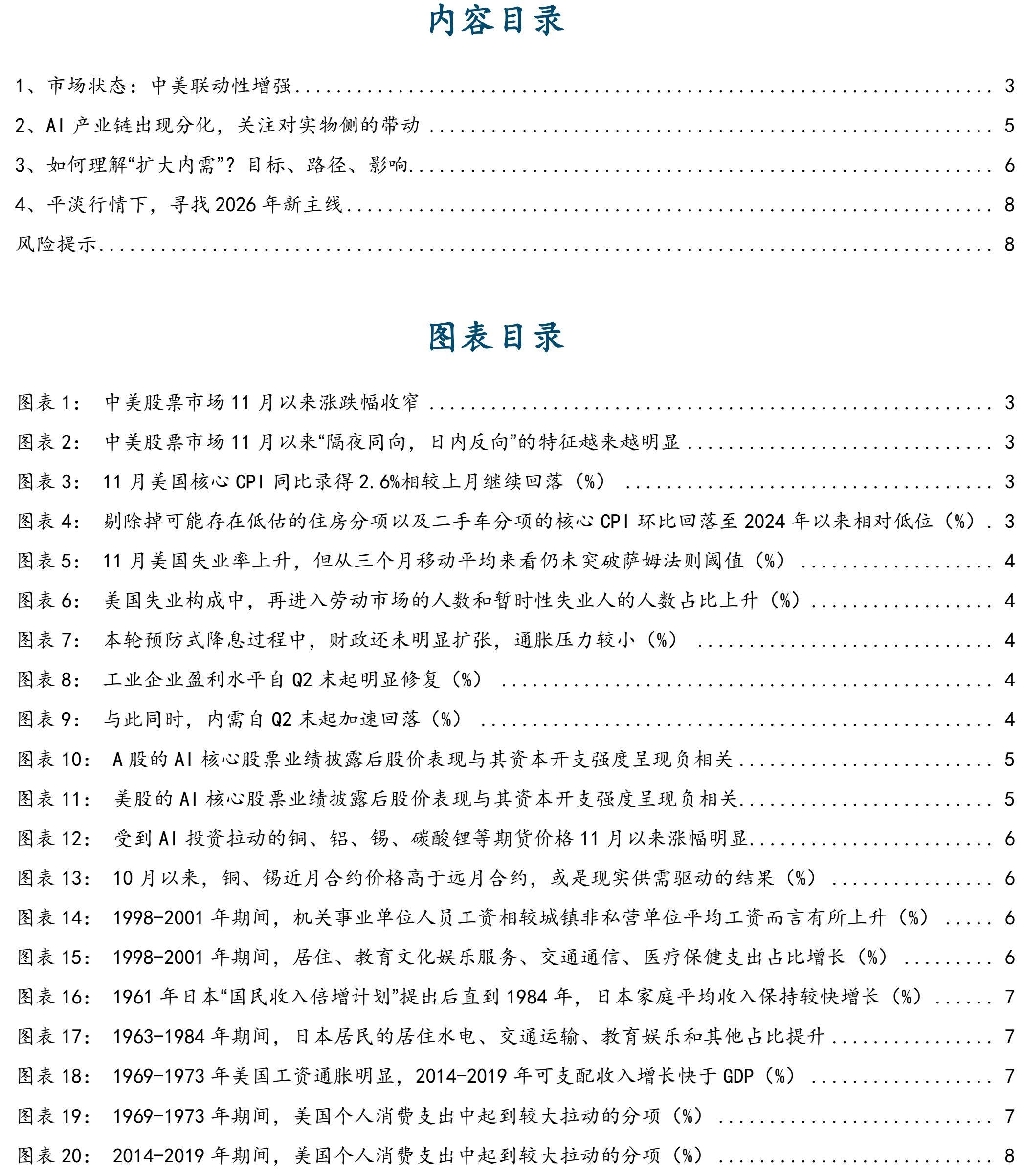
Group 1 - The market status indicates an increased correlation between the US and Chinese markets, with the 20-day rolling correlation of the CSI 300 and S&P 500 rising above the 90th percentile, reflecting a new normal of "overnight alignment and intraday reversal" [2][10][13] - The US core CPI has decreased to 2.6%, the lowest in three and a half years, while the unemployment rate has risen to 4.6%, primarily due to increased labor participation and temporary unemployment, indicating a stable economic environment without significant inflationary pressures [2][10][13] - China's economic fundamentals show a combination of corporate profit bottoming out and a decline in domestic demand, which opens a window for further policy support [2][10][13] Group 2 - The AI industry chain is experiencing a divergence, with broader AI-related assets (copper, lithium, aluminum, energy storage, and electrical equipment) performing better than core AI assets (computing chips, optical modules, PCB) [3][24][25] - Investors are becoming less tolerant of the contradiction between aggressive capital expenditures and the lack of revenue growth in companies within the AI industry chain, leading to a negative correlation between stock performance and capital expenditure as a percentage of revenue [3][24][25] - Commodity prices for copper, aluminum, tin, and lithium carbonate have been rising since late October, driven by demand from AI investments, with near-term contracts for copper and tin outperforming longer-term contracts [3][24][25] Group 3 - The concept of "expanding domestic demand" is emphasized as a strategic move, with a focus on increasing consumer demand supported by income growth and effective investment [4][31][32] - The government plans to enhance the second distribution of income by increasing minimum pension standards and implementing childcare subsidies, while future efforts may focus on optimizing the first distribution through wage reforms [4][31][32] - Historical examples from Japan and the US illustrate that income growth leads to increased service and new-type consumption, suggesting that China's current income growth initiatives could similarly boost consumer spending [4][31][32] Group 4 - The current market environment, characterized by limited macro elasticity and increased industry differentiation, suggests a shift in investment strategy towards tangible demand and domestic policy benefits as the new focus for 2026 [5][42][43] - Recommendations include investing in industrial resource products (copper, aluminum, tin, lithium, crude oil) that benefit from AI investment and global manufacturing recovery, as well as sectors poised for recovery in consumer spending (airlines, hotels, duty-free, food and beverages) [5][42][43] - Non-bank financial institutions (insurance, brokerage) are expected to benefit from capital market expansion and a rebound in long-term asset returns, alongside opportunities in China's equipment export chain and manufacturing sectors [5][42][43]

国金证券:迎接2026,告别单一叙事
Xin Lang Cai Jing· 2025-12-21 09:36
Group 1: Market Status - The correlation between A-shares and U.S. stocks has increased, with the 20-day rolling correlation of the CSI 300 and S&P 500 rising to over 90% since November, indicating a new norm of "overnight same direction, intraday reverse" [2][11][45] - Both the U.S. and Chinese economies are in a phase of "limited upward elasticity and reduced downward risk," with the U.S. core CPI falling to 2.6%, the lowest in three and a half years, and the unemployment rate rising to 4.6% primarily due to increased labor participation and temporary unemployment [2][13][47] - The Chinese economy shows signs of a bottom in corporate profits, while domestic demand is weakening, creating a favorable environment for subsequent policy support [2][13][47] Group 2: AI Industry Chain - The investment in the AI industry chain is showing two notable characteristics: first, "pan-AI" assets (copper, lithium, aluminum, energy storage, and electrical equipment) are performing better than core AI assets (computing chips, optical modules, PCB) [2][18][52] - Investors are becoming less tolerant of the contradiction between aggressive capital expenditures and the lack of revenue growth in companies within the AI industry chain, as evidenced by the negative correlation between stock performance and capital expenditure as a percentage of revenue [2][18][52] - Commodity prices for copper, aluminum, tin, and lithium carbonate have been rising since late October, driven by supply-demand dynamics, with near-term contracts for copper and tin outperforming longer-term contracts [2][19][53] Group 3: Understanding "Expanding Domestic Demand" - The articles published in "Qiushi" magazine emphasize the importance of consumer demand as a primary focus for expanding domestic demand, highlighting the need for a complete domestic demand system [3][24][58] - The strategy includes enhancing secondary distribution to increase residents' net transfer income and optimizing primary distribution to improve labor income, with potential reforms in state-owned enterprises to guide wage adjustments [3][25][58] - Historical examples from Japan and the U.S. show that periods of rising resident income lead to increased service and new-type consumption, indicating that the current "income increase plan" may boost demand for service consumption and technology-driven durable goods [3][27][58] Group 4: Preparing for 2026 - The current market conditions, characterized by limited macro elasticity and increased industry differentiation, suggest a shift in investment strategy towards "physical demand-driven" and "domestic demand policy dividends" as more certain avenues for growth [2][39][40] - Recommendations include focusing on industrial resource products (copper, aluminum, tin, lithium, crude oil, and oil transportation) that benefit from AI investment and global manufacturing recovery, as well as sectors like aviation, hotels, duty-free, and food and beverage that will benefit from increased consumer spending [2][32][39] - The non-bank financial sector (insurance, brokerage) is expected to benefit from capital market expansion and a bottoming out of long-term asset returns, alongside opportunities in China's equipment export chain and domestic manufacturing sectors [2][32][39]
A股策略周报20251207:新的变化正在到来-20251207
SINOLINK SECURITIES· 2025-12-07 09:24
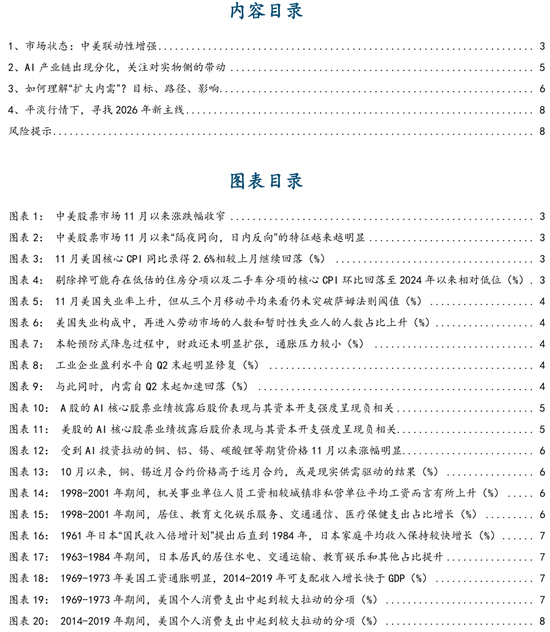
Group 1: A-shares and Commodity Markets - The A-share market is experiencing a significant reduction in trading volume, with the average turnover rate dropping to the lowest level since July 2023, indicating a cooling in market activity [3][15] - In contrast, commodity markets, particularly metals like silver and copper, are witnessing strong price increases due to historically low inventory levels, which reflect the industry's adaptation to a relatively stable policy environment [3][18] - The recent surge in commodity prices is attributed to the low inventory situation and the potential for new demand driven by emerging industries and policy changes, challenging traditional static supply-demand pricing perspectives [3][18] Group 2: Financial Market Changes - Recent changes in the financial market include a reduction in risk factors for insurance companies and discussions about expanding capital space and leverage limits for brokerages, which may lead to increased market liquidity [4][32] - Historical data suggests that past relaxations of risk factors and leverage policies have resulted in positive market performance, with non-bank financial institutions outperforming the overall A-share market [4][32] Group 3: Domestic Economic Fundamentals - There are positive signs in the domestic economy, particularly in exports, with the November manufacturing PMI showing significant improvement in new export orders, indicating a potential rebound in China's export growth [5][33] - The recovery in external demand is supported by rising export growth rates in South Korea and increased container throughput at major Chinese ports, suggesting a broader recovery in global trade [5][33] Group 4: Global Economic Outlook - The expectation of a shift to a looser global liquidity environment as the Federal Reserve enters a rate-cutting cycle is anticipated to boost foreign direct investment (FDI) and global trade demand [6][36] - Emerging markets, particularly in Africa and ASEAN, are beginning to see increased FDI inflows, which are expected to contribute to China's export growth [5][36][37] Group 5: Interest Rate Expectations - Recent dovish comments from Federal Reserve officials have led to a rise in December rate cut expectations, although the employment market remains a critical concern, with recent data showing a decline in job numbers [6][52][60] - The market is currently pricing in a higher likelihood of rate cuts in 2026 compared to previous forecasts, indicating a more optimistic outlook for monetary policy adjustments [6][57]
利好!7部门印发!
证券时报· 2025-11-17 09:18
Core Viewpoint - The article discusses the "East Silk West Solid" initiative aimed at promoting the high-quality development of the silk industry in China, focusing on balancing the industrial layout across eastern, central, and western regions, and enhancing international competitiveness [2][5]. Group 1: Overall Requirements - The initiative aims to create a modern industrial system that balances development across eastern, central, and western regions, with a focus on adapting to the silk industry's needs for gradual transfer and developing new productive forces [5]. - By 2028, the eastern region is expected to establish around 10 leading enterprises with revenues exceeding 10 billion yuan, cultivate over 20 well-known brands with independent intellectual property rights, and ensure that high-end silk product exports account for over 50% of the region's total [2][5]. - The central and western regions are targeted to build high-quality development clusters for the silk industry, nurturing over 10 leading enterprises with revenues exceeding 500 million yuan and achieving a 75% share of quality silk production in the region [2][5]. Group 2: Key Tasks - In the central and western regions, the focus is on extending the industrial chain and enhancing the development foundation by optimizing the silkworm and mulberry cultivation areas, promoting green and efficient technology, and ensuring stable supply of high-quality raw materials [6][7]. - The eastern region is tasked with strengthening technological leadership and enhancing product quality through the establishment of a national silk technology center and promoting high-end silk fabric and intelligent equipment development [8]. - Coordination between eastern and western regions will be emphasized to facilitate industrial collaboration, including building information platforms and conducting project matchmaking to support the transfer of silk-related industries [9][10]. Group 3: Work Assurance - Local governments are encouraged to recognize the significance of the "East Silk West Solid" initiative, enhance organizational coordination, and develop work plans to ensure effective implementation [11]. - The initiative includes promoting tax incentives, increasing financial support for foreign trade, and establishing a system for key silk enterprises to fulfill social responsibilities [3][11]. - Regular research and progress reporting will be conducted, along with the promotion of successful practices through various media channels to support the industry's quality upgrade [3][11].

【SH周报】宏观情绪退坡近端烧碱现货崩塌-20250808
Zhe Shang Qi Huo· 2025-08-08 06:11
1. Report Industry Investment Rating No relevant content provided. 2. Core Viewpoints - The macro - sentiment has declined, and the spot price of near - term caustic soda has collapsed. The upside space of caustic soda is limited, with pressure at the 2800 price level. The supply of liquid caustic soda is expected to remain high, the overall demand is weak, and both liquid and flake caustic soda have seen a week - on - week inventory build - up. The caustic soda price has been falling this week, mainly due to weakening demand in the Shandong region and a downward adjustment in the purchase price of alumina, the main downstream product [3][6]. - For different market participants, corresponding hedging strategies are recommended. For example, producers with high inventory can buy put options and sell call options; traders looking to build inventory can sell put options and buy call options; terminal customers worried about price increases can buy call options [4]. 3. Summary by Directory 3.1 Spot Price - China's caustic soda is divided into different specifications, including 32% liquid caustic soda, 50% liquid caustic soda, and 99% flake caustic soda. The price of low - concentration caustic soda in China has remained stable week - on - week. In Shandong, the average market price of 32% ion - exchange membrane liquid caustic soda is 847 yuan/ton (converted to 2646.875 yuan/dry ton), and the price of high - concentration liquid caustic soda has declined [11]. 3.2 Price Difference - **Model Price Difference**: The price differences between 50% caustic soda and 32% caustic soda, and between 99% flake caustic soda and 32% caustic soda in different regions such as Zhejiang, Jiangsu, Shandong, and Shaanxi are presented, with daily - updated data [37]. - **Regional Price Difference**: The price differences of 32% caustic soda, 50% caustic soda, and 99% flake caustic soda between different regions are analyzed, including the differences between Zhejiang - Shandong, Shaanxi - Shandong, and Jiangsu - Shandong, with daily - updated data [37]. 3.3 Supply - **Production and Supply**: China's caustic soda production capacity is mainly concentrated in North, Northwest, and East China, accounting for 80% of the total. This week, the estimated domestic caustic soda production is 828,100 tons, a week - on - week increase of 8,600 tons, and the weekly operating rate of liquid caustic soda enterprises is 84.32%, a week - on - week increase of 1.04% [55]. - **Maintenance Situation**: Many chlor - alkali plants have completed maintenance this week, while some are still under maintenance or have planned maintenance. This week's maintenance is expected to affect a total of 27,950 tons of caustic soda production in terms of 100% purity [60]. - **Flake Caustic Soda Unit Operation**: The operation status of flake caustic soda units of various manufacturers is reported, including normal operation, reduced operation, and maintenance [64]. 3.4 Downstream Demand - **Alumina**: This week, the supply of alumina has changed little. The overall supply - demand imbalance in the south has not improved significantly. As of August 7, the installed capacity of alumina in China is 114.8 million tons, the operating capacity is 94.4 million tons, and the operating rate is 82.23% [67]. - **Viscose Staple Fiber**: From August 1 to August 7, 2025, the capacity utilization rate of the viscose staple fiber industry is 84.97%, remaining unchanged from last week [67]. - **Printing and Dyeing Industry**: As of August 7, the comprehensive operating rate in the Yangtze River Delta is 69.28%, a week - on - week increase of 0.38%. The market demand in the printing and dyeing industry remains weak [67]. 3.5 Inventory - As of August 8, 2025, the inventory of domestic liquid caustic soda factories is 376,930 tons, a week - on - week increase of 3.99%. The inventory of flake caustic soda factories is 23,555 tons, a week - on - week increase of 23.65% [80]. 3.6 Valuation - **Cost Side**: The cost of caustic soda production mainly comes from raw salt and electricity. This week, the domestic industrial salt market has declined slightly, and the domestic thermal coal market price has risen [84]. - **Profit**: This week, the comprehensive profit of the chlor - alkali industry at the spot end has been compressed, with a slight increase in the cost - side price and a weakening of the liquid caustic soda market price [85]. 3.7 Chlorine - Consuming Downstream - The report presents data on the benchmark spot price of PVC, the weekly operating rate of PVC powder, the comprehensive profit of the calcium carbide method, and the comprehensive profit of the northwest integrated chlor - alkali industry. It also includes data on the capacity utilization rate and production profit of products such as propylene oxide and epichlorohydrin [97].
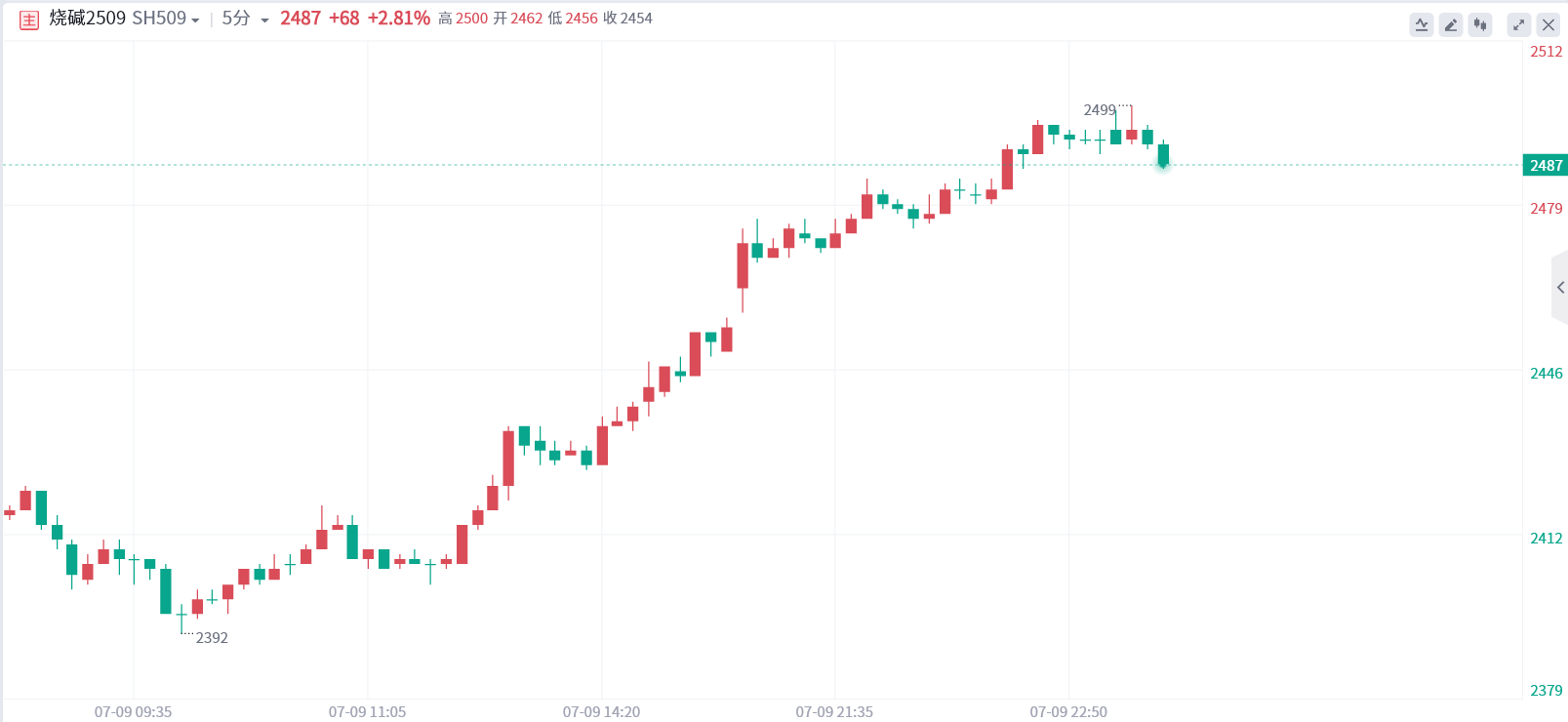
【期货热点追踪】烧碱期价延续走高,后市将如何看待?
Jin Shi Shu Ju· 2025-07-10 01:41
Group 1 - The chemical sector shows a warming trend, with caustic soda prices rising over 3% due to stable supply and seasonal demand support from key downstream industries [1] - Approximately 500,000 tons of caustic soda production capacity is expected to come online in the first half of 2025, primarily driven by the addition of 9.2 million tons of alumina production capacity [3] - The cost of caustic soda is decreasing, with a reduction of about 150 yuan per ton due to lower prices of raw salt, coal, and industrial electricity [3] Group 2 - The average utilization rate of caustic soda production decreased by 2.0% to 80.5% last week, influenced by increased maintenance of production facilities [5] - Liquid chlorine prices are under pressure due to supply-demand imbalances, affecting the profitability of chlor-alkali products [5][6] - Short-term market sentiment is improving, with expectations for price recovery in liquid caustic soda due to potential temporary production cuts from reduced profitability [7] Group 3 - Long-term supply pressures remain, with expectations that caustic soda prices will not see significant increases despite short-term strength in the market [8] - The inventory of liquid caustic soda decreased by 1.58% to 38.42 million tons, indicating a neutral to high level compared to the same period last year [5]