
小米 AI 眼镜

Search documents
智能眼镜行业跟踪报告:智能眼镜产品力系列二:大模型催化,AI眼镜异军突起
GUOTAI HAITONG SECURITIES· 2026-01-28 14:00
Investment Rating - The report assigns an "Accumulate" rating for the smart glasses industry, indicating a positive outlook for investment opportunities in this sector [6][75]. Core Insights - The smart glasses industry is expected to enter a rapid growth phase, with related companies poised to benefit from an upturn in market conditions [6][75]. - The report highlights that AI glasses without display functions are likely to meet the underlying demand logic of traditional eyewear, potentially leading to quicker market penetration [2][6]. Summary by Sections Product Development and Market Penetration - Continuous improvement in product capabilities is anticipated, with sales expected to increase. Key factors affecting rapid market penetration include reliance on traditional offline channels for final delivery, the need for lightweight materials for comfort, battery capacity constraints, and the performance of SoC chips [4][24][32][33][38]. Market Trends and Projections - The report draws parallels with the smart watch market, predicting that AI glasses will have a penetration rate of only 0.1% in 2024, similar to the early stages of smart watches. It forecasts that global AI glasses shipments will reach 291 million units by 2034, with a CAGR of 55.16% from 2025 to 2034 [21][23][75]. Key Product Launches - The report discusses the launch of Ray-Ban Meta, which features significant improvements in audio and video quality, and integrates with Meta's social platforms, enhancing user experience and application scenarios [10][11][15][71]. Investment Recommendations - The report recommends investing in leading domestic lens brand Mingyue Lens and company Inpai, which are expected to benefit from the industry's growth. Mingyue Lens is actively collaborating with top brands in the industry, while Inpai is expanding into the smart sports equipment sector [6][75][76].
智能眼镜行业跟踪报告:智能眼镜产品力系列深度一:AR的崛起,不是偶然
GUOTAI HAITONG SECURITIES· 2026-01-21 05:20
Investment Rating - The report rates the smart glasses industry as "Buy" [1] Core Insights - The smart glasses industry is expected to enter a rapid growth phase, with related companies poised to benefit from an upturn in market conditions. Recommended companies include Mingyue Lens, which is actively collaborating with leading brands in the industry, and Inpai, which is accelerating its layout in the smart sports equipment sector [2][66] - The launch of the Ray-Ban Meta smart glasses marks a new cycle in smart glasses products, featuring improved audio and video quality, and integration with Meta's social platforms [2][66] - The supply chain for smart glasses has expanded significantly, incorporating more electronic components compared to traditional eyewear, with a diverse range of manufacturers involved [2] Summary by Sections New Product Developments - The domestic AI glasses market has seen a rapid increase in sales, with 210,000 units sold in Q3 2025, a 200% quarter-on-quarter growth. Major contributors include Xiaomi, Ray-Ban Meta, and others [5][8] - Xiaomi's AI glasses are projected to surpass 300,000 units sold by the end of 2025, while the Ray-Ban Meta has achieved global sales of 1.12 million units in Q3 2025, reflecting a nearly 50% increase [5][6] Key Players and Products - Major AR glasses manufacturers are actively launching new products, including: - Ray-Ban V3 by FFALCON, released in January 2025 - INMO Air 3, set to launch in November 2024 - Rokid Glass, expected to be available in June 2025 [6][15] - The report highlights the emergence of unicorn brands in the AI glasses sector, with valuations exceeding 1 billion RMB for companies like INMO and Rokid [11] Market Trends and Projections - The CES 2026 event is expected to showcase a significant increase in AI glasses exhibitors, with 55 companies participating, up from over 30 in 2025 [11][14] - The report anticipates continued innovation in 2026, with major tech companies like Google and Apple planning to release new AI glasses [14] Financial Projections - Financial forecasts for key companies in the smart glasses sector indicate a positive outlook, with Mingyue Lens and Inpai both rated as "Buy" based on their earnings per share (EPS) projections for 2025 to 2027 [68]
双重突围:国产算力与AI应用
Bank of China Securities· 2025-09-29 09:04
Group 1 - The commercialization of AI applications is approaching a critical turning point, driven by the maturation of underlying technology and the validation of business models [8][23][24] - The efficiency and cost-effectiveness of AI computing power have significantly improved, with the cost of inference for AI models dropping dramatically, providing economic support for commercialization [9][20] - The capabilities of large models have reached commercial standards, with advancements in multi-turn dialogue, long-term memory, and multi-modal perception, exemplified by models like GPT-5 [19][11][12] Group 2 - The demand for AI applications is rapidly expanding, as indicated by the significant increase in token consumption, which reflects the growing commercial value of AI across various sectors [24][26][28] - AI programming has emerged as a leading area for commercialization, with notable advancements and user growth in tools like GitHub Copilot and Cursor, indicating a clear path to revenue generation [28][29][49] - AI multi-modal applications, particularly in visual content generation, are becoming commercially viable, with companies like Kuaishou and Meitu demonstrating significant revenue growth [33][35] Group 3 - AI is reshaping the advertising value chain, enhancing return on investment (ROI) through improved user insights and targeted advertising strategies [39][40] - AI-driven enterprise services are catalyzing performance across various sectors, with companies like Salesforce and Palantir reporting substantial revenue growth attributed to AI integration [44][45] - The education sector is experiencing a transformation through AI, with personalized learning solutions driving user engagement and revenue growth for platforms like Duolingo [46][49] Group 4 - The healthcare industry is leveraging AI for precise diagnostics and accelerated drug development, with companies like Tempus achieving significant revenue increases through AI applications [51][52] - The current AI application market is influenced by overseas business models, with a focus on sectors that have demonstrated clear revenue validation, such as AI programming and AI healthcare [53][54]
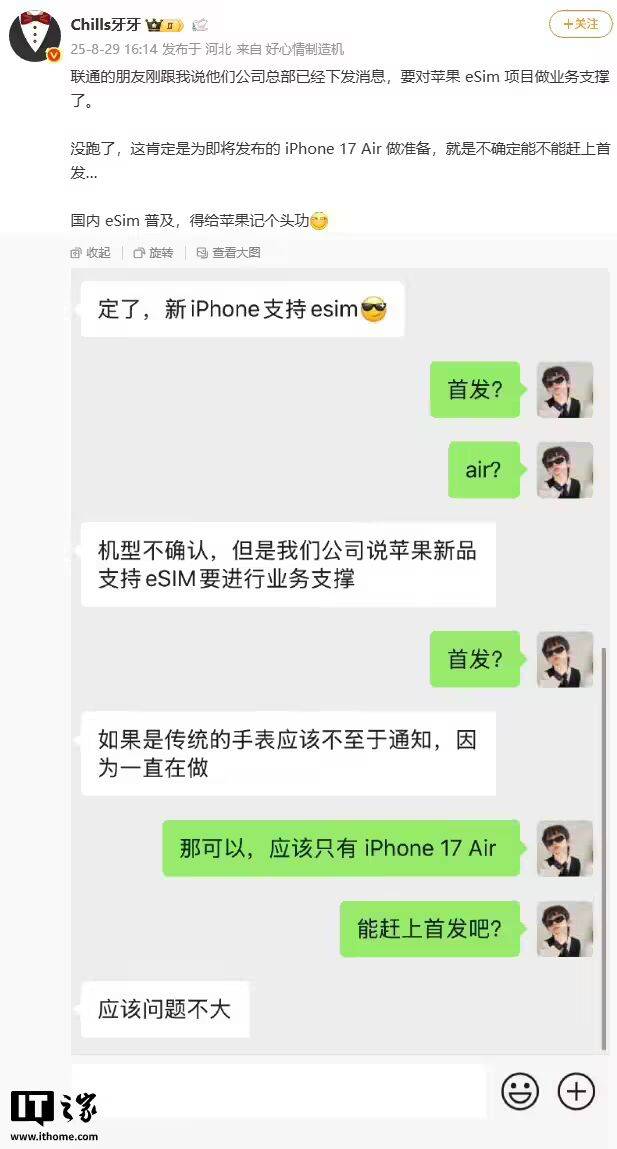
科技大事件 丨 消息称中国联通将支持苹果 eSIM;雷军、周鸿祎等人受邀参加观礼
Sou Hu Cai Jing· 2025-09-04 04:24
Group 1: Apple and eSIM Developments - China Unicom has reportedly issued a notice to support Apple's eSIM project, indicating preparations for the iPhone 17 series, particularly the iPhone 17 Air, which is expected to eliminate the physical SIM card slot due to its ultra-thin design [1][4] - Other models in the iPhone 17 series may still include a physical SIM card slot, but no confirmation has been provided yet [4] Group 2: AI Integration and Partnerships - Apple has entered into a new agreement with Google to evaluate the Gemini AI model, moving away from plans to acquire Perplexity [2][5] - Apple is testing various AI solutions, including those from OpenAI, Anthropic, and Google, with Gemini becoming a focal point for collaboration [5] - An AI-driven search product named "World Knowledge Answers" is in development, set to integrate with Siri and expected to launch next year [5] Group 3: Retail Expansion in India - Apple has opened its fourth retail store in India, located in Koregaon Park, Pune, which is approximately 160.9 kilometers from its first store in Mumbai [6][7] - The new store aims to provide a destination for customers to connect with the Apple ecosystem [6] Group 4: Innovations in MacBook and iPhone Technology - Apple has been granted a patent for an innovative antenna system that integrates wireless components into the MacBook's cooling vents, paving the way for future 5G connectivity [9] - A new patent for a tactile engine has been approved, focusing on enhancing the impact resistance of iPhones through a mechanical system that absorbs and disperses external forces [11]


东海证券晨会纪要-20250820
Donghai Securities· 2025-08-20 07:12
Group 1: Global Smart Glasses Market - The global smart glasses market experienced a year-on-year growth of 110% in the first half of 2025, with expectations of maintaining a compound annual growth rate (CAGR) of over 60% from 2024 to 2029 [6][7] - Meta leads the market with a 73% share, driven by the popularity of Ray-Ban smart glasses, while new entrants like Xiaomi and RayNeo are accelerating market expansion [7] - AI smart glasses accounted for 78% of total shipments in the first half of 2025, indicating a strong trend towards AI integration in this sector [7] Group 2: Domestic Semiconductor Equipment Breakthroughs - Domestic semiconductor equipment has achieved significant breakthroughs, including the mass production of 28nm electron beam measurement equipment and the testing of the first commercial electron beam lithography machine [8][10] - The domestic market for semiconductor electron beam measurement equipment is projected to reach $2.383 billion in 2024, with a 35.84% share from China, and is expected to grow at a CAGR of 22.46% from 2024 to 2030 [8][10] - The first domestic commercial electron beam lithography machine, designed for quantum chips and new semiconductor devices, has entered the testing phase, marking a significant advancement in China's semiconductor technology [10] Group 3: Yanjing Beer Company Performance - Yanjing Beer reported a revenue of 8.558 billion yuan in H1 2025, a year-on-year increase of 6.37%, with a net profit of 1.103 billion yuan, up 45.45% [12][13] - The beer business saw a revenue of 7.896 billion yuan, with sales volume reaching 2.3517 million kiloliters, reflecting a 2.03% increase [13] - The company's gross margin improved to 45.50% in H1 2025, driven by product structure upgrades, while the net profit margin reached 12.89% [14][15] Group 4: Robotics Industry Development - The first World Humanoid Robot Games took place in Beijing, showcasing 280 teams and highlighting the rapid development of the humanoid robotics industry [17][18] - The event serves as a platform for technological innovation and market entry for startups, indicating a growing interest and investment in robotics [18] - The competition included teams from 15 countries, emphasizing the global nature of advancements in humanoid robotics [18]

2025 年上半年全球智能眼镜市场同比激增 110%
Bei Jing Shang Bao· 2025-08-12 05:18
Core Insights - The global smart glasses market is projected to see a 110% year-on-year increase in shipment volume in the first half of 2025, driven by strong demand for Ray-Ban Meta smart glasses and the entry of new players like Xiaomi and TCL-RayNeo [1][2] Group 1: Market Growth - In the first half of 2025, AI smart glasses are expected to account for 78% of total smart glasses shipments, a significant increase from 46% in the first half of 2024 and 66% in the second half of 2024 [1] - The AI glasses segment is projected to grow over 250% year-on-year, significantly outpacing the overall market growth [1] Group 2: Brand Performance - Meta's market share in the global smart glasses market rose to 73% in the first half of 2025, with Ray-Ban Meta AI glasses experiencing over 200% year-on-year shipment growth [1] - Xiaomi's AI glasses emerged as a dark horse in the global smart glasses market, becoming the fourth best-selling model globally and the third best-selling in the AI glasses segment, despite only being on sale for about a week in the first half of 2025 [2]


GPT-5发布前,Anthropic对OpenAI封锁API;特斯拉被曝拖欠账款致两小企破产;人均在职7个月?字节回应|AI周报
AI前线· 2025-08-03 05:33
Group 1 - OpenAI is expected to release a significant number of new models and products in the coming months, including GPT-5, although it faces data bottlenecks and technical challenges [2][3][5] - Anthropic has cut off OpenAI's access to its Claude AI model API, citing violations of service terms, which may impact competition between Claude and GPT-5 [7][8][9] - Tesla has been reported to owe over $110 million to suppliers, leading to the bankruptcy of at least two small companies, highlighting issues with its payment practices [10][11] Group 2 - Hikvision is currently in the process of IPO for its robotics division, indicating strong performance in the domestic robotics industry [15] - Microsoft reported a 24% increase in net profit for Q4 2025, despite laying off 9,000 employees, driven by strong performance in its Microsoft 365 and Azure services [16][17] - ByteDance has clarified that the average tenure of its employees is around 3 years, countering rumors of a high turnover rate [14] Group 3 - Apple has faced talent loss in its AI division, with four researchers leaving for Meta, prompting CEO Tim Cook to reassure employees about the company's AI strategy [20][21] - Meta is planning significant capital expenditures for AI infrastructure, with expectations of spending between $66 billion to $72 billion in 2025 [19] - The Chinese AI market has seen over 3.1 billion registered users for large model applications, indicating rapid growth in AI adoption [24]




东海证券晨会纪要-20250703
Donghai Securities· 2025-07-03 09:09
Group 1 - The report highlights the frequent release of new products by companies like Xiaomi and Honor, emphasizing the importance of the domestic production process for new materials [5][6] - The Chinese government is supporting equipment upgrades in the petrochemical and chemical industries with a funding of 200 billion yuan, which is expected to accelerate the modernization of these sectors [5][6] - The introduction of new products, such as Xiaomi's first SUV and Honor's latest smartphones, is seen as a significant advancement in China's consumer electronics sector, potentially driving the domestic supply chain and high-end material development [6][9] Group 2 - The report indicates that the securities sector may experience upward momentum after a period of consolidation, with technical indicators showing positive trends [11][12] - The Shanghai Composite Index has shown resilience, maintaining above key moving averages despite recent fluctuations, suggesting potential for further gains [19][20] - The report notes that large capital inflows into the market indicate strong buying interest, which may support continued upward movement in the securities sector [15][19] Group 3 - The report tracks industry performance, noting that the petrochemical index has underperformed compared to the broader market, while the basic chemical index has outperformed [7][22] - Specific sub-sectors such as membrane materials and other plastic products have shown significant price increases, indicating strong demand and potential investment opportunities [7][22] - The report emphasizes the importance of selecting resilient and advantageous sectors within the chemical industry, particularly those benefiting from supply-side reforms and domestic production initiatives [9][10]
电子行业周报:AIGlasses市场持续爆发-20250701
Shanghai Aijian Securities· 2025-07-01 08:54
Investment Rating - The report rates the electronic industry as "stronger than the market" [1] Core Insights - The integrated circuit manufacturing sector continues to be strong, leading the electronic industry with a weekly increase of 4.61%, outperforming the CSI 300 index which increased by 1.95% [2] - The AI Glasses market is experiencing explosive growth, with global sales expected to reach 2.34 million units in 2024, a year-on-year increase of 588.2%, and projected to reach 90 million units by 2030, with a CAGR of 83.7% [6][13] - Xiaomi's AI Glasses, launched on June 26, 2025, are positioned as a new entry point in the smart wearable market, featuring advanced AI capabilities and lightweight design [5][20] Summary by Sections 1. AI Glasses Overview - AI Glasses are smart wearable devices that integrate AI technology for enhanced reality experiences and personalized services [8] - The market is characterized by a focus on lightweight design and scenario-based functionality, differentiating from AR, VR, and XR devices [11] 2. Global AI Glasses Market Growth - The global AI Glasses market is projected to grow significantly, with Ray Ban Meta expected to capture over 90% of the market share by Q4 2024 [6][13] - Competition is intensifying between international brands like Meta and domestic manufacturers focusing on localized scenarios [16] 3. Performance Comparison of Xiaomi AI Glasses - Xiaomi's AI Glasses feature a Qualcomm Snapdragon AR1 dual-core architecture, weighing 40g, and a battery capacity of 263mAh, outperforming competitors in several key specifications [20][21] - The AI functionality of Xiaomi's product is enhanced through localized semantic understanding, differentiating it from Ray Ban's offerings [20] 4. Investment Recommendations - The report suggests investors focus on upstream suppliers related to AI Glasses, specifically Tianyue Advanced and Kangnate Optical, which are key players in the supply chain [22][23]

小米YU7大定超预期,人车家全生态势能向上
2025-06-30 01:02
Summary of Xiaomi's Conference Call Company and Industry Overview - **Company**: Xiaomi - **Industry**: Automotive and IoT (Internet of Things) Key Points and Arguments Automotive Business Performance - **Xiaomi U7 Orders**: The Xiaomi U7 received approximately 289,000 pre-orders within the first hour of release, significantly exceeding market expectations of 150,000 to 250,000 for the first 24 hours [2][3] - **Xiaomi SU7 Orders**: The Xiaomi SU7 garnered around 88,000 pre-orders within 24 hours of its launch [2] - **Growth Drivers**: The high order volume is attributed to the U7's competitive pricing (starting at 253,500 yuan), strong performance metrics (0-100 km/h in 3.23 seconds), and the appeal to a broader audience, including female consumers and Apple users [2][3] - **Production Capacity**: The second phase of the Yizhuang factory is crucial for meeting the demand, with expected deliveries of 350,000 to 400,000 units by 2025 [4] Financial Performance - **Q1 2025 Financials**: Xiaomi's overall revenue grew by 47% year-on-year, with adjusted net profit increasing by 65%, despite a loss of approximately 500 million yuan in the automotive sector [6][8] - **Automotive Gross Margin**: The automotive business achieved a gross margin of 23.2% in Q1 2025, reflecting a 2.7 percentage point increase from the previous quarter [5][6] IoT and Internet Business - **IoT Business Growth**: The IoT segment became the largest contributor to gross profit, driven by enhanced product performance and a focus on cost-effectiveness, particularly in smart home appliances [7] - **Internet Business Revenue**: The internet business saw a 13% year-on-year revenue increase, benefiting from the growth of hardware segments [8] Strategic Initiatives - **"Human-Car-Home Ecosystem" Strategy**: This strategy is pivotal for Xiaomi, with over 700 million monthly active users (MAU) as of Q1 2025, providing a solid user base for various business segments [6][9] - **Future Focus**: Investors are encouraged to monitor the development of new vehicle models and the ongoing profitability of the automotive business beyond 2026 [4][6] Technological Innovations - **Virtual Panoramic Display Technology**: The Xiaomi SU7 features a pioneering "weather screen panoramic display system," which is expected to enhance consumer interest and industry adoption of this technology [9][10] - **Laser Radar Market Expansion**: The market for laser radar in vehicles is anticipated to grow, driven by advancements in autonomous driving technology and decreasing costs [15][17] Challenges and Considerations - **Production Challenges**: The automotive sector faces challenges related to production capacity and the timely release of new models, which are critical for sustaining growth [4][6] - **Technical Hurdles**: The implementation of virtual panoramic display technology involves complex optical design and system integration challenges [12][13] Additional Important Insights - **Consumer Behavior**: The curiosity and interest in new models, particularly among potential SU7 buyers, have contributed to the strong pre-order numbers for the U7 [3] - **Market Trends**: The automotive industry is shifting towards integrating advanced technologies like laser radar as standard features in mass-market vehicles, reflecting a broader trend in the sector [20][21] This summary encapsulates the key insights from Xiaomi's conference call, highlighting the company's performance, strategic initiatives, and the broader industry context.