
市政债

Search documents
美债投资手册系列报告(一):美国债券市场生态全景
Changjiang Securities· 2026-03-15 12:23
1. Report's Industry Investment Rating - No information provided in the report 2. Core Viewpoints of the Report - The US bond market is the world's largest and most liquid fixed - income market, with a stock of about 40% of the global total as of 2024, and its interest rate serves as the global pricing anchor. The US bond market has a complete variety system, with Treasury bonds playing a dominant role. It has a mature operating mechanism, clear liquidity stratification, and a perfect rating system. There are differences between the Chinese and US bond markets in terms of market complexity, institutional behavior, and regulatory intensity [5][8]. 3. Summary According to the Directory 3.1 US Bond Market Overview - **Scale and Status**: The US bond market is the world's largest, most liquid, and most dominant fixed - income market. As of 2024, the US fixed - income securities stock accounts for about 40% of the global bond market, and its interest rate is the global asset pricing anchor [21]. - **Bond Category Distribution**: The US bond market has a complete and well - structured variety system. It can be classified from multiple dimensions such as issuer, term structure, interest rate form, and credit rating. Treasury bonds have the largest stock, accounting for half of the market. Corporate bonds and MBS have steadily increased in volume, while municipal bonds, federal agency bonds, and ABS play a more structural supplementary role [23][25]. - **Term and Yield Distribution**: Different bond types have significant differences in terms of term and yield. Municipal bonds and MBS are mainly long - term bonds. Treasury bonds are mainly medium - term, with medium - term Treasury bonds accounting for the highest proportion. High - yield corporate bonds have the highest interest rate level, and different types of bonds' interest rates show cyclical fluctuations [31][33][37]. 3.2 Core Operating Mechanisms and Key Infrastructure of the US Bond Market - **Primary Market Issuance**: It operates under a registration system framework. There are exemption issuance systems such as Rule 144A and Regulation S. Underwriters play a key role in the issuance process, and the book - building process is used to determine the issue price. Different bond markets have their own core systems [40][42][43]. - **Core Operating Center: Primary Dealer System**: Primary dealers are key partners of the Federal Reserve in implementing monetary policy. They ensure the smooth issuance of Treasury bonds, maintain market liquidity, and act as the Fed's counterparties for policy transmission [47]. - **Secondary Market Trading**: The secondary market is mainly over - the - counter (OTC) and uses electronic trading platforms. The TRACE system enhances market transparency by providing real - time transaction data [49][50]. - **Clearing and Settlement**: The US bond market depends on the DTCC. The FICC under the DTCC provides central counterparty clearing, and the DTC is responsible for securities custody and final settlement [55]. 3.3 Bond Ratings: Multi - Dimensional Assessment of Credit, ESG, and Information Disclosure - **Credit Rating**: Three major rating agencies, S&P Global Ratings, Moody's, and Fitch Ratings, establish a unified credit - stratification framework for the US bond market [68]. - **ESG Rating**: Three mainstream international evaluation systems, Morningstar Sustainalytics ESG risk rating, MSCI rating, and LSEG ESG score, are used to describe ESG risks and performance from different perspectives [73]. - **Information Disclosure**: The information disclosure system in the US bond market is well - structured and clearly stratified. Different bond types have different disclosure rules [77]. - **Default Situation**: The default rates of different bond types vary significantly. Corporate bonds have the highest default rate, while US Treasury bonds and agency bonds have the lowest [80]. 3.4 Differences between Chinese and US Bond Markets - **Market Complexity**: The US bond market has more diverse varieties and more complex trading mechanisms, with both OTC and electronic platforms. The Chinese bond market has a relatively concentrated structure and clearer market levels and trading patterns [86]. - **Institutional Behavior**: Both markets are dominated by institutional investors. However, US institutional investors have more diverse strategies and more common active trading and hedging behaviors, while Chinese institutional investors mainly focus on allocation - based and stable investments [89]. - **Regulatory Intensity**: Both countries attach great importance to the bond market, but the US adopts a multi - regulatory - agency division of labor and a market - rule - based regulatory model, while China's regulatory system is relatively centralized, with more prominent policy coordination and administrative guidance [91].
美联储决议前瞻:“暂停”是确定,不确定的是“鹰派还是鸽派暂停”
美股研究社· 2026-01-27 10:44
Core Viewpoint - Morgan Stanley anticipates that the upcoming January FOMC meeting will maintain interest rates unchanged, focusing on the tone of the statement [2][5] Group 1: Interest Rate Outlook - The Federal Reserve is expected to keep the federal funds rate target range at 3.50%-3.75%, indicating a tactical adjustment rather than a return to a tightening cycle [2] - The statement is likely to upgrade the economic growth assessment from "moderate" to "robust" and remove references to "increased risks to employment," suggesting reduced concerns about the labor market [2] Group 2: Forward Guidance - The key aspect for investors is the forward guidance, with Morgan Stanley predicting the statement will retain language about "considering further adjustments" rather than "any adjustments," indicating a continued dovish stance [3][5] Group 3: Voting Dynamics - There is an expectation of dissenting votes, with predictions that Governor Miran will vote against the decision, advocating for a 50 basis point rate cut [4] Group 4: Economic Context - Powell is expected to justify the pause by referencing recent strong growth data, stable hiring, and a decrease in the unemployment rate to 4.375% [7] - Despite strong activity data, inflation data has not shown the expected effects from tariffs, but the Fed remains confident that inflation will decline later in the year [7] Group 5: Market Strategy - The short-term financing market remains accommodative, with repo rates normalizing below the interest on reserve balances (IORB), indicating an excess of cash in the system [9] - Morgan Stanley recommends a long position on the 2-year UST SOFR swap spread, targeting -14 basis points, based on the loose financing environment and expectations of a steepening front-end curve [10] Group 6: Currency Outlook - Morgan Stanley has revised its outlook for the foreign exchange market, now expecting stronger U.S. economic growth (GDP growth forecast for 2026 raised to 2.4%) and a delay in Fed rate cuts [12] - Despite this, the firm maintains a moderately bearish view on the U.S. dollar due to synchronized global growth and undervaluation of the Japanese yen [13] Group 7: Asset Class Focus - In the mortgage-backed securities (MBS) sector, the significant $200 billion purchase plan by GSEs has led to a substantial narrowing of MBS spreads, prompting a neutral stance from Morgan Stanley [18] - Municipal bonds are considered fundamentally sound but expensive, with low yield ratios compared to corporate bonds, raising concerns about sustainability if the Fed provides ambiguous signals [18]


美联储决议前瞻:“暂停”是确定,不确定的是“鹰派还是鸽派暂停”
华尔街见闻· 2026-01-26 09:42
Core Viewpoint - Morgan Stanley anticipates that the upcoming January FOMC meeting will maintain interest rates unchanged, focusing on the tone of the statement [1][2] Group 1: FOMC Meeting Insights - The Federal Reserve is expected to keep the federal funds rate target range at 3.50%-3.75%, indicating a tactical adjustment rather than a return to a tightening cycle [2] - The statement is likely to upgrade the economic growth assessment from "moderate" to "robust" and remove references to "increased risks to employment," suggesting reduced concerns about the labor market [2][4] - Morgan Stanley predicts a dissenting vote from a board member advocating for a 50 basis point rate cut [2] Group 2: Market Strategy and Liquidity - Despite the Fed's pause on rate cuts, the short-term financing market remains loose, with repo rates normalizing below the interest on reserve balances (IORB), indicating an "excessively ample" cash situation [5] - The Fed is expected to maintain reserve levels by purchasing $40 billion in Treasury bills monthly, with projections for the SOMA account holdings to exceed $600 billion by the end of 2026 [6] Group 3: Currency Outlook - Morgan Stanley has revised its outlook on the foreign exchange market, now projecting a stronger U.S. economy with a GDP growth forecast of 2.4% for 2026, delaying the anticipated rate cuts [8] - Despite this, the firm maintains a moderately bearish view on the dollar due to synchronized global growth and undervaluation of the Japanese yen, which is expected to converge [9] Group 4: Asset Class Focus - In the mortgage-backed securities (MBS) sector, the significant $200 billion purchase plan by government-sponsored enterprises has led to a narrowing of MBS spreads, prompting a neutral stance from Morgan Stanley [11] - The municipal bond market shows solid fundamentals but is considered expensive, with low yield ratios compared to corporate bonds, raising concerns about sustainability if the Fed signals ambiguity rather than a clear dovish stance [11]
下周美联储决议前瞻:“暂停”是确定,不确定的是“鹰派还是鸽派暂停”
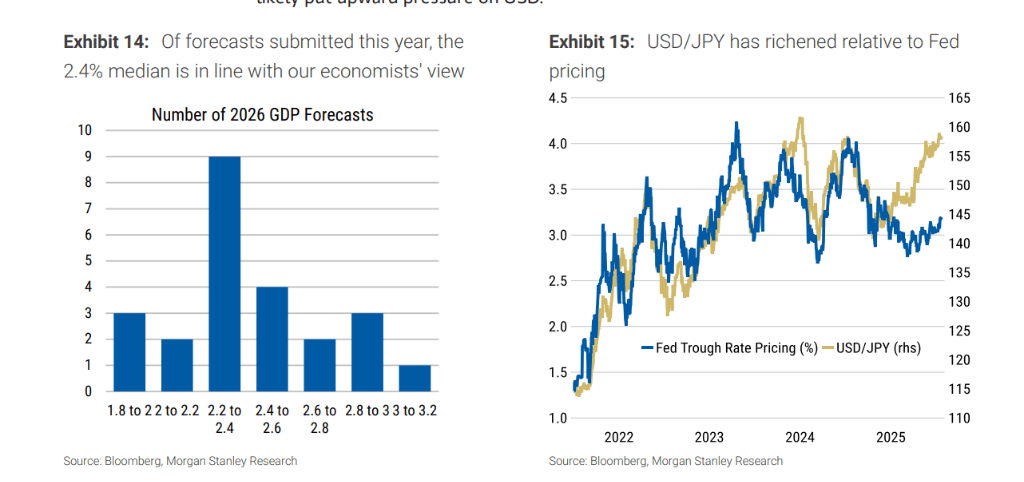
Sou Hu Cai Jing· 2026-01-25 09:09
Group 1 - The core viewpoint is that Morgan Stanley anticipates the Federal Reserve will maintain interest rates during the upcoming January FOMC meeting, with a focus on the tone of the statement indicating a dovish pause to soothe the market [1][2] - The Federal Reserve is expected to keep the federal funds rate target range unchanged at 3.50%-3.75%, which is seen as a tactical adjustment rather than a return to a tightening cycle [1][2] - The key for investors lies in the forward guidance, with expectations that the Fed will retain language suggesting consideration for further adjustments, indicating a continued dovish stance [2][9] Group 2 - Jerome Powell is expected to justify the pause by referencing recent strong growth data, stable hiring, and a decrease in the unemployment rate to 4.375% [3] - Despite the Fed's pause on rate cuts, the short-term financing market remains loose, with repo rates normalizing below the interest on reserve balances (IORB), indicating an excess of cash in the system [4] - Morgan Stanley has revised its outlook on the foreign exchange market, now projecting a stronger U.S. economy with an upward adjustment of GDP growth to 2.4% for 2026, while delaying the anticipated rate cuts [5] Group 3 - In the mortgage-backed securities (MBS) sector, the announcement of a $200 billion purchase plan by government-sponsored enterprises (GSEs) has led to a significant narrowing of MBS spreads, prompting a neutral stance from Morgan Stanley [8] - The FOMC statement is expected to upgrade the assessment of economic growth from "moderate" to "robust" and remove references to increased risks in the labor market, reflecting a more positive outlook [9] - The Federal Reserve is projected to maintain a monthly purchase of $40 billion in Treasury bills to manage reserve levels, with expectations that the SOMA account will exceed $600 billion by the end of 2026 [9]
【财经分析】2026美债迷局:美联储的“隐形宽松”与利率的悬崖之舞
Xin Hua Cai Jing· 2025-12-17 06:49
Core Viewpoint - The Federal Reserve is expected to initiate a significant transition from "Quantitative Tightening" (QT) to "Reserve Management Purchases" (RMP) by the end of 2025, which may signal the start of a form of "invisible easing" in 2026 [1][2] Group 1: Mechanism Change - The cessation of QT in Q4 2025 marks the end of a period where approximately $2.4 trillion in liquidity was withdrawn from the market, leading to the introduction of RMP in January 2026 [2] - RMP is officially defined as a technical operation to ensure sufficient liquidity in the financial system, but is interpreted by the market as a form of "covert easing" or "quasi-quantitative easing" [2] - The shift to RMP is driven by structural liquidity constraints in the financial system, as banks prefer to pay higher premiums in the market rather than utilize reserves held at the Fed [2] Group 2: Economic Outlook and Interest Rate Predictions - There is a notable divergence in predictions for the federal funds rate in 2026, with ICBC International forecasting a reduction of 50-75 basis points, while J.P. Morgan anticipates only a single rate cut [4] - ICBC International's bearish outlook is based on the need to shift monetary policy focus from anti-inflation to stabilizing growth amid slowing domestic demand [4] - J.P. Morgan's optimistic view is supported by strong non-residential fixed investment, suggesting limited rate cuts and stabilization around 3%-3.25% [4] Group 3: Fiscal Concerns - The implementation of RMP coincides with historically high federal budget deficits, raising concerns about the potential for monetizing fiscal deficits through the issuance of short-term Treasury bonds [3] Group 4: Yield Curve Dynamics - Analysts predict a steepening of the U.S. Treasury yield curve, with expectations that the federal funds rate will settle around 3% by the end of 2026, driven by a tug-of-war between short-term rate easing and long-term concerns over fiscal sustainability [6] - The yield curve's shape in 2026 may serve as a litmus test for the impact of the AI revolution on the economy, with a healthy inflation cycle potentially leading to a steepening curve [5] Group 5: Scenario Analysis for 2026 - ING outlines two extreme scenarios for 2026: one where the Fed cuts rates in response to a significant economic downturn, leading to a drop in 10-year Treasury yields to around 3%, and another where premature rate cuts occur without economic justification, potentially pushing yields above 5% [7] - The baseline forecast from ING suggests that 10-year Treasury yields will fluctuate around 4.5% before gradually declining to 4.25% by year-end [7] Group 6: Investment Strategies - First Source Bank emphasizes the importance of structural opportunities in a volatile environment, recommending a diversified bond portfolio that includes investment-grade corporate bonds, municipal bonds, mortgage-backed securities, and selected high-yield options [8]

美银市场或已不信鹰派降息?哈塞特,带来买谣言和卖事实交易机会
Sou Hu Cai Jing· 2025-12-14 10:22
Group 1 - The market widely anticipates a rate cut from the Federal Reserve in December, with Bank of America suggesting investors "buy the rumor" and increase holdings in long-term bonds, predicting the 10-year Treasury yield will drop below 4% in the coming months [2][5][12] - Adjustments in inflation and economic growth forecasts are expected, providing a rationale for the rate cut, with the dot plot potentially indicating two more rate cuts next year [5][7] - Federal Reserve Chair Powell faces challenges in conveying a "hawkish rate cut" signal, as upcoming economic data releases may complicate his messaging [8][10] Group 2 - The Federal Reserve is expected to announce a $45 billion monthly Treasury purchase plan starting in January, which is larger than market expectations and aims to bolster bank reserves [12][13] - This liquidity boost is seen as beneficial for the market, supporting arbitrage trading and keeping bond market volatility low, with expectations that MBS spreads could narrow [15] - Concerns arise regarding potential administrative interference in Federal Reserve decisions, particularly with rumors of Hassett potentially becoming the new chair, which could impact long-term interest rates [17][21] Group 3 - Bank of America recommends an overweight position in agency MBS, non-agency MBS, and CMBS, anticipating a decline in 30-year mortgage rates below 6% as the housing market picks up in spring [23][25] - CLOs are viewed as attractive investments due to stable pricing and decent yield opportunities, while high-yield bonds may underperform due to volatility in the AI sector and changing policy expectations [25][27] - The municipal bond issuance is projected to reach $640 billion next year, with recommendations to buy long-duration, high-rated bonds in the first half of the year for potential returns [27][29]

美银:市场或已不信“鹰派降息”,哈赛特带来“买谣言,卖事实”交易机会
美股IPO· 2025-12-09 07:15
Core Viewpoint - Bank of America anticipates a 25 basis point rate cut by the Federal Reserve this week, but Powell may struggle to present a "hawkish cut," leading the market to potentially bet more aggressively on further cuts in January [1][3]. Group 1: Federal Reserve Rate Cut Expectations - The market expects a 95% probability of a 25 basis point rate cut at the upcoming Federal Reserve meeting, with economic forecasts suggesting an upward revision for growth in 2025-2026, while unemployment rate predictions may also rise [3]. - The median dot plot may indicate two rate cuts next year, with the potential for a more dovish stance from the new Fed chair, Hassett, raising concerns about long-term interest rates [3][6]. Group 2: Liquidity Management and RMPs - Bank of America predicts the Federal Reserve will announce a Reserve Management Purchase (RMP) plan, starting in January with monthly purchases of $45 billion in Treasury securities, exceeding market expectations [4][11]. - This liquidity injection is expected to support arbitrage trading and maintain a low volatility environment, benefiting the front-end market [4][12]. Group 3: Market Reactions and Investment Strategies - The anticipated decline in the 10-year U.S. Treasury yield below 4% is likely to occur, driven by the "buy the rumor" strategy surrounding Hassett's nomination, which may also lower 30-year mortgage rates below 6% [7][9]. - Bank of America maintains an overweight recommendation on agency MBS, non-agency MBS, and CMBS, expecting the MOVE index to decline further, leading to a tightening of spreads [9]. Group 4: Credit and Securitized Asset Allocation - In the credit market, if the new Fed chair adopts a dovish stance, investment-grade corporate bond spreads may initially narrow due to duration chasing, while the yield curve between 10-year and 30-year bonds may flatten [13]. - CLOs are highlighted as resilient assets with good carry yield and price stability, while high-yield bonds face challenges due to volatility driven by AI and shifting Fed expectations [13].

美银:市场或已不信“鹰派降息”,哈赛特带来“买谣言,卖事实”交易机会
Hua Er Jie Jian Wen· 2025-12-09 06:27
Group 1 - The core viewpoint of the articles indicates that despite the Federal Reserve signaling a potential 25 basis point rate cut in December, the market remains skeptical about the credibility of this "hawkish cut" stance [1][3] - Market expectations suggest a 95% probability of a rate cut in the upcoming Federal Reserve meeting, with projections indicating an upward revision of economic growth forecasts for 2025-2026, alongside a potential increase in unemployment rate predictions [1][2] - The anticipated announcement of the Reserve Management Purchase (RMP) plan, involving monthly purchases of $45 billion in Treasury bills starting in January, is expected to exceed market expectations and support a low volatility environment [2][12] Group 2 - The report highlights that Powell may struggle to maintain a credible hawkish stance due to the release of significant economic data before the January meeting, which could lead to more aggressive market pricing for a rate cut [3][4] - The nomination of Hassett as the potential new Fed Chair is causing shifts in fixed income product return logic, with expectations that the 10-year Treasury yield could fall below 4%, benefiting the housing market as mortgage rates decline [4][6] - The credit market outlook suggests that if the new Fed Chair is perceived as extremely dovish, investment-grade corporate bond spreads may initially narrow, while CLOs are viewed as strong buy candidates due to their stable pricing and yield characteristics [8] Group 3 - The liquidity injection from the RMPs is expected to directly benefit the front-end market, with recommendations to go long on the January SOFR/Federal Funds rate spread, as historical data indicates that increased liquidity typically leads to a rapid decline in SOFR relative to FF [12] - The municipal bond market is projected to see a total issuance of $640 billion in 2026, with strategies suggesting buying and holding long-duration high-rated municipal bonds in the first half of 2026 [8]
特朗普一个多月购债券逾八千万美元
Zhong Guo Ji Jin Bao· 2025-11-16 22:56
Group 1 - Trump purchased at least $82 million in corporate and municipal bonds from late August to early October, with total bond purchases potentially exceeding $337 million [1] - The bonds acquired include those from sectors benefiting from Trump's policy adjustments, such as financial deregulation [1] - Specific companies whose bonds were purchased include semiconductor manufacturers like Broadcom and Qualcomm, tech companies like Meta, retail firms like Home Depot and CVS Health, and Wall Street banks like Goldman Sachs and Morgan Stanley [1] Group 2 - Following the U.S. government's investment in Intel, Trump also bought Intel-issued bonds [2] - Trump has reported over $100 million in bond purchases since returning to the presidency on January 20 [2] - Trump's annual financial disclosure indicated income exceeding $600 million from various businesses, including cryptocurrency and golf course properties, raising concerns about potential conflicts of interest [2] Group 3 - Unlike his predecessor, Trump has not divested assets or placed them in a blind trust; his business empire is managed by his two sons [3]
特朗普重仓了!
Zhong Guo Ji Jin Bao· 2025-11-16 16:08
Core Insights - Trump purchased at least $82 million in corporate and municipal bonds from late August to early October, with total potential investments exceeding $337 million based on upper limits of disclosed ranges [1][2] - The bonds acquired span various sectors, including those benefiting from Trump's policy adjustments, such as financial deregulation [1] - Notable companies whose bonds were purchased include Broadcom, Qualcomm, Meta, Home Depot, CVS Health, Goldman Sachs, and Morgan Stanley [1] Investment Details - Trump bought bonds from Intel following the U.S. government's investment in the company [2] - The financial disclosure does not specify exact transaction amounts, only general ranges, and no asset sales were reported [2] - Since returning to the presidency, Trump has purchased over $100 million in bonds, with significant income reported from various business ventures, including cryptocurrency [2] Management and Oversight - Unlike previous administrations, Trump has not divested assets or placed them in a blind trust; his business empire is managed by his sons [3] - Trump's financial activities raise potential conflict of interest concerns due to the overlap between his business interests and presidential policies [3]