DeepSeek R1大模型

Search documents
“中国何以挑战美国AI霸权?这就是答案”
Guan Cha Zhe Wang· 2026-02-02 03:51
Core Insights - China's "Genius Class" system is effectively cultivating AI talent, transforming the country from a talent void to a powerhouse in AI development [1][2] - The scale of talent cultivation in China, with approximately 5 million STEM graduates annually, far exceeds that of the United States, which produces around 500,000 [2] - Graduates from the "Genius Class" are significantly contributing to leading tech companies in China and are also making their mark in international AI research institutions [1][4] Group 1: Talent Development Mechanism - The "Genius Class" system allows students aged 16 to 18 to engage in intensive study, bypassing traditional college entrance exams based on their performance in international competitions [2] - This system has been pivotal in producing leaders in China's tech industry, with notable alumni from companies like ByteDance, Alibaba, and DeepSeek [1][2] Group 2: Historical Context and Evolution - The emphasis on science education in China dates back to post-World War II, with a national belief that "science is key to national progress" [8] - The "Genius Class" emerged in the 1980s, inspired by the success of Chinese students in international science competitions, leading to a structured approach to nurturing top talent [9][10] Group 3: Impact on AI Industry - The rise of AI as a national strategic priority in 2017 has accelerated the focus on talent cultivation, with 35 new AI-focused classes established in 2018 alone [9][10] - Companies like DeepSeek, staffed predominantly by "Genius Class" graduates, are challenging Western dominance in AI, exemplified by their development of competitive models at significantly lower costs [5][6] Group 4: Personal Experiences and Outcomes - Graduates from the "Genius Class" report a unique educational experience that fosters creativity and problem-solving skills, which are essential in the tech industry [6][13] - The success of the "Genius Class" is reflected in the high number of graduates now holding significant positions in tech, finance, and academia, indicating a broad impact on various sectors [13]

天数智芯赴港上市,国产大模型算力底座的含金量!
Ge Long Hui· 2026-01-08 01:20
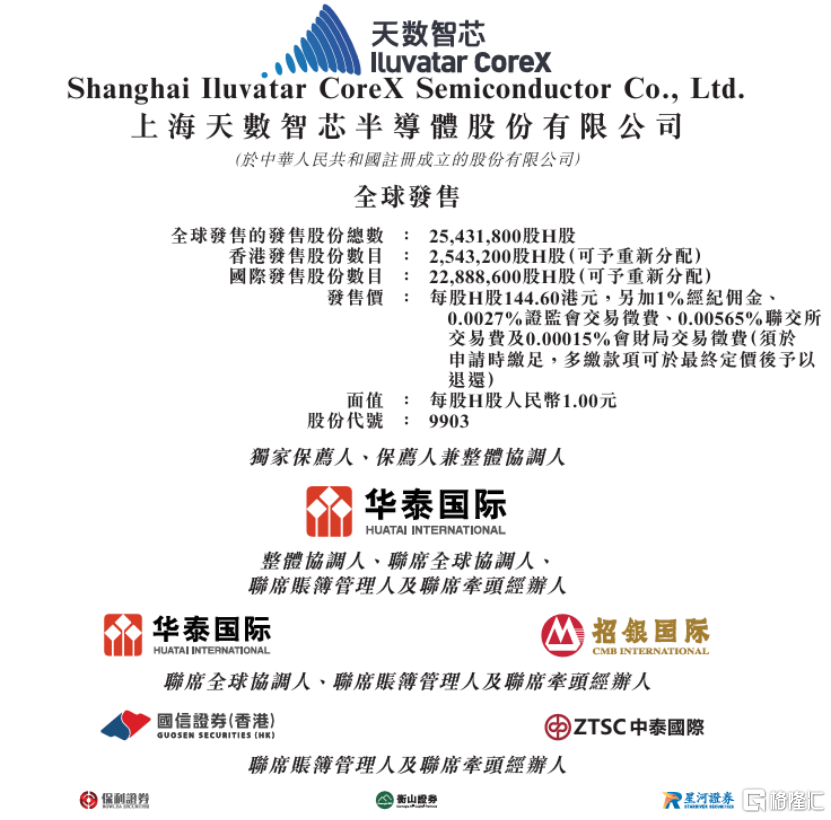
Core Viewpoint - The article highlights the excitement in the Hong Kong stock market surrounding the computing power sector, particularly focusing on the upcoming IPO of TianShu ZhiXin, a leading domestic GPU company, which is positioned as a key player in the Chinese AI landscape [1][4][21]. Company Overview - TianShu ZhiXin is set to debut on the Hong Kong stock market, boasting a cumulative shipment of 52,000 units and backing from 18 cornerstone investors, indicating strong market confidence [4]. - The company has shifted from merely telling a "technology story" to focusing on "certain profitability," aiming for a more pragmatic investment approach [4][5]. Market Positioning - TianShu ZhiXin has established itself as a critical provider of computing power for large model companies, emphasizing its role in the domestic GPU market without directly competing with international giants [7]. - The company achieved a rapid adaptation of its DeepSeek R1 model in just one day, setting a benchmark for efficiency in integrating domestic computing power with top-tier models [7]. Financial Performance - The Chinese general GPU market is projected to reach 154.6 billion yuan in 2024 and grow to 715.3 billion yuan by 2029, with domestic replacement rates expected to rise from 17.4% to over 50% [8]. - TianShu ZhiXin's revenue for the first half of 2025 is reported at 324 million yuan, surpassing its total revenue for 2023, showcasing its strong market traction [12]. Competitive Analysis - Compared to competitors like BiRan Technology, TianShu ZhiXin has a more favorable research and development expenditure to revenue ratio, indicating a healthier investment strategy [14]. - The company has diversified its customer base across 290 clients in various industries, reducing dependency on any single sector and mitigating risks associated with market fluctuations [15]. Investment Insights - The IPO pricing for TianShu ZhiXin is set at 144.60 HKD per share, with a total of 25.43 million shares available, and a balanced allocation for retail investors [10]. - The company is expected to benefit from the current market sentiment and the recent surge in interest in the computing power sector, particularly following the strong debut of BiRan Technology [21].
破茧2025|投资人的这一年,交出满意答卷
Sou Hu Cai Jing· 2025-12-31 10:41
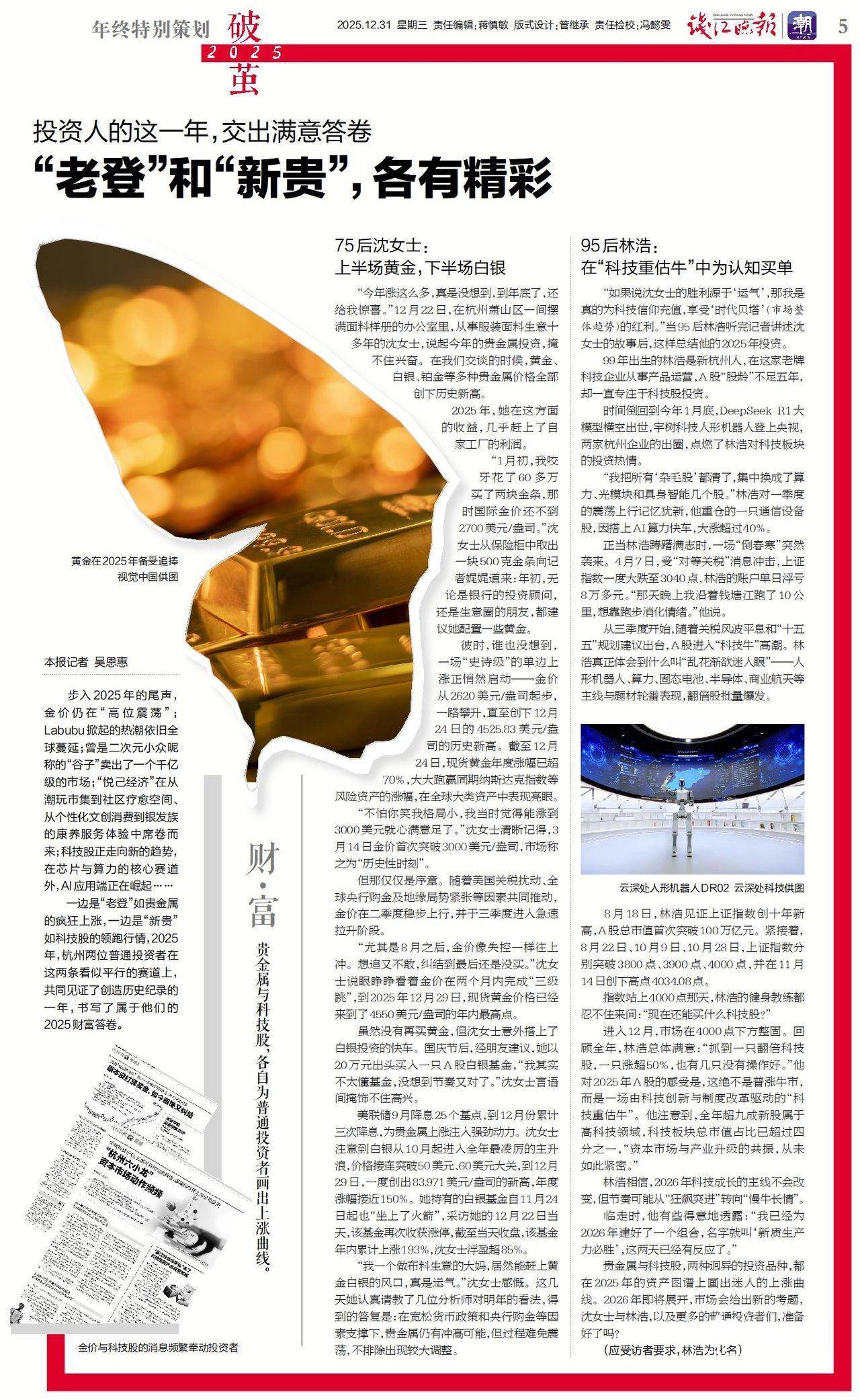
Group 1: Precious Metals Market - Gold prices have experienced a significant increase, reaching a historical high of $4,525.83 per ounce by December 24, 2025, marking an annual increase of over 70% [5][7] - Silver also saw substantial growth, with prices surpassing $72.7 per ounce, resulting in an annual increase of nearly 150% [7][8] - The rise in precious metals is attributed to factors such as U.S. tariff disruptions, global central bank gold purchases, and geopolitical tensions [7] Group 2: Technology Sector - The technology sector is undergoing a "revaluation bull market," driven by innovations in AI, computing power, and robotics, with significant stock price increases observed [10][12] - A notable surge in A-share technology stocks occurred, with the Shanghai Composite Index reaching a ten-year high and the total market capitalization of A-shares exceeding 100 trillion yuan [11][12] - Over 90% of new stocks in 2025 were in the high-tech sector, indicating a strong correlation between capital markets and industrial upgrades [12]
杭州女子年初咬牙砸60万买黄金,国庆后花20万买白银基金:踩中风口,真运气
Sou Hu Cai Jing· 2025-12-31 10:23
Group 1: Precious Metals Investment - In 2025, gold and silver prices reached historical highs, with gold rising from $2,620 per ounce to a peak of $4,525.83 per ounce, marking an annual increase of over 70% [4][6] - The surge in gold prices was driven by factors such as U.S. tariff disruptions, global central bank purchases, and geopolitical tensions, particularly accelerating in the second half of the year [6][7] - Silver also experienced significant growth, with prices reaching $83.971 per ounce by December 29, 2025, resulting in an annual increase of nearly 150% [6][7] Group 2: Technology Sector Investment - The technology sector saw a "revaluation bull market," with significant investments in AI and related technologies, leading to substantial gains for investors [8][11] - The A-share market experienced a surge, with the Shanghai Composite Index reaching a ten-year high and surpassing 100 trillion yuan in total market capitalization [10][11] - Over 90% of new stocks in 2025 were in the high-tech sector, indicating a strong correlation between capital markets and industrial upgrades [11]

“老登”和“新贵”,各有精彩
Sou Hu Cai Jing· 2025-12-31 00:40
Group 1: Precious Metals Investment - Gold prices have reached historical highs, with a significant increase from $2,620 per ounce at the beginning of the year to $4,525.83 per ounce by December 24, marking an annual increase of over 70% [11][12] - Silver also saw substantial gains, with prices rising from around $20 to a peak of $83.971 per ounce, resulting in an annual increase of nearly 150% [12] - The investment in precious metals has been driven by factors such as U.S. tariff disturbances, global central bank purchases, and geopolitical tensions [11] Group 2: Technology Sector Investment - The technology sector has experienced a "revaluation bull market," with significant interest in AI and related technologies, leading to substantial gains in stocks related to computing power and robotics [13][14] - The A-share market saw the total market capitalization exceed 100 trillion yuan, with the Shanghai Composite Index reaching new highs throughout the year [15] - Over 90% of new stocks in the market were in the high-tech sector, indicating a strong correlation between capital markets and industrial upgrades [15]

观网2025年中国十大科技新闻,“西方科学霸权不再无人挑战”
Guan Cha Zhe Wang· 2025-12-30 09:51
Core Insights - China's contribution to applied sciences reached a score of 22,261, accounting for 56% of global output, significantly surpassing the United States' 4,099 points at 10% [1] - The dominance of Chinese research institutions in the top thirty positions has raised global awareness and highlighted a shift in scientific leadership [1] Group 1: AI Developments - The release of the DeepSeek R1 model marks China's entry into the top tier of global AI, surpassing OpenAI in several authoritative tests and achieving the top position in app store rankings [2] - DeepSeek's open-source model and competitive pricing (1%-3.6% of competitors) have disrupted the global AI landscape, demonstrating China's capability to lead in AI innovation [4] Group 2: Drone Technology - The issuance of the first operational certificates for manned drones in China signifies the country's leadership in the low-altitude economy, opening up a trillion-level market [5] - The successful flight of the TP1000 unmanned transport aircraft represents a significant advancement in logistics capabilities, with a payload of 1,000 kg and a range of 1,000 km [14] Group 3: Space Exploration - The successful launch of the Tianwen-2 probe initiates China's first asteroid sampling mission, enhancing its deep space exploration capabilities [8] - The launch of the "Three-Body" satellite constellation establishes the world's first space computing network, aiming to revolutionize data processing methods [11] Group 4: Energy Research - The EAST nuclear fusion experiment achieved a record operation time of 1,066 seconds, marking a significant advancement in fusion energy research [17] - The successful operation of the Jiangmen neutrino experiment represents a major milestone in particle physics, aiming to uncover fundamental questions about the universe [25] Group 5: Space Safety and Infrastructure - The Shenzhou-22 spacecraft's readiness for emergency launch reflects the maturation of China's manned space safety system, enhancing astronaut safety during missions [28] - The completion of the second phase of the Meridian Project enhances China's capabilities in space environment monitoring, contributing to global space governance [19]
雷鸟X3 Pro入选《时代》2025最佳发明
Zheng Quan Shi Bao Wang· 2025-10-10 09:45
Core Insights - TIME magazine has released its list of the best inventions for 2025, highlighting breakthrough products from global tech companies including Apple, Huawei, BYD, DeepSeek, and Raybird Innovation [1][2] - Chinese companies have shown remarkable performance, with Huawei Pura80 Ultra leading in consumer electronics, BYD in electric vehicles, DeepSeek R1 model pushing AI advancements, and Raybird RayNeo X3 Pro recognized as a top AR product [1] Group 1 - Raybird RayNeo X3 Pro is the world's first mass-produced full-color etched waveguide AR glasses, featuring the smallest mass-produced full-color Micro-LED light engine and the first etched waveguide technology [1] - The product achieves industry leadership in 3D spatial display, screen brightness, and color reproduction, along with innovative Live AI interaction capabilities [1] - RayNeo X3 Pro has transitioned from a "large screen tool" to a "personal smart terminal" with the introduction of the RayNeo AR virtual machine [1] Group 2 - At the IFA 2025, Raybird Innovation won the IFA Innovation Award, further solidifying its status as a top global AR product [2] - In Q2 2025, Raybird Innovation captured a 39% share of the global AR glasses market, marking its first time at the top position [2] - The recognition from TIME magazine is expected to help promote "Chinese AR" to a wider audience [2]
AI诊疗之辩:“神助攻”还是“乌托邦”
Mei Ri Shang Bao· 2025-06-19 23:20
Core Viewpoint - AI technology is rapidly entering the healthcare sector, with diverse applications emerging, including surgical robots and digital health management, leading to a surge in AI-related news and discussions about its reliability and accountability [1] Group 1: AI in Healthcare Applications - The integration of DeepSeek R1 model into Zhejiang University Shao Yifu Hospital's health management platform allows for real-time health monitoring and personalized health risk assessments based on extensive medical data [2] - The "smart critical care" system developed by Zhejiang Hospital has recorded over 5,000 patient data entries and is capable of identifying infection risks up to 8 hours in advance, significantly improving treatment efficiency [3][4] Group 2: Limitations and Concerns of AI - AI cannot replace doctors in diagnosis or prescription, as it lacks the ability to engage in nuanced patient interactions and clinical judgment, which are crucial in complex medical cases [7][10] - There are concerns regarding the accuracy of AI-generated medical advice, with studies indicating that while some AI models achieve around 80% diagnostic accuracy, the remaining 20% error rate poses significant risks in healthcare [6][7] Group 3: Patient Interaction with AI - Many patients still prefer direct interaction with healthcare professionals over AI tools, particularly older patients who may struggle with technology [5][6] - Instances of AI systems generating prescriptions without thorough patient evaluations raise ethical and safety concerns, highlighting the need for stringent oversight in AI-assisted medical practices [9][10] Group 4: Regulatory and Ethical Considerations - The National Health Commission emphasizes that AI is a tool to assist healthcare professionals, and any errors should not be used as an excuse for inadequate medical practice [10] - The sensitive nature of medical data complicates the use of AI, necessitating careful management to protect patient privacy while leveraging AI capabilities [7][10]
汽车和汽车零部件行业周报20250615:车企承诺降低账期,整零关系走向双赢-20250615
Minsheng Securities· 2025-06-15 08:21
Investment Rating - The report maintains a positive investment rating for the automotive and automotive parts industry [5] Core Viewpoints - The automotive industry is transitioning from a zero-sum game to a win-win situation as multiple automakers commit to reducing payment terms to suppliers within 60 days, responding to government regulations and enhancing supply chain stability [2][10] - The report highlights the importance of intelligent and globalized breakthroughs in quality domestic automakers, recommending companies such as Geely, BYD, Li Auto, and Xpeng [12][4] - The upcoming Huawei Developer Conference is expected to catalyze advancements in embodied intelligence, with significant potential in hardware segments like dexterous hands and lightweight materials [3][11] Summary by Sections Weekly Perspective - Automakers are unifying payment terms to suppliers to enhance cash flow and supply chain stability, which may lead to the exit of financially weaker companies [2][10] - The report suggests focusing on quality domestic automakers that are accelerating in intelligence and globalization [12][4] Market Performance - The automotive sector underperformed the market, with a decline of 0.37% from June 9 to June 13, ranking 18th among sub-industries [27][29] Weekly Data - In the first week of June 2025, passenger car sales reached 362,000 units, a year-on-year increase of 12.4% but a month-on-month decrease of 22.3% [36][40] - New energy vehicle sales were 202,000 units, with a penetration rate of 55.7%, reflecting a 2.6 percentage point increase from the previous month [40] Key Companies - Recommended companies include Geely, BYD, Li Auto, Xpeng, and Xiaomi for passenger vehicles, and various suppliers in the new energy and intelligent driving sectors [4][15]


CGI宏观视点 | 从规模不经济到规模新经济
中金点睛· 2025-04-01 23:34
Core Viewpoint - China's green industry is leading globally, with recent breakthroughs in AI prompting a reevaluation of its innovation capabilities, while weak demand remains a significant economic challenge [3][5]. Group 1: Economic Growth Dynamics - The contrast between strong supply and weak demand in China's economy highlights the importance of economies of scale, which can drive innovation and efficiency [5][6]. - The transition from scale inefficiency to a new scale economy is characterized by the growth of green and digital economies, which lower unit costs through large-scale production [3][4]. - Challenges to realizing economies of scale include internal factors like the adjustment of the financial cycle and external pressures from geopolitical tensions, particularly with the U.S. [3][4][5]. Group 2: Green Industry Development - China's green industry has achieved significant scale, with solar panel production capacity accounting for approximately 80% of the global market and nearly 60% of the global market for new energy passenger vehicles in 2023 [13][15]. - The success of the green industry is attributed to economies of scale and government policies that correct externalities, facilitating a shift from fossil fuels to competitive manufacturing [15][16]. - The need for public policy intervention arises from the negative externalities associated with fossil fuels and the positive externalities of green energy innovation, necessitating support for research and development [16][17]. Group 3: AI and Digital Economy - The recent emergence of the DeepSeek AI model illustrates the potential for innovation in China's digital economy, emphasizing the interplay between scaling laws and economies of scale [19][20]. - The scaling laws suggest that increasing model parameters and computational resources can enhance AI performance, but the marginal returns diminish, necessitating algorithmic advancements [20][21]. - China's comparative advantage in AI lies in its large talent pool and application scenarios, positioning it well for algorithmic innovation despite U.S. restrictions on computational resources [21][22]. Group 4: Geopolitical Economic Challenges - The G2 model of innovation, where the U.S. focuses on technological innovation and China on industrial innovation, is under threat from geopolitical tensions, impacting both supply and demand dynamics [25][26]. - China's role as the largest manufacturing hub faces challenges from protectionist measures, which could suppress demand for its green industry products [27][28]. - The transition from scale inefficiency to a new scale economy requires a focus on market mechanisms and government interventions to optimize resource allocation [28][29]. Group 5: Policy Recommendations - To address weak demand, macroeconomic policies should shift towards fiscal expansion targeting household sectors, enhancing social security systems to stimulate consumption [33][35]. - The government should prioritize demand-side policies, including reducing taxes and increasing transfer payments to improve disposable income for lower-income groups [35][36]. - Emphasizing investment in human capital and social welfare can enhance long-term economic growth and innovation, aligning with the need for a shift from supply-side to demand-side focus [36][38].