NYMEX原油期货

Search documents
国际油价一夜暴跌!油气股集体走低,多股跌停
第一财经· 2026-03-10 05:44
Core Viewpoint - The article discusses the significant decline in the oil and gas sector in the A-share market, primarily influenced by geopolitical tensions and market reactions to statements made by U.S. President Trump regarding oil sanctions and potential releases from strategic reserves by the G7 countries [5][6]. Group 1: Market Reaction - A large number of oil and gas stocks opened lower, with several hitting the daily limit down, including companies like Zhongjie Oil and Shandong Molong [3][4]. - The international oil prices experienced a drastic drop, with Brent crude and NYMEX crude futures falling by 10% in a single trading session [5]. Group 2: Geopolitical Influences - Trump's announcement to lift some oil-related sanctions aims to stabilize oil prices amid market turmoil caused by U.S. and Israeli actions against Iran [5]. - The International Energy Agency (IEA) indicated that G7 discussions included the possibility of releasing emergency oil reserves, with member countries holding over 1.2 billion barrels in reserves [6]. Group 3: Supply Chain Concerns - The core trading focus for oil currently revolves around Middle Eastern geopolitical risks, with analysts suggesting that prolonged conflicts could significantly impact oil supply and prices [7]. - The Strait of Hormuz, a critical passage for oil exports, sees an average daily flow of 19.47 million barrels, accounting for about 20% of global oil consumption [9]. Group 4: Production Adjustments - Iraq and Kuwait have begun preventive production cuts due to storage capacity issues, with a total expected reduction of 3.3 million barrels per day [10]. - The speed and difficulty of resuming production after cuts can vary significantly based on the reasons for the shutdown, which adds to the uncertainty of supply recovery [10]. Group 5: Future Market Outlook - Goldman Sachs projected a significant oversupply pressure in the global oil and gas market by 2026, although current geopolitical factors may lead to price volatility that overshadows fundamental analysis [11].






油气股现跌停潮,港股山东墨龙跌近20%,集运指数大跌14%
21世纪经济报道· 2026-03-10 02:05
Market Overview - A-shares and Hong Kong stocks opened higher on March 10, with the Shanghai Composite Index rising by 0.31% and the ChiNext Index increasing by 2.51% [1] - The Hang Seng Index opened up by 1.6%, while the Hang Seng Tech Index rose by 1.69% [1] Sector Performance - The A-share computing hardware industry chain rebounded, with CPO and memory sectors leading the gains [1] - Cloud computing and computing leasing themes were actively traded, while semiconductor, AI applications, humanoid robots, and lithium mining stocks saw significant increases [1] - Shipping stocks experienced a low opening but rallied, with China Merchants Energy hitting the daily limit, COSCO Shipping Energy approaching the limit, and China Merchants South Oil rising over 6% [1] Declines in Oil and Gas Sector - The oil and gas sector faced a significant downturn, with the "Big Three" oil companies collectively dropping over 6% [1] - Specific stocks like Continental Oil and Shandong Molong hit the daily limit down, while others like Keli Co., Tress, and Potential Holdings opened down over 10% [1] - In the Hong Kong market, oil and gas equipment stocks also fell, with Shandong Molong dropping nearly 20%, despite having risen over 170% this year [1] Commodity Market Movements - Brent crude and NYMEX crude futures saw a sharp decline of 10% during trading, influenced by Trump's statement regarding military actions against Iran [3] - Domestic commodity futures mostly fell, with shipping futures leading the decline, and the shipping index (European line) dropping over 14% [3] - Energy products experienced a downturn, with crude oil prices falling over 13% [3] Notable Company Announcements - Contemporary Amperex Technology Co., Ltd. (CATL) announced projected revenues of 423.70 billion yuan for 2025, representing a year-on-year growth of 17.04%, and a net profit of 72.20 billion yuan, up 42.28% year-on-year [3]

地缘局势与商品周期共振 国际油价中期有望延续强势
Zhong Guo Zheng Quan Bao· 2026-02-25 22:34
Core Viewpoint - International crude oil prices have continued their strong performance since the Spring Festival, with Brent crude futures experiencing the highest increase in 13 years during this period, driven primarily by geopolitical tensions rather than supply-demand fundamentals [1][2]. Geopolitical Factors - The rise in international oil prices is significantly supported by geopolitical tensions, particularly the ongoing situation between the U.S. and Iran, which has raised concerns about potential military conflict and supply risks [2][5]. - Analysts suggest that the geopolitical premium in the oil market is currently around $1, which could increase to $4-$5 if tensions escalate further [3][8]. Supply-Demand Dynamics - Despite a shift in the global oil market towards oversupply, with an estimated surplus of 1.5 to 2 million barrels per day expected as OPEC+ begins to increase production in 2025, the current price trends are largely influenced by geopolitical factors rather than fundamental supply-demand metrics [2][4]. - Historical data indicates that while there have been more years of price declines post-Spring Festival, the magnitude of price increases during those years has been significantly higher, suggesting a favorable risk-reward ratio for potential price increases in the near term [4][5]. Market Predictions - Short-term predictions indicate that if the U.S. and Iran reach an agreement, oil prices may face downward pressure, potentially reversing gains made during the Spring Festival. Conversely, if tensions escalate, prices could remain elevated, with Brent crude expected to trade between $70 and $75 per barrel [8]. - In the medium to long term, analysts project that oil prices could rise to the range of $75 to $80 per barrel by 2026, supported by bullish market expectations and geopolitical premiums [8].
地缘局势与商品周期共振国际油价中期有望延续强势
Zhong Guo Zheng Quan Bao· 2026-02-25 20:22
Core Viewpoint - International crude oil prices have continued their strong performance since the Spring Festival, with Brent crude futures experiencing the highest increase in 13 years during this period, driven primarily by geopolitical tensions rather than supply-demand fundamentals [1][2]. Geopolitical Influence - The current rise in international oil prices has diverged from the oversupply fundamentals, with geopolitical factors, particularly the U.S.-Iran situation, becoming the main influence [2][3]. - Analysts suggest that the geopolitical risk premium in the oil market is currently around $1, which could rise to $4-$5 if tensions escalate, while a de-escalation could lead to a rapid price drop [2]. Historical Trends Post-Spring Festival - Historical data from 2013 to 2025 indicates that oil prices tend to have a higher potential for increase in the month following the Spring Festival, with an average increase of approximately 10.96% during the years when prices rose [2][3]. - Despite more years of price declines, the magnitude of increases in rising years significantly outweighs the declines, suggesting a favorable risk-reward ratio for price increases post-holiday [2]. Factors Affecting Oil Prices - Key supportive factors for oil prices include geopolitical uncertainties and U.S. sanctions on oil-producing countries, while global economic weakness and ongoing oversupply remain as negative factors [3]. - Historical events have shown that significant geopolitical events have a greater impact on oil prices than conventional supply-demand dynamics [3]. Commodity Cycle and Oil Price Outlook - The current global commodity cycle, characterized by rising prices in precious and industrial metals, is expected to provide upward momentum for oil prices [4][5]. - The analysis indicates that the transmission of price increases from precious metals to industrial metals and then to oil is effective, driven by liquidity improvements and economic recovery [4][5]. - Despite the unique characteristics of the current cycle, two main supportive factors for oil prices are identified: bullish market expectations and geopolitical risk premiums [5]. Short-term and Long-term Predictions - In the short term, geopolitical factors are expected to strongly influence oil prices, with potential fluctuations based on developments in U.S.-Iran relations [5]. - In the long term, historical trends suggest that oil prices may rise to the range of $75 to $80 per barrel by 2026, supported by bullish market sentiment and geopolitical risk premiums [5].
欧洲股市,集体上涨!黄金、白银反弹
Sou Hu Cai Jing· 2026-02-18 14:12
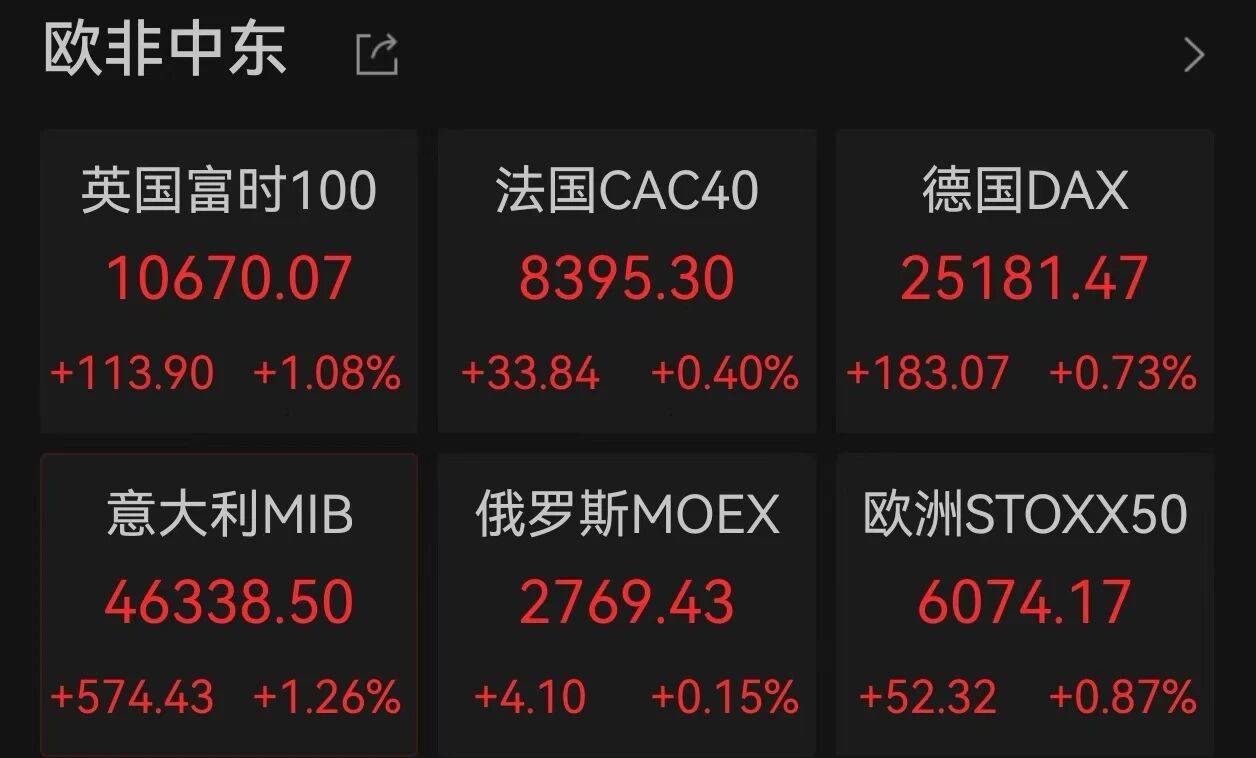
Group 1: European Stock Market Performance - European stock markets experienced a broad rally on February 18, with multiple indices reaching or approaching historical highs. The UK FTSE 100 index rose over 1% and hit a record high, while the French CAC40, German DAX, and Euro Stoxx 50 indices increased by 0.4%, 0.73%, and 0.87% respectively, nearing their historical peaks [1][3]. - The Italian MIB index also saw a significant increase, rising over 1% [3]. Group 2: Commodity Market Trends - The international precious metals market saw a collective rebound, with COMEX gold futures and London gold spot prices increasing by 0.77% and 1.13%, reaching $4943.6 per ounce and $4931.611 per ounce respectively [5]. - Silver prices showed even more pronounced gains, with COMEX silver futures and London silver spot prices rising by 2.69% and 2.8%, priced at $75.52 per ounce and $75.548 per ounce respectively [5][6]. - In the energy sector, both NYMEX crude oil and ICE Brent crude oil futures rose by over 2%, with NYMEX approaching $64 per barrel and ICE nearing $70 per barrel [5].
美股收盘:纳指尾盘跳水,道指刷新历史新高!中概股逆势四连涨,黄金白银高位震荡
Jin Rong Jie· 2026-02-10 23:57
Market Overview - The U.S. stock market exhibited significant divergence on February 10, with the Dow Jones Industrial Average reaching a historical high of 50,512.79 points during intraday trading, while the Nasdaq and S&P 500 indices turned negative, closing down by 0.59% and 0.33% respectively [1] - Major technology stocks such as Microsoft, Apple, Nvidia, Amazon, and META experienced declines, contributing to the overall market downturn, while Tesla saw an increase of nearly 2% [1] - In contrast, Chinese concept stocks showed strong performance, with the Nasdaq China Golden Dragon Index rising nearly 1% for four consecutive trading days [1] Commodity Market - In the international precious metals market, gold and silver prices continued to show weak fluctuations, with COMEX gold futures and London spot gold prices reporting slight declines of 0.6% and 0.71% respectively [2] - Silver prices experienced more volatility, with COMEX silver futures dropping over 2% and London silver spot prices falling more than 3% [2] - In the oil market, NYMEX and ICE Brent crude futures also saw minor declines, with prices at $64.19 per barrel and $69.01 per barrel respectively, indicating a shift from event-driven pricing to fundamental trading [2] Geopolitical Risks - Geopolitical uncertainties have added volatility to the market, particularly following statements from U.S. President Trump regarding potential military actions against Iran if negotiations fail [3] - The presence of the USS Abraham Lincoln carrier strike group in the region raises the possibility of military engagement within a short timeframe if ordered by the White House [3]
美科技股上涨 白银再创新高!
Zhong Guo Zheng Quan Bao· 2025-12-20 00:23
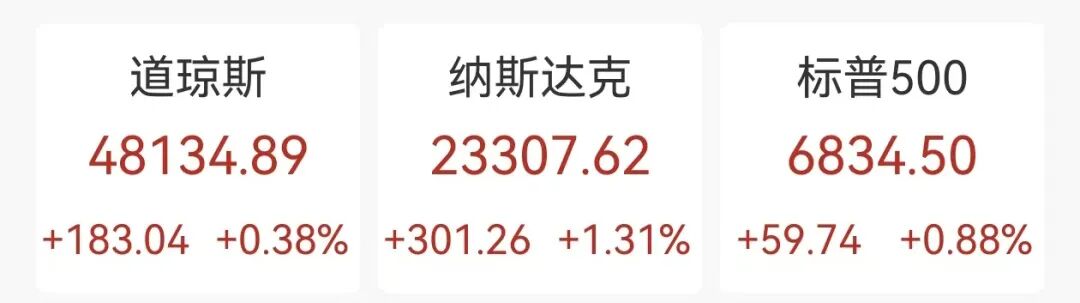
Market Performance - On December 19, US stock indices collectively rose, with technology stocks leading the gains. The Dow Jones increased by 183.04 points (0.38%) to 48,134.89, the Nasdaq rose by 301.26 points (1.31%) to 23,307.62, and the S&P 500 gained 59.74 points (0.88%) to 6,834.50 [1] Technology Sector Highlights - Major technology stocks saw significant increases: Nvidia rose by 3.93%, Google by 1.6%, Apple by 0.54%, Microsoft by 0.40%, and Amazon by 0.26%. Additionally, AMD surged by 6.15%, TSMC increased by 1.47%, and Broadcom rose by 3.18% [5][6] - Bernstein noted that Nvidia's valuation relative to the Philadelphia Semiconductor Index is attractively priced, currently at a 13% discount, which is in the historical first percentile [6] Company-Specific Developments - Oracle experienced a rebound, increasing by 6.87%, despite previous reports of setbacks in its AI infrastructure expansion plans. Oracle stated that negotiations for a $10 billion data center project are proceeding as planned [7] - Micron Technology continued its upward trend, rising by 6.99%. Its latest earnings report for Q1 FY2026 showed revenue of $13.64 billion, a 57% year-over-year increase, significantly surpassing analyst expectations of $12.95 billion. Adjusted net income was $5.482 billion, a 58% increase, with earnings per share at $4.78, exceeding the forecast of $3.95 [8]
美科技股上涨,白银再创新高!
Xin Lang Cai Jing· 2025-12-20 00:23
Market Performance - On December 19, US stock indices collectively rose, with technology stocks leading the gains. The Dow Jones increased by 183.04 points (0.38%) to 48,134.89, the Nasdaq rose by 301.26 points (1.31%) to 23,307.62, and the S&P 500 gained 59.74 points (0.88%) to 6,834.50 [1] - Notable technology stocks included Nvidia, which rose by 3.93%, Google by 1.6%, Apple by 0.54%, Microsoft by 0.40%, and Amazon by 0.26%. AMD saw a significant increase of 6.15%, while TSMC and Broadcom rose by 1.47% and 3.18%, respectively [2] Company Highlights - Nvidia's valuation is currently attractive, trading at a 13% discount relative to the Philadelphia Semiconductor Index, a rare occurrence in its history [3] - Oracle experienced a rebound, increasing by 6.87%, despite previous reports of setbacks in its AI infrastructure expansion plans. Oracle clarified that negotiations for a $10 billion data center project are proceeding as planned [4][5] - Micron Technology continued its upward trend, rising by 6.99%. Its latest earnings report for Q1 FY2026 showed revenue of $13.64 billion, a 57% increase year-over-year, significantly exceeding analyst expectations [5] Commodity Market - On December 19, COMEX silver futures rose by 3.34%, reaching a record high of $67.395 per ounce. Additionally, NYMEX crude oil futures closed at $56.54 per barrel, up 0.96%, while ICE Brent crude futures increased by 1.04% to $60.12 per barrel [5]
25个基点!美联储降息
Zhong Guo Zheng Quan Bao· 2025-10-29 22:30
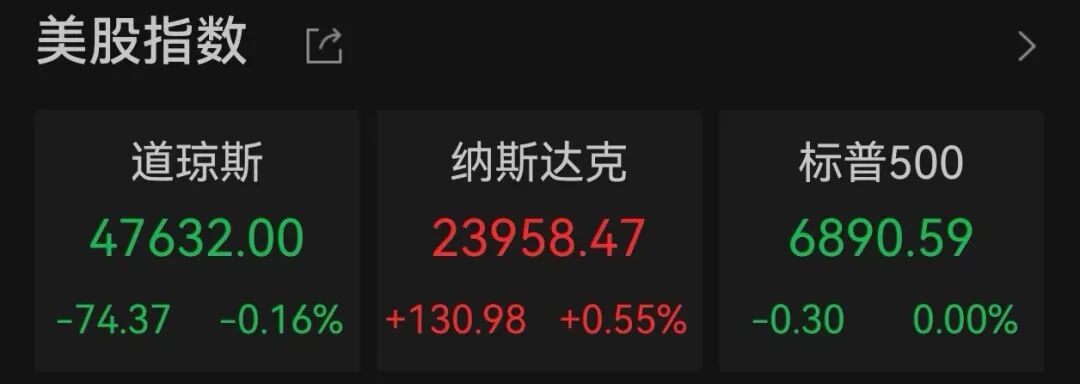
Group 1 - The Federal Reserve has lowered the federal funds rate target range by 25 basis points to 3.75%-4%, marking the second rate cut of the year, totaling a 50 basis point reduction [1][3] - The Federal Open Market Committee (FOMC) will end the balance sheet reduction starting December 1 and will continue to monitor economic indicators for potential adjustments to monetary policy [2][3] - There is a notable division within the FOMC, with some members advocating for a larger rate cut of 50 basis points, indicating increasing internal disagreements [4][5] Group 2 - Major U.S. stock indices showed mixed performance after reaching new highs, reflecting cautious market sentiment regarding the Fed's future rate cuts [6][8] - Nvidia's market capitalization has surpassed $5 trillion, making it the first company to achieve this milestone, while other tech giants also saw gains [6][8] - The Nasdaq China Golden Dragon Index experienced fluctuations, with individual Chinese stocks showing varied performance [8] Group 3 - International gold prices have declined, while oil prices have seen a slight increase, indicating a divergence in commodity market trends [9][10] - Analysts suggest that gold prices may continue to experience high volatility due to a combination of reduced risk appetite and speculative sentiment [10] - Oil prices are expected to remain under pressure due to the nearing end of the Northern Hemisphere's consumption peak and OPEC+ production increases [11]
美欧“动手”,国际原油狂飙!后市怎么看?
券商中国· 2025-10-23 15:09
Core Viewpoint - The recent sanctions imposed by the U.S. Treasury on Russian oil companies Rosneft and Lukoil, along with the EU's 19th round of sanctions against Russia, have heightened concerns over potential disruptions in Russian oil supply, leading to significant increases in international oil prices [1][2][4]. Group 1: Sanctions and Market Reactions - The U.S. sanctions now encompass all four major Russian oil companies, with Rosneft and Lukoil being the latest targets, which could impact nearly half of Russia's oil exports, approximately 2.2 million barrels per day in the first half of this year [1][4]. - Following the announcement, international oil prices surged, with Shanghai crude futures closing up over 4% and NYMEX crude futures rising more than 5.8% [2][4]. - The sanctions are expected to reduce India's purchases of Russian oil, as India currently sources over 36% of its crude imports from Russia [4]. Group 2: Supply and Demand Dynamics - The global oil market is currently characterized by an oversupply situation, with OPEC+ gradually increasing production and major oil-exporting countries maintaining high export levels [5][6]. - The International Energy Agency (IEA) has consistently downgraded global oil demand growth forecasts due to expectations of a slowing global economy [5]. - Recent market indicators, such as the WTI crude futures structure showing a shift to a contango state, suggest increasing concerns over supply excess [5]. Group 3: Price Forecasts and Market Outlook - Despite the recent sanctions potentially causing short-term volatility in oil prices, the overall oversupply situation is expected to limit sustained price increases, with Brent crude projected to remain in the $60 to $70 per barrel range [5][6]. - Goldman Sachs anticipates further declines in Brent crude prices, potentially reaching $52 per barrel by the fourth quarter of next year [5]. - The long-term outlook suggests that geopolitical risks may diminish, allowing market fundamentals to regain dominance, with OPEC+ shifting towards a strategy of increasing production to maintain market share [6].