Guan Cha Zhe Wang

Search documents
企业生产销售“儿童色情特征”情趣娃娃,当地通报:已要求其停产
Guan Cha Zhe Wang· 2025-12-03 11:47
Core Viewpoint - The Huizhou market supervision authority has initiated an investigation into a local company suspected of producing and selling "sex dolls" with child-like features, leading to an immediate suspension of production and a broader crackdown on similar enterprises in the region [1][2]. Group 1: Investigation and Regulatory Actions - The Huizhou market supervision bureau, in collaboration with police and health departments, formed a joint investigation team to address the issue of the company allegedly producing and selling dolls with child pornography characteristics [2]. - The investigation has resulted in the immediate suspension of the company's production activities while the inquiry is ongoing [2]. - A special inspection will be conducted across the Huizhou area to enhance regulation of such enterprises [2]. Group 2: Product Characteristics and Market Presence - Investigations revealed that various e-commerce platforms listed products labeled as "child-like dolls," which are actually silicone or TPE products designed for adult use, with heights ranging from 70 cm to 140 cm [3]. - These products, marketed under terms like "BJD figures" and "anime dolls," are equipped with sexual functions and are priced from several hundred to over a thousand yuan [3]. - Local factories in Dongguan and Huizhou were found to produce dolls with "child pornography characteristics," offering customization options and various adult-oriented features [3]. Group 3: Social Implications - The emergence of these products has raised concerns among child protection advocates, who argue that it undermines societal norms and the consensus on protecting children from sexual exploitation [3]. - Multiple e-commerce platforms have begun to take action by removing listings of "child-like sex dolls" in response to the growing scrutiny [4].
涉内幕交易,贵州百灵实控人姜伟被立案
Guan Cha Zhe Wang· 2025-12-03 10:40
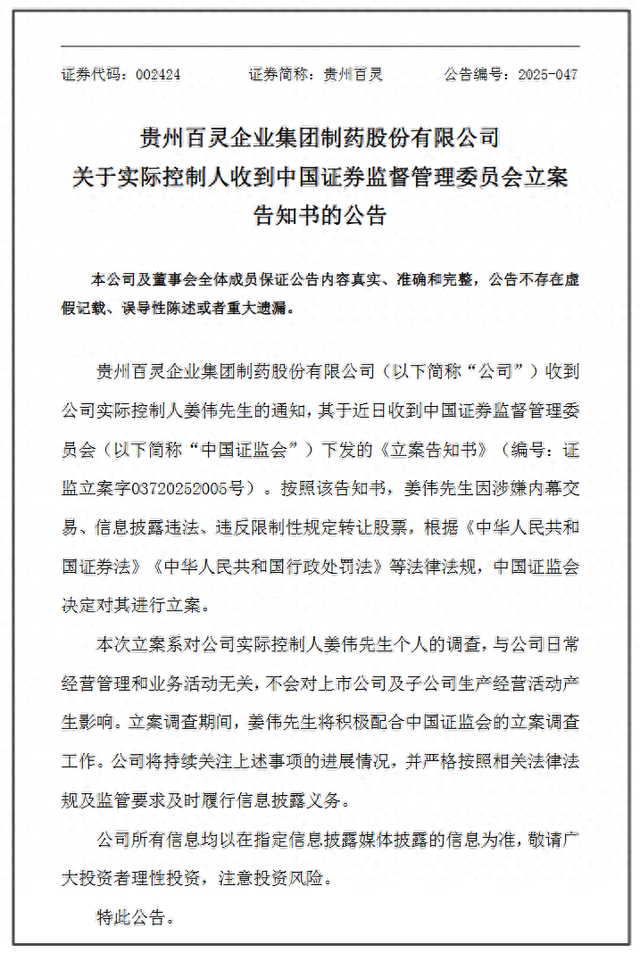
Core Viewpoint - Guizhou Bailing announced that its actual controller, Jiang Wei, is under investigation by the China Securities Regulatory Commission (CSRC) for insider trading and information disclosure violations, which is unrelated to the company's operations and will not impact its business activities [1][4]. Company Overview - Guizhou Bailing is engaged in the research, production, and sales of traditional Chinese medicine, with a registered capital of 1.4112 billion yuan and total assets of 7.059 billion yuan. The company was listed on the Shenzhen Stock Exchange in June 2010 and aims to strengthen its position in the traditional Chinese medicine sector [4][3]. Financial Performance - For the first three quarters of 2025, Guizhou Bailing reported revenue of 2.102 billion yuan, a year-on-year decrease of 24.28%, and a net profit attributable to shareholders of 57 million yuan, down 35.60% year-on-year [5]. - The company experienced a significant decline in revenue and net profit in the first half of 2025, with revenue of 1.462 billion yuan, a decrease of 31.77%, and a net profit of 52 million yuan, down 40.73% year-on-year. The decline in revenue from traditional Chinese medicine products, which account for over 80% of total revenue, was particularly notable, with a year-on-year decrease of 37.07% [4][5]. - Despite a year-on-year increase in revenue and net profit in the third quarter, the overall performance for the first three quarters remained significantly lower due to poor results in the first half of the year [4].


八年“联姻”走到十字路口,雀巢或剥离蓝瓶咖啡
Guan Cha Zhe Wang· 2025-12-03 10:29
Core Viewpoint - Nestlé is collaborating with JPMorgan to conduct a strategic assessment of its premium coffee brand, Blue Bottle Coffee, with the potential sale of the brand being a central topic of discussion [1] Group 1: Company Background - Blue Bottle Coffee, founded in 2002 by James Freeman, emerged from a desire for fresher coffee and quickly gained popularity, leading to its first physical store opening in San Francisco in 2005 [3] - The brand is known for its strict quality control and minimalist aesthetic, which has drawn comparisons to Apple in the coffee industry, attracting the attention of Nestlé [3] Group 2: Acquisition and Performance - In September 2017, Nestlé acquired a 68% stake in Blue Bottle Coffee for $500 million, valuing the company at over $700 million at that time [5] - Following the acquisition, Blue Bottle Coffee was expected to maintain operational independence while expanding its store count from 29 to 55 by the end of 2017 [5] - Despite initial optimism, Blue Bottle Coffee has not achieved the anticipated growth, with only about 140 stores globally as of August this year, indicating slow expansion [5] Group 3: Market Challenges - The trajectory of Blue Bottle Coffee in the Chinese market exemplifies its challenges, where initial excitement has waned, and competition from local brands has intensified [7] - The brand's first store in mainland China opened in February 2022, generating significant initial interest, but has since struggled to maintain customer traffic [7] Group 4: Strategic Review and Future Outlook - The potential sale of Blue Bottle Coffee is part of a broader strategic review under Nestlé's new CEO, aimed at simplifying the company's business portfolio and moving away from capital-intensive retail operations [11] - The estimated valuation for the potential sale of Blue Bottle Coffee is expected to be lower than the $700 million valuation at the time of acquisition, with a possibility of separating the brand from its physical café operations [11] - The future of Blue Bottle Coffee remains uncertain, marking a significant turning point in its eight-year relationship with Nestlé [11]


安踏动刀狼爪渠道:小红书旗舰店将于年底关闭
Guan Cha Zhe Wang· 2025-12-03 08:21
(文/霍东阳 编辑/吕栋) 12月2日,德国户外品牌狼爪(Jack Wolfskin)在其小红书旗舰店发布闭店通知,宣布"因公司运营策略调整",该店将于2025年12月31日正式结束运营。公 告称,店铺即日起进入运营收尾阶段,将逐步停止销售功能,但已生成的订单将继续提供完整售后服务至年底。 无时尚中文网创始人唐小唐曾向观察者网表示,中国户外运动的市场的增长仍旧是确定的,"安踏集团收购狼爪的原因还是因为对户外赛道的看好,但相对 而言,中端市场的发展前景远不及高端品牌甚至一些初创品牌。" 这一时点距离安踏体育以2.9亿美元全资收购狼爪仅过去半年多,也是曾任亚玛芬体育大中华区总裁的姚剑调任狼爪品牌总裁的第五个月。这一系列紧密关 联的动作,显示出安踏正加速对狼爪的整合与重塑。 值得注意的是,狼爪仅在小红书平台发布了闭店通知,其他平台均未发布类似信息。而在发布闭店公告后,狼爪小红书账号又发布了一篇偏重内容营销的帖 子,这一细节或许暗示了品牌未来在该平台的运营方向。 对关闭小红书旗舰店,有很多评论认为这可能是源于安踏收购后对产品线和销售渠道的重新整合。 还有业内人士分析称,就公告内容而言,不排除此前狼爪的小红书有单独的运 ...


不满债券本息全展期,部分万科债权人反对推迟偿付
Guan Cha Zhe Wang· 2025-12-03 08:09
Core Viewpoint - Vanke is facing significant pushback from bondholders regarding its proposal to extend the repayment of the "22 Vanke MTN004" bond, which has a balance of 2 billion yuan and was originally due on December 15, 2025 [1][2] Group 1: Bond Extension Proposal - Vanke proposed to extend the repayment of the "22 Vanke MTN004" bond by 12 months, moving the repayment date to December 15, 2026, due to severe operational challenges [1][2] - The interest rate for the bond remains unchanged at 3%, but bondholders expressed dissatisfaction with the lack of upfront interest payments during the extension period [1][3] - Comparatively, another developer, Oceanwide, offered a more favorable repayment structure for a similar bond, allowing for partial principal repayments and upfront interest payments, which has heightened bondholders' discontent with Vanke's proposal [2][3] Group 2: Debt Obligations and Market Impact - Vanke has additional debt obligations, including 3.7 billion yuan of the "22 Vanke MTN005" bond due on December 28, 2025, and faces a peak repayment period with over 12 billion yuan of domestic debt maturing in 2026 [4] - As of November 27, 2025, Vanke has a total of 15 outstanding bonds with a combined balance of approximately 20.316 billion yuan, with a significant portion maturing before 2026 [4] - The handling of Vanke's debt situation is critical for the broader real estate market, as mismanagement could negatively impact market sentiment and the capital market due to Vanke's size and interconnectedness with various stakeholders [4]


首次赎回一座万达广场,万达债务“解套”了?
Guan Cha Zhe Wang· 2025-12-03 07:20
Core Insights - Wanda has initiated a core asset buyback, marking a significant shift from its previous asset disposal strategy [1][2] - The buyback involves the redemption of Yantai Zhifu Wanda Plaza, with Wanda's subsidiary, Wanda Ruichi, becoming the sole shareholder [1] - The company has significantly reduced its debt pressure through asset sales, with domestic debts cleared and only one overseas bond remaining [2] Group 1: Asset Transactions - Wanda's asset buyback is part of a broader strategy to recover funds and reduce liabilities, transitioning from a heavy asset model to a lighter one [1][2] - The company has engaged in multiple transactions with Kunhua, which is backed by New China Life Insurance and CICC Capital, facilitating the management of a 10 billion yuan real estate fund [2][3] - Since its establishment, Kunhua has acquired nine Wanda Plazas from Wanda, with a total subscribed capital exceeding 3 billion yuan [3] Group 2: Strategic Implications - The transactions between Wanda and Kunhua resemble a "strategic borrowing," allowing Wanda to quickly recover funds while retaining operational control over the assets [4] - This approach enables Wanda to alleviate financial pressure while maintaining business continuity and stability [4] - Industry experts speculate that if Wanda continues to redeem more Wanda Plazas, it would indicate a recovery from its financial difficulties [4]
朱雀三号验证的每一项技术,都是在给我国的商业航天探路
Guan Cha Zhe Wang· 2025-12-03 06:45
Core Viewpoint - The successful launch of the Zhuque-3 rocket by Blue Arrow Aerospace marks a significant step towards reusable rocket technology in China's commercial space sector, despite the failure of the first-stage rocket recovery [1][3]. Group 1: Launch Details - Zhuque-3 is China's first large liquid launch vehicle designed for reusability, with a total length of 76.6 meters and a payload capacity of 21.3 tons to low Earth orbit [3]. - The rocket's first-stage recovery was unsuccessful due to an anomaly during the landing phase, although the primary mission of delivering the payload to the designated orbit was achieved [1][3]. - The launch was initially scheduled for November 29 but was postponed to December 3 due to unspecified reasons [3]. Group 2: Technical Specifications - Zhuque-3 utilizes Blue Arrow's self-developed Tianque series liquid oxygen-methane engines, with the first stage powered by nine TQ-12B engines and the second stage by one TQ-15B vacuum engine [3]. - The rocket is designed for a minimum of 20 reuse cycles for its first stage, aiming to significantly reduce launch costs [3][19]. Group 3: Industry Insights - The launch is seen as a critical milestone in validating the future development path of the commercial space industry in China, particularly in the context of reusable rocket technology [4][5]. - The use of liquid oxygen-methane as fuel is highlighted for its cleanliness and low maintenance costs, which are essential for achieving operational efficiency in space transportation [17][19]. - The current gap between satellite launch demand and capacity in China is significant, with an estimated annual demand of 1500 to 2000 tons, indicating a strong market need for rockets like Zhuque-3 [20]. Group 4: Market Position and Future Prospects - Zhuque-3 is positioned as a competitive player in the global reusable rocket market, with its development reflecting a shift towards lower-cost, high-frequency access to space [9][11]. - The commercial space sector in China is expected to evolve with a focus on practical applications and market needs, particularly in low Earth orbit satellite constellations [22][24]. - The potential for cost reductions of 80%-90% through reusability and innovative materials like stainless steel is emphasized, transforming the economics of space launches [19][13].

中国平板季度出货:华为占比31%甩开苹果,联想增长71%
Guan Cha Zhe Wang· 2025-12-03 06:28
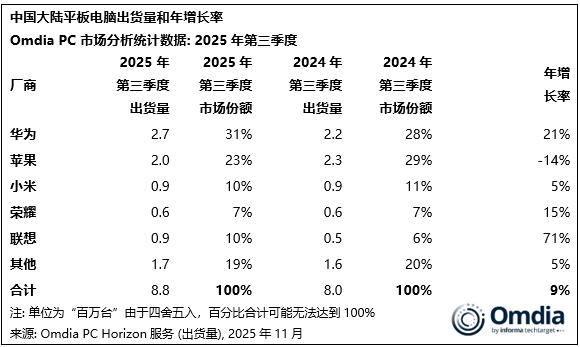
Group 1: Tablet Market Overview - The Chinese tablet market continues to show strong momentum, with Q3 2025 shipments increasing by 9% year-on-year to 8.8 million units, characterized by a split between domestic brands leading and Apple declining [1] - Huawei leads the market with a shipment of 2.7 million units and a 31% market share, growing 21% year-on-year, while Apple's iPad shipments fell 14% to 2 million units, reducing its market share from 29% to 23% [1] - Domestic manufacturers collectively hold 77% of the market share, up 5 percentage points from the previous year, with Xiaomi and Lenovo each shipping 900,000 units and Honor at 600,000 units [1] Group 2: Challenges for Apple - Apple's iPad faces multiple challenges in the domestic market, including competition from local tablets priced between 2,000-3,000 yuan that offer superior specifications [1] - The lack of product innovation and extended iteration cycles for the iPad, despite the strong performance of the M chip, make it difficult to compete with localized innovations from Huawei and Lenovo [1] Group 3: Future Market Projections - Omdia forecasts that the tablet market will grow by 12% to 35 million units by the end of 2025, driven by aggressive product launches and pricing strategies from domestic manufacturers [2] - However, a market adjustment is expected in 2026, with a projected decline of 9% to 32 million units [2] Group 4: PC Market Overview - In Q3 2025, the Chinese PC market saw a 2% year-on-year increase in shipments, reaching 11.3 million units, with desktop shipments growing by 8% to 3.3 million units, primarily driven by strong demand in the commercial sector [2][3] - Lenovo remains the market leader with a 39% share, shipping 4.4 million units, while Huawei's shipments declined by 7% to 1 million units, reducing its market share to 9% [3] Group 5: Future Projections for PC Market - Omdia anticipates a 5% year-on-year growth in the PC market by the end of 2025, reaching 41.5 million units, supported by robust commercial procurement and steady consumer demand [5] - The trend is expected to continue into 2026, although a slight decline of 2% is projected due to weakening consumer demand [5] - The adoption of AI is accelerating in both consumer and commercial markets, with 32% of PCs in Greater China expected to have AI capabilities by 2025, increasing to 46% by 2026 [5]


“美国拒绝中国天才,太蠢了”
Guan Cha Zhe Wang· 2025-12-03 06:10
Core Viewpoint - The article criticizes the Trump administration's hostile policies towards foreign talent, particularly Chinese researchers, which are driving them back to China and threatening the U.S.'s competitive edge in technology and innovation [1][2]. Group 1: Talent Flow Changes - The number of Chinese students studying in the U.S. grew sixfold from 2000 to 2019, peaking at over 372,000, but has since declined by nearly 30% due to the U.S. government's hostile attitude and the COVID-19 pandemic [4]. - The perception of overseas graduates in China has shifted, with local graduates now considered equally capable, diminishing the previous advantages of returning scholars [4]. - A significant trend of Chinese scientists returning to China has emerged, with approximately two-thirds of those leaving the U.S. in 2021 choosing to return home, compared to less than half in 2010 [6]. Group 2: Impact of U.S. Policies - The Trump administration's "China Initiative," launched in 2018, aimed at investigating researchers for alleged espionage, causing widespread fear among Chinese scientists, although only a quarter of cases resulted in convictions [5][6]. - The U.S. government has proposed measures such as a $100,000 fee for H1-B visa applications, which disproportionately affects Chinese and Indian applicants, further complicating the situation for foreign talent [2]. Group 3: AI Talent Migration - Despite the U.S. being a leading hub for AI talent, China is becoming a significant source of top talent, with nearly half of the world's leading AI researchers having received their undergraduate education in China [8]. - The proportion of foreign AI researchers in the U.S. who choose to return to China after graduation has increased from 4% in 2019 to 8% in 2022, indicating a potential trend of talent migration [9]. - The article highlights that the tightening of U.S. immigration policies and the perception of hostility towards Chinese nationals are influencing the decisions of talented individuals in the AI field [9][10].
全球折叠屏手机出货新高:三星独大,华为增长10%,vivo增长67%
Guan Cha Zhe Wang· 2025-12-03 05:57
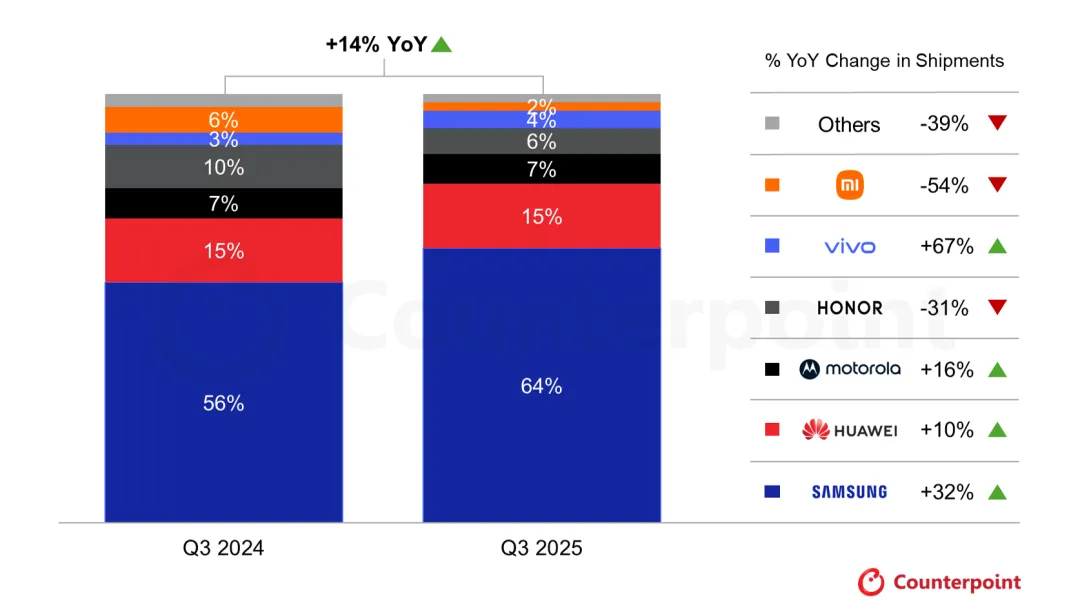
Core Insights - The global foldable smartphone market is projected to see a 14% year-on-year increase in shipments by Q3 2025, reaching a historical quarterly high for this category [1] - Samsung leads the market with a 64% share in Q3, experiencing a 32% increase in shipments compared to the previous year [1][3] - Huawei holds the second position with a 15% market share, growing by 10% year-on-year, while Motorola ranks third with a 7% share and a 16% increase [1][3] Market Performance - The foldable smartphone segment now accounts for 2.5% of global smartphone shipments, driven by the popularity of book-style models and the launch of Samsung's Galaxy Z Fold7 and Huawei's Mate series [3] - The Galaxy Z Fold7's features, such as a thinner body and improved durability, have significantly enhanced its appeal in the high-end market, contributing to unexpected growth [3] - Motorola's competitive pricing and strong channel partnerships have effectively expanded its user base in the foldable segment [3] Future Projections - Counterpoint Research anticipates a 16% year-on-year growth for the foldable market by the end of 2025, with high-end users increasingly favoring larger screens for productivity [4] - The market is expected to enter a significant expansion phase in 2026, driven by improvements in durability, thinner designs, and enhanced AI-driven software experiences [4] - Apple is expected to enter the foldable market in the second half of 2026, leveraging its large iPhone user base to initiate a new high-end product upgrade cycle [4] Competitive Landscape - The importance of technological innovation is increasing as existing manufacturers accelerate the development of multi-form factor products in anticipation of Apple's entry [5] - Companies are focusing on enhancing their technological leadership and product differentiation strategies, with foldable designs evolving beyond traditional book-style formats [5] - Samsung's upcoming tri-fold device is positioned as a pilot product to validate durability and software optimization before larger-scale commercialization [5]