
Guo Ji Jin Rong Bao

Search documents
万马奔腾朝前跃
Guo Ji Jin Rong Bao· 2026-01-01 03:59
骐骥驰骋马蹄疾。如预期般踏着时间的鼓点,2026年稳步而来。 这是新世纪的又一个马年,也是中国经济的又一个承上启下之年:"十四五"已然圆满收官,"十五五"正 在从容开启。站在这一重要的历史节点,我们既要总结过去,更要开局未来。 面临深刻复杂变化的发展环境,我们继续坚持科技自立自强这个核心战略。我们清晰地认识到,加快高 水平科技自立自强,引领发展新质生产力,既是对全球科技竞争格局的深刻洞察,更是对中国式现代化 进程中"发展动力从何而来"的响亮回答,做好这道应对全球变局与时代挑战的必答题,就一定能破解困 扰发展的桎梏,引领中国经济向更高质量、更可持续的方向迈进。 面临深刻复杂变化的发展环境,我们继续坚持走改革开放这条"必由之路"。我们清晰地认识到,不断扩 大对外开放、提高对外开放水平,以开放促改革、促发展,是新时代中国不断取得发展新成就的重要法 宝,只要进一步推进深层次改革,扩大高水平开放,就一定能破解制约高质量发展的体制机制障碍,持 续增强发展动力和社会活力。 面临深刻复杂变化的发展环境,我们继续坚持高质量发展这个新时代的硬道理。我们清晰地认识到,发 展是硬道理,这既是新时代做好经济工作的规律性认识,更是推动我 ...
主要发达国家长期护理保险经验借鉴
Guo Ji Jin Rong Bao· 2026-01-01 00:31
荷兰的长护险制度主要由"三大支柱法案"构成:一是《长期护理法案》,作为整个制度的核心,主 要为需要最密集、全天候监管护理的人群提供保障,例如严重失智症患者、重度残疾人以及需要临终关 怀的人群;二是《健康保险法案》,覆盖临床必需的专业医疗护理服务,如术后居家护理、物理治疗 等;三是《社会支持法案》,由地方政府负责实施,旨在帮助人们尽可能长时间地实现独立居家生活, 相关服务包括家务协助、出行支持、住房改造以及社区支持网络建设等。 在筹资与支付机制方面,荷兰的长护险所需资金主要来源于两个方面:一是专项收入所得税,所有 雇员和退休人员都需缴纳,税率由政府设定;二是政府财政补贴,即当保险基金出现赤字时,由国家财 政进行补充。对于资金的支付与运营,荷兰采取了高度集中化方式,即资金由一个名为CAK的公共机 构执行,它不提供护理服务,而是负责向提供长期护理服务的机构支付费用,并计算和收取个人应承担 的部分费用,其中对于居家护理,荷兰引入了"全包护理包"的支付方式,也就是评估机构根据个人需求 核定一个护理总预算,这个预算可以直接用于购买经认证的护理机构提供的打包服务,由此给了消费者 一定的选择权,也引入了市场竞争。 长期护理保 ...
2026年我国经济高质量发展三大看点
Guo Ji Jin Rong Bao· 2026-01-01 00:31
Group 1 - China's economy is expected to maintain steady growth in 2025, successfully achieving annual targets, with strong momentum continuing into 2026 driven by new consumption, enhanced production capabilities, and a solid export position in global supply chains [1] Group 2 - New consumption is set to expand and improve, with policies aimed at boosting domestic demand, including increased quotas for trade-in programs and an expanded range of supported products, leading to over 2.5 trillion yuan in sales benefiting more than 360 million people in 2025 [2] - The shift in consumer trends towards value-for-money and emotional value is notable, with experiential consumption in areas like culture, travel, and fitness driving growth [2] - AI is enhancing both online and offline retail experiences, with innovations like instant retail and smart shopping becoming more prevalent, expected to lead to deeper integration and quality improvements in consumption by 2026 [3] Group 3 - Core technology breakthroughs are reshaping industrial advantages, with advancements in AI, semiconductors, and commercial aerospace expected to drive high-quality upgrades in various sectors [4] - The renewable energy sector is projected to expand significantly, with an expected addition of over 20 million kilowatts of wind and solar power capacity by 2026, contributing to energy structure optimization and carbon peak goals [4] - The digital transformation of manufacturing is advancing, with a penetration rate of 68% in 2025, leading to efficiency improvements of over 25% in key industries [4] Group 4 - Export resilience is anticipated, with a focus on diversifying markets and consolidating China's leading position in global supply chains [6] - The reduction of tariff uncertainties is expected to stabilize trade with the U.S., while high-value, green products are becoming key growth drivers, with electric vehicle exports reaching 3.01 million units in 2025, a 62% increase [7] - China's trade with Belt and Road Initiative countries accounted for over 50% of exports in 2025, indicating a strong foundation for non-U.S. trade [7] - Continued high-level openness and trade innovation are expected to strengthen global supply chain positions, with rapid growth in cross-border e-commerce and digital technologies reducing trade costs [8]
布局未来:六大产业引领“十五五”新开局
Guo Ji Jin Rong Bao· 2026-01-01 00:31
Core Viewpoint - The "14th Five-Year Plan" lays the foundation for the "15th Five-Year Plan," which aims to cultivate emerging and future industries as a key part of building a modern industrial system, positioning China strategically for the next round of global technological and industrial transformation [1][3] Group 1: Strategic Overview - The "15th Five-Year Plan" emphasizes the construction of a modern industrial system and the consolidation of the real economy as primary strategic tasks, signaling the necessity for a solid technological and industrial foundation for China's modernization [3] - Future industries are characterized by their frontier, disruptive, and high-growth nature, stemming from significant breakthroughs in basic science, and are expected to dominate global economic landscapes in the coming decades [3] Group 2: Key Future Industries - Six future industries identified in the "15th Five-Year Plan" are crucial for driving the next wave of technological revolution, interlinked and collaboratively evolving to form a new matrix of productive forces [5] - Quantum technology is positioned as a cornerstone for information security and computational advancements, with China leading in quantum communication and achieving "quantum supremacy" with prototypes [5] - Biomanufacturing connects green transformation with industrial upgrading, with a market size nearing 1 trillion yuan, showcasing potential in achieving carbon neutrality through innovative technologies [5] - Hydrogen and nuclear fusion energy represent ultimate solutions for energy, with ongoing developments in compact fusion devices pushing towards engineering applications [5] Group 3: Market and Technological Development - Brain-computer interfaces and embodied intelligence are redefining human-machine relationships, with significant market growth expected in these areas by 2025 [6] - The sixth generation of mobile communication (6G) is set to integrate communication, perception, computation, and artificial intelligence, with China establishing a leading edge in 6G technology [6] Group 4: China's Unique Advantages - China's unique advantages lie in the combination of a new type of national system and a super-large market, allowing for concentrated resource investment in strategic areas like quantum and fusion technologies [8] - A tailored approach is essential for developing future industries, focusing on 1-2 key segments based on local resources and industrial foundations [8] - Establishing a virtuous cycle of technology, capital, and talent is crucial for fostering innovation and long-term investment in emerging technologies [8]
沪指11连阳!节后谁是主线?
Guo Ji Jin Rong Bao· 2025-12-31 18:49
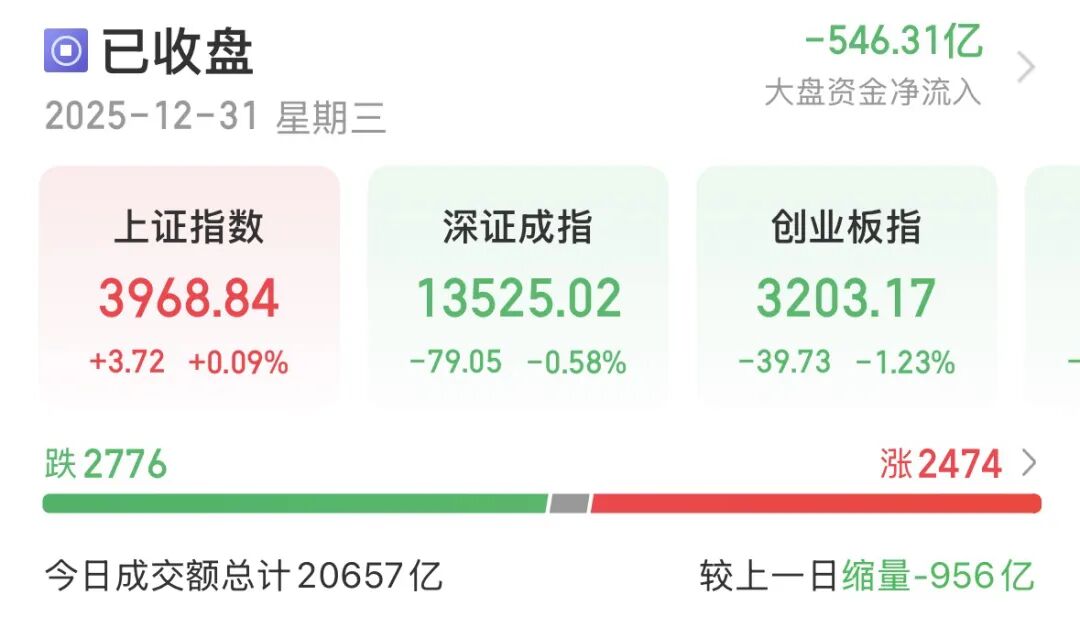
Market Overview - The Shanghai Composite Index closed at 3968 points, up 0.09%, with an annual increase of over 18% [2] - The Shenzhen Component Index closed at 13525 points, down 0.58%, with an annual increase of over 29% [2] - The ChiNext Index closed at 3203 points, down 1.23%, with an annual surge of over 49% [2] Market Sentiment - Analysts suggest that after several months of sideways movement, the A-share market is expected to continue its upward trend post-New Year [2] - A breakthrough of 4000 points in the Shanghai Index could signal the official start of the "second half of the bull market" [2][15] - High-growth sectors such as robotics, AI applications, and commercial aerospace are anticipated to attract significant capital [2][15] Sector Performance - The defense and military sector saw a notable increase, with a rise of 2.13% [7] - Other sectors such as media, real estate, and non-ferrous metals also performed well, each rising over 1% [7] - Conversely, sectors like communication, agriculture, and electronics experienced declines, with communication down 1.35% [9] Trading Volume and Activity - The market's trading volume decreased to 2.07 trillion yuan, down approximately 958 billion yuan from the previous trading day [4] - Margin trading balances in the Shanghai and Shenzhen markets rose to 2.56 trillion yuan as of December 30 [4] Investment Strategies - Investment strategies are focusing on high-certainty sectors, particularly in technology self-reliance and high-end manufacturing upgrades [17] - The AI sector is expected to see significant developments, with potential upgrades in large models anticipated to catalyze industry growth [16][17] - The strategy of balancing between offensive positions in technology and defensive positions in high-dividend assets is recommended [12][17]

吉利出行业务加速整合!曹操出行斥资3亿收购耀出行和吉利商旅
Guo Ji Jin Rong Bao· 2025-12-31 16:09
Core Viewpoint - Geely's integration efforts are advancing as Caocao Travel announces two strategic acquisitions, acquiring 100% of Yaochuxing for 225 million yuan and 100% of Geely Business Travel for 65 million yuan, totaling nearly 300 million yuan [2][4] Group 1: Company Overview - Caocao Travel, founded in 2015 and headquartered in Suzhou, is a ride-hailing platform incubated by Geely Holding Group and is the second-largest shared mobility platform in China [4] - Yaochuxing is a high-end mobility brand co-created by Geely and Mercedes-Benz, while Geely Business Travel focuses on comprehensive travel management services [4][5] Group 2: Strategic Implications - The acquisition of Yaochuxing will enhance Caocao Travel's high-end service offerings and expand its vehicle lineup, while also providing a platform for international expansion [4][5] - Geely Business Travel's corporate client resources will facilitate cross-selling opportunities, aiding Caocao Travel in rapidly expanding its corporate client base and market share [5] Group 3: Market Position and Financial Performance - Caocao Travel is transitioning from a single ride-hailing platform to a comprehensive service provider, aiming to fill gaps in high-end business travel and corporate travel management [5][7] - In the first half of the year, Caocao Travel reported revenues of 9.456 billion yuan, a 53.5% year-on-year increase, with a net loss reduced by 34% to 330 million yuan and a gross margin improvement to 8.4% [7][8] Group 4: Competitive Landscape - The Chinese internet taxi market is projected to reach 83.4 billion yuan by 2025, with the business taxi segment growing at 18.4%, while Didi holds a leading market share of 62.9% [9] - The acquisition will allow Caocao Travel to directly access luxury vehicle capacity and high-end customer resources, enhancing its competitive edge in the market [10]
车市寒冬迎新政“强心针”,2026年前景如何?
Guo Ji Jin Rong Bao· 2025-12-31 16:09
Core Viewpoint - The Chinese automotive market is experiencing a downturn as the year ends, with many companies facing challenges in sales and inventory management due to policy changes and consumer hesitation [1][6][15]. Group 1: Market Conditions - The automotive market is described as facing a "cold winter," with sales personnel frequently using the term to describe current conditions [1][5]. - Sales data indicates a significant decline in orders, with some brands reporting a drop from approximately 20 orders to around 10 in a month [9]. - The overall market sentiment is cautious, with many consumers waiting for clearer policy guidelines for 2026 before making purchasing decisions [6][7]. Group 2: Policy Impact - The Ministry of Finance and other departments released the implementation details for the 2026 vehicle trade-in subsidy, which is expected to provide a boost to the market [2][16]. - The new subsidy structure includes up to 20,000 yuan for electric vehicles and 15,000 yuan for fuel vehicles, aimed at encouraging consumer purchases [16]. - The discontinuation of previous trade-in subsidies has led to a decline in consumer demand, contributing to the current market slowdown [15]. Group 3: Sales Trends - Retail sales in the first three weeks of December showed a decline of approximately 19% year-on-year, with wholesale sales down by about 23% [14]. - The new energy vehicle segment also faced challenges, with retail sales only increasing by 1% year-on-year, while wholesale sales decreased by 10% [14]. - The disappearance of the "tail effect" typically seen at year-end is attributed to policy changes and consumer uncertainty regarding future incentives [15]. Group 4: Future Outlook - Industry experts predict that the overall growth rate for the automotive market in 2026 will exceed zero growth, with expectations for a strong start in January [16]. - Companies are focusing on inventory clearance and promotional strategies to stabilize sales channels as they await further policy developments [12].

双轮驱动,并购迎高质量发展新阶段
Guo Ji Jin Rong Bao· 2025-12-31 15:43
Group 1: Market Overview - The global M&A market shows signs of recovery in 2025, with China's M&A market experiencing a fundamental reshaping of rules, leading to a near doubling of the number of M&A approvals and a significant increase in major restructuring transaction volume compared to the past six years [1] - In 2025, the number of disclosed M&A events by A-share companies reached 4,044, with 147 major asset restructuring projects, a year-on-year increase of 44.12%, and the number of major asset restructuring approvals was 29, nearly doubling from 2024 [3] - The global M&A market in 2025 saw a transaction value of approximately $4.5 trillion, a nearly 50% year-on-year increase, marking the second-highest in history [7] Group 2: Policy Environment - The "14th Five-Year Plan" emphasizes a positive positioning for M&A and restructuring, aiming to support listed companies in transformation and upgrading, enhancing market efficiency through a set of policy measures [2] - The new "National Nine Articles" and "M&A Six Articles" are expected to create a policy environment that encourages industrial mergers and enhances market efficiency [2] Group 3: Sector Trends - The technology sector is becoming a focal point for M&A, with significant activity in areas such as AI, quantum computing, and advanced materials, driven by the need for companies to enhance operational efficiency and innovate [6] - The healthcare sector is also seeing increased M&A activity, particularly in biotech companies with breakthrough therapies, as well as in digital health and telemedicine, driven by rising demand for innovative treatments [9] Group 4: Future Outlook - In 2026, the M&A market is expected to benefit from continued policy optimization, with a focus on technology empowerment and industrial integration, particularly in traditional industries undergoing digital transformation [5][6] - The capital market is anticipated to support M&A activities through improved refinancing mechanisms, with a focus on high-quality assets and sectors such as new energy, innovative pharmaceuticals, and infrastructure [10][11]
愿智慧如光,照亮财富之路
Guo Ji Jin Rong Bao· 2025-12-31 15:36
Group 1 - The market experiences fluctuations similar to seasons, with short-term surges being enticing but sustainable wealth growth stemming from a deep understanding of enterprise value and long-term trends [2] - The importance of broadening cognitive boundaries and continuous learning to adapt to market changes is emphasized, as yesterday's success may not apply to tomorrow [2] - The fundamental purpose of investing is highlighted as improving life quality, encouraging a balance between investment and personal happiness in the new year [2] Group 2 - The narrative of investment success is framed around patience and consistent market research, suggesting that true investment wisdom lies in adapting to trends and finding a personal rhythm [1] - The need to reassess risk tolerance and establish a scientific asset allocation framework is stressed, with a reference to investment masters who achieve steady progress across multiple market cycles [1] - The call for cultivating the ability to penetrate noise and focus on familiar fields is made, indicating that true value often lies hidden beneath the surface [1]
金融“造血”新图景
Guo Ji Jin Rong Bao· 2025-12-31 15:36
Core Viewpoint - The central economic work conference in 2025 emphasizes financial support for key areas such as expanding domestic demand, technological innovation, and small and micro enterprises, marking a shift from "overall stability" to "structural reshaping" in financial regulation [1][2][3] Financial Support Focus - Financial institutions will focus on enhancing support for the real economy by creating a financial support system that integrates growth momentum, innovation, and market entities [2] - The shift aims to redirect funds from over-concentrated sectors like real estate to areas with higher marginal output, such as domestic demand and technology innovation [3][4] Internal Demand Expansion - The expansion of domestic demand faces structural bottlenecks on both the demand and supply sides, including high thresholds for consumer credit and insufficient financial support for consumption [5][6] - Strategies to enhance domestic demand include customizing financial products for specific consumption scenarios and improving financial infrastructure in rural areas [5][6] Technology Innovation Financing - Financing for technological innovation encounters challenges such as light assets, long cycles, and high risks, necessitating a comprehensive financial service chain that covers all stages of enterprise development [7][8] - Recommendations include establishing risk-sharing mechanisms and promoting the capitalization of intellectual property to facilitate funding for hard technology [7][8] Small and Micro Enterprises Financing - Small and micro enterprises face financing challenges due to credit gaps, information asymmetry, and weak risk resistance [9][10] - Solutions involve enhancing credit evaluation through big data, expanding government guarantee coverage, and simplifying approval processes to make inclusive finance accessible [9][10]