
Di Yi Cai Jing Zi Xun

Search documents
约3000名沃尔沃电车车主被警告:不要充满电
Di Yi Cai Jing Zi Xun· 2026-01-13 11:33
Group 1 - Volvo has initiated a recall plan for the EX30 model due to potential overheating risks associated with the high-voltage battery, affecting over 3,300 vehicles across multiple markets [1][2] - The recall includes 2,815 units in Australia, 40 units in the United States, 85 units in Canada, and 372 units in South Africa, with additional concerns raised for 10,440 units in the UK [2] - The battery cells in question are supplied by Shandong Geely Xinhua Power Battery Co., Ltd., which has faced previous legal issues regarding battery quality defects [2] Group 2 - Volvo has stated that the battery issue does not affect all EX30 models and has not resulted in serious injuries, emphasizing a proactive approach to safety [3] - The EX30 is a key model for Volvo's transition to full electrification, with 2025 sales figures showing a decline of 13% in pure electric vehicle sales, totaling 151,830 units, which represents about 21% of total sales [3]
创始人张勇重任海底捞CEO
Di Yi Cai Jing Zi Xun· 2026-01-13 11:29
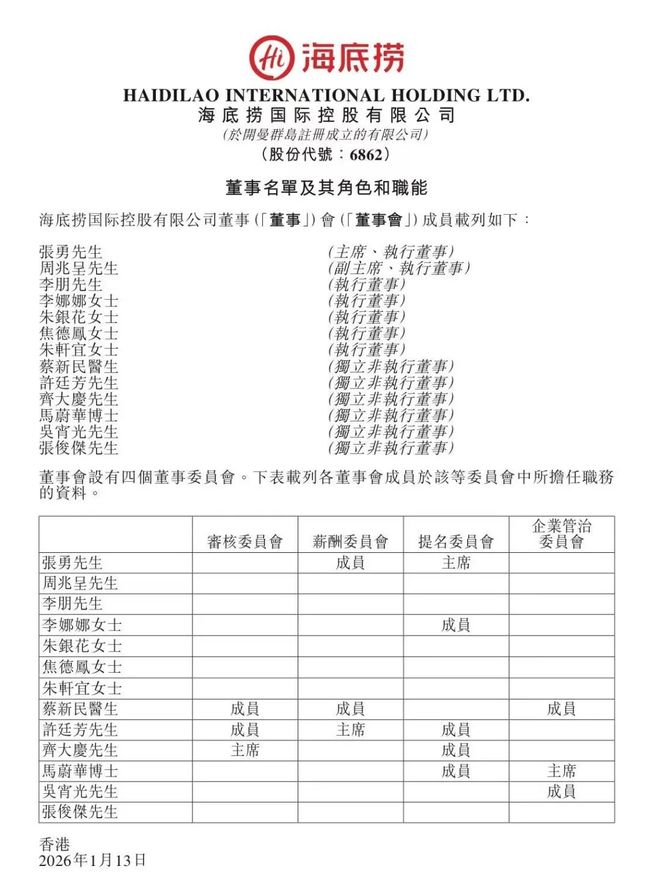
此外,公司的几名执行董事也有变更。宋青辞任公司执行董事及提名委员会成员,高洁辞任公司执行董 事。相关人员辞任后,将继续在集团担任重要管理职能。同时,为支持本公司持续创新及长期发展,磨 砺并培养年轻一代管理团队,李娜娜、朱银花、焦德凤及朱轩宜已分别获委任为公司执行董事,均为女 性。 创始人张勇又做回海底捞CEO了。 1月13日,海底捞国际控股有限公司(下称"海底捞",股票代码:6862.HK)发布公告称,苟轶群辞去 CEO,张勇接任。 | | 審核委員會 | 新酬委員會 | 提名委員會 | 企業管治 委員會 | | --- | --- | --- | --- | --- | | 張勇先生 | | 成員 | 主席 | | | 周兆呈先生 | | | | | | 李朋先生 | | | | | | 李娜娜女士 | | | 成員 | | | 朱銀花女士 | | | | | | 焦德鳳女士 | | | | | | 朱軒宜女士 | | | | | | 蔡新民醫生 | 成員 | 成員 | | 成員 | | 許廷芳先生 | 成員 | 主席 | 成員 | | | 齊大慶先生 | 主席 | | 成員 | | | 馬蔚華博士 | | ...


7亿基金突遭“资金洪流”
Di Yi Cai Jing Zi Xun· 2026-01-13 11:16
Group 1 - The core point of the article highlights the recent surge in interest and investment in the Debon Fund's "Debon Stable Growth" product, leading to significant purchase limits being imposed to protect existing investors [2][4][11] - On January 13, the A-share market reached a record trading volume of nearly 3.7 trillion yuan, with many equity funds hitting new net asset value highs, prompting over 80 equity funds to announce purchase limits since the beginning of the year [2][11][12] - The Debon Stable Growth fund saw a single-day inflow of 12 billion yuan, although the fund company denied disclosing real-time fund size data, emphasizing that such information is not publicly available until the end of the trading day [4][9] Group 2 - The fund's risk rating was raised to "high risk" on the Ant Financial platform due to increased trading activity and market volatility, while another platform still categorized it as "medium to high risk" [6][8] - The fund's A-class share reported a year-to-date return of 29.42% as of January 12, with significant performance from its top holdings in the technology sector [8][9] - The recent market dynamics are attributed to institutional and absolute return funds driving a notable rally, with expectations for continued upward movement in the spring market [3][13]

钟薛高创始人宣布终审胜诉
Di Yi Cai Jing Zi Xun· 2026-01-13 10:56
Core Viewpoint - The final ruling on the "love to buy or not" maliciously edited interview has been upheld, confirming it as malicious editing by the media, marking the end of a nearly five-year legal battle for the founder of Zhong Xue Gao, Lin Sheng [2]. Group 1: Legal Proceedings - The final judgment confirmed that the edited video, which misrepresented Lin Sheng's comments about high-priced ice cream, was a result of malicious editing driven by traffic [2]. - The first-instance judgment in 2025 recognized the editing as defamation, ordering the defendants to pay 2.3 million yuan and issue a public apology [2]. - The legal battle began in 2021 and concluded recently, with Lin Sheng stating that while the outcome does not help Zhong Xue Gao's current situation, it is still considered good news [2]. Group 2: Financial Status - As of now, Zhong Xue Gao Food (Shanghai) Co., Ltd. has two enforcement cases with a total amount of 5.8673 million yuan, and a historical record of 39 enforcement cases exceeding 67.11 million yuan [3]. - The company has been listed as a dishonest executor in 10 cases, involving amounts over 7.25 million yuan [3]. - On July 16, 2025, Zhong Xue Gao was applied for bankruptcy by Shanghai Zhenliao Trading Co., Ltd., with the Shanghai Third Intermediate People's Court handling the case [2].

上海发布28条新政促消费
Di Yi Cai Jing Zi Xun· 2026-01-13 10:50
Core Insights - Shanghai has introduced a new policy document aimed at enhancing service quality and boosting consumption, marking a shift from short-term stimulus measures to a long-term strategic focus on service and consumption interlinkage [2][3] Group 1: Policy Measures - The new measures consist of 28 policy initiatives designed to optimize supply and expand consumption, fostering new growth points in service supply and consumer demand [2][3] - The focus is on systemic interlinkage, emphasizing quality competition on the supply side and signaling a clear policy direction to promote consumption through quality [2][4] Group 2: Economic Context - The service sector and consumption in Shanghai have shown positive growth trends, with service value added increasing by 5.9% and retail sales of consumer goods growing by 5% in the first eleven months of 2025, both surpassing national averages [3][4] - The interlinkage between service and consumption is seen as essential for stabilizing growth and supporting domestic demand [3][4] Group 3: Industry Focus - The policy targets six key industries: finance, information services, transportation, cultural and entertainment services, life services, and inspection and certification, which together account for about 60% of Shanghai's service sector value added [5][6] - Financial innovation is highlighted as a crucial driver for consumption and industry growth, with an emphasis on integrating consumption scenarios with financial products [5][6] Group 4: Consumer Experience Enhancement - The measures aim to enhance the quality and diversity of life services, including the establishment of employee-based housekeeping companies and the promotion of "no companion care" services in medical institutions [7][8] - The document outlines initiatives to improve brand certification, standard systems, and inspection services, aiming to enhance consumer trust and service quality [8] Group 5: Implementation Strategy - The Shanghai government plans to ensure effective implementation of the measures by coordinating service supply with consumer demand and creating a conducive policy environment [9][10] - Emphasis is placed on cross-departmental collaboration to avoid policy fragmentation and to establish a dynamic evaluation mechanism for monitoring policy effectiveness [10]
贵州茅台,推进新转型
Di Yi Cai Jing Zi Xun· 2026-01-13 10:10
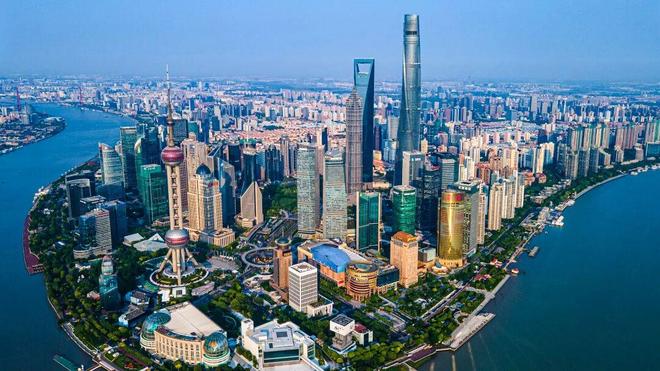
Core Viewpoint - Guizhou Moutai has announced a market-oriented transformation plan for its marketing system to better align with market and consumer trends, focusing on a consumer-centric approach and market demand-driven strategies [1] Group 1: Product System - The plan includes a comprehensive product system that aims to enhance the overall marketing strategy [1] Group 2: Operational Model - The operational model is shifting from a traditional "self-sale + distribution" model to a multi-dimensional collaborative marketing system that includes "self-sale + distribution + consignment + consignment" to better meet consumer needs [1] - The self-sale model will focus on direct sales through self-operated stores and the iMoutai platform, targeting both C-end and B-end consumer groups, while eliminating the previous distribution model [1] - The distribution model will clarify sales volume, designated sales areas or channels, and transfer ownership to distributors, while the consignment model will not transfer ownership and will leverage online retail, offline retail, dining, and private domain channels to enhance regional coverage and channel reach [1] Group 3: Pricing Mechanism - The pricing mechanism will be market-oriented, establishing a dynamic adjustment mechanism for retail prices in the self-operated system that is "in line with the market and relatively stable" [1] - The current retail prices in the self-operated system are already being implemented on the iMoutai platform and in self-operated stores [1]

百亿申购传闻后,德邦稳盈增长一日两限,C类骤降至1万
Di Yi Cai Jing Zi Xun· 2026-01-13 09:04
Core Viewpoint - The company, Debon Fund, has tightened its purchase limits for its A and C class shares to 100,000 yuan and 10,000 yuan respectively, following a significant inflow of over 10 billion yuan in a single day [1] Group 1: Fund Management Decisions - Debon Fund announced the new purchase limits will take effect from January 14 [1] - The company denied disclosing the intraday scale of subscriptions and emphasized the importance of protecting the interests of all fund shareholders [1] - The decision to lower the subscription limits was made to prevent potential dilution of fund returns due to large inflows [1] Group 2: Market Response and Future Actions - The company will continue to monitor changes in fund size and market volatility [1] - Future adjustments to the subscription limits will be made based on actual operational needs [1]
预售丨《公司的秘密》第七辑来了!
Di Yi Cai Jing Zi Xun· 2026-01-13 08:44
Core Insights - The seventh edition of "Company Secrets" is now available for pre-sale, focusing on in-depth financial analysis rather than superficial business advice [1] - The publication aims to uncover the underlying logic of companies' profitability and losses, featuring case studies from various companies [1] Summary by Topics Company Performance - NIO's L90 achieved a monthly sales figure of 15,000 units, attributed to a pricing strategy of 260,000 and platform-based production, marking a significant recovery from 5,000 monthly sales to over 40,000 [1] - Pop Mart's revenue reached 3.4 billion, with profits surpassing global toy giant Mattel, driven by the normalization of IP blockbuster products [1] - Bawang Tea's revenue increased by 167% within a year, supported by a high-end positioning strategy and expansion into lower-tier markets [1] Industry Trends - The publication also addresses challenges faced by Nintendo with the Switch, Hengrui's transformation in centralized procurement, and Cambrian's resurgence in AI computing power [1]


收盘丨创业板指冲高回落跌近2%,商业航天概念大幅回调
Di Yi Cai Jing Zi Xun· 2026-01-13 07:24
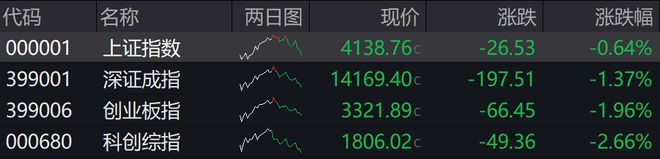
Market Performance - The A-share market experienced a day of volatility, with the Shanghai Composite Index falling by 0.64%, the Shenzhen Component Index down by 1.37%, the ChiNext Index decreasing by 1.96%, and the Sci-Tech Innovation Board Index dropping by 2.66% [1][2]. Sector Performance - The commercial aerospace sector saw a significant decline, with multiple stocks hitting the daily limit down [2][4]. - The computing hardware supply chain faced a downturn, particularly in the server and CPO segments [2]. - Conversely, sectors such as AI applications, innovative pharmaceuticals, medical services, and ultra-high voltage concepts showed strength [2]. Notable Stocks - Oil and gas stocks experienced a rally, with TBEA Co., Ltd. and Zhongyou Co. hitting the daily limit up, and Tongyuan Petroleum rising over 10% [2][3]. - Specific stocks that gained include: - Tongyuan Petroleum: +11.66% to 7.18 - Zhongyou Co.: +10.00% to 9.02 - CNOOC Services: +46.03% to 15.29 [3]. Declining Stocks - The commercial aerospace concept stocks collectively retreated, with companies like China Aerospace Science and Technology and China Satellite Communications hitting the daily limit down [2][4]. - Notable decliners include: - Aerospace Electronics: -10.01% to 28.40 - Putian Technology: -10.01% to 36.78 - Aerospace Long Peak: -10.00% to 26.45 [4]. Trading Volume - The total trading volume in the Shanghai and Shenzhen markets reached 3.65 trillion, setting a new historical high, with over 3,700 stocks declining [4]. Capital Flow - Main capital flows showed net inflows into sectors like medical devices, gaming, and energy metals, while there were net outflows from consumer electronics, aerospace, and telecommunications [6]. - Specific stocks with net inflows include: - TBEA Co., Ltd.: +1.846 billion - Haige Communication: +1.661 billion - Zhangqu Technology: +791 million [6]. - Stocks with significant net outflows include: - Goldwind Technology: -5.043 billion - Aerospace Electronics: -4.378 billion - Bluefocus Communication: -2.976 billion [6]. Institutional Insights - Guotai Junan Securities noted that market fluctuations do not alter the slow bull market trend, suggesting a focus on AI and cyclical opportunities [6]. - Jinyuan Securities indicated that the market is in a consolidation phase, recommending attention to undervalued sectors [6]. - Zhongtai Securities projected that the market may exhibit characteristics of bottom lifting and active main lines in the first quarter and beyond [6].

创业做电商Agent,前钉钉副总裁获数千万投资
Di Yi Cai Jing Zi Xun· 2026-01-13 05:44
Core Insights - K2 Lab, founded by former Alibaba DingTalk Vice President Wang Ming, has completed a seed round financing of several tens of millions of yuan, exclusively invested by Yunshi Capital [1] Group 1: Financing Details - The seed round financing will primarily be used for product and AI capability development, user growth, and the establishment of an AI Native team [1] - The funding aims to advance the infrastructure for content e-commerce agents targeting super individuals [1] Group 2: Product Development - The first product will assist influencers in product selection recommendations, script generation, multi-camera video production, and intelligent editing [1]