
Zhong Guo Huan Jing Bao

Search documents
环境规划院副总工程师王夏晖:“十五五”时期持续深入推进生态系统优化,该抓好哪些工作重点?
Zhong Guo Huan Jing Bao· 2025-11-23 23:21
Core Viewpoint - The 20th Central Committee's Fourth Plenary Session has approved the proposal for the 15th Five-Year Plan, emphasizing significant progress in building a beautiful China as a primary goal for economic and social development during this period [1] Group 1: Achievements in Ecological Protection and Restoration - Significant progress has been made in ecological protection and restoration, establishing a solid foundation for optimizing ecosystems during the 15th Five-Year Plan [2] - The overall quality of ecosystems in the country has stabilized and improved, with a new pattern for biodiversity protection gradually forming [2][3] - The area of ecological protection red lines exceeds 30% of the land area, with 90% of terrestrial ecosystem types and 74% of key protected wild species effectively protected [3] Group 2: Challenges and Future Directions - Despite achievements, the ecological protection and restoration efforts face challenges, including the need to solidify existing gains and expand improvements [4] - The current ecological system remains under significant human activity pressure, with a need for modernization in the regulatory framework [4] Group 3: Key Focus Areas for the 15th Five-Year Plan - The focus will be on optimizing ecological systems, improving quality, enhancing functions, realizing value, and efficient regulation [5] - A comprehensive national ecological security system will be constructed, addressing spatial planning and ecological resource management [6] Group 4: Collaborative and Integrated Approaches - Emphasis on a multi-faceted approach to improve ecosystem quality, integrating various ecological elements [7] - Implementation of integrated protection and restoration projects targeting specific ecological degradation areas [8] Group 5: Enhancing Ecosystem Services and Resilience - The need to enhance ecosystem service functions and develop a robust ecological risk resilience system in response to climate change [9] - Focus on technology and innovation to improve ecological monitoring and risk assessment capabilities [11] Group 6: Realizing Ecological Product Value - The plan includes expanding channels for realizing the value of ecological products, aligning with national strategies for sustainable development [10] - Encouragement of innovative practices in ecological product value realization to support local environmental protection and economic growth [10]
从劣V类到Ⅲ类,济南白云湖重现“江北明珠”风采
Zhong Guo Huan Jing Bao· 2025-11-22 05:27
Core Viewpoint - The transformation of Baiyun Lake from an ecologically degraded area to a thriving national wetland park is attributed to systematic ecological protection and restoration efforts by the local government, which include pollution control, habitat restoration, and biodiversity enhancement [1][3][5]. Group 1: Ecological Restoration Efforts - Baiyun Lake's water quality improved from Class V to Class III between 2006 and 2025, with significant biodiversity increases, including 145 bird species and 223 plant species [1][6]. - The local government has invested 124.27 million yuan in flood control and drainage projects, clearing 566,000 cubic meters of sediment and restoring 20,000 mu of wetland area [6][7]. - A total investment of 350 million yuan has been allocated for the comprehensive cleanup of 1,544 fish ponds around the lake, restoring wetland areas to over 26,000 mu [7]. Group 2: Pollution Control Measures - The local government has shut down over 2,600 illegal plastic recycling operations around Baiyun Lake, addressing significant pollution sources [4][5]. - Agricultural practices have been adjusted to reduce chemical fertilizer and pesticide use, thereby mitigating nutrient pollution in the lake [4][5]. - A comprehensive management system has been established to monitor and enforce environmental regulations, ensuring ongoing protection of the wetland ecosystem [9][10]. Group 3: Community Engagement and Education - The Baiyun Lake National Wetland Park has implemented educational programs and community activities to raise awareness about wetland conservation, reaching over 15,000 participants [10][14]. - A reporting mechanism has been established to encourage public involvement in protecting the wetland from harmful activities [10][14]. - The park management has focused on integrating ecological tourism and educational initiatives to foster a deeper connection between the community and the wetland environment [10][14].


这座岭南水乡因美丽河湖而生机勃勃
Zhong Guo Huan Jing Bao· 2025-11-22 03:44
Core Viewpoint - Zhongshan is transitioning from water pollution control to the construction of beautiful rivers and lakes, focusing on ecological and economic development through a comprehensive governance model [1][2][3]. Group 1: Governance and Planning - A high-level conference was held to mark the beginning of a new journey in beautiful river and lake protection and construction, emphasizing the importance of the "Hundred Million Project" [2]. - Zhongshan has established a multi-departmental coordination mechanism to ensure effective governance, transitioning from a pollution control command to a beautiful river and lake protection command [3][4]. - The city has developed a three-year action plan (2025-2027) and specific technical guidelines to outline the main tasks and implementation steps for beautiful river and lake construction [4][5]. Group 2: Implementation and Progress - The city aims to complete the "Six Pollution Control" project by 2025, targeting the construction of over 100 municipal-level beautiful rivers and lakes [4][5]. - A systematic approach is being adopted, with detailed plans for each river and lake, addressing water quality, surrounding industries, and existing challenges [4][6]. - Since the end of 2021, Zhongshan has constructed 7,000 kilometers of new sewage pipelines and increased sewage treatment capacity by 1.02 million tons per day, achieving a 100% rural sewage treatment rate [12]. Group 3: Community Engagement and Economic Development - Community involvement is crucial, with local leaders actively engaging residents to explain the benefits of environmental improvements [9][10]. - The revitalization of rivers and lakes has spurred economic development, with various projects enhancing local industries and tourism [7][12]. - The city is focused on creating a beautiful environment that fosters economic growth, aiming to integrate beautiful river and lake projects with agriculture, tourism, and other sectors [12].
“公园乡村”是什么样的?浙江云和为山区县“两山”转化提供了样本
Zhong Guo Huan Jing Bao· 2025-11-21 00:19
Core Insights - Zhejiang province, as the origin and pioneer of the "Two Mountains" concept, has integrated high-quality development with high-level protection over the past two decades, exemplified by Lishui City's Yunhe County, which has achieved significant ecological and economic outcomes [1] Group 1: Ecological Foundation - Yunhe County prioritizes ecological resource protection as the foundation for the "Two Mountains" transformation, establishing a comprehensive ecological protection system through ecological planning, digital remediation, and systematic restoration [2] - The county has developed a quantitative standard system with 127 indicators across 30 categories to coordinate ecological, service, cultural, and economic development [2] - The forest coverage rate in Yunhe County has reached 81.29%, and the surface water quality compliance rate is 100% [1] Group 2: Ecological Restoration - The county has implemented integrated protection and restoration projects, restoring over 5,000 acres of terraced fields and reducing the abandonment rate from 65% in 2016 to 3.3% [3] - Innovative agricultural practices such as "rice + snail" and "rice + fish" have been adopted to achieve ecological and economic benefits [3] Group 3: Economic Transformation Mechanisms - Yunhe County has established the first "Two Mountains Bank" in the country, offering "Two Mountains Loans" that integrate ecological credit as a prerequisite for financial support [4] - By selling the first "ecological land" in the country, the county has developed a model that combines economic output value with ecological environment appreciation [4] - As of March 2025, loans for Yunhe snow pears have reached a total credit of 312 million yuan, with 143 million yuan disbursed [4] Group 4: Ecotourism and Industry Integration - In 2024, the Yunhe terraced scenic area is expected to receive over 1.2 million visitors, generating tourism revenue of 250 million yuan [5] - The terraced fields have been approved as a 5A scenic area, with 285,800 visitors during the National Day and Mid-Autumn Festival holidays in 2025, resulting in tourism consumption of 137 million yuan [5] Group 5: Park Village Development - Yunhe County has established eight "Park Villages" as demonstration sites, with per capita disposable income for rural residents projected to reach over 22,400 yuan in 2024 [6] - The county has invested 87 million yuan in 2023 for 28 projects, leading to a 60% increase in collective operating income for villages [7] Group 6: Long-term Operation Mechanisms - The county employs an EPCO model for project management, enhancing efficiency and providing job opportunities for villagers [8] - A special fund for operations has been established, with over 100 million yuan allocated for "farm stay" loans, promoting the gathering of technology, capital, and talent in rural areas [8]
从新一轮NDC到COP30,中国为全球低碳转型注入宝贵的确定性
Zhong Guo Huan Jing Bao· 2025-11-20 23:20
Group 1 - The COP30 conference is a significant milestone in global climate governance, with China promoting action and consensus to address current challenges [1] - China aims to enhance and implement its Nationally Determined Contributions (NDCs), encouraging other countries to adopt more ambitious climate commitments [1][2] - The new NDC framework from China includes a clear target of reducing greenhouse gas emissions by 7%-10% from peak levels by 2035, alongside specific quantitative and qualitative indicators [2][3] Group 2 - China is committed to multilateralism and provides stable expectations for global climate governance through clear and measurable commitments [3] - The country is leading in clean energy, contributing over 60% of the global new wind and solar capacity in 2024, supporting both domestic and global decarbonization goals [3][4] - The national carbon trading market covers over 40% of China's CO2 emissions, with plans to increase coverage to over 60%, making it the largest carbon market globally [3][4] Group 3 - China is implementing systematic reforms to address its energy structure, aiming for an 18% reduction in carbon emissions per unit of GDP by 2024 compared to 2019 [4] - The country has integrated energy-saving and carbon reduction targets into local government performance assessments, fostering a collaborative approach to climate action [4] - China emphasizes open cooperation and aims to build a fair global climate governance system, actively engaging in South-South cooperation to assist developing countries [5] Group 4 - China is willing to collaborate with other nations to contribute to global ecological civilization and the construction of a community with a shared future for mankind [6]
淄博聚力攻坚描绘蓝天碧水生态美画卷
Zhong Guo Huan Jing Bao· 2025-11-20 01:27
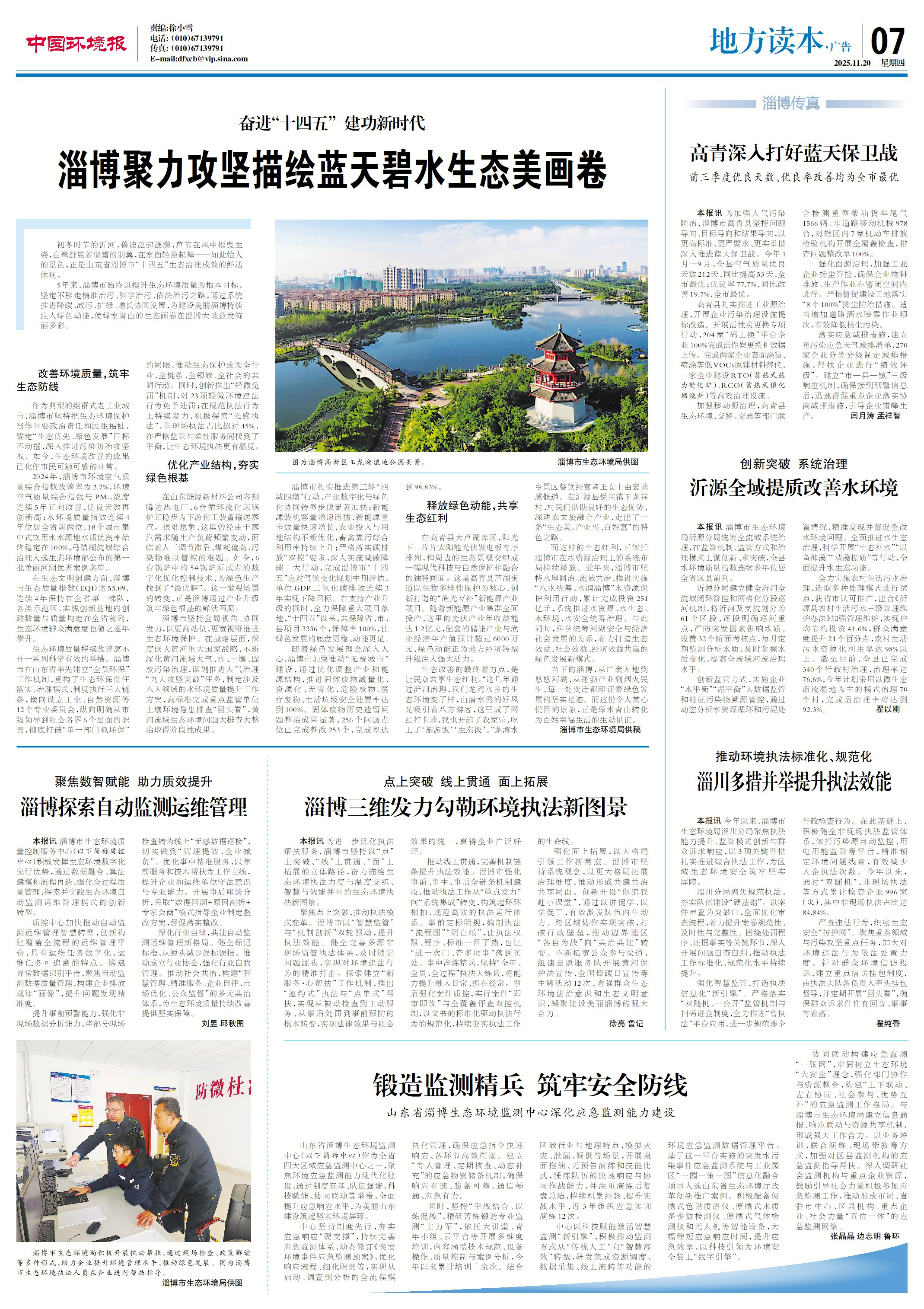
Core Viewpoint - The news highlights the ecological governance achievements of Zibo City during the "14th Five-Year Plan" period, emphasizing the commitment to improving environmental quality through systematic pollution control and green development initiatives [2][3][13]. Environmental Quality Improvement - Zibo City has prioritized ecological environment protection as a political responsibility and a matter of public welfare, achieving a 2.7% improvement in the comprehensive air quality index for 2024, with PM2.5 concentrations showing positive trends for five consecutive years [14][15]. - The water quality index has ranked among the top two in the province for four consecutive years, with 100% of centralized drinking water sources meeting quality standards [14][15]. - The ecological quality index (EQI) reached 55.09, maintaining a leading position in the province, with increasing public satisfaction regarding environmental quality [14][15]. Industrial Structure Optimization - Zibo City is advancing industrial upgrades to establish a solid green foundation, implementing digital optimization technologies in energy production to enhance efficiency and reduce emissions [16][17]. - The city is integrating ecological protection into broader national strategies, focusing on comprehensive pollution control across air, water, soil, and waste management [16][17]. Green Development Initiatives - The city has launched the "Four Reductions and Four Increases" action plan, significantly accelerating the digital and green transformation of industries, with rapid growth in renewable energy capacity and improvements in agricultural practices [17]. - Zibo has achieved a 100% safety disposal rate for hazardous, medical, and municipal waste, with a high completion rate for historical solid waste issues [17]. Economic and Ecological Synergy - The "Fishing and Light Complementarity" project in Gaoqing County exemplifies the integration of modern technology with ecological conservation, generating significant economic returns from solar energy and fisheries [18]. - The city has invested 251 billion yuan in water resource management, promoting a holistic approach to water conservation and ecological restoration, which has enhanced both environmental and economic benefits [19].
科技赋能生态建造 匠心守护青山绿水——记中交一航局第一工程有限公司八十载绿色发展之路
Zhong Guo Huan Jing Bao· 2025-11-20 00:39
Core Viewpoint - The company, China Communications First Harbor Engineering Company (CCFHEC), has evolved over 80 years from a national team focused on port and road construction to a modern comprehensive construction enterprise, emphasizing green development and ecological protection in its projects [1][2][3]. Group 1: Company Evolution and Achievements - CCFHEC has built over 600 berths, with more than 61% being over 10,000 tons, establishing itself as a "cradle of port construction" [3]. - The company has received numerous awards for its engineering excellence, including 7 National Quality Engineering Gold Awards and 19 National Quality Engineering Awards [13]. - CCFHEC has developed innovative construction techniques, such as the vacuum preloading method, which enhances efficiency and reduces environmental impact [4]. Group 2: Commitment to Green Construction - The company has integrated ecological considerations into its construction processes, achieving significant improvements in water quality and biodiversity in projects like the Baiyangdian governance [5][6]. - CCFHEC has implemented a series of green engineering initiatives, including the use of low-carbon materials and energy-efficient technologies, resulting in a 40% reduction in operational costs and emissions in projects like the Xiong'an Future Science City [8][15]. - The company has established a comprehensive green management system, focusing on resource recycling and waste reduction [10][19]. Group 3: Technological Innovation - CCFHEC has embraced technology as a core driver of its green development strategy, with over 540 national patents and a focus on smart construction techniques [13][14]. - The company has developed a digital twin platform that enhances project management and environmental monitoring, ensuring real-time data analysis and risk management [16]. - Innovative construction methods, such as the use of prefabricated components and eco-friendly materials, have been successfully implemented to minimize environmental impact [17][18]. Group 4: Future Outlook - CCFHEC aims to continue its commitment to green and low-carbon transformation, actively participating in national strategies like the Belt and Road Initiative and contributing to ecological civilization [19][20]. - The company plans to enhance its green technology innovation and application, focusing on sustainable practices in water environment governance and marine ecological restoration [19]. - CCFHEC is dedicated to building a modern infrastructure system that aligns with the principles of ecological protection and sustainable development [20].
促进资源再生利用,政策、标准、技术一个都不能少
Zhong Guo Huan Jing Bao· 2025-11-20 00:26
Core Insights - The recycling industry in China is undergoing transformation and growth, driven by policies such as "Two New" initiatives, with a projected total recycling volume of 401 million tons in 2024, representing a 6.5% year-on-year increase, and a recycling value of 1.33 trillion yuan [1] - The establishment of the China Resource Recycling Group has significantly increased industry concentration, while the development of the recycling system is creating a multi-layered network from collection points to utilization bases [1] - The industry faces challenges including incomplete macro policies, low recycling rates for low-value recyclable materials, a need for a more integrated recycling supply chain, weak influence from local leading enterprises, and insufficient technological innovation [2][3] Policy and Industry Development - The current macro policies require improvement, with existing tax incentives needing to address issues such as cooperation between buyers and sellers, personal income tax withholding, and the establishment of quality standards for recycled products [1][2] - The recycling rate for low-value recyclable materials remains low due to factors such as dispersed sources, low value, and high collection costs, particularly for items like used textiles and low-value plastics [2] - The recycling supply chain needs enhancement, as many enterprises operate independently, leading to low added value in primary processed products and the presence of unregulated companies causing environmental issues [2] Recommendations for Improvement - It is suggested to increase policy support for the recycling industry, including the development of tiered tax incentives and financial subsidies to encourage enterprises to recycle and utilize waste materials [3] - Establishing a comprehensive certification system for resource recycling that covers various levels of regions, organizations, and products is recommended, along with improving standards for second-hand goods circulation [3] - The creation of resource recycling demonstration bases and support for upgrading existing solid waste utilization enterprises is advised, alongside promoting synergy between resource recycling and carbon reduction efforts [3]
从伤疤到财富,江西这样把“废矿”变“金山”
Zhong Guo Huan Jing Bao· 2025-11-19 23:18
Core Viewpoint - The restoration of abandoned mines, despite the depletion of natural resources, holds significant economic value through potential agricultural use, development of parks, and tourism, emphasizing the need for integrating ecological restoration with economic development [1] Group 1: Economic Value of Abandoned Mine Restoration - Restored abandoned mines can be utilized for agriculture, forestry, and tourism, highlighting their economic potential [1] - Jiangxi province has actively promoted the integration of abandoned mine restoration with economic development, achieving notable experiences that can serve as references [1] Group 2: Financial Support and Policy Incentives - National policies have been established to provide financial incentives for local governments to engage in abandoned mine restoration, including funding for demonstration projects [2] - Jiangxi has successfully applied for 3 billion yuan in central financial support for ecological restoration projects, being the only province to secure funding for four consecutive years, totaling 15 billion yuan across five projects [2] - A three-tiered financial system has been established in Jiangxi to leverage central funding, attract social capital, and collaborate with financial institutions for mine restoration financing [2] Group 3: Expanding Value Realization Paths - The restoration of abandoned mines can support industrial development by converting abandoned land into operational land for industrial projects [3] - Jiangxi has generated significant economic benefits through land trading by converting restored mine areas into supplementary farmland and construction land indicators [3] Group 4: Multi-Benefit Realization - The introduction of social capital for building distributed photovoltaic power stations on restored mines can achieve multiple benefits, including carbon reduction and economic gains [4] Group 5: Integration with Rural Revitalization - Abandoned mines can be transformed into agricultural land through targeted restoration strategies, enhancing soil quality and supporting local agricultural development [5] - Jiangxi has combined ecological restoration with rural environment improvement, focusing on enhancing infrastructure in surrounding villages [5] Group 6: Cultural Tourism Development - Jiangxi promotes protective development of historical mining sites to enhance modern service industry growth through tourism [6] - The establishment of national mining parks and cultural tourism sites has been initiated, integrating local cultural heritage with mining restoration projects [6] Group 7: Empowering Rural Revitalization through Tourism - The development of rural tourism around restored mines can facilitate ecological, economic, and social transformations, contributing to rural revitalization [7] - Jiangxi's initiatives in creating cultural and tourism experiences around restored mines have yielded positive economic and social outcomes [7]
避免地面乱糟糟、空中飘电线,就要坚持规划先行建设美丽乡村
Zhong Guo Huan Jing Bao· 2025-11-19 09:44
Core Viewpoint - The rapid development of rural housing in the Dabie Mountains has led to disorganized construction, negatively impacting the landscape and sustainable economic development [1] Group 1: Issues in Rural Housing Development - The lack of planning and supporting policies for rural housing has resulted in scattered and chaotic construction, which disrupts the natural beauty of the villages [1] - The "three connections" project (electricity, water, and internet) faces increased costs and safety hazards due to the dispersed nature of housing, leading to inefficient resource use [1] Group 2: Recommendations for Sustainable Development - Emphasizing ecological priority and planning is essential for beautiful rural construction, advocating for tailored plans that respect local geography [1] - Suggestions include concentrating residents in planned living areas, preserving natural features like ancient trees and wetlands, and burying utility lines to maintain the landscape [1] - Establishing dedicated entrepreneurial zones to support returning youth with necessary facilities is recommended for balancing modern conveniences with natural aesthetics [1]